
BEING AN AMERICAN has never been easy. Even at the start, the idea of independence wasn’t exactly popular. About a third of people in the colonies supported the American Revolution, a third were on the side of the British Empire, and a third didn’t really care one way or the other or were just indifferent. As The Who sang in 1971, “Meet the new boss, same as the old boss.” I fear I might have belonged to this third category. I’d like to say I would have been there with Franklin and Jefferson in Philadelphia.
But I can’t really be sure.
In recent years, American politics have been challenging. It’s hard to recall that Minnesota and Greenland were the main topics earlier this year. In the meantime, there’s been a war in Iran. Or is it a war? Is it still ongoing or is it over? Nobody knows. And nobody can even say if it was a war or some other kind of armed conflict. I feel strangely indifferent to it, but perhaps that reflects the same ambivalent feelings that presented at America’s moment of birth.
For me, America is not about flags, armies, and politics. And it isn’t even “American food.” During these years in which America has been wrestling with its soul, I have rediscovered my own origins. I’m happy to inform you that they do eat well there. Not barbecue, hamburgers, fries, or anything else considered to be typical American food. It’s at times easy to forget that America might be an idea, but it’s also a place, where each region has its culture and cuisine.
I am from the East Coast.
What that means is that our local nature found its way onto our plates and soup bowls. When I think of my childhood foods, there were no potatoes or schnitzels, as they have here in Estonia. There was no blood sausage, and dark rye was essentially unknown. The only real black bread available was at some German restaurant, though you could find pumpernickel in the stores. But it’s not the same thing.
We had lobsters, though, all kinds of crabs, shark and tuna steaks and bags full of clams and mussels. I remember one lovely summer, maybe 1985 or thereabouts, when my father was away on a business trip in England. My mother didn’t feel like making a big dinner that night and decided that our dinner would be a big bowl full of mussels with melted butter. There I sat with my brother on the deck, eating away. I have to admit; it was probably one of the best dinners I’ve ever had.
We lived in a village on the north shore of Long Island. Before the Second World War, this was a summer place, and many of the houses were built as summer cottages at first, before they were outfitted for year-round living. From my window, you could see the sound that separated Long Island from the State of Connecticut. At night, you could see lights glowing on the other side of the water. During the day, white sailboats and ships moved across the water, and sometimes you might hear the honk of a fog horn.
Our food culture was very influenced by New England and in some ways Long Island is a more natural part of that region. The City of New York has a colorful history, where the first Europeans who settled were the Dutch and their heritage lives on in local foods such as koolsla, cole slaw, a cabbage salad with mayonnaise. We did eat this, but more in restaurants or delis.
But my mother did take me to the seafood store regularly, where all kinds of surprises awaited. A usual purchase was soft-shell crabs. These were breaded and fried. I ate every part of them. I don’t even want to know what parts I ate, but there were certainly some unusual tasting parts. Were those the crab brains? Who knows. For me, they were the most nutritious food around.
There were also scallops, which were very welcome for dinner. These came straight from Peconic Bay on the eastern end of Long Island. But you could get these up and down Long Island and across New England and up into Maine, and from there on to Canada, Nova Scotia, New Brunswick. Who knows where the end of the scallop trail is. Scallops were a kind of delicacy, because they were more expensive. Clams were much more common. Truth be told, Justin Petrone’s first meal after breast milk was linguine in white clam sauce.
Just as an Estonian may dream of potato salad, black bread, beer and herring, I dream of shellfish.
In the seafood store, there were also lobsters sleeping in tubs, their claws held shut by colorful rubberbands. We ate lobster quite often. My mother would buy four or five and they would be put in a paperbag. At home, they would await their fate in the cold of the refrigerator until evening. Then they would be put into the boiling water. I remember how I could hear them tapping at the inside of the pot, trying to get out. But at some moment, there was no more tapping. The best parts were the claws, of course, and the rich and meaty tail.
Lobster was something special. They were expensive too and we would eat them at birthdays or some other special occasion. I have a weird memory of my father’s 38th birthday. I was about five years old and I remember how a lobster got up and tried to run across the table, away from my knife and fork. In the end, I did get him. What’s weird is how clear this memory is, even if it was probably a dream. Or was it?
It’s odd to think of how much time I have spent with crustaceans.
Once, in the seafood store, the owner decided to play a trick. He took out the lobster and put it on the floor. It began to move toward me. This was like a scene from a science fiction movie. I can still hear all of those legs tapping on the ceramic tiled floor.
It’s interesting that even McDonalds offers lobster rolls in New England. All you have to do is order your lobster roll and drive up to the next window. And there it is, in your hand. In New York, this is less common, so it was always a fun part of traveling north.
Just one ferry ride and the lobster roll is yours.
What a weird combination — a fast-food delicacy.
I haven’t even got to the soup. Our chowders are interesting. As a child, I knew two kinds. There was New England clam chowder and then Manhattan clam chowder. New England clam chowder is cream based and filling, Manhattan is tomato based and a bit spicier. I should acknowledge that when I was a kid, the waters around Manhattan were not the cleanest. So, I would wonder, peering into my soup, what kind of stuff was in the Manhattan clam chowder. Was there hospital waste in there? Dead bodies? That’s what I imagined was floating in it.
Everybody knew the mafia dumped their hits in the waters around New York.
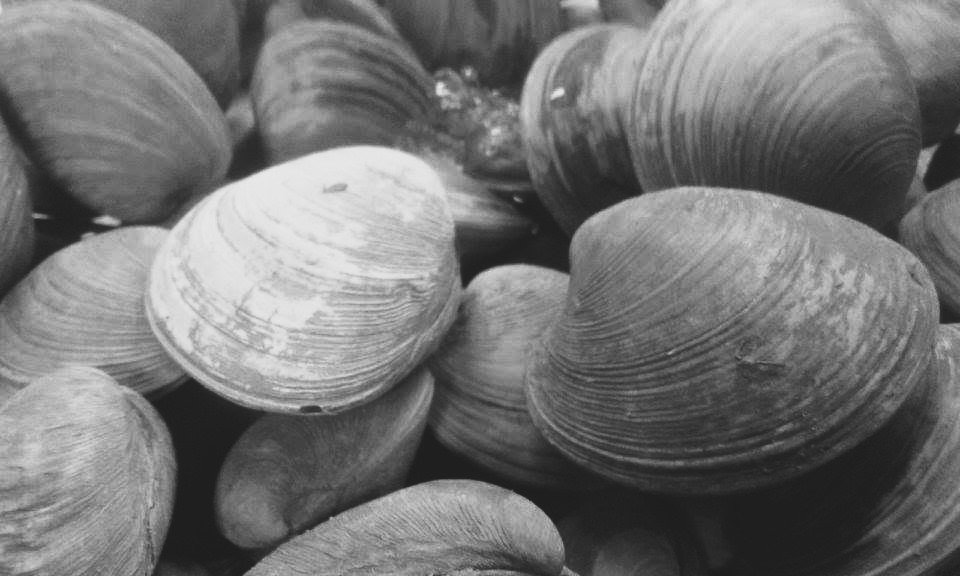
If you head out farther east, or travel by ship to Martha’s Vineyard and Nantucket, you’ll encounter quahog chowder. Quahog is an Algonquain word, it refers to a kind of clam with a very tough kind of meat. This is very everyday food. One summer when I was spending time at my friend’s grandparents’ house on the eastern end of Long Island, we spent the day collecting clams and made soup at night. So, if someone asks me about American food, this is what comes to mind. What we actually ate.
It’s nice to think and write about soup. It’s like getting your country back with every spoonful.
Long Island’s north shore looks out on Long Island Sound, its east will lead you to Europe, eventually, and its south shore opens up to the Atlantic. These are deep waters and so we often had swordfish, tuna, and mako shark steaks on our table. My father never really made dinner, that was mom’s specialty, but the grill was his domain. He would grill up some shark.
We ate Jaws with baby potatoes.
The indigenous people along the east coast were mainly Algonquians and they subsisted on maize, beans, and squash. In Tallinn, the Three Sisters refers to three old houses, but for indigenous people, the three sisters were just these three staple crops. In school I learned that there was often a big pot at the center of their homes into which they tossed all three, plus some venison or fish. If you were hungry, you just grabbed a bowl and helped yourself.
We never ate that way, exactly, but we did have the sweetest corn in the US, or so we told ourselves, and we knew that the corn we ate at the end of summer would be even sweeter. I had my own strategy for eating corn. Some just chomp away, with corn flying every which way, but I take my time. I do it systematically, so that every piece is properly eaten. Husking the corn was my favorite thing to do before dinner (or do you really want to put out the plates? I don’t.)
So there I would sit. But how many did we usually buy? Sixteen?
Even as suburbia was growing all around us, there were still some functional farms in existence. We would buy our corn from there.
For us, summer meant seafood, corn, and potatoes.
The potatoes were also cultivated on the local farms.
My grandmother wasn’t from the place where we lived. She came from down south. Her father was from North Carolina, and her mother was from Virginia. They had a different food culture. The climate there is warmer, the people are closer to the land. They had smoked hams, fried chicken. Lots of peanuts. Some farmers only grew peanuts. But corn had a special place of honor. My grandma would make me cornbread all the time. Every time I went to visit her, where she had her Elvis Presley Christmas album, she sent me home with bags full of cornbread.
The word for maize comes from an indigenous language — the Taino word mahiz. So I think there’s nothing more American than corn or maize. It’s probably one of the things that define it.
It’s interesting to think of American food today, a rainy morning in some Estonian cafe. Sometimes I even forget that I am from there, but then something odd happens, like I see a bunch of shipping pallets and think, for a moment, that they are lobster traps. Or I start to talk about lobsters and people look at me like I’m weird.
What kind of person talks about lobsters?
Once I had to find the Estonian word for spout, when I was writing about whales. People had no idea what it was. “You know, that spurt that comes out when the whale surfaces to breathe?” Then I realized that I was just from somewhere else. A place where people talk about whales and lobsters all the time. A place where your homeland comes with a hot bowl full of quahog chowder.
America is, after all, named after some Italian explorer named Amerigo. But maize and quahog? Those are real American words, if you ask me.
An Estonian version of this article appeared in the magazine GO Reisiajakiri earlier this year.

