AFTER VICE PRESIDENT JD Vance returned from his trip to Tallinn, it was said that a great change had come over him. No one was quite sure what had catalyzed this right-on-time midlife crisis onset, but it could have been the sum of experiences. Maybe it was viewing the Anton Corbijn retrospective at Fotografiska, or merely watching men and women the same age as him engaged in stirring table tennis matches in the many yards and alleyways of Telliskivi. Maybe it was his first taste of a delicious VLND Burger. Nobody knew what had caused it.
The changes were visible. The Ulysses S. Grant-inspired beard was the first to go, followed by that sharp suit he had worn when famously lecturing Zelenskyy. After the Tallinn trip, Vance had started wearing a pale blue, long-sleeve shirt that read TALLINN on it. The shirt was one-size too large, which gave Vance a billowy, college-freshman-getting-over-his-hangover look.
It was this changed Vance that I encountered at the Elliott School of International Studies in Washington, DC, a few weeks later when I went to retrieve a few books I had left behind in the student lounge during a six-week crash course in Baltic Studies. I went into the sparse, multi-level area, climbed a set of stairs and found the books in the corner where some older couples were sitting around and chatting. One of the women, with dyed blonde hair, wore a pink dress, the amount of cleavage visible was on the level of the grotesque. Who were these people?
It was then that I noticed a van pull up outside the school, and Vance and his entourage — a mix of press pool, Secret Service, and Hillybilly Elegy fans — follow him in. With his pink, cleanly shaven face and TALLINN long-sleeve t-shirt, it occurred to me that Vance was starting to look more ex-boyband star than vice president. He came into the lobby and was mobbed by students. Then he told his followers that he needed a rest and sat down on a couch across from me. I was nervous. What could I tell Vance? Was now the time to do some lobbying on behalf of the Baltics? What would Kasekamp say? How would he handle this? I decided to play it cool, to let him do the talking, to make him think that I was his friend. If I came at him with some slogans, he was more likely to tune me out. For whatever reason, the president had not yet turned on Vance, despite his new look. Perhaps after having alienated the British and Italian prime ministers and the Pope, he had decided that annoying the man who could make him redundant with one flip of the 25th Amendment was not the best idea.
“Well,” Vance said. “I came to hear your ideas.” Something about that Ohio drawl made “ideas” sound like “odors.” His put his hands on his thighs, leaned in. “You want to smell our odors?” I asked. Vance gave me a strange look. I gave him a strange look. It occurred to me that I might be tripping. Had I been dosed? How else to explain the weird 1950s couple in the student lounge, especially the woman with the pink dress and obscene cleavage. What was going on?
I noticed some other students in the back, leftwing university alumni, familiar to me from my undergraduate days. They began to circle each other. I was mortified. They were going to mess up my lobbying on behalf of the Baltics. We had Vance right here in the palms of our hands. He was becoming one of us, the seventh friend, so to speak, in addition to Ross, Phoebe, Joey, Monica, Chandler and Rachel. Or was JD Vance the replacement for Chandler? All we needed to do was give him some good coffee and his transition to the light would be complete. And those boneheads wanted to insult him? To my amazement, they began singing a familiar song. It was “When You Wish Upon a Star,” the Disney anthem. One of the protestors had even dressed up like Mickey Mouse in Fantasia and was dancing on the hands of the protestors.
“Anything your heart desires will come to you!” Mickey shouted down at JD Vance. I clasped my hands over my eyes. I was certain that I had been drugged. None of this could be true. But when I looked back, I saw that JD Vance was crying. The impromptu singing of the Disney song had moved something in him. “I love that song,” he said. “I just love that song.” Vance turned to me and said, “I’m staying here with you guys.” Happy collegiate faces surrounded him, encouraging his big change. Someone shouted out, “Get this man a latte with coconut milk!”
“No, sir,” said James David Vance, shaking his head. “I ain’t ever going back to the White House.”
BUT IN NARVA, I AM NEXT. I’m next here in line in the lobby of Hotell Inger, where I am met by a young woman named Valeria who has obvious Slavic features, as if she was Gorbachev’s granddaughter.
She has dark hair, a pale complexion. It’s hard to say what makes her stand out. Is it the lips? The eyes? The whole road to Narva I’ve been nervous because I don’t know a lick of the Russian language. It reminds me of when I was in Beijing and I had to order food. Of course, I know some phrases, but these aren’t the most polite ones, so better not to use them. But somehow I have to communicate. To my surprise, my questions in Estonian are met with Estonian responses. With an accent, naturally, but I also have an accent. How is it possible? I think. This is the most Russified city in Estonia. Almost everyone who lives here is a Russian speaker. But in my hotel, Estonian is just fine. I’m given a key, a room, and the right to swim for free at the Narva Ujula.
My room is on the fifth floor on the left. Clean, standard, comfortable. From the window, you can see the old town hall or raekoda of Narva, and the Hermann Fortress as well as some streets, where a few Narvans are visible strolling about at night. And there, just beyond, lies notorious Russia. The Russia we all fear. Russia is sleeping now and Narva is going to sleep behind it, as is the rest of Estonia. So I too fall off to sleep. It was a long trip to get to Narva. By bus from Viljandi to Tartu, from Tartu through Mustvee and Jõhvi. Even when you leave the Sillamäe Bus Station, Narva still feels far away, always in the distance.
The area around Narva is dotted with birch trees, hay fields, and swamps. The landscape is empty, only a few houses catch one’s eye. Maybe that’s why I have only visited this border city two times in the last 20 years. This is my second time in Narva and the first time that I will spend the night here beneath a warm blanket, my head resting on a soft pillow. Why is traveling by bus so tiring? But whatever. Good night, gorod Narva. I’ll see you in the morning.
WHEN THE SUN RISES, the mornings in Narva are lovely. The sun appears from the east over the town and is visible behind the tower of the raekoda. It feels as if the light has arrived directly from Japan. I sit on the first floor of the hotel in its restaurant and listen to the conversations of the other guests — Estonian businessmen, a Spanish couple, and maybe some Chinese? There are even a few Americans here, someone is saying something about Indianapolis. I don’t feel like introducing myself to them. God knows why they have traveled out here to Narva. I have my own suspicions that any foreigner who winds up in Narva simply must be a spy.
The hotel is located on Pushkin Street and faces a gray apartment building, the kind known as a khrushchevka, because it was built when Nikita Khrushchev was the Soviet premier. In front of this building walks a young Narva boy on his way to school. I take a sip of coffee. Why did I even come to this place? That’s a good question. In January, when the status of Greenland was in the news, I had a dream that a summit was held at the Hermann Fortress and Marco Rubio, JD Vance, Kaja Kallas, and Lars Løkke Rasmussen were in attendance to discuss Greenland’s future. I was dispatched to write about it for a magazine.
After this vision, I decided that I had to go to Narva. Narva was waiting for me. It was speaking to me in my dreams. Immediately, I wrote to the Narva College, which in turn invited me to attend a conference in honor of the national writer, Anton Hansen Tammsaare. Naturally, I accepted the offer.
But that was just one reason for visiting Narva. The other was that I needed to get away from it all, to take a little vacation from myself, so to speak. In Viljandi, where I live, I feel like a hamster caught in a wheel at times. The same feelings, memories, thoughts. The same streets, people, problems. The same old stories haunting me. Not like Narva was like some place from the novel Eat, Pray, Love, a city where one could find himself, but I had a feeling that it would be a good idea to travel as far as I could while still remaining in Estonia. Narva seemed at that moment the ideal destination.
Estonians have a weird relationship with Narva. In some ways, Estonians consider it to be a part of their homeland. At the same time, nobody really wants to come here. Maybe to some conference, or to a concert, or just to have a look at the castle and take a few photos and then drive back. As far as I understand it, the Estonian version of Narva’s history goes something like this. Once upon a time, Narva was an Estonian city. There lived mostly Estonians, who sang national songs, danced national dances, and ate fried Baltic herring. Everything was fine. But then came the war and the Russians bombed Narva’s beautiful Old Town into dust and Estonians were not allowed to resettle there. The Russians built atop the rubble some ugly apartment blocks and moved in. Now there’s not much to do or see there.
“There’s nothing there,” I was warned ahead of my travels. “Everything was destroyed in the war.”
After doing my own research though, I have come to understand that it wasn’t exactly so. The statistics reveal, for example that in 1897, about half of Narva’s inhabitants were Estonians and half of them were Russians. In 1934, about 65 percent were Estonians and 30 percent were Russians. Had I come to visit Narva in 1926 instead of 2026, I would have had a similar linguistic experience.
The Soviet Union did bomb the city in its war against Nazi Germany. Actually, both sides destroyed the city, but the coup de grace was the Soviet bombing in March 1944 which took place the same week that I happen to be here, drinking coffee. The Soviet Union did not value old architecture. When given the choice to save what was left or just bulldoze it, the Soviets chose to toss the old Narva into the dust bin. The same thing happened in Tallinn, by the way, where the Soviets razed the ancient cemetery in Kalamaja in 1964. The Soviets wanted to build a red future, where smiling Gagarins would fly through the cosmos, sharing the joys of Communism with the aliens.
After the war, a great number of people moved to Narva from all over the Soviet Union. In addition to Russians, there were many other nations. By 1989, more than 80,000 people lived here. At the moment, there’s just 50,000, and many of these are 50 plus. Where do people go when they leave Narva behind? To Tallinn, I am told, but also Helsinki, London, and Paris.
This might be one positive thing about the city. In Narva, I feel like a kid. Later, when I step into Lidl to buy some toothpaste, I noticed that I am surrounded by pensioners who are looking for the best deals. Peanuts just €1.8. Don’t you want some cheap shampoo? They whisper to their friends and relatives in their phones. Harasho? (“Good?”) Harasho! (“Good!”). In Viljandi, the site of the Culture Academy, as well as in Tartu, with its universities, I feel like a real dinosaur who was born in the wrong century. I don’t even dare tell people there that I was born in the Seventies. Sometimes I lie, but more often, I just decline to give my age. But here in Narva, I feel like I’m still a boy.
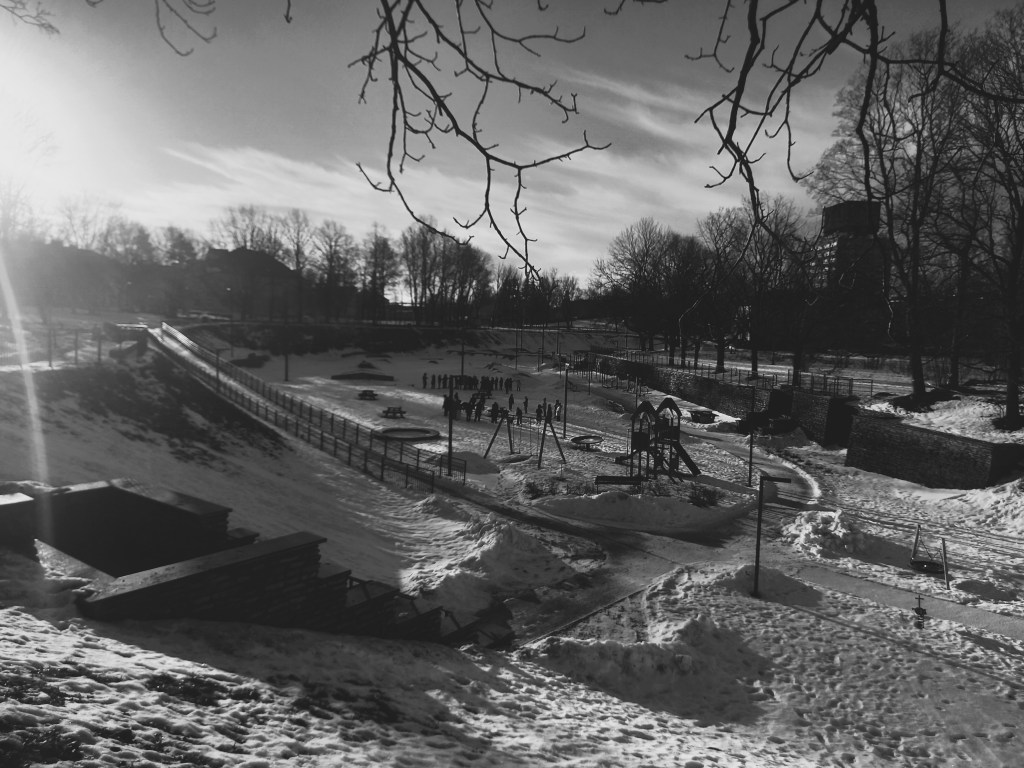
Narva’s Lidl supermarket is like something from another universe. As if a spaceship has landed here in town. Long escalators, everything made of metal and glass. When I walk toward the river, I can see that the city hasn’t completely recovered from the war. Eighty years later and the scars are around every corner. Vast empty spaces between buildings. Into one of them has been constructed a new playground, where young Narvans are busy playing. My first morning in Narva is cold and brisk, and everyone is still wearing winter coats. They all seem so happy though that I have to pause and take a photo of them. No matter how hard it tries, war can never really snuff out people’s souls. I watch the young Narvans play and they give me hope.
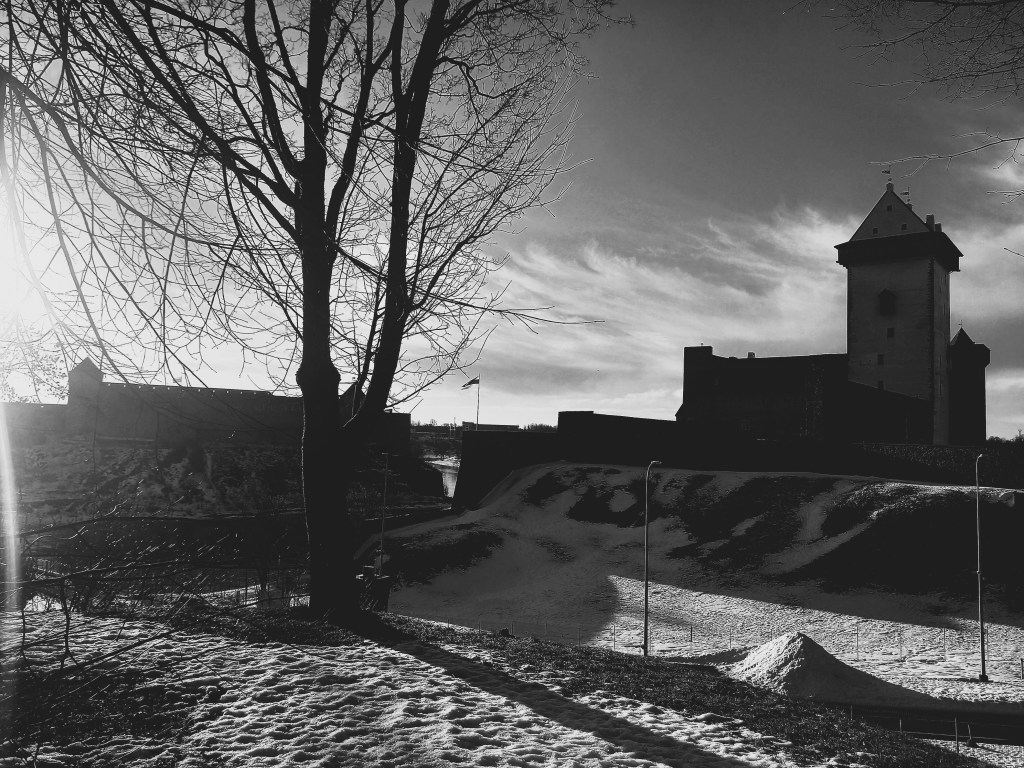
LATER I STAND BESIDE the Hermann Fortress and watch the Estonian flag dance against a blue sky. At the same time I am listening to the soundtrack from the film From Russia with Love. Narva seems so ideal for espionage, the perfect spot for swapping secrets. In the old Cold War movies, I would meet my contact here to obtain some stolen microfiche. Unfortunately, no one from MI5 is here to meet me today, and it seems Kaja Kallas didn’t show up either.
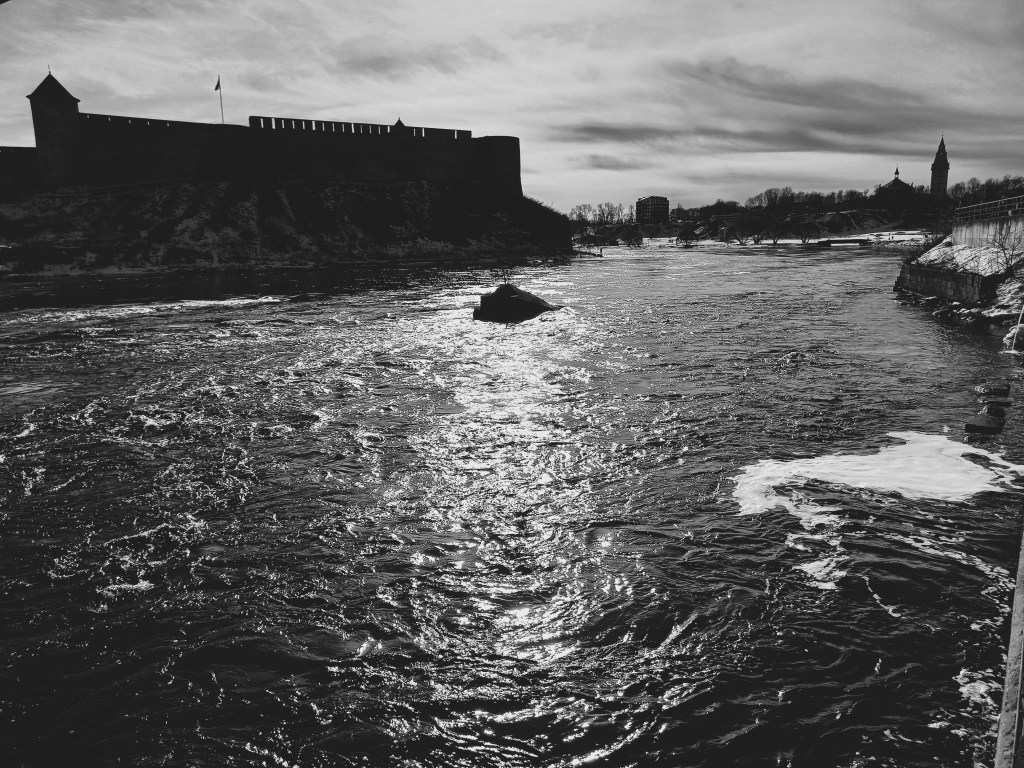
But so what. I like being here, I like the way the sun shines and how powerfully the river flows by. I am aware that being on the border is serious stuff and that Russia is so dangerously close, but I just can’t take it too seriously. The people on the other side of the river at least look somewhat normal. Someone is fishing in Ivangorod today. I stare at the Ivangorod fortifications and can’t say exactly where I am, culturally. Old ladies greet me with Privet (“Hello”) but there’s some kind of Scandinavian flavor to the place thanks to this castle. Nearby there is also the famed “Swedish Lion” memorial to the victims of the Great Northern War. I keep walking along the river until I reach Kreenholm. I have always wanted to see this old factory complex with my own eyes.
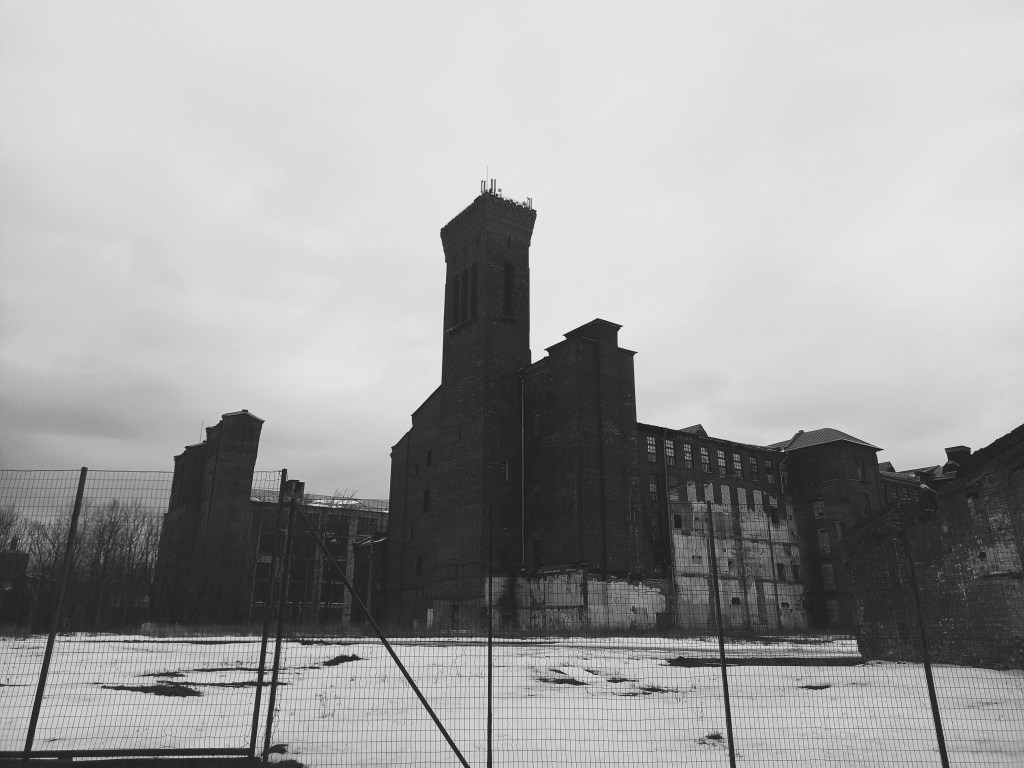
How many Europeans know that Ursula von der Leyen’s ancestor, Ludwig Knoop, founded the Kreenholm Manufacturing Company in 1857? Odd to think that Kaja Kallas and Von der Leyen are colleagues these days, so that Estonians and Baltic Germans are running the European Union. These old friends are at it again. “Let’s do it like we used to do it, Kaja!” This old abandoned factory is part of the story. Europe starts right there. I have heard through the international press, echoing (successful) Russian talking points, that “Narva is next.” Originally, this meant Putin’s next target, but the Estonians have repurposed it to make it sound like it will become the latest, trendiest place. A better slogan would be just this, “Europe starts here.” Maybe someone is already using it?
When Von der Leyen visited Narva, she also came to Kreenholm. There are photos of her taken on that day. She looks like a little girl standing in front of the factory. “All of my childhood stories started here,” she said. Nearby brick buildings, that once belonged to the factory complex, remind me of Glasgow though. Later, I am told that Knoop was inspired by British architecture. Where even is this place? Russia? Estonia? Denmark? Scotland?
Nearby, I discover some more extraterrestrial Soviet architecture. At least that’s how I refer to it. There are great white columns, a collapsed roof. What even is this thing? The Vassili Gerassimov Palace of Culture? I look it up. Gerassimov was a worker at Kreenholm who led a strike in 1872. Here stands his palace, although he never dwelled in his palace, because he died in Yakutsk.
There, across from the palace, a young Estonian woman is pushing a baby carriage, with the tot tucked safely within, sound asleep. The weather has changed, and now a moisty, freezing wind is blowing against us and toying with the woman’s hair. She’s dressed all in black and her skin is very white. It’s strange to hear Estonian spoken in Narva. She must be a local. Who else would take a baby for a walk here on such a day? There are about 1,500 Estonians living in Narva these days. One of them is still an infant.
Later at the Rimi supermarket, I encounter another Estonian woman with a child. They are buying food and the child is complaining that he wants more candy. Classic. The woman looks like an Estonian, she’s obviously an introvert. With that sweater and those jeans, she might as well be from Rakvere. People coexist here peacefully. The Russians are not arrogant at all, at least the ones I interact with in the store. And when I have a problem, the Rimi cashier comes and helps me right away and says Aitäh (“Thanks”) and Palun (“Please”) to me. She even smiles. Rimi feels like a real oasis in this gray, post-Soviet soup. The whole city center is so gray. But in Rimi you can buy colorful Estonian brands and hear a radio advertisement that begins, “Greetings. I’m Koit Toome.” It’s somehow a relief to hear good old Koit’s voice all the way out here in Narva.
THE NEXT MORNING in Narva, I decide to head in the other direction, to the north. According to the map, there’s both a German and a Jewish cemetery there, and these seem like good destinations. At the top of the hill, one finds the Narva Gümnaasium, a modern and new high school. There used to be a woman in my life who attended school here, but she’s long gone, like most of the others. Such are the women of my life. I think about writing to her for a moment, but then I decide against it. Why does she need to see a photo of Narva Gümnaasium. I know exactly what she will say too. “I know all too well what it looks like, thanks.”
From the high school, one can see apartment blocks in the distance that remind one of Sarajevo. On the other side, there is a low-lying neighborhood with an Orthodox church at its center. The church offers the only color, with its gold-yellow tones, because the weather is so cold and gray again. What did it feel like to grow up here like her? I wonder. Especially as an Estonian, a minority in your own country? For a moment, it’s as if I can almost hear her voice.
On my way to the cemetery, I decide to turn to the right. I want to see the river again, to have a look at Russia. Everyone is afraid of Russia. Even my father sent me a message before I left that, “Whatever you do, don’t get too close to Russia!” This here is the last street in Estonia and the European Union. Or at least one of them. The houses are in disrepair, the fences too, and I see more dark windows than I do people. I do start to feel afraid. I’m reminded of the Eston Kohver affair. At the same time, I don’t believe I would be very useful to the Russian regime. I’m not so important. I turn around and a van is waiting for me, from which leap two men, border guards. Light-haired, bearded young Estonian guys. They want to know who I am and what I am doing here. It’s kind of funny to be a writer from Viljandi who just likes to wander aimlessly. Did I forget to mention that I’m actually from New York?
“What are you doing in Estonia?” “Well, I once met a girl from Karksi-Nuia and here I am.” Understood. These young Estonian guys do their jobs well. It must be uncomfortable to work on the border, and with every step west, I feel freer. I am reminded of John Reed, the American Communist who is buried in the Kremlin, but also of Lee Harvey Oswald, who traveled by train from Helsinki to Moscow in the fall of 1959. Upon arriving to the Soviet capital, he promptly informed the authorities of his desire to become a Soviet citizen. Even the KGB thought he was crazy. We Americans are a restless people. I once read a John McCain quote where he said something like, “wherever Americans go, they start problems.” And here I am on the border of the European Union and the Russian Federation taking photos. This same morning when I am walking around Narva, my homeland is bombing Iran.
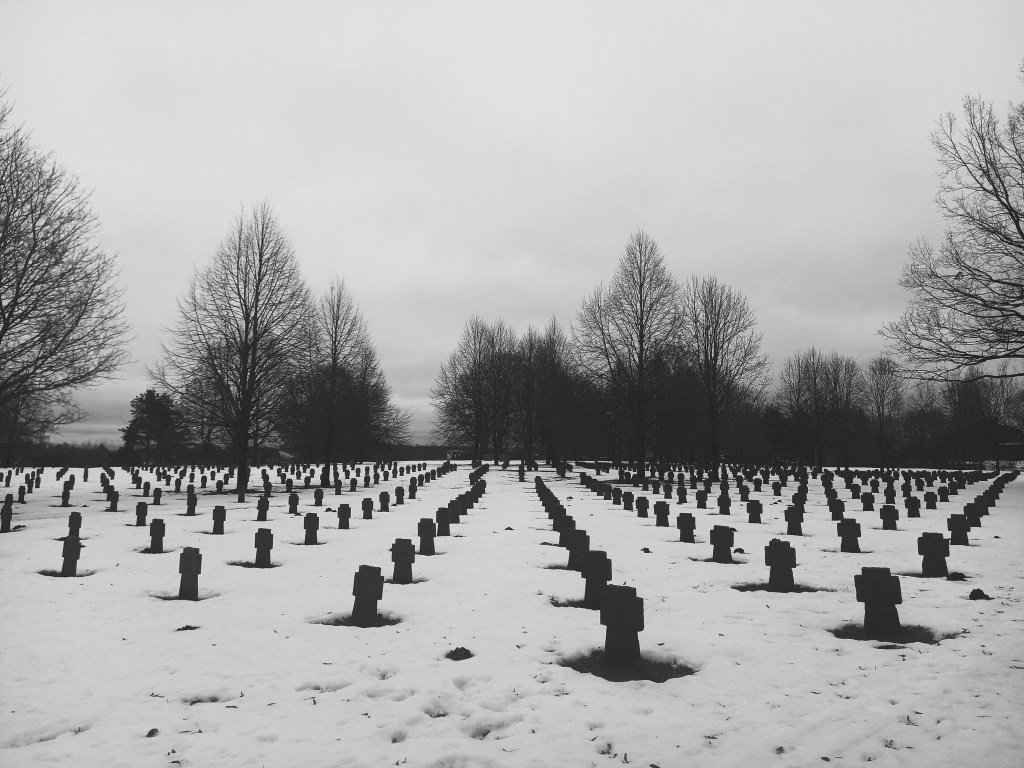
When I finally make it to the German cemetery, I am greeted by a sign that says that I am not particularly welcome, because some renovation work is underway. The snowy field is full of graves. Standing there, I can read one stone. Beneath it are buried three men. One of them was only 18 years old when he died in 1944. So, a young man from Germany was sent here, to Narva, to die. Because the Germans needed more space? Or did they just want to destroy Bolshevism? No matter how you frame it, it’s a stupid story. There are about 10,000 Germans buried here. Across the road, there is a spot that according to the map should be a Jewish cemetery. After looking around, I find there’s no cemetery in sight, just a path into the woods. After the border guard incident, I don’t really feel like getting lost in the forests around Narva. Everything here is just too quiet and covered in snow. An old lady then emerges from the forest, just at that moment. She is wearing a black coat and hat, and she doesn’t seem to notice me there. Something about this place is just too eerie. I turn around and head back into town.
I HAVE ALL KINDS of experiences here in Narva. I find some safe spots for myself right away. One of these is certainly the Muna Kohvik at the Narva College. You can get a decent cappuccino there and they play sweet jazz on the speakers. The atmosphere is spacious and light and every visitor can find a corner.
There are students from the Tallinn University of Technology here who recline and socialize in the beanbag chairs in the atrium. They happen to be having a conference here this week and there are international visitors too, as I hear plenty of English spoken. There are ties and jackets. Coffee breaks. On the wall, there’s a poster for the Station Narva festival to be held in September. Triphop godfather Tricky and the Icelandic band Gusgus will headline. Everything is so modern, Scandinavian, and open here. I could be in Uppsala or Aarhus. The vibe is friendly, lively. People meet and speak in the café, gesturing over its tables. Maybe they have meetings or are just catching up over lunch. How can it be that those war cemeteries are so close by, those crumbling buildings, those serious border guards? Everything here is so nice and light.
On the wall, a slogan is painted in blue that reads, “Estonia’s home in Narva.” Muna Kohvik is my Estonian home here.
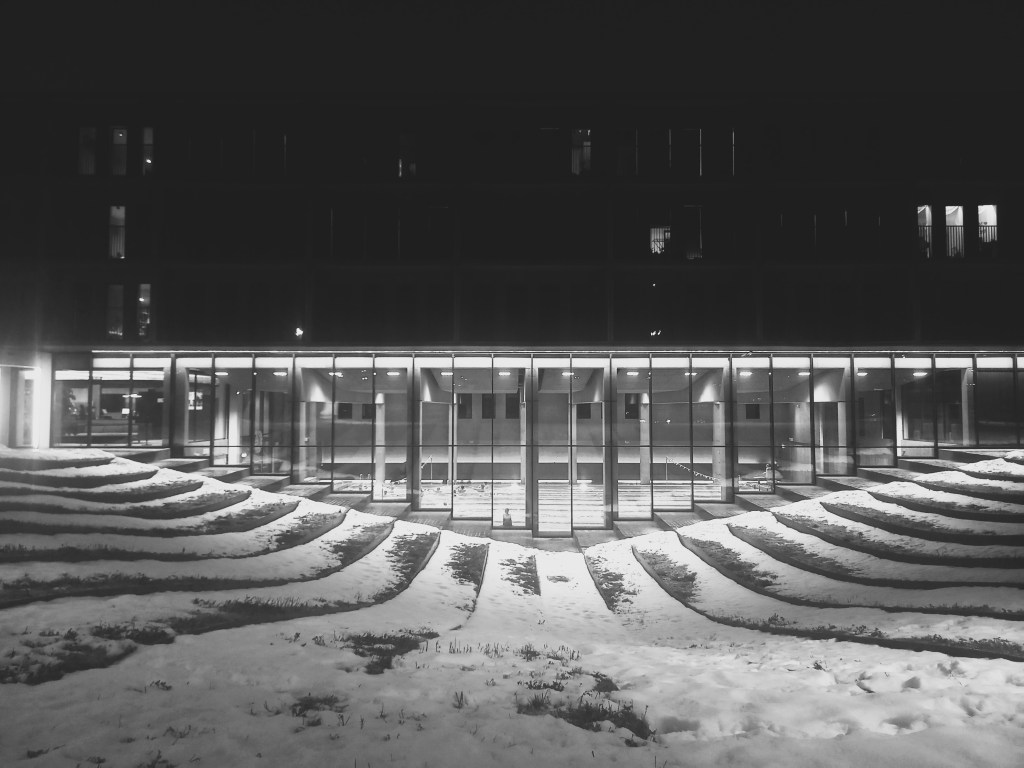
My other home is the Narva Ujula, which is located within the Estonian Academic of Security Sciences on Kerese Street. I go swimming in the evenings to get a little exercise in. Even if I haven’t found myself in Narva just yet, I can at least start a new hobby. In this same pool, the women of Narva undertake their evening water aerobics classes. Everything is clean here, everything is new, and I have absolutely no language issues with the people at the front desk. But in the changing room, it’s another story. This is where I take in all kinds of interesting Russian-language discussions. Or rather, these take place around me, and I just pretend like I understand. One night in the changing room, one man even seems to give a speech. I have no idea if he is talking to me or someone else. I watch him as warily as the British adventurer John Smith did the Powhatan in Virginia. I nod along and smile. When he finishes, I say, “Yes. I mean, да.”
One of the other characters in the changing room looks like Khrushchev. White hair, big teeth. He smiles his Khruschev smile and laughs along with the others. He seems like a friendly fellow, this Khrushchev.
DURING THE DAY, I take part in a conference where people only speak of the Estonian writer Anton Hansen Tammsaare. Tammsaare is connected to Narva because he took his school exams at Narva Gümnaasium in 1903. But how did young Anton even get here? Probably not by LuxExpress bus. Maybe he took the train? I am present when a memorial plaque is unveiled to Tammsaare on the old high school. The people gather and speak. Someone plays violin first, and then there’s a group of karmoška players. I should mention that Anton Hansen Tammsaare is my children’s relative. The whole family is so proud of Anton, that he belongs to their tribe.
I hear plenty of Tammsaare’s work at the conference too. I like his prose, it’s musical, playful. When he visited Narva in 1903, it was also a border city in a way, but one with a community of artists. People painted here, wrote, played chess. This is a place that feels like the edge of the world. Strange then that I don’t feel out of place here. If Danes, Swedes, Russians, Germans, and Estonians have all called this place home, then why couldn’t I? If there were just a few more comfortable cafes, some restaurants, new houses, a nice bakery, this would be the perfect retreat. I would return to Narva, just to write. I think others would come here too. It’s no longer possible to save the old Narva, but it is possible to build something new on its foundations. The same vibration is always at play here, and I think it would be possible to restore the soul of Narva, if given a chance.
The Narva River does work its magic, it’s nice just to stand beside it and hear it. The river water is as dark and rich as kali. Each time there’s a break at the conference, I return to the river’s edge, just to stand below the bridge. Young families pose for photos here. Tourists smoke and await spring. People march back and forth over the bridge. Bags, shadows. From one country to another. I understand that borders can be annoying. But I suppose some things in this life just have to be annoying.
On my last day in Narva, when it’s time to leave, I discover that I’m a little sad and I don’t want to go. I’ve adapted quickly here. I understand now that I am just this kind of person who likes to wander around, scribbling in his journal. I guess I have always been something of an observer, even before I met that girl from Karksi-Nuia who became the mother of my children.
Some friends have already written to me, concerned about my whereabouts. Have I moved to Narva? Not yet. But I do like that river. I like those shadows, the fresh air. This place does have value. I can’t say if I have found myself here, but I do feel a little different now. Something new is pulsating away inside of me.
I do feel some relief about going back though. I’ve become used to the Estonians’ pace of life, the way they communicate. But where is Narva then? Is it also a part of Estonia? Sure, it is, I decide. These kinds of border towns exist everywhere. In northern Italy, you can find towns where people speak German mostly. Narva is like Estonia’s Bolzano, I think as I wait in line for the bus. Our own little Bolzano, something exotic on our side of the border. A place with a kind spirit and plenty of potential. That’s my Narva. Will I be back? In a word, Короче, ühesõnaga. Yes.
An Estonian-language version of this piece was published last month in Edasi magazine.
THE EPSTEIN HOTEL was on Vermont Avenue in Washington, DC. It was built in the Second Empire style for some diplomat but later after passing hands through successive generations of elite bureaucrats had been repurposed as a hotel and hostel. By the time I arrived one night, with just one suitcase, fresh off an Amtrak train from Newport News, Virginia, all of the single rooms had been booked and I was given a bunk in one of the hostel’s eight-bed dormitories.
This turned out to be a lovely space on the top floor with its own kitchenette, a nice view of some green memorial park, and plenty of guests. All of the other seven beds in the room were taken, and one of my bunkmates happened to be Heath Harrigan, an old high school chum, now a karate teacher and lifestyle influencer who had strong opinions on vaccines, chem trails and the like, and had accrued a following of thousands. Joe Rogan had even interviewed him.
He looked great — the supplements he sold on his channel were working, his hair was still dark and wavy — and he invited me in to what soon became a rather wild bunkbed party, with plenty of pretty university students and Japanese tourists who were also domiciled at the Epstein Hotel. It was good to see Heath again, but I was tired, and I crawled up to my top bunk. It was impossible to sleep. They were all arguing about the measles mumps rubella vaccine.
“Shut up,” I heard Heath tell one of the Japanese. “You don’t know what you’re talking about.”
The plan was to go to Boston to meet up with Bergerac, a former university friend who had taken on a teaching position and had an office in Cambridge, Massachusetts, just over the Charles. In my mind, Boston didn’t seem so far away from Washington, it was just a quick jaunt, like going to the supermarket for some butter or bread. Just a quick journey to Boston and I would be back. Bergerac had become quite knowledgeable since graduation and knew the details on the makings of all albums by The Who. Bergerac was tall, bearded, French, Jewish. I liked him immensely. Just a train to Boston to visit Bergerac and all would be jake.
Besides, there was no sleep going on at the Epstein Hotel. My roommates were too loud with their arguments over vaccinations and pillow fights. In the middle of the night, I got up to get a bottle of water from a vending machine in the common area, and maybe some salted peanuts. I began to wander the halls of the hotel. Everything had been refurbished in that light, beige, putrid colonial tone that many hotels in Washington and Alexandria and other such places are painted in.
The air smelled of aged carpet, but it wasn’t a musty smell, just a hotel smell. There in the back hall, I encountered the man himself, Lord Epstein. This was him in his element, the Epstein Hotel. He was seated in a corner with two young blonde women beside him. These were Estonian women, maybe 25 years old. He was talking. They were laughing at his jokes.
“Sorry to intrude,” I told Epstein. He nodded a bit with that big ominous head of his and pretended that he didn’t hear me. He just watched them, swigging from a bottle of Perrier.
Returning to my room was complicated. All of those beige carpeted hallways, turns, dead ends. When I got back, the police had arrived. They were marking off the crime scene and taking photos. The two same young Estonian women I had seen before were sprawled out on the floor. They were both very dead, but otherwise looked quite peaceful, as if they were sleeping.
Heath came over to me. He was holding a half-empty bottle of champagne and his shirt was off. His eyes were all bloodshot. Heath Harrigan said to me, in a tired, subdued voice, “Epstein stopped by, man. But the party got out of hand. Things got way out of hand. You should leave now.” That I did. I was on the next train to Boston, to meet with Bergerac, to talk about Tommy.
“Tommy can you hear me? Can you feel me near you?”
I whistled as Washington dissolved into Maryland. Before I knew it, we were in Philadelphia. Home free.
“HERE,” HE SAID. “If you need a place to stay for a while, you can go to Ghislaine Maxwell’s apartment in Peconic City.” My father placed the set of keys into my hands and told me the address, which was 9 Nantucket Avenue, and drove me to the station. The trip out to Peconic City wasn’t long. He told me that the house was located next to a money broker. Atlantic Union, I believe. When I got out into the station, I turned left, as I had been instructed and found myself in a kind of shanty town made up of small shacks set up inside the building. “It’s not much,” I recalled my father telling me, “but no one will look for you there.” Was this “Nantucket Avenue?” I walked by the shanty town, where indigent women were out selling flowers and other things. I asked an old flower seller how to get to Nantucket Avenue, and she told me I had to go outside the building, through the station’s back entrance, and turn right.
I checked my possessions. A single gym bag full of clothes, my phone, my wallet, a paperback. I walked through the central atrium of the station and out the back entrance, just as instructed, and walked down a sidewalk to the right until I saw a series of modern homes set back from the road with green lawns, even in winter. Down one of these lawns, a whole parade of media figures and cameramen came in my direction, one woman speaking loudly in those clipped, made-for-broadcast tones about the plight of Ghislaine. At that moment, I wondered how my father had even had come to possess Ghislaine Maxwell’s keys or why he had sent me there.
Even at a distance, I could read the words “Nantucket Avenue” on one of the houses, all of which had peaked roofs and were built to incorporate Puritan architectural elements, a sort of House of Seven Gables for the big money age. Did my father really think this was a good place for someone like me to hide out? In front of one of the houses, someone had strung up some effigies of Jeffrey Epstein and Donald Trump, except had given them vampire fangs that dripped red blood. “Death to the Rich,” a sign read. Some yellow-toothed vagrants stood around the Epstein and Trump vampire effigies, panhandling, hoping to get a dime out of me.
The interior of the house was dull and contemporary and all of the walls were covered with large photographs of Ghislaine and Epstein vacationing in the Caribbean, wearing bleached white shirts that were so bright they made your eyes ache, khakis as crisp as morning toast, blue jeans that were so blue, they looked as if they had only been worn once and then tossed away. Epstein’s gray hair was always that unruly mop, trimmed to a desired, specified length. Ghislaine looked like she had once starred in a 1990s Bond film, perhaps as the sexy villainess who gets killed in the end. One picture though made my heart sink. It showed Epstein, Ghislaine, and British diplomat Peter Mandelson clustered around the deck of a yacht as Jorma Kaukonen played guitar. They were on the sea somewhere, drenched in a pink orange sunset.
Jorma was in on it too? Later, when the revelations came out, Jorma Kaukonen, the white-bearded, Finnish Hemingway-looking ex-lead guitarist of seminal San Franciscan psychedelic rock group Jefferson Airplane, who had transitioned into the rough-and-tumble bar room blues act Hot Tuna in the 1970s, denied all wrongdoing. Instead, he said that Epstein had been a fan of Hot Tuna, and that he had performed for him and his guests on occasion and was always well paid. “I’m just a blues musician,” Jorma said. “Simple as that.” When asked what Epstein’s favorite Hot Tuna song was, Jorma acknowledged that it was “Hesitation Blues.” “Epstein made me play it two times during every set,” Jorma had said in a beachside interview. “It started to annoy me.”
In the interview, Jorma wore his white fisherman’s sweater and seemed at ease in his skin. He had his glasses on and his arms were at his sides and he seemed to be hiding nothing. It was hard to believe that he had ever been anything other than a minstrel to the evil rich.
I WAS INVITED to give a talk at the new community center in Tartu, across from the Lõunakeskus shopping center. There I stood, in a small modern classroom, lecturing on the fate of the Eastern Algonquians to a small class of perhaps a dozen curious Estonians, an American flag hanging in the corner, when a middle-aged man who looked like Flava Flav in a blue jumpsuit walked in and began shouting slogans. “We have to get behind Trump!” he said. “To own the libs and end woke!” The students backed away, not knowing what to do. Then in walked Obama, calmly, coolly, boldly. He stood at the center of the classroom dressed in desert khakis, like a soldier from Operation Desert Storm and said, “Please go ahead with your presentation. I for one found it to be most informative and, in my opinion, quite patriotic.”
After Obama and the man who looked like Flava Flav left, I walked home, whistling, hands in my pockets. How could it be that Obama was in Tartu? What was he doing here? Later I found out that, under pressure in the US from the Trump administration, the Obamas had decided to rent a house on the periphery of Tartu. Obama had been to Estonia several times and found it a most welcoming place. He was particularly impressed by its sauna and singing culture and enjoyed a mouthful of moose pasteet. Obama and Michelle would cycle to the market in the warmer months to inspect the eye-watering array of cucumbers, tomatoes, and berries. In the cooler months, Michelle would fill her basket with handfuls of glorious chanterelle mushrooms and prepare at home for Obama his favorite dish, chanterelle sauce with potatoes, laden with dill. Obama would smack his lips. “Michelle, baby,” he would say, wrapping an arm around her waist. “You’re the greatest woman who ever lived. This kukeseenekaste is just perfection.”
The Obamas became a fixture of Tartu life after that. Somehow, even though he was from Hawaii, or Indonesia, or Kenya, or Chicago, or wherever he was from, he fit right in to the city’s free and inventive-thinking population. He would wave at university students as he rounded the turn onto Kroonuaia Street, his arm lifted joyously in the air. He took part in fencing matches at EÜS. Michelle could be seen at H&M in Kvartal, digging through the sock bin, or weighing deals on cosmetics at Tradehouse and Douglas. They were true Tartu lovers.
Then it so happened that I was dispatched to the house of a soothsayer or witch on the opposite side of the River Emajõgi, set back deep in the pine and birch forests. I went there to undergo something called constellation therapy. When I got to the house, a white colonial built at the top of a hill, something immediately felt off. It was winter by then, the snow hardened and iced over, and there was an eerie stillness, even in the light of a February day. The front door to the house was ajar. As I approached it, I began to hear the cries of wolves coming from the woods. Not knowing what to do, I went inside. Its interior was full of expensive lifeless furniture, the kind that wealthier people acquire not knowing what else to get. White couches and dark wooden tables. Some tasteless art beside the cold fireplace.
At its back though, I encountered an old university friend, Chas Flaubert, an architect from Charleston, South Carolina, who had gone to high school with Stig, an Estonian expatriate. Small world indeed. Chas informed me that, during his time in South Carolina, Stig had lived his life as a gay man, but had a sort of reverse coming out experience, suddenly discovering at the age of 20 or so, that he was a robust heterosexual, and that he only had feelings for women. After that, the posters of Fabio, Madonna, and Ricky Martin in his teenage bedroom came down and were replaced by pinups of Farrah Fawcett, Sally Field, and Miss Cheryl Tiegs. “I’m not sure how that happens,” said Chas in his molasses drawl, while puffing on a marijuana cigarette, “but that’s the truth.” “It’s very funny, because Stig is probably the straightest hetero I know,” I said. A suave, one-man nightclub variety show act nicknamed “the gray fox” for his striking hair, Stig Sandbrook was known to have lain with women from Lake Tamula to Lake Titicaca. “He’s more hetero than hetero,” I went on. “Do you mind if I hit that joint, Chas?”
Our conversation was interrupted by the howls of the wolves. Looking out the window, we could see three or four of the shaggy sinister beasts beat a line toward the backyard. “We’re done for,” I told Chas. “Once they get inside, they’ll eat us all for dinner!” We stood there at the windows, awaiting our certain doom. There came a loud crackle and a kind of zipping sound. One of the wolves toppled over, then the next. After four crackling sounds, they were all dead.
It was then that I saw who had shot them. Obama descended the slope in winter hunting gear, rifle in hand. He waved to us. “God bless that Obama,” said Chas. “Where would any of us be without him?” “In the belly of those wolves,” I replied. Obama whistled and a flatbed truck came down the slope. With an Estonian friend, he loaded in the wolf corpses. After sharing a smoke with the driver and some chit chat, Obama climbed into the truck and they drove off.
ON OUDEZIJDS ACHTERBURGWAL, a street and canal at the center of De Wallen, Amsterdam’s Red Light District, a woman sits in a window on a Friday morning staring into an overcast late November day. She is dressed only in her bra and panties and her hair hangs loosely about her shoulders. She is a voluptuous, pale character with doll-like features and pink lips and her face reveals a mixture of morning grogginess and utter resignation. This is the face of a woman who has seen everything and done everything, and everyone, and she seems bored by the world.
Upon seeing her from across the canal, I give her a friendly wave and she waves back to me. For a moment, it feels like we are old school chums. There is a sense of camaraderie there. Though I am a writer and not a prostitute, I suppose we are in the same kind of business. We give pieces of ourselves away for financial rewards. My soul is written with words onto paper. Her soul is pressed into flesh. She is someone’s daughter, someone’s sister, maybe a mother.
But this has been her fate, to sit here tiredly selling herself, while my fate is to head off to Rotterdam, to give a talk about what it’s like to be a writer who writes in cafes. I feel disgusted, of course, for myself, for the woman, for the world. I feel disgusted as a man, too. But then I wonder why as people we are so often disgusted with ourselves and with our day-to-day lives. As the weekend crowds line the canals of the Red Light District and the sinister laughter of throngs of British men (and women) echoes up and down the alleys, one can only feel disgust.
This is the heart of the decadent West, a West that we have convinced ourselves is dying every day. The official capital of the European Union is in Brussels, but its spiritual heart might be right here by these old canals with their erotic boutiques, 5D pornographic theatres, and sex workers.
Our revulsion and gloom about our future is only compounded by the migrant crisis and climate change. I recently read an article in The Guardian where it said that only one in five female scientists planned to have children, to spare their would-be offspring this shame of being born. No one else should have to contend with the endless famines, wars, hurricanes and droughts.
They want to save the world and so they choke off its future, as if they were solely responsible for all its sins and misfortunes. As demographers forecast our societies will only shrink more, people turn to animals for companionship. There are social media sites for cat and dog owners where their pets can confirm they’re going to meetups at the park, or share photos in a group chat. I suppose the dogs can wish each other a happy birthday. Because animals are innocent and people are guilty. This is how we have learned to think about ourselves. This is the future we are building for ourselves, an indulgent childless future of pet social media.
But hasn’t it always been like this? This is what I think that morning as I wave to my newfound Dutch friend over the canal. She is certainly not the first woman to live this life or have this fate. There are many others. I pass by them as they prepare for the day. Then I turn the corner.
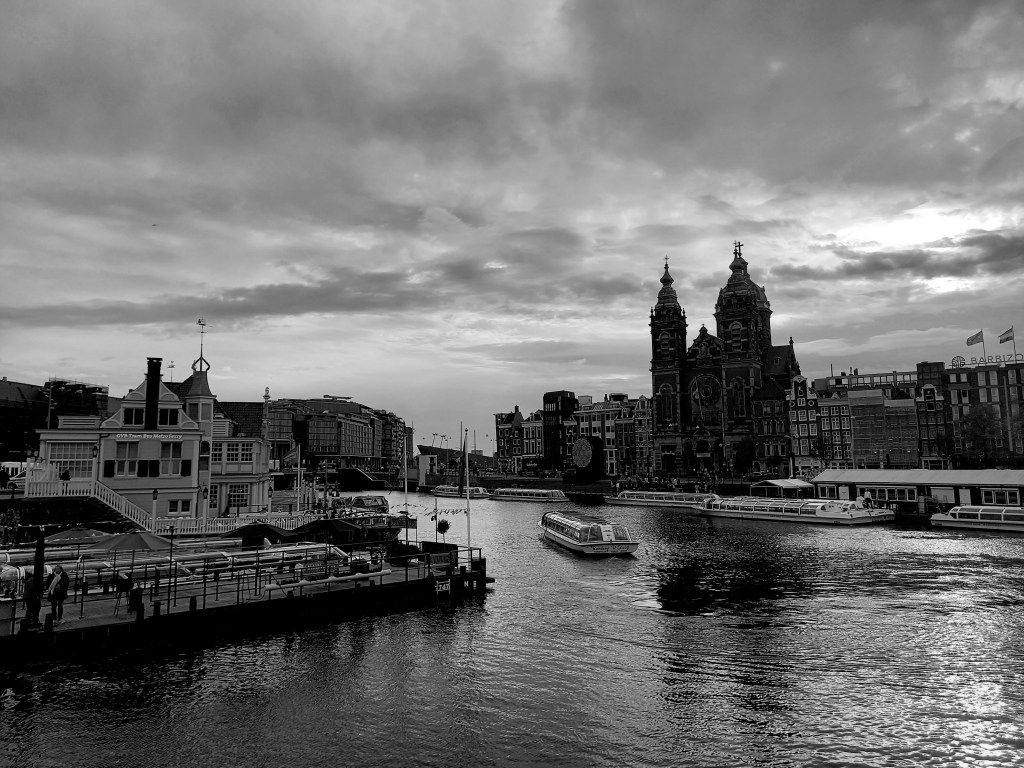
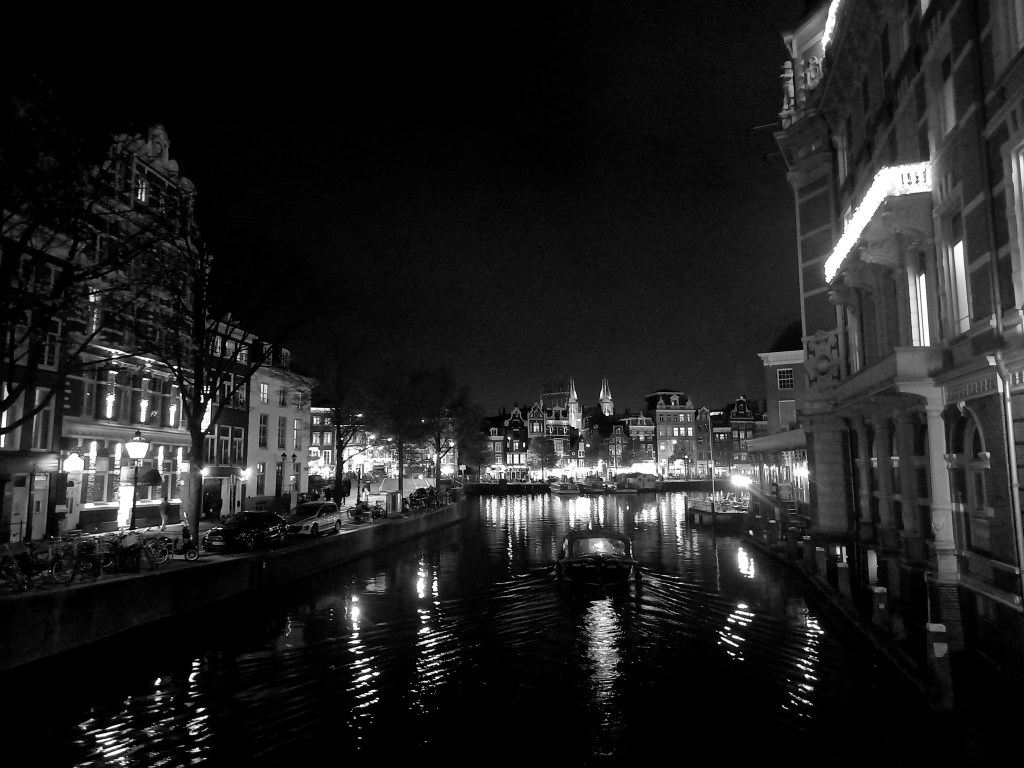
ON THE NEXT MORNING in the Red Light District, the municipal workers sweep up broken glass and soggy french fries and the ravenous seagulls attack piles of trash. This is how yesterday is replaced by today, but the bakeries and cheese vendors are already open, their shops glowing with warm, inviting lights. Life tumbles sleepily forward in Amsterdam, like an old man fumbling for his keys. At night, the city is a hubbub, a bazaar. Whatever you want to eat, you can find it. Whatever you want to see, you can see it. Whatever you want to do, you can probably do it. The Dutch are a tolerant people and that tolerance has become a foundational element of what we call European or Western values. We measure our Westernness according to the number of rainbow-colored Pride flags that hang outside of bars, or by the casual way we smoke cannabis.
We unbutton our top button and walk down Oudezijds Achterburgwal, waving at the women.
We are a free people, we tell ourselves, free people who can do whatever they want and listen to whatever they want. We can spend part of the night in a record shop, as I did, digging through the record bins, engulfed in green marijuana smoke, unearthing treasures by Jamaican and Zydeco bands.
The Western life can be a comfortable life, one where the main existential question is, “How should I spend my Friday night?” Or, “What concert should I go to?” One can just while away the days, in pursuit of personal satisfaction, pleasure, what some call happiness. In corners of the world like Amsterdam’s De Wallen, there are almost no children at all and you can imagine if you close your eyes that they don’t even exist. For many of my friends they don’t. There is an invisible divide between us, I think, those of us who have had children and those who haven’t, and I think we both feel pressured in different ways. When my third child was born, a colleague asked me why I had decided to have one more. “You will never be able to support them on a journalist’s salary,” he said. He was right, but in my mind, that was somehow irrelevant. I took the whole thing to be a kind of godsend or the fulfilment of a prophecy. “Did you expect me to weigh the pros and cons, make an Excel file, and budget for it?” I asked him. “Yes,” he said. “Of course!”
He’s never had any children and so the world of having children was still abstract for him. As it has been for other childless friends, who seem to see kids as something like larger pets, that you can leave at home with a bowl of water for a day or two while you head off to some soiree. Children are an impediment to having fun, a thick wall that walls off happiness. “Every guy I see with a kid is walking down the street, shaking his head and talking to himself,” another friend told me. He hasn’t had children either.
The world for parents among childless friends can be a cold one. “Aren’t you coming to the party?” someone might ask. And then they are disappointed when you can’t, because your daughter is vomiting. They understand that such are the pitfalls of reproduction. They can’t see why someone would voluntarily do it to themselves. Where’s the benefit? Truth be told, it makes no sense. Because if I was to weigh the pros and cons, it would never be the right time to have children. The forces of Western society seem aligned against it. They make it hard in every way.
The West’s days are over, it seems. There’s nothing to do but close up shop, turn out the lights.
But if the ship of the West is sinking into the sea, why not just get our kicks before it slips below the surface?
ON MY LAST NIGHT in Amsterdam, I take a walk to see an old friend. She lives all the way at the end of Vondelpark, which is where my hippie father spent a night sleeping on a bench in 1973. I think about my father as I walk the avenue beyond Leidseplein, which is lined on both sides by restaurants and homes where childless couples watch Netflix while the West slowly dies. In one of these apartments lives an my friend from New York who, like me, attended college in Washington, DC, and later settled in Europe. She has married a Dutchman and has made two Dutch children who are now awaiting Sinterklaas.
Their building is a brutalist masterpiece. Its balconies face an internal courtyard. Outside the doors to the apartments, some boots and toys can be seen. Families have started to move in here, replacing the first generation of inhabitants who had lived in it since it was built in 1961.
That was the year the Berlin Wall went up brick by brick. The next summer, the Cuban Missile Crisis happened. Life must have seemed just as impossibly damned then as it does now. Yet people continued to marry and have children. In 1961, the Netherlands experienced the highest birth rate in recent history, with 3.2 children per woman. But just like in Estonia, the Netherlands are expected to lose people over the next decades. In this massive post-war edifice, young families huddle. They are demographic survivors.
My friend’s family gathers around a table and eats soup and pasta. The little boy, aged three, is dressed in pajamas that resemble a cat. The girl, aged six, is eager to put out her shoe for Sinterklaas, who will reward her with snoep, or candy. My friend’s Dutch life is very different from my Estonian life. She lives in the busiest corner of Europe. I live in the frozen wastes. But we both know the joy of setting out a shoe or slipper for a Christmastime visitor who brings candy.
The family tonight is being visited by a neighbor, a 34-year-old Dutch designer who looks like a woman from a Johannes Vermeer painting. She has red hair and is milky white and once lived in a black neighborhood in Bedford-Stuyvesant in Brooklyn where her neighbor was in a gang. In Amsterdam, she has taken up with a Russian software engineer from Saint Petersburg, and they are expecting their second child. “I only have a few months left,” she says, patting her belly.
This is how new Europeans come into this world.
Later, when I ask my friend about why she decided to have children when so many of our classmates didn’t, she gives a bunch of different reasons. But she also notes that it hasn’t been easy being a mother, that her career has suffered and that academia, even in the progressive Netherlands, is still quite male dominated, and that the women who have secured the best positions for themselves tend to not have children. But she does love her children and she wouldn’t have it any other way, she says. Her main reason for having children appears to have been that she had an awesome amount of love to give and just wanted to give it to someone.
Which, to me, seems like the best reason that a person can have.
EVEN LATER THAT NIGHT, I head back to the Red Light District. Something fascinates me about its stark grotesqueness. I lean up against the Oude Kerk, which has stood since the 13th century, writing in my journal with the hope that the walls of the church will imbue me with more marvellous writing powers. Down the way, some young men negotiate a price with a sex worker. Then I go looking for the woman I saw on the first morning in Amsterdam, the lady in the window. I just want to see her one more time, to wave goodbye to her, to make us both feel like we are human, for just one precious moment. The West may be rotten to its core and in decline. We may all peer out at our futures with that same haggard look of resignation, but I do feel compassion for her as she plies her trade. We are, after all, in the same kind of business.
WE WERE IN TARTU at the intersection of Riia Street and Puusepa Street, across from Tammelinn and the Oskar Luts Home Museum. But on the other side of the road, where Tammelinn should have been, there was just forest leading down to a pristine lake. There I was, walking along a muddy dirt path through what I suppose in the future would become Tammelinn with Stig and Riken the mountaineer. We all had on rubber boots and there was a black animal trailing us. Later, it occurred to me that this was the hellhound of blues yore, of which Robert Johnson sang so sorrowfully in 1937’s “Hell Hound on My Trail.” At times it would try to nip at our boots. I was afraid it had rabies, but I was told not to worry. “He’s completely harmless,” Stig said. He was fiddling with his slingshot. Where were we even going? Hunting? Or maybe this was an impromptu berry foraging expedition?
Later, the Russians attacked Tartu with drones, but having run out of real drones in Ukraine, they were forced into lobbing old couches and rusty oil tankers. I looked up as a rusty oil tanker drone descended in the starry winter sky toward the greenhouses at Luunja, but before it obliterated all of those tasty cucumbers, it was neutralized in mid-air by the Estonian air defences. It looked something like a spectacular series of fireworks as it burned out against the skyline of Tartu. My wife in the meantime had been trying to convince me that we should go and hide out in Ukraine. I told her she was crazy. Her logic was they would never look for us there. “Think about it,” she said. “If we hide in the occupied parts, they won’t notice us because they’re trying to conquer Paris!” It seemed like a long journey to avoid rusty oil tanker drones. I imagined us at the shadowy Polish-Ukrainian border with a loaded car and lots of passports. No thanks.
We sought refuge in a new hotel and conference center instead, and I recalled there, while my paperwork was being inspected at the entrance, and I was talking to a woman in line, that I had once been at that same center as a journalist and covered a scientific conference there. She had been at the same conference, she said. Remember, Kersti Kaljulaid gave the day’s keynote speech? We all watched sadly then as a single bomb-sniffing Starship Technologies robot swept across the foyer of the hotel. “Like R2D2,” I said. It reminded us of simpler times.
AFTER HIS COMPLETION of the Epstein Ballroom, President Donald J. Trump went to work on a new building to house Scott Bessent’s Treasury Department. The old Federal and Georgian-style Treasury Building, the central and east wings of which were erected in 1835 through 1842, was reduced to rubble and a new castle-like fortress was constructed on its foundation, as tall as the Sagrada Familia. This, strangely, contained elements of New York City’s Trump Tower, and its walls, escalators, and stairwells shined with gold-coated plates.
I was one of the first journalists allowed into the new Treasury Building, escorted inside with a North Korea-style sightseeing group. We were led up the stairs, which were gleaming with gold, to the second floor, which had the décor of an ancient Scottish castle, with moist, dripping stone walls and antique tapestries. Trump was there himself, bedecked in a Highland Tartan, and several other Scotsmen and women sat around an open fire. Trump seemed preoccupied with something and stared intensely into the air. He was whispering to himself and his blue eyes reminded one of a beached fish running out of oxygen. The Scottish guests only stoked the fire and talked loudly about how they felt comfortable in the new Treasury. “Aye, it’s not too opulent,” a bald man in a sweater said. “Only parts are covered in gold! What’s the fuss about?”
Downstairs, I discovered that a food court had opened. There were people sitting all around on wooden benches, the kinds that you might find at an ice skating rink. Here I encountered some Trump supporters in winter coats who were boasting loudly about how decisive their leader was. “Biden could never make up his mind,” one jeered. I intervened and said that, in reality, their president changed his mind almost every day if not minute. “Yes, I will give the Ukrainians Tomahawk missiles. No, I won’t. Yes, well, actually I will. Let’s see what Putin says.” For daring to bring this to their attention, I was cursed out, but I didn’t care. “The only thing Trump’s consistent about,” I shouted at his supporters as they dispersed, “is his love of tariffs!”
Down the gold escalator rode my old friend Eamon O’Toole next, with his loving Irish grin. He was dressed in a white sweater and gold chain, as if he had just got back from a wild house party with Kid and Play. The first thing Eamon O’Toole did upon meeting me in the new Treasury Building was laugh and say, “Well, well, well. Fancy meeting you here!” He had sprouted a slight red beard in the meantime, and there was a crazy gleam in his eyes. I told him about the Trump supporters and the tariff comment. Eamon O’Toole only laughed more. “All of these people suck,” was all Eamon said with an irrepressible delight. “I hate them all.”
We were then interrupted by Rory Lapp, an Estonian writer and poet and coffeehouse ghost who said, “Excuse me, but do you know where a bestselling author might get a decent espresso?” We went over to the coffee machine, but the first cup was full of a strange, milky liquid, and we realized the machine was cleaning itself, so we pushed the button again. Rory stood there in his black button-down shirt, waiting patiently to taste his first Treasury coffee. Funny that I would rendezvous with some of my best friends in such a gilded, tasteless place.
I noticed then a small gray mailbox by the coffee machine and opened it. Inside, I found a single letter, addressed to me, which I opened as well. It was a postcard with a picture of Ronja Rippsild, a prominent Estonian photographer. She was standing there, in her red shirt and green coat, a winter’s hat on her head. She was as pale as ever — I don’t think Ronja was capable of getting tan — and her dark hair hung around her shoulders. The note read, “Goodbye Justin,” and I scanned it intently, hoping that Trump’s demolition of the Treasury Building hadn’t caused my Estonian friend to commit suicide. Instead she said that she had had enough of the world’s problems and was going on a pilgrimage of sorts, which she intended to wrap up by the year 2049. “By that time, I’m sure we can live happy lives again,” Ronja had written. In the meantime, she planned to embark on a global Camino de Santiago.
“Well, that’s one way of coping,” I said to myself. I was going to miss Ronja while she was away. I sighed and returned to the coffee machine, where some loud Trump bashing was underway.
I HAD SEX with Julie Andrews. At least, I think it was her. It happened on the second floor of an old theatre in London and it happened during a right-wing putsch against the Starmer government led by Elon Musk. Out in the streets, it was Unite the Kingdom Day and then some. There were union jacks fluttering everywhere, and the crowds swarmed into the theatre, up and down its regal staircases. British fiends helped themselves to free concessions.
Up on the second floor, I encountered Julie Andrews and we began to make love on some old chairs upholstered in plush red velvet. She looked just like she did in the Mary Poppins and Sound of Music era, except her hair was gray. This part I couldn’t understand. Why was her hair gray but her body had not aged? She had very long, supple, and tan legs. Maybe she had just returned from a holiday to Santorini or Tenerife? Some place where British actresses go.
The lovemaking was tender and sincere, but had a passionate, hurried quality to it. I told her, “I think we’re on the threshold of a new era in international politics and this is a part of it.” Julie Andrews gasped. Her legs were in the air. That’s all I remember, truly. But I don’t think I will ever watch those old classics the same way again. Knowing what I know about Miss Andrews.
ANOTHER DAY, ANOTHER CHARLIE KIRK MEMORIAL. The “stadium tour” had been a boon to the president’s sinking approval numbers. And with each pyrotechnics display, each series of rousing speeches, one could almost forget that he had promised to end the war between Ukraine and the Russian Federation in one day, or to reverse inflation, or to do many other things that never seemed to bear fruit. This however did not dissuade young women like Elspeth from watching the Charlie Kirk Stadium Tour. Rather, she curled up on her couch with a box of tissues, sobbing each time they showed the Charlie Kirk “That’s why I am a Christian” montage, pieced together from diverse podcasts and various debate spats. After drying her eyes, she would clench her fists and stammer something angry about the “radical leftist left.”
“But it’s not just the left that has its radical elements,” I would caution her. “Think of Bison Man and January 6. Surely, you must admit that the Proud Boys were just as hostile an element in US politics.” This might have made sense in a less emotionally fraught situation, but not to someone who had just lost, as she saw it, the 13th apostle of Christ. I felt ever more like a unrepentant, mate-sipping Che Guevara. And like Guevara before me, I leaned in and began to work my vulgar Latin socialist charm on Elspeth. There have been passionate kisses in history. Think of Julius Caesar and Cleopatra or Cleopatra and Mark Antony. But this sudden melting away of toxic political distress into a very steamy couch lovemaking session won them all.
On the TV set, there were more pyrotechnics. One of Trump’s rotten children cried out, “Je suis Charlie!” By this time, I was just about to consummate my relationship with Elspeth. She was a flaxen-haired, freckly lass of Highlands descent. A Presbyterian turned evangelical, a dedicated follower of god. She was unsure though and she called in her assistant, a young Siamese woman who carried an appointment book with her. “Miss L. can you tell me how far I am into my cycle?” Elspeth requested. “Yes, madame,” said the Siamese assistant, who quickly paged through the book. “It is an inauspicious time for making love, madame,” she said. “Thank you, L., that will be all,” she told her assistant. “You are dismissed.” The woman bowed and left.
“I’m terribly sorry,” Elspeth whispered to me on the couch. “But I just don’t want to risk it. I do hope you understand.” “That’s all fine,” I said. “I’ll just lick your breasts.” “Fair enough.” Elspeth pulled up her t-shirt, revealing two very soft, very pink breasts. They looked like a treat you might find in a Helsinki bakery, tucked in between the cinnamon buns and fluffy Napoleons. “You know,” Elspeth said a moment later. “This is probably the best sex I’ve ever had. And we don’t even share the same politics! If more of us just had sex, we could reconcile all of our differences.” I kissed Elspeth, pushing back her sunny-colored hair, and said, “You’re a genius.”