
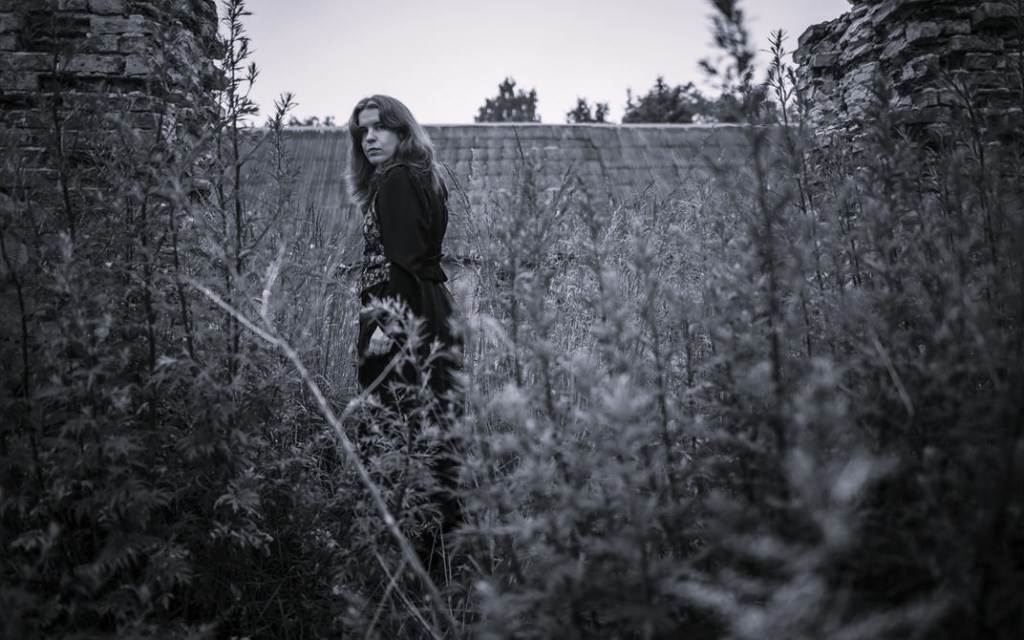
I FIRST MET KAISA KUSLAPUU in my yard one summer. She was standing outside a neighbor’s apartment and wearing a red sweatshirt with a picture of Mickey Mouse on it. I had no idea who she was, and for a while I didn’t even know she was a musician. She was just the “girl with the Mickey Mouse sweatshirt.” Later I learned that these women who were hanging out in the yard were 6hunesseq, and I was invited to a concert. This took place at the Jaani kirik, or Saint John’s Church. The four singers performed from the choir loft, so that we could never see them during the performance. Only when it was over did they emerge, peering down. The loft reminded me of the deck of a ship. I thought they resembled ship captains.
Kaisa was one of the captains.
During this time, my youngest daughter began living with her mother in Võru, a town in the southeast corner of Estonia. Upstairs lived a very energetic older woman — I later learned she was 90 — who spent her days tending to the house’s gardens in spring, shovelling snow in winter, or raking the grass spotless in the autumn. There was something odd about the way she spoke Estonian to me when we passed each other in the stairwell. She would say kuis muudu instead of mis moodi — “what way” — or mine õkva instead of mine otse, “go straight.”
I was sure my Estonian was terrible, but then I learned she was speaking the Võro language. To understand the Võro language, I had to open my ears more. I had to listen and be patient.
It wound up preparing me for Kaisa’s new album vaŕo because Kaisa is from Võru and she decided to make an album in the local language. You have to step back here and appreciate how rare this is. On one hand, we have a very versatile musician and composer, with an incredible singing voice, and on the other hand, she is combining with her finesse for writing jazz and classical influenced pop with a language that is spoken by about 75,000 people.
In this way, vaŕo is already a goldmine for linguists and musicologists.
But the achievements of this album are not just conceptual. When searching for a metaphor, I kept seeing a toy box. Each time you pull one of these songs out of this “toy box,” you discover something new about it. You hold it up, inspect it from different angles. Kaisa’s songs are like that. They are dynamic, they are multidimensional, they are creative. Each one is its own world. You can get lost in these songs, move around in them a bit, and allow your mind to explore. The styles are diverse. Some are more like ballads, others have runosong cadences. Some really swing, some (like “Viktor Viktooria”) have an almost punk-like edginess to them.
Most are on the soft side. Kaisa evem calls her style, “võrosoft.” She told me in an interview that for this project, she wanted to do something for herself, and something in the Võru language, a language she heard all around her as a child. To assemble the songs, she wrote her own lyrics or set the words of writers like Raimond Kolk and Kauksi Ülle to her own music. She also discovered a kind of intimacy in singing in Võru, one that felt different from Estonian.
“The Võro language is in my DNA,” she told me. “My ancestors spoke it.”
For me, as a listener, it was interesting to hear familiar words and phrases in songs. These were the same words the old granny in the stairwell might shout at me — Kuis muudu? Mine õkva! — but now rendered in a lyrical way, against a gently unfolding musical musicscape. The songs drift through you, weaving meditatively, dredging up memories and country melancholy.
The album is collaborative. Eleven different musicians were involved. You can hear Katariina Tirmaste’s flute or Naomi McCarroll-Butler’s clarinet and whistle. There were some Canadians involved in the recording of vaŕo, too, most notably multi-instrumentalist Sam Gleason and bassist Alan Mackie. Some of the tracks were recorded in Tartu; others in Toronto. The guitar leans indie — is that Johnny Marr I hear in there? — the bass is deep, supple, and supportive.
Each has surprises, like the sprawling “Huug,” which runs for 7 minutes and 24 seconds, and takes the listeners through different experiences to the backing sound of an organ, as if they were wandering through a village at night. My personal favorite became “Inglikuur” (“Angel’s Choir”), set to lyrics by Raimond Kolk, and this was the first song Kaisa played during her concert at Heino Elleri Muusikakool in Tartu on 5 November. It was a very black and cool Saturday night, and the evening seemed to sparkle with the promise of something. There she was, accompanied by Gleason on guitar and Mackie on bass, and Marti Tärn on percussion. Seated next to me, was a representative from the Võro Instituut, who was wearing a green pin. “Võru is not a dialect,” she told me. “It is its own language.” I told her about the old Võru woman shouting õkva and how I first came to meet “the girl in the Mickey Mouse sweatshirt.”
I had wondered, sitting in the front row there, before Kaisa went on, if she could pull off these songs live. The recordings were so rich, that I didn’t know if a four-piece band could do justice to them. But they did, and they made it look easy. Afterward, Kaisa emerged wearing her cloak and beads, and people hugged her, brought her flowers, and had her autograph new LPs. I thought, “This is how new music reaches people: just like this, with a concert and a hug after.”
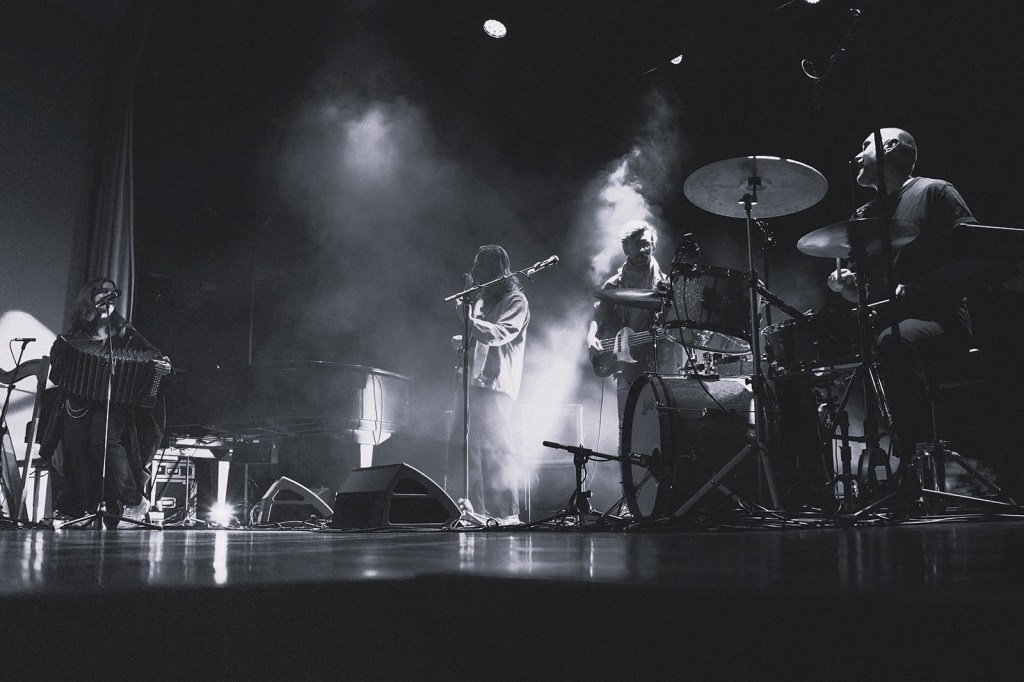
Kaisa Kuslapuu on stage with guitarist Sam Gleason, bassist Alan Mackie, and drummer Marti Tärn in Võru in early November. Photo by Aap-Eerik Lai.

