lidl

I HAD NOWHERE to stay, so I made a little nest in the corner of the Lidl supermarket with some discounted German pillows and blankets. I rested my head against a display case full of frozen pizzas. It was late afternoon and for some reason the lights had been turned off and the counters were covered with root vegetables, like radishes, carrots, cabbages, and so on, when I saw her there. Dulcinea, in her dark coat, glinting like gold at the end of a cave, talking to a supervisor in a pleasant but slightly pleading way. Then she saw me, sleeping in the corner and came over and said, “Mother says that I have to get a job. She said they have some openings.”

These were the first words she had said to me in three years. A tear ran down a heavy cheek. I had to pause to collect my poise. “Well, there’s a good chance I’ll still be sleeping here tomorrow night,” I told her, from my makeshift supermarket sleep nest. “Maybe we’ll be seeing each other again.” “Yes, it would be quite nice to see you again,” she told me. She meant it.

When she left, there was a special throb in my chest that I recognized instantly as love, and I allowed it to spread to every part of my body and to ache away in unison. What better feeling was there in this life than this kind of undying chance supermarket encounter love? But then I had to get a job and the sad fact is that I wasn’t at Lidl when Dulcinea started working there.

A conference on agricultural biotechnology, held in lower fourth level of the University of Life Sciences. Why did they build auditoriums so deep in the earth? Room 424B. Or was 403B? I couldn’t remember. It was all quite newly renovated, but what was with this green carpeting, the dark wood panelling on the walls? To make covering the conference more challenging, someone had given me a baby to care for, so I was pushing a stroller with the tyke in front. He was wriggling and at times sobbing quite loudly. The diaper had come loose, and his urine fountained everywhere. Whose child was this? He couldn’t have been mine. Way too blonde.

“I’ll get that little boy all cleaned up,” said a woman who came to help. She looked like Tippi Hedrin’s character in The Birds. She swept away with the mystery infant and I spent the rest of the day in the back row of a stale-aired conference room listening to dull talks about agronomy. Later I realized that I didn’t have a change of clothes for the conference. Could I really recycle the same shirt? The same black pair of pants? It occurred to me that somewhere inside Lidl they probably sold decent clothes on the cheap. So I would go back. Maybe I could find something high quality and German, but at a reasonable price. Maybe Dulcinea would be waiting at the counter. Again the feeling swept over me like cool winds across the steppe. And the fields and grasses rustled, whispering, “Love, love, love,” and “Always, always, always.”
kabul airport

BUT WHY DO I love her so? But why do I love her so? But why did I love Dulcinea? The question wrapped around the experience, like paper on a bottle. The more you turned it, the more you saw. Then everything went all zig-zag again and I wasn’t quite sure where I was, only that one piece connected to another — and there was a little boy there — one minor plot twist turned things. The next thing I knew we were landing at Kabul Airport in sandy Afghanistan.

Why were we here? Don’t tell me our band was on tour. But didn’t you know, our new keyboard player had let down all her previous bands? There was a large metallic overhang, like the roof of the stage over the Tallinn Song Festival Grounds. Everything else was underwater. Warm, chlorinated, waterpark kind of blue water. We lugged our suitcases through it, or rather they floated. Floating by went spinning islands of American candies, leftovers from the retreat? Mars, Snickers, Twix, Pringles, take your pick. And what were we even doing here? I grabbed a chocolate from one of the airport waterpark islands and looked up, saw orange. Great glowing comet-like streaks were running the length of the sky. Was it a fireworks display or had the Iran War spread to Afghanistan? But weren’t the Pakistanis also fighting the Afghanis now?

When I got to the hotel, I decided that I had my fill of adventure. I went to the café bar, told them to make me the blackest, darkest, evilest espresso there was. If she was the light, then I would be the dark. If she was wholesome and good, I would bristle with sinister malevolence. This life without her had been a graveyard dead end. Light unto light, dark unto dark, her pure into my pure. I stared down into the cup and it whispered back up to me like a haunted well.

staircases

AGAIN THAT TABLE, worn and soft to the touch, coming into view in the dim light of wherever this was. A bar, restaurant, a speakeasy tavern? The table was long, wide, thick. Two familiar friends sat down next to me, maybe one of them was Matti, a semi-famous, experimental writer, and he said to an approaching waitress in a white blouse, “Get this man a glass of the …” I didn’t hear the rest, but when it arrived, there was a near bowl of something that looked like pinot noir or valpolicella. I pushed the glass back on the table and announced, “For the very last time, Matti, I told you that I don’t drink anymore!” Then, gesturing to the kind waitress in the blouse, I affected a more diplomatic tone and said, “But I will have an espresso, thanks.” “Very good,” she said, and there was some turning and clicking of the heels. Matti, who was dressed all in black, guzzled my wine. His bald head was impressive, emerging from his neck like a boulder on Everest, or the corpse of a mountaineer who had fallen there.

I became aware that there were others around the table, including Violette who was waiting patiently for me. I began to reach for the fabric of her dress and brushed against her chest, ever so slightly, hoping that if I made her blush enough, she would unsheathe one for me. Just a few more pats around the breast and soon I would have one in my mouth, if I could only just lay back, like this? The espresso arrived on a silver tray and I took it and drank. It was hot and frothy, splashing around like waves in the Great Western Ocean. Then I announced to all, that I needed to use the bathroom. I headed for one downstairs, but Violette called after me, “No!”

It wasn’t there anymore, in fact everything had changed. The walls had been retiled, there were boxes of construction materials. I came up to the main floor again and Violette was standing there in her dress. She said, “My company acquired the building and there is no toilet anymore, except one for the management on the top floor, but you can’t go up there.” I made another play for her breasts. What did they look like under there? She had some kind of checker print material on, she reminded me of a tablecloth. Picnic baskets, summer, delicious. She just sort of swatted me away, but there was a happy little grin in there, beneath the hair.

“Nonsense,” I told her. “I’m going to find it. But first, I need my journal.” I took my journal from my bag and began climbing the steps to the off-limits upper floors. These had been demolished too and replaced with a swaying, unstable temporary metal staircase. All around me there were cranes and men in white shirts and hardhats conducting the lifting of materials and scaffolding. They were talking into headset microphones and giving orders and wore sunglasses. The staircase only swayed more and I remembered that I was terrified of heights.

I looked down and Violette was shaking her head, each one of those breasts still locked away, like fresh rolls behind bakery glass. “I told you,” she said. I looked down and saw there was a pool below me, a new pool for the company management who were developing the building. I decided to leap into the pool — I had lost all my desire to find a toilet — and kept the journal aloft as I came down feet first into the warm water. Unfortunately, the corner of this most precious book became wet in the fall. I held it up as I swam back to the restaurant. Violette helped me out. “It will dry,” I told her. “Even the wettest journals can be dried and read again.” Then, noticing Violette’s chest through the dress’s material, I said, “Let’s go sit down together.”

landlord

I MUST HAVE RENTED an apartment from a middle-aged Estonian man. He was maybe a decade older, dark tufts of hair, graying at the temples, tawny complexion. He might have been Spanish or Jewish in a previous life. He worked in some dusty corner of the financial services universe and was always dressed smart casual, with a jacket, shirt open at the collar, khakis.

His wife had recently left him, or they had separated or taken a time out. So they said. She took the rest of the children off to the Canary Islands, where she had become a poolside yoga teacher and worshipper of the Hindu love gods. The eldest daughter stayed behind to finish her studies. She was disarmingly beautiful. He was certain the girl had caught my eye. She had.

At night, her father would kick off his loafers after a long day spent shilling for the bank and watch the news on an enormous screen he had got a great deal on during the pandemic. When he saw me entering my apartment through the big glass windows on the first floor, and most of the house was made of metal and glass, he would shake his head a little and purse his lips and then nurse another sip from a bottle of beer. The apartment itself was a tranquil single room, wide and spacious, all painted white, with high, echoey ceilings, and a small kitchenette.

It had three windows and through them I would watch the eldest daughter arrive and depart on her way to or from her semiotics classes. The bob of a golden brain in the late winter sun. The lyrical cadence of a youthful, ever optimistic voice heard through the glass, concerned for her joyless, dead-hearted father. There was something to her, a kind of music so faint you could only hear it if you strained your very ears. But it was also so removed from my waking conscience that I could barely grasp at it, even if I tried. This sparkle might have found its way into a magazine article I wrote, one with sultry allusions to such inappropriate relationships.

And then one day, my landlord was there before me, clutching a rolled up copy of the magazine’s latest edition in his hand, ready to strike. I could see my face above the column, which was printed neatly in black and white “You,” he said, “are a sick pervert! I have already initiated legal proceedings, a kohtuprotsess!” I stepped back and he whacked me with my own words. I tried to defend myself. “But it was all fictionalized!” I cried. “All of it was fiction!” “Lies,” he shouted and struck. “Of course, some of it was based on reality.” “Jail!” he growled. “Jail!”

In my apartment, I let down the white blinds. Outside I could hear him howling, banging. I grabbed my things, crawled out the back window like a character in a Willie Nelson song. Then I was down the forest path, on my way, almost free at last when his wife appeared like mirage. I tumbled and there were orange leaves everywhere, so many leaves I began to swim. The enlightened landlord’s wife looked down out me, her head wrapped in a bandana. Stars flooded the sky and began circling her like little birds. They arranged themselves into a crown. She reached down and pulled me free from my leafy oceans. At long last, I had been rescued.

The landlord’s wife was a fine looking woman, very smooth features, a kind of gray-brown hair just visible beneath her turban, and she had very clear blue eyes that were skies unto themselves. She did not fear my love of her daughter, for as she saw it, all daughters needed to be loved. “Would you like honey too?” She poured me some tea on the terrace later. I mixed in the honey, watched it dissolve in the peppermint, and drank deep from the warm ceramic cup. I was still kind of shaken up and could see her husband through the windows. He was filming the whole thing. Evidence to be used at trial. He gave me the middle finger. Then he motioned to his throat and made a slashing gesture. He mouthed the words: “Pervert, pervert. Jail, jail.”

frittata

SIGBRITT was making a frittata. She was in the little yellow kitchen with its dim yellow lighting and she was very excited. Her flame of yellowblonde hair was open and loose and messy. Sigbritt was making frittata in the old school way, sprinkling breadcrumbs on top of the mix, cooking it over a low heat in a cast iron pan. Who had taught her the recipe? Her hair and skin reflected back the light from the kitchen. Soon she would put it in the oven to finish up.

Each time she added an ingredient, she leapt up, and each time she jumped, I caught her breast in my mouth. Sigbritt was not very tall and she was still very clothed, in a silky green-gray blouse. With each leap of happiness, I gave her another lick. “But I have a boyfriend, but I have a boyfriend, but I have a boyfriend,” she said and teased me. As she chanted, her blue eyes sparkled. “His name is Giovanni, his name is Giovanni, his name is Giovanni!” “I don’t care, I don’t care,” I said, suckling Sigbritt. First one, then the other. First the left and then the right. “So what, so what, so what?”

underwater book

THE HOUSE was at the top of a hill on the edge of town, some wooded area, exclusive wherever it was and in any case. Whoever owned it had not been there for some time. Maybe it was a summer place? My car pulled into its gravel driveway and parked beside a wooden gate. I had driven it there, but I don’t remember why I decided to stop in that shady place.

Maybe I just needed a rest.

Outside, I could see two figures talking in the dust, a very elegant woman dressed all in black with sunglasses and her hair done up and a groundskeeper who was being given instructions as to what needed to be trimmed, moved, painted, refurbished, et cetera. He had on khaki and white and looked like he was about to go fishing. There he stood, holding a white bucket while she went on and on. When she was at last finished, the man disappeared behind a red barn.

That left the two of us. She didn’t see me, or I didn’t notice her seeing me. She had on those big sunglasses, the scarf around her neck. What a fashionable lady, and clearly very posh, to live in such a palace, even if it was in disrepair. She went inside the house to dust the old vases.

I began to wander the estate, past the hedges, under the arches. Where was this? England? Estonia? The Hamptons? There was an old swimming pool tucked into a courtyard, its green clear waters moving against a light breeze. In the shallower part of the pool, I could see there was a book. The book was open, about halfway through. If I focused my eyes, stared at the book long enough, I could read the words on the page through the water ripples on the pool’s surface. Blurry words. Then something unusual happened. I dove headfirst into the water.

The water was cool, fresh, almost sweet to the taste. And so clear, like it was fed from an underground stream or a Greek grotto. I came up again with the book in my hands, looked around. The interior of the courtyard was covered in green ivy, climbing up all walls. And from this darkness emerged the lady of the house, clutching imperiously at her shawl. I realized that I knew who she was as she removed her sunglasses. But wasn’t she 10 years older than me?

“I see that you like my underwater book,” she said. I did. I held it on the edge of the pool. I liked the text, it was set in Renner’s classic 1927 Futura. The pages were strange, they just slipped through my fingers, except they didn’t fall apart. They were soft to the touch, it was a kind of softness I had never felt. “Come up here,” she said. “Sit by me.” I sat on the edge of the pool with the book in my lap and the woman came over to me. Then she gently removed the book, set it down beside me, and sat in my lap facing me. Next, I was inducted into her. It went quick.

“There, there,” she said, with a hint of satisfaction and a very happy sigh. “That’s much better.”

hollow road

HOLLOW ROAD was a shady road. If you followed it from one end to the other, it would carry you from the Village Green to Cedar Street. It was called Hollow Road because it ran the length of a hollow. Atlantic coastal deciduous trees rose up on both sides, tall, towering oaks, cedars, and maples. In all seasons, the hillsides were covered with their colorful rotting leaves. About halfway down on the left, as you traveled the road toward Cedar Street, there was an old cemetery where the original British settler families like the Conklins and Bayles were entombed behind iron gates and beneath Victorian angels. But I never went up in there.

On this day, I walked on ahead, gingerly, freely. It was late spring, early summer, or the onset of fall. The sun shone through the leaves into the darkness of the hollow and as I exited this kind of natural tunnel, I found myself at the foot of Suffolk Avenue. On the right hand side though, I could see that several newer houses had been constructed since I went away, in a style someone might call Scandinavian contemporary. Such buildings would not be out of place on the other side of the ocean. In fact, the more I observed them, the more I began to realize that this part of Hollow Road matched Hariduse Street, which means Education Street. At least the houses looked like the kinds that one found at the start of Hariduse Street, just before the old Airplane Factory. But this was not Estonia. This was Long Island. I was sure of it. The trees were proof. Estonia didn’t have these trees.

The houses were deserted. I didn’t see one trampoline in a yard or car in a driveway. They were made of wood with yellow corrugated metal roofs. All of the trees around them had been cut down, the underbrush removed. The land had been ploughed through and reshaped and covered with fresh green sod from the sod farms out east. It was just too vacant and peculiar. I walked up one of the gravel driveways and found myself at the door of one of these Scandinavian contemporary houses on Hollow Road. The door was ajar and so I went in.

There was almost no furniture in the house. A table, a couch. But someone was living here. On the table, I saw piles of chocolate wrappers from Ghirardelli and other big name manufacturers. On the walls hung the glinting paintings of the Austrian symbolist painter Gustav Klimt. I stood there in that unlit room admiring the Klimt paintings when a woman walked in and startled me. “Who are you? What are you doing here in my house?” she said.

She was younger than me and she had raven black hair. This was pulled up in a messy braid. She wore a white jacket. Her eyes were light and remarkable but not threatening. I told her quickly that I had used to live in the neighborhood, how I can discovered the strange houses, how I had decided to look inside, how my curiosity had got the best of me. She told me that she was a translator, a chocolate translator, and how she was responsible for translating all of Ghirardelli’s packaging and marketing materials into other languages. But how did she come to acquire the Klimt paintings? Weren’t they worth millions? They were beautiful pieces.

“Yes, I also like them very much,” she said. At that moment, I began to feel a familiar, wavy sea-like sensation. It was like the floor was being pulled out from beneath me. She just stood there, staring at me. She had very light, soft skin. It was like milk. She looked too familiar. Who was she? The maritime sensation continued. “Well,” the woman said. Her voice tinkled like faint, far off music. “What now?”

kristi kangilaski’s ‘however it feels’ at rüki galerii

THE TEMPERATURE has remained below freezing this winter, but artist and illustrator Kristi Kangilaski has brought some warm tropical colors to Viljandi with her new exhibition, “However It Feels.” The exhibition opened on 15 January at the Rüki Gallery on Tartu Street and will last until the end of February.

Kangilaski was born in 1982, the same year that Brezhnev died, though before his death which means that, in all likelihood, she is not the reincarnation of Leonid Brezhnev. In fact, it’s the opposite: our Kangilaski is no fat, hairy Communist. Rather, she’s a tall, charming woman who at some point tattooed the words “left” and “right” on her wrists so that she wouldn’t forget which was which. With her hat and long dark coat, this Estonian Academy of Arts-educated artist resembles Mary Poppins from a distance. Her well-marked, magical hands never rest.

When she is not at work as the Viljandi city artist, Kangilaski has created a whole exhibition-full of acrylic paintings. She works at home, somewhere between the bedroom and kitchen, and her warehouse is a corner in her daughter’s room. She uses acrylic paints because she likes to work quickly and acrylic paints dry quickly. “I’m an impatient, restless person,” she says. The paintings emerged according to how she happened to feel. She had no certain plans or preconceptions. Slowly, the collection assembled itself. Almost all of the paintings were undertaken in 2025 — one of them was even finished this January.

At the opening, wine and grapes were served.

At the exhibition, a visitor encounters images of people, horses, elephants, black cats, crocodiles, birds, and bears. In part, the atmosphere is playful and childlike. When I arrived to the gallery the second time to view the exhibition, an entire art school class was there and some little boys even hid themselves beneath the gallery couch and still wouldn’t come out, even when I tried to join them there.

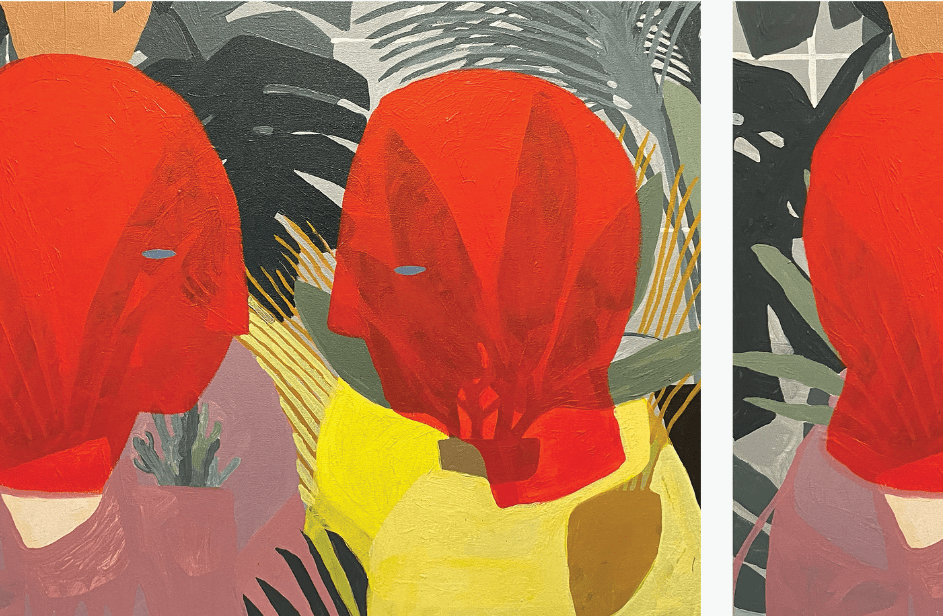
Yet, as another viewer remarked to me, there are also more serious themes. The painting “Black Cat” depicts a mother’s difficult daily life, and “Crocodile” shows a woman seated at a table, with a man’s shadow in back, and that fearsome creature behind them. There is also “Fire Heads,” two red heads in opposition, which brings to mind an argument.

The style is interesting. I was reminded of Picasso and Modigliano’s primitivism as well as Viljandi’s own Paul Kondas, the godfather of naïve art. But Kangilaski herself can’t say exactly what style it is or what inspired it. “I’m especially inspired by different arrangements or compositions that happen appear before me,” she says. “And I have always loved colors,” she adds. “Inspiration is drawn from everything around me.”

Kangilaski agrees that the current colorful exhibition does leave one feeling as if they’re in the jungle. And in the jungle, one can experience all kinds of emotions. The artist has even considered bringing some palm trees to the gallery next time she has an exhibition and I have agreed in principle to help her move them. When she is not out looking for palm trees in Estonia, Kangilaski paints on. As an illustrator, she is just about to begin a new book project.

An Estonian version of this review appears this month in the Estonian magazine Edasi.

coldplay

COLDPLAY WERE BOOKED to perform at Folk. And not just perform, but to headline, with their concert scheduled for the festival’s last evening. I’m not sure whose brilliant idea this was, but I suppose that after NÖEP performed in the same slot in ’25, the door was open for the likes of Coldplay.

I was in the press office as usual right before they went on, but a blonde woman, whom I understood was my wife, was there with me. She was a supporter of the band and had bought Parachutes after “Yellow” started getting played on MTV. But she wanted more than just to see Coldplay play. She wanted me to make love to her during the concert.

This seemed to be physically impossible: where would we find a proper spot? Her solution was an old ironing board. “See, I’ll just put my elbows here, like this,” she demonstrated to me during a break in their sets. “And then, when they play ‘Yellow’ and it peaks you can take me from behind.” “You’re crazy,” I told her. “I’m not having sex with you during a Coldplay concert!”

While we discussed the matter, Chris Martin led the crowd in a singalong of one of their blasé, forgettable songs. The entire band, including Martin, wore rain ponchos. Martin held up an umbrella and sang. Visually, it was stunning, but the music still didn’t inspire me. Meantime my wife was demanding that I help her to climax during “Yellow.” I felt so alone there standing next to that ironing board. “Please,” she whispered. “Please.”

***

While all of this was happening, Klaudia was waiting for me on a beach. She was wearing a red swimsuit that highlighted her ample bust and the salt from the sea had teased her hair into a bouquet of sunshine. She was wearing sunglasses and saying, “You are going to have to choose, you know. You are going to have to choose between her and me. You must choose between her and me.” I could see myself reflected in Klaudia’s sunglasses, which meant that I was on the beach even though I was at the festival. “Which of us two will you choose now? Which one?” Grains of sand were in my eyes, grains of time, the sky above was pastel blue.

***

I guess I caught the rest of Coldplay’s performance. Before the encore, Martin came over to me on the side of the stage and asked me how they had done. I told him it had been a wonderful show. Later, The Who came on, as a special mystery guest, and began to warm up the crowd.

Keith Moon told me that if I wanted to hear their set better, it would make sense to go up one of the towers on the edge of the stage. “That way your ears won’t bleed,” he said.Up the steps I went. When I got to the third floor of the tower, I found myself in a room full of Estonian women dressed in traditional costume, with red headscarves. One of them was a younger, dark haired woman whose name was Mai. I knew Mai from the streets of Viljandi. We had shopped at the same Konsum.

“What’s wrong with you?” Mai said. Her gray eyes peered out at me from beneath a red scarf. “You look as if you’ve just seen a ghost.” “Two women are after me,” I said. I felt like an outlaw bandit. Always on the run from women and ironing boards. Then, glancing down at her in her red skirt, I asked, “Can I hug you?” “Muidugi!” she said. “Of course, you can!” “You mean you’re not afraid of me?” Mai just embraced me, warmly, softly. “But why should I be afraid of you anyway?” she said. “Besides, it’s not my fault I’m so sexy and young.”

obama in tartu

I WAS INVITED to give a talk at the new community center in Tartu, across from the Lõunakeskus shopping center. There I stood, in a small modern classroom, lecturing on the fate of the Eastern Algonquians to a small class of perhaps a dozen curious Estonians, an American flag hanging in the corner, when a middle-aged man who looked like Flava Flav in a blue jumpsuit walked in and began shouting slogans. “We have to get behind Trump!” he said. “To own the libs and end woke!” The students backed away, not knowing what to do. Then in walked Obama, calmly, coolly, boldly. He stood at the center of the classroom dressed in desert khakis, like a soldier from Operation Desert Storm and said, “Please go ahead with your presentation. I for one found it to be most informative and, in my opinion, quite patriotic.”

After Obama and the man who looked like Flava Flav left, I walked home, whistling, hands in my pockets. How could it be that Obama was in Tartu? What was he doing here? Later I found out that, under pressure in the US from the Trump administration, the Obamas had decided to rent a house on the periphery of Tartu. Obama had been to Estonia several times and found it a most welcoming place. He was particularly impressed by its sauna and singing culture and enjoyed a mouthful of moose pasteet. Obama and Michelle would cycle to the market in the warmer months to inspect the eye-watering array of cucumbers, tomatoes, and berries. In the cooler months, Michelle would fill her basket with handfuls of glorious chanterelle mushrooms and prepare at home for Obama his favorite dish, chanterelle sauce with potatoes, laden with dill. Obama would smack his lips. “Michelle, baby,” he would say, wrapping an arm around her waist. “You’re the greatest woman who ever lived. This kukeseenekaste is just perfection.”

The Obamas became a fixture of Tartu life after that. Somehow, even though he was from Hawaii, or Indonesia, or Kenya, or Chicago, or wherever he was from, he fit right in to the city’s free and inventive-thinking population. He would wave at university students as he rounded the turn onto Kroonuaia Street, his arm lifted joyously in the air. He took part in fencing matches at EÜS. Michelle could be seen at H&M in Kvartal, digging through the sock bin, or weighing deals on cosmetics at Tradehouse and Douglas. They were true Tartu lovers.

Then it so happened that I was dispatched to the house of a soothsayer or witch on the opposite side of the River Emajõgi, set back deep in the pine and birch forests. I went there to undergo something called constellation therapy. When I got to the house, a white colonial built at the top of a hill, something immediately felt off. It was winter by then, the snow hardened and iced over, and there was an eerie stillness, even in the light of a February day. The front door to the house was ajar. As I approached it, I began to hear the cries of wolves coming from the woods. Not knowing what to do, I went inside. Its interior was full of expensive lifeless furniture, the kind that wealthier people acquire not knowing what else to get. White couches and dark wooden tables. Some tasteless art beside the cold fireplace.

At its back though, I encountered an old university friend, Chas Flaubert, an architect from Charleston, South Carolina, who had gone to high school with Stig, an Estonian expatriate. Small world indeed. Chas informed me that, during his time in South Carolina, Stig had lived his life as a gay man, but had a sort of reverse coming out experience, suddenly discovering at the age of 20 or so, that he was a robust heterosexual, and that he only had feelings for women. After that, the posters of Fabio, Madonna, and Ricky Martin in his teenage bedroom came down and were replaced by pinups of Farrah Fawcett, Sally Field, and Miss Cheryl Tiegs. “I’m not sure how that happens,” said Chas in his molasses drawl, while puffing on a marijuana cigarette, “but that’s the truth.” “It’s very funny, because Stig is probably the straightest hetero I know,” I said. A suave, one-man nightclub variety show act nicknamed “the gray fox” for his striking hair, Stig Sandbrook was known to have lain with women from Lake Tamula to Lake Titicaca. “He’s more hetero than hetero,” I went on. “Do you mind if I hit that joint, Chas?”

Our conversation was interrupted by the howls of the wolves. Looking out the window, we could see three or four of the shaggy sinister beasts beat a line toward the backyard. “We’re done for,” I told Chas. “Once they get inside, they’ll eat us all for dinner!” We stood there at the windows, awaiting our certain doom. There came a loud crackle and a kind of zipping sound. One of the wolves toppled over, then the next. After four crackling sounds, they were all dead.

It was then that I saw who had shot them. Obama descended the slope in winter hunting gear, rifle in hand. He waved to us. “God bless that Obama,” said Chas. “Where would any of us be without him?” “In the belly of those wolves,” I replied. Obama whistled and a flatbed truck came down the slope. With an Estonian friend, he loaded in the wolf corpses. After sharing a smoke with the driver and some chit chat, Obama climbed into the truck and they drove off.