
THE FIRST QUESTION that came to mind when I stepped into Rüki Galleri to see Eiko Ojala’s new exhibition was: “Is Eiko a woman or a man?” With a name like that, it would probably be a man, but I wasn’t sure. Maybe she was Japanese? Like Miho, Yoko, Eiko. The woman behind the counter told me that Eiko Ojala was a man and an all-around nice guy. “In my opinion, he’s quite friendly,” she added. Her name was Inessa. So, Eiko and Inessa — these were my main characters.
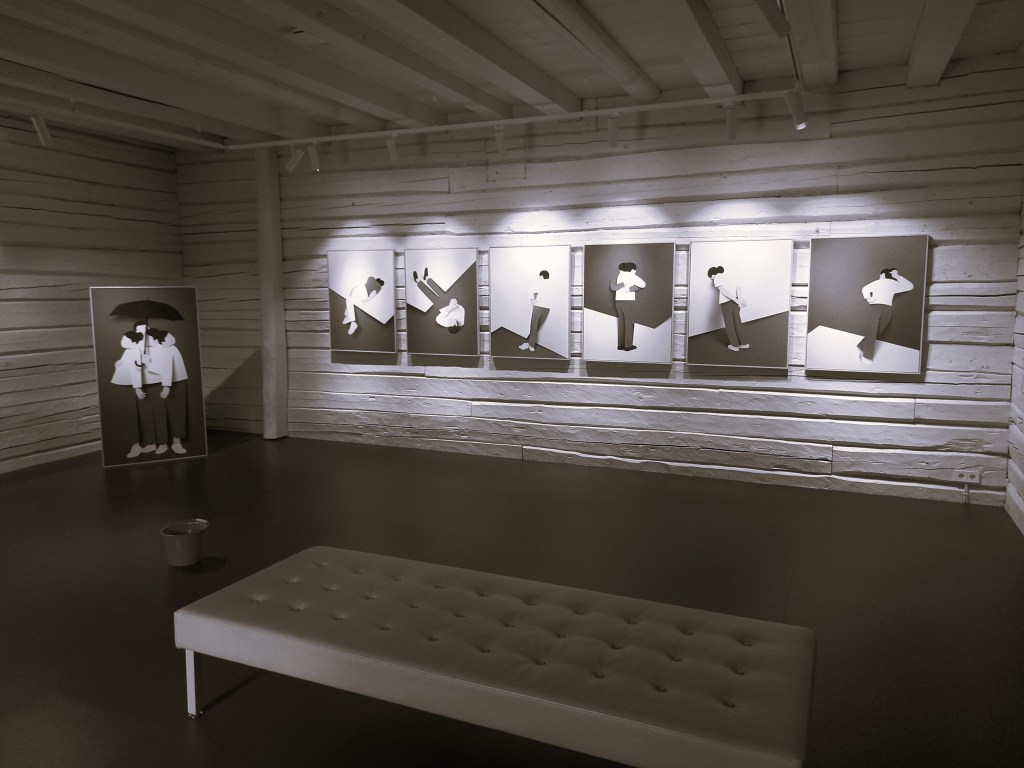
Rüki Galerii was once stored rye flour. The gallery is located behind the new SEB bank on Tartu Street in the heart of Viljandi. The place is wide and spacious, and precisely for that reason ideal for experiencing Eiko’s exhibition “Mind Notes.”
The technique here is pigment print. At first glance, it’s hard to tell what’s going on. It looks as if someone has cut figures out of paper and glued them all together. But that’s not the case. It’s simply a 3D effect. There are various shapes: men, women; some are lying down, some dancing, some running together, some standing under an umbrella. Incidentally, the figures do look Japanese. They have black hair. Pale skin. There is indeed something Japanese about them. Even though Eiko Ojala is an Estonian man.
There are two buckets on the right. One on the left. Seeing them, I asked Inessa if the roof was leaking. Inessa said no. The buckets were part of the exhibition, she explained.
Inessa also tells me that Eiko Ojala is a famous artist: “His pictures have even appeared in The New Yorker.” And not only. The Washington Post. National Geographic. Time. Le Monde. Wired. Politico. It’s a great honor that “Mind Notes” is here, in Rüki, in the quiet small town of Viljandi.
In the corner are information sheets in Estonian and English describing the concept of the exhibition. These images speak about the body: how the body reacts even when consciousness ignores it. Disturbances, fatigue, comfort. The Silicon Valley “live-to-work” mentality is one influence. The fiction of Franz Kafka is another. How authority functions through spaces, processes, and customs, and how a person goes along with it until they no longer perceive that this is how they are behaving.
Ojala’s human figures express this through restless poses. They are strange, admittedly. They bring to mind characters from the film Backrooms, though it’s hard to say why. Also Playmobil toy people. The prices are high. A picture of people standing together under an umbrella costs 1,500 euros. But these are not exactly the kind of pictures you hang on your bathroom wall. At the same time, they are unique and, in that sense, welcome. After all, when you go to an exhibition, you expect something different. Something new.
I think a visitor who comes here will not be disappointed.
Looking at these images — for example, a dancing person — I’m reminded of old drawings of shamans, where someone “flies” together with some spirit. Like in old Tibetan art, where the gods strike different poses. Overall, the exhibition is a haunting, strange place. Inessa says it reminds her of the series Severance, which depicts a gloomy biotechnology company whose employees have undergone a severance procedure that separates a person’s memories between work and personal life. That seems about right.
Later, when I wrote to Eiko, he sent me the text he read at the exhibition opening in August. He adds that this was actually his first solo exhibition and therefore especially personal.
“As the name suggests, ‘Mind Notes’ — these works are connected to our senses and how we notice and interpret the messages they send us,” he wrote. “Especially in situations where we don’t pay attention to ourselves. Or rather, one could ask whether we notice those messages at all. The claim of this exhibition is that, as it were, we don’t.”
And the buckets? They symbolize repetition. At first, the visitor notices that there are three buckets of water. But over time, the water quietly evaporates. They become part of the exhibition’s rhythm.
My main question, of course, was how the author himself feels about his exhibition. In general, Eiko Ojala is satisfied. “Tranquil Viljandi was the perfect place for this,” he answered me. “But no artist can ever be fully satisfied with their art. One must always keep pushing forward.”
*
‘Mind Notes’ opened at Rüki on 16 August and will remain through 26 September. An Estonian version of this review first appeared in Edasi. More of Eiko Ojala’s art can be seen here. And Inessa (Saarits) is an artist herself.
 north!