ALL I REMEMBER is that she came into the apartment, closing the door behind her. She began speaking to me at once, in a somewhat worried and anxious tone. Her work was getting to her. Some of the patients at the mental hospital were career criminals and psychopaths, although they did not term them as such. They could be quite seductive and build up a rapport with even the most seasoned psychologists. “They get under your skin,” she had told me. “It’s hard to wash them off.” She had scrubbed and shampooed her luscious blonde hair in vain.
There she was in the cold glow of a kitchen light. It was evening now in Estonia, the darkness was settling in earlier and earlier, and we all knew which way things were heading as the last days of summer faded away and the equinox breathed its first fall-time breathe. She was still talking there in the kitchen, but her cadence was so fast I had a hard time following her. She had on that button sweater of hers, the soft one, and the light made it look only more cloud-like and gauzy, up from the skies. “I’m sorry things are so tough at the mad house,” I said.
I kissed her after that. The psychologist undid all her buttons and soon I was touching her other buttons. My hands were guided by some instinct, I knew just where to push, just where to pull, just how to conjure ecstasy. And then, mid-kiss, her eyes opened and she recoiled in a kind of befuddled plot-twist horror. “We never agreed we could do that!” she stammered at me. “We never had agreement to make love!” “But, but …” My voice trailed off, but it sounded distant, as if it was echoing back from the end of a tunnel. Calamity, despair. All I had wanted to do was take the edge off, to make her feel blissful. I still did. Even as she pushed me away.
THE MAIN SQUARE of Boston had a large, palatial Edwardian-style home at its center, something like the famous painted ladies in San Francisco. This was surrounded by a number of large oaks, from which dangled ribbons and wooden swings, probably put there by the mayor and his many unruly children. I had boarded the T across the river in Charlestown and saw the city as the train passed over the Charles River. Esmeralda was sitting in the train that September morning, along with some other young woman from the Academy. Esmeralda Kask, whose Estonian parents had named her after a character in a Victor Hugo novel, was wearing a corduroy jacket. Her potato brown hair was pulled back, so that her eyes could only better reflect the blue from the sky and river and the white from the clouds over the bay.
She was sitting there listening to the stories of some stylish Japanese man, laughing at every motion of his body or every hint of a joke. He was maybe 30 years old, his dark hair was cut almost like John Lennon’s on the cover of A Hard Day’s Night. Probably an artist, I thought. Or a bioinformatician. Esmeralda’s gems of eyes did not stray from the handsome Japanese. I walked by her, changing my seat, with the hope she might take notice of my existence. There I sat in the middle of the train, the part that turns, where the seats are less comfortable, listening to the hum of their conversation. Each mirthful laugh of hers only hurt me more.
At the center of Boston, by the Edwardian mayor’s residence, we all disembarked. I suppose we were near Beacon Hill, or an associated Hill. Copp’s Hill? Was there a Faneuil Hill nestled in those cobblestone streets somewhere? Esmeralda and her friend disappeared into the crowds, I could see her put her headphones on as she sauntered away, hands in her pockets. The handsome Japanese walked toward the business district. Then I saw him take out his phone and talk to someone, but then grow outraged, shouting, “Five minutes late? Nobody told me!” This was followed by rapid-fire bursts of obscenities, until he threw himself on the ground and his body exploded in a puff of white smoke and crackling fire. People began running after that.
“Come quick,” a woman of Boston said, motioning to me. She was dressed up like a British postal worker from the time of the Second World War, and had her blonde hair tied back in a thick, golden braid. “He seems to have spontaneously combusted,” she said. “Run! Others might start to combust!” The British postal worker easily outpaced me as I ran up the hill, passing by a familiar bookstore, one I had visited each time I was on assignment in Boston.
My pace slowed though as I reached the edge of the square, even though we were all engulfed in a gray haze. I wondered why I just couldn’t be bothered to run away from things anymore. There was no immediacy to my flight. Maybe I didn’t care if I would be spontaneously combusted that day? If it didn’t happen on that day, it could have happened on any other. All I could think about was Esmeralda Kask and how she had ignored me again. Why did she ignore me?
My running slowed to a half-hearted jog.
Down a street, I ducked into a building and climbed up a flight of old stairs. This happened to be the studio of a popular area radio station. At once, I was led to a desk where Will Ferrell sat opposite me, asking me about the blast, what I had seen, what I had heard. I told him about the train over the Charles River, my encounter with Esmeralda Kask, and her affinity for the handsome Japanese. “It seems he had some kind of meltdown because he was late,” I told Will Ferrell. “That caused him to spontaneously combust.” “Mmm,” Will Ferrell said, listening to me live on the air. “Is there anything else you would like to say?” “Only that I feel guilty,” I told him. “I feel guilty that it gave me some pleasure to watch another man destroy himself in public. Because no matter how good Esmeralda’s love is, it shouldn’t be worth the sight of another human being in pain, just because of my own jealousy, my own envy, my own pathetic malice.”
VERY WELL THEN, I’ll make up your room. Yours can be on the first floor. The house is never completely empty, but you’ll have your own entry way, your own door. I’ll give you your own key. The room will be fully furnished, in fact you’ll never suspect that it ever belonged to anyone else or was used for any other purpose. Your room will be as cozy and warm as cozywarm can be, there will be a soft, broken-in, long and lovely blue couch that you can fold out into a bed, and shelves lined with books from any writer who ever wormed their way into your heart: Sylvia Plath, Simone de Beauvoir, Anaïs Nin, Camus and Antoine de Saint-Exupéry.
There will be an old-fashioned floor lamp in the corner that you can turn on with the tug of a chain, and a pot of sweet peppermint, camomile, or fireweed tea that has been steeping for ages, and yet whenever you take a cup, it’s always at the right temperature and is never too weak nor too strong for your taste. This will be the little room I make up for you in my heart. From here, you can come, go, and inhabit me. You can put your black stockinged legs up and stretch out, set your tired hands behind your sleepy head, drowse and admire the wallpaper.
SOMETHING WAS WRONG with their new house. They told me that it was “possessed.” I wasn’t sure what that meant, so I went over to see for myself. It was down one of the older, zigzagging walking streets in the Old Town. The interior hadn’t been refurbished since the Imperial Swedes had the run of the place. When I walked up the steps into the kitchen, I noticed how musty and dreary the house was, but that hadn’t stopped my father-in-law and his wife from acquiring it. He was there by the sink, but looked different. His cheeks were pink and rosy. His eyes had turned orange or yellow, and his pupils were white instead of black.
He did seem in good spirits as he involved himself in some mundane task. His wife came over and kissed him on the cheek, but her eyes were also orange-yellow. I looked at him and said his name, but he cocked his head as if he had never heard it. “Don’t you know what your name is?” I asked him. He was almost too jolly. My father-in-law, or former father-in-law, was not especially known for jolly moods while undertaking renovation. He was a taciturn, quiet sort of man. He chuckled loudly and the white wisps of hair around his ears made him look comical.
I walked up to him and pushed his chest. “Don’t you remember your name?” I said, pushing him. He seemed taken aback. “You need to wake up and remember your name,” I said. I pushed him so hard he fell on the floor, and in that dizzying instant, I saw his orange-yellow eyes flicker to a light blue again. He wiped them and looked around the kitchen, dazed and blinking.
“What is going on here?” he said. “Where am I?”
It was true then that the house was possessed. But where was the ghost? I was waiting for it to make itself visible, to manifest, appear, but as I searched it from top to bottom, I saw nothing, only cobwebs and dust. Maybe the entirety of the house was possessed and so it would be impossible to see just what was possessing it. From the outside of the house though I noticed I could see a white bird flying on the second floor of the building. The bird hovered there as if to land and then fell dead on the floor. Then through a ground floor window, the scene repeated itself as a white bird went to land in the kitchen and fell dead into the kitchen sink.
My youngest daughter then came skipping out of the house. She said, “Daddy, I want to go to town.” I hoisted her up on my shoulders and said, “Good, because I want to get the hell out of this place.” We went walking toward the center of the town, past rows of English hedges and fieldstone walls. Windmills twirled in the distance. Eventually, the main street sloped down, just like the road into Tallinn, Estonia, and we came down the hill, by which time we were at an intersection that looked like Sörnäinen in Helsinki. Where even was this place? There were some young families seated on pink blankets over the tram tracks. They were having a picnic.
It was a sunny day in a northern city, whatever city it happened to be, and the white clouds were beautiful and enormous. My youngest daughter told me that we should stop and sit a while. It felt good to be away from the possessed house. That episode already felt like a dream.
THE HOTEL WAS LOCATED in a most exclusive area of the city. To get there, one had to follow a winding road through a pine forest which led down to the waterfront. It was a gray, cool day in Alaska, but that hadn’t discouraged the fleet of news vans and journalists from milling by the chain-link fence that had been installed. There were other parties, cult members, UFO truth seekers with binoculars around their necks, true believers, true doubters, and just random indigent folks who had, exhausting the homeless encampments down south, worked their way up the coast to the pristine nature surrounding Anchorage and Cook Inlet.
Luckily, I was accredited to cover the summit, but that didn’t mean I was free to roam the premises. After being let through the first gate, I was ushered into a tent, where a man in a military uniform sat at a desk. I showed him my Edasi press card, but as I looked up and down the table, I noticed that there were various tubes and lateral flow tests. I wouldn’t be allowed anywhere near the summit unless I submitted blood, saliva, and urine samples. “You have to be kidding me,” I told the man in uniform. “Putin is a war criminal and you’re afraid that I’m going to get him sick!” “This is standard procedure for the Alaska Summit, sir,” said the uniformed man. “We want Mr. Putin to feel comfortable, welcome, and entirely at home here in the great state of Alaska.” “No, no,” I said. “I refuse to submit any samples to anyone,” I told him. I exited the tent, which oddly was unguarded, allowing me to creep closer to the hotel.
At this point, some musicians from Estonia who had also breached the security perimeter encountered me. They had planned an intervention along the road leading into the hotel. We wrapped ourselves in Ukrainian flags and lied down in the road in the rain, only to see several small armored vehicles approach. “Disperse!” one of the commanders shouted from somewhere. “Disperse! You are disrupting the high-stakes Alaska Summit!” The musicians groaned on the asphalt, but did not move. Then came the bursts of and blasts of tear gas. There was a scramble, some chaos, and in a moment of fear and cowardice, I stood and fled and was followed by some others. I ran toward the hotel complex, turned toward a posh waterside café.
There, behind the café, there was some space between two stone walls. The walls were made of beige brick decorated with natural motifs, such as bears, whales, or caribou. I hid myself between those walls and groups of soldiers went marauding by. I put my head down and realized that my journal was still there in my bag. My precious journal, purchased last September at Rahva Raamat. I pulled my journal from my bag and decided to write a little.
I WAS SEATED with Igrayne at a round table at a restaurant in Tallinn. She was to my right, drinking a coffee, looking at me. Her hair was open and rested loosely around her shoulders. I was nursing an espresso in a black cup. I think I still liked Igrayne in spite of all of the juicy cleavage photos she had posted on Instagram. I’m not sure why I still liked her. I had met a lot of people, but there was a kind of comfort with this one. Igrayne had led a rather messy life, and that messiness was familiar. It was as if we met just like this, now and then, and relaxed.
There were other people at the round table, but these people were mere acquaintances. A large screen in the corner showed some kind of sporting competition, but this was also vague and obscured, distant. It could have been cross country skiing, tennis, or the Tour de France. Several nosy old ladies though found our table and did not like the sight of me sitting next to this young lady, or rather were distressed by the very idea of it. “You should be ashamed!” one of the nosy old ladies said to me. She was wearing a brown corduroy coat. Indeed, toxic masculinity and the pedophilic lifestyles of the rich and famous dominated the news cycles. Surely, I was just another B-level celebrity who had once sent Jeffrey Epstein a birthday card.
“We don’t have such a big age difference,” I told the nosy old woman in the brown corduroy coat. “When I was born the US president was a Democrat, and when she was born, the president was also a Democrat.” Two Democrats. This prompted some discussion and analysis among the trio of nosy old ladies. I heard different names being tossed around. “Truman.” “Johnson.” “Roosevelt.” “Kennedy.” “Woodrow Wilson.” They stood there and eyed me evilly.
“Did you really need to make this so complicated for them?” Igrayne said to me. “Once again you’ve gone and turned everything into a fucking history lesson.” “It’s not so hard,” I said in my defense. “Who even was president when you were born?” she squinted at me. “Carter,” I said. “The correct answers are Carter and Clinton.” “Nobody remembers Carter,” she said. Igrayne frowned. Her coffee cup was empty. A server came by and replenished our drinks. By this time, some of Igrayne’s other twentysomething friends had joined her and were seated at the table. They were the class of … Who knows when. 2015? Something unknown, unusual. They had tracked the careers of every former member of One Direction, even that one who leapt to a tragic death. But my presidential trivia had done the trick. The village gossips had disappeared.
A LOT HAD CHANGED in my old elementary school back on Long Island, but the basic layout of the building had been maintained. The hallway led me to the left and I knew very well where it would terminate: at the school library. But the classrooms had been converted into greenhouses. I could see students through the glass, watering tomato plants or checking in on cucumbers. Piles of hay and fertilizer had drifted into the hallways and it seemed as if the roof had been removed all together as the hot sun beat down and some chickens clucked on by.
I was rather impressed. The school’s redirection into horticulture made some sense, it was a return to the area’s pastoral roots. In the 19th century, this had been a farming community. Outside the boys’ bathroom, just before the library, I checked the wall for that old memorial. In the 1930s, one boy had died on the mill pond trying to save another who had fallen through the ice. The fallen boy had been rescued and survived, but his rescuer sadly had perished. Sure enough, the memorial plaque, which had been in the building since that time, was still there.
At the library, things had also changed. Chairs had been set out and a librarian informed me that I was expected to give a lecture on writing. Before I did so, I wanted to have a look around the old library, I told her. I wondered if it had that same old musty smell. And what was the name of that old librarian, the one who first told us that all of the card catalogues would be digitized? Wasn’t it Mrs. von Steuben? At the front of the library, I was surprised to see that there was now a toy store, selling plastic figurines and assorted merchandise from Guardians of the Galaxy, Aquaman, and other Marvel and DC movies. “Whose bright idea was it to put a toy store in a library?” I asked the librarian. She said that the library toy store had been there for at least a decade. “That came long after you left the school,” she said. “Even before I came.”
Just then I had an idea, that I would tell the students the story about how I once borrowed John Lennon’s biography, only to find a biography of one VI Lenin on the shelf beside it and, intrigued by the man’s bald head submerged in a sea of socialist red, took it home at once and read it quietly, so that no one could see. Other than Mein Kampf, was there any more seditious a book in the late 1980s, the era of Glasnost and Perestroika? Perhaps these books were still on the library’s shelves somewhere. They would make good props. I looked out across the library, but didn’t see any books there. Just toys and computers were everywhere. “But where are the books?” I asked. “We’ve stored the books in other parts of the library,” the librarian told me.
Thus I began my adventure in trying to locate the library’s hidden old books. The ones that had been stored elsewhere. I went down a hallway into a section of the library that seemed ancient, as if it hadn’t been renovated since the Victorian Era. Light was streaming into the hall through a series of stained glass windows featuring various Biblical scenes. There were some old dusty books here, but they were more intended for children. At the back of the hall, I made a left and went into a darker system of corridors where there was no lighting. I ran deeper and deeper, closing doors behind me along the way, until I emerged at the library toy store again.
“I couldn’t find what I was looking for,” I told the librarian. “But all of our titles are available electronically now,” she said. “There’s no need for physical books.” About 10 pupils in white t-shirts looked up at me. They were all holding tablets. “Do you remember what you agreed to teach them?” the librarian said. “No,” I told her. “You’re supposed to introduce a writer to them and then teach them how to write in the style of that writer.” “Am I getting paid for this?” I asked. “Yes and quite well,” the librarian said. “Very well then, let’s do Ian Fleming,” I told the class. “I want you to start with Goldfinger, Thunderball, Dr. No,” I said. “Then Moonraker.” “You seem very sure of yourself,” the librarian said. “Are you sure you can do this?” “Naturally,” I said. “I could do it in my sleep.”
I WENT TO the Rimi supermarket to buy some bread. Of course, I could have picked up a loaf at any of the many fine bakeries in town, among them the house bakery on Oru Street which is renowned for its delicious rye. The latter I often consume with salted butter, and I can devour a whole loaf in the span of a midnight hour. I could have gone there, but I wanted the gluten-free loaf made by some German company, with its soft yet firm texture, laced with seeds and other delights, fibre-laden and fortified with vitamins, available only here at Rimi supermarket.
As soon as I stepped foot in the supermarket, which is enclosed in a new shopping center built on the site of a former prison, in which some Soviet wartime executions and atrocities once took place, I could sense that something was different. There was virtually nobody inside Rimi’s vast and expansive aisles, save for a few employees pushing metal carts stacked up with boxes. Some kind of retro muzak was playing in the distance, maybe an orchestral version of some old Hall and Oates song. Maybe it was “Maneater,” maybe not. As if it even mattered.
When I got to the gluten-free section, where one can find all kinds of sugar-free, dairy-free, nut-free and allergen-proof goodies, I found that it was no longer there. The aisles were only stacked with plastic bottles, bags of potato chips. “Where’s my favorite bread?” I asked one of the supermarket ladies. “The owners decided to get rid of the natural foods section,” she told me in Estonian. “It wasn’t selling well.” There was a sad, melancholic, deadpan manner to her speech. Her skin was pale, her eyes were deadened. Her hair had been bleached. I imagined if you were paid scant wages, or had not had sex in months, you might begin to talk like that.
Then I noticed that the lights in the supermarket were dimmed. It was quite dark. “Why is it so dark in here?” I asked the woman. “The owners can no longer afford to keep the lights on,” she told me in that same mournful, taciturn way. “It’s a sad story, I’m afraid. We have to work like this all day in darkness.” So this was the final result of years of inflation and high energy prices. A vacant supermarket that only sold chips and bottles of soda, where even lighting was a luxury, and they played horrible retro muzak inside. After that, I searched the aisles. I wandered among them, looking for something to buy, something to eat. I left emptyhanded.
THE INTERVIEW was somewhere in the countryside. The photographer said that she would take me there herself. She drove a black SUV, the make and the model of which I didn’t notice and I sat in the passenger’s side seat. The car was clean if not new, the interior was comfortable. I sat back and glanced in the side mirrors as the car traveled through the northern forests until these gave way to a series of green hills, pastures, and distant silos.
It was a very gray day that day, there was fog everywhere. It felt as if the sky had descended to Earth. “Are you sure you know where you’re going?” I asked her. “Of course,” she said, glancing in the rear view mirror. She briefly licked her lips. They were very red. She was my age with blonde wavy hair and she had on a red blouse. I could just see the slope of her breasts through the material and I observed them carefully, for she was a no-nonsense woman, and I didn’t want to do anything that would set her off. We had worked together on a lot of assignments. She took the photographs and I wrote the articles. She made the images, I made the words.
Somewhere off in those hills, she turned onto a gravel road and parked the car. There was fog all around, floating between the trees and lurking in the runoff ditches. The sky was a milky cloudy abyss, but I could hear birds crying in the nearby woods. I said to her, “What are we doing out here?” She said, “This,” and leaned in and kissed me. “I see,” I said. That might have been the last thing I said that day. Soon she was consuming me. Devouring me. Drinking me. Imagine all that. I thought that I was such a big strong man, but I only slipped and cascaded into deeper levels of vulnerability. Then I felt myself inducted, encompassed, engulfed, swallowed up whole, mind, body and soul. There was a restorative tenderness in her and she held my hand and led me to it, all the way back to the little silver blue spark at the end of the tunnel. It glowed bright with love brilliance. I dissolved. “We both need this,” was all she said.
THE ROAD INTO VÕRU is hypnotizingly long. It just keeps going and going, and even when you pass the turn off to Kanepi, it rolls on longer. Time stands still or vanishes all together out here. There are forests and more forests, with farms and old churches tucked in between. You become disoriented, forget where you are. Jaan Kaplinski used to live out here. I suppose it’s a weird Kaplinski kind of place. Just outside of Võru, there is even a settlement called Magari, which means something like, “if only,” or “I wish,” in Italian. That’s right, I think when I pass it. Magari! I do wish! If only!
If only I wasn’t driving to Võru again. What if I was down there in the Mississippi Delta, or maybe in a jeep on the yellow plains of Tanzania? Maybe if I squinted at that horizon toward Lake Tamula long enough, I might see the neck of a giraffe emerge or hear a lion roar? Every place is this mix of what it is and what you make of it. But there are no giraffes in Võru and the only lion is my daughter’s dog, who is named Lõvi*. Võru is, on its surface, a tidy provincial town. It has a nice central square and decent shops and cafes. There’s some funky street art on the facades. The lake promenade is well cared for and it’s enjoyable to walk over that bridge to Roosisaare. At night you can walk over the bridge and see the lights of Võru from across the water. It almost looks like a real city. It’s hard to imagine that this pretty town is the last outpost of Western civilization. Some outsiders who have moved in have warned me never to relocate. They say the old ladies are very nosy and that they use strange words like määne, sääne, and õkva.
This last word is the giveaway that you are dealing with a võrokas. There’s a nice old lady who lives in the same apartment as my daughter and she is always telling me to go õkva somewhere. Legend has it she is one of the original inhabitants of this Khrushchev-era house. Estonians call these kinds of apartment buildings with small kitchens and bathrooms Khrushchevkas. But the houses that were built in the days of Brezhnev are not called Brezhnevkas and nobody has ever boasted of living in a grand Gorbachevka. There are all of these incongruous pieces that fit together so snuggly in their minds but that make no sense to me. Of course, there’s no such thing as a Gorbachevka! Stupidest thing I’ve ever heard! But a Khruschevka? That’s different.
I like that old lady who tells me to go õkva though. She has a lovely wrinkled face and seems curious about this stranger from a faraway land who arrives sometimes and takes the lion dog for a walk. She is industrious, always busy. In the winter, she shovels snow. In the fall, she rakes leaves. Now she is tending to the flowers. Whatever you do, don’t step on those flowers.
***
I CANNOT SAY that Võru and the county that surrounds it are another country per se, but they do feel different from other parts of Estonia, or at least the ones I am more familiar with. For the people there, Võru is the capital of their own imaginary universe. Tartu is for school and shopping and Tallinn is for concerts and careers, but Võru is the real sun in their solar system. Even my daughter, who has now lived there for some time, said to me in New York one day, “But we have the same kinds of shops in Kagukeskus!” In the mornings, gas stations with ominous names like Coffee Terminal are busy with worker bees in overalls getting their first caffeine fix, in the evenings, those with a taste for finer things gather together and sip wine in NAMM Resto. Võru is also a destination for unsung musical heroes. Jethro Tull may never play Võru. But Jethro Tull guitarist Martin Barre played a sold out concert at a venue called Kannel.
It was at Kannel some time ago that I gathered with this rough-hewn tribe of Võru town folk and frontier woodsmen and watched one of the Apteeker Melchior films with my daughter. I felt like I was in a Roald Dahl book. I’m not sure which one, but those scheming farmers from The Fantastic Mr. Fox did come to mind. I should also note though that the Võru women are striking. On many occasions, your dedicated correspondent has found himself standing in line at the supermarket among local ladies who appear to be buxom, straw-haired angels, but have hardened, disillusioned country interiors. The Võru women and their gruff camouflaged husbands, who wear green either out of style or because they’ve been out hunting, seem impenetrable. If you were to ask them a question, the only word they’d reply is mida?! What?! It’s better to stay quiet.
Võru can seem both modern and ancient, and it has the Soviet period as a kind of mystery filling. In Võru, you can walk past the Kreutzwald Museum and feel as if Elias Lönnrot himself was in there having tea at noon, and then visit the Võru Huub Youth Innovation Center. At the Kubija Spa on the edge of town one can in the mornings enjoy a discounted spa package and socialize with old-timers in the sauna. Võru grandfathers discuss the Soviet era here as if it just ended a few weeks ago. “Do you remember, we had full employment? Everybody had work! You didn’t have to look,” I heard one of these men say to another. “It wasn’t like today.”
“But we were all stealing!” the other grandfather shot back. “Don’t you remember how we used to steal food at the cafeteria? We’d take those bags with us and just load up with food. And my friend, he used to work at the milk factory. All of his friends got free milk. All we did was steal!”
“Maybe you’re right, maybe you’re right,” the first Võru grandfather said. Then, turning his attention to the stranger in their midst, he instructed me to toss some water on the kerris.
***
THERE ARE MULTIPLE WAYS out of Võru and one is the southern route to Valga that skirts the boundary with the Republic of Latvia. Here there are new yellow signs that read Nursi, as if Nursi was an up-and-coming residential development, or maybe a business park, like Ülemiste City. But Nursi is a military training ground. This is clear not only because of all of the military traffic on the road, but because of the unfamiliar sound of helicopters floating over the highway. A few summers ago, I was driving near Sänna on a hot and dusty day only to see several tanks cross a bridge beneath which several Võrumaa girls were swimming in a stream.
This military presence is supposed to make us feel safer, but I can only think of movies about the Second World War. “That summer was the last summer of peace,” some narrator says from somewhere against this pastoral backdrop with a stirring orchestral piece playing. “Everything changed after that.” I saw tanks practicing in the fields as I drove toward Antsla. What am I to make of all this? The saga of the Nursipalu base expansion has touched me in various ways. Once in a south Estonian café, I encountered a stressed folk singer named Mari Kalkun studying a notebook as she worked with residents of the expansion zone to save their family farms. Mari is a musician and a usually cheerful one at that. To see her blue eyes moist with concern unsettled me. My friend’s house, perched in a forest along the Mustjõgi will be possessed. He’ll get good money for it, but who knows what will become of this modest estate where he raised his children or scattered his mother’s ashes. Maybe someone will drop a bomb on it. Just last week I stopped by the place, gave it a lookover and admired its stillness in the spring rain. When I am out in the Võrumaa wilds these days, I am reminded only more of Apocalypse Now. I’m waiting for Marlon Brando’s Colonel Kurtz to emerge from behind the sauna with a bundle of birch branches in his hands.
At night, the road to Valga is deserted. Maybe you might see two other cars pass you the entire way. When I am out there alone on those dark roads around Hargla, I am just waiting to see a UFO land and perhaps be abducted. Don’t most UFO abductions take place on roads like these? “I saw a bright light glowing in the forest. Then a strange pale man stopped my car.”
Nothing of consequence has ever happened to me in Valga, and its traffic flow was designed to disorient and fluster outsiders. Not only is it hard to get out of the town, but one hill even leads up into Latvia, where people speak Latvian and everything is different. This is some mapmaker’s idea of a practical joke. Sepa tänav becomes Semināri ielā. Sõpruse, or Friendship Street, ends abruptly without ever having reached the Latvian border. It’s a metaphor for the aloof Estonian-Latvian relationship, I think. Once I did see some Latvian kids at a gas station in Valga ordering french fries at about midnight in the Estonian language though. There was something endearing about hearing their goofy Latvian-Estonian accents. “Frikartulit, palun.” Beyond that gas station, the road leads northward toward a cozy town called Tõrva, which is where the singer Hedvig Hanson is from, and Helme, where my friend is waiting for me at the Helme pansionaat.
***
IT’S HARD TO THINK of a more unusual fate for an English journalist. Some get blown up by rockets, others are on planes that get shot out of the sky by paramilitaries. But here lies my old friend T. in the last room on the left at the pansionaat, stretched out in bed. He looks thinner, the gray hair around his bald pate is as gray as ever. His blue eyes are still lively. He’s been here since the winter. The windowsill is a shrine of bowls of peanuts and other snacks his Estonian children have brought him. He became aware that he was having a stroke when he got out of bed one morning, he says. T. lives alone, or lived alone, and was only able to alert his neighbors to his predicament by knocking on the floor. His mind is as fresh as it has always been, but his left leg and left arm are still out of commission. “I will recover,” he tells me. “You shall see!”
T.’s roommate is an older Estonian man in his pajamas. The roommate has fluffy tufts of messy white hair and a dreamy look to him. He spends most of his days watching TV and talking to business contacts.
After T. had his stroke, there was some discussion within the Viljandi hospital system as to where he should go to recover. And so he was sent here, to the Helme pansionaat. A modest white building on the edge of nowhere. The nurses come in and position T. into his wheelchair and we sit in the small recreation room beneath a giant screen where Hannes Rumm is interviewing Marju Lauristin. One of the nurses slides a bowl of seljanka in front of him, along with a single slice of wholewheat bread or sepik. He observes the broth with some curiosity. “What do we have here?” he asks. “It looks like seljanka,” I answer. “Hmm,” he says, puts a spoonful in his mouth and swallows. T. doesn’t know Estonian very well, and in the background Rumm and Lauristin are still talking and talking. It’s indeed a strange fate to be a foreigner.
Outside the windows, Helme youths busy themselves playing football between the small apartment houses, oblivious to the struggles of these older neighbors. I brought T. some genoa salami, pecorino romano, artichokes, olives, a loaf of ciabatta, and Saaremaa salted butter. He looks at the food as if it’s a cache of treasure.
“This must have cost you a fortune,” he says. “Where did you get it? Do you usually eat this?” “It only cost me about 15 euros,” I told him. “See,” I tell him. “It pays to have an Italian friend.”
There is hope for T. In a week, he will start rehabilitation at Viljandi Hospital. And this is a man who used to work across the desk from Bill Bryson in London in the ’80s. “If Bryson could only see you now,” I say. “Bryson?” he perks up. “That old chap? Is he still alive?”
Beside the pansionaat are the castle ruins and adjacent to these ruins is a series of sandstone caves. Peasants once hid themselves in these cool dark caves to escape marauding armies, or so they say. Down the hill, there is the so-called Doctor’s Spring, which is said to heal many ailments. Here on its banks I stand for a moment and watch a single small green frog swim across its surface. Other than the bubbling of the water, there is no other sound. If I could bring T. down here, I think, maybe he could be healed. If you just repeat a few phrases and douse yourself in the spring, all can be restored. You need to say the right words the right way.
***
THERE ARE A LOT of stories in the south. Some are pleasant, some are sadder. People down here are living out their lives, passing the time, almost invisible to those in the larger cities and in the north. They are here imagining giraffes drinking from the pristine waters of Lake Tamula or UFO abductions outside of Hargla. They are here eating seljanka in the Helme pansionaat. Once I went to a festival at Õisu Manor, not far from Helme, where there was a dixie jazz band playing. You would have thought we were in New Orleans. Imagine traveling into the Estonian wilds, only to wind up on Bourbon Street. I have a friend who lives in Kalamaja, Tallinn’s premier neighborhood, where lumberjack-looking men with beards push baby strollers to playgrounds with sea views, and where women scurry off to startups in Telliskivi, just like factory workers did a century ago. For them, these tales of the south seem far off, and after a train ride through the forests of the north, they also can feel a world away.
But just the other day I was walking near the beach in Võru when a red-headed young woman came running after me down the street saying, “What are you doing here!” She was wearing a marvelous coat and had on such interesting sunglasses, that it took some time to realize that I knew her from any number of run-ins at Viljandi events. “But what are you doing in Võru?” The red-headed woman said it as if we both happened to be cosmonauts who had crash-landed on the same cold moon. “I’m here often,” I told her. “My daughter lives here.” “Oh, oh,” she said, looking around. “But you know, I have lived my whole life in Estonia and this is the first time I’ve been here,” she said. “The very first time! It’s wonderful,” she paused to wonder at her surroundings. “Here down south, there’s just plenty of excitement and melancholy.”
Quite a few Estonian words appear in this piece. Lõvi is the Estonian word for Lion. Määne, sääne, and õkva are Võru dialect words that mean “which,” “such,” and “straight.” A pansionaat is what Americans would call a nursing home and the British a care home.

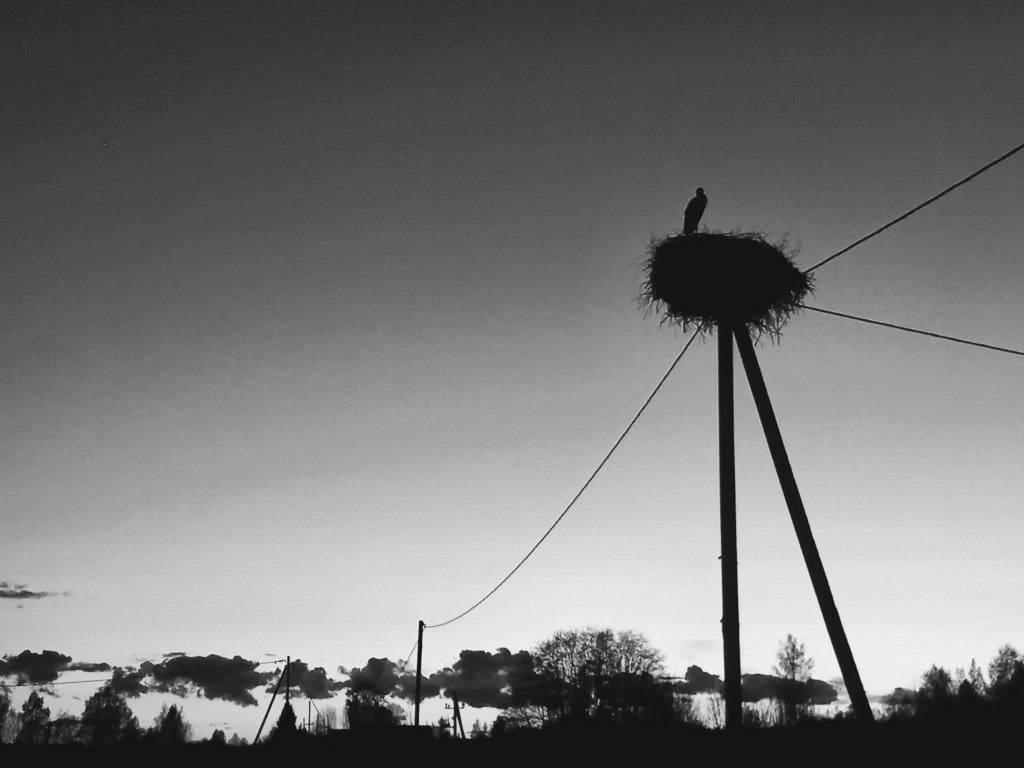
 north!