HOLLOW ROAD was a shady road. If you followed it from one end to the other, it would carry you from the Village Green to Cedar Street. It was called Hollow Road because it ran the length of a hollow. Atlantic coastal deciduous trees rose up on both sides, tall, towering oaks, cedars, and maples. In all seasons, the hillsides were covered with their colorful rotting leaves. About halfway down on the left, as you traveled the road toward Cedar Street, there was an old cemetery where the original British settler families like the Conklins and Bayles were entombed behind iron gates and beneath Victorian angels. But I never went up in there.
On this day, I walked on ahead, gingerly, freely. It was late spring, early summer, or the onset of fall. The sun shone through the leaves into the darkness of the hollow and as I exited this kind of natural tunnel, I found myself at the foot of Suffolk Avenue. On the right hand side though, I could see that several newer houses had been constructed since I went away, in a style someone might call Scandinavian contemporary. Such buildings would not be out of place on the other side of the ocean. In fact, the more I observed them, the more I began to realize that this part of Hollow Road matched Hariduse Street, which means Education Street. At least the houses looked like the kinds that one found at the start of Hariduse Street, just before the old Airplane Factory. But this was not Estonia. This was Long Island. I was sure of it. The trees were proof. Estonia didn’t have these trees.
The houses were deserted. I didn’t see one trampoline in a yard or car in a driveway. They were made of wood with yellow corrugated metal roofs. All of the trees around them had been cut down, the underbrush removed. The land had been ploughed through and reshaped and covered with fresh green sod from the sod farms out east. It was just too vacant and peculiar. I walked up one of the gravel driveways and found myself at the door of one of these Scandinavian contemporary houses on Hollow Road. The door was ajar and so I went in.
There was almost no furniture in the house. A table, a couch. But someone was living here. On the table, I saw piles of chocolate wrappers from Ghirardelli and other big name manufacturers. On the walls hung the glinting paintings of the Austrian symbolist painter Gustav Klimt. I stood there in that unlit room admiring the Klimt paintings when a woman walked in and startled me. “Who are you? What are you doing here in my house?” she said.
She was younger than me and she had raven black hair. This was pulled up in a messy braid. She wore a white jacket. Her eyes were light and remarkable but not threatening. I told her quickly that I had used to live in the neighborhood, how I can discovered the strange houses, how I had decided to look inside, how my curiosity had got the best of me. She told me that she was a translator, a chocolate translator, and how she was responsible for translating all of Ghirardelli’s packaging and marketing materials into other languages. But how did she come to acquire the Klimt paintings? Weren’t they worth millions? They were beautiful pieces.
“Yes, I also like them very much,” she said. At that moment, I began to feel a familiar, wavy sea-like sensation. It was like the floor was being pulled out from beneath me. She just stood there, staring at me. She had very light, soft skin. It was like milk. She looked too familiar. Who was she? The maritime sensation continued. “Well,” the woman said. Her voice tinkled like faint, far off music. “What now?”
THE FIRST BUS dropped me off in the center of the city, somewhere near the New York Public Library. There were a lot of people there, I think there had been more demonstrations against the government. I could see the blue uniforms of the police and the street camoflage of the federal agents. The air smelled of tear gas and fries. Somewhere, a Salvation Army Santa Claus was ringing a bell. Out of this mess of faces and catastrophe, Celeste and Berglind emerged, both walking in the same direction, which on the real map of Manhattan would have been toward Bryant Park, but here became a sort of long, white corridor that led back to their apartment in a sparkling white dormitory. Along they sauntered, in a carefree, unfazed way.
“If you want, you can stay at our place,” said Berglind. “That way we can play all night.” Celeste and Berglind were about eight or 10 years younger than me, but seemed much younger now, in their colorful Moomin pajamas. Each dragged along a dolly and yawned as they did it. Celeste looked especially lovely with her chunks of curly red-gold hair. At some point, midtown Manhattan turned into Kalamaja. When we got to their apartment, I had second thoughts. I looked at the two women with their pajamas and dollies. They looked like little girls. I was too old now to spend the night with them. I had my own bed and that’s where a man like me belonged. Besides, I figured Celeste and Berglind would have a better time together without me.
I kissed them both goodbye.
On the way home, I stopped to think about Celeste. I leaned against a bank façade and thought of how I had missed her in my bones, in my soul, in my blood. Years and years had gone by, and nothing seemed to rid my spirit of hers. A thousand blurry kisses in a thousand blurry doorways couldn’t wash her residue away. She was stuck to me like salty barnacle grime. Nothing to do about it but leave her be with her dolly and her friend and her dormitory room. I kept walking through the city, until I saw something unusual on the next street.
My daughter was there and she was standing outside a second bus. My eldest daughter, who I hadn’t seen in ages. She was about 18 years old now and wearing a blue top and her hair was back in a ponytail. Beside her, there was a tall blonde girl, about the same age, dressed in about the same way. Her name, she said, was Oksana, and she was from Ukraine. My daughter and Oksana said they had stolen this second bus. I had no idea why. They didn’t know either. “The thing is,” my eldest daughter said, while biting her lip. “Neither of us even knows how to drive a bus!” I observed the vehicle from head to end. It was a vintage blue bus, probably made more than half a century ago by some Swiss or German manufacturer. What was it doing here?
I climbed the steps to the spacious driver’s chair, took a seat behind the wheel, which was so big it looked like it could have been used to pilot the Titanic. I felt a little like Captain Smith. My daughter and Oksana got on, and soon we were cruising along while Tallinn became New York again and Tööstuse Street turned into Amsterdam Avenue. I didn’t even bother to wonder where I was anymore, or where I was going. Where we were going. The windows were open and the sky was a dense, otherworldly gold and pink. The wind was in our hair. I felt just fine.
I INHERITED FROM MY GRANDMOTHER a house on the coast overlooking the bay. For some reason, it took 10 years for the estate to be parcelled out, but one day I drove up to the modern, two-storey, three bedroom structure and entered from the side door. It seemed odd to me that my grandmother could have kept this in her possession for so many years without me knowing about it, but she was always tight-lipped about such things and it had wonderful views. Its spacious second floor with its wide windows looked strangely like my childhood home on Long Island. “This,” I thought, “will be the perfect place to get some writing done.”
Downstairs though I heard some clanging and loud voices. Upon descending the steps, I encountered two well-dressed older men, who bore a resemblance to Robert Davi and Joe Pantoliano, who played the Fratelli brothers in The Goonies. One of them was wearing a white, button-down shirt, open at the collar. “What are you doing here?” he said. “Are you a customer?” I looked around the room and could see there was a massage table, along with a stand of various creams and essential oils. “What are you doing here?” I responded. “This is my grandmother’s house, I inherited it. It was a part of her estate!” “We’ve been running a health and wellness center here for years, kid,” he replied. Quickly, it became a shouting match.
I stormed out to visit my lawyer, an older Japanese man named Ushikawa, but his office was a mess. There were pieces of potato chips all over the carpet and crushed cans of Coca Cola. He shrugged at my problem. “What do you want me to do about it?” my attorney said. “Do you think I can personally evict them?” Looking over the old Japanese man with his gray hair, I realized that he was right, and that the police would be needed. Back at the house, I gave the Fratellis another warning and told them to leave. But they again dismissed me. “You go and call the cops,” the brothers told me. “See if either of us cares.” Bunch of arrogant pricks, really.
I did call the police, but the phone rang and rang, and in the end, nobody came to help me.
Later, I wound up at Constantine Kim’s house in some other part of this leafy, island suburbia. I was sitting on his couch and trying to learn “Hey Joe” by Jimi Hendrix on the guitar, especially the introduction. This I paid special attention to. There I was, figuring out Jimi’s moves, when Constantine said that we had to go to an important function (maybe a class reunion?) and I would have to put on some better clothes. “You can’t go looking like that,” Constantine said. “When you see the world, the world sees you.” He had matured into a proper gentleman, I thought, in the intervening years. All suit and tie. Gone was that rambunctious Korean kid with a bowl cut, I once knew. I got cleaned up and went outside in my finest (and only) jacket. At that moment, Benji Rosario came walking by dressed like a postal worker. He had grown his yellow hair out, but otherwise looked just as he had in high school. I greeted him and we got on swell, just like old times. It was good to see Constantine and Benji after all of these years. But what was Benji doing here? What was I doing back in suburbia on Long Island? What about my grandma’s house? Maybe, if we worked together, we could take it back from the Fratellis?
I WAS ON MY WAY HOME when I saw the man. He was standing by the roadside in a field. He was wearing a black, button down shirt, a pair of blue jeans, his arms were folded. He looked like a young Benny Andersson of ABBA, but was clean shaven. He saw me on my scooter and waved me down. “Are you lost?” I asked. The stranger replied, “Hey man, could you give me a ride?”
It seemed like a peculiar request. He wanted to ride on my Bolt scooter? But there was only room for one. I shook my head. “I’m going home,” I told him. “I live right around the corner.” With that, I was off. The roads around my house were elevated, but more or less followed the same pattern as Pineapple Street, Prince Street, and Rich Old Bastard’s Neck Road, out in Quahog Ponds at the easternmost point of Long Island. At the end of Rich Old Bastard’s, there was an old manor house, and at the start of that road, there was a burial ground for African and Indian servants.
I went to make the turn onto Rich Old Bastard’s Neck Road, and the man stood in front of me again. He had somehow sprinted through the fields, forests and wetlands and arrived to the spot before I got there. Who was capable of running so quickly? And without breaking a sweat? He approached me with that same Benny Andersson cool. “Hey man,” he asked again, “could you give me a ride?”
This time, I decided to ditch the man in black. I revved the scooter, zoomed up ahead to another waterfront estate. I held the scooter in one hand and came up through the terrace in front, ducking through some screened-in corridors and walkways until I came out the other side, where I could see that the way home was all clear. Then I boarded my scooter and cruised on down Rich Old Bastard’s Neck Road to the old manor house where I seemingly lived. It was a fine day and the sun was out. I could see the ducks and geese in the water and reeds that lined the road.
When I got to the house, I quickly went in and locked the door behind me. My daughters’ toys and clothes were all over the floor in the foyer, and I began to pick them up and put them away in a cupboard. The door handle began to jiggle and I could see that someone was trying to get in. I went over to the door and put my eye to the keyhole. I saw the man’s eye on the other side. This time, he wasn’t so friendly. “I asked,” he grunted while trying to break down the door, “if you could give me a ride!” The door opened at that moment and he collapsed inside. Not knowing what to do, I fell back. As the man lunged, I kicked the air, hoping to strike. “Get the hell out of my house,” I shrieked. “Get out now!”
A LOT HAD CHANGED in my old elementary school back on Long Island, but the basic layout of the building had been maintained. The hallway led me to the left and I knew very well where it would terminate: at the school library. But the classrooms had been converted into greenhouses. I could see students through the glass, watering tomato plants or checking in on cucumbers. Piles of hay and fertilizer had drifted into the hallways and it seemed as if the roof had been removed all together as the hot sun beat down and some chickens clucked on by.
I was rather impressed. The school’s redirection into horticulture made some sense, it was a return to the area’s pastoral roots. In the 19th century, this had been a farming community. Outside the boys’ bathroom, just before the library, I checked the wall for that old memorial. In the 1930s, one boy had died on the mill pond trying to save another who had fallen through the ice. The fallen boy had been rescued and survived, but his rescuer sadly had perished. Sure enough, the memorial plaque, which had been in the building since that time, was still there.
At the library, things had also changed. Chairs had been set out and a librarian informed me that I was expected to give a lecture on writing. Before I did so, I wanted to have a look around the old library, I told her. I wondered if it had that same old musty smell. And what was the name of that old librarian, the one who first told us that all of the card catalogues would be digitized? Wasn’t it Mrs. von Steuben? At the front of the library, I was surprised to see that there was now a toy store, selling plastic figurines and assorted merchandise from Guardians of the Galaxy, Aquaman, and other Marvel and DC movies. “Whose bright idea was it to put a toy store in a library?” I asked the librarian. She said that the library toy store had been there for at least a decade. “That came long after you left the school,” she said. “Even before I came.”
Just then I had an idea, that I would tell the students the story about how I once borrowed John Lennon’s biography, only to find a biography of one VI Lenin on the shelf beside it and, intrigued by the man’s bald head submerged in a sea of socialist red, took it home at once and read it quietly, so that no one could see. Other than Mein Kampf, was there any more seditious a book in the late 1980s, the era of Glasnost and Perestroika? Perhaps these books were still on the library’s shelves somewhere. They would make good props. I looked out across the library, but didn’t see any books there. Just toys and computers were everywhere. “But where are the books?” I asked. “We’ve stored the books in other parts of the library,” the librarian told me.
Thus I began my adventure in trying to locate the library’s hidden old books. The ones that had been stored elsewhere. I went down a hallway into a section of the library that seemed ancient, as if it hadn’t been renovated since the Victorian Era. Light was streaming into the hall through a series of stained glass windows featuring various Biblical scenes. There were some old dusty books here, but they were more intended for children. At the back of the hall, I made a left and went into a darker system of corridors where there was no lighting. I ran deeper and deeper, closing doors behind me along the way, until I emerged at the library toy store again.
“I couldn’t find what I was looking for,” I told the librarian. “But all of our titles are available electronically now,” she said. “There’s no need for physical books.” About 10 pupils in white t-shirts looked up at me. They were all holding tablets. “Do you remember what you agreed to teach them?” the librarian said. “No,” I told her. “You’re supposed to introduce a writer to them and then teach them how to write in the style of that writer.” “Am I getting paid for this?” I asked. “Yes and quite well,” the librarian said. “Very well then, let’s do Ian Fleming,” I told the class. “I want you to start with Goldfinger, Thunderball, Dr. No,” I said. “Then Moonraker.” “You seem very sure of yourself,” the librarian said. “Are you sure you can do this?” “Naturally,” I said. “I could do it in my sleep.”
MY YOUNGEST sent me a message. She wanted to meet me in the city. The city here being the City of New York, Manhattan, or however else you’d like to refer to it. She was barely a teenager and who knows what she was up to. I imagine it was quite a steamy jungle with all its open fire hydrants, pickpockets, uncollected trash piles, and Chinatown markets. I drove to the nearest train station, which, for whatever reason, was Freeport, Bellmore, Merrick. One of those. I parked the car and from the parking lot I could see the new Long Island Rail Road trains, which happened to look a lot like a Finnair fuselage. Or maybe Finnair and the LIRR had come to some special deal. The blue F of the Finnair logo was painted on the train exterior.
Inside, I discovered rows of Finnish passengers including my old friend Lasse. He was a good-natured older man, with dark, graying hair. He was seated there sipping on blueberry juice and paging through the day’s Helsingin Sanomat. I took a seat next to him and the train “took off,” rising into the air just like an airplane, only to “land” at the next station. “I don’t understand,” I told Lasse. “Is this a plane or a train?” Lasse grinned at me over the paper and said, “both!”
The train-plane though was heading in the wrong direction. I was supposed to be on my way to meet up with my teenage daughter in Manhattan, but the following stops were Bay Shore and, later, East Hampton. I disembarked the train and found a Finnair stewardess on the East Hampton station platform. “I’m supposed meet my daughter in the city,” I said. “Why are we in East Hampton?” The Finnair stewardess, a short, plump, blonde lady in the airline’s trademark blue outfit, said, “But this is a Montauk-bound joint Finnair-Long Island Rail Road service. You’ll have to wait for the westbound train to take you all the way to Pennsylvania Station.”
The East Hampton train station was enormous, cavernous, with escalators going every which way. The walls were made of thick blocks of red brick. One part of it had been fashioned for skateboarders, a little skate course, optimized for elevated tricks. As I clambered down the embankment to make my way over to the opposite track, I noticed that the grass was a little different here. It was golden, spongey. I was stepping on hand-sized potato chips, but soft ones, like those chewy chocolate chip cookies. I picked a few of these strange chewy potato chips and made my way over to the westbound track, munching on them all along the way.
EVERY ITALIAN FAMILY has at least one good Uncle Frank story. This is for the simple reason that there are so many Uncle Franks. Frank, or Francesco, continues to be one of the most popular Italian names, and even in the 2020s, it ranks second only behind Leonardo among new-born Italians.
My grandfather’s name was Frank, and so to all of his nieces and nephews, he was Uncle Frank. My mother’s brother is also called Frank. Believe me, we have a lot of Uncle Frank stories concerning this particular Uncle Frank. The funny thing is that all of those Uncle Franks also had their own Uncle Franks. It’s like looking through a kaleidoscope or prism; you point it at one Uncle Frank and then suddenly there are hundreds of them reflected in tiny pixels, a fantastic mosaic of Franks for the eyes.
This is not to be confused with Cousin Frank. Cousin Franks, sometimes nicknamed Frankie, are a different phenomenon. Thanks to Italian naming traditions, I have at least two Cousin Frankies that I know of, and there may be more. Years ago, when I briefly toyed with the idea of compiling a family biography, I began collecting stories. I knew that I had a Cousin Frankie who was in a rock band. Because of his dark and mysterious looks, he had at least for some time been nicknamed Cochise, after the Apache Indian guerrilla.
There was another cousin that I had heard of, however, who had ventured to the South Pole. And then there was a cousin who was running a pizza restaurant out in the Rocky Mountains The book project was going well, and I imagined all of these as three separate profile pieces. The rock musician, the Polar explorer, the pizza guy. After some investigation, however, it turned out that all of these cousins were the same person, Frankie Abbatecola, one of my great Uncle Vinny’s legions of grandchildren. Had I written the book, most of it would have been about the same person. This energetic Cousin Frankie is a Mötley Crüe devotee not much older than me, who slings pizza dough during the day, wakes up the neighbors with his electric at night and yes, even once made it to Antarctica, or at least some place where there happened to be lots of penguins. Today, Frankie runs a busy pizza restaurant in Massachusetts called “I Love Frankies.”
Whenever anyone questions my Italian identity, I just tell them about I Love Frankies.
“That’s my Cousin Frankie’s place,” I say. They seem satisfied by this information.
***
BUT THIS STORY is not about Cousin Frankie. This story is about Uncle Frank, and a certain Uncle Frank who happened to be the older brother of my grandfather Jerry’s mother Rosaria. I suppose to me, he would be a great great uncle. His real name was Francesco Petrellis, and he was born on a mountain top in Calabria in a village called San Giorgio Albanese overlooking the Ionian Sea, the same place where I once happened to spend the night watching Godzilla dubbed into Italian after almost sleeping in a furniture store. His birth year was 1889. It was a long time ago. At that time, America had not even yet formed itself on the lips of my predecessors. It’s interesting to imagine that if I rewound the clock back a century, most of my family was not speaking English. They were Italians, born and bred into the soil.
Uncle Frank emigrated to the United States with his family in 1900. It seems his father, whose name was Carmine Petrellis, and who came from an old Greek family in that little hilltop village of San Giorgio Albanese, had already crossed the mighty Atlantic once before, but this time decided to make the move with his whole family. There was Francesco, Rosaria, Maria Theresa, and their youngest sister Rosina.
It’s hard for me to imagine what the lives of this immigrant family was like because Carmine, the father, was illiterate, and when they later purchased a house in the town of Huntington on Long Island in the 1920s, where I was born, it was Carmine’s much younger wife, Anna Meringolo, who signed the contract, because her husband didn’t even know how to write. By that time, they had come to call themselves Peters, instead of Petrellis, to make their American lives more manageable. That was a fundamental aspect of American identity. Even if you were not born in America, and obviously were not an American, you could give yourself an American name. Petrellis became Peters. It was a cosmetic change though. Because a person can change their name, but that doesn’t change who they really are. A name is just a name.
The newly minted American “Frank Peters,” known to anyone within his circle of family and friends still as “Francesco Petrellis” was a loyal citizen of the United States but spoke Italian as a native tongue. He married, perchance, a Hungarian immigrant named Ethel, who was from a village called Nyírbátor near the Romanian border. I know much of this information because in 1920, she applied for a passport to visit Czechoslovakia. What I find fascinating about this is that she had never had a passport before then. In the early 1900s you could sail from country to country and settle with no documentation.
It seems that Uncle Frank and my grandfather Jerry had something of a rapport. Perhaps because my grandfather Jerry did not get on so well with his own father, Salvatore, which was understandable considering that he had once left him tied up in a basement cellar. According to my grandmother Margaret, they would go and visit Uncle Frank and share some coffee together. Maybe have cake.
Jerry had met my grandmother Margaret, who was not Italian, while working for a construction company in Virginia during the war. They were introduced by friends and married impulsively after knowing each other for just a few weeks. Margaret at that time was working as a school teacher. One can only imagine this young Virginian school teacher being introduced to the enigmatic Uncle Frank, with his fedora hat and thick Italian accent, and his equally mysterious Hungarian wife Ethel. He told the government whenever they asked him that he did odd jobs for a living. But according to various family members, Uncle Frank really made his living as a chauffeur for underworld figures. My father claims it was to Vito Genovese himself, “Don Vitone,” the founder of the Genovese crime syndicate who dominated the American mafia for most of the 20th century. Others claim that he drove around another mobster called Capone.
Whether true or not, Uncle Frank was well paid for whatever kind of work he was doing in his career of odd jobs. Then one day in early 1965, when he was already an old man with a cane, Uncle Frank paid his nephew Jerry a visit and gave him a $500 bill. This banknote, which is no longer in circulation, featured President William McKinley on the front. My father still recalls the scene of the old man in his fedora sitting in the family kitchen and handing his nephew the money. Uncle Frank visited all of his relatives that week and similarly gave each one of them a $500 bill. And this became the Uncle Frank Story, the old relative who showed up, handing out $500 left and right. He then departed the United States, ceased being Frank Peters, and resumed being Francesco Petrellis and died several months later in San Giorgio Albanese, his home village. After he died, my grandfather Jerry went over to his uncle’s house. Frank’s wife had died the previous year and the house was empty. To his surprise, he discovered bags of money, hidden in various places. There were several purses full of banknotes that had been stuffed in the oven.
***
AS AN ITALIAN-AMERICAN, such stories fascinated me. Not only because anything connected to the Mafia had been glamorized by Hollywood, or in glossy magazines that featured modern day bosses like John Gotti on their covers, but also because they were so distinct from neighbors or schoolmates, whose worldly predecessors might have been prominent attorneys, or perhaps the lieutenant governor of Massachusetts. What to make of this murky connection to murky people doing shady, shadowy things? And was I also one of them? Did the apple not fall from the tree? I had tried to be a respectable journalist, but respectability always seemed just out of grasp for my family. It was elusive. We were people who kept cash in ovens.
After I had returned to New York after an adventure in Calabria at the age of 30, I did show photos of San Giorgio Albanese to my Virginian grandmother, who was 91 years old then, and quite lucid, though fading mentally. This little old gray lady without a drop of Italian in her veins. Her body was trim and lean, and she had her own kind of measured or balanced energy that she carried with her. She spoke softly, and on the few occasions that I told her I loved her, she seemed a little embarrassed. Such was not the measured, restrained way of the Virginians. Her husband was gone, but here was his grandson asking questions.
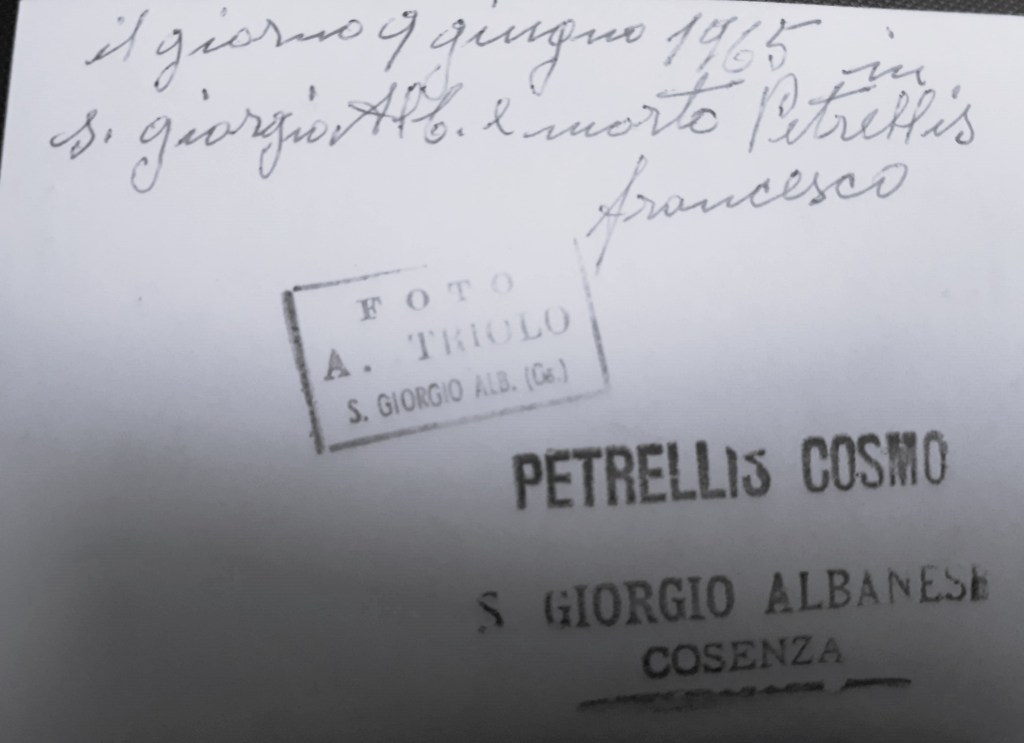
A few days later, she called the house to inform me and my father that she had found a curious photo. Later, when I saw it, I found it quite interesting indeed. For the black-and-white photo showed a dead man in a coffin, covered with bouquets of flowers. On the back of this photo read, in Italian, “On the 9th day of June 1965, in San Giorgio, died Petrellis Francesco.” The photo had been taken by A. Triolo, also of San Giorgio, and the photo was signed by Cosmo Petrellis.
This family curiosity had traveled across the Atlantic and across decades of forgotten memories, only to find its way into my hands, hands that had recently returned to that same village. In thinking about Uncle Frank with his fedora hat and bags full of mob money, I felt that I had understood something that perhaps only another Italian could understand. That whoever we were, and wherever we lived, and whatever names we called ourselves, we were still this illusory thing. Italians were just another unexplained meteorological phenomenon, like those tall waterspout tornadoes rising up like the mighty staff of Poseidon from the depths of the Ionian Sea. We came and we left, we appeared, vanished, and reappeared. One day, we might show up at your door in a crisp gray suit and fedora with a bag full of $500 bank notes. The next day we were gone. And weeks later, we might turn up in the old village, to greet our many relatives.
Just as I had done weeks before in the mountains of Calabria.
Uncle Frank was Frank Peters to the US government and Francesco Petrellis to the Italian one. His odd jobs were driving bigshot mobsters around. But Italians belonged to other kinds of systems. Governments didn’t mean as much as family. The mafia was just another kind of human organization, as legitimate or illegitimate as the local police. Laws were distant, arbitrary, written by strangers. Politics, like in the mafia, was personal, dangerous, and corrupt. And time was just imaginary. Everybody knew that it didn’t really exist.

 north!