AFTER HIS COMPLETION of the Epstein Ballroom, President Donald J. Trump went to work on a new building to house Scott Bessent’s Treasury Department. The old Federal and Georgian-style Treasury Building, the central and east wings of which were erected in 1835 through 1842, was reduced to rubble and a new castle-like fortress was constructed on its foundation, as tall as the Sagrada Familia. This, strangely, contained elements of New York City’s Trump Tower, and its walls, escalators, and stairwells shined with gold-coated plates.
I was one of the first journalists allowed into the new Treasury Building, escorted inside with a North Korea-style sightseeing group. We were led up the stairs, which were gleaming with gold, to the second floor, which had the décor of an ancient Scottish castle, with moist, dripping stone walls and antique tapestries. Trump was there himself, bedecked in a Highland Tartan, and several other Scotsmen and women sat around an open fire. Trump seemed preoccupied with something and stared intensely into the air. He was whispering to himself and his blue eyes reminded one of a beached fish running out of oxygen. The Scottish guests only stoked the fire and talked loudly about how they felt comfortable in the new Treasury. “Aye, it’s not too opulent,” a bald man in a sweater said. “Only parts are covered in gold! What’s the fuss about?”
Downstairs, I discovered that a food court had opened. There were people sitting all around on wooden benches, the kinds that you might find at an ice skating rink. Here I encountered some Trump supporters in winter coats who were boasting loudly about how decisive their leader was. “Biden could never make up his mind,” one jeered. I intervened and said that, in reality, their president changed his mind almost every day if not minute. “Yes, I will give the Ukrainians Tomahawk missiles. No, I won’t. Yes, well, actually I will. Let’s see what Putin says.” For daring to bring this to their attention, I was cursed out, but I didn’t care. “The only thing Trump’s consistent about,” I shouted at his supporters as they dispersed, “is his love of tariffs!”
Down the gold escalator rode my old friend Eamon O’Toole next, with his loving Irish grin. He was dressed in a white sweater and gold chain, as if he had just got back from a wild house party with Kid and Play. The first thing Eamon O’Toole did upon meeting me in the new Treasury Building was laugh and say, “Well, well, well. Fancy meeting you here!” He had sprouted a slight red beard in the meantime, and there was a crazy gleam in his eyes. I told him about the Trump supporters and the tariff comment. Eamon O’Toole only laughed more. “All of these people suck,” was all Eamon said with an irrepressible delight. “I hate them all.”
We were then interrupted by Rory Lapp, an Estonian writer and poet and coffeehouse ghost who said, “Excuse me, but do you know where a bestselling author might get a decent espresso?” We went over to the coffee machine, but the first cup was full of a strange, milky liquid, and we realized the machine was cleaning itself, so we pushed the button again. Rory stood there in his black button-down shirt, waiting patiently to taste his first Treasury coffee. Funny that I would rendezvous with some of my best friends in such a gilded, tasteless place.
I noticed then a small gray mailbox by the coffee machine and opened it. Inside, I found a single letter, addressed to me, which I opened as well. It was a postcard with a picture of Ronja Rippsild, a prominent Estonian photographer. She was standing there, in her red shirt and green coat, a winter’s hat on her head. She was as pale as ever — I don’t think Ronja was capable of getting tan — and her dark hair hung around her shoulders. The note read, “Goodbye Justin,” and I scanned it intently, hoping that Trump’s demolition of the Treasury Building hadn’t caused my Estonian friend to commit suicide. Instead she said that she had had enough of the world’s problems and was going on a pilgrimage of sorts, which she intended to wrap up by the year 2049. “By that time, I’m sure we can live happy lives again,” Ronja had written. In the meantime, she planned to embark on a global Camino de Santiago.
“Well, that’s one way of coping,” I said to myself. I was going to miss Ronja while she was away. I sighed and returned to the coffee machine, where some loud Trump bashing was underway.
PIE IN THE SKY, gauzy cotton carpets, glides the plane toward Riga, the sun shining on its golden wing tip. In some places the clouds pile up like sand, mountains, valleys, crevasses, river deltas, a whole air world stacked on top of the land world. The self is a similar sort of shell game. Now you see it, poof! The Gulf of Riga, container ships slowly chugging somewhere with their cargo.
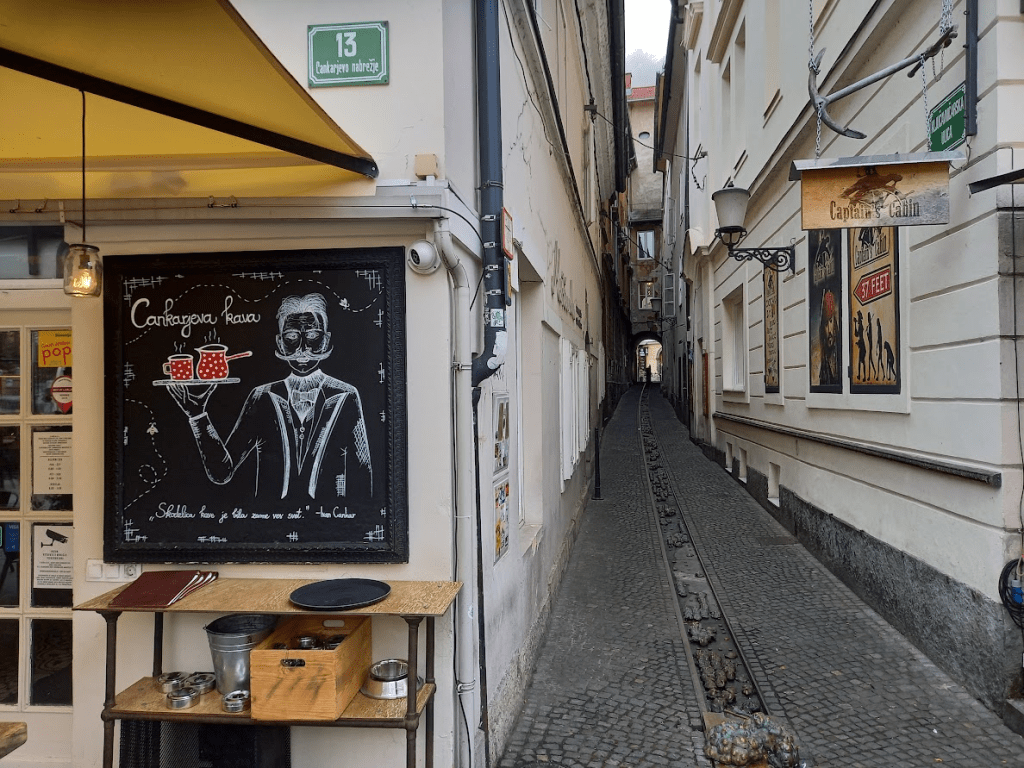
A poster for a play in Kranj, Slovenia. It’s only two hours by plane from Riga, Latvia, to Slovenia.
Upon arrival …
Kranj, Slovenia. #47 on this street or ulica is colored squash yellow, pumpkin orange, old chain-linked fences, weathered stones and concrete, pedestrian murmurings, grape vines, ivy vines, alpine balconies, a trumpet playing somewhere, a bicycle cycling something, whirrish whir displacing air. #16 on another ulica is painted hope-pink. Lekarna is a pharmacy and jaune santiarije is a public toilet, and ne must mean no, because that’s what a woman keeps saying to her dog.
Outside the bookstore, the sellers are smoking and sipping wine and saying something like koushka and Naked Lunch costs 16 euros inside, and outside a building under construction and covered in scaffolding a worker is yelling out “Matjas!” Later, the receptionist at the hotel informs me that the word I heard was kučki, which means two small dogs in Slovene, and prosim is please, of course, of course, a kuža is just a doggie, like the Estonian kutsu.
The next morning…
Each morning in Ljubljana is cool and foggy, until the sun burns off the mountain valley moisture.
I DON’T KNOW what to say about Ljubljana, I have trouble spelling and saying the name. Slovenia has Mediterranean elements, Alpine elements, South Slavic elements. I like the way the language looks on signs and billboards and theater posters. In a funny way, it reminds me of Lithuanian, only because of the length and special characters (these languages are far removed). (Vzgojiteljica is ‘kindergarten teacher’).
Reading some genetic studies of the Slovenes, conveniently featured on their Wikipedia page, I learned that they are closer to Czechs than to “real” South Slavs, like Bulgarians and Macedonians. The language? I know nothing. Prosim (please, thank you) gets you everywhere in Slavic land, and “Cheers” is the familiar na zdravje… I forget at times what a vast hunk of Europe is populated by Slavs of all flavors, the Poles, the Slovenes, the Croatians, the Slovaks, the Bosnians, the Serbs, the Ukrainians, and then those more niche groups, like the Ruthenians. Or were the Ruthenians the Ukrainians? Try the Rum Raisin Slavs, the Butterscotch Pecan Slavs, while you’re at it. They’re out there somewhere, inhabiting some valley …
Bear in mind, at times people are just as at a loss when it comes to the Estonians, so they can be forgiven when it comes to distinguishing all of these cultures and subcultures. It takes time to study up on Slovenia.
During breaks from workshops, your intrepid writer wandered aimlessly around, writing more nonsense.
ANYWAY, this is a lively city. People are outside in the evening, riding bikes, strolling, talking loudly. It’s by population smaller than Tallinn, but even on its finest summer days, Tallinn just isn’t as lively. People just seem to pour into restaurants and out of supermarkets. A lot of Slovenians are tall, even taller than me, and there is a subset of the guys with really frizzy, nappy hair, which they grow out, so that they look like Thulsa Doom’s henchmen from Conan the Barbarian. Some of them cut it short and ride around on electric scooters wearing puffy black vests or jackets. The Slovenian girls are ranging in packs and talking loudly. Their jackets are also puffy.
How funny that for them, Ljubljana is the world, and they are having modern day street romances by the dozen, and breaking up, and someone is dating someone in Kranj, or someone moved to … where do Slovenes even move to? Probably Vienna. Yes. They split up, and she moved to Vienna for work. Broke his heart in two. All of this drama taking place in this foggy basin, people made born and lived, day by day in Slovenia, and the world shuffles by, barely taking notice.
The hotels (I’ve been spoiled) have retained some continental grace. Very Grand Budapest Hotel, the concierge is overly eager to help. In Estonia, they are too busy texting their friends, or just don’t want to make eye contact at all. There’s no, “Yes, sir,” “Anything else. sir?” Estonia could use a little more Monsieur Gustave H, I think. But who am I to judge?
***
Who was I when I was here 23 years ago? Am I still him at all? What has become of all that? Well, there’s no need to dwell on it. Yesterday went into yesterday, like krill into the belly of a baleen whale, and I don’t recall it all, nor should I.
***
The long way up the castle hill. This photo snapped accidentally while talking to my daughter on the phone.
THE LAST TIME I was in Slovenia, it was ’02. A lot of time has elapsed since then, but it doesn’t feel so far away. It hasn’t yet taken on the glow of nostalgia. I didn’t have a phone then, and nobody really knew where I was, although my father said he could track my movements according to the bank statements that were mailed home. It wasn’t a big issue.
I did have a journal with me, so somewhere in my closet, buried underneath all of my other journals*, I can find out more or less what happened, but since I have not retrieved these memories since about that time, I only have some recollections of the bus station, the hotel, some cool-looking teenagers sitting in a park, the church, the river, and not making it up the hill to the castle (which repeated again this time, as I did not hike all the way up. Maybe it will take 23 more years to get there?) And of course the trip to the caves, which are called jama in Slovenian, which means crap or bullshit in Estonian. But that’s about it. Maybe some more will resurface. I was only 23 years old the first time.
Enough about that. In Slovenia, when you walk into a shop, the shopkeepers will often greet you with “dan,” which means, “day,” as in “good day,” dober dan. I was thinking that if your name happened to be Dan, this would be a good city to live in, because every time you went to the supermarket or popped into the bookstore, the sellers would address you personally. “Dan!” Or imagine the unsuspecting Dan who ventured into Slovenia, only to hear strangers saying his name to each other. He walks into the bookstore, but all the girls keep saying his name, or maybe he thinks he’s hearing things. Onset schizophrenia.
“Dan,” they all whisper. “Dan, dan, dan!”
The city at night, more restless wandering awaits.
ON A SATURDAY NIGHT, Ljubljana was fairly lively into the late hours, though most boutiques and stores closed their doors by 9 pm. I wonder about these pretty faces through the windows, the Slovenian yuppie set, who do they work for, where do they get their nice sweaters? Some clubs remained open, and I heard all kinds of fun music from the speakers, including Dr. Dre and Snoop Dogg’s “Deep Cover,” followed by some vintage Michael Jackson (pre-Off the Wall, maybe Jackson 5?) and then Tom Jones’ rendition of “Burning Down the House,” followed by Lipps Inc.’s 1980 hit “Funky Town.” A guitar player was singing “Creep” by Radiohead but he couldn’t hit those Thom Yorke high notes.
There were also decent restaurants open late, serving fried seafood, Indian curries, and kebab, which is what you need if you want to get some deep sleep. In the earlier part of the evening, I attended a traveling Flemish production of Medea’s Children with Slovenian subtitles. I think I understood a few phrases in Flemish (their expression for “please,” alsjeblieft, is the same as it is in Dutch) but Slovenian was impenetrable. It looked like a cat had run across the keyboard. (Where are you from is od kod prihajaš? and thank you is hvala!) I was reminded of the fake “Eastern European” language from Ingmar Bergman’s 1963 film The Silence (where the Estonian word for hand, käsi is taught by the concierge to the little Swedish boy in the hotel).
Ingmar Bergman employed a fake “Eastern European language in his 1963 film Tystnaden or The Silence.
And then he writes…
Oh, the melancholy sorrow of the pretty youths and sorrow over missing my own pretty youth, long gone and burned away, but can it be resurrected, just like the actress cries on demand for the camera, her cheeks wet and so sincere, the tenderness of lovely youth, and afterwards an after party of salami, prosciutto, Slovenian theatre life, as if I ever knew what I was doing ever.
The next day
Across from here we had a good lunch of fried fish, potatoes, drenched in a yummy creamy garlic sauce.
SLOVENIA HAS MIXED/uncomfortable feelings about its southern neighbors, let’s call them that. Someone asked a friend something in Serbo-Croatian, which was taught to all Yugoslav school children prior to 1991 as a common state language. Old-school nationalism, everyone in a single geographic box, speaking the same language, believing in common myths that link their heritage with a mystery genetic component (it’s in our blood) while rooting for certain football teams, praying for Olympic glory, and engaging in armed border conflicts in cultural gray zones, seems antiquated and kind of silly. Yet this was the solution to the imperial collapses of 1914. Come feel the nationalism!
The same Ottoman Empire that once ruled over much of the southern Balkans also ruled over what is now called Israel and Palestine. But up here, this was all Austro-Hungary, Ljubljana is thus a provincial capital of the late Austro-Hungarian Empire. It’s odd, I think, that nobody is trying to resuscitate this particular empire these days. The Russians are still crying about theirs and “their ancient land” but the Austrians are, well, I am not sure what they are up to. Maybe bodybuilding. Or skiing. Maybe their beer is just better and so they have fewer complaints.
And just like that, it’s over …
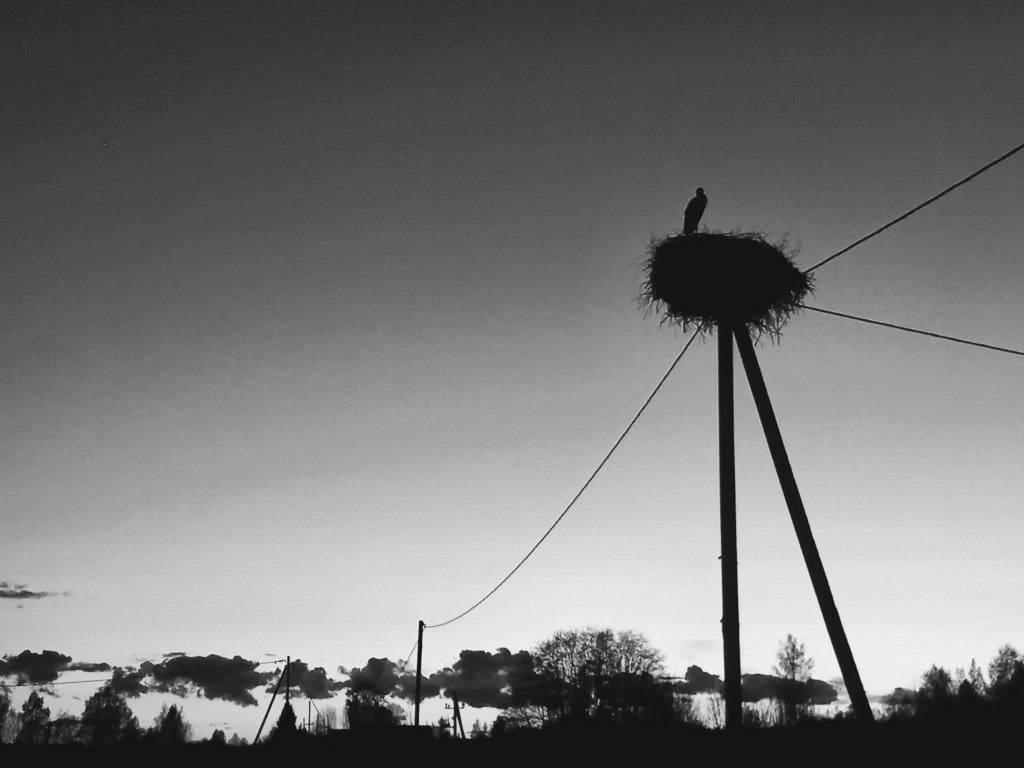
Back in the north woods of Estonia, where the land is green indeed.
AFTER LEAVING the mountains around Slovenia and Austria, ‘Europe’ is one big dusty plain of farms, roads, and shiny grain silos, and the occasional large settlement.
This rolls straight up into southern Latvia where things get woodsier north of the Daugava river, and Estonia is even more swampy and green. Also the road, farms, town pattern is less observable, in Estonia it looks like some giant sneezed and the houses went all over. A very dispersed settlement.
That river is the Jägala, I think. Do you know that in the reign of Ivan the Terrible, the Russians also tried to conquer this region? But that they lost and badly? And that even then the Swedes and Poles supported the governments in Estonia and Livonia because they didn’t want Ivan as a neighbor?
Some things never change.
A compilation of journal entries (in italics) and Facebook-Instagram posts from a recent trip to Slovenia.
Later, I uncovered my journal from ’02, only to discover I was mostly focused on creative projects and my relationship when I was in Slovenia, and barely wrote about the trip at all.
THE MAIN SQUARE of Boston had a large, palatial Edwardian-style home at its center, something like the famous painted ladies in San Francisco. This was surrounded by a number of large oaks, from which dangled ribbons and wooden swings, probably put there by the mayor and his many unruly children. I had boarded the T across the river in Charlestown and saw the city as the train passed over the Charles River. Esmeralda was sitting in the train that September morning, along with some other young woman from the Academy. Esmeralda Kask, whose Estonian parents had named her after a character in a Victor Hugo novel, was wearing a corduroy jacket. Her potato brown hair was pulled back, so that her eyes could only better reflect the blue from the sky and river and the white from the clouds over the bay.
She was sitting there listening to the stories of some stylish Japanese man, laughing at every motion of his body or every hint of a joke. He was maybe 30 years old, his dark hair was cut almost like John Lennon’s on the cover of A Hard Day’s Night. Probably an artist, I thought. Or a bioinformatician. Esmeralda’s gems of eyes did not stray from the handsome Japanese. I walked by her, changing my seat, with the hope she might take notice of my existence. There I sat in the middle of the train, the part that turns, where the seats are less comfortable, listening to the hum of their conversation. Each mirthful laugh of hers only hurt me more.
At the center of Boston, by the Edwardian mayor’s residence, we all disembarked. I suppose we were near Beacon Hill, or an associated Hill. Copp’s Hill? Was there a Faneuil Hill nestled in those cobblestone streets somewhere? Esmeralda and her friend disappeared into the crowds, I could see her put her headphones on as she sauntered away, hands in her pockets. The handsome Japanese walked toward the business district. Then I saw him take out his phone and talk to someone, but then grow outraged, shouting, “Five minutes late? Nobody told me!” This was followed by rapid-fire bursts of obscenities, until he threw himself on the ground and his body exploded in a puff of white smoke and crackling fire. People began running after that.
“Come quick,” a woman of Boston said, motioning to me. She was dressed up like a British postal worker from the time of the Second World War, and had her blonde hair tied back in a thick, golden braid. “He seems to have spontaneously combusted,” she said. “Run! Others might start to combust!” The British postal worker easily outpaced me as I ran up the hill, passing by a familiar bookstore, one I had visited each time I was on assignment in Boston.
My pace slowed though as I reached the edge of the square, even though we were all engulfed in a gray haze. I wondered why I just couldn’t be bothered to run away from things anymore. There was no immediacy to my flight. Maybe I didn’t care if I would be spontaneously combusted that day? If it didn’t happen on that day, it could have happened on any other. All I could think about was Esmeralda Kask and how she had ignored me again. Why did she ignore me?
My running slowed to a half-hearted jog.
Down a street, I ducked into a building and climbed up a flight of old stairs. This happened to be the studio of a popular area radio station. At once, I was led to a desk where Will Ferrell sat opposite me, asking me about the blast, what I had seen, what I had heard. I told him about the train over the Charles River, my encounter with Esmeralda Kask, and her affinity for the handsome Japanese. “It seems he had some kind of meltdown because he was late,” I told Will Ferrell. “That caused him to spontaneously combust.” “Mmm,” Will Ferrell said, listening to me live on the air. “Is there anything else you would like to say?” “Only that I feel guilty,” I told him. “I feel guilty that it gave me some pleasure to watch another man destroy himself in public. Because no matter how good Esmeralda’s love is, it shouldn’t be worth the sight of another human being in pain, just because of my own jealousy, my own envy, my own pathetic malice.”
THE ROAD INTO VÕRU is hypnotizingly long. It just keeps going and going, and even when you pass the turn off to Kanepi, it rolls on longer. Time stands still or vanishes all together out here. There are forests and more forests, with farms and old churches tucked in between. You become disoriented, forget where you are. Jaan Kaplinski used to live out here. I suppose it’s a weird Kaplinski kind of place. Just outside of Võru, there is even a settlement called Magari, which means something like, “if only,” or “I wish,” in Italian. That’s right, I think when I pass it. Magari! I do wish! If only!
If only I wasn’t driving to Võru again. What if I was down there in the Mississippi Delta, or maybe in a jeep on the yellow plains of Tanzania? Maybe if I squinted at that horizon toward Lake Tamula long enough, I might see the neck of a giraffe emerge or hear a lion roar? Every place is this mix of what it is and what you make of it. But there are no giraffes in Võru and the only lion is my daughter’s dog, who is named Lõvi*. Võru is, on its surface, a tidy provincial town. It has a nice central square and decent shops and cafes. There’s some funky street art on the facades. The lake promenade is well cared for and it’s enjoyable to walk over that bridge to Roosisaare. At night you can walk over the bridge and see the lights of Võru from across the water. It almost looks like a real city. It’s hard to imagine that this pretty town is the last outpost of Western civilization. Some outsiders who have moved in have warned me never to relocate. They say the old ladies are very nosy and that they use strange words like määne, sääne, and õkva.
This last word is the giveaway that you are dealing with a võrokas. There’s a nice old lady who lives in the same apartment as my daughter and she is always telling me to go õkva somewhere. Legend has it she is one of the original inhabitants of this Khrushchev-era house. Estonians call these kinds of apartment buildings with small kitchens and bathrooms Khrushchevkas. But the houses that were built in the days of Brezhnev are not called Brezhnevkas and nobody has ever boasted of living in a grand Gorbachevka. There are all of these incongruous pieces that fit together so snuggly in their minds but that make no sense to me. Of course, there’s no such thing as a Gorbachevka! Stupidest thing I’ve ever heard! But a Khruschevka? That’s different.
I like that old lady who tells me to go õkva though. She has a lovely wrinkled face and seems curious about this stranger from a faraway land who arrives sometimes and takes the lion dog for a walk. She is industrious, always busy. In the winter, she shovels snow. In the fall, she rakes leaves. Now she is tending to the flowers. Whatever you do, don’t step on those flowers.
***
I CANNOT SAY that Võru and the county that surrounds it are another country per se, but they do feel different from other parts of Estonia, or at least the ones I am more familiar with. For the people there, Võru is the capital of their own imaginary universe. Tartu is for school and shopping and Tallinn is for concerts and careers, but Võru is the real sun in their solar system. Even my daughter, who has now lived there for some time, said to me in New York one day, “But we have the same kinds of shops in Kagukeskus!” In the mornings, gas stations with ominous names like Coffee Terminal are busy with worker bees in overalls getting their first caffeine fix, in the evenings, those with a taste for finer things gather together and sip wine in NAMM Resto. Võru is also a destination for unsung musical heroes. Jethro Tull may never play Võru. But Jethro Tull guitarist Martin Barre played a sold out concert at a venue called Kannel.
It was at Kannel some time ago that I gathered with this rough-hewn tribe of Võru town folk and frontier woodsmen and watched one of the Apteeker Melchior films with my daughter. I felt like I was in a Roald Dahl book. I’m not sure which one, but those scheming farmers from The Fantastic Mr. Fox did come to mind. I should also note though that the Võru women are striking. On many occasions, your dedicated correspondent has found himself standing in line at the supermarket among local ladies who appear to be buxom, straw-haired angels, but have hardened, disillusioned country interiors. The Võru women and their gruff camouflaged husbands, who wear green either out of style or because they’ve been out hunting, seem impenetrable. If you were to ask them a question, the only word they’d reply is mida?! What?! It’s better to stay quiet.
Võru can seem both modern and ancient, and it has the Soviet period as a kind of mystery filling. In Võru, you can walk past the Kreutzwald Museum and feel as if Elias Lönnrot himself was in there having tea at noon, and then visit the Võru Huub Youth Innovation Center. At the Kubija Spa on the edge of town one can in the mornings enjoy a discounted spa package and socialize with old-timers in the sauna. Võru grandfathers discuss the Soviet era here as if it just ended a few weeks ago. “Do you remember, we had full employment? Everybody had work! You didn’t have to look,” I heard one of these men say to another. “It wasn’t like today.”
“But we were all stealing!” the other grandfather shot back. “Don’t you remember how we used to steal food at the cafeteria? We’d take those bags with us and just load up with food. And my friend, he used to work at the milk factory. All of his friends got free milk. All we did was steal!”
“Maybe you’re right, maybe you’re right,” the first Võru grandfather said. Then, turning his attention to the stranger in their midst, he instructed me to toss some water on the kerris.
***
THERE ARE MULTIPLE WAYS out of Võru and one is the southern route to Valga that skirts the boundary with the Republic of Latvia. Here there are new yellow signs that read Nursi, as if Nursi was an up-and-coming residential development, or maybe a business park, like Ülemiste City. But Nursi is a military training ground. This is clear not only because of all of the military traffic on the road, but because of the unfamiliar sound of helicopters floating over the highway. A few summers ago, I was driving near Sänna on a hot and dusty day only to see several tanks cross a bridge beneath which several Võrumaa girls were swimming in a stream.
This military presence is supposed to make us feel safer, but I can only think of movies about the Second World War. “That summer was the last summer of peace,” some narrator says from somewhere against this pastoral backdrop with a stirring orchestral piece playing. “Everything changed after that.” I saw tanks practicing in the fields as I drove toward Antsla. What am I to make of all this? The saga of the Nursipalu base expansion has touched me in various ways. Once in a south Estonian café, I encountered a stressed folk singer named Mari Kalkun studying a notebook as she worked with residents of the expansion zone to save their family farms. Mari is a musician and a usually cheerful one at that. To see her blue eyes moist with concern unsettled me. My friend’s house, perched in a forest along the Mustjõgi will be possessed. He’ll get good money for it, but who knows what will become of this modest estate where he raised his children or scattered his mother’s ashes. Maybe someone will drop a bomb on it. Just last week I stopped by the place, gave it a lookover and admired its stillness in the spring rain. When I am out in the Võrumaa wilds these days, I am reminded only more of Apocalypse Now. I’m waiting for Marlon Brando’s Colonel Kurtz to emerge from behind the sauna with a bundle of birch branches in his hands.
At night, the road to Valga is deserted. Maybe you might see two other cars pass you the entire way. When I am out there alone on those dark roads around Hargla, I am just waiting to see a UFO land and perhaps be abducted. Don’t most UFO abductions take place on roads like these? “I saw a bright light glowing in the forest. Then a strange pale man stopped my car.”
Nothing of consequence has ever happened to me in Valga, and its traffic flow was designed to disorient and fluster outsiders. Not only is it hard to get out of the town, but one hill even leads up into Latvia, where people speak Latvian and everything is different. This is some mapmaker’s idea of a practical joke. Sepa tänav becomes Semināri ielā. Sõpruse, or Friendship Street, ends abruptly without ever having reached the Latvian border. It’s a metaphor for the aloof Estonian-Latvian relationship, I think. Once I did see some Latvian kids at a gas station in Valga ordering french fries at about midnight in the Estonian language though. There was something endearing about hearing their goofy Latvian-Estonian accents. “Frikartulit, palun.” Beyond that gas station, the road leads northward toward a cozy town called Tõrva, which is where the singer Hedvig Hanson is from, and Helme, where my friend is waiting for me at the Helme pansionaat.
***
IT’S HARD TO THINK of a more unusual fate for an English journalist. Some get blown up by rockets, others are on planes that get shot out of the sky by paramilitaries. But here lies my old friend T. in the last room on the left at the pansionaat, stretched out in bed. He looks thinner, the gray hair around his bald pate is as gray as ever. His blue eyes are still lively. He’s been here since the winter. The windowsill is a shrine of bowls of peanuts and other snacks his Estonian children have brought him. He became aware that he was having a stroke when he got out of bed one morning, he says. T. lives alone, or lived alone, and was only able to alert his neighbors to his predicament by knocking on the floor. His mind is as fresh as it has always been, but his left leg and left arm are still out of commission. “I will recover,” he tells me. “You shall see!”
T.’s roommate is an older Estonian man in his pajamas. The roommate has fluffy tufts of messy white hair and a dreamy look to him. He spends most of his days watching TV and talking to business contacts.
After T. had his stroke, there was some discussion within the Viljandi hospital system as to where he should go to recover. And so he was sent here, to the Helme pansionaat. A modest white building on the edge of nowhere. The nurses come in and position T. into his wheelchair and we sit in the small recreation room beneath a giant screen where Hannes Rumm is interviewing Marju Lauristin. One of the nurses slides a bowl of seljanka in front of him, along with a single slice of wholewheat bread or sepik. He observes the broth with some curiosity. “What do we have here?” he asks. “It looks like seljanka,” I answer. “Hmm,” he says, puts a spoonful in his mouth and swallows. T. doesn’t know Estonian very well, and in the background Rumm and Lauristin are still talking and talking. It’s indeed a strange fate to be a foreigner.
Outside the windows, Helme youths busy themselves playing football between the small apartment houses, oblivious to the struggles of these older neighbors. I brought T. some genoa salami, pecorino romano, artichokes, olives, a loaf of ciabatta, and Saaremaa salted butter. He looks at the food as if it’s a cache of treasure.
“This must have cost you a fortune,” he says. “Where did you get it? Do you usually eat this?” “It only cost me about 15 euros,” I told him. “See,” I tell him. “It pays to have an Italian friend.”
There is hope for T. In a week, he will start rehabilitation at Viljandi Hospital. And this is a man who used to work across the desk from Bill Bryson in London in the ’80s. “If Bryson could only see you now,” I say. “Bryson?” he perks up. “That old chap? Is he still alive?”
Beside the pansionaat are the castle ruins and adjacent to these ruins is a series of sandstone caves. Peasants once hid themselves in these cool dark caves to escape marauding armies, or so they say. Down the hill, there is the so-called Doctor’s Spring, which is said to heal many ailments. Here on its banks I stand for a moment and watch a single small green frog swim across its surface. Other than the bubbling of the water, there is no other sound. If I could bring T. down here, I think, maybe he could be healed. If you just repeat a few phrases and douse yourself in the spring, all can be restored. You need to say the right words the right way.
***
THERE ARE A LOT of stories in the south. Some are pleasant, some are sadder. People down here are living out their lives, passing the time, almost invisible to those in the larger cities and in the north. They are here imagining giraffes drinking from the pristine waters of Lake Tamula or UFO abductions outside of Hargla. They are here eating seljanka in the Helme pansionaat. Once I went to a festival at Õisu Manor, not far from Helme, where there was a dixie jazz band playing. You would have thought we were in New Orleans. Imagine traveling into the Estonian wilds, only to wind up on Bourbon Street. I have a friend who lives in Kalamaja, Tallinn’s premier neighborhood, where lumberjack-looking men with beards push baby strollers to playgrounds with sea views, and where women scurry off to startups in Telliskivi, just like factory workers did a century ago. For them, these tales of the south seem far off, and after a train ride through the forests of the north, they also can feel a world away.
But just the other day I was walking near the beach in Võru when a red-headed young woman came running after me down the street saying, “What are you doing here!” She was wearing a marvelous coat and had on such interesting sunglasses, that it took some time to realize that I knew her from any number of run-ins at Viljandi events. “But what are you doing in Võru?” The red-headed woman said it as if we both happened to be cosmonauts who had crash-landed on the same cold moon. “I’m here often,” I told her. “My daughter lives here.” “Oh, oh,” she said, looking around. “But you know, I have lived my whole life in Estonia and this is the first time I’ve been here,” she said. “The very first time! It’s wonderful,” she paused to wonder at her surroundings. “Here down south, there’s just plenty of excitement and melancholy.”
Quite a few Estonian words appear in this piece. Lõvi is the Estonian word for Lion. Määne, sääne, and õkva are Võru dialect words that mean “which,” “such,” and “straight.” A pansionaat is what Americans would call a nursing home and the British a care home.
IN STOCKHOLM on a peaceful July day– at last. Bryggartäppan is a children’s playground, the size of one city block approximately, with clusters of leaning red buildings set up to look like an old Swedish village. There’s even a wooden putka here where two fine-looking ladies make coffee for the parents, mostly mothers, even on a Sunday. Tiny birds flit around and one of the sellers is most fetching, a sturdy lass with silver hoop earrings. Her eyes are as blue as the sky and her hair is pulled back. Such Swedish playground baristas are the last respite of the recently divorced father.
But maybe it’s not just her that toys with my senses but that smell of baking waffles, coupled with all of those cream-colored buildings around us. There was even a little yellow fly that landed on my hand before. Have I ever seen an insect that color? Is everything in Stockholm made of gold? “I don’t want water, there’s juice there, there’s some juice over there!” This is what my youngest daughter, age 5, is shrieking in Bryggartäppan. Then she cries aloud in Estonian, “Ma saan nii kurjaks,” “I’m getting so angry!”, and punches her older sister, age 9. Then she begins to sulk and cry. The youngest is wearing a light blue headband from Copenhagen Tiger, and totes around a blue fairy balloon from Gröna Lund, the amusement park. This troubles her older sister. “I told you at the park that I also wanted you to get me a balloon but you didn’t get me one!”
At last the seller returns from making waffles and hands over a box of äppel juice. Quickly, the straw is in the little one’s mouth, and she is quiet for a moment. The other children here are Swedish. They are pale, thin, and have straw-colored hair. They are physically active, and on occasion expressive, but I have not witnessed the kind of seismic outbursts of which our children are so ready and capable. I search our family trees for some culprit — is it their mother’s Komi great grandfather? A plosive mix of Siberian and Greco-Roman blood? — but there is no answer.
The parents here at Bryggartäppan are, as a rule, older. Perhaps a few of them are actually grandparents. Swedes are a peculiar breed though. They are married to modernity. They are infatuated with their perfect civilized society, yet so haunted and repressed by this civilizational impulse that they have the emotional temperament of office wallpaper. They hide away their thoughts, dreams, dark sides behind apartment doors, sunglasses, and politely phrased, thoughtful sentences that implore only moderation. Rows and rows of perfectly symmetrical apartment windows, cascades of identical balconies, rising up and up and up, peaking in crescendos of tiled roofs and towers. The pursuit of wealth, the proper means to express it, these are the chief concerns of the Stockholm Swedes. Everything here must be perfect. A little girl with her face painted and her hair done up in cornrows goes skipping by, and another waits patiently for the five year old to dismount a small rocking horse. When she does get off the horse she sulks again and then announces to the lot, “I am so bored!” To which a little boy nearby, who understands English, chides her. “Be quiet,” he says. “You’re acting like a baby.” “I am not,” she says, and smacks at the air with her balloon. “I am not a baby,” the five year old sobs and then takes her apple juice and squeezes the liquid all over her older sister’s drawing on a table beside the playground café. “You are bad!” the nine year old scolds her, to which she only shouts, “I’m not bad!” “You poured juice on my picture — that’s bad.” “I did not.” “You did too.” “Tegid küll.” “Ei teinud. SA VALETAD!” “YOU LIE!” These are perhaps the loudest sentences that have been uttered on Swedish soil since Estonian pirates sacked the old Swedish capital Sigtuna in 1187. There are lots of pregnant Scandinavians in the park here today, paging through magazines and pretending not to hear this terrible squall. Their days will come.
“Here’s an idea for a good life,” my Swedish pal Erland said yesterday, skulking around the Pressbyrån at Slussen with his hands in his pockets and harbor wind in his hair. “Meet a girl, have a bunch of kids with her,” he said. “Then you can all be wonderfully miserable together for a few years. Doesn’t that just sound like the greatest idea?”
STORA BLECKTORNSPARKEN is an urban park a bit farther south on Södermalm with the same kinds of Bullerby buildings as Bryggartäppan. There is more graffiti here, though, and shreds of rubbish, broken glass shards, fruit peels, chipped paint and rust, the illusion of safety. “Dad? Dad? Dad!” “What?” “Look what I can do!” The nine year old swings away as the five year old arrives, panting. “Daddy, my knee hurts, look what happened. I slipped on the rocks.” I survey the wound only to be interrupted by, “Dad? Dad? Dad! Watch me swing!” And she swings higher and higher. Mothers sit around us tinkering with their phones. More wonderful park birds flit about. It feels good to breathe and write in Stockholm. To write without any project or desire for money. Just writing with feeling, without that evil thought looking over your shoulder, the one that says that every word has to count toward something. But maybe that thought came from the office or from some editor. Maybe it was never my thought to begin with.
“When you are with someone, you become someone else,” says Erland. “You change yourself. When I was with Henrietta I was someone else. And when I was with Agnetha I was someone different from that person. And when I was with Gunnhildur, that Icelandic football player, I was also someone else.” Erland has been a lot of people. “Dad? Dad? Dad! Come here, help me off this swing. Come, Dad. Come!” These children. They so crave my attention. If I only had some time off I could be such a better father to them. I could never have any more children. Not now. I would go crazy. That would just be the end of the story. Not with these thin Swedish women. Not a chance. Although the lady who made me coffee was rather nice and might get me to reconsider, especially if she turns out to be some Zelda Fitzgerald type who can ruin me and provide me with loads of material about her schizophrenia. This playground is a madhouse. All the sobbing, crying children. All the childhood drama and trauma. The pale thin mothers call after their offspring, their barn. One of the children steals the five year old’s balloon and I have to run after him and take it back, causing a puzzled look from the toddler, who thought the balloon was his.
In the meantime, a mouse ran over the nine year old’s shoes at the bottom of the slide. The parents here all look at each other. I suppose this is one way to pass the time at a playground on a hot day. A Muslim family arrives, the mother’s head covered, the daughters bare to the sun. They look truly happy, content, and I sense no disturbance or cultural conflict. The Swedes don’t dress so differently from Americans. They seem maybe more capitalistic though. A Swede is the sum of all he or she consumes. The patterned dresses, the well-groomed facial hair. A barber shop stands on every other corner, catering to the perfectionism of the Swedish man. The women shop for dresses at the boutiques in between. One must exude one’s wealth and value. A haircut, a shave, a flowing cut of textile, this is worth nothing alone. It’s the effort that goes into being Swedish. This is what pays the real dividends.
At night, we find ourselves at another playground nearby on Nytorget. Teenagers stand among the benches singing songs and playing ukuleles. “Södermalm is like the best place ever,” my nine year old says. “There is no traffic, the houses are pretty, and everyone has time to do whatever they want.” This is the fun of a playground in the dusky twilight of midnight in Stockholm. As the children play on, and the ukuleles strum, and I admire the lights from the cafes around the park, I read a sign about local history. This was once the site of a large garbage heap, it reads. And in the 18th century it also was the location of the gallows and a major site of public executions. I wish I could have seen Stockholm then when it was rough and tumble and full of pickpockets and convicts, truants and robbers, counterfeiters, highwaymen, gentlemen of the day and ladies of the night. Before the boutiques and barbers, there were wards of the state sentenced to hard time. Looking around nighttime Nytorget, this seems impossible. It’s as if it never happened.
ON KATARINA KYRKOBACKE, at 8:30 am or thereabouts. A small street winding with the cool air through the bluffs of Södermalm, damp and refreshing, creamy houses with mustardy finishes and black stovetop pipes protruding, cobblestones and fine hemmed in trees. These give way to red wooden dwellings with toys and yellow flowers in the windows and everywhere that faint chirping of Stockholm birds. In the distance the roar of construction by the locks of Slussen winds up. Outside a school, a father is gently combing through his daughter’s white-platinum hair and a black car breaks the silence, its wheels finessing the stones of the road. A man in a flat cap jaunts by, clears his throat loudly, spits on the street. Despite this, there is the feel of polished cleanliness everywhere, that well-to-do feeling, as if the Swedes have always known wealth and wealth is all they’ve ever known.
Back at the hotel, we have a good breakfast of scrambled eggs with chives and onions, big bowls of yogurt, dried banana, crisp dried coconuts, and three cups of the finest coffee there is. “Of course, you drink more coffee here,” says Erland, a steaming mug in his hands. “You’re in Sweden.” He says it as if we have all died and gone to heaven. This Swedish angel is proud of his homeland. He even approves of its bike paths and pedestrian walks. “It’s not like in Estonia where BMWs and Lexuses blow by you, splashing you with water,” he says bitterly. I am surprised he chooses to recall the makes of the cars, but Sweden is old money and the Estonians are nouveau riche. It’s that old old money, new money thing, along with some shared hand-me-down of clumsy woodsman’s poverty. I feel blessed to be here. I remember my first trip to Stockholm in ’01, staring up at the wreck of the Vasa in the VasaMuseet, a museum I had read about in a children’s book my grandparents once gave me but never expected to see with my own two eyes. After breakfast, we head to the Nordiska Museet, where my children make for the playroom first and never really leave, hoisting toy wooden buckets into an old make-pretend farm.
Maybe it wouldn’t be so bad to stay in Sweden, I consider, to elope with that redhead from the Pressbyrån in Slussen, to lie beside her at night, listening to ship’s horns in the harbor, and hear of the inner workings of this marvelous convenience store. “We were out of Maribou chocolate.” “It was time to refill the cups.” To lie sprawled in bed sheets with a woman who reeks of cinnamon buns, kanelbulle. In the mornings, she is off to the shop, to prepare the coffee, stor cappuccino, lite cappuccino, the whir of the machine, and there she is again behind the counter, processing people’s payments in her blue shirt and saying, varsågod. The blue of her shirt brings out the blue of her eyes, just like the water licks at the docks of Östermalm where we step off a boat later and are surprised by the golden glitz of the gilded Royal Drama Theatre.
I keep processing this idea for a children’s book, about a Stockholm teenage girl with a ne’er-do-well father who turns to petty theft to make ends meet. Then one day she is caught and sent away to Långholmen, the old prison island down the harbor. I play with this idea all the way to the ship that takes us back to Estonia, the front bar of which has been permanently converted into a playroom. The five year old’s balloon is still with us, believe it or not, this artifact from Gröna Lund. It may be the best balloon we have known collectively in all of our lives. It cannot be lost, deflated, or stolen. In the playroom, they play Estonian children’s disco music, oi-oi-oi, ai-ai-ai, a strobe light projects dancing rainbows across the floor, and I take a seat beside a Swedish mother whose hair is a mess and is probably as full of ice cream as mine is. She looks to be about as tired as I am, sapped, haggard, and so hungover by life. This is how we set sail on a gray day to face our decisions and memories.
More or less directly transcribed from a notebook I kept in the summer of 2017.
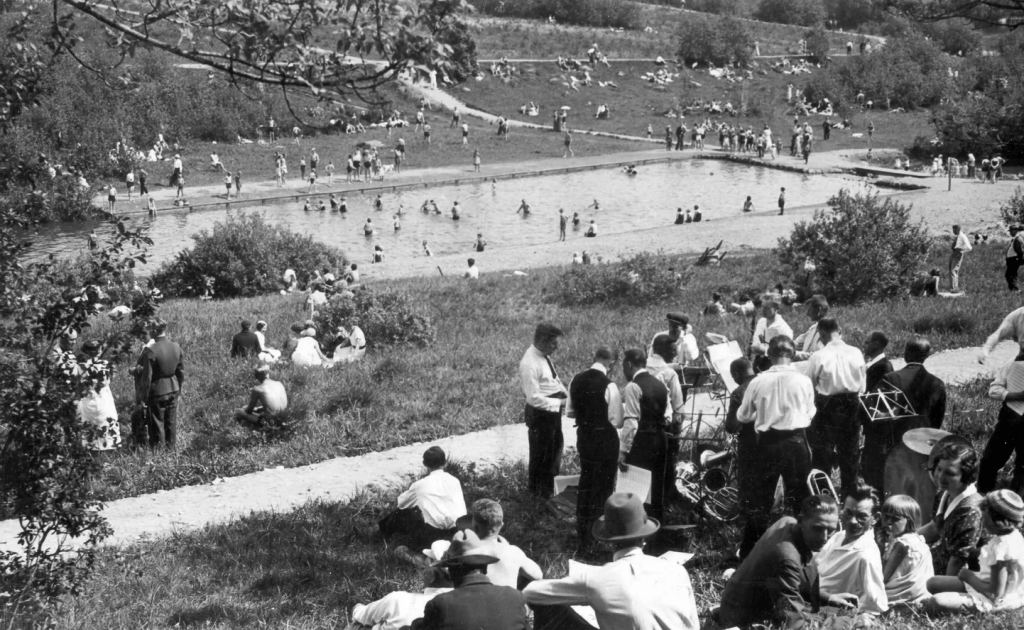
Those were the days. Viljandi’s Uueveski Valley in 1930.
FOR DAYS, IF NOT A WEEK, I had been planning to meet with Heiki to talk about Uueveski org or, as I call it, Uueveski Park. To me, it’s clear that this large natural area just adjacent to the center of the town is a town park, but on maps it is merely marked as an org or valley, as if it’s such a natural place that it has not yet been fenced in and given something like an official name or status. I had written to Heiki inquiring about the origins of this place and had been told we would have to meet face to face. Such information needed to be communicated in person, he said. This meeting of the minds proved elusive. I was in Tallinn or Tartu, or just too tired. The discussion of the valley’s origins was pushed off. Then one day at the supermarket, Heiki appeared with a basket in hand. It was one of those Viljandi moments, when the person you’ve been planning to see appears effortlessly, as if by magic. I had almost completely forgotten about Uueveski. There he was, ready to instruct. Heiki comes off as wily, clever. He seems to know who lived in each apartment and how they got along with their neighbors. Heiki just has a nose for these things.
In a few minutes, Heiki recounted the history of this sleepy place, which has belonged to the town for all of living memory and into which a series of swimming pools were built back in the 1930s. At that time, Viljandi Lake was a less attractive swimming hole, as it was full of pasture run-off. The pools on the stream that feeds Viljandi’s least known waterbody, Kösti Lake, were clean and cool and more appealing. There are photos of Viljandiers in old-time swimsuits having a wonderful time. These days it’s rare to see someone taking a dip in the pools, some of which have been renovated, but I have been told that vipers like to sun themselves on the stream’s banks. Each time I walk around those pools, I keep an eye out for those vipers.
When I first lived in Viljandi, some 15 years ago, I never visited Uueveski. I’m not sure why. Maybe because my children were small and I was a house husband. Viljandi to me at that time seemed like the Castle Ruins, the Green House Cafe, and maybe the Statoil on the way into town. There was no Uku shopping center then, there was no Kodukohvik, and there was definitely no Asia Billa Nepalese restaurant. During the pandemic, Uueveski Valley became a close refuge for me. It’s a shady, peaceful place. Many times I have found myself standing on one side of that bubbling stream, which they call the “Uueveski River,” wondering if it would be possible to cross it. There are some places where it seems possible, where the rocks are aligned in an almost perfect bridge. Yet I never attempt it. When I was a boy, I would have done it many times by now, but I lack that childhood bravery I once had. One of these days though I am going to try to traverse the stream, even if I get wet. Even if everyone here sees.
On the other side of the stream, closer to the Forest Cemetery, or Metsakalmistu, there’s a series of large villas that bring to mind the chalets of the French or Swiss Alps. For this reason, I have nicknamed this neighborhood “Little Switzerland.” I have no idea who lives in these palatial residences. Sometimes I see little blond children bouncing on trampolines from a far distance. These must be Swiss children, I think. Their fathers and mothers are involved in money laundering. For breakfast, bowls of müsli. For an afternoon snack, bars of Toblerone. In the evenings, they participate in mandatory military training in the grassy hills up there.
The great green lawn in front of Viljandi’s Little Switzerland is so long it must be trimmed by a robot. One day, I went there with my daughter’s dog, who eyed the robotic lawnmower with curiosity and suspicion. Back and forth it scuttled, like some kind of metallic crab, and the dog didn’t know if it should bark and chase it or not. In the end, we just walked on to the old mill.
I wonder who lives in those large chalets. I wonder who the Uueveski Valley Swiss even are. This is a town of hairdressers, of small shop owners, of cafe cashiers. Who are these wealthy denizens of Little Switzerland? Like so much of Viljandi, their stories remain hidden behind fences, trees, curtains. Northern European anonymity creates these kinds of funny fantasies. If you don’t know who your neighbors are, or what they do, then you just have to imagine it all.
Even if the Viljandi Swiss remain apart and mysterious, there are other friends to be made in the valley. Recently, I was walking up the hillside on the other side of the park when two squirrels came bounding in my direction. In New York where I grew up we have fat and lazy, overly satisfied gray squirrels, and in Washington, where I went to college, there are even social black squirrels lounging by the park benches. But these daredevil red squirrels are a feature of the Northern European forests, with their pointy ears and frisky, energetic pace.
Spending more time in nature, I have come to see the animals here as other people. They may not speak to me in a language that I can understand, but I can communicate with them. All around Viljandi, I’ve had run-ins with foxes, for example, who sometimes pause and watch me knowingly, as if they were my guardian angels. Then there are the poor, lost little hedgehogs, who never seem to know where they are going or why. These Uueveski squirrels were busy bodies. They chased each other around the base of an enormous pine. When they saw me, the squirrels froze. For a moment there, we all blinked at each other. Then they looked back at each other as if to say, What is this stranger doing here in our forest? For the Uueveski squirrels, we’re all just intrusive strangers. In their devilish little minds, they own the place. Maybe they do.
An Estonian version of this article, translated by Triin Loide, appeared in Sakala this week.
BEFORE I GO ANY FURTHER, I should tell you more about Montrone and Canneto, these two towns outside of Bari that have grown together. For centuries they remained apart, distant, at arm’s length, and in fact they maintained two very different dialects. One of the towns hosted a Norman French garrison in the 11th century, and its dialect was therefore influenced by French. The other was settled by Greek refugees in the 10th century, and its dialect was infused with Greek. Cousin Lorenzo says it’s possible to tell someone from Montrone, a montronese, from someone from Canneto, a cannetano, by the way they say the word for “bread.”
“They say, u pan,” says Lorenzo. “But we montronese say u pen.“
The official word for bread in Italian is pane. In French, it’s pain. So the local dialect word, which is common in the dialects around Bari, called barese, is a bit closer to French. To me both of the versions sound almost exactly the same. U pan, u pen. U pen, u pan. U pan …
There are these tiny differences, you see. But a single vowel can give away your identity.
One must realize that the country or nation of Italy is largely a fiction, or at least a coincidence of geography. Every region, every city, every town, even every neighborhood has its own history and its own dialect, many of which are so unintelligible to outsiders that they are considered their own languages. It is said that the singer Frank Sinatra’s mother, Natalina, who played a role in local politics in Hoboken, New Jersey, where Sinatra was born and raised, was successful in part because she could speak all the dialects of the Italian peninsula. This made her indispensable when dealing with the immigrants who thronged New York City a century ago, people like my great grandfather Domenico Abbatecola, who was from Bari, or my father’s grandfather, Salvatore Petrone, who came from a village in Calabria. Even during my first trip to Italy, at the age of 22, I became aware of the language issue when I was stopped by an older man with a white mustache from Palermo on a street in Bologna. He was looking for the train station. People had responded to him in the Bolognese dialect. He was unable to understand their directions. “I can’t understand a word these people say,” the old Sicilian told me that day.
How odd then, that I could understand him. When I was 22, I really didn’t speak Italian at all.
Now and then I replay that moment over and over in my mind. How did I understand him?
***
FROM THE PORT OF BARI, where the ships leave for the ports of Bar in Montenegro, Dürres in Albania, and Dubrovnik in Croatia, it is about 15 straight kilometers south into Montrone and Canneto. These towns, however, no longer appear on maps because in 1927 they were united into one municipality called Adelfia, from the Greek word αδελφός (adelphos), “brother.”
On a map, at least, the Montrone and Canneto sections of Adelfia are distinguishable. Canneto, to the west, with its ancient Torre Normana, or Norman Tower, is the larger of the settlements. Montrone is the sleepier, eastern side of Adelfia. The main landmark here is the public gardens, with its Fontana dell’emigrante, or Fountain of Emigrants, which is a fitting name because my great grandfather Domenico was born and grew up right across the street.
Just a few houses down, there is a little cafe called the Pasticceria Caffetteria Petrone, where you can get a pastry and an espresso in the morning. There is nothing better than waking to the sounds of the church bells, or to the neverending calls of the people in the streets, and walking to the Caffeteria Petrone. The owner, as far as I know, is not a relative, and is from Naples. There are many Petrones in southern Italy, and we are not all close relatives. There, you take your place at the counter, and wait for that little white cup to arrive. Everyone is here, the dentist, the postman, the cosmetologist. And even if they don’t know you, they still know you. The eyes search each other, the cup is lifted, and you are wished a buon giorno.
“Good morning,” or, actually, “good day.”
This is how the montronesi start their days, and just a few hundred meters down the Via Vittorio Veneto, and over the old aqueduct, the mornings of the cannetani are much the same. Only that they call bread u pan and the montronesi call bread u pen. There are other divisions. For example, no one in these two towns can agree on exactly where the border between them lies. This I was told one night, strolling around with cousin Lorenzo. While the aqueduct seems like a natural boundary, only the people from Canneto believe that. The montronesi say the boundary between the towns is really a column on an old building just over the bridge. “This is where Montrone really ends,” said Lorenzo one night as we paraded around the old lanes of Montrone, venturing into disputed territory. “Beyond this point, they say u pan and not u pen. Beyond this point, you are dealing with the cannetani, who speak a very different dialect.”
He gestured quickly with his head, as if these people, the cannetani, were an alien race.
***
I DON’T KNOW how old my Italian cousin Lorenzo is, and I have never asked, but I assume he is about my age. At the time we first met, he was working for a software company that designs platforms for managing airports. He had returned to Bari after many years in Rome and he was single and had decided on something of a career change, to go into academia after a life in the private sector. I cannot fully understand how the Italian economy even works because I only see these people eating and meeting with family members, but during the working hours, they do disappear someplace, to do at least some work, just a little, before returning to the table.
Lorenzo’s father, Giuseppe, works in agriculture, a job he quite enjoys. In the evenings, he heads out to the piazza in Adelfia to play cards and share stories with old friends. Night after night, the old men are out there in their caps talking and making noise. At night, Italy is even livelier than during the day and I am always impressed to see the offices of the country’s political parties on the piazzas in the evenings, the windows lit up, and people seated around inside eating pasta together. They are more like social clubs than real political parties. In the US, they would be outside with signs, yelling at each other. In Adelfia, the only thing they yell is something like, “Would you please pass the bread?” Or, “How about another espresso?”
Lorenzo against this backdrop casts a more lonesome, stark figure. He is tall, dark-haired, at times silent, at times with great humor. He is instantly likeable. Some people just have this kind of quality. You can’t help but like them. While his career path is in mathematics and science, he loves to talk about traditions and he is very thoroughly grounded in the local culture. That same night we went out to see the disputed border between Canneto and Montrone, we also stopped into a church to light a candle and view the shrine to San Trifone, the patron of Adelfia. The interior of the Church of Saint Nicholas of Bari and Saint Tryphon Martyr is beautiful. Its high ceilings are covered with pastel blue and frescoes, triumphant angels, and nativity scenes. And beneath all of this color moved a figure clothed in black named Lorenzo.
I cannot say that Lorenzo is a nationalist, because how could a montronese belong to a nation? Italians are not a nation in this sense, they are a combination of many now forgotten peoples, mingling on the soils of this land over generations. The Greeks, the French, the Albanians, the Visigoths. But Lorenzo is proud of the south and of his home here in southern Italy, and is sensitive to the stereotypes about the southerners that pervade Italy, and elsewhere, that they are dangerous, criminal, and violent. He also likes to talk about history, and how Bari and adjacent areas of Italy were sacked and plundered by foreign armies. In the 9th century, Islamic invaders created the Emirate of Bari, but just a handful of years later the Byzantines took it back from the Ottoman Turks. Then, in 1071, Robert Guiscard and his swashbuckling Norman adventurers swooped in. Among other feats, they built the Norman Tower right here.
Not only the tower remains, but the blue eyes and light hair that exists to this day among some of the inhabitants of Adelfia are a reminder of these Normans. My great grandfather Domenico also had blue eyes as does my mother Christine. As do two of my three children. As a child, it linked my mom and her towering Italian grandfather. He would look down and say, “Our people came from the north.”
“For centuries, Italians were subjected to invasion after foreign invasion,” Lorenzo told me that night. “Only in 1860 were we able to stop being picked apart and fought over by others. Then came the risorgimento, the unification under Giuseppe Garibaldi. Some say that it was a unification, but others say that the piedmontese just annexed the rest of Italy. They helped themselves to the resources and labor of the south, but they think that we are criminals.”
“But my grandfather Petrone, my father’s father, said that our people were criminals,” I insisted. “I have heard that Calabria, where the Petrones were from, was legendary for its banditry.”
“No, no the Calabrese weren’t bandits,” said Lorenzo. They were briganti. Brigantines! They were a movement, trying to wake up the north, to tell them what was going on in Italy.”
Such were the lectures of my cousin Lorenzo. He seemed offended that I would even suggest that our countrymen were anything other than noble Robin Hoods, stealing from the rich to give to the poor, fighting the powerful and wealthy families of the north by flouting their laws and creating their own codes of justice. One man’s brigantine was another man’s criminal. His body language was subdued though. Lorenzo is not your stereotypical Italian who argues loudly, flailing his arms. It’s hard to imagine him yelling out a car window while pounding away on his horn. But in his quiet certainty about the nature of Italy, I felt I had said something wrong, even though I was proud of these stories of criminality that we had carried with us from the south. In America, such tales of lawlessness had a kind of mystique. Who wanted to descend from law-abiding Italians, when you could claim your cousin was a notorious outlaw?
“People are afraid of the south,” I pressed on. “A Florentine told me it’s dangerous. They say they lock their cars when they see Neapolitan license plates. Even when they are driving.”
“Florence is far more dangerous than Bari,” my cousin Lorenzo shook his head. “That’s what’s so funny about the northerners, you know. They think the south is full of criminals. But since all the money is in cities like Milan, that is where all of the real criminals go. Milan is more dangerous than any city in the south.” To his credit, nobody robbed us that night as we paraded around Montrone and Canneto in the dangerous south of Italy. The only thing I was ever robbed of in the south was hunger though, because it seemed like all we did was eat.
***
SOME DAYS LATER, we had a fine meal at a restaurant in Adelfia, consisting of tiny mozzarellinis, polenta baked in marinara sauce, and many other delights, such as sauteed chicken hearts. Lorenzo was there, as were Pamela and Antonella and Lello. Platter after platter of food arrived, glasses of wine were consumed, and I began to worry who would be picking up the bill for this feast. There was even a mozzarella the size of a loaf of bread. On the way out, I asked the chef at the counter about the bill. I imagined that it was enormous.
He in turn simply asked me if I preferred Northern Italy or Southern Italy.
“Whose side are you on?” said the chef. He was a roly-poly man with Sinatra blue eyes.
“The South,” I told him with my most casual Italian shrug. “Naturally.”
“Good! In that case, your meal was free,” the chef said and bowed his head. “Grattis.”
Much later, I found out that my cousins had already settled the bill. But I like to live in that illusion that just professing a love for the South over the North could earn you a free meal anywhere south of Rome. All you had to say was that the South was better, and a waiter would bring you a tray of free mozzarellinis and the cooks in the back would start baking polenta.
I HAD ALWAYS BEEN, even without knowing it, a lost son of Italy. I think most Italian-Americans are the country’s lost sons and daughters. We forgot our language, we forgot our family stories. We forgot what our names meant and we forgot what roles we had played in history. In America, we were supposed to be new people. Some of us changed our names or we gave our children names that would not, on first notice, smack of any kind of ethnic affinity. It was only through my own personal interest and research that I had learned the family stories. In uncovering these forgotten stories, I began to learn the real reasons why we left Italy.
The story about how I learned the truth started when I was 30 years old, to the day. I had spent the night before celebrating my birthday with friends at a restaurant in Estonia, then taken a night bus to Tallinn Airport, pausing only to buy a few gifts for relatives, mostly boxes of Estonian and Finnish chocolates, and one bottle of vodka, which would be prized among any nation other than the Italians. I would come to regret purchasing that bottle of vodka.
***
That morning the plane carried me from the November frosts of the Baltic and across the expanse of the German countryside to Munich, where I changed planes. From the air, Germany was a tidy patchwork of church steeples and fields. These were disrupted by the massive Alps, rocky and jagged, spiked with ice. Then came the valleys of the Po, and those black-green, forested hills, the Apennines. From the mons of the Alps sprang this nether region called Italy, dark and intriguing, the genitals of Europe swaying down into the Mediterranean.
I was a little nervous as that plane descended toward its destination. I had been to Italy before then, but as a simple tourist. This trip though would take me to places I hadn’t been before and put me into situations I had never experienced. I was to travel from the capital Rome deep into the South, meeting with relatives I had never met before, serving as a kind of self-appointed family ambassador, making up for decades of no contact. I had no idea what to expect, but I was willing to take the plunge. I was married, had two small children, and was soundly employed. I did feel kind of stuck. I had just turned 30 and things needed shaking up.
Inside, I still had the heart of an adventurer, I think. I yearned to discover something new. This new discovery would be Italy, but not the Italy of Rome or Venice, of art galleries and souvenir shops, or fashion boutiques and tours of Tuscan vineyards. I was already aware, vaguely, that I was about to leap off into the unknown, into a world where nobody spoke English, and I spoke only a little bit of Italian. Still, I have always enjoyed these kinds of challenges.
At last, we landed in Fiumicino, right on the coast at the very spot where the Tiber begins its snaky crawl toward the heart of the old empire. Here I found my way through an apocalyptic wasteland of industrial parks splashed with graffiti, the reeking armpit of the capital. Whichever way you turned, Rome was dirty and foul, a pungent and fermenting heap of trash and history. The air smelled of trains, of fried foods, of espresso, car exhaust, cigarettes, and pigeons. It smelled of the crisp uniforms of the carabinieri, the tangled shampooed locks of the Roman women as they sped by on Vespas, clutching the waists of their daredevil boyfriends.
I took a train into the central station, and then walked a few blocks to my hostel. The manager on duty took my money and shook my hand and wished me a happy birthday, as he had noticed it was my birthday when he copied down the information from my passport. He next gave me the keys to my room. It would only be a night there before I left for Bari. In the next room, some young American women were already drinking wine in the afternoon and boisterously toasting to each other. “To a happy vacation in Italy with lots of hot Italian men!”
I strongly doubted that they would consider me to be one of these exotic men and I felt a little insulted by the idea that that’s all an Italian could ever mean to them. A quick fling on a Roman holiday. Some Mediterranean spice to their otherwise white bread lives. They would go home and marry some boring man in Indianapolis or Houston or god knew where they called home. They would marry a normal man with a normal name, but there would always be Italy!
I was so annoyed by them that I decided the only thing that could lift my spirits would be a walk to see the Colosseum and a slice of pizza. I remember that moment, sitting with my back against the wall, listening to those girls. Sometimes, I wasn’t proud to be an American.
That was one of those times.
***
THE NEXT MORNING I was back at the train station with my backpack, stuffed with boxes of Estonian chocolates and that bottle of Estonian vodka. I bought a ticket for Bari Centrale and took a seat on the train across from an older woman who wore a giant crucifix around her neck and spent her time surfing the web on a laptop, or calling by phone to check on various relatives. This is a four-hour journey that takes you to the outskirts of Naples and then straight across to the other side of the peninsula. You know you are close to Bari when you can at least see the Adriatic from your window. You see the quiet Adriatic and the lights from the ships sailing on it. When we at last arrived at Bari Centrale, I somehow could not believe it. I couldn’t believe I had gone back, even though I had never stepped foot in the city. For a moment, I almost thought it was a film set, to see that sign hanging above informing me that this was the real Bari: the Bari I had only seen in photos and atlases. It was evening and the moisture of the Adriatic was everywhere. That smell of the sea put me at ease. It was familiar to me, and I felt my body relax, even though I was about to come face to face with a relative.
A cousin that I had never met.
I knew of course that my ancestors had come from this port city in the south, and thanks to some correspondence my cousin Mary Ann — a granddaughter of the famous Uncle Vinny — had initiated, as well as some social media dialogues with this newly discovered relative named Cousin Lorenzo, I now had an invitation to dinner in Adelfia, which sits outside the city.
Cousin Lorenzo and I met via Facebook. Perhaps only because of his last name, he was suggested as a friend to me, considering all of the other Abbatecolas on my friend’s list (Abbatecola being my mother’s maiden name). Not only was I interested in him, he was interested in me. He wanted to meet this lost American relative. Something about the promise of America still stirs the fantasies of Italians. Bright lights, big cities. Fame and fortune. New York, Chicago, Hollywood and Disneyland. Almost every Italian has a lost relative to the American Dream. Almost none of them came back to old Italy, and after a while, all contact with these dreamers ceased. Before I arrived at Bari Centrale, Lorenzo sent me a message.
He wrote:
I am in station. Yuo take off and wait. See a black hat in my hand.
There he was, Cousin Lorenzo, standing beneath the big sign that said Bari, with dark hair and a familiar face. We approached each other with great curiosity. From what we had determined, Lorenzo was a distant cousin to me. My great grandfather, Domenico was the son of a man named Vincenzo Abbatecola, who was born in the year 1846, when Italy wasn’t a country. Lorenzo’s forefather was Vincenzo’s brother. His name, as you might expect, was also Lorenzo.
I remember that feeling of meeting Cousin Lorenzo for the first time. I would not say it was an odd or funny feeling, but everything about him was so familiar to me. It was as if I had staggered into the bathroom at some early hour and glanced at myself in the mirror. Many people had told me that I didn’t look like a real Italian, because I was so tall, but Lorenzo was as tall as I was, and he looked me directly in the eyes. We were undoubtedly related, we few tall Italians, and I wondered about who our common tall Italian ancestor was, who looked this way, and when he had lived and under what circumstances. Was there once a tall villager in some village in Italy in the 17th century who looked like me and Lorenzo? Was he also one of us?
After having known Cousin Lorenzo for a few seconds, I determined he was everything I imagined an Italian cousin should be. Lorenzo was about the same age. We had entered this world at the same time and had grown up on opposite sides of a great ocean, speaking different languages, unaware of each other’s existence. Lorenzo was here in Italy. I was over there in America. He was doing his Italian things, like kicking a soccer ball against a wall. I was doing my American things, like also kicking a soccer ball against a wall. Only that that wall was in America, not in Italy. We did not know each other and yet, in a second, by looking into each other’s eyes, we arrived both at an understanding. Two shadows meeting on a train platform.
“Cugino?” Lorenzo said to me at the train station. “Cousin? Is it really you?”
***
AFTER THAT, I was more or less immediately accepted into the warm bosom of my new family. Each night, I was invited to dinner at Cousin Lorenzo’s parents’ house in Adelfia. Adelfia was a patchwork of multi-story stone houses of indeterminate age, separated from each other by narrow streets and narrower alleyways. There was an ancient, dusty, almost Middle Eastern feeling to these rows of beige and white homes. Lorenzo’s house was among them, accessible from the street through a metal gate. Meals in general were the domain of Giuseppina, his diminutive and vivacious mother, who worked through the day to prepare them. Giuseppe, her husband, would later arrive as would Lorenzo’s sisters Pamela and Antonella. All of them showed great curiosity in me, as if I was an alien or something and brought me different kinds of sweets, dolci, and explained their regions of origin and historical significance. “This is a local sweet,” Antonella would say. “But this one here comes from Sicily. See, you can tell by the use of orange slices.” Antonella had wonderfully thick black curly hair. She looked like one of those women from an ancient Greek vase. Pamela had a fun, playful, boundless energy to her.
Antonella’s boyfriend Lello would also be there while I was being instructed about different sweets, yawning through the evening news. The most important news in Italy at the time involved Piero Marrazzo, the governor of Lazio, a region adjacent to Rome, who had been filmed taking drugs and having sex with some Brazilian transsexuals. One of these transsexual prostitutes died later in a mysterious fire. By eating together with the family, I therefore learned a great deal about Italian culture. Much had changed since my great grandfather left.
Some things remained the same.
Cousin Lorenzo showed me the lemon trees in the yard, as well as the wine press in the basement. Each year, Lorenzo’s family would harvest the grapes from the vineyards and make wine at a certain time, all so that it would be ready for the great Feast of San Trifone, the patron saint of Adelfia, as every Italian village and city has its own patron saint, if not several of them. Meals with his family were familiar, salad, pasta, fish or meat, washed down with this same homemade wine. After the meals, they would munch on stalks of garden-grown fennel, or then indulge ripe fleshy slices of cachi, or persimmons. The tiny cups of hot espresso would come around and a shot of limoncello, the famed liqueur made with grain alcohol, sugar, and boiled lemon rinds, or its lesser known cousin, mandorino, which is made with the skins of oranges. Then these sons and daughters of Italy would lean back and make conversation.
Such were their ways.
***
ONE AFTERNOON, Uncle Vincenzo, or “Enzo” for short, was invited over to discuss the history of the family with me. Enzo was the son of Michele, my great grandfather Domenico’s older brother. At that time, he was about 70 years old, a spry old man with gray hair and glasses and palpable energy. Enzo marched into the dining room, where we were sitting around eating cachi and pointed. Enzo said, “Your great grandfather was the one who beat up the priest.”
Everyone laughed then. I and what surprised me was that they all seemed to know the story. As for me, I was speechless and did not know how to react. I had never heard the story, and yet I was not surprised. That side of my family was known for these kinds of transgressions. Relatives were known to wield a bat with people who crossed them the wrong way. Tempers flared, impulses could not be contained. Sometimes an argument overheated and the police might be called in to calm things down. In a way, I was almost relieved that Domenico had only beaten the priest and not killed this man of god. Certainly, I was embarrassed by the story and the attention. To think that I had come all this way to be confronted by Domenico’s past.
But he was my great grandfather. Surely he had had his reasons.
This had happened in the early 1900s. More than a century ago. The story had been carried forward though, and Enzo was now closing the circle. He was pulling the threads between then and now, between America and Italy, between me and him. The priest, he said, had taken a liking to Domenico and Michele’s sister. He had crossed the line on several occasions. And so Domenico and his younger brother Saverio, who were running a brewery, decided to settle scores. They attacked the lecherous priest with police batons, injuring him badly. The news soon spread quickly, and my great grandfather and his younger brother sought counsel from their father, a businessman, as well as older brother Michele, Enzo’s father, a policeman. “He said, if it was anyone else I could protect you,” Enzo recalled his father’s words. “But this is a Catholic country. If you beat up a priest, you will go to jail. You have to leave the country.”
This is what had sent Saverio and Domenico to the Port of Naples seeking passage to New York. Later, Enzo told me there was more to the story. The incident was not only related to protecting the honor of their sister. They also had “big political problems,” as Enzo had put it.
“They were anarchists,” he said, anarchici. “That’s why they did it.”
“Anarchists?”
Enzo nodded. Anarchici. The word sounded strange and dangerous. It sounded like men with mustaches lurking in the vestibules of churches with police batons ready to pounce. It sounded like terrorists robbing banks or cutting the throats of policemen in their sleep. I had read once of anarchists in Italy who had stolen and burned bank records in a bonfire, as to eliminate any records of people’s debts. With no debts, people could start again fresh. They could rebuild their lives. I remembered thinking that it sounded like a wonderful idea.
Many people I knew had all kinds of different people in their families. Especially in Estonia, it wasn’t hard to meet someone who descended from a notorious Communist, or perhaps someone who had helped the Nazi German regime a little too enthusiastically during the grim and bloody war years. But anarchists? Anarchici? I was the great grandson of an anarchist? What did that even mean? Could anarchism be passed down, like so many other things?
Was I an anarchist too?
***
WHEN I LATER called my mother and told her the story, she said that she had heard something like this whispered around her when she was a child. Nobody knew exactly what had happened, but they knew that it was bad. That was our family. We were passionate, but perhaps too passionate. Whether we were followers of the anarchist Errico Malatesta and read his paper Umanità Nova, or claimed to know nothing of it, you didn’t want to cross us.
For me, personally, this story opened a door to another era. It helped me to better understand my links to this country we left behind. Not long ago, there had been a predecessor just like me, who felt passionately about various injustices in the world. He had sat here in this same comune or municipality outside of Bari, under the influence of the revolutionary anarchists. The story of the two brothers and the priest therefore helped me to feel closer to my origins. It kicked open a door. Just as that door had opened before me, many others would open.
SOMETIMES I WONDER how I ever wound up here.This northern land of trees where there’s snow on the ground from November through April. The Estonian doctors told me long ago that my body wasn’t designed for this climate. I have come to believe them. My body was designed for sun-baked countryside, for almond and olive groves, for the spray of the sea and for tins of tuna fish. But I am not there, where I should be. I am here and it is snowing again.
Such thoughts ramble through my mind as I make my way to an establishment called the Grand Hotel. There’s a gym in the basement there and you can book it for an hour at a time. That small hotel gym basement has become my sanctuary in the winter months. Outside, it’s dark, freezing, but down there it’s warm and I can wear shorts. There’s also a TV mounted on the wall. My favorite channel is the history channel. It almost exclusively shows documentaries about Hitler and Mussolini. Sometimes the old film reels of Mussolini bother me. I look like some of the blackshirts crowding around Il Duce. There’s a cranky old Estonian man who gets coffee at the same cafes that I do here, and he refers to me as one of the “Mussolini nation.” “What are you doing in Estonia?” the old man asks now and then. “You’re an invasive species!”
***
THE CRANKY OLD ESTONIAN MAN, whose name is Imre, and who also sometimes visits the hotel for late night and early morning coffees, isn’t here this time, but Ragne is at the desk as always. Oh, Ragne. Ragne is about five years younger than me and has declared her singular interest in older men. We’re just so mature and worldly. She likes to wink at me, fluster me, to toy with me, and then tell me that she has absolutely no interest in me. She is a serious Estonian woman, who prefers serious Estonian men. A sentimental Italian is of no use to Ragne. She plays with her blonde hair. Life is better as a blonde, Ragne says. Ragne has a new manicure every other day. She also always has to remind me to be on time. She has to remind me because I often roll in 10 minutes late. Not on purpose. It just always happens that way.
Ragne finds my tardiness infuriating. This time I have decided to book my gym hour for 5 pm.
“That means 5 pm Estonian time!” Ragne calls out to me as I walk back out the door. This somehow gets under my skin, strikes at my very identity. 5 pm Estonian time. Invasive species. One of the Mussolini nation. How did I even wind up in this land of snow and no nonsense?
“But didn’t you know?” I call back. “Time doesn’t really exist. It’s just numbers!”
“That’s not true,” Ragne shouts back over the desk. “Time does exist.”
“No, time doesn’t exist, Ragne,” I reply, giving her my best Italian shrug. “Time is crap,” I say.
Then I leave.
***
I DECIDE TO HEAD DOWN the street to the café for an espresso, Ragne’s words nipping at my heels like little dogs. If I’m not operating on Estonian time, I must be operating on Italian time, I think. And Italian time, as I have noted, is flexible. Italian time is so limitless that it doesn’t exist. Whole years can disappear into seconds in Italy. Seconds erupt forth from years. The idea that you could be late for an appointment is surreal, absurd. Do you think Fellini was ever late for anything? Fellini was always on time, because whenever Fellini arrived, it just happened to be the right time to arrive. Life does happen, you know. Life has its own plans. You don’t know what might happen in life. Here I am reminded of a story about my great uncle Vinny, who was the older brother of my mother’s father Frank. This happened way back in the 1950s or 1960s, before the era of smartphones, a time when one picked up the receiver and said, “Give me New York 555,” and a dispatcher connected your phone line to another one. As my Estonian cafe espresso arrives black and hot, I think about the story about Vinny and time.
It goes something like this.
***
ONE DAY, my mother Christine, then maybe an adolescent with a soon-to-be very dated permanent hairdo, received word that her Uncle Vinny and his entourage of wife and six children were on their way to visit her father Frank, and that he intended to be there later that same morning. So she put on her best white dress and went outside to sit on the stairs and to wait for Uncle Vinny to show up. It was a fine summer’s day and somewhere the Four Seasons were probably playing on a radio. Frankie Valli was singing. My mother was waiting patiently.
Uncle Vinny operated a restaurant on the south shore of Long Island, which is the largest island in the United States and juts out into the ocean east of Manhattan. Like New Jersey to its west, Long Island became a sandy, coastal destination for Italians longing to escape New York City. They moved there and built their homes, their children went to school, and within a few years, they became new Long Islanders, living side by side with the original British stock, happy to live in such a fragrant place. The name of Vinny’s restaurant on Long Island was “Vinny’s Happy Landing.” It was from this beachy enclave on the south shore that Uncle Vinny was traveling in his bid to make it to the north shore of Long Island to visit his brother Frank, who lived in a New England-feeling coastal village clustered around a harbor called Northport. My mother was there waiting for him to arrive in the morning, sitting outside in her dress.
I’ve only seen one photo of Vinny as a young man in the 1940s, but I could immediately recognize the slant of his eyes and white-toothed smile, finished off with curly-black hair on top. He seems to have been quite charismatic, and I can imagine my mother waiting for this man to show up that morning, maybe even with a gift of some kind, or perhaps a bouquet of flowers. But Uncle Vinny got distracted along the way. Maybe he had some car trouble, but more likely he ran into some friends, and got invited over for coffee or something like that. Then he met another friend who offered him a quick lunch and, as you know, it’s impolite to refuse a meal. Morning turned to noon. Noon turned to late afternoon. My mother kept waiting. The Four Seasons were no longer playing. Now it was maybe the Everly Brothers. Afternoon turned to evening. The crickets began to chirp. My mother was still sitting there. All day long she waited for the magic uncle to make an appearance, but Uncle Vinny never came.
***
THIS SAME GIRL grew up to be legendary for lateness too. It was a joke in the family that if a party started at 4 pm, it was best to invite my mother at 2 pm. That way she would show up two hours late and be right on time. I must admit, I have inherited this carelessness about time when it comes to being anywhere, even if it is for my own time at the gym in Estonia. Of course, I only allow myself to be five or 10 minutes late on those occasions, and I do make it to flights mostly on time, even though I always feel a little annoyed by punctuality and the rigidness of the non-Italian world. People are late because the fates of life interfere in their schedules. Can one always prepare himself for every flat tire or broken-down train? What if someone asks you in for lunch? Would you really refuse? But it is an insult to refuse lunch.
Wallowing in my wintry blues in Nowheresville, Estonia, I think about such things. Other people talk about the weather, real estate, or the soaring prices of cappuccinos, but I am still contending with Ragne’s pronouncement that I should turn up on “Estonian time” and not a second too late or too early. What is it with these Northerners and time? I often wonder what it is they are running from here, or trying to accomplish. How great is the fear of these numbers on the wall? Don’t they know that time is elastic? I understand, at least logically, that the hotel here needs to manage its gym appointments. I am never dramatically late. I don’t show up in the morning or the evening. But five minutes? Ten minutes? Come on! Is it really such a sin to be late? What happens to you if you are not on time? Do you burst into flames? Sometimes I like to be late, honestly. I feel that I am slowly teaching the local people a lesson about the futility of clocks. They need to learn such things and I am here to teach them.
***
A FEW YEARS AGO, when I was in Bari, a coastal city on the Adriatic and the ancient home of my mother’s family, the Abbatecolas, my cousin Michele told me he would be at my rented apartment at 5 pm. Michele’s grandfather, also named Michele, and Domenico, the father of my grandfather Frank and his ethereal brother Vinny, were brothers. As such, Michele and I are rather close relatives and treat each other as such, with the obligatory pecks on the cheek.
From there, Michele would take us to dinner in Adelfia, about 15 minutes or so from downtown Bari. Being a somewhat dutiful resident of a Northern European country, I made preparations just in case he might actually show up at 5 pm. But true to his nation, our special “Mussolini Nation,” Michele did not show up until about 6:30. There he was, standing outside my apartment, holding his phone, waiting for me. Italians are often stereotyped as being short people, but Michele is as tall as I am. He has great gray hair, wears glasses, has a patient manner and friendly smile, and is anything anyone would want in an Italian cousin. Michele himself is about 15 years older than me. He plays guitar in an REM cover band, and sometimes I have helped him make sense of Michael Stipe’s muddled lyrics. This is not an easy task for me either.
And so there he was. He was also an hour and a half late, and yet didn’t even bother to acknowledge it or to apologize. I didn’t ask him any questions. We were on Italian time that night and Italian time felt great. Italian time was wild and unstable and truly exciting. You never knew what might happen on Italian time. That was part of its everlasting allure and fun.
***
DURING THAT SAME TRIP, my 10-year-old daughter Anna got frustrated with living a humdrum existence in a rented apartment around the corner from Bari Centrale, besieged by scooter traffic in the mornings, while her father downed espressos in little dive cafes and engaged in meandering conversations with relatives in Italian at night. To calm her need to do touristy things, I rented a car from a firm near the central station and took off across the country to the famous Pompeii. There she saw the fossilized remains of Latins who had given up the ghost in AD 79. She was so impressed by the ruins that she posed for photos by the stone corpses and we drove back to Puglia happy. “My classmates will be so jealous,” she said.
On the way back though, we were impossibly late to return the car. There had been an unusual snowfall — it was November — and just getting past Salerno was a slippery nightmare of traffic jams and cursing drivers. The renter, a short, scrappy, amiable fellow who had once lived in New Jersey and spoke excellent English, had specified a return time of 9 am. It wasn’t until 11 am that we showed up at the agency to return the car. Curiously, the man had stepped out of the office but left the door ajar. I went inside and left the keys. I was expecting him to call me up and demand another day’s rental fee for the late return. That’s what they would do to you in Estonia or in the United States, or other countries run by punctual people. Later, I went back to apologize. It seemed like the right thing to do for my error of returning the car late. The proprietor had just walked back from having another espresso and was in rather high spirits.
“But we were two hours late!” I said. “I am so very sorry. Please forgive me for my late return.”
The man just gave me a wonderful Italian shrug in his leather jacket. “The contract says you had to return it in the morning and it’s still morning,” he said. “Mattina è mattina,” he said. “Morning is morning.”
***
I REVISIT THAT PHRASE “morning as morning” on this snowy morning as I sip my coffee and the flakes cascade and sparkle down. The cranky old man is at the counter now. He’s talking about politics but has not yet come by to speak of Mussolini and invasive species. In Estonia, an easy-going expression such as “morning is morning” is seldom heard, I think. Up here, things happen on Estonian time, which can be as ruthless and unforgiving as the weather. Up here, people fear clocks. Down Italy way, nobody looks at them. In Italy, morning is just morning.
I remember that morning when I returned the rental car in Bari late. I remember how I paused to look at the palm trees that stand in the park in front of Bari Centrale that special day, so proud and so tropical. There was something so warm and supportive about Italy. It was as if my body had been created from its fertile fields. In Italy, it felt like the whole country loved you. You could talk to a stranger and he would talk back. You could be late with a rental car and the renter wouldn’t be annoyed. You could stand outside in winter admiring palm trees. I had been told that place was not my home. I didn’t speak the local dialect. My forefathers and mothers had left it all behind. But how could it not be home? Maybe home isn’t a place? Maybe home is something that simmers away inside of you like a hot espresso on a northern day.
EVERY ITALIAN FAMILY has at least one good Uncle Frank story. This is for the simple reason that there are so many Uncle Franks. Frank, or Francesco, continues to be one of the most popular Italian names, and even in the 2020s, it ranks second only behind Leonardo among new-born Italians.
My grandfather’s name was Frank, and so to all of his nieces and nephews, he was Uncle Frank. My mother’s brother is also called Frank. Believe me, we have a lot of Uncle Frank stories concerning this particular Uncle Frank. The funny thing is that all of those Uncle Franks also had their own Uncle Franks. It’s like looking through a kaleidoscope or prism; you point it at one Uncle Frank and then suddenly there are hundreds of them reflected in tiny pixels, a fantastic mosaic of Franks for the eyes.
This is not to be confused with Cousin Frank. Cousin Franks, sometimes nicknamed Frankie, are a different phenomenon. Thanks to Italian naming traditions, I have at least two Cousin Frankies that I know of, and there may be more. Years ago, when I briefly toyed with the idea of compiling a family biography, I began collecting stories. I knew that I had a Cousin Frankie who was in a rock band. Because of his dark and mysterious looks, he had at least for some time been nicknamed Cochise, after the Apache Indian guerrilla.
There was another cousin that I had heard of, however, who had ventured to the South Pole. And then there was a cousin who was running a pizza restaurant out in the Rocky Mountains The book project was going well, and I imagined all of these as three separate profile pieces. The rock musician, the Polar explorer, the pizza guy. After some investigation, however, it turned out that all of these cousins were the same person, Frankie Abbatecola, one of my great Uncle Vinny’s legions of grandchildren. Had I written the book, most of it would have been about the same person. This energetic Cousin Frankie is a Mötley Crüe devotee not much older than me, who slings pizza dough during the day, wakes up the neighbors with his electric at night and yes, even once made it to Antarctica, or at least some place where there happened to be lots of penguins. Today, Frankie runs a busy pizza restaurant in Massachusetts called “I Love Frankies.”
Whenever anyone questions my Italian identity, I just tell them about I Love Frankies.
“That’s my Cousin Frankie’s place,” I say. They seem satisfied by this information.
***
BUT THIS STORY is not about Cousin Frankie. This story is about Uncle Frank, and a certain Uncle Frank who happened to be the older brother of my grandfather Jerry’s mother Rosaria. I suppose to me, he would be a great great uncle. His real name was Francesco Petrellis, and he was born on a mountain top in Calabria in a village called San Giorgio Albanese overlooking the Ionian Sea, the same place where I once happened to spend the night watching Godzilla dubbed into Italian after almost sleeping in a furniture store. His birth year was 1889. It was a long time ago. At that time, America had not even yet formed itself on the lips of my predecessors. It’s interesting to imagine that if I rewound the clock back a century, most of my family was not speaking English. They were Italians, born and bred into the soil.
Uncle Frank emigrated to the United States with his family in 1900. It seems his father, whose name was Carmine Petrellis, and who came from an old Greek family in that little hilltop village of San Giorgio Albanese, had already crossed the mighty Atlantic once before, but this time decided to make the move with his whole family. There was Francesco, Rosaria, Maria Theresa, and their youngest sister Rosina.
It’s hard for me to imagine what the lives of this immigrant family was like because Carmine, the father, was illiterate, and when they later purchased a house in the town of Huntington on Long Island in the 1920s, where I was born, it was Carmine’s much younger wife, Anna Meringolo, who signed the contract, because her husband didn’t even know how to write. By that time, they had come to call themselves Peters, instead of Petrellis, to make their American lives more manageable. That was a fundamental aspect of American identity. Even if you were not born in America, and obviously were not an American, you could give yourself an American name. Petrellis became Peters. It was a cosmetic change though. Because a person can change their name, but that doesn’t change who they really are. A name is just a name.
The newly minted American “Frank Peters,” known to anyone within his circle of family and friends still as “Francesco Petrellis” was a loyal citizen of the United States but spoke Italian as a native tongue. He married, perchance, a Hungarian immigrant named Ethel, who was from a village called Nyírbátor near the Romanian border. I know much of this information because in 1920, she applied for a passport to visit Czechoslovakia. What I find fascinating about this is that she had never had a passport before then. In the early 1900s you could sail from country to country and settle with no documentation.
It seems that Uncle Frank and my grandfather Jerry had something of a rapport. Perhaps because my grandfather Jerry did not get on so well with his own father, Salvatore, which was understandable considering that he had once left him tied up in a basement cellar. According to my grandmother Margaret, they would go and visit Uncle Frank and share some coffee together. Maybe have cake.
Jerry had met my grandmother Margaret, who was not Italian, while working for a construction company in Virginia during the war. They were introduced by friends and married impulsively after knowing each other for just a few weeks. Margaret at that time was working as a school teacher. One can only imagine this young Virginian school teacher being introduced to the enigmatic Uncle Frank, with his fedora hat and thick Italian accent, and his equally mysterious Hungarian wife Ethel. He told the government whenever they asked him that he did odd jobs for a living. But according to various family members, Uncle Frank really made his living as a chauffeur for underworld figures. My father claims it was to Vito Genovese himself, “Don Vitone,” the founder of the Genovese crime syndicate who dominated the American mafia for most of the 20th century. Others claim that he drove around another mobster called Capone.
Whether true or not, Uncle Frank was well paid for whatever kind of work he was doing in his career of odd jobs. Then one day in early 1965, when he was already an old man with a cane, Uncle Frank paid his nephew Jerry a visit and gave him a $500 bill. This banknote, which is no longer in circulation, featured President William McKinley on the front. My father still recalls the scene of the old man in his fedora sitting in the family kitchen and handing his nephew the money. Uncle Frank visited all of his relatives that week and similarly gave each one of them a $500 bill. And this became the Uncle Frank Story, the old relative who showed up, handing out $500 left and right. He then departed the United States, ceased being Frank Peters, and resumed being Francesco Petrellis and died several months later in San Giorgio Albanese, his home village. After he died, my grandfather Jerry went over to his uncle’s house. Frank’s wife had died the previous year and the house was empty. To his surprise, he discovered bags of money, hidden in various places. There were several purses full of banknotes that had been stuffed in the oven.
***
AS AN ITALIAN-AMERICAN, such stories fascinated me. Not only because anything connected to the Mafia had been glamorized by Hollywood, or in glossy magazines that featured modern day bosses like John Gotti on their covers, but also because they were so distinct from neighbors or schoolmates, whose worldly predecessors might have been prominent attorneys, or perhaps the lieutenant governor of Massachusetts. What to make of this murky connection to murky people doing shady, shadowy things? And was I also one of them? Did the apple not fall from the tree? I had tried to be a respectable journalist, but respectability always seemed just out of grasp for my family. It was elusive. We were people who kept cash in ovens.
After I had returned to New York after an adventure in Calabria at the age of 30, I did show photos of San Giorgio Albanese to my Virginian grandmother, who was 91 years old then, and quite lucid, though fading mentally. This little old gray lady without a drop of Italian in her veins. Her body was trim and lean, and she had her own kind of measured or balanced energy that she carried with her. She spoke softly, and on the few occasions that I told her I loved her, she seemed a little embarrassed. Such was not the measured, restrained way of the Virginians. Her husband was gone, but here was his grandson asking questions.
A few days later, she called the house to inform me and my father that she had found a curious photo. Later, when I saw it, I found it quite interesting indeed. For the black-and-white photo showed a dead man in a coffin, covered with bouquets of flowers. On the back of this photo read, in Italian, “On the 9th day of June 1965, in San Giorgio, died Petrellis Francesco.” The photo had been taken by A. Triolo, also of San Giorgio, and the photo was signed by Cosmo Petrellis.
This family curiosity had traveled across the Atlantic and across decades of forgotten memories, only to find its way into my hands, hands that had recently returned to that same village. In thinking about Uncle Frank with his fedora hat and bags full of mob money, I felt that I had understood something that perhaps only another Italian could understand. That whoever we were, and wherever we lived, and whatever names we called ourselves, we were still this illusory thing. Italians were just another unexplained meteorological phenomenon, like those tall waterspout tornadoes rising up like the mighty staff of Poseidon from the depths of the Ionian Sea. We came and we left, we appeared, vanished, and reappeared. One day, we might show up at your door in a crisp gray suit and fedora with a bag full of $500 bank notes. The next day we were gone. And weeks later, we might turn up in the old village, to greet our many relatives.
Just as I had done weeks before in the mountains of Calabria.
Uncle Frank was Frank Peters to the US government and Francesco Petrellis to the Italian one. His odd jobs were driving bigshot mobsters around. But Italians belonged to other kinds of systems. Governments didn’t mean as much as family. The mafia was just another kind of human organization, as legitimate or illegitimate as the local police. Laws were distant, arbitrary, written by strangers. Politics, like in the mafia, was personal, dangerous, and corrupt. And time was just imaginary. Everybody knew that it didn’t really exist.