AFTER HIS COMPLETION of the Epstein Ballroom, President Donald J. Trump went to work on a new building to house Scott Bessent’s Treasury Department. The old Federal and Georgian-style Treasury Building, the central and east wings of which were erected in 1835 through 1842, was reduced to rubble and a new castle-like fortress was constructed on its foundation, as tall as the Sagrada Familia. This, strangely, contained elements of New York City’s Trump Tower, and its walls, escalators, and stairwells shined with gold-coated plates.
I was one of the first journalists allowed into the new Treasury Building, escorted inside with a North Korea-style sightseeing group. We were led up the stairs, which were gleaming with gold, to the second floor, which had the décor of an ancient Scottish castle, with moist, dripping stone walls and antique tapestries. Trump was there himself, bedecked in a Highland Tartan, and several other Scotsmen and women sat around an open fire. Trump seemed preoccupied with something and stared intensely into the air. He was whispering to himself and his blue eyes reminded one of a beached fish running out of oxygen. The Scottish guests only stoked the fire and talked loudly about how they felt comfortable in the new Treasury. “Aye, it’s not too opulent,” a bald man in a sweater said. “Only parts are covered in gold! What’s the fuss about?”
Downstairs, I discovered that a food court had opened. There were people sitting all around on wooden benches, the kinds that you might find at an ice skating rink. Here I encountered some Trump supporters in winter coats who were boasting loudly about how decisive their leader was. “Biden could never make up his mind,” one jeered. I intervened and said that, in reality, their president changed his mind almost every day if not minute. “Yes, I will give the Ukrainians Tomahawk missiles. No, I won’t. Yes, well, actually I will. Let’s see what Putin says.” For daring to bring this to their attention, I was cursed out, but I didn’t care. “The only thing Trump’s consistent about,” I shouted at his supporters as they dispersed, “is his love of tariffs!”
Down the gold escalator rode my old friend Eamon O’Toole next, with his loving Irish grin. He was dressed in a white sweater and gold chain, as if he had just got back from a wild house party with Kid and Play. The first thing Eamon O’Toole did upon meeting me in the new Treasury Building was laugh and say, “Well, well, well. Fancy meeting you here!” He had sprouted a slight red beard in the meantime, and there was a crazy gleam in his eyes. I told him about the Trump supporters and the tariff comment. Eamon O’Toole only laughed more. “All of these people suck,” was all Eamon said with an irrepressible delight. “I hate them all.”
We were then interrupted by Rory Lapp, an Estonian writer and poet and coffeehouse ghost who said, “Excuse me, but do you know where a bestselling author might get a decent espresso?” We went over to the coffee machine, but the first cup was full of a strange, milky liquid, and we realized the machine was cleaning itself, so we pushed the button again. Rory stood there in his black button-down shirt, waiting patiently to taste his first Treasury coffee. Funny that I would rendezvous with some of my best friends in such a gilded, tasteless place.
I noticed then a small gray mailbox by the coffee machine and opened it. Inside, I found a single letter, addressed to me, which I opened as well. It was a postcard with a picture of Ronja Rippsild, a prominent Estonian photographer. She was standing there, in her red shirt and green coat, a winter’s hat on her head. She was as pale as ever — I don’t think Ronja was capable of getting tan — and her dark hair hung around her shoulders. The note read, “Goodbye Justin,” and I scanned it intently, hoping that Trump’s demolition of the Treasury Building hadn’t caused my Estonian friend to commit suicide. Instead she said that she had had enough of the world’s problems and was going on a pilgrimage of sorts, which she intended to wrap up by the year 2049. “By that time, I’m sure we can live happy lives again,” Ronja had written. In the meantime, she planned to embark on a global Camino de Santiago.
“Well, that’s one way of coping,” I said to myself. I was going to miss Ronja while she was away. I sighed and returned to the coffee machine, where some loud Trump bashing was underway.
SOMETIMES HELSINKI looks a lot like Long Island. I was heading to Kamppi, the impressive gray and gleaming shopping center in the middle of the Finnish capital, but I missed my tram and had to hitchhike. I scored a ride with an older gentleman who wore one of those sugarloaf pilgrim’s hats that were so fashionable in the 17th century, with the proud gold buckle, and shoulder-length greasy hair. During the entire ride, I never saw his face. Not one time. An adolescent boy or girl sat in the passenger’s side seat up front. I never saw his or her face either. It could have been a boy, because the blonde hair was cut so short, but there was something so sleight about the frame that suggested the passenger was a girl with short hair.
Like Mia Farrow in Rosemary’s Baby.
“Where can I take you?” the pilgrim man said in a Finnish accent. I told him I was trying to get to Kamppi. “Fair enough.” We drove along a rural road, making a turn that looked too much like the intersection of North Country Road, 25A, and Bennetts Road, near the Bagel Express and CVS Pharmacy (there used to be a Merrill Lynch on this corner, in an old house, but it was bulldozed long ago in the name of progress). The sky was a swirling, glowing psychedelic pink.
We made the left and the pilgrim Finn asked where he should leave me. None of the terrain looked anything like Helsinki. On one side, there were old farms, on the other side, a thick and tangled forest. I got out by the forest, thanked the driver, and began to search for my entry into the Kamppi shopping center. I came upon a series of white Scandinavian-style wooden houses here, and I went into one, thinking that Kamppi must just be on the other side of these houses. The house turned out to be some kind of preschool that wasn’t in session. It was tidy and all of the furniture had been fashioned out of wood. Hearts and horses had been carved into the cabinets and doors, and there were blankets draped across chairs that had been knitted in the traditional Swedish way. A strange place, and though there were multiple levels of the house, none of the doors led to Kamppi and, as I discovered, there was no way out.
I heard a rustling downstairs, then a whistling. One of the preschool teachers had apparently entered. Maybe this was one of those Swedish preschools in Helsinki. A daghemmet. But what would they do with a strange American if they found him snooping around a preschool for the Finlandsvenska? Surely, I would be publicly shamed or lugged off to prison. The cover of Iltalehti. “Hobo arrested.” I decided to hide myself in one of the cabinets. Before I did, I noticed there was a bowl full of shiny yellow delicious apples, ripe and ready. I took one of the golden apples, bit into it, and hid myself away, all while listening to the footsteps as they came closer.
PIE IN THE SKY, gauzy cotton carpets, glides the plane toward Riga, the sun shining on its golden wing tip. In some places the clouds pile up like sand, mountains, valleys, crevasses, river deltas, a whole air world stacked on top of the land world. The self is a similar sort of shell game. Now you see it, poof! The Gulf of Riga, container ships slowly chugging somewhere with their cargo.
A poster for a play in Kranj, Slovenia. It’s only two hours by plane from Riga, Latvia, to Slovenia.
Upon arrival …
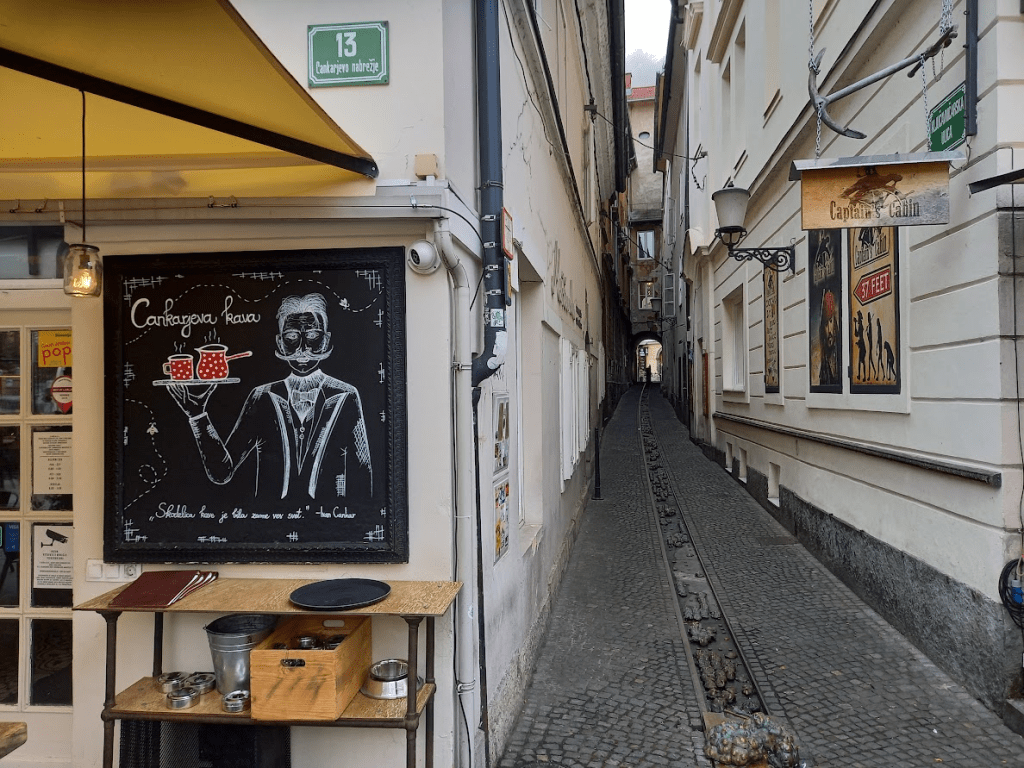
Kranj, Slovenia. #47 on this street or ulica is colored squash yellow, pumpkin orange, old chain-linked fences, weathered stones and concrete, pedestrian murmurings, grape vines, ivy vines, alpine balconies, a trumpet playing somewhere, a bicycle cycling something, whirrish whir displacing air. #16 on another ulica is painted hope-pink. Lekarna is a pharmacy and jaune santiarije is a public toilet, and ne must mean no, because that’s what a woman keeps saying to her dog.
Outside the bookstore, the sellers are smoking and sipping wine and saying something like koushka and Naked Lunch costs 16 euros inside, and outside a building under construction and covered in scaffolding a worker is yelling out “Matjas!” Later, the receptionist at the hotel informs me that the word I heard was kučki, which means two small dogs in Slovene, and prosim is please, of course, of course, a kuža is just a doggie, like the Estonian kutsu.
The next morning…
Each morning in Ljubljana is cool and foggy, until the sun burns off the mountain valley moisture.
I DON’T KNOW what to say about Ljubljana, I have trouble spelling and saying the name. Slovenia has Mediterranean elements, Alpine elements, South Slavic elements. I like the way the language looks on signs and billboards and theater posters. In a funny way, it reminds me of Lithuanian, only because of the length and special characters (these languages are far removed). (Vzgojiteljica is ‘kindergarten teacher’).
Reading some genetic studies of the Slovenes, conveniently featured on their Wikipedia page, I learned that they are closer to Czechs than to “real” South Slavs, like Bulgarians and Macedonians. The language? I know nothing. Prosim (please, thank you) gets you everywhere in Slavic land, and “Cheers” is the familiar na zdravje… I forget at times what a vast hunk of Europe is populated by Slavs of all flavors, the Poles, the Slovenes, the Croatians, the Slovaks, the Bosnians, the Serbs, the Ukrainians, and then those more niche groups, like the Ruthenians. Or were the Ruthenians the Ukrainians? Try the Rum Raisin Slavs, the Butterscotch Pecan Slavs, while you’re at it. They’re out there somewhere, inhabiting some valley …
Bear in mind, at times people are just as at a loss when it comes to the Estonians, so they can be forgiven when it comes to distinguishing all of these cultures and subcultures. It takes time to study up on Slovenia.
During breaks from workshops, your intrepid writer wandered aimlessly around, writing more nonsense.
ANYWAY, this is a lively city. People are outside in the evening, riding bikes, strolling, talking loudly. It’s by population smaller than Tallinn, but even on its finest summer days, Tallinn just isn’t as lively. People just seem to pour into restaurants and out of supermarkets. A lot of Slovenians are tall, even taller than me, and there is a subset of the guys with really frizzy, nappy hair, which they grow out, so that they look like Thulsa Doom’s henchmen from Conan the Barbarian. Some of them cut it short and ride around on electric scooters wearing puffy black vests or jackets. The Slovenian girls are ranging in packs and talking loudly. Their jackets are also puffy.
How funny that for them, Ljubljana is the world, and they are having modern day street romances by the dozen, and breaking up, and someone is dating someone in Kranj, or someone moved to … where do Slovenes even move to? Probably Vienna. Yes. They split up, and she moved to Vienna for work. Broke his heart in two. All of this drama taking place in this foggy basin, people made born and lived, day by day in Slovenia, and the world shuffles by, barely taking notice.
The hotels (I’ve been spoiled) have retained some continental grace. Very Grand Budapest Hotel, the concierge is overly eager to help. In Estonia, they are too busy texting their friends, or just don’t want to make eye contact at all. There’s no, “Yes, sir,” “Anything else. sir?” Estonia could use a little more Monsieur Gustave H, I think. But who am I to judge?
***
Who was I when I was here 23 years ago? Am I still him at all? What has become of all that? Well, there’s no need to dwell on it. Yesterday went into yesterday, like krill into the belly of a baleen whale, and I don’t recall it all, nor should I.
***
The long way up the castle hill. This photo snapped accidentally while talking to my daughter on the phone.
THE LAST TIME I was in Slovenia, it was ’02. A lot of time has elapsed since then, but it doesn’t feel so far away. It hasn’t yet taken on the glow of nostalgia. I didn’t have a phone then, and nobody really knew where I was, although my father said he could track my movements according to the bank statements that were mailed home. It wasn’t a big issue.
I did have a journal with me, so somewhere in my closet, buried underneath all of my other journals*, I can find out more or less what happened, but since I have not retrieved these memories since about that time, I only have some recollections of the bus station, the hotel, some cool-looking teenagers sitting in a park, the church, the river, and not making it up the hill to the castle (which repeated again this time, as I did not hike all the way up. Maybe it will take 23 more years to get there?) And of course the trip to the caves, which are called jama in Slovenian, which means crap or bullshit in Estonian. But that’s about it. Maybe some more will resurface. I was only 23 years old the first time.
Enough about that. In Slovenia, when you walk into a shop, the shopkeepers will often greet you with “dan,” which means, “day,” as in “good day,” dober dan. I was thinking that if your name happened to be Dan, this would be a good city to live in, because every time you went to the supermarket or popped into the bookstore, the sellers would address you personally. “Dan!” Or imagine the unsuspecting Dan who ventured into Slovenia, only to hear strangers saying his name to each other. He walks into the bookstore, but all the girls keep saying his name, or maybe he thinks he’s hearing things. Onset schizophrenia.
“Dan,” they all whisper. “Dan, dan, dan!”
The city at night, more restless wandering awaits.
ON A SATURDAY NIGHT, Ljubljana was fairly lively into the late hours, though most boutiques and stores closed their doors by 9 pm. I wonder about these pretty faces through the windows, the Slovenian yuppie set, who do they work for, where do they get their nice sweaters? Some clubs remained open, and I heard all kinds of fun music from the speakers, including Dr. Dre and Snoop Dogg’s “Deep Cover,” followed by some vintage Michael Jackson (pre-Off the Wall, maybe Jackson 5?) and then Tom Jones’ rendition of “Burning Down the House,” followed by Lipps Inc.’s 1980 hit “Funky Town.” A guitar player was singing “Creep” by Radiohead but he couldn’t hit those Thom Yorke high notes.
There were also decent restaurants open late, serving fried seafood, Indian curries, and kebab, which is what you need if you want to get some deep sleep. In the earlier part of the evening, I attended a traveling Flemish production of Medea’s Children with Slovenian subtitles. I think I understood a few phrases in Flemish (their expression for “please,” alsjeblieft, is the same as it is in Dutch) but Slovenian was impenetrable. It looked like a cat had run across the keyboard. (Where are you from is od kod prihajaš? and thank you is hvala!) I was reminded of the fake “Eastern European” language from Ingmar Bergman’s 1963 film The Silence (where the Estonian word for hand, käsi is taught by the concierge to the little Swedish boy in the hotel).
Ingmar Bergman employed a fake “Eastern European language in his 1963 film Tystnaden or The Silence.
And then he writes…
Oh, the melancholy sorrow of the pretty youths and sorrow over missing my own pretty youth, long gone and burned away, but can it be resurrected, just like the actress cries on demand for the camera, her cheeks wet and so sincere, the tenderness of lovely youth, and afterwards an after party of salami, prosciutto, Slovenian theatre life, as if I ever knew what I was doing ever.
The next day
Across from here we had a good lunch of fried fish, potatoes, drenched in a yummy creamy garlic sauce.
SLOVENIA HAS MIXED/uncomfortable feelings about its southern neighbors, let’s call them that. Someone asked a friend something in Serbo-Croatian, which was taught to all Yugoslav school children prior to 1991 as a common state language. Old-school nationalism, everyone in a single geographic box, speaking the same language, believing in common myths that link their heritage with a mystery genetic component (it’s in our blood) while rooting for certain football teams, praying for Olympic glory, and engaging in armed border conflicts in cultural gray zones, seems antiquated and kind of silly. Yet this was the solution to the imperial collapses of 1914. Come feel the nationalism!
The same Ottoman Empire that once ruled over much of the southern Balkans also ruled over what is now called Israel and Palestine. But up here, this was all Austro-Hungary, Ljubljana is thus a provincial capital of the late Austro-Hungarian Empire. It’s odd, I think, that nobody is trying to resuscitate this particular empire these days. The Russians are still crying about theirs and “their ancient land” but the Austrians are, well, I am not sure what they are up to. Maybe bodybuilding. Or skiing. Maybe their beer is just better and so they have fewer complaints.
And just like that, it’s over …
Back in the north woods of Estonia, where the land is green indeed.
AFTER LEAVING the mountains around Slovenia and Austria, ‘Europe’ is one big dusty plain of farms, roads, and shiny grain silos, and the occasional large settlement.
This rolls straight up into southern Latvia where things get woodsier north of the Daugava river, and Estonia is even more swampy and green. Also the road, farms, town pattern is less observable, in Estonia it looks like some giant sneezed and the houses went all over. A very dispersed settlement.
That river is the Jägala, I think. Do you know that in the reign of Ivan the Terrible, the Russians also tried to conquer this region? But that they lost and badly? And that even then the Swedes and Poles supported the governments in Estonia and Livonia because they didn’t want Ivan as a neighbor?
Some things never change.
A compilation of journal entries (in italics) and Facebook-Instagram posts from a recent trip to Slovenia.
Later, I uncovered my journal from ’02, only to discover I was mostly focused on creative projects and my relationship when I was in Slovenia, and barely wrote about the trip at all.
MY DAUGHTER CALLED ME. She said that Uncle Agostino was sick and that he had decided that, for whatever reason, he would soon board a flight to London, where he intended to die. Why he had selected England as his place of moving on to the underworld was unknown to me, but Uncle Agostino was a history buff, and it’s possible he just wanted to see some of its museums before leaving.
At once, I began my sojourn to Uncle Agostino’s house, down by the port. When I arrived, the old man was seated in a chair, dressed up in a Apulian folk costume. The wisps of his white hair poked out from beneath his cap and his arms were crossed. His legs were up on the counter and he seemed quite peaceful, or molto tranquilo, as they say. “Uncle Agostino,” I said, “is it true that you are going to die?” Agostino said nothing, but briefly glanced at me, as if he registered what I was saying. “And why do you want to die in England of all godforsaken places?” Again, there came no answer from caro Uncle Agostino.
My cousin Gabriele was at my side a second later. In fact, the whole house was full of various relatives. His dark hair had grown longer, his skin was tanned from all of the sun. He was in a fine mood despite the somber backdrop. The countertop was submerged in local cuisine. Panzarotti. Orecchiette con cime di rapa. Spaghetti e polpo. “Don’t mind Uncle Agostino,” Gabriele said. “He’s just preparing his soul for his journey to the underworld.” “I can see that.” “But those clothes won’t do for the funeral later,” Gabriele said to me. “You need to get some new Italian clothes. We Italians like to look sharp at funerals.”
Out into the street I went, searching for my wardrobe upgrade. Gabriele was correct. My shoes were worn so thin, they were coming apart. My pants were baggy and covered with stains. Mysteriously, my belt was too long, though there was no evidence that I had lost any weight. My shirt had been bought in India. Indeed, I was the very picture of a beggar. Again I came down by the port, where a ship carrying refugees from Africa had just docked. I stepped over them in my search for new Italian clothes. The sky was a strange, otherworldly pink, and it swirled high above the sleepy Adriatic, full of pulsating yellow-white blobs. It was a kind of Mediterranean aurora borealis.
“This is not Puglia,” I said, observing the sky. “This is somewhere else.” I turned up a street by the port and walked into a restaurant, where another family was celebrating some event, birth, death, marriage, what have you. But I was escorted out on account of my shit attire. Up the street, I found a shop that sold belts, shoes, pants, and for decent prices. There I was, rummaging through the discount bins, trying to look something like a presentable Italian. Again my phone rang. It was my daughter. “Are you coming?” she said. “Uncle Agostino is ready to go to England now. Agostino says he wants you to come with him.”
I NEVER DID FEEL comfortable walking by that room. It was on the second floor of the house and faced the rising sun. I suppose the house was here in Estonia, but it could have been anywhere. I knew, in a way, that it was haunted or occupied. It had such a terrible feeling to it. Some might say it was possessed. Some might say it was a poltergeist. Whatever spirit, entity, or otherworldly presence or being was rooted within those walls, I never knew of it or saw it. Until one day, when I walked by the room and saw that the door, usually shut tight, was ajar.
“There are two kinds of people in this world,” I whispered to myself. “Those who dare and those who don’t.” It was time to confront the darkest aspects of my subconscious. I opened the door and went in. To my surprise, this off-limits, evil-feeling room was in proper order. It was furnished with Art Deco pieces, a few velvet chairs and one long green sofa. At first, I thought there was no one in the room. On the wall, I saw there were a few paintings, also from the interwar period, except of boy band stars. Robbie Williams and Justin Timberlake leered out.
Who knew they had both had careers and been so popular a century ago?
Then, when I turned, I noticed the ghost woman. She was not quite transparent and floating by the window. She had shoulder-length brown or reddish brown hair and a white dress. Her back was turned to me. The spirit of a sad woman. Was she the embodiment or origin of the awful feeling coming from this room? Her hair was cut in the old style. I couldn’t make out any of her features. “Hey,” I said, reaching out. “Who are you? What are you doing in my home?”
My hands went right through her and she faded.
Puzzled, I looked around the room again, and noticed there was another room attached, with the door slightly ajar. The sad, horrible feeling was stronger there, I felt. I needed to go and look in that room too. At the door, I peered in. This room was dismal and purpleblue. The walls were painted the same, and the furniture was also from the 1920s. There were clothes tossed everywhere, the drawers to the cabinets and dressers were half open. This must have been the woman’s room. What was strange about it is that it was rendered in a different kind of spectrum. It was if Matisse had dabbed his brush over all. The room was soaked in colors.
So that was that. I stood there looking around the messy Henri Matisse room and then went back into the hall. But I had seen her, I had at last seen her. I didn’t know who she was, but she did exist. The source of the dread, the source of the unease, floating transparently in a corner with her back turned, fading into light. What would I do the next time our paths crossed?
I HAD SEX with Julie Andrews. At least, I think it was her. It happened on the second floor of an old theatre in London and it happened during a right-wing putsch against the Starmer government led by Elon Musk. Out in the streets, it was Unite the Kingdom Day and then some. There were union jacks fluttering everywhere, and the crowds swarmed into the theatre, up and down its regal staircases. British fiends helped themselves to free concessions.
Up on the second floor, I encountered Julie Andrews and we began to make love on some old chairs upholstered in plush red velvet. She looked just like she did in the Mary Poppins and Sound of Music era, except her hair was gray. This part I couldn’t understand. Why was her hair gray but her body had not aged? She had very long, supple, and tan legs. Maybe she had just returned from a holiday to Santorini or Tenerife? Some place where British actresses go.
The lovemaking was tender and sincere, but had a passionate, hurried quality to it. I told her, “I think we’re on the threshold of a new era in international politics and this is a part of it.” Julie Andrews gasped. Her legs were in the air. That’s all I remember, truly. I don’t think I will ever watch those old classics the same way again. Knowing what I know about Miss Julie Andrews.
ANOTHER DAY, ANOTHER CHARLIE KIRK MEMORIAL. The “stadium tour” had been a boon to the president’s sinking approval numbers. And with each pyrotechnics display, each series of rousing speeches, one could almost forget that he had promised to end the war between Ukraine and the Russian Federation in one day, or to reverse inflation, or to do many other things that never seemed to bear fruit. This however did not dissuade young women like Elspeth from watching the Charlie Kirk Stadium Tour. Rather, she curled up on her couch with a box of tissues, sobbing each time they showed the Charlie Kirk “That’s why I am a Christian” montage, pieced together from diverse podcasts and various debate spats. After drying her eyes, she would clench her fists and stammer something angry about the “radical leftist left.”
“But it’s not just the left that has its radical elements,” I would caution her. “Think of Bison Man and January 6. Surely, you must admit that the Proud Boys were just as hostile an element in US politics.” This might have made sense in a less emotionally fraught situation, but not to someone who had just lost, as she saw it, the 13th apostle of Christ. I felt ever more like a unrepentant, mate-sipping Che Guevara. And like Guevara before me, I leaned in and began to work my vulgar Latin socialist charm on Elspeth. There have been passionate kisses in history. Think of Julius Caesar and Cleopatra or Cleopatra and Mark Antony. But this sudden melting away of toxic political distress into a very steamy couch lovemaking session won them all.
On the TV set, there were more pyrotechnics. One of Trump’s rotten children cried out, “Je suis Charlie!” By this time, I was just about to consummate my relationship with Elspeth. She was a flaxen-haired, freckly lass of Highlands descent. A Presbyterian turned evangelical, a dedicated follower of god. She was unsure though and she called in her assistant, a young Siamese woman who carried an appointment book with her. “Miss L. can you tell me how far I am into my cycle?” Elspeth requested. “Yes, madame,” said the Siamese assistant, who quickly paged through the book. “It is an inauspicious time for making love, madame,” she said. “Thank you, L., that will be all,” she told her assistant. “You are dismissed.” The woman bowed and left.
“I’m terribly sorry,” Elspeth whispered to me on the couch. “But I just don’t want to risk it. I do hope you understand.” “That’s all fine,” I said. “I’ll just lick your breasts.” “Fair enough.” Elspeth pulled up her t-shirt, revealing two very soft, very pink breasts. They looked like a treat you might find in a Helsinki bakery, tucked in between the cinnamon buns and fluffy Napoleons. “You know,” Elspeth said a moment later. “This is probably the best sex I’ve ever had. And we don’t even share the same politics! If more of us just had sex, we could reconcile all of our differences.” I kissed Elspeth, pushing back her sunny-colored hair, and said, “You’re a genius.”
ON THE WAY to the airport, we stopped at the intersection of Liivalaia and what they call the Tartu Highway. We were opposite of the Stockmann department store, by the Laura beauty salon and a striptease club called Virgins. We were about to hike up the hill to the airport. It was a sunny, dusty day, and from that vantage point, the airport looked like it was a floating mirage, gleaming tall and white. It loomed up over us like the old Police Administration Building from Dragnet, the old home of the LAPD. Don’t you remember that old voice over? “This is the city: Los Angeles.” But we were not in Los Angeles. We weren’t even going there.
We had tickets printed out for a Ryanair flight to Italy or Spain. Whatever one it was, it made no difference. And we were late. I was traveling with my eldest daughter and youngest daughter, the eldest one barely a teenager, the youngest one maybe five years old. “What time is it?” I asked the older one. She looked at her wristwatch, a Swatch. “It says it’s 10:20,” she said. “Damnit,” I said. “We might miss the flight!” She had on a backpack, but the littlest one tugged along a pink-colored Barbie suitcase. The suitcase sputtered over the stones as we went.
Thus we began the hike up the hill toward the airport, traffic whizzing by from all directions. There, by the turn off for Lasnamäe, the littlest one dropped a toy down a long flight of steps. I was surprised by how steep those steps were, they descended for meters and meters, or yards and yards. She expected me to retrieve it. She was crying about her toy. I stepped down onto the first step and noticed that the stairs were not secure. Rather they started to wobble and bend, like they were made of a soft, pliant rubber. The steps had a gummy, candyland quality.
With the next step, I noticed the upper steps started to fold over the lower ones. And by applying my body weight, I could easily make the top of the staircase arch and bend in such a way, as that I could retrieve my child’s lost toy and then spring back up to the Tartu Highway. Imagine a young tree branch pulled downward then released. The steps bent in just such a way. With a few movements, the toy was in my hands, the bendy steps had bounced back into place, and we were on our way. The half Estonian child was happy, if only for a few minutes.
THERE WAS A FURNITURE SHOP up by the train station where some local entrepreneur had set up his business in an old barn. It was there that I acquired a swivel armchair and then began to push the chair into town on its wheels. This was tedious work but I covered ground quickly, soon passing the Konsum supermarket. By the cemetery, where poets and war heroes are enshrined and entombed, a car pulled up.
It looked like an old black Buick, but I could be remembering it wrong. There were two women inside, both blonde, both older. One had shorter cropped hair and wore a blue tank top. She was at the wheel. The other had shoulder-length hair, she sat in the back. She wore looser, more colorful garments. The one with the longer hair said, “Need a ride?”
I said, “But there’s no way my chair will fit in your car.” The longer-haired lady smiled. “I bet it’s a perfect fit.” It was. The chair fit perfectly in back. I sat next to it and the two women sat up front. But when we went to turn at the roundabout toward town, we made a sudden turn and drove off into the forests. “We’re leaving for Italy tomorrow,” the driver announced. You should come with us.” I was hesitant. But seeing as two women were willing to give me a lift to Italy, I decided to go. What was there to lose?
Their house was situated deep in the woods. It belonged to the woman with shorter hair. Her name was Ingrid and that the house had been built by some forefather in the 19th century. There were crooked stairways inside going to different levels. Ingrid gave me a room on the top floor. There was a large, comfortable bed with a thick blanket and the bedding was snow white. I slept alone that night, but when I awoke, Ingrid was already in bed with me and we were making love. I remember the way the light caught on her eyes. Ingrid had sun-kissed skin, freckles. I felt her smoothness everywhere.
Later we got in the car and began our trip south. It would take us days to get to Italy. Ingrid was at the wheel again and her companion, who was called Astrid, was seated beside me in back. Astrid had on a pair of red pants, some yellow kummikud or boots and a loose-fitting white blouse, held together at the top by a ribbon. A bucket and a knife. She told me we were going to go mushrooming. “But Italy?” I asked. Astrid just smiled at me, as if I was the dumbest man she had ever met. “Did you really believe us?” she laughed. “You’re far more gullible than I thought!”
Ominous. Ingrid left us at the edge of a forest and went to run some errands. I followed Astrid into woods. Deeper in we went, until I began to worry that I couldn’t remember the way back. I wondered if I would make love with Astrid now, just as I had made love with her friend in the morning. It would be interesting to know Astrid, just as I had known Ingrid. I was developing a real taste for these neurotic older women, yes, each one more delicious than the next.
Astrid moved from spot to spot, filling her bucket with chanterelles and birch boletes. Her fingers became grimier from the slaying of mushrooms. Something drew me to her more, a kind of terrifying breath. I could no longer speak, I could no longer think. I was tangled up in some bursting energy field. The woods began to hum with it and glisten, as if they had for the first time been penetrated by sunshine.
“Why are you looking at me like that?” Astrid asked. “Like what?” “You’re looking at me as if I was a kohupiimakorp.” I approached her and undid the ribbon to her shirt, exposing her pink chest in the air of the forest. Then I licked her as if I really was licking the cream off a pastry. “This is all I really want,” I whispered, in between the licks. “Just this.”
ALL I REMEMBER is that she came into the apartment, closing the door behind her. She began speaking to me at once, in a somewhat worried and anxious tone. Her work was getting to her. Some of the patients at the mental hospital were career criminals and psychopaths, although they did not term them as such. They could be quite seductive and build up a rapport with even the most seasoned psychologists. “They get under your skin,” she had told me. “It’s hard to wash them off.” She had scrubbed and shampooed her luscious blonde hair in vain.
There she was in the cold glow of a kitchen light. It was evening now in Estonia, the darkness was settling in earlier and earlier, and we all knew which way things were heading as the last days of summer faded away and the equinox breathed its first fall-time breathe. She was still talking there in the kitchen, but her cadence was so fast I had a hard time following her. She had on that button sweater of hers, the soft one, and the light made it look only more cloud-like and gauzy, up from the skies. “I’m sorry things are so tough at the mad house,” I said.
I kissed her after that. The psychologist undid all her buttons and soon I was touching her other buttons. My hands were guided by some instinct, I knew just where to push, just where to pull, just how to conjure ecstasy. And then, mid-kiss, her eyes opened and she recoiled in a kind of befuddled plot-twist horror. “We never agreed we could do that!” she stammered at me. “We never had agreement to make love!” “But, but …” My voice trailed off, but it sounded distant, as if it was echoing back from the end of a tunnel. Calamity, despair. All I had wanted to do was take the edge off, to make her feel blissful. I still did. Even as she pushed me away.




 north!