MY MOTHER bought us tickets to the US, but they were from Frankfurt to Oakland, California. She said it was the cheapest deal she could find. This did result in some quarrelling. I told her I didn’t want to fly all the way to Oakland and then drive cross country. Over desert sands, mountain peaks, rolling plains? None of that. But the tickets to Oakland were booked.
It was all pre-arranged.
I tried to convince myself that it wasn’t a bad deal. I imagined little Oakland down there, gleaming beneath the silvery wing of the plane, the high bridge over the bay. The friendly taxi drivers, the friendly toll takers, those friendly Hells Angels, et cetera. And didn’t you know that in Oakland some families were now trying to live as they do in the country, keeping their own backyard goats? Hipster dads would disappear with their saucepans to collect the fresh milk.
Something unsettled me about the thing. Tickets acquired, with no input from me. I had to sit on that long flight whether I wanted to or not. A long, lengthy flight over half the world, and all of the North American landmass. “It’s only three hours longer than usual,” she said. I suppose I was going to go, and in the end I did. We packed our things and were off in that big shiny jet.
When we got there, I was dead tired. We checked into a boutique hotel on the corner of Bush and Powell. I had missed the San Francisco Bay. Maybe this wasn’t too bad. And maybe we could fly to New York. No need for a perilous road trip. My daughter slept on the floor, for some reason, and there were two single beds, like in those old Hollywood movies. I was in one bed and my wife slept in the other one. She looked sort of like a young Anu Saagim, during her notorious ’03 milk photoshoot. “Oh, you’re not going to sleep just yet,” she said. “Not without a good …” She climbed out of her bed and into mine with enthusiasm. The last thing I remember is those breasts dangling like fruit, freckles in between. Two freckly warm jugs.
AND SO WE RETURNED to Huntington on Long Island, which is one of the few settlements that could be called a real town on the North Shore and not on overgrown coastal meadow village or a sprawled out ship-building port, but a real micro-city with its own library and its ways and boulevards with names like New York Avenue and Prospect Street. There used to be trolleys running the length of Main Street, gliding along metallic grooves, bells ringing, in the old days, the Model T and Model A days, when the automobile was a luxury and the straw hat ruled. The trolleys inevitably circled around the grand town hall at the end of Main Street.
This vast brick structure, constructed by some post-war — here meaning post-Civil War — architect was still in use when I returned there with an Estonian woman, whose name I could never remember, but who was so keen to see my childhood places, such as the swimming pool at the YMCA, and we walked up the granite steps, where there were long lines of townspeople waiting to see some clerk or process some paperwork. What was her name anyway? Annikki? Tuulikki? In the long lawns that stretched down toward the center of town, some women were at work gardening. One poked her head up from between the bushes and I noticed the embroidered white linen bonnet of an Estonian folk costume. Then I heard lines of Estonian dialogue passed between the women, who were planting the gardens with yellow flowers.
Annikki and I came down the steps and there was a friendly encounter with the Estonian gardeners. “What on earth are you doing here?” She asked. “We came over for the summer,” the woman said. She was dressed in a white, traditional folk costume. It was strange that she would wear such beautiful clothes for such hard work, yet there wasn’t a spot of dirt on her.
The cemetery was next to the town hall, on the other side of a grove of dark trees. There was a long stone wall now erected between these properties, but there were many doors in this wall, which stretched for quite some ways, but most of the doors were sealed, and even from in between the few cracks, I could only hear the sounds of young town hall civil servants talking.
We found our way around to the cemetery, which was where my grandfather was entombed, and his father Salvatore and mother Rosaria, and their fathers and mothers and many cousins.
“This is where they sleep, the old Italians,” I told Annikki. She was a slender girl, with tufts of red hair and freckles. Her hair seemed to be in constant windblown animation. I put an arm around her. Annikki was compulsively curious about the world. But something about this world was off. For when I peered down in the cemetery, I saw the ruins of Rome, the tombs of Pompeii. Crumbling columns, nude statues missing arms and noses, all covered with moss.
“This must be the older part of the cemetery,” I told Annikki. “Where the very old Italians sleep. My relatives are buried in the newer part.” There was a small stone house at the gate, with statues of Apollo and Venus out in front. Out of this house stepped an Italian woman, dark-haired and olive-eyed, some years older than me, her skin a perpetual sun-kissed brown.
She began to speak to me, but in Italian, and I expressed myself to the best of my abilities. Some words fell out. Cimitero, parenti. “Your Italian is just awful,” she said in a turn. “Bruto. Who even taught you to speak our language?” “That’s the thing,” I said, sadly. “Nobody did.”
WHEN I MOVED out of the apartment, I discovered the extent of my hoarding over the years. No matter how many boxes of books I moved, no matter how many armfuls of coats and shirts I extracted, the task was endless. I worked day and night and still got nowhere with the thing.
The apartment was in some up-and-coming residential area in Tallinn, like Noblessner maybe, but farther inland, though no place is very far inland in Tallinn. I had outgrown the neighborhood though, it being taken over by hipsters 20 years my junior with tech jobs.
While doing the move, I stopped and helped myself to some refreshing water flavored with effervescent mint at a café bar in the building’s food court. Some kid in a flannel shirt called me an old man for sitting there. ‘Next you’re going to start talking about the Eighties,’ he said.
Outside, I paused in the courtyard to breathe beneath the palatial, intergalactic, honeycomb looking apartment terraces and balconies, made of brick, glass and iron. And that’s when I heard it, the unmistakable sound of the early Stones. The fuzz of the guitar, that stark beat.
But something was strange about this song, for I had never heard it before. It was a bit like ‘Tell Me’ crossed with ‘The Last Time.’ How could it be that I had never heard it? Surely it had popped up in some anthology. But no. Looking up at the brick work, I could see the band, projected high in black and white. Mick Jagger was up there singing, holding the microphone.
Then it occurred to me. This must have been one of Brian’s songs. Andrew Loog Oldham had said that Brian Jones had written a few songs that Jagger and Richards, the primary songwriting team, had snubbed. By Oldham’s telling, Jones’s output had been worthless junk. But girlfriend Linda Lawrence recalled otherwise. She said that Brian’s songs were brilliant.
This must have been one of those lost songs, leaked from the vaults at last, played by Tallinn hipsters from some upper floor pad in the digital future. They were still cool. I was old and in the way, but the Stones were young. Mr. Brian Jones, 57 years dead, still lived on, his music played and played. Some consolation it was to hear the Rolling Stones on that sad day.
I HAD NOWHERE to stay, so I made a little nest in the corner of the Lidl supermarket with some discounted German pillows and blankets. I rested my head against a display case full of frozen pizzas. It was late afternoon and for some reason the lights had been turned off and the counters were covered with root vegetables, like radishes, carrots, cabbages, and so on, when I saw her there. Dulcinea, in her dark coat, glinting like gold at the end of a cave, talking to a supervisor in a pleasant but slightly pleading way. Then she saw me, sleeping in the corner and came over and said, “Mother says that I have to get a job. She said they have some openings.”
These were the first words she had said to me in three years. A tear ran down a heavy cheek. I had to pause to collect my poise. “Well, there’s a good chance I’ll still be sleeping here tomorrow night,” I told her, from my makeshift supermarket sleep nest. “Maybe we’ll be seeing each other again.” “Yes, it would be quite nice to see you again,” she told me. She meant it.
When she left, there was a special throb in my chest that I recognized instantly as love, and I allowed it to spread to every part of my body and to ache away in unison. What better feeling was there in this life than this kind of undying chance supermarket encounter love? But then I had to get a job and the sad fact is that I wasn’t at Lidl when Dulcinea started working there.
A conference on agricultural biotechnology, held in lower fourth level of the University of Life Sciences. Why did they build auditoriums so deep in the earth? Room 424B. Or was 403B? I couldn’t remember. It was all quite newly renovated, but what was with this green carpeting, the dark wood panelling on the walls? To make covering the conference more challenging, someone had given me a baby to care for, so I was pushing a stroller with the tyke in front. He was wriggling and at times sobbing quite loudly. The diaper had come loose, and his urine fountained everywhere. Whose child was this? He couldn’t have been mine. Way too blonde.
“I’ll get that little boy all cleaned up,” said a woman who came to help. She looked like Tippi Hedrin’s character in The Birds. She swept away with the mystery infant and I spent the rest of the day in the back row of a stale-aired conference room listening to dull talks about agronomy. Later I realized that I didn’t have a change of clothes for the conference. Could I really recycle the same shirt? The same black pair of pants? It occurred to me that somewhere inside Lidl they probably sold decent clothes on the cheap. So I would go back. Maybe I could find something high quality and German, but at a reasonable price. Maybe Dulcinea would be waiting at the counter. Again the feeling swept over me like cool winds across the steppe. And the fields and grasses rustled, whispering, “Love, love, love,” and “Always, always, always.”
BUT WHY DO I love her so? But why do I love her so? But why did I love Dulcinea? The question wrapped around the experience, like paper on a bottle. The more you turned it, the more you saw. Then everything went all zig-zag again and I wasn’t quite sure where I was, only that one piece connected to another — and there was a little boy there — one minor plot twist turned things. The next thing I knew we were landing at Kabul Airport in sandy Afghanistan.
Why were we here? Don’t tell me our band was on tour. But didn’t you know, our new keyboard player had let down all her previous bands? There was a large metallic overhang, like the roof of the stage over the Tallinn Song Festival Grounds. Everything else was underwater. Warm, chlorinated, waterpark kind of blue water. We lugged our suitcases through it, or rather they floated. Floating by went spinning islands of American candies, leftovers from the retreat? Mars, Snickers, Twix, Pringles, take your pick. And what were we even doing here? I grabbed a chocolate from one of the airport waterpark islands and looked up, saw orange. Great glowing comet-like streaks were running the length of the sky. Was it a fireworks display or had the Iran War spread to Afghanistan? But weren’t the Pakistanis also fighting the Afghanis now?
When I got to the hotel, I decided that I had my fill of adventure. I went to the café bar, told them to make me the blackest, darkest, evilest espresso there was. If she was the light, then I would be the dark. If she was wholesome and good, I would bristle with sinister malevolence. This life without her had been a graveyard dead end. Light unto light, dark unto dark, her pure into my pure. I stared down into the cup and it whispered back up to me like a haunted well.
AGAIN THAT TABLE, worn and soft to the touch, coming into view in the dim light of wherever this was. A bar, restaurant, a speakeasy tavern? The table was long, wide, thick. Two familiar friends sat down next to me, maybe one of them was Matti, a semi-famous, experimental writer, and he said to an approaching waitress in a white blouse, “Get this man a glass of the …” I didn’t hear the rest, but when it arrived, there was a near bowl of something that looked like pinot noir or valpolicella. I pushed the glass back on the table and announced, “For the very last time, Matti, I told you that I don’t drink anymore!” Then, gesturing to the kind waitress in the blouse, I affected a more diplomatic tone and said, “But I will have an espresso, thanks.” “Very good,” she said, and there was some turning and clicking of the heels. Matti, who was dressed all in black, guzzled my wine. His bald head was impressive, emerging from his neck like a boulder on Everest, or the corpse of a mountaineer who had fallen there.
I became aware that there were others around the table, including Violette who was waiting patiently for me. I began to reach for the fabric of her dress and brushed against her chest, ever so slightly, hoping that if I made her blush enough, she would unsheathe one for me. Just a few more pats around the breast and soon I would have one in my mouth, if I could only just lay back, like this? The espresso arrived on a silver tray and I took it and drank. It was hot and frothy, splashing around like waves in the Great Western Ocean. Then I announced to all, that I needed to use the bathroom. I headed for one downstairs, but Violette called after me, “No!”
It wasn’t there anymore, in fact everything had changed. The walls had been retiled, there were boxes of construction materials. I came up to the main floor again and Violette was standing there in her dress. She said, “My company acquired the building and there is no toilet anymore, except one for the management on the top floor, but you can’t go up there.” I made another play for her breasts. What did they look like under there? She had some kind of checker print material on, she reminded me of a tablecloth. Picnic baskets, summer, delicious. She just sort of swatted me away, but there was a happy little grin in there, beneath the hair.
“Nonsense,” I told her. “I’m going to find it. But first, I need my journal.” I took my journal from my bag and began climbing the steps to the off-limits upper floors. These had been demolished too and replaced with a swaying, unstable temporary metal staircase. All around me there were cranes and men in white shirts and hardhats conducting the lifting of materials and scaffolding. They were talking into headset microphones and giving orders and wore sunglasses. The staircase only swayed more and I remembered that I was terrified of heights.
I looked down and Violette was shaking her head, each one of those breasts still locked away, like fresh rolls behind bakery glass. “I told you,” she said. I looked down and saw there was a pool below me, a new pool for the company management who were developing the building. I decided to leap into the pool — I had lost all my desire to find a toilet — and kept the journal aloft as I came down feet first into the warm water. Unfortunately, the corner of this most precious book became wet in the fall. I held it up as I swam back to the restaurant. Violette helped me out. “It will dry,” I told her. “Even the wettest journals can be dried and read again.” Then, noticing Violette’s chest through the dress’s material, I said, “Let’s go sit down together.”
I SAW THEM ALL on stage, a smaller auditorium, standing only, playing just a few feet off the ground. This was the classic line up, and after the show, one of the singers came over. I couldn’t tell if her face was really melting off or if I had been dosed again. She had a doll-like yellow wig, which could have been her real hair, and her features looked sculpted, contorted into a menacing grin, and not quite human, like one of those shamanic masks from the Pacific Northwest. She wore loose, Tibetan-looking robes. She handed a large witches hat, about three feet high, to the woman next to me, and said. “Thank you for coming to the concert.” When the hat was opened, a pomegranate-like fruit protruded, with red flesh between its stiff membranes. The woman beside me said it was delicious. “Like persimmons mixed with honey.”
Next another singer in the band presented me with my own reward, a green hat of about the same size. It was made of unfamiliar textile, smooth and yet fuzzy, a bit course to the touch. The singer’s brown hair was long and he was dressed in Renaissance clothing. “Thanks for coming to the show, man,” he said. I pulled open the hat and devoured its sticky contents.
Later, I found myself on the second floor of a warehouse in New York. My great grandmother was there sitting at a table, dressed in a white youthful dress of the time, something circa 1914. She was sitting there staring off into space and someone was taking her photograph. Everything was black and white, and each time the camera flashed, I could see a dark negative of a child inside her. Not a baby, but a girl of maybe three or four years old, sitting peacefully there, in her own white dress. What even was this? Why was I being shown the past and the future? My great grandmother still didn’t notice me in the warehouse. She sat there quite still.
Downstairs, at a café, I waited in line to place my order. The seller told me that the cake I wanted was too strong for my needs. “If I give you this cake, and you digest it, it will change you, it will make you into a real monster,” he said. “I recommend this cinnamon bun, over here.” I took the cinnamon bun and noticed that Violette was sitting below the window in the sunshine. She was sitting there, watching me, with the sun in her red curls and Lata was by the counter, standing tall and erect, watching me. Lata also looked like she had no idea what she was doing in the café. I looked over at Violette. She smiled at me and winked. Lata’s brown hair was pulled back in a braid, she wore a white jacket and trousers, and her light eyes looked alert and alarmed. “So,” she said while waiting for her matcha latte. “Fancy meeting you here.”
I MUST HAVE RENTED an apartment from a middle-aged Estonian man. He was maybe a decade older, dark tufts of hair, graying at the temples, tawny complexion. He might have been Spanish or Jewish in a previous life. He worked in some dusty corner of the financial services universe and was always dressed smart casual, with a jacket, shirt open at the collar, khakis.
His wife had recently left him, or they had separated or taken a time out. So they said. She took the rest of the children off to the Canary Islands, where she had become a poolside yoga teacher and worshipper of the Hindu love gods. The eldest daughter stayed behind to finish her studies. She was disarmingly beautiful. He was certain the girl had caught my eye. She had.
At night, her father would kick off his loafers after a long day spent shilling for the bank and watch the news on an enormous screen he had got a great deal on during the pandemic. When he saw me entering my apartment through the big glass windows on the first floor, and most of the house was made of metal and glass, he would shake his head a little and purse his lips and then nurse another sip from a bottle of beer. The apartment itself was a tranquil single room, wide and spacious, all painted white, with high, echoey ceilings, and a small kitchenette.
It had three windows and through them I would watch the eldest daughter arrive and depart on her way to or from her semiotics classes. The bob of a golden brain in the late winter sun. The lyrical cadence of a youthful, ever optimistic voice heard through the glass, concerned for her joyless, dead-hearted father. There was something to her, a kind of music so faint you could only hear it if you strained your very ears. But it was also so removed from my waking conscience that I could barely grasp at it, even if I tried. This sparkle might have found its way into a magazine article I wrote, one with sultry allusions to such inappropriate relationships.
And then one day, my landlord was there before me, clutching a rolled up copy ofthe magazine’s latest edition in his hand, ready to strike. I could see my face above the column, which was printed neatly in black and white “You,” he said, “are a sick pervert! I have already initiated legal proceedings, a kohtuprotsess!” I stepped back and he whacked me with my own words. I tried to defend myself. “But it was all fictionalized!” I cried. “All of it was fiction!” “Lies,” he shouted and struck. “Of course, some of it was based on reality.” “Jail!” he growled. “Jail!”
In my apartment, I let down the white blinds. Outside I could hear him howling, banging. I grabbed my things, crawled out the back window like a character in a Willie Nelson song. Then I was down the forest path, on my way, almost free at last when his wife appeared like mirage. I tumbled and there were orange leaves everywhere, so many leaves I began to swim. The enlightened landlord’s wife looked down out me, her head wrapped in a bandana. Stars flooded the sky and began circling her like little birds. They arranged themselves into a crown. She reached down and pulled me free from my leafy oceans. At long last, I had been rescued.
The landlord’s wife was a fine looking woman, very smooth features, a kind of gray-brown hair just visible beneath her turban, and she had very clear blue eyes that were skies unto themselves. She did not fear my love of her daughter, for as she saw it, all daughters needed to be loved. “Would you like honey too?” She poured me some tea on the terrace later. I mixed in the honey, watched it dissolve in the peppermint, and drank deep from the warm ceramic cup. I was still kind of shaken up and could see her husband through the windows. He was filming the whole thing. Evidence to be used at trial. He gave me the middle finger. Then he motioned to his throat and made a slashing gesture. He mouthed the words: “Pervert, pervert. Jail, jail.”
ONE THING that has always impressed me about resident Viljandi Argentine musician José Manuel Prieto Garay, better known as Pepi, is his sincerity. It can be disarming at first, it can even make you a little suspicious, put you on guard. For how could a modern person be so sincere? At what point does such sincerity become an act? But his façade of sincerity is so durable and resilient that no matter what you throw at it, it just won’t stick. There’s no winking at the camera here, no hidden double meanings, no metamodernism. Everything is what it is.
This is sort of how I approach the new song by his group Araukaaria, too. “Canto Oscuro” is disarmingly sincere. It has a cinematic quality to it — it would make a good backing track to a montage about a religious pilgrimage. Considering the story behind it — the loss of Pepi’s father, a trip to Palestine — that’s not far off the mark. Pepi recounts a roadtrip between Chile and Argentina before his father passed away years ago in telling the story. His father was very ill at that time, and could barely make the trip. This song, “Canto Oscuro” (Dark Chant) is kind of like the soundtrack to that trip composed after the fact. It passes along like a mountain road at night.
Shadowy, lofty, winding, introspective.
“I think it was clear from the beginning of the song that it was some kind of lament or requiem,” says Pepi of the song. “I wanted to visualise the journey I lived with the music and lyrics.”
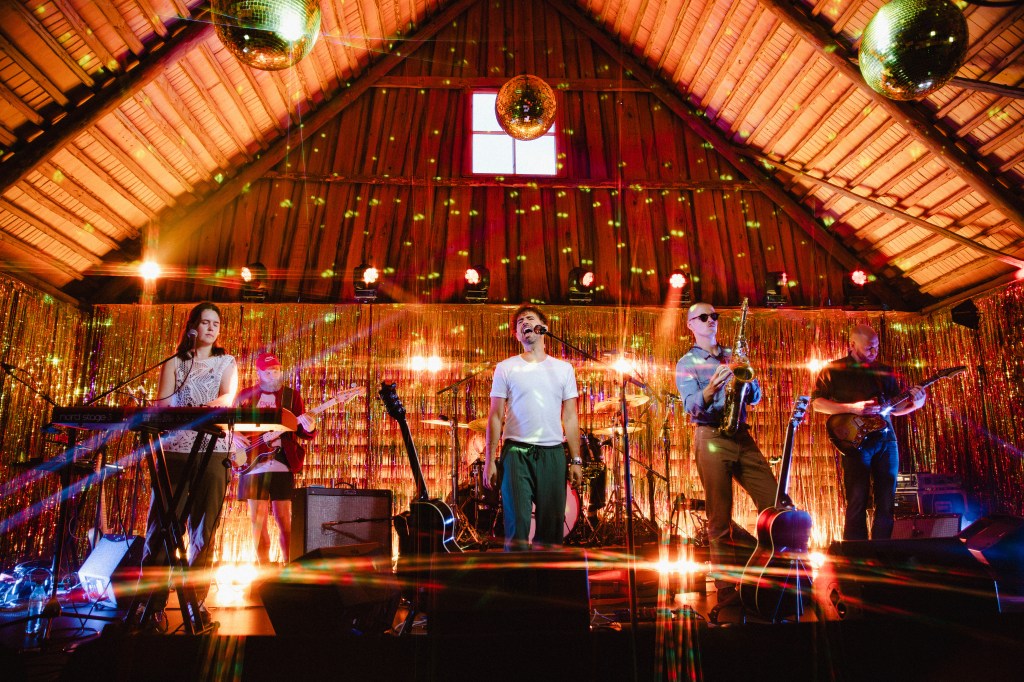
Supposedly it takes about 16 hours to drive from Santiago to Buenos Aires. “Canto Oscuro” is only about six minutes long, but it feels like it could be 16 hours long. There’s enough packed in, a flute motif by Rauno Vaher at its opening, atmospheric guitar playing by Viljandi virtuoso Norbert de Varenne, backing vocals by his sister María Julia Prieto Garay and keyboardist Lisanna Kuningas, and solid contributions by Fedor Bezrukov on bass and Johannes Eriste on drums, the rhythm section of an earlier incarnation of Araukaaria. Araukaaria is one of those bands like Nine Inch Nails, that revolve around a principal songwriter and musician, but that have a revolving cast of characters, some of whom return after various scrapes and adventures (Rauno Vaher was the original drummer, and the last time I saw them, he was back on drums).
“I like to work with different people and in particular here in Estonia most of the musicians are involved in three or four projects which makes it hard to schedule and coordinate,” says Pepi. “As the project is quite a live band project, having different people always brings a new flavor.”
One of these players is Lee Taul, also of Don’t Chase the Lizard, Black Bread Gone Mad, and the Songs and Stories from Ruhnu Island project, who provides epic sweep with her violin. And another is — surprise, surprise — Tomás del Real, another Viljandi Latin American musician, this time from Chile, who helps out on something called the charango, a “small Andean stringed instrument of the lute family,” as Wikipedia informs me. He hadn’t played it in years, he says. But here it is, filling out “Canto Oscuro,” fusing Estonian and Latin elements.
“One day I was working on some other stuff and Pepi rang me up and asked, ‘Do you have time today to help me with something? I need you to record a charango in two hours,” recalls del Real. “I hadn’t played in a while but I went over there and we locked in the studio for a little bit and I made what I could,” he says. “I knew that the song was important to him and that Chile in a way plays a part, this connection between his life here and there, so I guess I was one of the pieces he needed for that track.”
As a person who also lives a life bridging continents, I know that sentiment well. At times, in the air between Europe and the Americas, I have often thought of myself as pulling thread with a needle, trying to sew two lives, one here, one there, together. It’s this sense of disorientation, of displacement that lurks in the obscured background of “Canto Oscuro.”
It is felt, even if not expressed.
“Pepi has an ability to put images in music that the listener can understand without even understanding the lyrics,” says Kuningas. “A lot of his lyrics are very visual, and he is able to put these pictures in your mind.”
Most of the song was recorded in one live take, though a few elements — the backing vocals, the charango, classical guitar — were added later. Martin Mänd of Kopi Luwak recorded “Canto Oscuro.” It was mixed and mastered by Mattias Pärt. Animation to accompany the video was created by Pepi’s sister Camila. Pepi decided to release it on February 12, his father’s birthday. “This song is connected directly to my life, my story,” he says. “It’s a snapshot of that period of my life and has helped me to heal and to let go of a very big emotional burden.”
SIGBRITT was making a frittata. She was in the little yellow kitchen with its dim yellow lighting and she was very excited. Her flame of yellowblonde hair was open and loose and messy. Sigbritt was making frittata in the old school way, sprinkling breadcrumbs on top of the mix, cooking it over a low heat in a cast iron pan. Who had taught her the recipe? Her hair and skin reflected back the light from the kitchen. Soon she would put it in the oven to finish up.
Each time she added an ingredient, she leapt up, and each time she jumped, I caught her breast in my mouth. Sigbritt was not very tall and she was still very clothed, in a silky green-gray blouse. With each leap of happiness, I gave her another lick. “But I have a boyfriend, but I have a boyfriend, but I have a boyfriend,” she said and teased me. As she chanted, her blue eyes sparkled. “His name is Giovanni, his name is Giovanni, his name is Giovanni!” “I don’t care, I don’t care,” I said, suckling Sigbritt. First one, then the other. First the left and then the right. “So what, so what, so what?”

 north!