I MUST HAVE RENTED an apartment from a middle-aged Estonian man. He was maybe a decade older, dark tufts of hair, graying at the temples, tawny complexion. He might have been Spanish or Jewish in a previous life. He worked in some dusty corner of the financial services universe and was always dressed smart casual, with a jacket, shirt open at the collar, khakis.
His wife had recently left him, or they had separated or taken a time out. So they said. She took the rest of the children off to the Canary Islands, where she had become a poolside yoga teacher and worshipper of the Hindu love gods. The eldest daughter stayed behind to finish her studies. She was disarmingly beautiful. He was certain the girl had caught my eye. She had.
At night, her father would kick off his loafers after a long day spent shilling for the bank and watch the news on an enormous screen he had got a great deal on during the pandemic. When he saw me entering my apartment through the big glass windows on the first floor, and most of the house was made of metal and glass, he would shake his head a little and purse his lips and then nurse another sip from a bottle of beer. The apartment itself was a tranquil single room, wide and spacious, all painted white, with high, echoey ceilings, and a small kitchenette.
It had three windows and through them I would watch the eldest daughter arrive and depart on her way to or from her semiotics classes. The bob of a golden brain in the late winter sun. The lyrical cadence of a youthful, ever optimistic voice heard through the glass, concerned for her joyless, dead-hearted father. There was something to her, a kind of music so faint you could only hear it if you strained your very ears. But it was also so removed from my waking conscience that I could barely grasp at it, even if I tried. This sparkle might have found its way into a magazine article I wrote, one with sultry allusions to such inappropriate relationships.
And then one day, my landlord was there before me, clutching a rolled up copy ofthe magazine’s latest edition in his hand, ready to strike. I could see my face above the column, which was printed neatly in black and white “You,” he said, “are a sick pervert! I have already initiated legal proceedings, a kohtuprotsess!” I stepped back and he whacked me with my own words. I tried to defend myself. “But it was all fictionalized!” I cried. “All of it was fiction!” “Lies,” he shouted and struck. “Of course, some of it was based on reality.” “Jail!” he growled. “Jail!”
In my apartment, I let down the white blinds. Outside I could hear him howling, banging. I grabbed my things, crawled out the back window like a character in a Willie Nelson song. Then I was down the forest path, on my way, almost free at last when his wife appeared like mirage. I tumbled and there were orange leaves everywhere, so many leaves I began to swim. The enlightened landlord’s wife looked down out me, her head wrapped in a bandana. Stars flooded the sky and began circling her like little birds. They arranged themselves into a crown. She reached down and pulled me free from my leafy oceans. At long last, I had been rescued.
The landlord’s wife was a fine looking woman, very smooth features, a kind of gray-brown hair just visible beneath her turban, and she had very clear blue eyes that were skies unto themselves. She did not fear my love of her daughter, for as she saw it, all daughters needed to be loved. “Would you like honey too?” She poured me some tea on the terrace later. I mixed in the honey, watched it dissolve in the peppermint, and drank deep from the warm ceramic cup. I was still kind of shaken up and could see her husband through the windows. He was filming the whole thing. Evidence to be used at trial. He gave me the middle finger. Then he motioned to his throat and made a slashing gesture. He mouthed the words: “Pervert, pervert. Jail, jail.”
MIHKEL RAUD gave me a lift to the city. It was in one of those old-fashioned Volkswagen Beetles, beige exterior, red interior, remarkably clean. I couldn’t tell if he was just being friendly or had gone into the taxi or Bolt driver business, and I wasn’t really sure why I had got in the car to begin with, as I had no plans to go to the city. He wore his flat cap and looked the part of a driver, parked the Beetle on one of the lower levels of the Viru Keskus parking garage. Mihkel Raud hopped out and wished me a good day.
There I was, back in the city. A lot had changed since I was away. Tallinn looked sort of like Manhattan, but in the 1950s or 1960s. Brick buildings, iron railings, snow-covered cars, trash cans. Why did I feel like I was in Little Shop of Horrors or Rear Window? Tarja came walking by in a nice pink dress and waved to me. “But what are you doing here?” she said. “What brings you to town?” Her black hair was done up, she eyed me with her usual sparkling curiosity. “Well,” she said. “I need to get some shopping done. My children are hungry.” And she left.
At the end of the street, I noticed Esmeralda. Young Esmeralda Kask. I hadn’t seen her in ages. She looked quite beautiful in her dress, her chestnut hair was pulled back. There was something about those blue pearls of eyes, the slope of her cheeks. There was no one as beautiful as Esmeralda Kask. Not in this world. Something strange was happening though. She was leading a flock of sheep. When had Esmeralda become a shepherd? Or was she a shepherdess? I was too old for her, but I loved her anyway. Such loves are non-negotiable.
Just then my mother emerged from a store, clutching her grandmother’s pearls. “You, young lady,” she called out to Esmeralda. “What do you plan to do with all of those sheep?” Esmeralda blinked a few times. “I am going to sheer them,” said Esmeralda. “It’s been such a cold winter. I am going to make myself a warm coat.” “That sounds like a lovely idea,” my mother said and waved. Their interaction brought a tear to my eye. For Esmeralda Kask was what the Estonians would call a silmarõõm, my one true love. The tear swelled and rolled down my ice cold cheek.
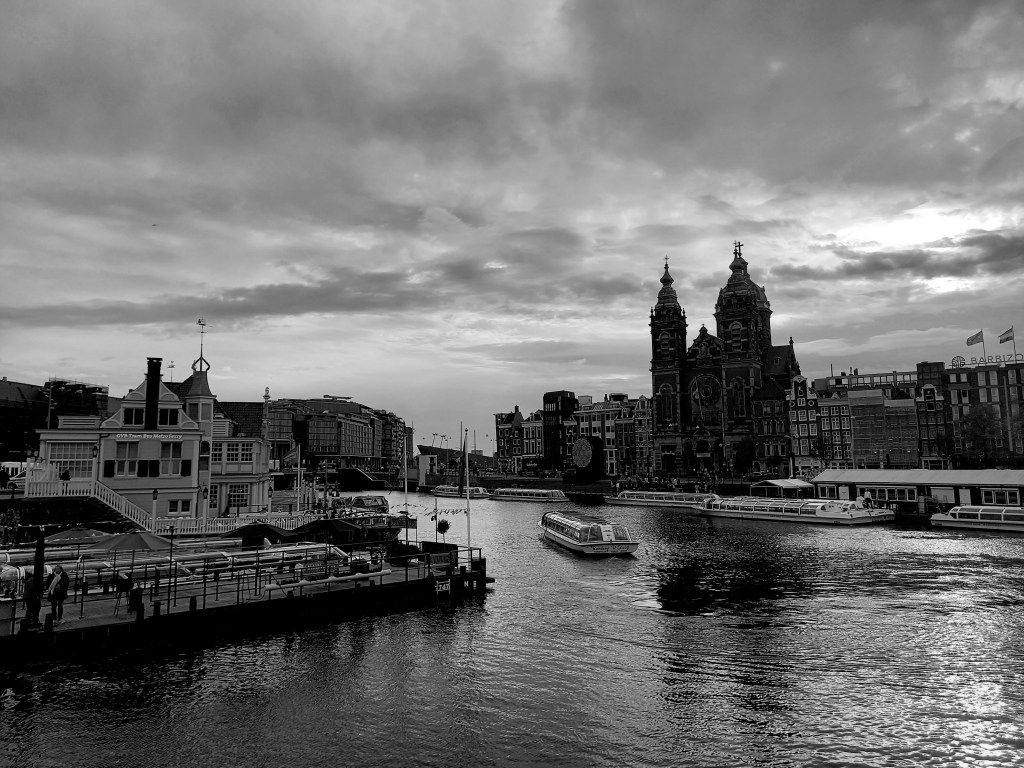
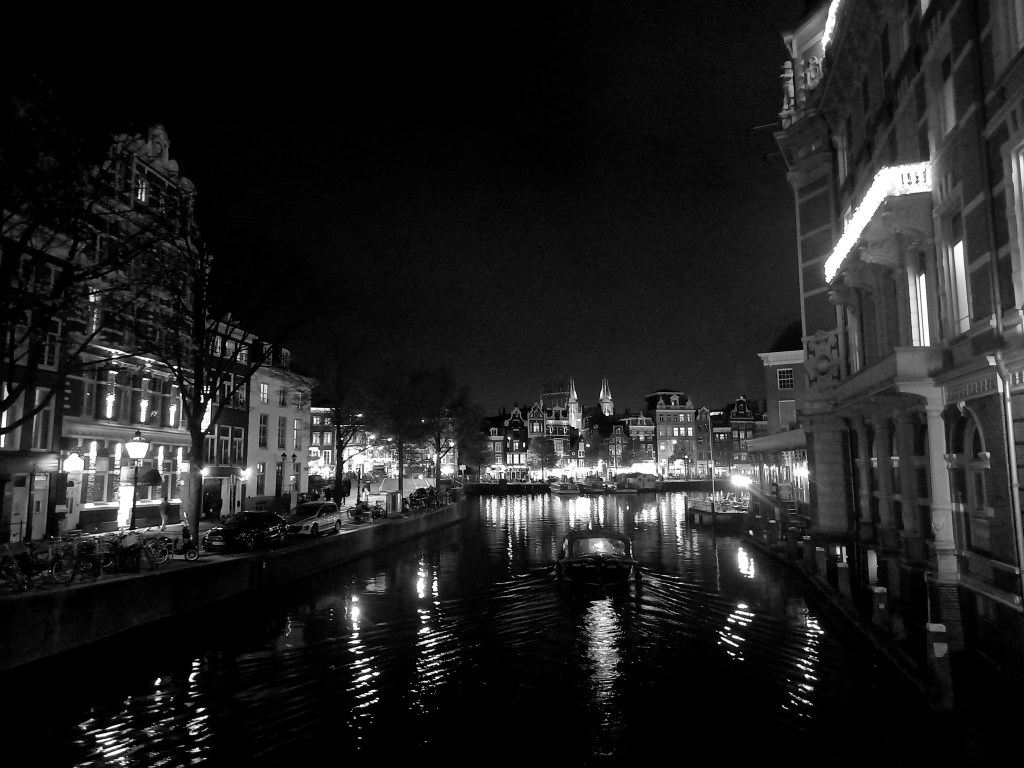
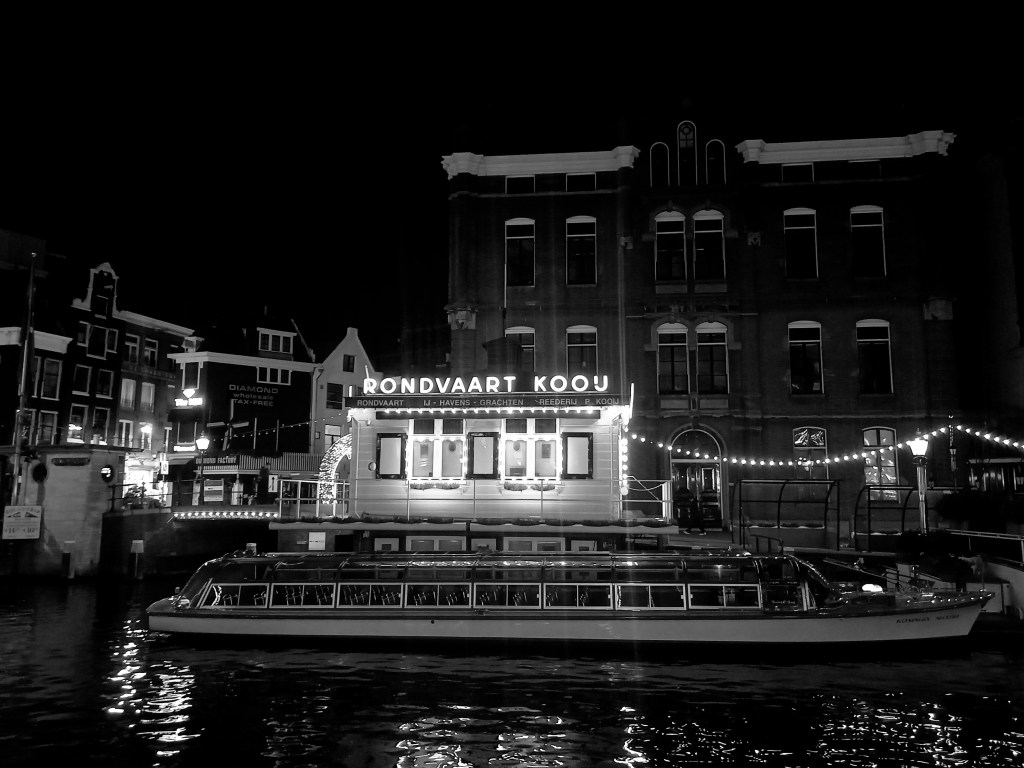
ON OUDEZIJDS ACHTERBURGWAL, a street and canal at the center of De Wallen, Amsterdam’s Red Light District, a woman sits in a window on a Friday morning staring into an overcast late November day. She is dressed only in her bra and panties and her hair hangs loosely about her shoulders. She is a voluptuous, pale character with doll-like features and pink lips and her face reveals a mixture of morning grogginess and utter resignation. This is the face of a woman who has seen everything and done everything, and everyone, and she seems bored by the world.
Upon seeing her from across the canal, I give her a friendly wave and she waves back to me. For a moment, it feels like we are old school chums. There is a sense of camaraderie there. Though I am a writer and not a prostitute, I suppose we are in the same kind of business. We give pieces of ourselves away for financial rewards. My soul is written with words onto paper. Her soul is pressed into flesh. She is someone’s daughter, someone’s sister, maybe a mother.
But this has been her fate, to sit here tiredly selling herself, while my fate is to head off to Rotterdam, to give a talk about what it’s like to be a writer who writes in cafes. I feel disgusted, of course, for myself, for the woman, for the world. I feel disgusted as a man, too. But then I wonder why as people we are so often disgusted with ourselves and with our day-to-day lives. As the weekend crowds line the canals of the Red Light District and the sinister laughter of throngs of British men (and women) echoes up and down the alleys, one can only feel disgust.
This is the heart of the decadent West, a West that we have convinced ourselves is dying every day. The official capital of the European Union is in Brussels, but its spiritual heart might be right here by these old canals with their erotic boutiques, 5D pornographic theatres, and sex workers.
Our revulsion and gloom about our future is only compounded by the migrant crisis and climate change. I recently read an article in The Guardian where it said that only one in five female scientists planned to have children, to spare their would-be offspring this shame of being born. No one else should have to contend with the endless famines, wars, hurricanes and droughts.
They want to save the world and so they choke off its future, as if they were solely responsible for all its sins and misfortunes. As demographers forecast our societies will only shrink more, people turn to animals for companionship. There are social media sites for cat and dog owners where their pets can confirm they’re going to meetups at the park, or share photos in a group chat. I suppose the dogs can wish each other a happy birthday. Because animals are innocent and people are guilty. This is how we have learned to think about ourselves. This is the future we are building for ourselves, an indulgent childless future of pet social media.
But hasn’t it always been like this? This is what I think that morning as I wave to my newfound Dutch friend over the canal. She is certainly not the first woman to live this life or have this fate. There are many others. I pass by them as they prepare for the day. Then I turn the corner.
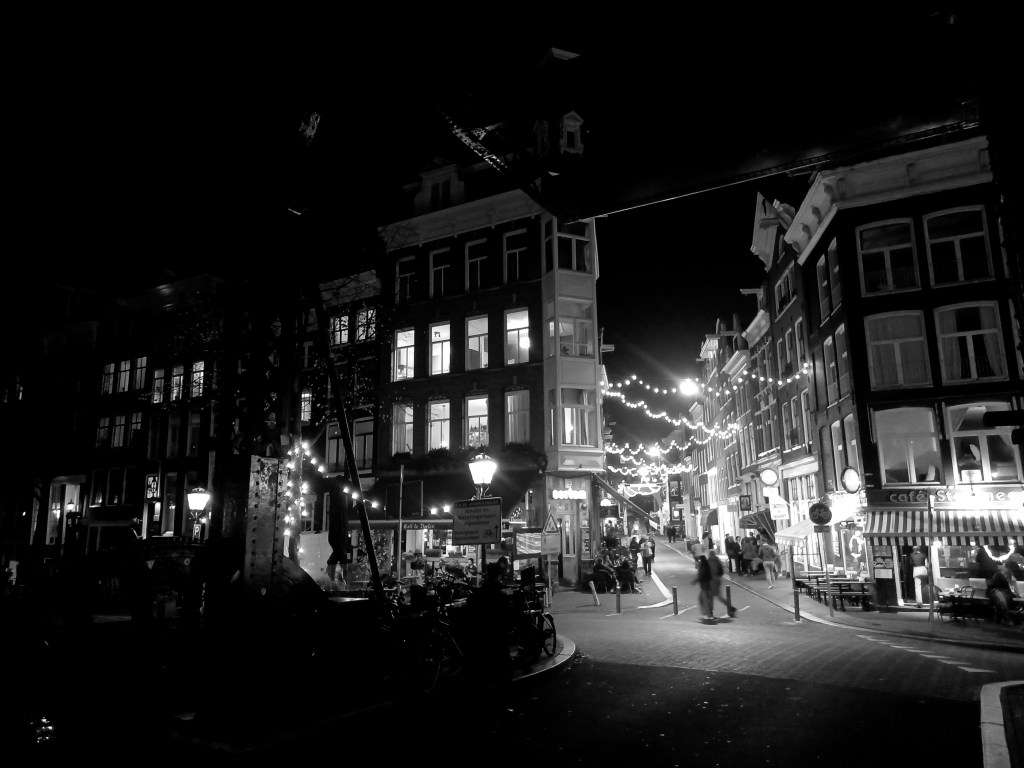
ON THE NEXT MORNING in the Red Light District, the municipal workers sweep up broken glass and soggy french fries and the ravenous seagulls attack piles of trash. This is how yesterday is replaced by today, but the bakeries and cheese vendors are already open, their shops glowing with warm, inviting lights. Life tumbles sleepily forward in Amsterdam, like an old man fumbling for his keys. At night, the city is a hubbub, a bazaar. Whatever you want to eat, you can find it. Whatever you want to see, you can see it. Whatever you want to do, you can probably do it. The Dutch are a tolerant people and that tolerance has become a foundational element of what we call European or Western values. We measure our Westernness according to the number of rainbow-colored Pride flags that hang outside of bars, or by the casual way we smoke cannabis.
We unbutton our top button and walk down Oudezijds Achterburgwal, waving at the women.
We are a free people, we tell ourselves, free people who can do whatever they want and listen to whatever they want. We can spend part of the night in a record shop, as I did, digging through the record bins, engulfed in green marijuana smoke, unearthing treasures by Jamaican and Zydeco bands.
The Western life can be a comfortable life, one where the main existential question is, “How should I spend my Friday night?” Or, “What concert should I go to?” One can just while away the days, in pursuit of personal satisfaction, pleasure, what some call happiness. In corners of the world like Amsterdam’s De Wallen, there are almost no children at all and you can imagine if you close your eyes that they don’t even exist. For many of my friends they don’t. There is an invisible divide between us, I think, those of us who have had children and those who haven’t, and I think we both feel pressured in different ways. When my third child was born, a colleague asked me why I had decided to have one more. “You will never be able to support them on a journalist’s salary,” he said. He was right, but in my mind, that was somehow irrelevant. I took the whole thing to be a kind of godsend or the fulfilment of a prophecy. “Did you expect me to weigh the pros and cons, make an Excel file, and budget for it?” I asked him. “Yes,” he said. “Of course!”
He’s never had any children and so the world of having children was still abstract for him. As it has been for other childless friends, who seem to see kids as something like larger pets, that you can leave at home with a bowl of water for a day or two while you head off to some soiree. Children are an impediment to having fun, a thick wall that walls off happiness. “Every guy I see with a kid is walking down the street, shaking his head and talking to himself,” another friend told me. He hasn’t had children either.
The world for parents among childless friends can be a cold one. “Aren’t you coming to the party?” someone might ask. And then they are disappointed when you can’t, because your daughter is vomiting. They understand that such are the pitfalls of reproduction. They can’t see why someone would voluntarily do it to themselves. Where’s the benefit? Truth be told, it makes no sense. Because if I was to weigh the pros and cons, it would never be the right time to have children. The forces of Western society seem aligned against it. They make it hard in every way.
The West’s days are over, it seems. There’s nothing to do but close up shop, turn out the lights.
But if the ship of the West is sinking into the sea, why not just get our kicks before it slips below the surface?
ON MY LAST NIGHT in Amsterdam, I take a walk to see an old friend. She lives all the way at the end of Vondelpark, which is where my hippie father spent a night sleeping on a bench in 1973. I think about my father as I walk the avenue beyond Leidseplein, which is lined on both sides by restaurants and homes where childless couples watch Netflix while the West slowly dies. In one of these apartments lives an my friend from New York who, like me, attended college in Washington, DC, and later settled in Europe. She has married a Dutchman and has made two Dutch children who are now awaiting Sinterklaas.
Their building is a brutalist masterpiece. Its balconies face an internal courtyard. Outside the doors to the apartments, some boots and toys can be seen. Families have started to move in here, replacing the first generation of inhabitants who had lived in it since it was built in 1961.
That was the year the Berlin Wall went up brick by brick. The next summer, the Cuban Missile Crisis happened. Life must have seemed just as impossibly damned then as it does now. Yet people continued to marry and have children. In 1961, the Netherlands experienced the highest birth rate in recent history, with 3.2 children per woman. But just like in Estonia, the Netherlands are expected to lose people over the next decades. In this massive post-war edifice, young families huddle. They are demographic survivors.
My friend’s family gathers around a table and eats soup and pasta. The little boy, aged three, is dressed in pajamas that resemble a cat. The girl, aged six, is eager to put out her shoe for Sinterklaas, who will reward her with snoep, or candy. My friend’s Dutch life is very different from my Estonian life. She lives in the busiest corner of Europe. I live in the frozen wastes. But we both know the joy of setting out a shoe or slipper for a Christmastime visitor who brings candy.
The family tonight is being visited by a neighbor, a 34-year-old Dutch designer who looks like a woman from a Johannes Vermeer painting. She has red hair and is milky white and once lived in a black neighborhood in Bedford-Stuyvesant in Brooklyn where her neighbor was in a gang. In Amsterdam, she has taken up with a Russian software engineer from Saint Petersburg, and they are expecting their second child. “I only have a few months left,” she says, patting her belly.
This is how new Europeans come into this world.
Later, when I ask my friend about why she decided to have children when so many of our classmates didn’t, she gives a bunch of different reasons. But she also notes that it hasn’t been easy being a mother, that her career has suffered and that academia, even in the progressive Netherlands, is still quite male dominated, and that the women who have secured the best positions for themselves tend to not have children. But she does love her children and she wouldn’t have it any other way, she says. Her main reason for having children appears to have been that she had an awesome amount of love to give and just wanted to give it to someone.
Which, to me, seems like the best reason that a person can have.
EVEN LATER THAT NIGHT, I head back to the Red Light District. Something fascinates me about its stark grotesqueness. I lean up against the Oude Kerk, which has stood since the 13th century, writing in my journal with the hope that the walls of the church will imbue me with more marvellous writing powers. Down the way, some young men negotiate a price with a sex worker. Then I go looking for the woman I saw on the first morning in Amsterdam, the lady in the window. I just want to see her one more time, to wave goodbye to her, to make us both feel like we are human, for just one precious moment. The West may be rotten to its core and in decline. We may all peer out at our futures with that same haggard look of resignation, but I do feel compassion for her as she plies her trade. We are, after all, in the same kind of business.
THE SCENE, an industrial area, a dump, maybe both. Rory Lapp, the acclaimed Estonian writer and poet drives in first, then I follow him, our automobiles follow a set course. It’s almost like we’re rally racing. Yet there are no competitive drivers, just rusting manufacturing waste that brings to mind a mineral processing plant. At some point, Rory leaves his vehicle with a sort of industrial plant valet and I do the same. Then we head into an old building, vast and obviously post-war, with a peeling façade. It’s an auditorium. Light wooden floors. Burgundy curtains.
Inside, everything has been renovated. I can see that we’re in something like a basketball court set up for a party. This is one of those multipurpose halls. There are long tables on both sides, and on stage, an unfamiliar hip hop trio is performing. They are pacing with microphones, trading rhymes, and a DJ spins records in the corner, cutting back and forth. At the head of the tables, I see a familiar-looking man, clean shaven, with a full head of wavy hair. He wears a red button down shirt, open at the top, and looks somehow lost in thought or just unimpressed.
“Who is that?” I ask from one of the partygoers, who is loading his plate from a bowl of potato salad. “He looks just like …” “That’s MCA,” the partygoer responds. “Today is his 61st birthday. Weren’t you invited?” “I guess so,” I say. Now I can see that MCA, also known as Adam Yauch, also known as Nathaniel Hornblower, is at the gifts table, and guests are hovering around him as he unties every last big package. I look down and see I have a gift bag in hand too. It’s full of my own books. “Yauch loved Minu Viljandi,” somebody says. “He’s a great fan of your work.” “He is?” I answer. “I have to say, he looks great for 61,” someone says. “Sixty-one?” another answers. “And I thought he was dead!” “Isn’t he though?” I ask them. But nobody answers.
Slowly I make my way to the busy gift table. MCA is seated there. He still looks like he’s part alien or something. Did the Beastie Boys really smoke so much dope back in the day? Or was it all that Tibetan Buddhism that did that to him? MCA is functioning on some other plane of consciousness. He’s floating around in the Third Bardo. I am afraid to even say hi to him. He’s a big superstar, one of the greatest emcees ever. I’m just … But how did MCA even find out about me? MCA looks up as I hand over my gift. He nods in his good-natured, all knowing way. Kind, sympathetic, brotherly. The man looks as if he’s about to speak. MCA looks up and says …
MAPLE LEAF was one of Estonia’s top drummers. His real name was Vahtraleht, which means “maple leaf” in Estonian, but his nickname was Vaht, which means “foam.” He was, by his 39th year, a seasoned and accomplished percussionist, who had once jammed with Tony Allen, Fela Kuti’s drummer, and Damon Albarn, albeit on congas. He had lived in several communes and had even spent a stint in Trenchtown. His hair was long and maple-colored, as was his beard, and his skin a flawless milk white. Because of this, he was nicknamed “Mormon Jesus” by some of his American friends. He played in three or four ensembles. He changed girlfriends like lightbulbs. It’s not easy to go steady with a mercurial character like Estonia’s own Maple Leaf.
But then he died. It was in a terrible car crash in Germany. Every single vehicle in the crash was German made. I think a BMW collided with his little white Volkswagen. Surprisingly, he survived the impact, but then crawled out onto the autobahn, where he writhed in pain for some time, pleading with God. “No,” he cried. “No!” Then, with a final tapping of his fingers, he expired from this life, and attained musical immortality. His was the kind of face that was spraypainted on the facades of old buildings in Tallinn, Tartu, and Viljandi. The Estonians had always yearned for their own Viktor Tsoi and in Maple Leaf, this had at least been achieved.
In honor of Maple Leaf and his dramatic end, I decided to bake a kind of maple sugar cake. I brought it into the temple that had been erected in his honor. This had been constructed in the same pattern of an ancient Indian temple. I found it incredibly sad that Maple Leaf would no longer play drums anymore. And to die in a car crash in Germany, of all godforsaken places. But nobody ate my cake at the Indian temple. I guess they were just too consumed with grief.
MY DAUGHTER CALLED ME. She said that Uncle Agostino was sick and that he had decided that, for whatever reason, he would soon board a flight to London, where he intended to die. Why he had selected England as his place of moving on to the underworld was unknown to me, but Uncle Agostino was a history buff, and it’s possible he just wanted to see some of its museums before leaving.
At once, I began my sojourn to Uncle Agostino’s house, down by the port. When I arrived, the old man was seated in a chair, dressed up in a Apulian folk costume. The wisps of his white hair poked out from beneath his cap and his arms were crossed. His legs were up on the counter and he seemed quite peaceful, or molto tranquilo, as they say. “Uncle Agostino,” I said, “is it true that you are going to die?” Agostino said nothing, but briefly glanced at me, as if he registered what I was saying. “And why do you want to die in England of all godforsaken places?” Again, there came no answer from caro Uncle Agostino.
My cousin Gabriele was at my side a second later. In fact, the whole house was full of various relatives. His dark hair had grown longer, his skin was tanned from all of the sun. He was in a fine mood despite the somber backdrop. The countertop was submerged in local cuisine. Panzarotti. Orecchiette con cime di rapa. Spaghetti e polpo. “Don’t mind Uncle Agostino,” Gabriele said. “He’s just preparing his soul for his journey to the underworld.” “I can see that.” “But those clothes won’t do for the funeral later,” Gabriele said to me. “You need to get some new Italian clothes. We Italians like to look sharp at funerals.”
Out into the street I went, searching for my wardrobe upgrade. Gabriele was correct. My shoes were worn so thin, they were coming apart. My pants were baggy and covered with stains. Mysteriously, my belt was too long, though there was no evidence that I had lost any weight. My shirt had been bought in India. Indeed, I was the very picture of a beggar. Again I came down by the port, where a ship carrying refugees from Africa had just docked. I stepped over them in my search for new Italian clothes. The sky was a strange, otherworldly pink, and it swirled high above the sleepy Adriatic, full of pulsating yellow-white blobs. It was a kind of Mediterranean aurora borealis.
“This is not Puglia,” I said, observing the sky. “This is somewhere else.” I turned up a street by the port and walked into a restaurant, where another family was celebrating some event, birth, death, marriage, what have you. But I was escorted out on account of my shit attire. Up the street, I found a shop that sold belts, shoes, pants, and for decent prices. There I was, rummaging through the discount bins, trying to look something like a presentable Italian. Again my phone rang. It was my daughter. “Are you coming?” she said. “Uncle Agostino is ready to go to England now. Agostino says he wants you to come with him.”
LINNEA WAS CAROUSING with another man. He looked and dressed like a young PIcasso and called himself “Dan.” I encountered them in an ice cream or gelato joint down on the beach. Linnéa wore a crisp white blouse and her head was an abundant tangle of sun gold beach hair. She was happy and Dan was happy. They were happy together until they saw me. “Oh,” was all Linnéa said, as if she had just been informed of a terrible accident. “Oh.” Dan lifted his cap to her and, before kissing her once on the hand and whispering some passionate phrases, left. Linnéa continued on, “It’s you. But what are you doing here? How is your new book coming along?”
I said nothing and sulked off. Later, Linnéa followed me into my bungalow. She crept up to my bed in the dark and then lied on top of me. Her back was to my front, her hair draped down across my face and breath. “Please write your book,” she said both to the ceiling and to me. “Please keep writing it.” “I don’t feel like writing any more books,” I grumbled. “I think I’m just about done with writing.” “No, no, no,” she whispered to the room. “Don’t let this,” she trailed off and the line lay limp, lifeless, sad, and incomplete. There was nothing to say about it.
Later we walked into town. We came down the promenade. I was still in an awful funk after The Dan Surprise. All of the gloom and jealousy in the world couldn’t make a woman love you, enjoy your company, truly, joyfully, effortlessly. The seaside was gray, hushed. Down a street, the police were breaking up a party that went out of bounds. The official reason was that the music was too loud. A few dark, unhappy partygoers complained to me about this injustice.
“We just wanted to listen to ‘Dancing on the Ceiling,'” one lamented. “Like in the ’80s.” They had strange, purple, almost alien faces.
“It didn’t used to be this way,” I said to Linnéa. “In the old days, you could listen to Lionel Ritchie as much you wanted, as loud as you wanted, and nobody would make you turn it down.” Linnéa was silent. She knew I was talking rubbish. “Again, again, again,” she said. “You again with your silly drama.” Dusk, night, fog, and twilight. Morning beachside melancholy.
DISSOLVING, DREAMING. Shot one: stacks of old furniture arrayed like layer cake. Stacks of old furniture that have decomposed into cake and chocolate and sugar. Cake furniture that can be consumed with a spoon. It’s just as soft and gives way, you can eat a mouthful of it. But it all used to be room furniture. It’s a new way of recycling, of turning old things into dessert.
Shot two: a merry-go-round. A carousel at the sliding glass doors of the Lauttasaari-Drumsö shopping center. It’s evening in Finland, but the light shines on the carousel that spins around and around. She is sitting in one of the merry-go-rounds, the only one there, propelling herself with a steering wheel. She wears a green coat and a red woolen scarf. Why is she looking in my direction? Why is she concerned for me? Why is she not running away like the others? Why have I not been blocked, ignored, and so on? Why do I feel like she won’t leave?
Shot three: she still hasn’t left, even though I have gone several times around the merry-go-round now. The light of the shopping center is on her face. She stands and looks at me. How could she be in Finland if she is in Estonia? She is saying something, but I cannot make out the words. I think she is saying my name. I can see her freckles in the light. I can see her brown hair beneath her cap. I am listening to her. I’m not leaving. Why am I still here? In the distance, there’s a whole dump, a graveyard of furniture converted into chocolate cake. The byproduct of a new kind of technology developed at TalTech that relies on strands of beneficial bacteria.
OUR PLANE had to be diverted to a regional Scandinavian airport on account of sightings of drones or other unidentified flying objects. I was traveling with what I suspected was the legation from the Danish foreign ministry on its way back from the United Nations meeting in New York. I clearly heard one call the other “Jens,” which seemed to settle it for me. They all wore matching navy-colored outfits, perhaps the attire of the diplomatic corps. The plane passed through the clouds in the moonlight. We landed wherever it was we happened to be.
The airline put us up in a hotel that had been built, based on the architecture, in the 1960s or 1970s, or at least designed to look that way, with its angular roofs and big glass windows. It looked like the setting for an ABBA video. As the rest of the hotel was already full, I was given the penthouse suite, which included a loft. The loft had a bathtub directly below a skylight and a sleeping area, while the lower floor had a couch, television and entertainment center, and a kitchenette opening out onto a balcony, from which a series of steps led down to a parking lot.
I was there on the main floor changing into a t-shirt to sleep in when there came a knock at the door. Outside it was dark and misty, and I couldn’t see who was behind the glass. I went over and opened the door, only to be visited by a strange woman in a red cape with the hood up. She slowly pulled back her cloak to reveal her face and her long golden hair. It was Linnéa! “You,” I said, stepping back. “What are you doing here?” Linnéa came into the room, shutting the door behind her. She rushed in like a gust of autumn wind. She said, “We need to talk.”
I looked at her standing there in her red cape. We were all alone in some hotel in Denmark or Norway. Or was it Sweden? This was an ideal moment to finally consummate the relationship. However the night would end, there was no doubt in mind that sex was on the agenda. How could it not be? Sex had always been in the plans, hot, karmic, transcendent sex. Linnéa’s eyes lit up for a brief second as if reading my mind, but otherwise she gave no hint that she was interested in sleeping with me. Instead she asked, “Do you have a place where I can clean up?”
I showed her the ladder to the loft and its big white bathtub. Linnéa climbed the ladder and began to run the water. Soon the steam from the tub was wafting down to the lower level. The steam fogged the windows. I looked up and could see Linnéa standing there in the nude beside the tub, each one of her breasts as pert and round as a cinnamon roll. It occurred to me that I had never seen Linnéa naked before. That was her, in the flesh. “You know,” I yelled up the ladder. “I could use a bath too! Our plane was diverted because of drones.” But Linnéa pretended not to hear me, or maybe she really didn’t hear me. Either way, I left her alone.
At last, thoroughly bathed and refreshed, she descended the same ladder in her red cloak. She went to a bag and pulled out a magazine. I forget the name of the magazine but it was also red and had something to do with the Tallinn arts scene. She ran her fingertips across the glossy magazine cover in an adoring, reverent way. Linnéa had beautiful fingers. She said, “We need someone to help with this new magazine and you’re just the one to help out. You’re such a great writer. I don’t think there’s a better writer in Estonia. Would you please write for us?”
Linnéa was talking but I was leaning in, centimeter by centimeter, more and more, until I was within kissing distance. But Linnéa pushed me away. She only wanted to talk business. There was no time for love. How long would I have to wait then? How long would I have to wait until Linnéa was here beside me? Something about it depressed me. All of these women, they just wanted to work and to do great things. They were so busy doing great things that it seemed that the simple pleasures of life had been forgotten all together. Food was there to fill an empty belly, drink to quench a dry throat. Sex was just sex, you know. But work was important.
“So, what do you think?” Linnéa asked. “Will you help with the magazine?” At that moment, there was another knock at the door and I went to get it. Into the suite poured the rest of the Danish legation from the plane. There were maybe 10 Danes standing around in their matching uniforms from the foreign ministry with bags and suitcases. The one named Jens stepped forward. He said, “I’m so sorry, but we all have to spend the night.” My heart sank. There would be no intimacy. Another opportunity lost. Of course, I agreed to help with the magazine. I’d write a hundred articles for Linnéa’s magazine if that would keep that woman in my orbit. Somehow, some way.
I PICKED UP MY PHONE and dialed. On the other end, one of the servers at the restaurant picked up. “Can I help you?” she asked. “Yes, I would like to speak to Jane,” I said. “Is she in?” “Yes, she’s here,” said the server. Through the phone, I could hear restaurant sounds, glasses clinking, plates dropping, muffled conversations. The phone changed hands with a quick shuffle and I next heard a man’s deep voice there. He said, “Why are you calling my wife tonight?” “We both have our birthdays soon,” I said. “I wanted to celebrate them together.”
Her husband, Frank, was friendly, cordial, and his voice had a warm, smooth, self-assured tone to it. If he suspected anything, or if there was even anything to suspect, it was hidden well behind that natural, mature, sympathetic charm. “Well, that’s a wonderful idea,” he said. “Except that we already celebrated her birthday.” “Oh,” I said. “I see.” Then thinking quickly I responded, “But perhaps you and I could celebrate our birthdays together. At the restaurant?”
“That would be impossible,” said Frank. “Because my birthday is in the spring.” “Isn’t it spring?” I said. I looked out the windows and saw snow falling. “No, it’s fall,” Frank said. “Your birthday is in November. Our birthdays are in the spring, you know that. Are you overtired or something?” I watched the white flakes cascade down and carpet the yard and the adjacent parks and streets. It was fall, for sure, if not winter. “Oh,” I said. “I guess I’ll just have to celebrate my birthday alone,” I told him. “I suppose so,” Frank said. There was a lengthy and moderately uncomfortable pause. “Can I still talk to Jane?” I pressed him. “I really need to talk to her.”
In the background, I could hear Jane talking. She had a recognizable, infectious laugh. I wanted to have a little piece of that joy for my own, if only for some seconds if not minutes. Just a little piece of joy, like a lucky charm. Her daughter’s voice could be heard whispering intensely nearby. She was asking her father a question. “Daddy,” she said. “I’m afraid it’s just not a very good time,” Frank said. “We’re busy.” “I understand,” I told him. “I’ll try again some other day.”

 north!