KLAUDIA AND I went walking along the docks. She stopped into small portside store, but complained about not having any money. She wasn’t in any kind of positive mood and she only had 50 cents to her name. “What am I supposed to buy with 50 cents?” Klaudia said. “Half a candy bar? A bite of a sandwich?” Quickly, I removed my laptop from its case and logged into my bank account with my personal ID card. The transfer happened effortlessly, instantaneously. “You have received €1.50 from so-and-so …” That’s what her notification must have read. It wasn’t an unserious sum of money. With €1.50 one might get a bowl of soup. At least the kind that you make in a cup in the microwave at a harbor convenience store.
We walked on through town. Klaudia was wearing a dark, puffy jacket. Her blonde, lion’s mane of hair was quite moist in the seaside drizzle. It was a maritime kind of place. Boats arriving, boats launching, the smell of chopped up bait and the whiff of luxury yacht interiors. We walked up a hill to an old house and went in. It was a well-preserved, Soviet-style habitation, though the wallpaper was slowly peeling from the walls. Old smelling furniture, old smelling bookcases. A woman sat on a couch watching TV. She was watching Wallace and Gromit.
“See,” I told Klaudia. “This is how people live outside of Tallinn.” “I know how people live outside of Tallinn, there are plenty of places like this in Tallinn anyway,” she said. “You’re right, you’re right,” I said. The old woman had dyed red hair that was white at the roots. She offered us a glass plate full of cookies. “Come and watch TV with me,” she said. “I do get lonely.” There we sat, watching Wallace and Gromit. The couch was comfortable. The film was entertaining. It made Klaudia laugh.
AND THEN ONE DAY, I was working as usual, in my usual café, at my usual table, engrossed in dull, painstaking work, unaware of the time, and when I had last eaten, when I looked over the top of my laptop only to see a lovely Cheshire Cat face peering back at me. It was one it took a moment to recognize, considering I hadn’t seen her in almost two decades. Frida was grinning at me with that big pussycat face of hers. She looked the same as she had in college. She was wearing a white Nader-LaDuke 2000 t-shirt and a bright yellow raincoat. She said, “I came all the way to Estonia from Vancouver to find you,” and, “I brought my mother for protection.”
Frida nodded over her shoulder at her mother, who was wearing a matching yellow raincoat. It was a funny thing, because I didn’t notice it was raining that day. This being Estonia though it was poised to rain one moment or another. Not a day went by without some rainfall, snowfall, or intermediate precipitation. Her mother, a sort of older, grayer version of Frida, with glasses, stood silently behind her. She nodded. “There are some things we need to discuss,” Frida said, leading me away from my desk to the basement. “Different topics we all need to address now.”
I came down the stairs and noticed it had been converted into a comfortable, warmly lit meeting space. There were a few chairs arranged with a table in between them, some tea cups and a pot of tea. But what did we need to talk about? I thought we had talked through everything. What did we need to discuss again? I thought she had sworn to never speak to me, of me, or even think about me in any way again. When Frida had married she had become “the married woman,” engaged in a lifetime’s pursuit of self-censorship and border enforcement.
No other man could come between Frida and her legal partner.
Here we were though, taking seats opposite one another in the basement of an Estonian coffeehouse. They were still wearing their matching yellow raincoats. I was nervous. There was a lot to apologize for. I didn’t know where to start or what an apology could ever be worth. The tea was poured. That’s how that began.
IN STOCKHOLM on a peaceful July day– at last. Bryggartäppan is a children’s playground, the size of one city block approximately, with clusters of leaning red buildings set up to look like an old Swedish village. There’s even a wooden putka here where two fine-looking ladies make coffee for the parents, mostly mothers, even on a Sunday. Tiny birds flit around and one of the sellers is most fetching, a sturdy lass with silver hoop earrings. Her eyes are as blue as the sky and her hair is pulled back. Such Swedish playground baristas are the last respite of the recently divorced father.
But maybe it’s not just her that toys with my senses but that smell of baking waffles, coupled with all of those cream-colored buildings around us. There was even a little yellow fly that landed on my hand before. Have I ever seen an insect that color? Is everything in Stockholm made of gold? “I don’t want water, there’s juice there, there’s some juice over there!” This is what my youngest daughter, age 5, is shrieking in Bryggartäppan. Then she cries aloud in Estonian, “Ma saan nii kurjaks,” “I’m getting so angry!”, and punches her older sister, age 9. Then she begins to sulk and cry. The youngest is wearing a light blue headband from Copenhagen Tiger, and totes around a blue fairy balloon from Gröna Lund, the amusement park. This troubles her older sister. “I told you at the park that I also wanted you to get me a balloon but you didn’t get me one!”
At last the seller returns from making waffles and hands over a box of äppel juice. Quickly, the straw is in the little one’s mouth, and she is quiet for a moment. The other children here are Swedish. They are pale, thin, and have straw-colored hair. They are physically active, and on occasion expressive, but I have not witnessed the kind of seismic outbursts of which our children are so ready and capable. I search our family trees for some culprit — is it their mother’s Komi great grandfather? A plosive mix of Siberian and Greco-Roman blood? — but there is no answer.
The parents here at Bryggartäppan are, as a rule, older. Perhaps a few of them are actually grandparents. Swedes are a peculiar breed though. They are married to modernity. They are infatuated with their perfect civilized society, yet so haunted and repressed by this civilizational impulse that they have the emotional temperament of office wallpaper. They hide away their thoughts, dreams, dark sides behind apartment doors, sunglasses, and politely phrased, thoughtful sentences that implore only moderation. Rows and rows of perfectly symmetrical apartment windows, cascades of identical balconies, rising up and up and up, peaking in crescendos of tiled roofs and towers. The pursuit of wealth, the proper means to express it, these are the chief concerns of the Stockholm Swedes. Everything here must be perfect. A little girl with her face painted and her hair done up in cornrows goes skipping by, and another waits patiently for the five year old to dismount a small rocking horse. When she does get off the horse she sulks again and then announces to the lot, “I am so bored!” To which a little boy nearby, who understands English, chides her. “Be quiet,” he says. “You’re acting like a baby.” “I am not,” she says, and smacks at the air with her balloon. “I am not a baby,” the five year old sobs and then takes her apple juice and squeezes the liquid all over her older sister’s drawing on a table beside the playground café. “You are bad!” the nine year old scolds her, to which she only shouts, “I’m not bad!” “You poured juice on my picture — that’s bad.” “I did not.” “You did too.” “Tegid küll.” “Ei teinud. SA VALETAD!” “YOU LIE!” These are perhaps the loudest sentences that have been uttered on Swedish soil since Estonian pirates sacked the old Swedish capital Sigtuna in 1187. There are lots of pregnant Scandinavians in the park here today, paging through magazines and pretending not to hear this terrible squall. Their days will come.
“Here’s an idea for a good life,” my Swedish pal Erland said yesterday, skulking around the Pressbyrån at Slussen with his hands in his pockets and harbor wind in his hair. “Meet a girl, have a bunch of kids with her,” he said. “Then you can all be wonderfully miserable together for a few years. Doesn’t that just sound like the greatest idea?”
STORA BLECKTORNSPARKEN is an urban park a bit farther south on Södermalm with the same kinds of Bullerby buildings as Bryggartäppan. There is more graffiti here, though, and shreds of rubbish, broken glass shards, fruit peels, chipped paint and rust, the illusion of safety. “Dad? Dad? Dad!” “What?” “Look what I can do!” The nine year old swings away as the five year old arrives, panting. “Daddy, my knee hurts, look what happened. I slipped on the rocks.” I survey the wound only to be interrupted by, “Dad? Dad? Dad! Watch me swing!” And she swings higher and higher. Mothers sit around us tinkering with their phones. More wonderful park birds flit about. It feels good to breathe and write in Stockholm. To write without any project or desire for money. Just writing with feeling, without that evil thought looking over your shoulder, the one that says that every word has to count toward something. But maybe that thought came from the office or from some editor. Maybe it was never my thought to begin with.
“When you are with someone, you become someone else,” says Erland. “You change yourself. When I was with Henrietta I was someone else. And when I was with Agnetha I was someone different from that person. And when I was with Gunnhildur, that Icelandic football player, I was also someone else.” Erland has been a lot of people. “Dad? Dad? Dad! Come here, help me off this swing. Come, Dad. Come!” These children. They so crave my attention. If I only had some time off I could be such a better father to them. I could never have any more children. Not now. I would go crazy. That would just be the end of the story. Not with these thin Swedish women. Not a chance. Although the lady who made me coffee was rather nice and might get me to reconsider, especially if she turns out to be some Zelda Fitzgerald type who can ruin me and provide me with loads of material about her schizophrenia. This playground is a madhouse. All the sobbing, crying children. All the childhood drama and trauma. The pale thin mothers call after their offspring, their barn. One of the children steals the five year old’s balloon and I have to run after him and take it back, causing a puzzled look from the toddler, who thought the balloon was his.
In the meantime, a mouse ran over the nine year old’s shoes at the bottom of the slide. The parents here all look at each other. I suppose this is one way to pass the time at a playground on a hot day. A Muslim family arrives, the mother’s head covered, the daughters bare to the sun. They look truly happy, content, and I sense no disturbance or cultural conflict. The Swedes don’t dress so differently from Americans. They seem maybe more capitalistic though. A Swede is the sum of all he or she consumes. The patterned dresses, the well-groomed facial hair. A barber shop stands on every other corner, catering to the perfectionism of the Swedish man. The women shop for dresses at the boutiques in between. One must exude one’s wealth and value. A haircut, a shave, a flowing cut of textile, this is worth nothing alone. It’s the effort that goes into being Swedish. This is what pays the real dividends.
At night, we find ourselves at another playground nearby on Nytorget. Teenagers stand among the benches singing songs and playing ukuleles. “Södermalm is like the best place ever,” my nine year old says. “There is no traffic, the houses are pretty, and everyone has time to do whatever they want.” This is the fun of a playground in the dusky twilight of midnight in Stockholm. As the children play on, and the ukuleles strum, and I admire the lights from the cafes around the park, I read a sign about local history. This was once the site of a large garbage heap, it reads. And in the 18th century it also was the location of the gallows and a major site of public executions. I wish I could have seen Stockholm then when it was rough and tumble and full of pickpockets and convicts, truants and robbers, counterfeiters, highwaymen, gentlemen of the day and ladies of the night. Before the boutiques and barbers, there were wards of the state sentenced to hard time. Looking around nighttime Nytorget, this seems impossible. It’s as if it never happened.
ON KATARINA KYRKOBACKE, at 8:30 am or thereabouts. A small street winding with the cool air through the bluffs of Södermalm, damp and refreshing, creamy houses with mustardy finishes and black stovetop pipes protruding, cobblestones and fine hemmed in trees. These give way to red wooden dwellings with toys and yellow flowers in the windows and everywhere that faint chirping of Stockholm birds. In the distance the roar of construction by the locks of Slussen winds up. Outside a school, a father is gently combing through his daughter’s white-platinum hair and a black car breaks the silence, its wheels finessing the stones of the road. A man in a flat cap jaunts by, clears his throat loudly, spits on the street. Despite this, there is the feel of polished cleanliness everywhere, that well-to-do feeling, as if the Swedes have always known wealth and wealth is all they’ve ever known.
Back at the hotel, we have a good breakfast of scrambled eggs with chives and onions, big bowls of yogurt, dried banana, crisp dried coconuts, and three cups of the finest coffee there is. “Of course, you drink more coffee here,” says Erland, a steaming mug in his hands. “You’re in Sweden.” He says it as if we have all died and gone to heaven. This Swedish angel is proud of his homeland. He even approves of its bike paths and pedestrian walks. “It’s not like in Estonia where BMWs and Lexuses blow by you, splashing you with water,” he says bitterly. I am surprised he chooses to recall the makes of the cars, but Sweden is old money and the Estonians are nouveau riche. It’s that old old money, new money thing, along with some shared hand-me-down of clumsy woodsman’s poverty. I feel blessed to be here. I remember my first trip to Stockholm in ’01, staring up at the wreck of the Vasa in the VasaMuseet, a museum I had read about in a children’s book my grandparents once gave me but never expected to see with my own two eyes. After breakfast, we head to the Nordiska Museet, where my children make for the playroom first and never really leave, hoisting toy wooden buckets into an old make-pretend farm.
Maybe it wouldn’t be so bad to stay in Sweden, I consider, to elope with that redhead from the Pressbyrån in Slussen, to lie beside her at night, listening to ship’s horns in the harbor, and hear of the inner workings of this marvelous convenience store. “We were out of Maribou chocolate.” “It was time to refill the cups.” To lie sprawled in bed sheets with a woman who reeks of cinnamon buns, kanelbulle. In the mornings, she is off to the shop, to prepare the coffee, stor cappuccino, lite cappuccino, the whir of the machine, and there she is again behind the counter, processing people’s payments in her blue shirt and saying, varsågod. The blue of her shirt brings out the blue of her eyes, just like the water licks at the docks of Östermalm where we step off a boat later and are surprised by the golden glitz of the gilded Royal Drama Theatre.
I keep processing this idea for a children’s book, about a Stockholm teenage girl with a ne’er-do-well father who turns to petty theft to make ends meet. Then one day she is caught and sent away to Långholmen, the old prison island down the harbor. I play with this idea all the way to the ship that takes us back to Estonia, the front bar of which has been permanently converted into a playroom. The five year old’s balloon is still with us, believe it or not, this artifact from Gröna Lund. It may be the best balloon we have known collectively in all of our lives. It cannot be lost, deflated, or stolen. In the playroom, they play Estonian children’s disco music, oi-oi-oi, ai-ai-ai, a strobe light projects dancing rainbows across the floor, and I take a seat beside a Swedish mother whose hair is a mess and is probably as full of ice cream as mine is. She looks to be about as tired as I am, sapped, haggard, and so hungover by life. This is how we set sail on a gray day to face our decisions and memories.
More or less directly transcribed from a notebook I kept in the summer of 2017.
“HONEY,” SHE SAID. “I want to see if that tree will work over here.” We had bought a new house at the end of a road all the way out in the far north woods. But she said there wasn’t enough greenery up front to block out intrusive neighborly eyes. Her solution was to uproot a tree from another property and replant it on our own. You can imagine how much I grumbled doing this. It was one thing for someone to tell you to replant a tree, it was another thing to do it, even knowing that its position might not be satisfactory and that I might have to do it again.
Instead, I dug a hole and held the tree in place while she went out and examined it from different angles. The tree, an Estonian pine, was as tall as a Manhattan skyscraper. It just went up and up into the clouds, and it was very hard to keep erect. It would tilt from one side to another, its trunk was heavy, and, in a moment of distraction, I let the pine slip and watched it with some horror crash into the corrugated metal roof of a nearby house. Its sole inhabitant, an old woman with white hair held back in a headscarf, came out and surveyed the damage.
The old gray granny whistled loudly.
With enough strength, I was able to position the tree in the hole again, holding it aloft through sheer exertion so the lady of the house could at last decide if this was a suitable location. But by this time, the lady of the house had disappeared to somewhere to inquire about acquiring some rhododendrons. The tree, frustrated by the whole scene, wilted at this moment, drooping over like an unhappy flower. “There there,” I told the pine tree. “No need to get upset.” It was no use, in a flash the tree removed itself from my hands and ran quickly away.
Into the woods, I assume.
When the lady of the house returned she asked about the tree. “What kind of man loses a pine tree?” she scolded me. “Only you could lose a whole pine!” I told her that the pine tree was upset. It had been waiting to be replanted all day. “Very well then,” she said. Our daughters gathered around her and she went to the barrel sauna, immersing herself in its bubbling waters. Then, pounding upon the surface of the waters, she began to chant. “I know how to retrieve lost trees!” she said. The children watched their mother with some alarm. But soon enough the tree came out of its hiding place in the woods. Begrudgingly, meekly, sheepishly. Arborescently.
I DON’T RECALL the immediate circumstances around how I ingratiated myself with Dulcinea’s parents. What I do know is that at some point we became quite good friends if not just neighborhood acquaintances, and I would bring my daughter there to their house to watch TV with her younger siblings. I felt like a maniac, of course, though my best self-analysis yielded nothing. My motives remained a mystery. In the process of suppressing and lying to myself about what I had truly wanted from her, and from life in general, I had arrived at a strange situation where my own desires and feelings were obscured, inaccessible. Supposedly, this was for her own benefit, but as I was about to discover, it only made things much worse.
Things came to a head when her father, a bearded, fisherman-looking type, confronted me about the small pile of literature I had amassed, my so-called Dulcinea stories. “You,” he said shaking his head at me doubtfully, “I am just in shock, pure shock,” he said. He went into the back room to inform his wife, Dulcinea’s mother, that the “family friend” who was hanging around had been secretly in love with their daughter. “You,” he said again, shaking that head. “You are old enough to be her father!” “Technically, yes,” I said. “If we lived in a pre-industrial, illiterate society then maybe. It’s not all so black and white.” “I’m not going to be the judge of that,” her father said. “I’m going to let law enforcement take care of it.” “But nothing happened!” I repeated. “I just wrote some stories. It’s all just literature. Literary Fiction!”
After that, I quickly left the house with my daughter. She couldn’t understand why she was being dragged away from a comfortable couch and ushered into the back of a car and we began to drive as fast as we could. The police were after me for my ill-fortuned, undying love of Dulcinea. Her parents were incensed. But what was I supposed to do? She wasn’t a child, far from it. Why, maybe some women her age were already grandmothers in illiterate, pre-industrial societies somewhere. Whatever I told myself, it didn’t matter. I had been found out. This had been a particularly cursed case of unrequited love.
On the way down the country road from their country estate, I noticed a change in scenery and greenery. Suddenly, we weren’t in Estonia at all, but back on Long Island. I realized then, that this was Equestrian Court, so-called because an old horse farm where a young Justin once went riding many decades ago was still visible from its back decks and terraces. That was Will Hooker’s house over there and Zimmerman lived right there at the end of the street. Across the way, the O’Malleys with their many children. Everything had changed. The trees had grown so tall, I felt as if I was standing in an old-growth forest. The neighbors were bickering. Someone had neglected to mow their lawn, someone had skipped tree duty. The wind picked up and the snow began to fall. Stony Brook had become Narnia. “Where are we?” my daughter asked me from the backseat. “I don’t even know anymore,” I said, blinking. “I don’t even know.”
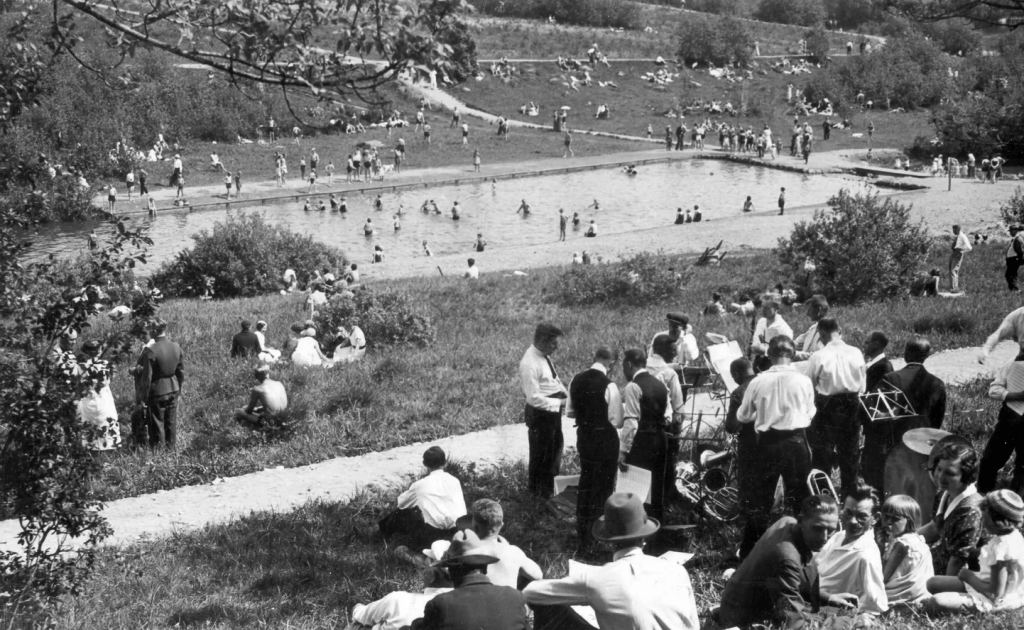
Those were the days. Viljandi’s Uueveski Valley in 1930.
FOR DAYS, IF NOT A WEEK, I had been planning to meet with Heiki to talk about Uueveski org or, as I call it, Uueveski Park. To me, it’s clear that this large natural area just adjacent to the center of the town is a town park, but on maps it is merely marked as an org or valley, as if it’s such a natural place that it has not yet been fenced in and given something like an official name or status. I had written to Heiki inquiring about the origins of this place and had been told we would have to meet face to face. Such information needed to be communicated in person, he said. This meeting of the minds proved elusive. I was in Tallinn or Tartu, or just too tired. The discussion of the valley’s origins was pushed off. Then one day at the supermarket, Heiki appeared with a basket in hand. It was one of those Viljandi moments, when the person you’ve been planning to see appears effortlessly, as if by magic. I had almost completely forgotten about Uueveski. There he was, ready to instruct. Heiki comes off as wily, clever. He seems to know who lived in each apartment and how they got along with their neighbors. Heiki just has a nose for these things.
In a few minutes, Heiki recounted the history of this sleepy place, which has belonged to the town for all of living memory and into which a series of swimming pools were built back in the 1930s. At that time, Viljandi Lake was a less attractive swimming hole, as it was full of pasture run-off. The pools on the stream that feeds Viljandi’s least known waterbody, Kösti Lake, were clean and cool and more appealing. There are photos of Viljandiers in old-time swimsuits having a wonderful time. These days it’s rare to see someone taking a dip in the pools, some of which have been renovated, but I have been told that vipers like to sun themselves on the stream’s banks. Each time I walk around those pools, I keep an eye out for those vipers.
When I first lived in Viljandi, some 15 years ago, I never visited Uueveski. I’m not sure why. Maybe because my children were small and I was a house husband. Viljandi to me at that time seemed like the Castle Ruins, the Green House Cafe, and maybe the Statoil on the way into town. There was no Uku shopping center then, there was no Kodukohvik, and there was definitely no Asia Billa Nepalese restaurant. During the pandemic, Uueveski Valley became a close refuge for me. It’s a shady, peaceful place. Many times I have found myself standing on one side of that bubbling stream, which they call the “Uueveski River,” wondering if it would be possible to cross it. There are some places where it seems possible, where the rocks are aligned in an almost perfect bridge. Yet I never attempt it. When I was a boy, I would have done it many times by now, but I lack that childhood bravery I once had. One of these days though I am going to try to traverse the stream, even if I get wet. Even if everyone here sees.
On the other side of the stream, closer to the Forest Cemetery, or Metsakalmistu, there’s a series of large villas that bring to mind the chalets of the French or Swiss Alps. For this reason, I have nicknamed this neighborhood “Little Switzerland.” I have no idea who lives in these palatial residences. Sometimes I see little blond children bouncing on trampolines from a far distance. These must be Swiss children, I think. Their fathers and mothers are involved in money laundering. For breakfast, bowls of müsli. For an afternoon snack, bars of Toblerone. In the evenings, they participate in mandatory military training in the grassy hills up there.
The great green lawn in front of Viljandi’s Little Switzerland is so long it must be trimmed by a robot. One day, I went there with my daughter’s dog, who eyed the robotic lawnmower with curiosity and suspicion. Back and forth it scuttled, like some kind of metallic crab, and the dog didn’t know if it should bark and chase it or not. In the end, we just walked on to the old mill.
I wonder who lives in those large chalets. I wonder who the Uueveski Valley Swiss even are. This is a town of hairdressers, of small shop owners, of cafe cashiers. Who are these wealthy denizens of Little Switzerland? Like so much of Viljandi, their stories remain hidden behind fences, trees, curtains. Northern European anonymity creates these kinds of funny fantasies. If you don’t know who your neighbors are, or what they do, then you just have to imagine it all.
Even if the Viljandi Swiss remain apart and mysterious, there are other friends to be made in the valley. Recently, I was walking up the hillside on the other side of the park when two squirrels came bounding in my direction. In New York where I grew up we have fat and lazy, overly satisfied gray squirrels, and in Washington, where I went to college, there are even social black squirrels lounging by the park benches. But these daredevil red squirrels are a feature of the Northern European forests, with their pointy ears and frisky, energetic pace.
Spending more time in nature, I have come to see the animals here as other people. They may not speak to me in a language that I can understand, but I can communicate with them. All around Viljandi, I’ve had run-ins with foxes, for example, who sometimes pause and watch me knowingly, as if they were my guardian angels. Then there are the poor, lost little hedgehogs, who never seem to know where they are going or why. These Uueveski squirrels were busy bodies. They chased each other around the base of an enormous pine. When they saw me, the squirrels froze. For a moment there, we all blinked at each other. Then they looked back at each other as if to say, What is this stranger doing here in our forest? For the Uueveski squirrels, we’re all just intrusive strangers. In their devilish little minds, they own the place. Maybe they do.
An Estonian version of this article, translated by Triin Loide, appeared in Sakala this week.
I USED TO TAKE THE TRAIN from Albertslund to Copenhagen Central Station, or Københavns Hovedbanegård, on the line that if you took it west, led all the way out to Høje Taastrup. I remember those sleepy gray mornings staring out the windows at sad-looking greenery and gray blue shadows on the trestles and tracks. At some point they must have created a similar environment as a part of the Rail Baltica project, because just yesterday I took a train that looked just like the Danish one from Pärnu to Tartu. When the Pärnu-Tartu train stopped at Viljandi, a host of Argentinian and Chilean musicians got on. From there we traveled east to Tartu, and again I stared out of the windows into that melancholy light, listening to the gentle lullaby of a slowly rocking northern train as it mechanically glided ever forward to infinity.
I must have fallen asleep, because by the time I opened my eyes, I was westbound again, rolling across the green plains outside of Tartu City. About 25 kilometers outside of town, I disembarked, not sure if I should just try to walk the distance, or if I should take a Bolt or even hitchhike. To my surprise, a music festival was being set up here, and there were a lot of people streaming out of the train and ambling down the steps to the dirt paths that led to a small country village. Celeste had even come with her children, although these “children” looked more like dolls. There she was, eyeing me with her blue eyes in small portions, while she combed the hair of her doll children. She was wearing a light blue summertime dress.
The dress seemed to blend into the sky with its clouds behind her.
At the center of the village, there was a church, just like all of the old churches that you can find out in the countryside. Inside, the pews were already filling up. There were two other priests waiting at the doorway. One of them looked like Pope Leo. He said, “Which one of us wants to be the first to start hearing confessions?” I volunteered and made my way down the aisle to the confession booth as everyone watched. It occurred to me that I wasn’t wearing a cassock or any other item that would represent the priesthood and that I didn’t even have a cross on my body and that I wasn’t quite sure if Jesus was the son of God, as they said. The Holy Trinity was a mystery to me still, but when Pope Leo commands, what else is there to do? Then, crossing myself in a brief moment of religious courtesy, I opened the door and went in.
I WAS TRYING to find some laundry detergent. That’s really how that whole story started. Someone had, after many years, returned to me a box of clothes, including precious and once-prized pairs of pajamas. The light blue ones with little golden anchors on them that reminded me of Popeye, and the rougher-textured wool ones, with the polar bear print. At the supermarket at the Baltic Station, where the dead-eyed cashier ladies never even so much as acknowledge your very existence, I searched the aisles. While I was trying to make up my mind between Mulieres and Mayeri I passed the media stand. And that’s where I saw it, gleaming to me among the tabloids, newspapers, and glossy magazines about the USSR.
Skiing with the Dead: Stavanger ’72.
What the hell was this? Its cover was a color photograph of the Grateful Dead with the cool, clean and white Scandinavian mountains beyond them. There were some ski chalets in the distance, a period lift. Mickey Hart the drummer was out in front with his headband and dark mustache. Jerry Garcia was behind him. Jerry had on a big wool hat that was incapable of covering all of his bushy black hair. He was smiling. Of course, he was smiling. Why wouldn’t Jerry be smiling while he was skiing at one of the Norwegian resorts. I knew that the Dead had gone on tour in Europe in ’72 and had even recorded an album called Europe ’72. But I didn’t know that the Grateful Dead had ventured as far north as Norway or that they even skied.
This was a strange new discovery. A new chapter in Dead lore. Did Jeff Tamarkin know about this? I beheld this fascinating magazine and skimmed its contents. There was an article about how Phil Lesh dosed the band before they got to the to the famed Bjorli Ski Center, and a recent interview with the other drummer Bill Kreutzman about a long-sought after bootleg recording they did up in the mountains called Trippin’ on the Slopes: the Bjorli Sessions. I shook my head. I thought I knew everything there was to know about the Dead. I was very wrong.
At that moment, an older hippie with gray hair and sunglasses happened to walk past me in the Baltic Station supermarket. You know the type, a watered down version of George Carlin in his black sweater years. He had a basket full of produce. He said, “What are you looking at there, young man?” I showed him the glossy magazine. “Did you know that the Dead played shows in Norway in ’72?” I told the hippie. “They went skiing! Can you imagine? Jerry on skis!” “Of course,” the hippie told me. “I was there, man. Skiing. LSD. Norwegians. It was far out.”
BEFORE I GO ANY FURTHER, I should tell you more about Montrone and Canneto, these two towns outside of Bari that have grown together. For centuries they remained apart, distant, at arm’s length, and in fact they maintained two very different dialects. One of the towns hosted a Norman French garrison in the 11th century, and its dialect was therefore influenced by French. The other was settled by Greek refugees in the 10th century, and its dialect was infused with Greek. Cousin Lorenzo says it’s possible to tell someone from Montrone, a montronese, from someone from Canneto, a cannetano, by the way they say the word for “bread.”
“They say, u pan,” says Lorenzo. “But we montronese say u pen.“
The official word for bread in Italian is pane. In French, it’s pain. So the local dialect word, which is common in the dialects around Bari, called barese, is a bit closer to French. To me both of the versions sound almost exactly the same. U pan, u pen. U pen, u pan. U pan …
There are these tiny differences, you see. But a single vowel can give away your identity.
One must realize that the country or nation of Italy is largely a fiction, or at least a coincidence of geography. Every region, every city, every town, even every neighborhood has its own history and its own dialect, many of which are so unintelligible to outsiders that they are considered their own languages. It is said that the singer Frank Sinatra’s mother, Natalina, who played a role in local politics in Hoboken, New Jersey, where Sinatra was born and raised, was successful in part because she could speak all the dialects of the Italian peninsula. This made her indispensable when dealing with the immigrants who thronged New York City a century ago, people like my great grandfather Domenico Abbatecola, who was from Bari, or my father’s grandfather, Salvatore Petrone, who came from a village in Calabria. Even during my first trip to Italy, at the age of 22, I became aware of the language issue when I was stopped by an older man with a white mustache from Palermo on a street in Bologna. He was looking for the train station. People had responded to him in the Bolognese dialect. He was unable to understand their directions. “I can’t understand a word these people say,” the old Sicilian told me that day.
How odd then, that I could understand him. When I was 22, I really didn’t speak Italian at all.
Now and then I replay that moment over and over in my mind. How did I understand him?
***
FROM THE PORT OF BARI, where the ships leave for the ports of Bar in Montenegro, Dürres in Albania, and Dubrovnik in Croatia, it is about 15 straight kilometers south into Montrone and Canneto. These towns, however, no longer appear on maps because in 1927 they were united into one municipality called Adelfia, from the Greek word αδελφός (adelphos), “brother.”
On a map, at least, the Montrone and Canneto sections of Adelfia are distinguishable. Canneto, to the west, with its ancient Torre Normana, or Norman Tower, is the larger of the settlements. Montrone is the sleepier, eastern side of Adelfia. The main landmark here is the public gardens, with its Fontana dell’emigrante, or Fountain of Emigrants, which is a fitting name because my great grandfather Domenico was born and grew up right across the street.
Just a few houses down, there is a little cafe called the Pasticceria Caffetteria Petrone, where you can get a pastry and an espresso in the morning. There is nothing better than waking to the sounds of the church bells, or to the neverending calls of the people in the streets, and walking to the Caffeteria Petrone. The owner, as far as I know, is not a relative, and is from Naples. There are many Petrones in southern Italy, and we are not all close relatives. There, you take your place at the counter, and wait for that little white cup to arrive. Everyone is here, the dentist, the postman, the cosmetologist. And even if they don’t know you, they still know you. The eyes search each other, the cup is lifted, and you are wished a buon giorno.
“Good morning,” or, actually, “good day.”
This is how the montronesi start their days, and just a few hundred meters down the Via Vittorio Veneto, and over the old aqueduct, the mornings of the cannetani are much the same. Only that they call bread u pan and the montronesi call bread u pen. There are other divisions. For example, no one in these two towns can agree on exactly where the border between them lies. This I was told one night, strolling around with cousin Lorenzo. While the aqueduct seems like a natural boundary, only the people from Canneto believe that. The montronesi say the boundary between the towns is really a column on an old building just over the bridge. “This is where Montrone really ends,” said Lorenzo one night as we paraded around the old lanes of Montrone, venturing into disputed territory. “Beyond this point, they say u pan and not u pen. Beyond this point, you are dealing with the cannetani, who speak a very different dialect.”
He gestured quickly with his head, as if these people, the cannetani, were an alien race.
***
I DON’T KNOW how old my Italian cousin Lorenzo is, and I have never asked, but I assume he is about my age. At the time we first met, he was working for a software company that designs platforms for managing airports. He had returned to Bari after many years in Rome and he was single and had decided on something of a career change, to go into academia after a life in the private sector. I cannot fully understand how the Italian economy even works because I only see these people eating and meeting with family members, but during the working hours, they do disappear someplace, to do at least some work, just a little, before returning to the table.
Lorenzo’s father, Giuseppe, works in agriculture, a job he quite enjoys. In the evenings, he heads out to the piazza in Adelfia to play cards and share stories with old friends. Night after night, the old men are out there in their caps talking and making noise. At night, Italy is even livelier than during the day and I am always impressed to see the offices of the country’s political parties on the piazzas in the evenings, the windows lit up, and people seated around inside eating pasta together. They are more like social clubs than real political parties. In the US, they would be outside with signs, yelling at each other. In Adelfia, the only thing they yell is something like, “Would you please pass the bread?” Or, “How about another espresso?”
Lorenzo against this backdrop casts a more lonesome, stark figure. He is tall, dark-haired, at times silent, at times with great humor. He is instantly likeable. Some people just have this kind of quality. You can’t help but like them. While his career path is in mathematics and science, he loves to talk about traditions and he is very thoroughly grounded in the local culture. That same night we went out to see the disputed border between Canneto and Montrone, we also stopped into a church to light a candle and view the shrine to San Trifone, the patron of Adelfia. The interior of the Church of Saint Nicholas of Bari and Saint Tryphon Martyr is beautiful. Its high ceilings are covered with pastel blue and frescoes, triumphant angels, and nativity scenes. And beneath all of this color moved a figure clothed in black named Lorenzo.
I cannot say that Lorenzo is a nationalist, because how could a montronese belong to a nation? Italians are not a nation in this sense, they are a combination of many now forgotten peoples, mingling on the soils of this land over generations. The Greeks, the French, the Albanians, the Visigoths. But Lorenzo is proud of the south and of his home here in southern Italy, and is sensitive to the stereotypes about the southerners that pervade Italy, and elsewhere, that they are dangerous, criminal, and violent. He also likes to talk about history, and how Bari and adjacent areas of Italy were sacked and plundered by foreign armies. In the 9th century, Islamic invaders created the Emirate of Bari, but just a handful of years later the Byzantines took it back from the Ottoman Turks. Then, in 1071, Robert Guiscard and his swashbuckling Norman adventurers swooped in. Among other feats, they built the Norman Tower right here.
Not only the tower remains, but the blue eyes and light hair that exists to this day among some of the inhabitants of Adelfia are a reminder of these Normans. My great grandfather Domenico also had blue eyes as does my mother Christine. As do two of my three children. As a child, it linked my mom and her towering Italian grandfather. He would look down and say, “Our people came from the north.”
“For centuries, Italians were subjected to invasion after foreign invasion,” Lorenzo told me that night. “Only in 1860 were we able to stop being picked apart and fought over by others. Then came the risorgimento, the unification under Giuseppe Garibaldi. Some say that it was a unification, but others say that the piedmontese just annexed the rest of Italy. They helped themselves to the resources and labor of the south, but they think that we are criminals.”
“But my grandfather Petrone, my father’s father, said that our people were criminals,” I insisted. “I have heard that Calabria, where the Petrones were from, was legendary for its banditry.”
“No, no the Calabrese weren’t bandits,” said Lorenzo. They were briganti. Brigantines! They were a movement, trying to wake up the north, to tell them what was going on in Italy.”
Such were the lectures of my cousin Lorenzo. He seemed offended that I would even suggest that our countrymen were anything other than noble Robin Hoods, stealing from the rich to give to the poor, fighting the powerful and wealthy families of the north by flouting their laws and creating their own codes of justice. One man’s brigantine was another man’s criminal. His body language was subdued though. Lorenzo is not your stereotypical Italian who argues loudly, flailing his arms. It’s hard to imagine him yelling out a car window while pounding away on his horn. But in his quiet certainty about the nature of Italy, I felt I had said something wrong, even though I was proud of these stories of criminality that we had carried with us from the south. In America, such tales of lawlessness had a kind of mystique. Who wanted to descend from law-abiding Italians, when you could claim your cousin was a notorious outlaw?
“People are afraid of the south,” I pressed on. “A Florentine told me it’s dangerous. They say they lock their cars when they see Neapolitan license plates. Even when they are driving.”
“Florence is far more dangerous than Bari,” my cousin Lorenzo shook his head. “That’s what’s so funny about the northerners, you know. They think the south is full of criminals. But since all the money is in cities like Milan, that is where all of the real criminals go. Milan is more dangerous than any city in the south.” To his credit, nobody robbed us that night as we paraded around Montrone and Canneto in the dangerous south of Italy. The only thing I was ever robbed of in the south was hunger though, because it seemed like all we did was eat.
***
SOME DAYS LATER, we had a fine meal at a restaurant in Adelfia, consisting of tiny mozzarellinis, polenta baked in marinara sauce, and many other delights, such as sauteed chicken hearts. Lorenzo was there, as were Pamela and Antonella and Lello. Platter after platter of food arrived, glasses of wine were consumed, and I began to worry who would be picking up the bill for this feast. There was even a mozzarella the size of a loaf of bread. On the way out, I asked the chef at the counter about the bill. I imagined that it was enormous.
He in turn simply asked me if I preferred Northern Italy or Southern Italy.
“Whose side are you on?” said the chef. He was a roly-poly man with Sinatra blue eyes.
“The South,” I told him with my most casual Italian shrug. “Naturally.”
“Good! In that case, your meal was free,” the chef said and bowed his head. “Grattis.”
Much later, I found out that my cousins had already settled the bill. But I like to live in that illusion that just professing a love for the South over the North could earn you a free meal anywhere south of Rome. All you had to say was that the South was better, and a waiter would bring you a tray of free mozzarellinis and the cooks in the back would start baking polenta.
I HAD ALWAYS BEEN, even without knowing it, a lost son of Italy. I think most Italian-Americans are the country’s lost sons and daughters. We forgot our language, we forgot our family stories. We forgot what our names meant and we forgot what roles we had played in history. In America, we were supposed to be new people. Some of us changed our names or we gave our children names that would not, on first notice, smack of any kind of ethnic affinity. It was only through my own personal interest and research that I had learned the family stories. In uncovering these forgotten stories, I began to learn the real reasons why we left Italy.
The story about how I learned the truth started when I was 30 years old, to the day. I had spent the night before celebrating my birthday with friends at a restaurant in Estonia, then taken a night bus to Tallinn Airport, pausing only to buy a few gifts for relatives, mostly boxes of Estonian and Finnish chocolates, and one bottle of vodka, which would be prized among any nation other than the Italians. I would come to regret purchasing that bottle of vodka.
***
That morning the plane carried me from the November frosts of the Baltic and across the expanse of the German countryside to Munich, where I changed planes. From the air, Germany was a tidy patchwork of church steeples and fields. These were disrupted by the massive Alps, rocky and jagged, spiked with ice. Then came the valleys of the Po, and those black-green, forested hills, the Apennines. From the mons of the Alps sprang this nether region called Italy, dark and intriguing, the genitals of Europe swaying down into the Mediterranean.
I was a little nervous as that plane descended toward its destination. I had been to Italy before then, but as a simple tourist. This trip though would take me to places I hadn’t been before and put me into situations I had never experienced. I was to travel from the capital Rome deep into the South, meeting with relatives I had never met before, serving as a kind of self-appointed family ambassador, making up for decades of no contact. I had no idea what to expect, but I was willing to take the plunge. I was married, had two small children, and was soundly employed. I did feel kind of stuck. I had just turned 30 and things needed shaking up.
Inside, I still had the heart of an adventurer, I think. I yearned to discover something new. This new discovery would be Italy, but not the Italy of Rome or Venice, of art galleries and souvenir shops, or fashion boutiques and tours of Tuscan vineyards. I was already aware, vaguely, that I was about to leap off into the unknown, into a world where nobody spoke English, and I spoke only a little bit of Italian. Still, I have always enjoyed these kinds of challenges.
At last, we landed in Fiumicino, right on the coast at the very spot where the Tiber begins its snaky crawl toward the heart of the old empire. Here I found my way through an apocalyptic wasteland of industrial parks splashed with graffiti, the reeking armpit of the capital. Whichever way you turned, Rome was dirty and foul, a pungent and fermenting heap of trash and history. The air smelled of trains, of fried foods, of espresso, car exhaust, cigarettes, and pigeons. It smelled of the crisp uniforms of the carabinieri, the tangled shampooed locks of the Roman women as they sped by on Vespas, clutching the waists of their daredevil boyfriends.
I took a train into the central station, and then walked a few blocks to my hostel. The manager on duty took my money and shook my hand and wished me a happy birthday, as he had noticed it was my birthday when he copied down the information from my passport. He next gave me the keys to my room. It would only be a night there before I left for Bari. In the next room, some young American women were already drinking wine in the afternoon and boisterously toasting to each other. “To a happy vacation in Italy with lots of hot Italian men!”
I strongly doubted that they would consider me to be one of these exotic men and I felt a little insulted by the idea that that’s all an Italian could ever mean to them. A quick fling on a Roman holiday. Some Mediterranean spice to their otherwise white bread lives. They would go home and marry some boring man in Indianapolis or Houston or god knew where they called home. They would marry a normal man with a normal name, but there would always be Italy!
I was so annoyed by them that I decided the only thing that could lift my spirits would be a walk to see the Colosseum and a slice of pizza. I remember that moment, sitting with my back against the wall, listening to those girls. Sometimes, I wasn’t proud to be an American.
That was one of those times.
***
THE NEXT MORNING I was back at the train station with my backpack, stuffed with boxes of Estonian chocolates and that bottle of Estonian vodka. I bought a ticket for Bari Centrale and took a seat on the train across from an older woman who wore a giant crucifix around her neck and spent her time surfing the web on a laptop, or calling by phone to check on various relatives. This is a four-hour journey that takes you to the outskirts of Naples and then straight across to the other side of the peninsula. You know you are close to Bari when you can at least see the Adriatic from your window. You see the quiet Adriatic and the lights from the ships sailing on it. When we at last arrived at Bari Centrale, I somehow could not believe it. I couldn’t believe I had gone back, even though I had never stepped foot in the city. For a moment, I almost thought it was a film set, to see that sign hanging above informing me that this was the real Bari: the Bari I had only seen in photos and atlases. It was evening and the moisture of the Adriatic was everywhere. That smell of the sea put me at ease. It was familiar to me, and I felt my body relax, even though I was about to come face to face with a relative.
A cousin that I had never met.
I knew of course that my ancestors had come from this port city in the south, and thanks to some correspondence my cousin Mary Ann — a granddaughter of the famous Uncle Vinny — had initiated, as well as some social media dialogues with this newly discovered relative named Cousin Lorenzo, I now had an invitation to dinner in Adelfia, which sits outside the city.
Cousin Lorenzo and I met via Facebook. Perhaps only because of his last name, he was suggested as a friend to me, considering all of the other Abbatecolas on my friend’s list (Abbatecola being my mother’s maiden name). Not only was I interested in him, he was interested in me. He wanted to meet this lost American relative. Something about the promise of America still stirs the fantasies of Italians. Bright lights, big cities. Fame and fortune. New York, Chicago, Hollywood and Disneyland. Almost every Italian has a lost relative to the American Dream. Almost none of them came back to old Italy, and after a while, all contact with these dreamers ceased. Before I arrived at Bari Centrale, Lorenzo sent me a message.
He wrote:
I am in station. Yuo take off and wait. See a black hat in my hand.
There he was, Cousin Lorenzo, standing beneath the big sign that said Bari, with dark hair and a familiar face. We approached each other with great curiosity. From what we had determined, Lorenzo was a distant cousin to me. My great grandfather, Domenico was the son of a man named Vincenzo Abbatecola, who was born in the year 1846, when Italy wasn’t a country. Lorenzo’s forefather was Vincenzo’s brother. His name, as you might expect, was also Lorenzo.
I remember that feeling of meeting Cousin Lorenzo for the first time. I would not say it was an odd or funny feeling, but everything about him was so familiar to me. It was as if I had staggered into the bathroom at some early hour and glanced at myself in the mirror. Many people had told me that I didn’t look like a real Italian, because I was so tall, but Lorenzo was as tall as I was, and he looked me directly in the eyes. We were undoubtedly related, we few tall Italians, and I wondered about who our common tall Italian ancestor was, who looked this way, and when he had lived and under what circumstances. Was there once a tall villager in some village in Italy in the 17th century who looked like me and Lorenzo? Was he also one of us?
After having known Cousin Lorenzo for a few seconds, I determined he was everything I imagined an Italian cousin should be. Lorenzo was about the same age. We had entered this world at the same time and had grown up on opposite sides of a great ocean, speaking different languages, unaware of each other’s existence. Lorenzo was here in Italy. I was over there in America. He was doing his Italian things, like kicking a soccer ball against a wall. I was doing my American things, like also kicking a soccer ball against a wall. Only that that wall was in America, not in Italy. We did not know each other and yet, in a second, by looking into each other’s eyes, we arrived both at an understanding. Two shadows meeting on a train platform.
“Cugino?” Lorenzo said to me at the train station. “Cousin? Is it really you?”
***
AFTER THAT, I was more or less immediately accepted into the warm bosom of my new family. Each night, I was invited to dinner at Cousin Lorenzo’s parents’ house in Adelfia. Adelfia was a patchwork of multi-story stone houses of indeterminate age, separated from each other by narrow streets and narrower alleyways. There was an ancient, dusty, almost Middle Eastern feeling to these rows of beige and white homes. Lorenzo’s house was among them, accessible from the street through a metal gate. Meals in general were the domain of Giuseppina, his diminutive and vivacious mother, who worked through the day to prepare them. Giuseppe, her husband, would later arrive as would Lorenzo’s sisters Pamela and Antonella. All of them showed great curiosity in me, as if I was an alien or something and brought me different kinds of sweets, dolci, and explained their regions of origin and historical significance. “This is a local sweet,” Antonella would say. “But this one here comes from Sicily. See, you can tell by the use of orange slices.” Antonella had wonderfully thick black curly hair. She looked like one of those women from an ancient Greek vase. Pamela had a fun, playful, boundless energy to her.
Antonella’s boyfriend Lello would also be there while I was being instructed about different sweets, yawning through the evening news. The most important news in Italy at the time involved Piero Marrazzo, the governor of Lazio, a region adjacent to Rome, who had been filmed taking drugs and having sex with some Brazilian transsexuals. One of these transsexual prostitutes died later in a mysterious fire. By eating together with the family, I therefore learned a great deal about Italian culture. Much had changed since my great grandfather left.
Some things remained the same.
Cousin Lorenzo showed me the lemon trees in the yard, as well as the wine press in the basement. Each year, Lorenzo’s family would harvest the grapes from the vineyards and make wine at a certain time, all so that it would be ready for the great Feast of San Trifone, the patron saint of Adelfia, as every Italian village and city has its own patron saint, if not several of them. Meals with his family were familiar, salad, pasta, fish or meat, washed down with this same homemade wine. After the meals, they would munch on stalks of garden-grown fennel, or then indulge ripe fleshy slices of cachi, or persimmons. The tiny cups of hot espresso would come around and a shot of limoncello, the famed liqueur made with grain alcohol, sugar, and boiled lemon rinds, or its lesser known cousin, mandorino, which is made with the skins of oranges. Then these sons and daughters of Italy would lean back and make conversation.
Such were their ways.
***
ONE AFTERNOON, Uncle Vincenzo, or “Enzo” for short, was invited over to discuss the history of the family with me. Enzo was the son of Michele, my great grandfather Domenico’s older brother. At that time, he was about 70 years old, a spry old man with gray hair and glasses and palpable energy. Enzo marched into the dining room, where we were sitting around eating cachi and pointed. Enzo said, “Your great grandfather was the one who beat up the priest.”
Everyone laughed then. I and what surprised me was that they all seemed to know the story. As for me, I was speechless and did not know how to react. I had never heard the story, and yet I was not surprised. That side of my family was known for these kinds of transgressions. Relatives were known to wield a bat with people who crossed them the wrong way. Tempers flared, impulses could not be contained. Sometimes an argument overheated and the police might be called in to calm things down. In a way, I was almost relieved that Domenico had only beaten the priest and not killed this man of god. Certainly, I was embarrassed by the story and the attention. To think that I had come all this way to be confronted by Domenico’s past.
But he was my great grandfather. Surely he had had his reasons.
This had happened in the early 1900s. More than a century ago. The story had been carried forward though, and Enzo was now closing the circle. He was pulling the threads between then and now, between America and Italy, between me and him. The priest, he said, had taken a liking to Domenico and Michele’s sister. He had crossed the line on several occasions. And so Domenico and his younger brother Saverio, who were running a brewery, decided to settle scores. They attacked the lecherous priest with police batons, injuring him badly. The news soon spread quickly, and my great grandfather and his younger brother sought counsel from their father, a businessman, as well as older brother Michele, Enzo’s father, a policeman. “He said, if it was anyone else I could protect you,” Enzo recalled his father’s words. “But this is a Catholic country. If you beat up a priest, you will go to jail. You have to leave the country.”
This is what had sent Saverio and Domenico to the Port of Naples seeking passage to New York. Later, Enzo told me there was more to the story. The incident was not only related to protecting the honor of their sister. They also had “big political problems,” as Enzo had put it.
“They were anarchists,” he said, anarchici. “That’s why they did it.”
“Anarchists?”
Enzo nodded. Anarchici. The word sounded strange and dangerous. It sounded like men with mustaches lurking in the vestibules of churches with police batons ready to pounce. It sounded like terrorists robbing banks or cutting the throats of policemen in their sleep. I had read once of anarchists in Italy who had stolen and burned bank records in a bonfire, as to eliminate any records of people’s debts. With no debts, people could start again fresh. They could rebuild their lives. I remembered thinking that it sounded like a wonderful idea.
Many people I knew had all kinds of different people in their families. Especially in Estonia, it wasn’t hard to meet someone who descended from a notorious Communist, or perhaps someone who had helped the Nazi German regime a little too enthusiastically during the grim and bloody war years. But anarchists? Anarchici? I was the great grandson of an anarchist? What did that even mean? Could anarchism be passed down, like so many other things?
Was I an anarchist too?
***
WHEN I LATER called my mother and told her the story, she said that she had heard something like this whispered around her when she was a child. Nobody knew exactly what had happened, but they knew that it was bad. That was our family. We were passionate, but perhaps too passionate. Whether we were followers of the anarchist Errico Malatesta and read his paper Umanità Nova, or claimed to know nothing of it, you didn’t want to cross us.
For me, personally, this story opened a door to another era. It helped me to better understand my links to this country we left behind. Not long ago, there had been a predecessor just like me, who felt passionately about various injustices in the world. He had sat here in this same comune or municipality outside of Bari, under the influence of the revolutionary anarchists. The story of the two brothers and the priest therefore helped me to feel closer to my origins. It kicked open a door. Just as that door had opened before me, many others would open.




 north!