I WAS SEATED with Igrayne at a round table at a restaurant in Tallinn. She was to my right, drinking a coffee, looking at me. Her hair was open and rested loosely around her shoulders. I was nursing an espresso in a black cup. I think I still liked Igrayne in spite of all of the juicy cleavage photos she had posted on Instagram. I’m not sure why I still liked her. I had met a lot of people, but there was a kind of comfort with this one. Igrayne had led a rather messy life, and that messiness was familiar. It was as if we met just like this, now and then, and relaxed.
There were other people at the round table, but these people were mere acquaintances. A large screen in the corner showed some kind of sporting competition, but this was also vague and obscured, distant. It could have been cross country skiing, tennis, or the Tour de France. Several nosy old ladies though found our table and did not like the sight of me sitting next to this young lady, or rather were distressed by the very idea of it. “You should be ashamed!” one of the nosy old ladies said to me. She was wearing a brown corduroy coat. Indeed, toxic masculinity and the pedophilic lifestyles of the rich and famous dominated the news cycles. Surely, I was just another B-level celebrity who had once sent Jeffrey Epstein a birthday card.
“We don’t have such a big age difference,” I told the nosy old woman in the brown corduroy coat. “When I was born the US president was a Democrat, and when she was born, the president was also a Democrat.” Two Democrats. This prompted some discussion and analysis among the trio of nosy old ladies. I heard different names being tossed around. “Truman.” “Johnson.” “Roosevelt.” “Kennedy.” “Woodrow Wilson.” They stood there and eyed me evilly.
“Did you really need to make this so complicated for them?” Igrayne said to me. “Once again you’ve gone and turned everything into a fucking history lesson.” “It’s not so hard,” I said in my defense. “Who even was president when you were born?” she squinted at me. “Carter,” I said. “The correct answers are Carter and Clinton.” “Nobody remembers Carter,” she said. Igrayne frowned. Her coffee cup was empty. A server came by and replenished our drinks. By this time, some of Igrayne’s other twentysomething friends had joined her and were seated at the table. They were the class of … Who knows when. 2015? Something unknown, unusual. They had tracked the careers of every former member of One Direction, even that one who leapt to a tragic death. But my presidential trivia had done the trick. The village gossips had disappeared.
I WENT TO the Rimi supermarket to buy some bread. Of course, I could have picked up a loaf at any of the many fine bakeries in town, among them the house bakery on Oru Street which is renowned for its delicious rye. The latter I often consume with salted butter, and I can devour a whole loaf in the span of a midnight hour. I could have gone there, but I wanted the gluten-free loaf made by some German company, with its soft yet firm texture, laced with seeds and other delights, fibre-laden and fortified with vitamins, available only here at Rimi supermarket.
As soon as I stepped foot in the supermarket, which is enclosed in a new shopping center built on the site of a former prison, in which some Soviet wartime executions and atrocities once took place, I could sense that something was different. There was virtually nobody inside Rimi’s vast and expansive aisles, save for a few employees pushing metal carts stacked up with boxes. Some kind of retro muzak was playing in the distance, maybe an orchestral version of some old Hall and Oates song. Maybe it was “Maneater,” maybe not. As if it even mattered.
When I got to the gluten-free section, where one can find all kinds of sugar-free, dairy-free, nut-free and allergen-proof goodies, I found that it was no longer there. The aisles were only stacked with plastic bottles, bags of potato chips. “Where’s my favorite bread?” I asked one of the supermarket ladies. “The owners decided to get rid of the natural foods section,” she told me in Estonian. “It wasn’t selling well.” There was a sad, melancholic, deadpan manner to her speech. Her skin was pale, her eyes were deadened. Her hair had been bleached. I imagined if you were paid scant wages, or had not had sex in months, you might begin to talk like that.
Then I noticed that the lights in the supermarket were dimmed. It was quite dark. “Why is it so dark in here?” I asked the woman. “The owners can no longer afford to keep the lights on,” she told me in that same mournful, taciturn way. “It’s a sad story, I’m afraid. We have to work like this all day in darkness.” So this was the final result of years of inflation and high energy prices. A vacant supermarket that only sold chips and bottles of soda, where even lighting was a luxury, and they played horrible retro muzak inside. After that, I searched the aisles. I wandered among them, looking for something to buy, something to eat. I left emptyhanded.
THE INTERVIEW was somewhere in the countryside. The photographer said that she would take me there herself. She drove a black SUV, the make and the model of which I didn’t notice and I sat in the passenger’s side seat. The car was clean if not new, the interior was comfortable. I sat back and glanced in the side mirrors as the car traveled through the northern forests until these gave way to a series of green hills, pastures, and distant silos.
It was a very gray day that day, there was fog everywhere. It felt as if the sky had descended to Earth. “Are you sure you know where you’re going?” I asked her. “Of course,” she said, glancing in the rear view mirror. She briefly licked her lips. They were very red. She was my age with blonde wavy hair and she had on a red blouse. I could just see the slope of her breasts through the material and I observed them carefully, for she was a no-nonsense woman, and I didn’t want to do anything that would set her off. We had worked together on a lot of assignments. She took the photographs and I wrote the articles. She made the images, I made the words.
Somewhere off in those hills, she turned onto a gravel road and parked the car. There was fog all around, floating between the trees and lurking in the runoff ditches. The sky was a milky cloudy abyss, but I could hear birds crying in the nearby woods. I said to her, “What are we doing out here?” She said, “This,” and leaned in and kissed me. “I see,” I said. That might have been the last thing I said that day. Soon she was consuming me. Devouring me. Drinking me. Imagine all that. I thought that I was such a big strong man, but I only slipped and cascaded into deeper levels of vulnerability. Then I felt myself inducted, encompassed, engulfed, swallowed up whole, mind, body and soul. There was a restorative tenderness in her and she held my hand and led me to it, all the way back to the little silver blue spark at the end of the tunnel. It glowed bright with love brilliance. I dissolved. “We both need this,” was all she said.
THE ROAD INTO VÕRU is hypnotizingly long. It just keeps going and going, and even when you pass the turn off to Kanepi, it rolls on longer. Time stands still or vanishes all together out here. There are forests and more forests, with farms and old churches tucked in between. You become disoriented, forget where you are. Jaan Kaplinski used to live out here. I suppose it’s a weird Kaplinski kind of place. Just outside of Võru, there is even a settlement called Magari, which means something like, “if only,” or “I wish,” in Italian. That’s right, I think when I pass it. Magari! I do wish! If only!
If only I wasn’t driving to Võru again. What if I was down there in the Mississippi Delta, or maybe in a jeep on the yellow plains of Tanzania? Maybe if I squinted at that horizon toward Lake Tamula long enough, I might see the neck of a giraffe emerge or hear a lion roar? Every place is this mix of what it is and what you make of it. But there are no giraffes in Võru and the only lion is my daughter’s dog, who is named Lõvi*. Võru is, on its surface, a tidy provincial town. It has a nice central square and decent shops and cafes. There’s some funky street art on the facades. The lake promenade is well cared for and it’s enjoyable to walk over that bridge to Roosisaare. At night you can walk over the bridge and see the lights of Võru from across the water. It almost looks like a real city. It’s hard to imagine that this pretty town is the last outpost of Western civilization. Some outsiders who have moved in have warned me never to relocate. They say the old ladies are very nosy and that they use strange words like määne, sääne, and õkva.
This last word is the giveaway that you are dealing with a võrokas. There’s a nice old lady who lives in the same apartment as my daughter and she is always telling me to go õkva somewhere. Legend has it she is one of the original inhabitants of this Khrushchev-era house. Estonians call these kinds of apartment buildings with small kitchens and bathrooms Khrushchevkas. But the houses that were built in the days of Brezhnev are not called Brezhnevkas and nobody has ever boasted of living in a grand Gorbachevka. There are all of these incongruous pieces that fit together so snuggly in their minds but that make no sense to me. Of course, there’s no such thing as a Gorbachevka! Stupidest thing I’ve ever heard! But a Khruschevka? That’s different.
I like that old lady who tells me to go õkva though. She has a lovely wrinkled face and seems curious about this stranger from a faraway land who arrives sometimes and takes the lion dog for a walk. She is industrious, always busy. In the winter, she shovels snow. In the fall, she rakes leaves. Now she is tending to the flowers. Whatever you do, don’t step on those flowers.
***
I CANNOT SAY that Võru and the county that surrounds it are another country per se, but they do feel different from other parts of Estonia, or at least the ones I am more familiar with. For the people there, Võru is the capital of their own imaginary universe. Tartu is for school and shopping and Tallinn is for concerts and careers, but Võru is the real sun in their solar system. Even my daughter, who has now lived there for some time, said to me in New York one day, “But we have the same kinds of shops in Kagukeskus!” In the mornings, gas stations with ominous names like Coffee Terminal are busy with worker bees in overalls getting their first caffeine fix, in the evenings, those with a taste for finer things gather together and sip wine in NAMM Resto. Võru is also a destination for unsung musical heroes. Jethro Tull may never play Võru. But Jethro Tull guitarist Martin Barre played a sold out concert at a venue called Kannel.
It was at Kannel some time ago that I gathered with this rough-hewn tribe of Võru town folk and frontier woodsmen and watched one of the Apteeker Melchior films with my daughter. I felt like I was in a Roald Dahl book. I’m not sure which one, but those scheming farmers from The Fantastic Mr. Fox did come to mind. I should also note though that the Võru women are striking. On many occasions, your dedicated correspondent has found himself standing in line at the supermarket among local ladies who appear to be buxom, straw-haired angels, but have hardened, disillusioned country interiors. The Võru women and their gruff camouflaged husbands, who wear green either out of style or because they’ve been out hunting, seem impenetrable. If you were to ask them a question, the only word they’d reply is mida?! What?! It’s better to stay quiet.
Võru can seem both modern and ancient, and it has the Soviet period as a kind of mystery filling. In Võru, you can walk past the Kreutzwald Museum and feel as if Elias Lönnrot himself was in there having tea at noon, and then visit the Võru Huub Youth Innovation Center. At the Kubija Spa on the edge of town one can in the mornings enjoy a discounted spa package and socialize with old-timers in the sauna. Võru grandfathers discuss the Soviet era here as if it just ended a few weeks ago. “Do you remember, we had full employment? Everybody had work! You didn’t have to look,” I heard one of these men say to another. “It wasn’t like today.”
“But we were all stealing!” the other grandfather shot back. “Don’t you remember how we used to steal food at the cafeteria? We’d take those bags with us and just load up with food. And my friend, he used to work at the milk factory. All of his friends got free milk. All we did was steal!”
“Maybe you’re right, maybe you’re right,” the first Võru grandfather said. Then, turning his attention to the stranger in their midst, he instructed me to toss some water on the kerris.
***
THERE ARE MULTIPLE WAYS out of Võru and one is the southern route to Valga that skirts the boundary with the Republic of Latvia. Here there are new yellow signs that read Nursi, as if Nursi was an up-and-coming residential development, or maybe a business park, like Ülemiste City. But Nursi is a military training ground. This is clear not only because of all of the military traffic on the road, but because of the unfamiliar sound of helicopters floating over the highway. A few summers ago, I was driving near Sänna on a hot and dusty day only to see several tanks cross a bridge beneath which several Võrumaa girls were swimming in a stream.
This military presence is supposed to make us feel safer, but I can only think of movies about the Second World War. “That summer was the last summer of peace,” some narrator says from somewhere against this pastoral backdrop with a stirring orchestral piece playing. “Everything changed after that.” I saw tanks practicing in the fields as I drove toward Antsla. What am I to make of all this? The saga of the Nursipalu base expansion has touched me in various ways. Once in a south Estonian café, I encountered a stressed folk singer named Mari Kalkun studying a notebook as she worked with residents of the expansion zone to save their family farms. Mari is a musician and a usually cheerful one at that. To see her blue eyes moist with concern unsettled me. My friend’s house, perched in a forest along the Mustjõgi will be possessed. He’ll get good money for it, but who knows what will become of this modest estate where he raised his children or scattered his mother’s ashes. Maybe someone will drop a bomb on it. Just last week I stopped by the place, gave it a lookover and admired its stillness in the spring rain. When I am out in the Võrumaa wilds these days, I am reminded only more of Apocalypse Now. I’m waiting for Marlon Brando’s Colonel Kurtz to emerge from behind the sauna with a bundle of birch branches in his hands.
At night, the road to Valga is deserted. Maybe you might see two other cars pass you the entire way. When I am out there alone on those dark roads around Hargla, I am just waiting to see a UFO land and perhaps be abducted. Don’t most UFO abductions take place on roads like these? “I saw a bright light glowing in the forest. Then a strange pale man stopped my car.”
Nothing of consequence has ever happened to me in Valga, and its traffic flow was designed to disorient and fluster outsiders. Not only is it hard to get out of the town, but one hill even leads up into Latvia, where people speak Latvian and everything is different. This is some mapmaker’s idea of a practical joke. Sepa tänav becomes Semināri ielā. Sõpruse, or Friendship Street, ends abruptly without ever having reached the Latvian border. It’s a metaphor for the aloof Estonian-Latvian relationship, I think. Once I did see some Latvian kids at a gas station in Valga ordering french fries at about midnight in the Estonian language though. There was something endearing about hearing their goofy Latvian-Estonian accents. “Frikartulit, palun.” Beyond that gas station, the road leads northward toward a cozy town called Tõrva, which is where the singer Hedvig Hanson is from, and Helme, where my friend is waiting for me at the Helme pansionaat.
***
IT’S HARD TO THINK of a more unusual fate for an English journalist. Some get blown up by rockets, others are on planes that get shot out of the sky by paramilitaries. But here lies my old friend T. in the last room on the left at the pansionaat, stretched out in bed. He looks thinner, the gray hair around his bald pate is as gray as ever. His blue eyes are still lively. He’s been here since the winter. The windowsill is a shrine of bowls of peanuts and other snacks his Estonian children have brought him. He became aware that he was having a stroke when he got out of bed one morning, he says. T. lives alone, or lived alone, and was only able to alert his neighbors to his predicament by knocking on the floor. His mind is as fresh as it has always been, but his left leg and left arm are still out of commission. “I will recover,” he tells me. “You shall see!”
T.’s roommate is an older Estonian man in his pajamas. The roommate has fluffy tufts of messy white hair and a dreamy look to him. He spends most of his days watching TV and talking to business contacts.
After T. had his stroke, there was some discussion within the Viljandi hospital system as to where he should go to recover. And so he was sent here, to the Helme pansionaat. A modest white building on the edge of nowhere. The nurses come in and position T. into his wheelchair and we sit in the small recreation room beneath a giant screen where Hannes Rumm is interviewing Marju Lauristin. One of the nurses slides a bowl of seljanka in front of him, along with a single slice of wholewheat bread or sepik. He observes the broth with some curiosity. “What do we have here?” he asks. “It looks like seljanka,” I answer. “Hmm,” he says, puts a spoonful in his mouth and swallows. T. doesn’t know Estonian very well, and in the background Rumm and Lauristin are still talking and talking. It’s indeed a strange fate to be a foreigner.
Outside the windows, Helme youths busy themselves playing football between the small apartment houses, oblivious to the struggles of these older neighbors. I brought T. some genoa salami, pecorino romano, artichokes, olives, a loaf of ciabatta, and Saaremaa salted butter. He looks at the food as if it’s a cache of treasure.
“This must have cost you a fortune,” he says. “Where did you get it? Do you usually eat this?” “It only cost me about 15 euros,” I told him. “See,” I tell him. “It pays to have an Italian friend.”
There is hope for T. In a week, he will start rehabilitation at Viljandi Hospital. And this is a man who used to work across the desk from Bill Bryson in London in the ’80s. “If Bryson could only see you now,” I say. “Bryson?” he perks up. “That old chap? Is he still alive?”
Beside the pansionaat are the castle ruins and adjacent to these ruins is a series of sandstone caves. Peasants once hid themselves in these cool dark caves to escape marauding armies, or so they say. Down the hill, there is the so-called Doctor’s Spring, which is said to heal many ailments. Here on its banks I stand for a moment and watch a single small green frog swim across its surface. Other than the bubbling of the water, there is no other sound. If I could bring T. down here, I think, maybe he could be healed. If you just repeat a few phrases and douse yourself in the spring, all can be restored. You need to say the right words the right way.
***
THERE ARE A LOT of stories in the south. Some are pleasant, some are sadder. People down here are living out their lives, passing the time, almost invisible to those in the larger cities and in the north. They are here imagining giraffes drinking from the pristine waters of Lake Tamula or UFO abductions outside of Hargla. They are here eating seljanka in the Helme pansionaat. Once I went to a festival at Õisu Manor, not far from Helme, where there was a dixie jazz band playing. You would have thought we were in New Orleans. Imagine traveling into the Estonian wilds, only to wind up on Bourbon Street. I have a friend who lives in Kalamaja, Tallinn’s premier neighborhood, where lumberjack-looking men with beards push baby strollers to playgrounds with sea views, and where women scurry off to startups in Telliskivi, just like factory workers did a century ago. For them, these tales of the south seem far off, and after a train ride through the forests of the north, they also can feel a world away.
But just the other day I was walking near the beach in Võru when a red-headed young woman came running after me down the street saying, “What are you doing here!” She was wearing a marvelous coat and had on such interesting sunglasses, that it took some time to realize that I knew her from any number of run-ins at Viljandi events. “But what are you doing in Võru?” The red-headed woman said it as if we both happened to be cosmonauts who had crash-landed on the same cold moon. “I’m here often,” I told her. “My daughter lives here.” “Oh, oh,” she said, looking around. “But you know, I have lived my whole life in Estonia and this is the first time I’ve been here,” she said. “The very first time! It’s wonderful,” she paused to wonder at her surroundings. “Here down south, there’s just plenty of excitement and melancholy.”
Quite a few Estonian words appear in this piece. Lõvi is the Estonian word for Lion. Määne, sääne, and õkva are Võru dialect words that mean “which,” “such,” and “straight.” A pansionaat is what Americans would call a nursing home and the British a care home.
WHAT CAME before or after, I cannot say, only that the SUV pulled up to the parking payment kiosk and it was expected that I would get out and pay. This was the kiosk just outside the doors to the Rahva Raamat bookstore in Tartu’s Tasku shopping center. It was a sunny day, as much as I could see from the light beyond the second floor of the parking garage, but whether it was spring, summer, or fall, I had no idea. It was about midday. But how did I even get here?
The SUV was being driven by a woman. She was shorter in stature and had an airy, almost amorphous quality to her. I could only catch glimpses of her, even though she was sitting right next to me, a strand of brown hair, the slope of a chin. She was wearing a gray outfit, loose pants, a loose shirt. Her shirt was open at the top and restrained her bust from sliding out. Her skin had a smooth, cocoa-colored quality and texture. But she was an Estonian. A bronzed one.
Somehow she had managed to get tan by 2 June.
“If you’re going to stare at me like that,” she said, “you might as well just …” I didn’t hear any of the rest. But while we were kissing there, in that parking garage, with the car door still open, I knew that I was in trouble. Big trouble. That kiss was going to mean something. She was going to capitalize on that kiss. But it was a good parking garage kiss, a tasty, sensual, satisfying one. The kind you remember for years to come.
MY YOUNGEST sent me a message. She wanted to meet me in the city. The city here being the City of New York, Manhattan, or however else you’d like to refer to it. She was barely a teenager and who knows what she was up to. I imagine it was quite a steamy jungle with all its open fire hydrants, pickpockets, uncollected trash piles, and Chinatown markets. I drove to the nearest train station, which, for whatever reason, was Freeport, Bellmore, Merrick. One of those. I parked the car and from the parking lot I could see the new Long Island Rail Road trains, which happened to look a lot like a Finnair fuselage. Or maybe Finnair and the LIRR had come to some special deal. The blue F of the Finnair logo was painted on the train exterior.
Inside, I discovered rows of Finnish passengers including my old friend Lasse. He was a good-natured older man, with dark, graying hair. He was seated there sipping on blueberry juice and paging through the day’s Helsingin Sanomat. I took a seat next to him and the train “took off,” rising into the air just like an airplane, only to “land” at the next station. “I don’t understand,” I told Lasse. “Is this a plane or a train?” Lasse grinned at me over the paper and said, “both!”
The train-plane though was heading in the wrong direction. I was supposed to be on my way to meet up with my teenage daughter in Manhattan, but the following stops were Bay Shore and, later, East Hampton. I disembarked the train and found a Finnair stewardess on the East Hampton station platform. “I’m supposed meet my daughter in the city,” I said. “Why are we in East Hampton?” The Finnair stewardess, a short, plump, blonde lady in the airline’s trademark blue outfit, said, “But this is a Montauk-bound joint Finnair-Long Island Rail Road service. You’ll have to wait for the westbound train to take you all the way to Pennsylvania Station.”
The East Hampton train station was enormous, cavernous, with escalators going every which way. The walls were made of thick blocks of red brick. One part of it had been fashioned for skateboarders, a little skate course, optimized for elevated tricks. As I clambered down the embankment to make my way over to the opposite track, I noticed that the grass was a little different here. It was golden, spongey. I was stepping on hand-sized potato chips, but soft ones, like those chewy chocolate chip cookies. I picked a few of these strange chewy potato chips and made my way over to the westbound track, munching on them all along the way.
THE CLOUD COVER above the gulf was dense, cottony. The plane continued its path south. The orange sun, a stripe in the west, extended its rays towards its eastern origin point, but a cool dusk was setting in. Below the clouds, I could see pinpricks of light, crackling red and yellow bursts, which I took to be fireworks or strikes of lightning. Then the captain told us to fasten our seatbelts because we were going to have to make an immediate emergency landing.
I made sure my daughters’ safety belts were buckled in place. As the plane dipped below the clouds, I could see the red tiled roofs of the Latvian capital. We were going to land on one of those long streets that carve up the city centrs, maybe Krišjāņa Valdemāra iela or Brīvības iela. Somehow the captain landed the aircraft softly, pleasantly. Through the windows I could see that truck traffic had stopped moving. Latvians in gray uniforms were positioning anti-drone and missile batteries to fend off incoming attacks. They were not entirely successful. Ambulatory crews carried stretchers of bloody civilians across the street. Several buildings were on fire. Another drone came floating in and the gray-uniformed Latvians neutralized it.
War. We were at war. The Russians had decided to do to Latvia what they had done to Ukraine. And it had started while I was up in the air. Who knew what was Estonia’s fate. A gray-suited Latvian with a golden mustache led me and other other passengers to a point of safety somewhere in the Old Town. I never knew what to make of these Latvians. They seemed like another breed all together. I suppose that if one mated an Estonian with a Frenchman, he might get a Latvian, but only after several attempts. But they took good care of us in Rīga. What surprised me was how matter-of-factly we took it all, as if it was an electrical storm. My children seemed nonplussed about the war. The youngest yawned and curled up in a blanket.
MY FIRST IMPRESSION is one of disorientation. I see faces emerging from the crowd, legs, arms, red lips. There are white headscarves, blue and red caps folded down on one side, the black-brimmed hats of the men’s costumes and all kinds of expressions, from the moody and pouting looks of the teenage girls in their traditional regalia to the yellow crooked-toothed grins of old men who need assistance walking. There are lines everywhere here. Lines of ladies moving like migratory birds in unison toward some far-off goal, be it an assembly point or a staging area. Some of them are in line for the toilets, hundreds maybe, others are in line for ice cream. Lines line the stadium steps, take their positions on the fields, and then form ornate and intricate shapes that one can only appreciate by watching the enormous stadium screen.
This is Kalevi Central Stadium in Tallinn, Estonia, on a brisk and windy Thursday evening in early July. Built in 1955, the stadium is said to accommodate 12,000 people, but looking in every direction, I have no way of determining how many people are really here at the Iseoma Song and Dance Festival. I try to do some quick calculations — I count about 100 people, and then trying to guess how many people might be here all together, but then I abandon this task completely. All I can say is that there are a lot of people here, many people. At one end of the stadium, beyond a grove of trees, I find myself inside a tent city of dancers. A man in a black robe, the kuub of the southern Estonian Mulks, is helping a young blonde woman get into her dress beside a tree. Her arms are up in the air and he’s tugging away on her belt. The woman doesn’t look comfortable, but I suppose that such sacrifices are necessary for the nation.
The wind flows over the crowds, chasing away any remaining heat and humidity. Near the podium at the front of the stadium, guitarist Andre Maaker is pacing anxiously with a guitar. I try to make a joke about all the nuns at the event, nodding to the white headscarves, but Maaker is in no mood for jokes. Singer Kelly Vask is standing nearby in a traditional dress waiting. A moment later, I see why, as they take the stage to perform the national anthem.
For me, Maaker’s compositions will turn out to be the most memorable of the dance festival. First there is one called “Lööme Loojanguni Lokku” (composed with Laura Võigemast) and then “Iseoma” which he helped Jaan Pehk arrange. The melodies of these songs are so sweet and so soft that they stick to me like sugar. There are no bold crescendos to them. There is no drama. Everything is just so nice and so tore. Thisis the Estonian word. Yes, everything is so tore that I almost start crying and I don’t know why. All night long, as I try to sleep off the first night of the festival in a friend’s Mustamäe apartment, I hear the verses of “Lööme Loojanguni Lokku” and feel a profound shift is underway, as if the stars have reached down and pulled me up into the euphoria of the cosmos. I think most people feel like this at the song and dance festival.
A world of delicate music
IN THE MORNING, I take the Number 84 bus back into the city center, sharing the ride with a group of dancers in Seto costume who have been sleeping 10 or 20 to a room in the Tallinna Saksa Gümnaasium. Once, when I was staying at the Sai Baba ashram in India, I happened to spend a few nights in an all-male dormitory that consisted of hundreds of bunk beds arranged in a gym. These beds were filled with Sai Baba devotees from all over the world, in whom I took an almost anthropological interest. One of them, an older Italian man, had discovered his guru through a leaflet, which claimed Sai Baba was the embodiment of god. “If he claims to be god, who am I to argue?” the old Italian told me. Another devotee, a comedian from New Jersey, carried miniature figurines of Hanuman and Ganesha and would worship them every morning. He was counting on these gods to help him with his career in show business. At night, the Indian dormitory was a curious place. Hungarian devotees would have nightmares and start screaming in Hungarian. While watching the dancers in Seto costumes on the bus, I can’t help but wonder if their experiences have been similar. Do the Seto men start yelling in Seto in their sleep? Have there been intriguing conversations about Peko, the thunder god?
I spend most of the day in the warm sun of the rahvamuusikapidu, or the National Music Festival, on Freedom Square, pondering such things while being serenaded by youths playing the violin, kannel, bagpipe, and karmoška. Again, the music is so soft and so sweet that I feel that familiar stirring sensation. Watching the young women strum their kannels, I wonder about their inner worlds too. I wonder what they dream about. How do they feel? What are the desires that they have hidden away behind this pleasant music? This is the only world that they have ever known, a world of EU-subsidized highways, of bountiful supermarkets, a world of choirs, ensembles, and festivals. Their lives are lived from event to event, from rehearsal to rehearsal. There’s no time for worry or existential questions in this world. Theirs is a world of delicate music, where there are no loud voices, no shouting, no despair, no angst, no ennui. The life of the lovely kannel player seems gentle, patient, even kind.
In the evening, I am back at the Kalevi stadium for the final performance of the dance festival. One of my friends is a dance enthusiast and has been vigorously documenting her dance group on social media. But trying to find her or anyone at the dance festival is impossible. Every woman has blonde hair done up in braids just like she does. They are all wearing those kinds of tights and those colored skirts that she wears. They all look like the Estonian dolls they sell in the airport souvenir shops, though I would never tell her she looks like that. Then, out of the corner of my eye, I see her flit by, with a big, beautiful smile on her face. She looks happy, happier than I’ve seen her in months. I worry it’s a happiness that can’t be sustained.
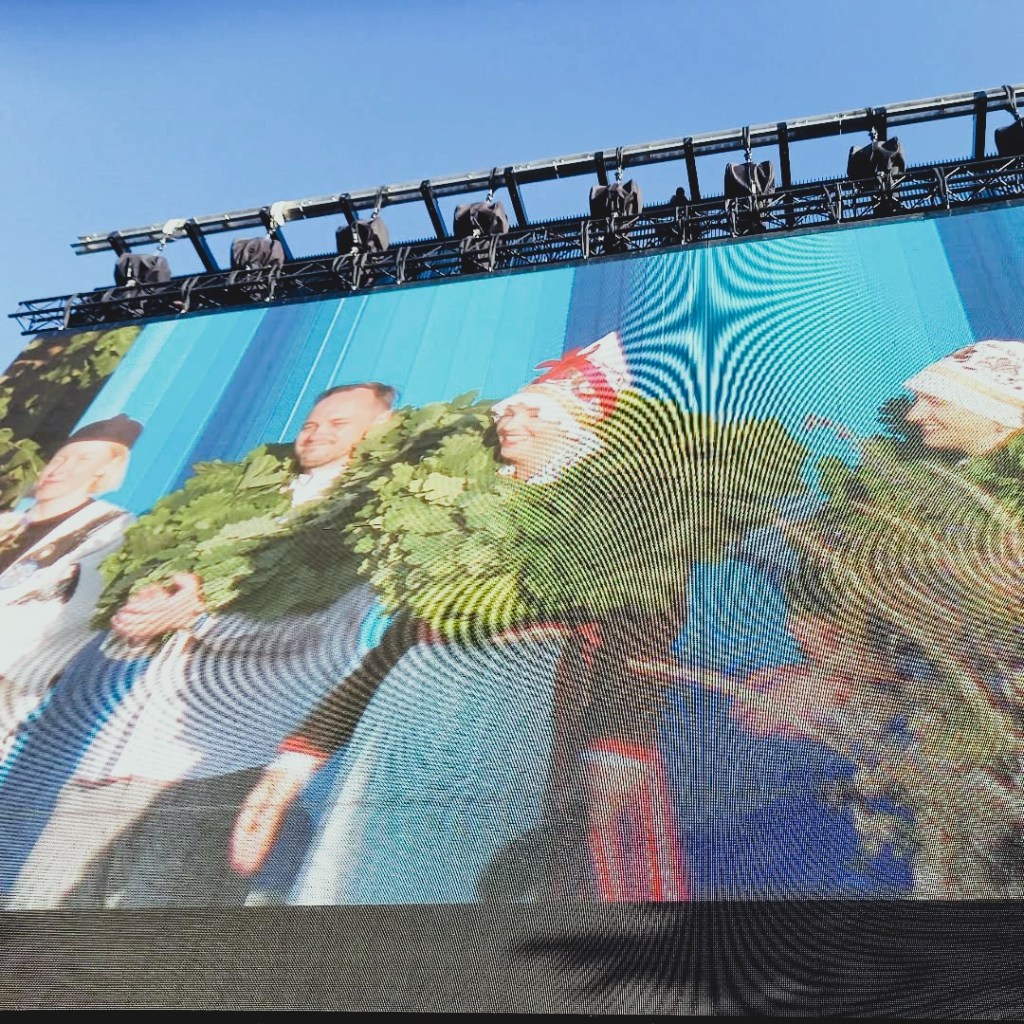
On the stage, there is a closing ceremony, and women and men in traditional garb ascend a steep staircase to be recognized for their contributions to the festival. The air is brisk, cool, calming. The sun is just peaking through the clouds over the distant skyline of the city. Behind the stage, there are stacks of what I think are evergreen Christmas wreaths, but these turn out to be made of oak leaves! Each person recognized has the oak wreath or tammepärg placed around his or her neck, so that soon it starts to look as if a whole forest of oaks is up on stage.
“But why do you use oak leaves?” I ask a woman behind the stage. “Because the oak is a very powerful tree,” she says, with an almost mystical glint in her eyes. I wonder about who creates the oak wreaths, where the branches are cut from and what becomes of them. Maybe someone mounts them on the wall of their sauna, to be revered for all time, or maybe they just wind up where everything else winds up in Estonia, as kindling for a fire in the furnace?
Soon our guitarist friend Maaker is also on stage with a wreath of oak leaves around his neck. When I ask him about the experience, he confirms that it was most pleasant. “Those oak wreaths just smell wonderful,” Maaker says. “And everyone at the dance festival was smiling.”
A rainy parade
I SPEND THE SECOND NIGHT of the festival in another friend’s apartment downtown. He’s just moved in and there is no furniture there, so my bed is a camping mattress, a sleeping bag, and a weak pillow. In the middle of the night, I hear people yelling and imagine that my friend is fighting with the police in the next room. I wait for the Estonian police to wake me up and interrogate me, but when I am at last roused from my sleep by the sound of a trumpet player somewhere nearby playing the national anthem at daybreak, I realize everything must have been taking place in the parking lot instead. My friend has in the meantime made a pot of coffee and when I ask him about the police, he says that he has no idea what I’m on about. “That’s just what life is like in Tallinn,” he says. “There are always people yelling at night.”
Tallinn life is a little bit different during the festival. My friend’s apartment is across from the Tallinna 21. Kool. At 10 am, there is a group of men in traditional black hats or kaabud and knickers seated around in front, like extras from the 2019 film Truth and Justice. I walk between these austere characters and enter the school to have a look around. In its atrium, about a hundred children are sitting and standing and sipping from juice boxes. On the second floor, the suitcases are piled up by the windows. Down the hall, I am greeted by a woman in a red headdress or tanu from Pärnumaa. Their group comes from Audru, she says, which isn’t too far from where my children’s grandmother was born. I have a complicated relationship with the Estonians. I am not one of them, nor do I wish to be, but my children are them. So we are relatives of a kind. Inside a classroom, I ask the dancers what it’s like to sleep in a school.
But you can forget any stories about loud nightmares. These people are tightknit and are used to each other’s company. They only respond with, “Noh, täitsa tore oli.” “Well, it was nice.”
The rongkäik or parade is tore, too, but it’s a challenge. One needs stamina, strength to march in this parade. Sheets of rain fall on us all along the route. The poncho I have brought along is quickly soaked, as are my pants. My hair is a wet mess, my skin is cold and damp. My journals are wet, the ink runs in places. My friend and I take refuge in Viru Keskus where I order a hot plate of Uzbek plov. My friend is not the kind of person who cries easily, or expresses any emotion without a joke or healthy skepticism. When you have lived as much as we have, those gentle, peaceful, fluttering kannel-music like moments are few and fleeting. But he admits that he can’t get through a rongkäik without shedding at least some tears. We’ve both been in Estonia for what feels like forever and talk about when Swedbank was Hansapank and when there was no Viru Keskus. Most changes are welcome, but we’re also worried that the Song and Dance Festival will eventually become a cultural attraction, where tourists buy up all the tickets and Estonians are only able to watch it at home. He considers that businesses might start sponsoring these events, so that one day there will be a Prisma, Rimi, or A. Le Coq Choir.
We agree that the festivals are an occasion for social renewal. All societies are made up of such tiny, bite-sized building blocks, like village choirs or dance groups, and of these smaller pieces, more elaborate superstructures are created. The festivals are necessary for society to function. They bond people together and the bonds created must last until the next festival. We hope that Tallinn never becomes another Venice or Barcelona, overrun by Jezz Bezos and other mindless tourists. It’s true that neither of us is Estonian. But we do have Estonian kids. We do worry for them.
The main event
IT’S A LONG MISTY WALK through Kadriorg to get to the song festival on Saturday. I take the Number 1 tram and then cross bridges and climb steps, eventually passing the Japanese Garden and exiting through a parking lot across from the Song Festival Grounds. When a person is caught up in those dense crowds, it becomes hard to construct a timeline of what happens. Even my journals become a mess of discombobulated, half-written entries, jotted down in spare moments and out of order. One thing I do see is a blonde, middle-aged woman running through the food area crying out, “Police! Police! Does anyone know where the police are?” Having seen some guards nearby, I point her in their direction. In chatting with some officers later, I find out that the number one issue they have to contend with is lost children. There’s even a pickup point where as many as 10 children might sit waiting for a parent to retrieve them. One wonders what life is like for the children in this makeshift “kindergarten.”
The police also have to deal with the occasional unruly attendee who has decided to “pregame” for the festival and either gotten drunk at home or hidden a flask of vodka in his underpants. (There is no alcohol on sale at the event). “It’s a shame,” one of the police tells me. “There are some who do not see this festival as a holy event, but as an opportunity to drink.”
The singing is here, but the singing and the songs are only a part of the experience. Yes, we have all come to hear these songs, to sing along, but the festival is also about the circus city that springs up around the stage, or the troupes of children in wet ponchos stumbling across the wet grass, following the instructions of some stern teacher who has commanded them here to participate in this grand event, or the meandering conversations in the press tent where French and Finnish journalists rub elbows and munch on free ice cream. There’s a lot to this thing, much more than any agile camera work or grinning selfie can ever do justice to.
After being drenched by rain for a day and a half, the appearance of the sun toward the end of the concert on Sunday does seem like a small miracle. Then come the best-known songs, “Tuljak,” which is conducted by choirmaster Triin Koch, and “Ta Lendab Mesipuu Poole,” which is conducted by composer Hirvo Surva. These musical personalities are treated with such reverence that every one of their moves is observed with an awesome curiosity. It’s almost like watching Wimbledon. Every flick of the wrist, every nod of the head is somehow meaningful. The conductors look as if they are holding back a mighty wave with the power of their hands.
What is it like to stand up there? I wonder. And how does one feel at the end? Neeme Järvi, the grand old conductor, now aged 88, knows this feeling well. His movements are tight, precise, controlled, but at the end, in a moment of triumph, Neeme Järvi topples over. From the back of the Song Festival Grounds, the Üldala, or general area, no one knows if he has just slipped or if really, being so caught up in the music, Järvi decided that this was his final day and he was going to go out with a cymbal crash. Throughout the entirety of the festival area, there is only silence and concern. This was obviously not planned. Is he alive? Has he died? What kind of festival even is this? But then we see that Neeme Järvi is alive and well and he jokes to the crowd as they chant, “Elagu! Elagu! Elagu!” Which means something like, “Long may you live!”
It is the final festival miracle.
The morning after
AND NOW IT’S THE MORNING of the day after. But when did this day even begin? When the light of the day is nearly seamless and the last people go home after the summer light returns, isn’t it hard to find a line between the two? After the festival, I have trouble sleeping. I awake at three and then five and then eight. I can hear the cries of the gulls and the muddle of downtown life at dawn. Like life, the trams creak back to work, back to normality. Even though my arms and legs are sore from standing for days, and my mouth is dry, my hair is greasy, there’s goop in my eyes, and I’m still wearing yesterday’s shirt, my other clothes piled up on the floor, my socks kicked across the room, the light of the new day is unrelenting. Even when I can’t bring myself to get up, and the euphoria of the festival is still pulsing in my blood, I get back on my feet, because the sunlight won’t leave me alone and life does move onward. Just as I do as I make my way to the Must Puudel cafe in the Old Town where I order a coffee and breakfast, first thing. Hungry city birds are perched, ready to peck at any discarded crumb.
After breakfast I go for a walk to stretch my legs, muddle through this new, post-festival reality that I have awakened to. Some tired singers are lounging in the sun of the Town Hall Square. Who knows when, or if, they ever went to sleep. On nearby Lai Street, I find a lillepärg or crown of flowers lying on the ground. Someone must have left it here in the early morning. I wonder who the woman was who left this flower crown here. I wonder what this crown has seen. By tomorrow, all of its petals will be dry, I think. By tomorrow, the festival will just be a memory.
An Estonian-language version of this piece was published online on 13 July 2025 in the magazine Edasi.
KLAUDIA AND I went walking along the docks. She stopped into small portside store, but complained about not having any money. She wasn’t in any kind of positive mood and she only had 50 cents to her name. “What am I supposed to buy with 50 cents?” Klaudia said. “Half a candy bar? A bite of a sandwich?” Quickly, I removed my laptop from its case and logged into my bank account with my personal ID card. The transfer happened effortlessly, instantaneously. “You have received €1.50 from so-and-so …” That’s what her notification must have read. It wasn’t an unserious sum of money. With €1.50 one might get a bowl of soup. At least the kind that you make in a cup in the microwave at a harbor convenience store.
We walked on through town. Klaudia was wearing a dark, puffy jacket. Her blonde, lion’s mane of hair was quite moist in the seaside drizzle. It was a maritime kind of place. Boats arriving, boats launching, the smell of chopped up bait and the whiff of luxury yacht interiors. We walked up a hill to an old house and went in. It was a well-preserved, Soviet-style habitation, though the wallpaper was slowly peeling from the walls. Old smelling furniture, old smelling bookcases. A woman sat on a couch watching TV. She was watching Wallace and Gromit.
“See,” I told Klaudia. “This is how people live outside of Tallinn.” “I know how people live outside of Tallinn, there are plenty of places like this in Tallinn anyway,” she said. “You’re right, you’re right,” I said. The old woman had dyed red hair that was white at the roots. She offered us a glass plate full of cookies. “Come and watch TV with me,” she said. “I do get lonely.” There we sat, watching Wallace and Gromit. The couch was comfortable. The film was entertaining. It made Klaudia laugh.
STEN GOT A NEW APARTMENT overlooking the capital city. I went to visit him to inspect the place with Riken, the Japanese mountaineer. We stood in a bare white kitchen lit by a skylight. There were unfamiliar varieties of Entenmann’s cakes that contained distinct Northern European flavors on the counter. Who knew that Entenmann’s made pumpkin cakes or ones flavored with lingonberries or cloudberries? I read and reread the ingredients on the boxes.
Sten was discussing with great detail the placement of a couch with Riken, but Riken was of another opinion. Riken rested an elbow against the mantle of the fireplace and nodded up and down as if studying the room and searching for an answer. Sten and Riken often got side-tracked by these kinds of minor details, such as where to put a piece of furniture, or for how long one should sauté the onions. “Hey, Sten,” I asked. “Can I try one of these cakes?” “Knock yourself out, man,” he said. Then he turned back to Riken, “The light from the window is best over here. The couch should go there.” “You’re wrong and you know it,” Riken countered him.
Sten’s girlfriend Pille-Riin stood all this time next to the couch in question with her arms folded and a particularly stiff-upper-lipped, “keep calm and carry on” expression on her face. She looked like a British nurse. Well, an attractive one, if such attractive British nurses still exist. Sten and Pille-Riin had acquired a bulldog in their time away from Estonia and the animal was pacing the apartment as Riken and Sten argued over the placement of the couch.
The dog ran over and licked Pille-Riin’s hand as she waited patiently.
After that, someone came into the apartment and cried out, “narcs!” You should have seen Sten’s face curl up in panic. “Everybody out!” he shouted. “Quick hide!” “What’s wrong?” I asked. “The cakes! The cakes! The cakes are all spiked with drugs!” “They are?” I said, with some cake crumbs on my lips. “Shit.” “Yes, out. Out!” I ran out of the building, only to glance down the street at Tallinn in the mist. It looked different, almost like Gothenburg, or some random Dutch city I had never seen before but knew existed. Rows and rows of red-tiled roofs with some sad-looking skyscrapers in the distance. Sten said he liked this part of town because he could get in and out of the city in a jiffy. Unlike Kalamaja, which had only one road in and out. This choice spot was being put to the test as we all fled the Estonian drug police.
I lost track of the others, of course, ambling across a rye field into a forest. I clambered over an old stone wall, found a sandy spot and began to bury myself in the moss and dirt. If I covered myself well enough, the drug police would never find me. Not long after though, I could hear Sten’s voice coming my way. He was being escorted by several Estonian police officers. He led them right to my hiding place. “There he is,” he said, pointing me out. “What are you doing, man?” I said. “I don’t want to go to jail!” Sten frowned. “It’s no use, man,” he said with a sorrowful voice. “They already know everything about us. The jig is up. We’re all going to jail.”

 north!