COLDPLAY WERE BOOKED to perform at the Viljandi Folk Music Festival. And not only just perform, but to headline it, with their concert scheduled for the festival’s last evening. I’m not sure whose brilliant idea this was, but I suppose that after NÖEP performed in the same slot in 2025, the door was wide open for the likes of Coldplay and their “Adventure of a Lifetime.”
I was in the press office as usual right before they went on, but an older amber-haired woman, whom I understood was my wife, was there with me. She was a steadfast supporter of the band and had bought Parachutes after “Yellow” started getting played on MTV. But she wanted more than just to see Coldplay play Viljandi. She wanted me to make love to her during the concert. This seemed to be physically impossible: where would we find a proper spot? Her solution was an old ironing board. “See, I’ll just put my elbows here, like this,” she demonstrated to me during a break in their sets. “And then, when they play ‘Yellow’ and it peaks you can take me from behind.” “You’re crazy,” I told her. “I’m not having sex with you during a Coldplay concert!”
While we discussed the matter, Chris Martin led the crowd in a singalong of one of their blasé, forgettable songs. Not from the earlier catalogue, some album track from 2015 or so. The entire band, including Martin, wore those rain ponchos that are so popular at Folk, and it was raining. The band reclined on an old beige couch, plucking their instruments, tapping their drums, while Martin held up an umbrella and sang. Visually, it was stunning, but the music still didn’t find its way into my heart. Meantime my wife was demanding that I help her to climax during “Yellow.” I felt alone there standing next to that ironing board. “Please,” she whispered.
***
While all of this was happening, Klaudia was waiting for me on a beach. She was wearing a red swimsuit that highlighted her ample bust and the salt from the sea had teased her hair into a bouquet of sunshine. She was wearing sunglasses and saying, “You are going to have to choose, you know. You are going to have to choose between her and me. You must choose between her and me.” I could see myself reflected in Klaudia’s sunglasses, which meant that I was on the beach even though I was at the festival. “Which of us two will you choose now? Which one?” Grains of sand were in my eyes, grains of time, the sky above was pastel blue.
***
I guess I caught the rest of Coldplay’s performance. I remember Chris Martin took his shirt off, only to reveal his body had been tattooed in Celtic symbols. Before the encore, he also came over to me on the side of the stage and asked me how they had done. I told him it had been a wonderful show. Later, The Who came on, as a special mystery guest, and began to warm up the crowd. Keith Moon told me that if I wanted to hear their set better, it would make sense to go up one of the towers on the edge of the stage. That way my ears wouldn’t bleed when they were done serving up Maximum R&B. Up the steps I went. When I got to the third floor of the stage tower, I found myself in a room full of Estonian women dressed in traditional costume, with red headscarves. One of them was a younger, dark haired woman whose name was Mai. I knew Mai from the streets of Viljandi. We had shopped at the same Konsum.
“What’s wrong with you?” Mai said. Her gray eyes peered out at me from beneath the red scarf. “You look as if you’ve just seen a ghost.” “Two women are after me,” I said. I felt an outlaw bandit or robin hood. Always on the run from women and ironing boards. Then, glancing down at her in her red skirt, I asked, “Can I hug you?” “Muidugi!” she said. “Of course, you can!” “You mean you’re not afraid of me?” Mai just embraced me, warmly, softly. She was a robust, loving country woman. She helped take the pain away. “Why should I be afraid of you?” she said. “Besides, it’s not my fault I’m so sexy and young!”
After that, I think we kept on hugging. I held onto Mai like she was flotsam from the Titanic. The Who played their set.
A friendly reminder: almost all of my North! stories are the product of what I call dream fiction. That is, I use what I can remember from dreams and create narratives from the material. I started this project in 2020, during the pandemic, and I have found it’s interesting to chart how the news of the world impacts my subconscious. During the pandemic, I dreamt of vaccines. As you can see here, I dreamt of Ghislaine and Epstein. I have always been a huge a fan of Jefferson Airplane. In fact, I think they might be my favorite group of all time, and so from time to time, band members surface in my dreams in unusual ways, as Jorma Kaukonen did in the previous story. Grace Slick, for example, turned up as a character in “The Return of Dulcinea” (January 2023). Charlie Watts has also turned up this way, as has Paul McCartney.
It’s interesting to me that it’s hard for some people to understand what I have been doing. Not only am I mapping my own subconscious, I am also providing a reflection of the world and how it filters through one person’s mind over time. These stories earn no money and garner limited attention. I have found this to be a very fulfilling artistic project. What else is there?
“HERE,” HE SAID. “If you need a place to stay for a while, you can go to Ghislaine Maxwell’s apartment in Peconic City.” My father placed the set of keys into my hands and told me the address, which was 9 Nantucket Avenue, and drove me to the station. The trip out to Peconic City wasn’t long. He told me that the house was located next to a money broker. Atlantic Union, I believe. When I got out into the station, I turned left, as I had been instructed and found myself in a kind of shanty town made up of small shacks set up inside the building. “It’s not much,” I recalled my father telling me, “but no one will look for you there.” Was this “Nantucket Avenue?” I walked by the shanty town, where indigent women were out selling flowers and other things. I asked an old flower seller how to get to Nantucket Avenue, and she told me I had to go outside the building, through the station’s back entrance, and turn right.
I checked my possessions. A single gym bag full of clothes, my phone, my wallet, a paperback. I walked through the central atrium of the station and out the back entrance, just as instructed, and walked down a sidewalk to the right until I saw a series of modern homes set back from the road with green lawns, even in winter. Down one of these lawns, a whole parade of media figures and cameramen came in my direction, one woman speaking loudly in those clipped, made-for-broadcast tones about the plight of Ghislaine. At that moment, I wondered how my father had even had come to possess Ghislaine Maxwell’s keys or why he had sent me there.
Even at a distance, I could read the words “Nantucket Avenue” on one of the houses, all of which had peaked roofs and were built to incorporate Puritan architectural elements, a sort of House of Seven Gables for the big money age. Did my father really think this was a good place for someone like me to hide out? In front of one of the houses, someone had strung up some effigies of Jeffrey Epstein and Donald Trump, except had given them vampire fangs that dripped red blood. “Death to the Rich,” a sign read. Some yellow-toothed vagrants stood around the Epstein and Trump vampire effigies, panhandling, hoping to get a dime out of me.
The interior of the house was dull and contemporary and all of the walls were covered with large photographs of Ghislaine and Epstein vacationing in the Caribbean, wearing bleached white shirts that were so bright they made your eyes ache, khakis as crisp as morning toast, blue jeans that were so blue, they looked as if they had only been worn once and then tossed away. Epstein’s gray hair was always that unruly mop, trimmed to a desired, specified length. Ghislaine looked like she had once starred in a 1990s Bond film, perhaps as the sexy villainess who gets killed in the end. One picture though made my heart sink. It showed Epstein, Ghislaine, and British diplomat Peter Mandelson clustered around the deck of a yacht as Jorma Kaukonen played guitar. They were on the sea somewhere, drenched in a pink orange sunset.
Jorma was in on it too? Later, when the revelations came out, Jorma Kaukonen, the white-bearded, Finnish Hemingway-looking ex-lead guitarist of seminal San Franciscan psychedelic rock group Jefferson Airplane, who had transitioned into the rough-and-tumble bar room blues act Hot Tuna in the 1970s, denied all wrongdoing. Instead, he said that Epstein had been a fan of Hot Tuna, and that he had performed for him and his guests on occasion and was always well paid. “I’m just a blues musician,” Jorma said. “Simple as that.” When asked what Epstein’s favorite Hot Tuna song was, Jorma acknowledged that it was “Hesitation Blues.” “Epstein made me play it two times during every set,” Jorma had said in a beachside interview. “It started to annoy me.”
In the interview, Jorma wore his white fisherman’s sweater and seemed at ease in his skin. He had his glasses on and his arms were at his sides and he seemed to be hiding nothing. It was hard to believe that he had ever been anything other than a minstrel to the evil rich.
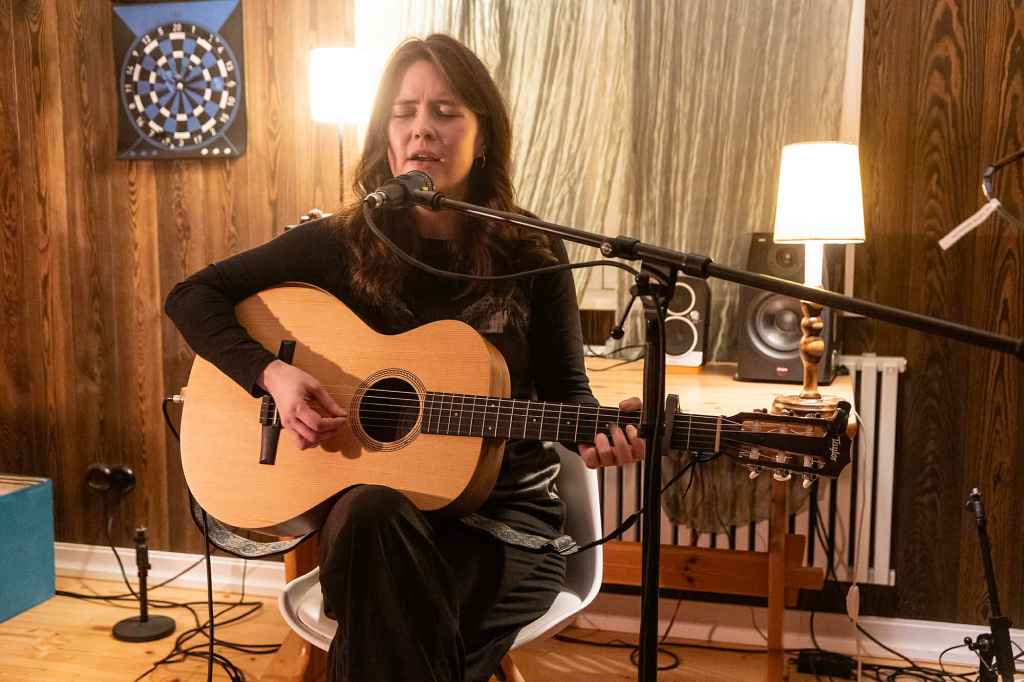
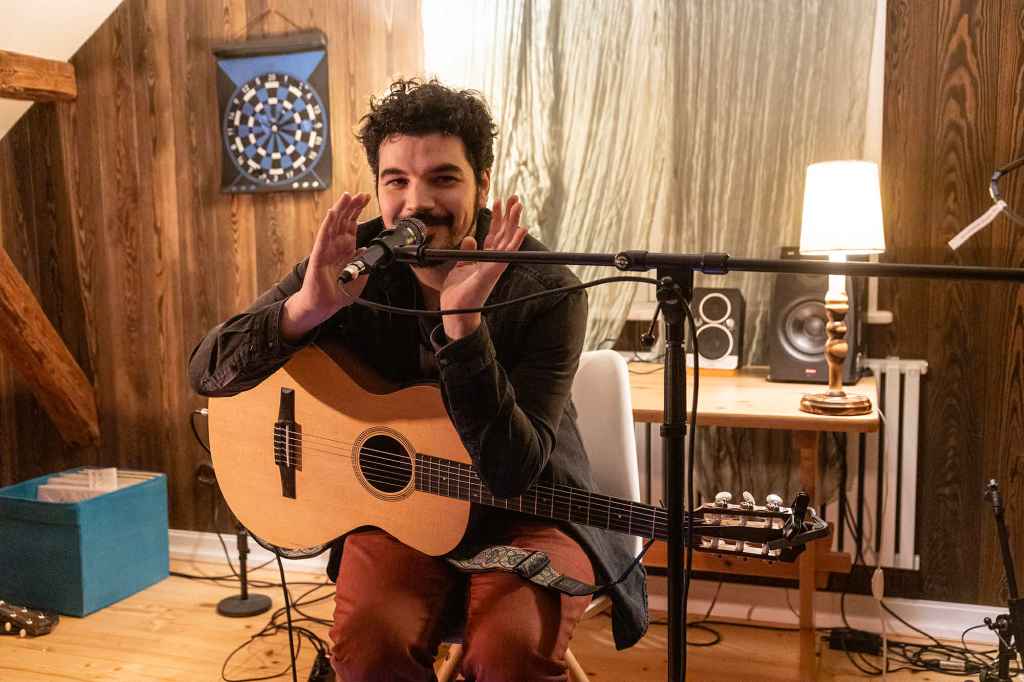
I WAS HAPPY TO CATCH the most recent loft concert at Tomás del Real’s house in Viljandi this past Saturday. He calls these intimate musical events the Viljandi Home Sessions, or VHS. This one was VHS Volume 5. I have been to every single session. The last session, about two weeks before Christmas, featured Lonitseera band members Kaisa Kuslapuu and Kristin Kaha doing renditions of obscure Estonian holiday songs. That was undoubtedly the most unique and chaotic session, as there was a dog present and the electricity went out. In my opinion, they undersold themselves. Kaisa’s keyboard playing was fun and unorthodox, her singing is always great, and Kristin has some alarming and impossible notes stored away in her vault of a mouth. There were certainly a few “holy shit” moments. But, in true Estonian fashion, when I complimented them on their performance they sort of shrugged and said, “Eh, it was okay.”
This session had more of the cuddly folkie feel that Tomás was probably going for when he dreamed it up. No dogs or babies were present, and no electrical outages occurred. A fox did visit Tomás on the day of the session, maybe to provide him with some luck. A singer songwriter from Chile, Tomás has lived in Viljandi for some years now. He opened with some of his songs, including a new one, “Algún día,” which I felt innovated on the material he recorded for Principios de Declaración and Notas Rotas. I wouldn’t say it was better, but there were some changes and melodies in there that surprised me. Some new landscapes emerging from familiar terrain. Then came Lisanna Kuningas, who played three of her own songs on the guitar. Lisanna is also the keyboard player for Araukaaria, and did a wonderful session with the band’s singer and guitarist Pepi Prieto in November. These were really fun and enjoyable.
And then there was Anett Tamm, performing songs from her 2025 album Compass under her artist name Alonette. I personally found the melodies to be interesting. Every time I thought I knew where a song was going, she turned it around and went sailing off in another direction. I’m a taller, larger person, and when I am at these sessions, I like to lie in the floor in the back. It’s just more comfortable for me. There’s a nice strobe light employed, and so when I look at the ceiling back there, as the performers play, it’s almost as if I am staring up at the stars as they shoot over me. Because of this effect, while listening to Alonette, I had the sensation that I was drifting through space. Her songs have an amorphous quality to them, they expand and contract, and so I started to feel like I was watching the aurora borealis. At one point, I looked over at Tomás as if to say, “She is great, isn’t she?” Tomás just nodded as if to say, “I know.”
Thanks for the music and thanks for the photos Tomi Palsa.
I WAS INVITED to give a talk at the new community center in Tartu, across from the Lõunakeskus shopping center. There I stood, in a small modern classroom, lecturing on the fate of the Eastern Algonquians to a small class of perhaps a dozen curious Estonians, an American flag hanging in the corner, when a middle-aged man who looked like Flava Flav in a blue jumpsuit walked in and began shouting slogans. “We have to get behind Trump!” he said. “To own the libs and end woke!” The students backed away, not knowing what to do. Then in walked Obama, calmly, coolly, boldly. He stood at the center of the classroom dressed in desert khakis, like a soldier from Operation Desert Storm and said, “Please go ahead with your presentation. I for one found it to be most informative and, in my opinion, quite patriotic.”
After Obama and the man who looked like Flava Flav left, I walked home, whistling, hands in my pockets. How could it be that Obama was in Tartu? What was he doing here? Later I found out that, under pressure in the US from the Trump administration, the Obamas had decided to rent a house on the periphery of Tartu. Obama had been to Estonia several times and found it a most welcoming place. He was particularly impressed by its sauna and singing culture and enjoyed a mouthful of moose pasteet. Obama and Michelle would cycle to the market in the warmer months to inspect the eye-watering array of cucumbers, tomatoes, and berries. In the cooler months, Michelle would fill her basket with handfuls of glorious chanterelle mushrooms and prepare at home for Obama his favorite dish, chanterelle sauce with potatoes, laden with dill. Obama would smack his lips. “Michelle, baby,” he would say, wrapping an arm around her waist. “You’re the greatest woman who ever lived. This kukeseenekaste is just perfection.”
The Obamas became a fixture of Tartu life after that. Somehow, even though he was from Hawaii, or Indonesia, or Kenya, or Chicago, or wherever he was from, he fit right in to the city’s free and inventive-thinking population. He would wave at university students as he rounded the turn onto Kroonuaia Street, his arm lifted joyously in the air. He took part in fencing matches at EÜS. Michelle could be seen at H&M in Kvartal, digging through the sock bin, or weighing deals on cosmetics at Tradehouse and Douglas. They were true Tartu lovers.
Then it so happened that I was dispatched to the house of a soothsayer or witch on the opposite side of the River Emajõgi, set back deep in the pine and birch forests. I went there to undergo something called constellation therapy. When I got to the house, a white colonial built at the top of a hill, something immediately felt off. It was winter by then, the snow hardened and iced over, and there was an eerie stillness, even in the light of a February day. The front door to the house was ajar. As I approached it, I began to hear the cries of wolves coming from the woods. Not knowing what to do, I went inside. Its interior was full of expensive lifeless furniture, the kind that wealthier people acquire not knowing what else to get. White couches and dark wooden tables. Some tasteless art beside the cold fireplace.
At its back though, I encountered an old university friend, Chas Flaubert, an architect from Charleston, South Carolina, who had gone to high school with Stig, an Estonian expatriate. Small world indeed. Chas informed me that, during his time in South Carolina, Stig had lived his life as a gay man, but had a sort of reverse coming out experience, suddenly discovering at the age of 20 or so, that he was a robust heterosexual, and that he only had feelings for women. After that, the posters of Fabio, Madonna, and Ricky Martin in his teenage bedroom came down and were replaced by pinups of Farrah Fawcett, Sally Field, and Miss Cheryl Tiegs. “I’m not sure how that happens,” said Chas in his molasses drawl, while puffing on a marijuana cigarette, “but that’s the truth.” “It’s very funny, because Stig is probably the straightest hetero I know,” I said. A suave, one-man nightclub variety show act nicknamed “the gray fox” for his striking hair, Stig Sandbrook was known to have lain with women from Lake Tamula to Lake Titicaca. “He’s more hetero than hetero,” I went on. “Do you mind if I hit that joint, Chas?”
Our conversation was interrupted by the howls of the wolves. Looking out the window, we could see three or four of the shaggy sinister beasts beat a line toward the backyard. “We’re done for,” I told Chas. “Once they get inside, they’ll eat us all for dinner!” We stood there at the windows, awaiting our certain doom. There came a loud crackle and a kind of zipping sound. One of the wolves toppled over, then the next. After four crackling sounds, they were all dead.
It was then that I saw who had shot them. Obama descended the slope in winter hunting gear, rifle in hand. He waved to us. “God bless that Obama,” said Chas. “Where would any of us be without him?” “In the belly of those wolves,” I replied. Obama whistled and a flatbed truck came down the slope. With an Estonian friend, he loaded in the wolf corpses. After sharing a smoke with the driver and some chit chat, Obama climbed into the truck and they drove off.
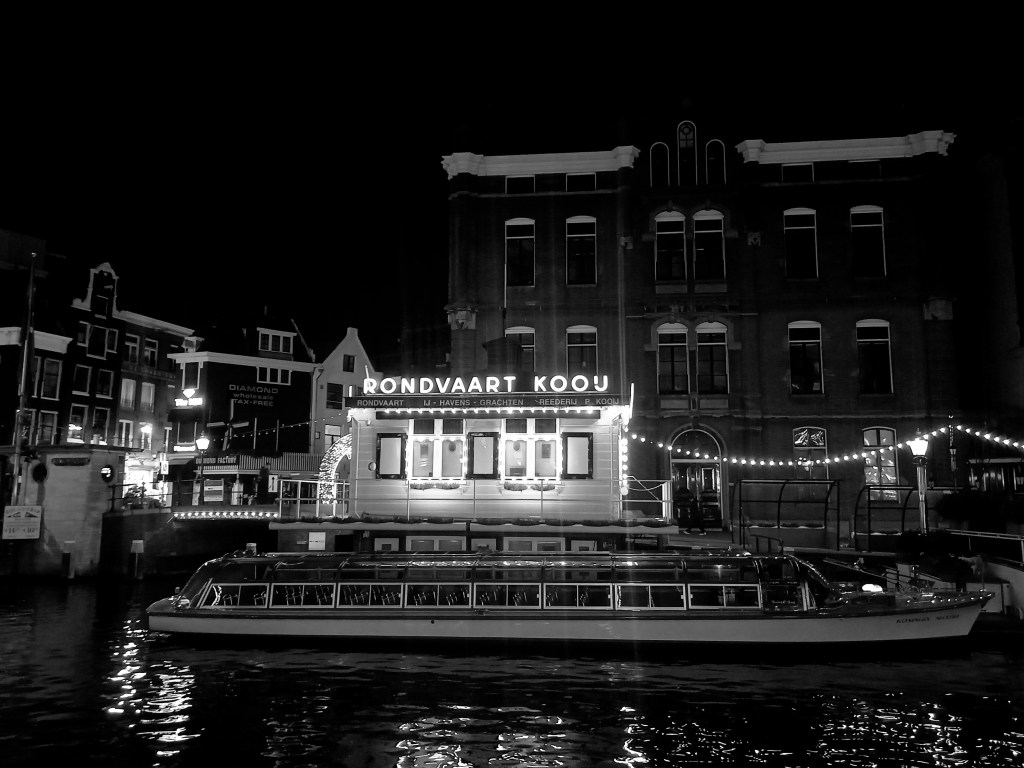
ON OUDEZIJDS ACHTERBURGWAL, a street and canal at the center of De Wallen, Amsterdam’s Red Light District, a woman sits in a window on a Friday morning staring into an overcast late November day. She is dressed only in her bra and panties and her hair hangs loosely about her shoulders. She is a voluptuous, pale character with doll-like features and pink lips and her face reveals a mixture of morning grogginess and utter resignation. This is the face of a woman who has seen everything and done everything, and everyone, and she seems bored by the world.
Upon seeing her from across the canal, I give her a friendly wave and she waves back to me. For a moment, it feels like we are old school chums. There is a sense of camaraderie there. Though I am a writer and not a prostitute, I suppose we are in the same kind of business. We give pieces of ourselves away for financial rewards. My soul is written with words onto paper. Her soul is pressed into flesh. She is someone’s daughter, someone’s sister, maybe a mother.
But this has been her fate, to sit here tiredly selling herself, while my fate is to head off to Rotterdam, to give a talk about what it’s like to be a writer who writes in cafes. I feel disgusted, of course, for myself, for the woman, for the world. I feel disgusted as a man, too. But then I wonder why as people we are so often disgusted with ourselves and with our day-to-day lives. As the weekend crowds line the canals of the Red Light District and the sinister laughter of throngs of British men (and women) echoes up and down the alleys, one can only feel disgust.
This is the heart of the decadent West, a West that we have convinced ourselves is dying every day. The official capital of the European Union is in Brussels, but its spiritual heart might be right here by these old canals with their erotic boutiques, 5D pornographic theatres, and sex workers.
Our revulsion and gloom about our future is only compounded by the migrant crisis and climate change. I recently read an article in The Guardian where it said that only one in five female scientists planned to have children, to spare their would-be offspring this shame of being born. No one else should have to contend with the endless famines, wars, hurricanes and droughts.
They want to save the world and so they choke off its future, as if they were solely responsible for all its sins and misfortunes. As demographers forecast our societies will only shrink more, people turn to animals for companionship. There are social media sites for cat and dog owners where their pets can confirm they’re going to meetups at the park, or share photos in a group chat. I suppose the dogs can wish each other a happy birthday. Because animals are innocent and people are guilty. This is how we have learned to think about ourselves. This is the future we are building for ourselves, an indulgent childless future of pet social media.
But hasn’t it always been like this? This is what I think that morning as I wave to my newfound Dutch friend over the canal. She is certainly not the first woman to live this life or have this fate. There are many others. I pass by them as they prepare for the day. Then I turn the corner.
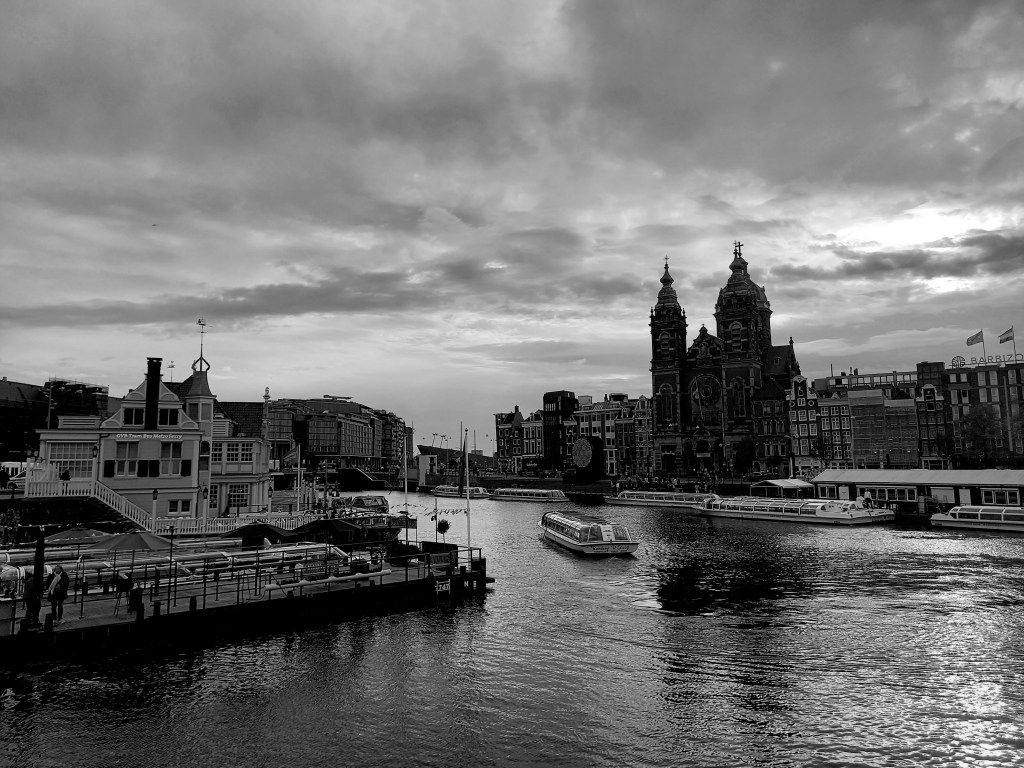
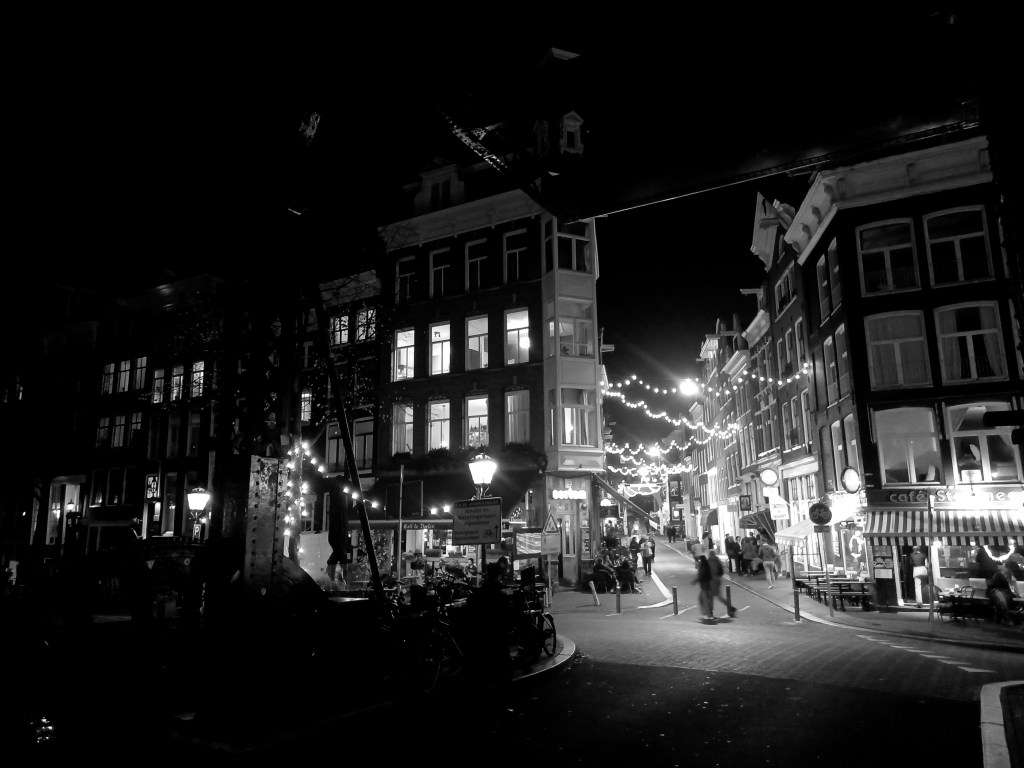
ON THE NEXT MORNING in the Red Light District, the municipal workers sweep up broken glass and soggy french fries and the ravenous seagulls attack piles of trash. This is how yesterday is replaced by today, but the bakeries and cheese vendors are already open, their shops glowing with warm, inviting lights. Life tumbles sleepily forward in Amsterdam, like an old man fumbling for his keys. At night, the city is a hubbub, a bazaar. Whatever you want to eat, you can find it. Whatever you want to see, you can see it. Whatever you want to do, you can probably do it. The Dutch are a tolerant people and that tolerance has become a foundational element of what we call European or Western values. We measure our Westernness according to the number of rainbow-colored Pride flags that hang outside of bars, or by the casual way we smoke cannabis.
We unbutton our top button and walk down Oudezijds Achterburgwal, waving at the women.
We are a free people, we tell ourselves, free people who can do whatever they want and listen to whatever they want. We can spend part of the night in a record shop, as I did, digging through the record bins, engulfed in green marijuana smoke, unearthing treasures by Jamaican and Zydeco bands.
The Western life can be a comfortable life, one where the main existential question is, “How should I spend my Friday night?” Or, “What concert should I go to?” One can just while away the days, in pursuit of personal satisfaction, pleasure, what some call happiness. In corners of the world like Amsterdam’s De Wallen, there are almost no children at all and you can imagine if you close your eyes that they don’t even exist. For many of my friends they don’t. There is an invisible divide between us, I think, those of us who have had children and those who haven’t, and I think we both feel pressured in different ways. When my third child was born, a colleague asked me why I had decided to have one more. “You will never be able to support them on a journalist’s salary,” he said. He was right, but in my mind, that was somehow irrelevant. I took the whole thing to be a kind of godsend or the fulfilment of a prophecy. “Did you expect me to weigh the pros and cons, make an Excel file, and budget for it?” I asked him. “Yes,” he said. “Of course!”
He’s never had any children and so the world of having children was still abstract for him. As it has been for other childless friends, who seem to see kids as something like larger pets, that you can leave at home with a bowl of water for a day or two while you head off to some soiree. Children are an impediment to having fun, a thick wall that walls off happiness. “Every guy I see with a kid is walking down the street, shaking his head and talking to himself,” another friend told me. He hasn’t had children either.
The world for parents among childless friends can be a cold one. “Aren’t you coming to the party?” someone might ask. And then they are disappointed when you can’t, because your daughter is vomiting. They understand that such are the pitfalls of reproduction. They can’t see why someone would voluntarily do it to themselves. Where’s the benefit? Truth be told, it makes no sense. Because if I was to weigh the pros and cons, it would never be the right time to have children. The forces of Western society seem aligned against it. They make it hard in every way.
The West’s days are over, it seems. There’s nothing to do but close up shop, turn out the lights.
But if the ship of the West is sinking into the sea, why not just get our kicks before it slips below the surface?
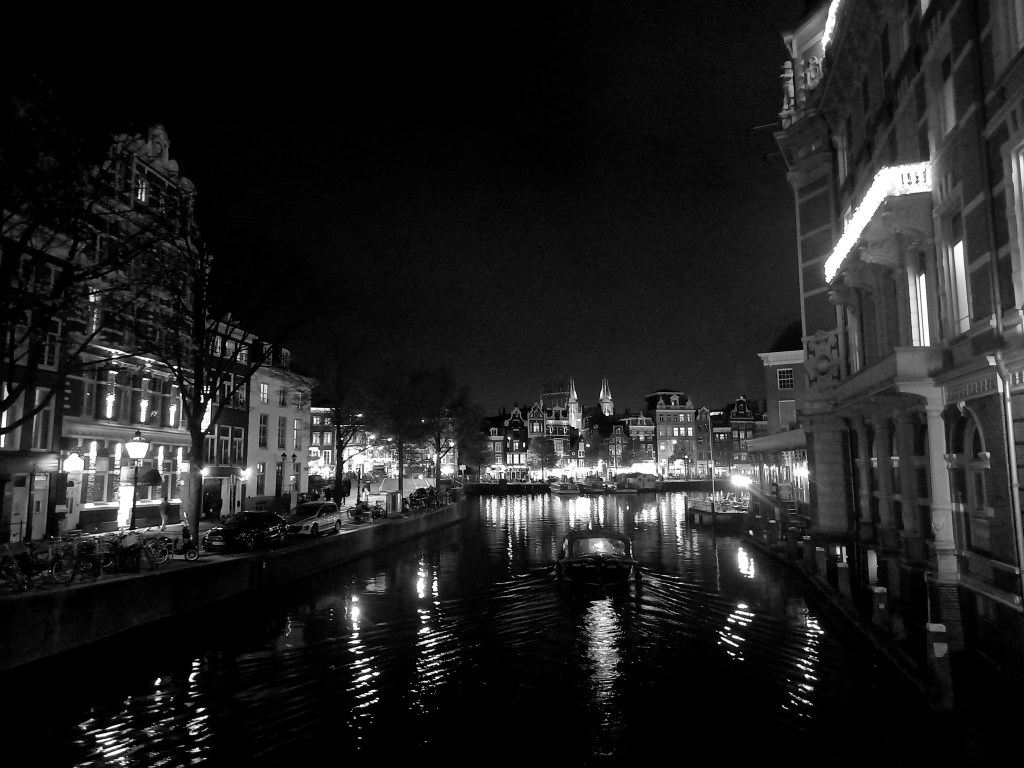
ON MY LAST NIGHT in Amsterdam, I take a walk to see an old friend. She lives all the way at the end of Vondelpark, which is where my hippie father spent a night sleeping on a bench in 1973. I think about my father as I walk the avenue beyond Leidseplein, which is lined on both sides by restaurants and homes where childless couples watch Netflix while the West slowly dies. In one of these apartments lives an my friend from New York who, like me, attended college in Washington, DC, and later settled in Europe. She has married a Dutchman and has made two Dutch children who are now awaiting Sinterklaas.
Their building is a brutalist masterpiece. Its balconies face an internal courtyard. Outside the doors to the apartments, some boots and toys can be seen. Families have started to move in here, replacing the first generation of inhabitants who had lived in it since it was built in 1961.
That was the year the Berlin Wall went up brick by brick. The next summer, the Cuban Missile Crisis happened. Life must have seemed just as impossibly damned then as it does now. Yet people continued to marry and have children. In 1961, the Netherlands experienced the highest birth rate in recent history, with 3.2 children per woman. But just like in Estonia, the Netherlands are expected to lose people over the next decades. In this massive post-war edifice, young families huddle. They are demographic survivors.
My friend’s family gathers around a table and eats soup and pasta. The little boy, aged three, is dressed in pajamas that resemble a cat. The girl, aged six, is eager to put out her shoe for Sinterklaas, who will reward her with snoep, or candy. My friend’s Dutch life is very different from my Estonian life. She lives in the busiest corner of Europe. I live in the frozen wastes. But we both know the joy of setting out a shoe or slipper for a Christmastime visitor who brings candy.
The family tonight is being visited by a neighbor, a 34-year-old Dutch designer who looks like a woman from a Johannes Vermeer painting. She has red hair and is milky white and once lived in a black neighborhood in Bedford-Stuyvesant in Brooklyn where her neighbor was in a gang. In Amsterdam, she has taken up with a Russian software engineer from Saint Petersburg, and they are expecting their second child. “I only have a few months left,” she says, patting her belly.
This is how new Europeans come into this world.
Later, when I ask my friend about why she decided to have children when so many of our classmates didn’t, she gives a bunch of different reasons. But she also notes that it hasn’t been easy being a mother, that her career has suffered and that academia, even in the progressive Netherlands, is still quite male dominated, and that the women who have secured the best positions for themselves tend to not have children. But she does love her children and she wouldn’t have it any other way, she says. Her main reason for having children appears to have been that she had an awesome amount of love to give and just wanted to give it to someone.
Which, to me, seems like the best reason that a person can have.
EVEN LATER THAT NIGHT, I head back to the Red Light District. Something fascinates me about its stark grotesqueness. I lean up against the Oude Kerk, which has stood since the 13th century, writing in my journal with the hope that the walls of the church will imbue me with more marvellous writing powers. Down the way, some young men negotiate a price with a sex worker. Then I go looking for the woman I saw on the first morning in Amsterdam, the lady in the window. I just want to see her one more time, to wave goodbye to her, to make us both feel like we are human, for just one precious moment. The West may be rotten to its core and in decline. We may all peer out at our futures with that same haggard look of resignation, but I do feel compassion for her as she plies her trade. We are, after all, in the same kind of business.
THE FIRST BUS dropped me off in the center of the city, somewhere near the New York Public Library. There were a lot of people there, I think there had been more demonstrations against the government. I could see the blue uniforms of the police and the street camoflage of the federal agents. The air smelled of tear gas and fries. Somewhere, a Salvation Army Santa Claus was ringing a bell. Out of this mess of faces and catastrophe, Celeste and Berglind emerged, both walking in the same direction, which on the real map of Manhattan would have been toward Bryant Park, but here became a sort of long, white corridor that led back to their apartment in a sparkling white dormitory. Along they sauntered, in a carefree, unfazed way.
“If you want, you can stay at our place,” said Berglind. “That way we can play all night.” Celeste and Berglind were about eight or 10 years younger than me, but seemed much younger now, in their colorful Moomin pajamas. Each dragged along a dolly and yawned as they did it. Celeste looked especially lovely with her chunks of curly red-gold hair. At some point, midtown Manhattan turned into Kalamaja. When we got to their apartment, I had second thoughts. I looked at the two women with their pajamas and dollies. They looked like little girls. I was too old now to spend the night with them. I had my own bed and that’s where a man like me belonged. Besides, I figured Celeste and Berglind would have a better time together without me.
I kissed them both goodbye.
On the way home, I stopped to think about Celeste. I leaned against a bank façade and thought of how I had missed her in my bones, in my soul, in my blood. Years and years had gone by, and nothing seemed to rid my spirit of hers. A thousand blurry kisses in a thousand blurry doorways couldn’t wash her residue away. She was stuck to me like salty barnacle grime. Nothing to do about it but leave her be with her dolly and her friend and her dormitory room. I kept walking through the city, until I saw something unusual on the next street.
My daughter was there and she was standing outside a second bus. My eldest daughter, who I hadn’t seen in ages. She was about 18 years old now and wearing a blue top and her hair was back in a ponytail. Beside her, there was a tall blonde girl, about the same age, dressed in about the same way. Her name, she said, was Oksana, and she was from Ukraine. My daughter and Oksana said they had stolen this second bus. I had no idea why. They didn’t know either. “The thing is,” my eldest daughter said, while biting her lip. “Neither of us even knows how to drive a bus!” I observed the vehicle from head to end. It was a vintage blue bus, probably made more than half a century ago by some Swiss or German manufacturer. What was it doing here?
I climbed the steps to the spacious driver’s chair, took a seat behind the wheel, which was so big it looked like it could have been used to pilot the Titanic. I felt a little like Captain Smith. My daughter and Oksana got on, and soon we were cruising along while Tallinn became New York again and Tööstuse Street turned into Amsterdam Avenue. I didn’t even bother to wonder where I was anymore, or where I was going. Where we were going. The windows were open and the sky was a dense, otherworldly gold and pink. The wind was in our hair. I felt just fine.
AT SOME TIME IN THE 1920s, a small contingent of Estonians arrived on the shores of British Columbia and set up a trading post on a rocky island off the coast, somewhere between Vancouver and Vancouver Island. The Estonians befriended and intermarried with the Coastal Salish people, and the city of New Tartu was constructed at the head of a clear, deepwater bay. The whole island was renamed New Estonia.
This amused old Estonians to no end, as not only was Estonia pancake flat (mostly), but Tartu was a river city, not a seaport city. But if Halifax, a country town southwest of Leeds, could in the new world be remade into the pearl of Nova Scotia, so too could New Tartu become a busy port, with cargo destined for the dockyards of Singapore, Tokyo, and Freemantle, Australia.
It was there, at New Tartu Regional Airport, that our Air Canada plane touched down and I disembarked after a long trip abroad. At the airport café — a brightly lit place, made out of fresh pine — I went to buy a riisipirukas and coffee, but discovered that my wallet had disappeared and my old 2018 Samsung phone, which I had pledged to use until it broke down, had at last disintegrated. The screen had come unglued and the frame had frayed. There was no way to pay for my food and there was no way to pay for a taxi for the ride back home.
I convinced the Bolt driver that my wife would pick up the tab when we got to the house, but when we got there, she was livid with me. “What kind of man uses the same phone for eight years?” she scolded me. “You always expect me to bail you out. Here,” she said, paying the driver. The children were sleeping on the floor in the kitchen when I came in and I was so tired that I went to sleep right next to them on the gray carpet.
***
Sometime later, I took my two oldest daughters to Montreal. We went to visit the old brass foundry that my great great grandfather, Aloysius Desjardins, had run in the city, only to learn that all the old houses along Cadieux Street had long since been demolished and taken over by red light district brothels, Chinese restaurants dangling roasted Peking ducks, and UQÁM.
Cadieux Street was now a canal, and there was an elevated train that ran above it, so that we stood along the manmade waterway, its murky waters fed by the Fleuve Saint-Laurent, waiting for the elevated train to take us back to our bed and breakfast, which was somewhere in an apartment block nestled in the sprawl on the opposite side of the city. Just then, I told my daughters, “If we’re in Montreal, we might as well go visit the graves of my great great grandparents Aloysius and Oona Desjardins. They’re buried in Mont-Royal.” My older daughter shook her head. “I didn’t come all the way to Montreal to go and visit dead people,” she said. “Yeah,” affirmed my second daughter. “Who cares about Canadian cemeteries and dead Québécois?”
They were right, but I still tried to sell them on the excursion. “Mont-Royal is a very trendy neighborhood, girls. There are a lot of crêperies!” They weren’t having it. What I think happened after that is that they went back to the bed and breakfast together and I decided to go visit old Aloysius and Oona Desjardins alone in the cemetery in Montreal. I don’t remember ever getting there though. The next thing I knew, I was waking up on Toomemäe in Tartu, the real one in Estonia, face down in the January snow. The snow had a refreshing, minty taste.
***
I wondered if I had been assaulted. Maybe someone had struck me on the back of the head and that’s how I passed out? Or maybe this was what had happened before? Is that how I lost my wallet? How Mont-Royal and Toomemäe had been fused together was beyond my powers of comprehension. Or perhaps we were still in Montreal, and Estonians had settled here too? It looked remarkably like Toomemäe though. Kristjan Jaak’s statue was over there, the cathedral ruins were visible through the icy mist. I began to hear voices, two boys talking in Estonian, and I hid behind a small snow dune until they passed by. Then more Estonian boys came, on skis, sleds, snowboards. I was amazed by the gusto with which they approached their descents. Down they went, flying high through the air, landing fine, crying and whooping in celebration.
I began to stroll toward Näituse Street, where it terminates at Kassitoome, and there discovered a small, familiar cottage, built halfway into the hill. Inside, a blonde Estonian woman was baking bread. She was wearing an old-fashioned apron and I could have sworn we had met before, but her name eluded me. No doubt, she was a Liis, Triin, or Tiina. She had lovely golden hoop earrings that dangled in the light of the kitchen. Who was she? She seemed to know me just fine. A moment later, we were joined together on the kitchen floor. When I raised my head, I could see the loaves of black bread rising in the hot oven.
I said something awful like, “I am going to now do to you everything I have ever wanted to do,” and she looked up over her shoulder and said something wonderful like, “Yes, please. Please do everything you have ever wanted to do to a woman with me.” This is what she had been waiting for in her heart. She had been yearning for just this kind of trouble. It was like the sweet and yummy cloudberry jam at the bottom of a cup of Alma yogurt. “Please,” she said again. “Please be as horrible with me as you wish.” And that’s how that part of the story ended, on a Tartu kitchen floor. Or were we in Montreal? Had I passed through a time loop in that cemetery? The Estonian woman sighed such musical sighs. Such sighs of kitchen ecstasy. The black bread loaves kept rising.
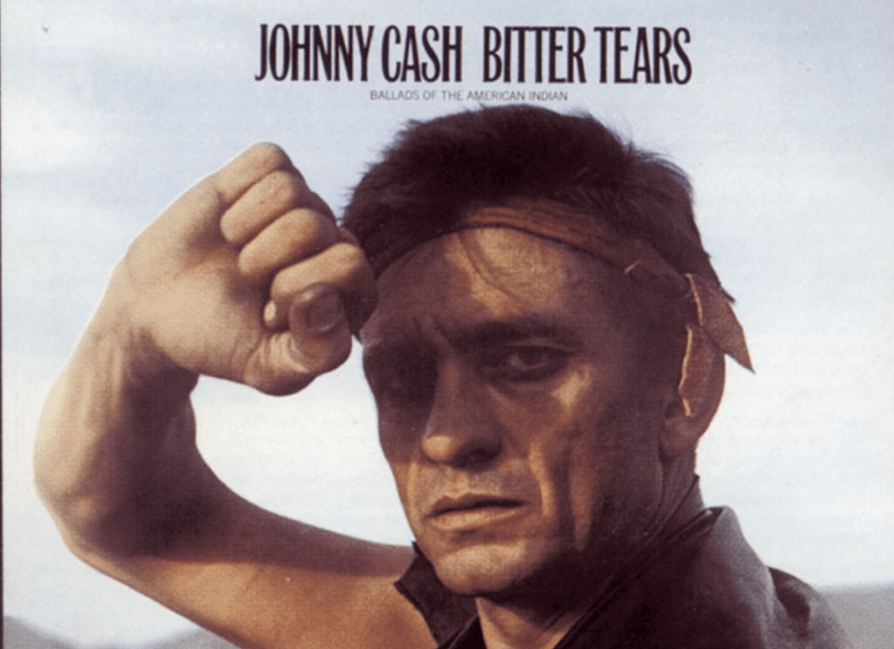
AMERICAN COUNTRY GENTLEMAN Johnny Cash was feeling particularly aggrieved in 1964 and wishing to highlight the struggles of indigenous peoples in the United States, so he recorded a whole album of songs called Bitter Tears: Ballads of the American Indian. The resulting record, released on October 1 of that year, less than a year after President Kennedy was killed in Dallas, and a month before Lyndon Johnson won a landslide victory against Barry Goldwater, is often a kind of side note. I don’t remember if it came up in Walk the Line. He didn’t mention it in A Complete Unknown either, even though it had just been recorded.
But it’s a beautiful collection, with spare, percussive musical accompaniment by the Tennessee Three, Cash’s backing band, which included Luther Perkins on guitar, Marshall Grant on bass, and WS Holland on drums. Session musicians Norman Blake, who is still alive (aged 87) and Bob Johnson helped out on guitar. The best parts of the songs are the lovely backing vocal contributions of The Carter Family. I had a hard time figuring out who was singing, but certainly Johnny’s future wife June Carter was in the lead, along with Maybelle, Helen, and Anita Carter. You can hear their sublime harmonies on “As Long As The Grass Shall Grow.”
“Custer” though might be my favorite on this record, if only for Johnny Cash’s dry and comic delivery. “Custer split his men / well, he won’t do that again.” We forget that for most of the time after George Armstrong Custer‘s defeat at the Battle of the Little Bighorn in 1876, he was considered to be an American military hero. But in the 1960s, the Lakota version of events started to win out (Custer’s widow Libbie, by the way, lived until 1933, which shows you how recent this history was.) Cash makes fine work of the legend here, though he didn’t write the song. Peter La Farge, a Greenwich Village folky regular, penned most of the songs on Bitter Tears. La Farge recorded several records of music with Native American and Western themes for Folkaways Records. La Farge died the year after Bitter Tears was released of an overdose.
Probably one of the most contentious aspects was Cash’s claim of Cherokee ancestry and accusations of being a Pretendian. On the cover of the album, his fist can be seen lifted in solidarity. Cash wears a headband, which makes him look just a little like Charlie Sheen’s character in Hot Shots. His claims of Cherokee identity were later debunked by Cash himself. He had no documented Cherokee ancestry. However, claims that he was purely of Scottish or British Isles descent are also false. A DNA test by his daughter revealed that she had African ancestry on both sides of her family, meaning that somewhere in Johnny’s “pure Scots” woodpile were some Africans. Note that this ancestry wasn’t documented either. And on Geni, at least some claim that Cash’s Hagler family from South Carolina might be linked to the Catawba Chief Hagler. So maybe Johnny was Catawba and not Cherokee. It’s certainly possible. This great record is the subject of a documentary and a tribute album too. “Custer” at two minutes and twenty-one seconds is not, maybe, the standout track, but it’s just perfect.
I remember that when Cash died in 2003, I said to a friend at that time, “But he was young, just 71 years old.” And the friend said, “But he had lived his life. He packed as much as he could into those 71 years.” I suppose after he lost June, just a few months prior, he had no reason to keep on living. But you are missed, Johnny Cash. We’re still listening to your music every single day.
I WAS DISPATCHED to cover the Greenland Summit, which would take place in Narva, Estonia, of all places. Delegates from the Kingdom of Denmark, the autonomous territory of Kalaallit Nunaat, the Republic of Estonia, and the United States of America were to descend on the old castle of Narva to feel each other out. At the last moment, it was announced that Vice President Vance would also be joining the Narva Greenland Summit. I drove up there through the pines of Ida-Virumaa and parked my car at the foot of the ancient fortifications.
But it was here that I encountered Els Stenbock, the poetess and repeat winner of the annual Lydia Koidula Prize, as well as the recipient of much Estonian Cultural Capital largess. She was sprawled out on a knit blanket in the snow by the castle, eating an apple and reading a book, clad in a light blue summer’s dress. “Oh,” she said, cocking an eye at me. Her amber hair was braided and her fair skin shined like the snow. The cold wind lifted her dress. How she wasn’t cold when yr.no, the Norwegian meteorological website, had predicted temperatures of -15 degrees Celsius was hard to understand, but she looked as lustrous as a patch of summer sunflowers. “Come here,” Els Stenbock said. “Let’s read some of Koidula’s poetry together.”
Soon we were kissing, long, sumptuous, lingering kisses. I had forgotten all about Lars Løkke Rasmussen, Marco Rubio, and JD Vance. But Els Stenbock was not satisfied with me. “Next time we meet in Narva, you should really wear some clean socks,” she said. “I’m sorry, I didn’t know I would wind up kissing the best poetess in Estonia today.” “Mmm,” she said. “But your socks should always be clean, just in case you do.” Didn’t she have a husband? Or at least a domestic partner? But these Estonian women, they knew no loyalties. They were only loyal to their present whims, how they felt at that moment. She felt like this. “Kiss me more,” Els whispered. Her light blue eyes attained a kind of supernatural effect. “More, more, more.”
Supposedly there was also a farmer’s market taking place in Narva, to coincide with the Narva Greenland Summit. But I could not find it. I walked along the river later and turned up a road, but when I got there, I only found dilapidated farmhouses and it was getting dark already. This area by the river scared me, not because of the risk of being kidnapped by marauding Russians, but because it supposedly was stalked by a werewolf of some kind, which had devoured several pedestrians. Up the hill, I saw some lights by the old Lutheran church, and headed up that way, expecting to find the market. Maybe they were also selling Narva Greenland Summit merch? But when I got to the church, it was empty and there was no one there at all. There I stood, watching the flakes tumble down. Slowly, slowly the snowflakes fell into winter bleakness.
At the foot of Narva Castle, Els Stenbock was still waiting patiently on her blanket. She had a little picnic basket with her. Some Russians or Ukrainians were milling around nearby, and so I went over to them and asked about the Narva Greenland Summit farmer’s market. To my surprise, they responded in Estonian, but said it was being held in an adjacent town. Maybe Narva-Jõesuu. I returned to the poetess and lied beside her. “Is it true that you got all of last year’s cultural capital budget?” I asked. “To publish 10 volumes of poetry?” Els looked up at me with her hungry blue werewolf eyes and said, “Shut up and kiss me, lollpea. More, more, more.”


 north!