
THEY TROOPED IN from a party and one of them was just perfect, fuzzy-haired and round, just like a fire spark. I still don’t know her name or who she was, and maybe there’s no reason to. She was probably a nobody with a nothing story. But maybe that was just me trying to write her out of my mind. Maybe she was the most vivid fire starter of all. I’m not afraid to get burned anymore, you know. I’ve got those sous-chef hands. I’m not afraid of fires. I like mine hot. I want my fires hot just like her, plump and flickering, orange, red, yellow and warm, rimmed with gold, and blue at the core, with eyes the same color that wink back to you just like a blueburst flame. Every oscillation is another step out of cold dark winter’s heartache.
Tag: writing
it will all start to make sense
IN THE CITY CENTER, a woman was managing a small aquarium. She filled this small water pool with different elements, which began to coalesce and take shape, creating new fish-like creatures, which emerged into sight as they swam in circles. Some of them looked like the kinds of strange fish one might find in a Swedish market, burbot, cod, and terrifying anglerfish, with their ugly toothy jaws. The woman was quite discrete about the fish. She wore a white raincoat and made sure they were fed. When I asked her what they were for, she said it was hard to describe, or that she couldn’t say. “You’ll see,” she said. “It will all start to make sense.”
Later, when there was another drone and missile attack in the center of the city, and pedestrians crouched and took shelter in between fast food kiosks and t-shirt vendors, I noticed that soldiers in white uniforms with backpacks emerged into the streets. With small hoses, they sprayed down parachuting Russian soldiers, who were rendered powerless by a thick pink goo. This, as I understood it, was the toxic by product of the new fish. The woman in the white raincoat had been creating a new form of biological weapon, fish that could kill.
I tried to tell my pal El Scorcho all about it as we walked through the city later when the latest missile attack had ended, but he was too busy talking about his music career. “She’s raised a whole mini-aquarium of biological terror,” I told him. “You wouldn’t believe it. It’s so far-fetched even I have trouble believing it.” El Scorcho was lost in his world. “Can you believe they want me to headline next year’s festival?” he said. “I’m think of covering some Paul McCartney solo stuff.” We arrived at a supermercato in the middle of town, one where you had to ride an escalator up to a second floor. The building itself was made of yellow adobe, so it looked as if El Scorcho was entering a pueblo. What a pueblo was doing in a Northern European city under constant in-coming Russian attack escaped me. El Scorcho tossed some bags of potato chips and plantains down the escalator at me after he bought them. He smiled down while sipping at a bowl of mate. “Will you shut up about those weird fish, man,” El Scorcho said. “Nobody cares.”
shapeshifter
IT HAPPENED AT NIGHT, or rather the early morning. The clock said it was 4:30 am. Either way, it was still dark. The black cat was biting my fingers, which was uncomfortable enough, except that this black cat was also my child. Somehow my child had shapeshifted into a black cat. I wasn’t sure which child this cat was. One I didn’t know or didn’t remember. My black cat child bit down hard. I tried to shake it from my hand. There was something vindictive about it.
I was being paid back for something by the universe. The cat’s fangs pierced into my thumb.
Silvia was in the apartment while this was going on. She was doing renovation work. Specifically, she had removed the front door, which looked like a water-logged piece of driftwood that had once been painted Mediterranean blue. “All of the doors have to be replaced,” Silvia told me. Her boyfriend Enrico was in the kitchen while she sanded down one of the doors. He was standing by the stovetop boiling a hot espresso. “Cats!” was all he said as he watched me tangling with the cat. He didn’t know what to make of the thing. Neither did I.
nineteen sixty-eight
WHERE WERE WE? I wondered. Then one of a pack of school boys turned my way and said, “Don’t you know, you’re in 1968!” Is that why everything was so weirdly sepia-toned, as if we had all stepped out of one of those ancient, musty smelling album covers, like Waiting for the Sun by The Doors, or Pisces, Aquarius, Capricorn & Jones Ltd. by The Monkees? A strange place was 1968, one foot in the past, one in the future. People’s hair was merely growing then, but had not yet achieved its 1970s freak-flag length. Wide collars, floppy hats. What was I even doing in this murky picture of the past? I was standing outside a school on a street. The boys from 1968 turned and went one way, and I went the other. A girl in a plaid dress passed me by.
It was autumn in 1968, a rainy autumn, or was it a rainy spring? It was cool, moist, there were wet leaves on the mottled asphalt of the street. I walked and walked and soon I was in my old neighborhood on Long Island, which wouldn’t be built for another 17 years or so, but here it was, and the houses were all finished. Jocko and his family were outside their home, which was across the street from my old house, and the sun had just come out. We used to play right over there, in the sand dunes between his house and the neighbors’, and wrestle in the mud. One time he even sprayed us with his sister’s tropical perfume, which made the hornets and the bees of the neighborhood go wild with lust. This time, he was kneeling before a stack of roofing tiles while his brothers did the hard work. I put my hand on his shoulder. “Are you doing okay, man?” I said. Jocko looked up at me, good-natured Sicilian that he was, and said, “Yeah, of course. Just this renovation job is taking forever.” It was. The façade was missing. I could see his room up on the second floor, the wind gusting through. “Where do you sleep at night?” I asked Jocko. “We have to sleep here,” he sighed. “But it sure does get cold at night.”
In the back of the house, I found stacks of utility uniforms, the kinds that construction workers wear. These piles formed elaborate patterns, so that it almost looked like they were a deck of playing cards. I was baffled by the uniforms and knew not what to make of the find.
From there, I walked on.
Eventually, I wound up back at the school where I started. It was a brick building, like all of the school buildings in the district, which had been, per chance, constructed in 1968. I stood there waiting outside of the school while other parents waited for their children. Just then, my friend El Scorcho, a Latin folk singer with a faint moustache I knew from Estonia, arrived. He came down the hill on his bicycle to the sounds of Simon and Garfunkel. He too was here in 1968, and his clothing was of the modern fashion. He wore a brown leather jacket, his black hair was becoming unruly, and he smelled of incense and marijuana. As soon as he saw me, he slowed his peddling and came to a stop. “Oh, you’re here too. You’re in 1968 too,” he said. “What are we doing in 1968?” I asked him. “Beats me,” he said. “I’ve been stuck in 1968 all week. But do you want to get some tacos? I found a place that’s good. Jim Morrison even goes there.”
frida and saskia
FRIDA AND SASKIA came to visit Estonia. They booked for themselves an exclusive suite in an Old Town hotel, one with its own traditional sauna. We sat by the fireplace in the suite together, waiting for the sauna to warm up and drinking tea. Saskia was at the table, thumbing through a fresh copy of Eesti Ekspress. Frida’s older sister looked the same, with her red-hair parted down the center, and she was wearing a t-shirt with a vest over it. I’m not sure why Saskia was so engrossed by Ekspress, because she couldn’t understand a word of the Estonian language, but maybe she liked the cartoons? She seemed in high spirits, whatever the case.
Frida stretched out on the couch. She was wearing a dark dress, maybe black, maybe navy colored, and seemed quite tired from all the travel and very unimpressed. Her brown hair fell across the couch pillows like waves of grain tossed about by an autumn wind, and she reminded me of one of those slightly jaded Romanov princesses from before the Revolution. I surveyed this woman from end to end and from head to toe. Frida looked me over with a glum mix of pity and boredom. She yawned. I took a blanket and draped it over her legs. “Why did you do that?” Frida said. “I was afraid you might get cold,” I told her. “But I wasn’t cold,” she said. She took out her phone and showed it to me. There was a photo of her and her husband there. They were embracing each other and both topless. Frida put the phone quickly away. “I’m a married woman. Married.” She repeated the word as if it had great eternal meaning.
“But married women also need to stay warm,” I said.
Saskia looked up from the newspaper at that moment. “Cute!” was all she said. She smiled at me. “Frida, do you remember him being so cute? Because I had no memory of him being so cute. He sure is cute!” “That’s always nice to hear,” I said. Frida lounged on in tranquil lethargy, eyeing me with a mix of frustration and half-amused interest. The nerve of this man to barge into her life again like this. Why couldn’t he just let her go? Why did it keep on happening?
I presented her next with a gift, a box wrapped in old-fashioned wrapping paper with small evergreen trees painted on it. Frida carefully undid its ribbon, and opened the parcel in a way that the paper could be reused. Inside there was a small toy piano, like the type that Fisher Price might make, except made of metal. Frida gave me a funny look and pressed down on the keys. The piano made a playful, tinny, musical sound. “This is for your children,” I told Frida.
To be honest, I had no idea how many children she had. We hadn’t spoken in years and I knew nothing about her anymore, other than it was her fixed policy and heartfelt desire that I would continue to know nothing. Frida gave me a clear-blue-eyed glance and a sad half smile. I stroked her legs again. Then Saskia set the copy of Ekspress down abruptly and looked over. “Well, you two love birds” she said. “I think the sauna is ready now.” It was ready. It was hot.
b‐boys makin’ with the apteek
AD-ROCK AND MIKE D were in the Raeapteek. Ad-Rock was wearing his red t-shirt and Mike D toted a stolen VW hood ornament around his neck. It was a summer’s day and there was light through the windows. It fell upon the jars of burnt bees, bleached dog feces, dried deer penises, and other potent medieval remedies. They were impressed, to say the least, especially by the thick, ancient volumes of the Burchard family, the original owners of the apothecary which, to their surprise, were full of dope rhymes about wack aldermen and fly maidens.
I be smokin’ roaches in the vestibule, in the next millennium I’ll still be old school.
“But where’s Yauch,” I asked? This was taking place in the past, you see, long before the sad, unnecessary, and tragic death of the vital MCA. “Yauch went to Helsinki,” Ad-Rock said. “He went to go to a Kaurismäki film screening with Lars von Trier.” I could see him then, with his nose to the sea, sniffing the Gulf of Finland. I could see him traveling on Tallink. I was worried about Yauch disappearing into a cinema in Helsinki though with this notoriously difficult Danish director. They would no doubt go out drinking. There would no doubt be pool hall fights. But then I remembered that Yauch had toured the world. Yauch had leapt into hotel pools from third-floor windows. Yauch had rapped alongside strippers in cages beneath giant inflatable phalluses. Yauch once made out with Madonna during the Like a Virgin Tour in ’85.
Yauch also had a beard like a billy goat.
“You don’t need to worry about Yauch,” Ad-Rock told me. “He always comes out unscathed.”
Yes, Yauch would turn up unscathed off the ship in Tallinn Harbor, munching on some fresh Karelian pies. Mike and Ad-Rock would have rhymes galore to share from the archives of the Raeapteek. And no matter what happened after that, the B-Boys would rhyme the rhyme well.
registration
ESMERALDA came in wearing a green dress. She arrived with the others, pointing out her name at the registration with her pretty ringed fingers. Her name was there, as was mine just a few lines away. I was surprised that she even remembered me. I was certain I had been entirely forgotten, maybe on purpose. She had skipped town months before, but here she was again in the full flesh. I asked Esmeralda where she had been all this time. If she only knew how many black nights I had walked home thinking of her, or half expecting her to appear from some shadow or behind some corner, only to whistle on alone in solemn disappointment. She said that she had been busy. ‘I’ve been so busy,’ she said. She was a busy kind of woman.
In the summer, during the festival, I would watch her walking up and down the street. She was always talking to someone, and she was mostly in a good mood when she wasn’t having one of her sad-looking sulky days, when she sat in the corner staring out the café windows. I asked Esmeralda why she hadn’t responded to any of my love letters, but she told me that there was no need to. She did this fluidly, as if she was dancing between the registration desk and the coffee. There were many bureaucrats in white shirts buzzing around. Her potato brown hair was pulled back. There was something about those eyes. Esmeralda has clever, fox-like eyes.
I could see her soft comforting milky white chest poking out of the top of that dress she had on, the same way you might see a gold coin reflecting the sunlight at the bottom of a clearwater lake or pool. Or the same way you might see a distant light in the night sky and wonder if it was a planet. What struck me was how at ease we were with this whole thing by now. It had become the default for us. It ebbed, it flowed, it undulated, rolled along and vibrated but it was reliably there, as sure and as trustworthy as the sunshine. ‘But you do know that I love you,’ I told her at registration. Esmeralda only smiled, her smart eyes drawing up into half moons. She placed a finger on my lips and said, “Hush, hush, hush.” Then I felt her all over me and in every part of me like a March wind. In my bones, in my blood, in my hair.
Everywhere.
fish coffins
BY THE SECOND WINTER, I already had a good stack of wood in my barn. It was birch wood and it kept us warm. Sometimes the kids in the neighboring yard would kick a ball over the rooftops. Without a word I would toss it back over and they would continue playing.
This was all part of Viljandi’s shanty life, footballs landing without notice, strange boys knocking at the door. One day a few boys even showed up in the snow. “Has anyone seen Benny?” one asked. “He owes us some money.”
“What do you mean, ‘owes you money’?” I said.
“We bought him ice cream and he promised to pay us back.”
“Well, he’s not here. You’ll have to find him somewhere else.”
Benny was the Swedish Chef’s son. Just eight or nine years old. He was already in ice cream debt.
That second winter, I moved into a larger apartment across the hall. The Chef came to live in the small apartment. It became his base, temporary residence for the next few months while he did side gigs in Norway — two weeks on, two weeks off. A spontaneous little commune bloomed up though, between me and my daughter, him and his three kids, and Musi, his girlfriend, and her son, who also stayed sometimes. All together there were five kids and three adults spread across two apartments. The children would race back and forth, doors slamming. There was howling, laughing, arguments, crying, things were thrown, there was anarchy, chaos and then the Chef made soup or porridge and they all ate.
Sometimes the Chef and Musi would come into my bedroom to check on me. I would be in bed trying to sleep. “Are you sleeping?” they would ask looking down at me in my bed. “It’s midnight,” I would say back. “Yes, but we just made some lentil soup.”
During the day, they built snowmen outside and my youngest came too. Now there were six children. On one hand, I enjoyed the company. On the other hand I never knew who might show up. Once I took a shower and forgot my towel. But Musi just happened to arrive at that moment. I asked her for one and she passed one between a crack in the door.
Having so many people around was really helpful. Clothing was mixed, socks exchanged. There was even a green dress in the laundry. No one knew where it came from. A hamster came to us too — Martinus — and he joined the commune. Then there were the two fish, Tsunami and Tornado. These we had bought off Epp’s old friend in Saaremaa. They were as adored and worshipped as any other creature. In the mornings, I would open the curtains so that they could watch the people in Posti Street. In my mind, it was entirely conceivable that they would live forever.
Tsunami and Tornado, swimming in circles, watching the street.
When we left for Italy, I left them in the care of the Chef and his children. They heated the apartment periodically with the wood from the barn, but one day before we were set to return the temperature slipped to -25.
That was the day the fish stopped swimming.
When we found them there, like that, suspended in cold water, upon arriving back from our trip, my daughter cried the cries of someone in deep emotional anguish. I took two matchboxes and made small coffins for them. Tornado, the blue fish, went into the red matchbox. Tsunami, the red fish, had a yellow matchbox coffin.
“Why don’t you just flush them down the toilet?” asked the Chef as I put their tiny fish corpses into these makeshift fish coffins.
“We have to wait to bury them in the spring,” I said.
“You could just cremate them,” he offered. He had apologized for their cold-water deaths, but wouldn’t be losing much sleep over them. This was a man who gutted salmon and carved up crabs for a living. Dead fish were a part of life.
“They deserve a proper funeral,” I told him. “They were family.”
I kept the fish coffins in the freezer. It became my tiny makeshift morgue for dead fish. Then one day, I opened the freezer to discover the coffins weren’t there anymore. When I saw the Chef, I was furious.
“What did you do to the fish? I know you did something!”
“What do you mean? I don’t know what you’re talking about.”
“You flushed them down the toilet, didn’t you! Or burned them.”
“Never happened.”
“I saw your eyes. You think I’m crazy. You think I am crazy for wanting to bury the fish. You don’t think that they deserve a proper burial!”
“But you are crazy. You’ve completely lost your mind, man.”
“I am not crazy!” I said. Or was I? That winter, with all those people around, with that constant low temperature, I had started to doubt my sanity. Maybe the fish had simply combusted or dematerialized? Or maybe the fish god had taken their souls? Viljandi was a very weird place, and in such very weird places, very weird things like that just might happen.
It was months later that I discovered the two little coffins, packed neatly into the ice in the back of the freezer. They had fallen behind some frozen pelmeenid. They looked like the graves of British explorers left behind in the Arctic wastes, only to be discovered by some later expedition. I took them out to the yard, dug a small hole for them beneath that crooked old tree, and set them to rest there for all eternity.
Written in 2018-19/Revised March 2025
sand street beach
I SWAM OUT to the end of the bay, to where it connects with the sound, just off the point. The water was darker and deeper here and the current was just too strong. Turning back was hopeless, so I let the water carry me all the way around the point to Sand Street Beach. Remember Sand Street Beach? Wasn’t there even a little shelter there, at least in the old days? Maybe it’s still there, with the names of aspiring lovers carved into its sturdy wooden walls.
Joanie loves Chachi.
It was there there that I emerged, dripping salt water and sand. It wasn’t such a long walk home, but a storm was setting in, and the air was thick with thunder and that ominous grayblue feeling. The wind picked up and danced with the cedar branches and I began the hike. Sand Street connected to Christian Avenue. Christian Avenue intersected with Quaker Path. I had this feeling all along that a hundred eyeballs were watching me through the windows of white clapboard houses that had once belonged to dead whaling ship captains.
the uncle frank story
Every Uncle Frank has his own Uncle Frank.
EVERY ITALIAN FAMILY has at least one good Uncle Frank story. This is for the simple reason that there are so many Uncle Franks. Frank, or Francesco, continues to be one of the most popular Italian names, and even in the 2020s, it ranks second only behind Leonardo among new-born Italians.
My grandfather’s name was Frank, and so to all of his nieces and nephews, he was Uncle Frank. My mother’s brother is also called Frank. Believe me, we have a lot of Uncle Frank stories concerning this particular Uncle Frank. The funny thing is that all of those Uncle Franks also had their own Uncle Franks. It’s like looking through a kaleidoscope or prism; you point it at one Uncle Frank and then suddenly there are hundreds of them reflected in tiny pixels, a fantastic mosaic of Franks for the eyes.
This is not to be confused with Cousin Frank. Cousin Franks, sometimes nicknamed Frankie, are a different phenomenon. Thanks to Italian naming traditions, I have at least two Cousin Frankies that I know of, and there may be more. Years ago, when I briefly toyed with the idea of compiling a family biography, I began collecting stories. I knew that I had a Cousin Frankie who was in a rock band. Because of his dark and mysterious looks, he had at least for some time been nicknamed Cochise, after the Apache Indian guerrilla.
There was another cousin that I had heard of, however, who had ventured to the South Pole. And then there was a cousin who was running a pizza restaurant out in the Rocky Mountains The book project was going well, and I imagined all of these as three separate profile pieces. The rock musician, the Polar explorer, the pizza guy. After some investigation, however, it turned out that all of these cousins were the same person, Frankie Abbatecola, one of my great Uncle Vinny’s legions of grandchildren. Had I written the book, most of it would have been about the same person. This energetic Cousin Frankie is a Mötley Crüe devotee not much older than me, who slings pizza dough during the day, wakes up the neighbors with his electric at night and yes, even once made it to Antarctica, or at least some place where there happened to be lots of penguins. Today, Frankie runs a busy pizza restaurant in Massachusetts called “I Love Frankies.”
Whenever anyone questions my Italian identity, I just tell them about I Love Frankies.
“That’s my Cousin Frankie’s place,” I say. They seem satisfied by this information.
***
BUT THIS STORY is not about Cousin Frankie. This story is about Uncle Frank, and a certain Uncle Frank who happened to be the older brother of my grandfather Jerry’s mother Rosaria. I suppose to me, he would be a great great uncle. His real name was Francesco Petrellis, and he was born on a mountain top in Calabria in a village called San Giorgio Albanese overlooking the Ionian Sea, the same place where I once happened to spend the night watching Godzilla dubbed into Italian after almost sleeping in a furniture store. His birth year was 1889. It was a long time ago. At that time, America had not even yet formed itself on the lips of my predecessors. It’s interesting to imagine that if I rewound the clock back a century, most of my family was not speaking English. They were Italians, born and bred into the soil.
Uncle Frank emigrated to the United States with his family in 1900. It seems his father, whose name was Carmine Petrellis, and who came from an old Greek family in that little hilltop village of San Giorgio Albanese, had already crossed the mighty Atlantic once before, but this time decided to make the move with his whole family. There was Francesco, Rosaria, Maria Theresa, and their youngest sister Rosina.
It’s hard for me to imagine what the lives of this immigrant family was like because Carmine, the father, was illiterate, and when they later purchased a house in the town of Huntington on Long Island in the 1920s, where I was born, it was Carmine’s much younger wife, Anna Meringolo, who signed the contract, because her husband didn’t even know how to write. By that time, they had come to call themselves Peters, instead of Petrellis, to make their American lives more manageable. That was a fundamental aspect of American identity. Even if you were not born in America, and obviously were not an American, you could give yourself an American name. Petrellis became Peters. It was a cosmetic change though. Because a person can change their name, but that doesn’t change who they really are. A name is just a name.
The newly minted American “Frank Peters,” known to anyone within his circle of family and friends still as “Francesco Petrellis” was a loyal citizen of the United States but spoke Italian as a native tongue. He married, perchance, a Hungarian immigrant named Ethel, who was from a village called Nyírbátor near the Romanian border. I know much of this information because in 1920, she applied for a passport to visit Czechoslovakia. What I find fascinating about this is that she had never had a passport before then. In the early 1900s you could sail from country to country and settle with no documentation.
It seems that Uncle Frank and my grandfather Jerry had something of a rapport. Perhaps because my grandfather Jerry did not get on so well with his own father, Salvatore, which was understandable considering that he had once left him tied up in a basement cellar. According to my grandmother Margaret, they would go and visit Uncle Frank and share some coffee together. Maybe have cake.
Jerry had met my grandmother Margaret, who was not Italian, while working for a construction company in Virginia during the war. They were introduced by friends and married impulsively after knowing each other for just a few weeks. Margaret at that time was working as a school teacher. One can only imagine this young Virginian school teacher being introduced to the enigmatic Uncle Frank, with his fedora hat and thick Italian accent, and his equally mysterious Hungarian wife Ethel. He told the government whenever they asked him that he did odd jobs for a living. But according to various family members, Uncle Frank really made his living as a chauffeur for underworld figures. My father claims it was to Vito Genovese himself, “Don Vitone,” the founder of the Genovese crime syndicate who dominated the American mafia for most of the 20th century. Others claim that he drove around another mobster called Capone.
Whether true or not, Uncle Frank was well paid for whatever kind of work he was doing in his career of odd jobs. Then one day in early 1965, when he was already an old man with a cane, Uncle Frank paid his nephew Jerry a visit and gave him a $500 bill. This banknote, which is no longer in circulation, featured President William McKinley on the front. My father still recalls the scene of the old man in his fedora sitting in the family kitchen and handing his nephew the money. Uncle Frank visited all of his relatives that week and similarly gave each one of them a $500 bill. And this became the Uncle Frank Story, the old relative who showed up, handing out $500 left and right. He then departed the United States, ceased being Frank Peters, and resumed being Francesco Petrellis and died several months later in San Giorgio Albanese, his home village. After he died, my grandfather Jerry went over to his uncle’s house. Frank’s wife had died the previous year and the house was empty. To his surprise, he discovered bags of money, hidden in various places. There were several purses full of banknotes that had been stuffed in the oven.
***
AS AN ITALIAN-AMERICAN, such stories fascinated me. Not only because anything connected to the Mafia had been glamorized by Hollywood, or in glossy magazines that featured modern day bosses like John Gotti on their covers, but also because they were so distinct from neighbors or schoolmates, whose worldly predecessors might have been prominent attorneys, or perhaps the lieutenant governor of Massachusetts. What to make of this murky connection to murky people doing shady, shadowy things? And was I also one of them? Did the apple not fall from the tree? I had tried to be a respectable journalist, but respectability always seemed just out of grasp for my family. It was elusive. We were people who kept cash in ovens.
After I had returned to New York after an adventure in Calabria at the age of 30, I did show photos of San Giorgio Albanese to my Virginian grandmother, who was 91 years old then, and quite lucid, though fading mentally. This little old gray lady without a drop of Italian in her veins. Her body was trim and lean, and she had her own kind of measured or balanced energy that she carried with her. She spoke softly, and on the few occasions that I told her I loved her, she seemed a little embarrassed. Such was not the measured, restrained way of the Virginians. Her husband was gone, but here was his grandson asking questions.
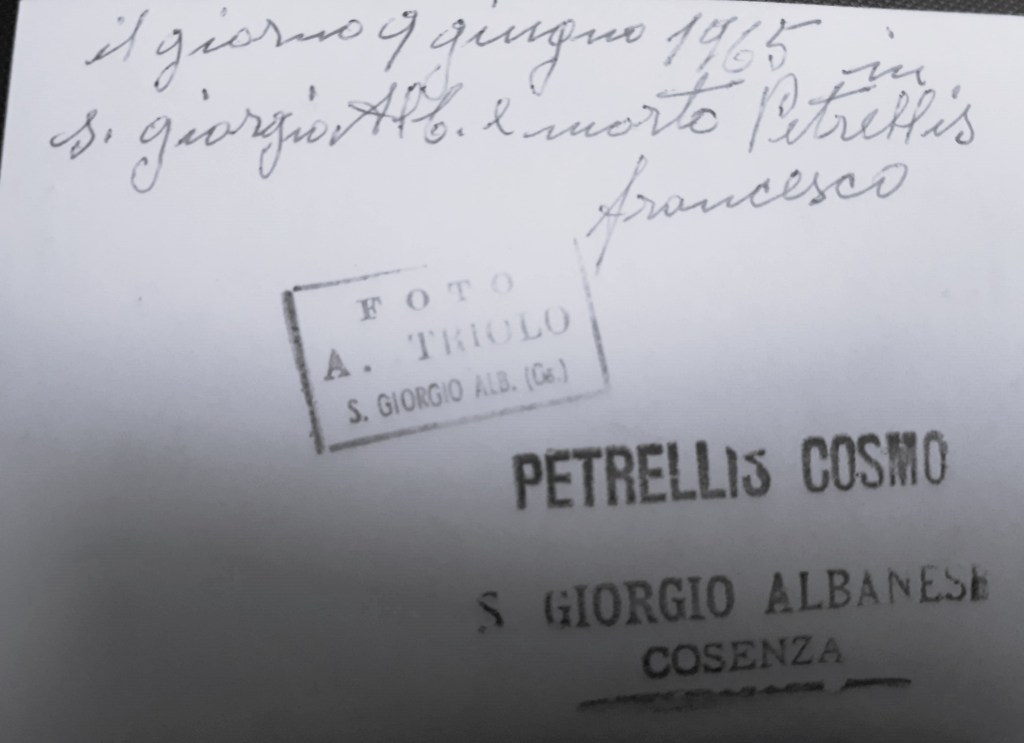
A few days later, she called the house to inform me and my father that she had found a curious photo. Later, when I saw it, I found it quite interesting indeed. For the black-and-white photo showed a dead man in a coffin, covered with bouquets of flowers. On the back of this photo read, in Italian, “On the 9th day of June 1965, in San Giorgio, died Petrellis Francesco.” The photo had been taken by A. Triolo, also of San Giorgio, and the photo was signed by Cosmo Petrellis.
This family curiosity had traveled across the Atlantic and across decades of forgotten memories, only to find its way into my hands, hands that had recently returned to that same village. In thinking about Uncle Frank with his fedora hat and bags full of mob money, I felt that I had understood something that perhaps only another Italian could understand. That whoever we were, and wherever we lived, and whatever names we called ourselves, we were still this illusory thing. Italians were just another unexplained meteorological phenomenon, like those tall waterspout tornadoes rising up like the mighty staff of Poseidon from the depths of the Ionian Sea. We came and we left, we appeared, vanished, and reappeared. One day, we might show up at your door in a crisp gray suit and fedora with a bag full of $500 bank notes. The next day we were gone. And weeks later, we might turn up in the old village, to greet our many relatives.
Just as I had done weeks before in the mountains of Calabria.
Uncle Frank was Frank Peters to the US government and Francesco Petrellis to the Italian one. His odd jobs were driving bigshot mobsters around. But Italians belonged to other kinds of systems. Governments didn’t mean as much as family. The mafia was just another kind of human organization, as legitimate or illegitimate as the local police. Laws were distant, arbitrary, written by strangers. Politics, like in the mafia, was personal, dangerous, and corrupt. And time was just imaginary. Everybody knew that it didn’t really exist.
 north!