AND SO WE RETURNED to Huntington on Long Island, which is one of the few settlements that could be called a real town on the North Shore and not on overgrown coastal meadow village or a sprawled out ship-building port, but a real micro-city with its own library and its ways and boulevards with names like New York Avenue and Prospect Street. There used to be trolleys running the length of Main Street, gliding along metallic grooves, bells ringing, in the old days, the Model T and Model A days, when the automobile was a luxury and the straw hat ruled. The trolleys inevitably circled around the grand town hall at the end of Main Street.
This vast brick structure, constructed by some post-war — here meaning post-Civil War — architect was still in use when I returned there with an Estonian woman, whose name I could never remember, but who was so keen to see my childhood places, such as the swimming pool at the YMCA, and we walked up the granite steps, where there were long lines of townspeople waiting to see some clerk or process some paperwork. What was her name anyway? Annikki? Tuulikki? In the long lawns that stretched down toward the center of town, some women were at work gardening. One poked her head up from between the bushes and I noticed the embroidered white linen bonnet of an Estonian folk costume. Then I heard lines of Estonian dialogue passed between the women, who were planting the gardens with yellow flowers.
Annikki and I came down the steps and there was a friendly encounter with the Estonian gardeners. “What on earth are you doing here?” She asked. “We came over for the summer,” the woman said. She was dressed in a white, traditional folk costume. It was strange that she would wear such beautiful clothes for such hard work, yet there wasn’t a spot of dirt on her.
The cemetery was next to the town hall, on the other side of a grove of dark trees. There was a long stone wall now erected between these properties, but there were many doors in this wall, which stretched for quite some ways, but most of the doors were sealed, and even from in between the few cracks, I could only hear the sounds of young town hall civil servants talking.
We found our way around to the cemetery, which was where my grandfather was entombed, and his father Salvatore and mother Rosaria, and their fathers and mothers and many cousins.
“This is where they sleep, the old Italians,” I told Annikki. She was a slender girl, with tufts of red hair and freckles. Her hair seemed to be in constant windblown animation. I put an arm around her. Annikki was compulsively curious about the world. But something about this world was off. For when I peered down in the cemetery, I saw the ruins of Rome, the tombs of Pompeii. Crumbling columns, nude statues missing arms and noses, all covered with moss.
“This must be the older part of the cemetery,” I told Annikki. “Where the very old Italians sleep. My relatives are buried in the newer part.” There was a small stone house at the gate, with statues of Apollo and Venus out in front. Out of this house stepped an Italian woman, dark-haired and olive-eyed, some years older than me, her skin a perpetual sun-kissed brown.
She began to speak to me, but in Italian, and I expressed myself to the best of my abilities. Some words fell out. Cimitero, parenti. “Your Italian is just awful,” she said in a turn. “Bruto. Who even taught you to speak our language?” “That’s the thing,” I said, sadly. “Nobody did.”
MY DAUGHTER CALLED ME. She said that Uncle Agostino was sick and that he had decided that, for whatever reason, he would soon board a flight to London, where he intended to die. Why he had selected England as his place of moving on to the underworld was unknown to me, but Uncle Agostino was a history buff, and it’s possible he just wanted to see some of its museums before leaving.
At once, I began my sojourn to Uncle Agostino’s house, down by the port. When I arrived, the old man was seated in a chair, dressed up in a Apulian folk costume. The wisps of his white hair poked out from beneath his cap and his arms were crossed. His legs were up on the counter and he seemed quite peaceful, or molto tranquilo, as they say. “Uncle Agostino,” I said, “is it true that you are going to die?” Agostino said nothing, but briefly glanced at me, as if he registered what I was saying. “And why do you want to die in England of all godforsaken places?” Again, there came no answer from caro Uncle Agostino.
My cousin Gabriele was at my side a second later. In fact, the whole house was full of various relatives. His dark hair had grown longer, his skin was tanned from all of the sun. He was in a fine mood despite the somber backdrop. The countertop was submerged in local cuisine. Panzarotti. Orecchiette con cime di rapa. Spaghetti e polpo. “Don’t mind Uncle Agostino,” Gabriele said. “He’s just preparing his soul for his journey to the underworld.” “I can see that.” “But those clothes won’t do for the funeral later,” Gabriele said to me. “You need to get some new Italian clothes. We Italians like to look sharp at funerals.”
Out into the street I went, searching for my wardrobe upgrade. Gabriele was correct. My shoes were worn so thin, they were coming apart. My pants were baggy and covered with stains. Mysteriously, my belt was too long, though there was no evidence that I had lost any weight. My shirt had been bought in India. Indeed, I was the very picture of a beggar. Again I came down by the port, where a ship carrying refugees from Africa had just docked. I stepped over them in my search for new Italian clothes. The sky was a strange, otherworldly pink, and it swirled high above the sleepy Adriatic, full of pulsating yellow-white blobs. It was a kind of Mediterranean aurora borealis.
“This is not Puglia,” I said, observing the sky. “This is somewhere else.” I turned up a street by the port and walked into a restaurant, where another family was celebrating some event, birth, death, marriage, what have you. But I was escorted out on account of my shit attire. Up the street, I found a shop that sold belts, shoes, pants, and for decent prices. There I was, rummaging through the discount bins, trying to look something like a presentable Italian. Again my phone rang. It was my daughter. “Are you coming?” she said. “Uncle Agostino is ready to go to England now. Agostino says he wants you to come with him.”
ONE DAY IN EARLY APRIL, when there was still fresh snow on the ground, I was walking down the street towards the seamstress’ place when I overheard two school boys singing a song outside the Lõuna-Mulgimaa Puuetega Inimeste Ühing, or the Association of People with Disabilities of South Mulgimaa, as it translates in English. The words of the familiar song they sang together went something like this, “Mi amore, espresso macchiato, macchiato, macchiato, por favore.”
The melody tumbled down into the street like big wet flakes of snow. I already knew it so well. Sometimes I think that “Espresso Macchiato” is always playing somewhere. I only happen to hear it now and then. When I am not hearing it, it is being played somewhere else or it’s replaying itself in someone’s mind. The song is always playing somewhere out in the universe. Maybe it has always existed then, and its creator merely channeled and recorded the song?
“Do you know that I am researching this song,” I told the young lads, who were perhaps 10 years old. They looked up at me with curious eyes, but they were not intimidated by the big stranger in a dark coat. Rather they were friendly and seemed to take me as just another, much larger school boy. One of the boys held his thumb up to me. “Good,” he said. “Because I love that song.” “Well, what else do you think about the song?” I asked the first boy. “It’s my favorite song,” he said. “Mine too,” said the other boy. “‘Espresso Macchiato’ is my favorite song too,” he added. “Very good,” I said. “Enjoy your favorite song.” “Oh, we will,” they said. At that, I left the boys at the corner, but I could hear them singing as they walked the other way.
‘You just have to watch it’
Everyone, I think, has now developed a special relationship with “Espresso Macchiato,” Estonia’s 2025 Eurovision entry, performed by Tommy Cash. For some, like those little Viljandi boys, it has become their new favorite. Seventy-five years from now, when they are living in some South Estonian hooldekodu, or nursing home, they might sit beside each other watching Aktuaalne kaamera and singing the song. “Mi casa very grandioso. Mi money numeroso.”
Everyone has their own story about how they first heard “Espresso Macchiato” and how it began to manifest itself in their lives. Think about it. Where were you when you first heard it? For me, I was sitting in a cafe in Tartu meeting an old friend in winter when she pulled out her phone and told me I just had to watch this video. “You just have to watch it,” she said. I didn’t know what to make of it at first. The friend, an Estonian journalist from Kuressaare, thought it was fantastic. I understood that to Estonians, I am something of an Italian, though not the genuine thing, and for them, it’s interesting how someone like me might respond to these stereotypes. Coffee, spaghetti, mafia. Screens displaying red-and-white checkered tablecloths.
There he stood, the mustachioed Tommy Cash, looking more like Dracula than any mafioso. The thin mustache, the shoulder-length hair, the pale skin. Was he not some kind of caffeinated disco nosferatu? But it was not blood upon the lips of this Estonian musician. It was a coffee drink. There he stood drinking another espresso macchiato. “Life is like spaghetti,” Cash sings. “It’s hard until you make it.” Then he sings, “No stresso, no stresso. It’s gonna be espresso.”
I had to wholeheartedly agree with him. Life is like spaghetti. More coffee is the answer. “Espresso Macchiato” is not just a Eurovision entry. It is a philosophical manifesto on life.
After my first encounter with “Espresso Macchiato,” baristas began to sing it to me. Nobody in Estonia could order an espresso anymore without someone asking if they didn’t want an espresso macchiato. “No stresso, no stresso,” the baristas said. “No need to be depresso!”
Did I really look so depressed?
Italians love to complain
There has also been controversy. An Italian consumer association appealed to the European Broadcasting Union suggesting that it was not fit to be included in the Eurovision competition. Some right-wing lawmakers were indignant and condemned it on social media. Not knowing how to process contrasting feelings of being offended but also honored, Italians dressed up like Estonians and made their own version about eating sprats. “Sööme sprotte!” The song had descended into a kind of transnational food fight, with Estonians throwing coffee cups and spaghetti over the continent at the Italians and the Italians tossing back cans of fish.
Maurizio D’Agapito, an Italian resident in Estonia who is also a musician and performer, has been asked to participate in numerous podcasts and radio programs, such as Spaghetti alla Chitarra, to weigh in on the merits of the song. Maurizio also provided his own analysis on his YouTube Channel, Itaallane Eestis, and so I decided to seek him out, arranging an interview at Fotografiska in Tallinn on a March day. I was intimidated of course, because I would have to do an interview in Italian. Maurizio is a Roman — he even looks like a Roman, with his coarse hair, broad shoulders — and did not mince his words when it came to Cash’s notorious song.
He approves of it. He performs it at his concerts. “Estonians go crazy when I play it,” he said.
“Italians have a word for a song that gets stuck in your head,” Maurizio added. “A tormentone.”
A tormentone torments its listener. Yet this torment is not necessarily bad. One learns to enjoy being tormented by a tormentone. There is something perversely satisfying about the torment. Here I must agree. If “Espresso Macchiato” had been too infectious, too catchy, it might have long ago burned itself out. But the song takes its time. It has a relaxed feel. You start to miss it.
“Mi amore, mi amore …”
Such is the nature of a tormentone. It is a phantom song, attaining a kind of immortality. One must be careful not to invoke the name of a tormentone. Otherwise it will begin to torment again.
And as for the controversy?
“But Espresso Macchiato is not Italian!” protested Maurizio. “It’s a big fucking mix of Spanish, Italian, English. Broccolino, no?” He laughs. The man is correct. Por favore is Spanish, not Italian. “It would be stupid to be offended by it.” He dismissed the idea with a hand gesture.
Some Italians were offended though, mostly by the use of the word ‘mafioso.’ The mafia is a very sensitive topic in Italy. Just three days ago, as I type this while drinking a coffee, the police arrested 24 in Naples for running a parking protection racketing scheme. They were also charged with possessing illegal weapons and drugs. “The mafia is a big issue,” said Maurizio.
The real issue though, as he put it, is that Italians just like to complain about things. If it’s hot, it’s too hot. If it is cold, it’s too cold. No matter the coffee or the meal, it could have been better. He is not the first Italian to acknowledge this national trait for complaining. If the Estonian way is to suffer quietly through real hardships then the Italian way is to complain loudly about imaginary ones. “Italians love to complain,” said Maurizio. “This gave them another reason to complain.”
Mostly, though, Maurizio is a fan of Mr. Cash. He said the marketing around the song, controversy included, had been perfect. “Oh, he was clever,” said Maurizio I imagine with a pinch of envy. “Very, very clever.”
The boy from Kopli
Of the author of this tormentone, I still know very little. He was born in Tallinn a dozen years after I was, and is of mixed ancestry. His home language was Russian and he speaks fluent Estonian having been educated in the Estonian language. He is therefore a multiethnic polyglot. Mr. Cash considers himself a post-Soviet rapper with an Eastern European soul and Scandinavian resume, they say. Perhaps that might be a good way of describing Tallinn to all. That’s the thing about artists, we hold them up as idols to better understand ourselves. Estonia in recent years has been worshipful of homegrown exotic heroes like Stefan, Alika, and Tommy.
I had thought that his birthname was probably “Toomas Sularaha,” or Tommy Cash in Estonian. In fact, it is Tomas — with one ‘o’ — Tammemets. He was raised in Kopli though, which tells me a lot. A long time ago, in the old days, when I was a 24-year-old recent arrival to Tallinn with a wife from Karksi-Nuia and a newborn baby who I would take on wintry excursions to Säästumarket, I also gave some English lessons in Kopli, which was a wooden ghetto of half-burnt buildings. There were no Argentinian steakhouses in those days, no boutiques or seaside breweries. There were characters who looked a lot like, well, Tommy Cash, in puffy jackets drinking vodka. Tommy Cash came out of Kopli, was a creature of its misty alleycat-inhabited back alleyways.
This idea, of a scrappy street performer who hustled his way into high-profile collaborations with Charli xcx and Diplo, has impressed even the most reticent Estonians. “You’ve got to hand it to him,” a bearded, Camus-obsessed Estonian told me on the street. “In a country where nobody wants to stand out, Tommy hasn’t been afraid to draw attention to himself, to stick his neck out.”
Another Estonian who is more aligned with the folk culture that colors Viljandi life, was similarly supportive of Mr. Cash. “I don’t know if I am down with ‘Pussy Money Weed’,” she said, referring to his 2018 single, which has garnered more than 15.4 million YouTube views since its release. “But if he is making fun of that kind of attitude, that lifestyle, then I can be supportive of that.”
It’s hard for me to understand the music world of which Tommy Cash is a character. I’m old school. I come from the world of concept albums, meticulously recorded in studios in the Bahamas or in Stockholm. Think Pink Floyd’s Dark Side of the Moon. Or Björk’s Homogenic. Think of Radiohead’s Kid A. I suppose in the old days, popularity was measured in units shipped, gold records gained. I’m not sure that 15.4 million views means something. What if one person just kept hitting refresh 15.4 million times? I don’t know what to make of these weirdly titled collaborations called “Zuccenberg,” “Ca$h Ready,” and “It’s Crazy, It’s Party.” I don’t know.
My old analog world of artistry did colide with Mr. Cash’s world of being a digital provocateur. That was the day when Kristiina Ehin, who writes paper books and paper poems, found herself in the Ankrusaal of Kopli unable to pay for a coffee, but rescued by a swashbuckling Mr. Cash. He promptly paid for the lady’s drink and informed her that, having already won Eurovision, at least in spirit, he had little better to do than to mill about Kopli cafes rescuing distressed poets.
“It did not change my life,” Kristiina later confided. “But it was fun and it was nice to see him.”
Kristiina’s husband, the esteemed musician Silver Sepp, also did not come away emptyhanded. Author of his own song about coffee, called “Kohvi,” in which he beat boxes using a microphone and coffee cup, Silver said he was not at all jealous of Mr. Cash after he rescued his wife in a Kopli cafe. “On the contrary,” he said. “After all, I got a coffee cup for myself,” he said. “A new instrument!”
The Kristiina Ehin Coffee Incident has been added to the lore around “Espresso Macchiato.” It is part of the story of the song, as much a part of it as the Italians who did a cover version about eating sprats. Such stories are as important as the songs, I think. All good songs have stories.
A parting drink
All across Estonia, espresso macchiato has either been added to the menu, or has risen to the top. At Sumi, young patrons from Kalamaja ask for it with a morning donut or pastry. At the Cafe Gustav in Solaris, they have even underlined the drink to make it more apparent to their clients.
“We’ve always offered it,” the barista said. “After the song came out, well, there was a wave.”
And at my local drinking establishment in Viljandi the drink, while not on the menu, is available upon request. I have been told to be careful. “It’s quite strong,” the barista warned me. “It’s just an espresso with just a little bit of milk.” The cup of espresso macchiato arrives and I sip it. It’s frothy and does have a certain kick. So this is the famed drink, I think. This tormenting coffee is the one that rules them all. This is the drink that could deliver Estonia a great Eurovision victory. One could get seriously addicted to a drink like this.
BEFORE I GO ANY FURTHER, I should tell you more about Montrone and Canneto, these two towns outside of Bari that have grown together. For centuries they remained apart, distant, at arm’s length, and in fact they maintained two very different dialects. One of the towns hosted a Norman French garrison in the 11th century, and its dialect was therefore influenced by French. The other was settled by Greek refugees in the 10th century, and its dialect was infused with Greek. Cousin Lorenzo says it’s possible to tell someone from Montrone, a montronese, from someone from Canneto, a cannetano, by the way they say the word for “bread.”
“They say, u pan,” says Lorenzo. “But we montronese say u pen.“
The official word for bread in Italian is pane. In French, it’s pain. So the local dialect word, which is common in the dialects around Bari, called barese, is a bit closer to French. To me both of the versions sound almost exactly the same. U pan, u pen. U pen, u pan. U pan …
There are these tiny differences, you see. But a single vowel can give away your identity.
One must realize that the country or nation of Italy is largely a fiction, or at least a coincidence of geography. Every region, every city, every town, even every neighborhood has its own history and its own dialect, many of which are so unintelligible to outsiders that they are considered their own languages. It is said that the singer Frank Sinatra’s mother, Natalina, who played a role in local politics in Hoboken, New Jersey, where Sinatra was born and raised, was successful in part because she could speak all the dialects of the Italian peninsula. This made her indispensable when dealing with the immigrants who thronged New York City a century ago, people like my great grandfather Domenico Abbatecola, who was from Bari, or my father’s grandfather, Salvatore Petrone, who came from a village in Calabria. Even during my first trip to Italy, at the age of 22, I became aware of the language issue when I was stopped by an older man with a white mustache from Palermo on a street in Bologna. He was looking for the train station. People had responded to him in the Bolognese dialect. He was unable to understand their directions. “I can’t understand a word these people say,” the old Sicilian told me that day.
How odd then, that I could understand him. When I was 22, I really didn’t speak Italian at all.
Now and then I replay that moment over and over in my mind. How did I understand him?
***
FROM THE PORT OF BARI, where the ships leave for the ports of Bar in Montenegro, Dürres in Albania, and Dubrovnik in Croatia, it is about 15 straight kilometers south into Montrone and Canneto. These towns, however, no longer appear on maps because in 1927 they were united into one municipality called Adelfia, from the Greek word αδελφός (adelphos), “brother.”
On a map, at least, the Montrone and Canneto sections of Adelfia are distinguishable. Canneto, to the west, with its ancient Torre Normana, or Norman Tower, is the larger of the settlements. Montrone is the sleepier, eastern side of Adelfia. The main landmark here is the public gardens, with its Fontana dell’emigrante, or Fountain of Emigrants, which is a fitting name because my great grandfather Domenico was born and grew up right across the street.
Just a few houses down, there is a little cafe called the Pasticceria Caffetteria Petrone, where you can get a pastry and an espresso in the morning. There is nothing better than waking to the sounds of the church bells, or to the neverending calls of the people in the streets, and walking to the Caffeteria Petrone. The owner, as far as I know, is not a relative, and is from Naples. There are many Petrones in southern Italy, and we are not all close relatives. There, you take your place at the counter, and wait for that little white cup to arrive. Everyone is here, the dentist, the postman, the cosmetologist. And even if they don’t know you, they still know you. The eyes search each other, the cup is lifted, and you are wished a buon giorno.
“Good morning,” or, actually, “good day.”
This is how the montronesi start their days, and just a few hundred meters down the Via Vittorio Veneto, and over the old aqueduct, the mornings of the cannetani are much the same. Only that they call bread u pan and the montronesi call bread u pen. There are other divisions. For example, no one in these two towns can agree on exactly where the border between them lies. This I was told one night, strolling around with cousin Lorenzo. While the aqueduct seems like a natural boundary, only the people from Canneto believe that. The montronesi say the boundary between the towns is really a column on an old building just over the bridge. “This is where Montrone really ends,” said Lorenzo one night as we paraded around the old lanes of Montrone, venturing into disputed territory. “Beyond this point, they say u pan and not u pen. Beyond this point, you are dealing with the cannetani, who speak a very different dialect.”
He gestured quickly with his head, as if these people, the cannetani, were an alien race.
***
I DON’T KNOW how old my Italian cousin Lorenzo is, and I have never asked, but I assume he is about my age. At the time we first met, he was working for a software company that designs platforms for managing airports. He had returned to Bari after many years in Rome and he was single and had decided on something of a career change, to go into academia after a life in the private sector. I cannot fully understand how the Italian economy even works because I only see these people eating and meeting with family members, but during the working hours, they do disappear someplace, to do at least some work, just a little, before returning to the table.
Lorenzo’s father, Giuseppe, works in agriculture, a job he quite enjoys. In the evenings, he heads out to the piazza in Adelfia to play cards and share stories with old friends. Night after night, the old men are out there in their caps talking and making noise. At night, Italy is even livelier than during the day and I am always impressed to see the offices of the country’s political parties on the piazzas in the evenings, the windows lit up, and people seated around inside eating pasta together. They are more like social clubs than real political parties. In the US, they would be outside with signs, yelling at each other. In Adelfia, the only thing they yell is something like, “Would you please pass the bread?” Or, “How about another espresso?”
Lorenzo against this backdrop casts a more lonesome, stark figure. He is tall, dark-haired, at times silent, at times with great humor. He is instantly likeable. Some people just have this kind of quality. You can’t help but like them. While his career path is in mathematics and science, he loves to talk about traditions and he is very thoroughly grounded in the local culture. That same night we went out to see the disputed border between Canneto and Montrone, we also stopped into a church to light a candle and view the shrine to San Trifone, the patron of Adelfia. The interior of the Church of Saint Nicholas of Bari and Saint Tryphon Martyr is beautiful. Its high ceilings are covered with pastel blue and frescoes, triumphant angels, and nativity scenes. And beneath all of this color moved a figure clothed in black named Lorenzo.
I cannot say that Lorenzo is a nationalist, because how could a montronese belong to a nation? Italians are not a nation in this sense, they are a combination of many now forgotten peoples, mingling on the soils of this land over generations. The Greeks, the French, the Albanians, the Visigoths. But Lorenzo is proud of the south and of his home here in southern Italy, and is sensitive to the stereotypes about the southerners that pervade Italy, and elsewhere, that they are dangerous, criminal, and violent. He also likes to talk about history, and how Bari and adjacent areas of Italy were sacked and plundered by foreign armies. In the 9th century, Islamic invaders created the Emirate of Bari, but just a handful of years later the Byzantines took it back from the Ottoman Turks. Then, in 1071, Robert Guiscard and his swashbuckling Norman adventurers swooped in. Among other feats, they built the Norman Tower right here.
Not only the tower remains, but the blue eyes and light hair that exists to this day among some of the inhabitants of Adelfia are a reminder of these Normans. My great grandfather Domenico also had blue eyes as does my mother Christine. As do two of my three children. As a child, it linked my mom and her towering Italian grandfather. He would look down and say, “Our people came from the north.”
“For centuries, Italians were subjected to invasion after foreign invasion,” Lorenzo told me that night. “Only in 1860 were we able to stop being picked apart and fought over by others. Then came the risorgimento, the unification under Giuseppe Garibaldi. Some say that it was a unification, but others say that the piedmontese just annexed the rest of Italy. They helped themselves to the resources and labor of the south, but they think that we are criminals.”
“But my grandfather Petrone, my father’s father, said that our people were criminals,” I insisted. “I have heard that Calabria, where the Petrones were from, was legendary for its banditry.”
“No, no the Calabrese weren’t bandits,” said Lorenzo. They were briganti. Brigantines! They were a movement, trying to wake up the north, to tell them what was going on in Italy.”
Such were the lectures of my cousin Lorenzo. He seemed offended that I would even suggest that our countrymen were anything other than noble Robin Hoods, stealing from the rich to give to the poor, fighting the powerful and wealthy families of the north by flouting their laws and creating their own codes of justice. One man’s brigantine was another man’s criminal. His body language was subdued though. Lorenzo is not your stereotypical Italian who argues loudly, flailing his arms. It’s hard to imagine him yelling out a car window while pounding away on his horn. But in his quiet certainty about the nature of Italy, I felt I had said something wrong, even though I was proud of these stories of criminality that we had carried with us from the south. In America, such tales of lawlessness had a kind of mystique. Who wanted to descend from law-abiding Italians, when you could claim your cousin was a notorious outlaw?
“People are afraid of the south,” I pressed on. “A Florentine told me it’s dangerous. They say they lock their cars when they see Neapolitan license plates. Even when they are driving.”
“Florence is far more dangerous than Bari,” my cousin Lorenzo shook his head. “That’s what’s so funny about the northerners, you know. They think the south is full of criminals. But since all the money is in cities like Milan, that is where all of the real criminals go. Milan is more dangerous than any city in the south.” To his credit, nobody robbed us that night as we paraded around Montrone and Canneto in the dangerous south of Italy. The only thing I was ever robbed of in the south was hunger though, because it seemed like all we did was eat.
***
SOME DAYS LATER, we had a fine meal at a restaurant in Adelfia, consisting of tiny mozzarellinis, polenta baked in marinara sauce, and many other delights, such as sauteed chicken hearts. Lorenzo was there, as were Pamela and Antonella and Lello. Platter after platter of food arrived, glasses of wine were consumed, and I began to worry who would be picking up the bill for this feast. There was even a mozzarella the size of a loaf of bread. On the way out, I asked the chef at the counter about the bill. I imagined that it was enormous.
He in turn simply asked me if I preferred Northern Italy or Southern Italy.
“Whose side are you on?” said the chef. He was a roly-poly man with Sinatra blue eyes.
“The South,” I told him with my most casual Italian shrug. “Naturally.”
“Good! In that case, your meal was free,” the chef said and bowed his head. “Grattis.”
Much later, I found out that my cousins had already settled the bill. But I like to live in that illusion that just professing a love for the South over the North could earn you a free meal anywhere south of Rome. All you had to say was that the South was better, and a waiter would bring you a tray of free mozzarellinis and the cooks in the back would start baking polenta.
I HAD ALWAYS BEEN, even without knowing it, a lost son of Italy. I think most Italian-Americans are the country’s lost sons and daughters. We forgot our language, we forgot our family stories. We forgot what our names meant and we forgot what roles we had played in history. In America, we were supposed to be new people. Some of us changed our names or we gave our children names that would not, on first notice, smack of any kind of ethnic affinity. It was only through my own personal interest and research that I had learned the family stories. In uncovering these forgotten stories, I began to learn the real reasons why we left Italy.
The story about how I learned the truth started when I was 30 years old, to the day. I had spent the night before celebrating my birthday with friends at a restaurant in Estonia, then taken a night bus to Tallinn Airport, pausing only to buy a few gifts for relatives, mostly boxes of Estonian and Finnish chocolates, and one bottle of vodka, which would be prized among any nation other than the Italians. I would come to regret purchasing that bottle of vodka.
***
That morning the plane carried me from the November frosts of the Baltic and across the expanse of the German countryside to Munich, where I changed planes. From the air, Germany was a tidy patchwork of church steeples and fields. These were disrupted by the massive Alps, rocky and jagged, spiked with ice. Then came the valleys of the Po, and those black-green, forested hills, the Apennines. From the mons of the Alps sprang this nether region called Italy, dark and intriguing, the genitals of Europe swaying down into the Mediterranean.
I was a little nervous as that plane descended toward its destination. I had been to Italy before then, but as a simple tourist. This trip though would take me to places I hadn’t been before and put me into situations I had never experienced. I was to travel from the capital Rome deep into the South, meeting with relatives I had never met before, serving as a kind of self-appointed family ambassador, making up for decades of no contact. I had no idea what to expect, but I was willing to take the plunge. I was married, had two small children, and was soundly employed. I did feel kind of stuck. I had just turned 30 and things needed shaking up.
Inside, I still had the heart of an adventurer, I think. I yearned to discover something new. This new discovery would be Italy, but not the Italy of Rome or Venice, of art galleries and souvenir shops, or fashion boutiques and tours of Tuscan vineyards. I was already aware, vaguely, that I was about to leap off into the unknown, into a world where nobody spoke English, and I spoke only a little bit of Italian. Still, I have always enjoyed these kinds of challenges.
At last, we landed in Fiumicino, right on the coast at the very spot where the Tiber begins its snaky crawl toward the heart of the old empire. Here I found my way through an apocalyptic wasteland of industrial parks splashed with graffiti, the reeking armpit of the capital. Whichever way you turned, Rome was dirty and foul, a pungent and fermenting heap of trash and history. The air smelled of trains, of fried foods, of espresso, car exhaust, cigarettes, and pigeons. It smelled of the crisp uniforms of the carabinieri, the tangled shampooed locks of the Roman women as they sped by on Vespas, clutching the waists of their daredevil boyfriends.
I took a train into the central station, and then walked a few blocks to my hostel. The manager on duty took my money and shook my hand and wished me a happy birthday, as he had noticed it was my birthday when he copied down the information from my passport. He next gave me the keys to my room. It would only be a night there before I left for Bari. In the next room, some young American women were already drinking wine in the afternoon and boisterously toasting to each other. “To a happy vacation in Italy with lots of hot Italian men!”
I strongly doubted that they would consider me to be one of these exotic men and I felt a little insulted by the idea that that’s all an Italian could ever mean to them. A quick fling on a Roman holiday. Some Mediterranean spice to their otherwise white bread lives. They would go home and marry some boring man in Indianapolis or Houston or god knew where they called home. They would marry a normal man with a normal name, but there would always be Italy!
I was so annoyed by them that I decided the only thing that could lift my spirits would be a walk to see the Colosseum and a slice of pizza. I remember that moment, sitting with my back against the wall, listening to those girls. Sometimes, I wasn’t proud to be an American.
That was one of those times.
***
THE NEXT MORNING I was back at the train station with my backpack, stuffed with boxes of Estonian chocolates and that bottle of Estonian vodka. I bought a ticket for Bari Centrale and took a seat on the train across from an older woman who wore a giant crucifix around her neck and spent her time surfing the web on a laptop, or calling by phone to check on various relatives. This is a four-hour journey that takes you to the outskirts of Naples and then straight across to the other side of the peninsula. You know you are close to Bari when you can at least see the Adriatic from your window. You see the quiet Adriatic and the lights from the ships sailing on it. When we at last arrived at Bari Centrale, I somehow could not believe it. I couldn’t believe I had gone back, even though I had never stepped foot in the city. For a moment, I almost thought it was a film set, to see that sign hanging above informing me that this was the real Bari: the Bari I had only seen in photos and atlases. It was evening and the moisture of the Adriatic was everywhere. That smell of the sea put me at ease. It was familiar to me, and I felt my body relax, even though I was about to come face to face with a relative.
A cousin that I had never met.
I knew of course that my ancestors had come from this port city in the south, and thanks to some correspondence my cousin Mary Ann — a granddaughter of the famous Uncle Vinny — had initiated, as well as some social media dialogues with this newly discovered relative named Cousin Lorenzo, I now had an invitation to dinner in Adelfia, which sits outside the city.
Cousin Lorenzo and I met via Facebook. Perhaps only because of his last name, he was suggested as a friend to me, considering all of the other Abbatecolas on my friend’s list (Abbatecola being my mother’s maiden name). Not only was I interested in him, he was interested in me. He wanted to meet this lost American relative. Something about the promise of America still stirs the fantasies of Italians. Bright lights, big cities. Fame and fortune. New York, Chicago, Hollywood and Disneyland. Almost every Italian has a lost relative to the American Dream. Almost none of them came back to old Italy, and after a while, all contact with these dreamers ceased. Before I arrived at Bari Centrale, Lorenzo sent me a message.
He wrote:
I am in station. Yuo take off and wait. See a black hat in my hand.
There he was, Cousin Lorenzo, standing beneath the big sign that said Bari, with dark hair and a familiar face. We approached each other with great curiosity. From what we had determined, Lorenzo was a distant cousin to me. My great grandfather, Domenico was the son of a man named Vincenzo Abbatecola, who was born in the year 1846, when Italy wasn’t a country. Lorenzo’s forefather was Vincenzo’s brother. His name, as you might expect, was also Lorenzo.
I remember that feeling of meeting Cousin Lorenzo for the first time. I would not say it was an odd or funny feeling, but everything about him was so familiar to me. It was as if I had staggered into the bathroom at some early hour and glanced at myself in the mirror. Many people had told me that I didn’t look like a real Italian, because I was so tall, but Lorenzo was as tall as I was, and he looked me directly in the eyes. We were undoubtedly related, we few tall Italians, and I wondered about who our common tall Italian ancestor was, who looked this way, and when he had lived and under what circumstances. Was there once a tall villager in some village in Italy in the 17th century who looked like me and Lorenzo? Was he also one of us?
After having known Cousin Lorenzo for a few seconds, I determined he was everything I imagined an Italian cousin should be. Lorenzo was about the same age. We had entered this world at the same time and had grown up on opposite sides of a great ocean, speaking different languages, unaware of each other’s existence. Lorenzo was here in Italy. I was over there in America. He was doing his Italian things, like kicking a soccer ball against a wall. I was doing my American things, like also kicking a soccer ball against a wall. Only that that wall was in America, not in Italy. We did not know each other and yet, in a second, by looking into each other’s eyes, we arrived both at an understanding. Two shadows meeting on a train platform.
“Cugino?” Lorenzo said to me at the train station. “Cousin? Is it really you?”
***
AFTER THAT, I was more or less immediately accepted into the warm bosom of my new family. Each night, I was invited to dinner at Cousin Lorenzo’s parents’ house in Adelfia. Adelfia was a patchwork of multi-story stone houses of indeterminate age, separated from each other by narrow streets and narrower alleyways. There was an ancient, dusty, almost Middle Eastern feeling to these rows of beige and white homes. Lorenzo’s house was among them, accessible from the street through a metal gate. Meals in general were the domain of Giuseppina, his diminutive and vivacious mother, who worked through the day to prepare them. Giuseppe, her husband, would later arrive as would Lorenzo’s sisters Pamela and Antonella. All of them showed great curiosity in me, as if I was an alien or something and brought me different kinds of sweets, dolci, and explained their regions of origin and historical significance. “This is a local sweet,” Antonella would say. “But this one here comes from Sicily. See, you can tell by the use of orange slices.” Antonella had wonderfully thick black curly hair. She looked like one of those women from an ancient Greek vase. Pamela had a fun, playful, boundless energy to her.
Antonella’s boyfriend Lello would also be there while I was being instructed about different sweets, yawning through the evening news. The most important news in Italy at the time involved Piero Marrazzo, the governor of Lazio, a region adjacent to Rome, who had been filmed taking drugs and having sex with some Brazilian transsexuals. One of these transsexual prostitutes died later in a mysterious fire. By eating together with the family, I therefore learned a great deal about Italian culture. Much had changed since my great grandfather left.
Some things remained the same.
Cousin Lorenzo showed me the lemon trees in the yard, as well as the wine press in the basement. Each year, Lorenzo’s family would harvest the grapes from the vineyards and make wine at a certain time, all so that it would be ready for the great Feast of San Trifone, the patron saint of Adelfia, as every Italian village and city has its own patron saint, if not several of them. Meals with his family were familiar, salad, pasta, fish or meat, washed down with this same homemade wine. After the meals, they would munch on stalks of garden-grown fennel, or then indulge ripe fleshy slices of cachi, or persimmons. The tiny cups of hot espresso would come around and a shot of limoncello, the famed liqueur made with grain alcohol, sugar, and boiled lemon rinds, or its lesser known cousin, mandorino, which is made with the skins of oranges. Then these sons and daughters of Italy would lean back and make conversation.
Such were their ways.
***
ONE AFTERNOON, Uncle Vincenzo, or “Enzo” for short, was invited over to discuss the history of the family with me. Enzo was the son of Michele, my great grandfather Domenico’s older brother. At that time, he was about 70 years old, a spry old man with gray hair and glasses and palpable energy. Enzo marched into the dining room, where we were sitting around eating cachi and pointed. Enzo said, “Your great grandfather was the one who beat up the priest.”
Everyone laughed then. I and what surprised me was that they all seemed to know the story. As for me, I was speechless and did not know how to react. I had never heard the story, and yet I was not surprised. That side of my family was known for these kinds of transgressions. Relatives were known to wield a bat with people who crossed them the wrong way. Tempers flared, impulses could not be contained. Sometimes an argument overheated and the police might be called in to calm things down. In a way, I was almost relieved that Domenico had only beaten the priest and not killed this man of god. Certainly, I was embarrassed by the story and the attention. To think that I had come all this way to be confronted by Domenico’s past.
But he was my great grandfather. Surely he had had his reasons.
This had happened in the early 1900s. More than a century ago. The story had been carried forward though, and Enzo was now closing the circle. He was pulling the threads between then and now, between America and Italy, between me and him. The priest, he said, had taken a liking to Domenico and Michele’s sister. He had crossed the line on several occasions. And so Domenico and his younger brother Saverio, who were running a brewery, decided to settle scores. They attacked the lecherous priest with police batons, injuring him badly. The news soon spread quickly, and my great grandfather and his younger brother sought counsel from their father, a businessman, as well as older brother Michele, Enzo’s father, a policeman. “He said, if it was anyone else I could protect you,” Enzo recalled his father’s words. “But this is a Catholic country. If you beat up a priest, you will go to jail. You have to leave the country.”
This is what had sent Saverio and Domenico to the Port of Naples seeking passage to New York. Later, Enzo told me there was more to the story. The incident was not only related to protecting the honor of their sister. They also had “big political problems,” as Enzo had put it.
“They were anarchists,” he said, anarchici. “That’s why they did it.”
“Anarchists?”
Enzo nodded. Anarchici. The word sounded strange and dangerous. It sounded like men with mustaches lurking in the vestibules of churches with police batons ready to pounce. It sounded like terrorists robbing banks or cutting the throats of policemen in their sleep. I had read once of anarchists in Italy who had stolen and burned bank records in a bonfire, as to eliminate any records of people’s debts. With no debts, people could start again fresh. They could rebuild their lives. I remembered thinking that it sounded like a wonderful idea.
Many people I knew had all kinds of different people in their families. Especially in Estonia, it wasn’t hard to meet someone who descended from a notorious Communist, or perhaps someone who had helped the Nazi German regime a little too enthusiastically during the grim and bloody war years. But anarchists? Anarchici? I was the great grandson of an anarchist? What did that even mean? Could anarchism be passed down, like so many other things?
Was I an anarchist too?
***
WHEN I LATER called my mother and told her the story, she said that she had heard something like this whispered around her when she was a child. Nobody knew exactly what had happened, but they knew that it was bad. That was our family. We were passionate, but perhaps too passionate. Whether we were followers of the anarchist Errico Malatesta and read his paper Umanità Nova, or claimed to know nothing of it, you didn’t want to cross us.
For me, personally, this story opened a door to another era. It helped me to better understand my links to this country we left behind. Not long ago, there had been a predecessor just like me, who felt passionately about various injustices in the world. He had sat here in this same comune or municipality outside of Bari, under the influence of the revolutionary anarchists. The story of the two brothers and the priest therefore helped me to feel closer to my origins. It kicked open a door. Just as that door had opened before me, many others would open.
SOMETIMES I WONDER how I ever wound up here.This northern land of trees where there’s snow on the ground from November through April. The Estonian doctors told me long ago that my body wasn’t designed for this climate. I have come to believe them. My body was designed for sun-baked countryside, for almond and olive groves, for the spray of the sea and for tins of tuna fish. But I am not there, where I should be. I am here and it is snowing again.
Such thoughts ramble through my mind as I make my way to an establishment called the Grand Hotel. There’s a gym in the basement there and you can book it for an hour at a time. That small hotel gym basement has become my sanctuary in the winter months. Outside, it’s dark, freezing, but down there it’s warm and I can wear shorts. There’s also a TV mounted on the wall. My favorite channel is the history channel. It almost exclusively shows documentaries about Hitler and Mussolini. Sometimes the old film reels of Mussolini bother me. I look like some of the blackshirts crowding around Il Duce. There’s a cranky old Estonian man who gets coffee at the same cafes that I do here, and he refers to me as one of the “Mussolini nation.” “What are you doing in Estonia?” the old man asks now and then. “You’re an invasive species!”
***
THE CRANKY OLD ESTONIAN MAN, whose name is Imre, and who also sometimes visits the hotel for late night and early morning coffees, isn’t here this time, but Ragne is at the desk as always. Oh, Ragne. Ragne is about five years younger than me and has declared her singular interest in older men. We’re just so mature and worldly. She likes to wink at me, fluster me, to toy with me, and then tell me that she has absolutely no interest in me. She is a serious Estonian woman, who prefers serious Estonian men. A sentimental Italian is of no use to Ragne. She plays with her blonde hair. Life is better as a blonde, Ragne says. Ragne has a new manicure every other day. She also always has to remind me to be on time. She has to remind me because I often roll in 10 minutes late. Not on purpose. It just always happens that way.
Ragne finds my tardiness infuriating. This time I have decided to book my gym hour for 5 pm.
“That means 5 pm Estonian time!” Ragne calls out to me as I walk back out the door. This somehow gets under my skin, strikes at my very identity. 5 pm Estonian time. Invasive species. One of the Mussolini nation. How did I even wind up in this land of snow and no nonsense?
“But didn’t you know?” I call back. “Time doesn’t really exist. It’s just numbers!”
“That’s not true,” Ragne shouts back over the desk. “Time does exist.”
“No, time doesn’t exist, Ragne,” I reply, giving her my best Italian shrug. “Time is crap,” I say.
Then I leave.
***
I DECIDE TO HEAD DOWN the street to the café for an espresso, Ragne’s words nipping at my heels like little dogs. If I’m not operating on Estonian time, I must be operating on Italian time, I think. And Italian time, as I have noted, is flexible. Italian time is so limitless that it doesn’t exist. Whole years can disappear into seconds in Italy. Seconds erupt forth from years. The idea that you could be late for an appointment is surreal, absurd. Do you think Fellini was ever late for anything? Fellini was always on time, because whenever Fellini arrived, it just happened to be the right time to arrive. Life does happen, you know. Life has its own plans. You don’t know what might happen in life. Here I am reminded of a story about my great uncle Vinny, who was the older brother of my mother’s father Frank. This happened way back in the 1950s or 1960s, before the era of smartphones, a time when one picked up the receiver and said, “Give me New York 555,” and a dispatcher connected your phone line to another one. As my Estonian cafe espresso arrives black and hot, I think about the story about Vinny and time.
It goes something like this.
***
ONE DAY, my mother Christine, then maybe an adolescent with a soon-to-be very dated permanent hairdo, received word that her Uncle Vinny and his entourage of wife and six children were on their way to visit her father Frank, and that he intended to be there later that same morning. So she put on her best white dress and went outside to sit on the stairs and to wait for Uncle Vinny to show up. It was a fine summer’s day and somewhere the Four Seasons were probably playing on a radio. Frankie Valli was singing. My mother was waiting patiently.
Uncle Vinny operated a restaurant on the south shore of Long Island, which is the largest island in the United States and juts out into the ocean east of Manhattan. Like New Jersey to its west, Long Island became a sandy, coastal destination for Italians longing to escape New York City. They moved there and built their homes, their children went to school, and within a few years, they became new Long Islanders, living side by side with the original British stock, happy to live in such a fragrant place. The name of Vinny’s restaurant on Long Island was “Vinny’s Happy Landing.” It was from this beachy enclave on the south shore that Uncle Vinny was traveling in his bid to make it to the north shore of Long Island to visit his brother Frank, who lived in a New England-feeling coastal village clustered around a harbor called Northport. My mother was there waiting for him to arrive in the morning, sitting outside in her dress.
I’ve only seen one photo of Vinny as a young man in the 1940s, but I could immediately recognize the slant of his eyes and white-toothed smile, finished off with curly-black hair on top. He seems to have been quite charismatic, and I can imagine my mother waiting for this man to show up that morning, maybe even with a gift of some kind, or perhaps a bouquet of flowers. But Uncle Vinny got distracted along the way. Maybe he had some car trouble, but more likely he ran into some friends, and got invited over for coffee or something like that. Then he met another friend who offered him a quick lunch and, as you know, it’s impolite to refuse a meal. Morning turned to noon. Noon turned to late afternoon. My mother kept waiting. The Four Seasons were no longer playing. Now it was maybe the Everly Brothers. Afternoon turned to evening. The crickets began to chirp. My mother was still sitting there. All day long she waited for the magic uncle to make an appearance, but Uncle Vinny never came.
***
THIS SAME GIRL grew up to be legendary for lateness too. It was a joke in the family that if a party started at 4 pm, it was best to invite my mother at 2 pm. That way she would show up two hours late and be right on time. I must admit, I have inherited this carelessness about time when it comes to being anywhere, even if it is for my own time at the gym in Estonia. Of course, I only allow myself to be five or 10 minutes late on those occasions, and I do make it to flights mostly on time, even though I always feel a little annoyed by punctuality and the rigidness of the non-Italian world. People are late because the fates of life interfere in their schedules. Can one always prepare himself for every flat tire or broken-down train? What if someone asks you in for lunch? Would you really refuse? But it is an insult to refuse lunch.
Wallowing in my wintry blues in Nowheresville, Estonia, I think about such things. Other people talk about the weather, real estate, or the soaring prices of cappuccinos, but I am still contending with Ragne’s pronouncement that I should turn up on “Estonian time” and not a second too late or too early. What is it with these Northerners and time? I often wonder what it is they are running from here, or trying to accomplish. How great is the fear of these numbers on the wall? Don’t they know that time is elastic? I understand, at least logically, that the hotel here needs to manage its gym appointments. I am never dramatically late. I don’t show up in the morning or the evening. But five minutes? Ten minutes? Come on! Is it really such a sin to be late? What happens to you if you are not on time? Do you burst into flames? Sometimes I like to be late, honestly. I feel that I am slowly teaching the local people a lesson about the futility of clocks. They need to learn such things and I am here to teach them.
***
A FEW YEARS AGO, when I was in Bari, a coastal city on the Adriatic and the ancient home of my mother’s family, the Abbatecolas, my cousin Michele told me he would be at my rented apartment at 5 pm. Michele’s grandfather, also named Michele, and Domenico, the father of my grandfather Frank and his ethereal brother Vinny, were brothers. As such, Michele and I are rather close relatives and treat each other as such, with the obligatory pecks on the cheek.
From there, Michele would take us to dinner in Adelfia, about 15 minutes or so from downtown Bari. Being a somewhat dutiful resident of a Northern European country, I made preparations just in case he might actually show up at 5 pm. But true to his nation, our special “Mussolini Nation,” Michele did not show up until about 6:30. There he was, standing outside my apartment, holding his phone, waiting for me. Italians are often stereotyped as being short people, but Michele is as tall as I am. He has great gray hair, wears glasses, has a patient manner and friendly smile, and is anything anyone would want in an Italian cousin. Michele himself is about 15 years older than me. He plays guitar in an REM cover band, and sometimes I have helped him make sense of Michael Stipe’s muddled lyrics. This is not an easy task for me either.
And so there he was. He was also an hour and a half late, and yet didn’t even bother to acknowledge it or to apologize. I didn’t ask him any questions. We were on Italian time that night and Italian time felt great. Italian time was wild and unstable and truly exciting. You never knew what might happen on Italian time. That was part of its everlasting allure and fun.
***
DURING THAT SAME TRIP, my 10-year-old daughter Anna got frustrated with living a humdrum existence in a rented apartment around the corner from Bari Centrale, besieged by scooter traffic in the mornings, while her father downed espressos in little dive cafes and engaged in meandering conversations with relatives in Italian at night. To calm her need to do touristy things, I rented a car from a firm near the central station and took off across the country to the famous Pompeii. There she saw the fossilized remains of Latins who had given up the ghost in AD 79. She was so impressed by the ruins that she posed for photos by the stone corpses and we drove back to Puglia happy. “My classmates will be so jealous,” she said.
On the way back though, we were impossibly late to return the car. There had been an unusual snowfall — it was November — and just getting past Salerno was a slippery nightmare of traffic jams and cursing drivers. The renter, a short, scrappy, amiable fellow who had once lived in New Jersey and spoke excellent English, had specified a return time of 9 am. It wasn’t until 11 am that we showed up at the agency to return the car. Curiously, the man had stepped out of the office but left the door ajar. I went inside and left the keys. I was expecting him to call me up and demand another day’s rental fee for the late return. That’s what they would do to you in Estonia or in the United States, or other countries run by punctual people. Later, I went back to apologize. It seemed like the right thing to do for my error of returning the car late. The proprietor had just walked back from having another espresso and was in rather high spirits.
“But we were two hours late!” I said. “I am so very sorry. Please forgive me for my late return.”
The man just gave me a wonderful Italian shrug in his leather jacket. “The contract says you had to return it in the morning and it’s still morning,” he said. “Mattina è mattina,” he said. “Morning is morning.”
***
I REVISIT THAT PHRASE “morning as morning” on this snowy morning as I sip my coffee and the flakes cascade and sparkle down. The cranky old man is at the counter now. He’s talking about politics but has not yet come by to speak of Mussolini and invasive species. In Estonia, an easy-going expression such as “morning is morning” is seldom heard, I think. Up here, things happen on Estonian time, which can be as ruthless and unforgiving as the weather. Up here, people fear clocks. Down Italy way, nobody looks at them. In Italy, morning is just morning.
I remember that morning when I returned the rental car in Bari late. I remember how I paused to look at the palm trees that stand in the park in front of Bari Centrale that special day, so proud and so tropical. There was something so warm and supportive about Italy. It was as if my body had been created from its fertile fields. In Italy, it felt like the whole country loved you. You could talk to a stranger and he would talk back. You could be late with a rental car and the renter wouldn’t be annoyed. You could stand outside in winter admiring palm trees. I had been told that place was not my home. I didn’t speak the local dialect. My forefathers and mothers had left it all behind. But how could it not be home? Maybe home isn’t a place? Maybe home is something that simmers away inside of you like a hot espresso on a northern day.
EVERY ITALIAN FAMILY has at least one good Uncle Frank story. This is for the simple reason that there are so many Uncle Franks. Frank, or Francesco, continues to be one of the most popular Italian names, and even in the 2020s, it ranks second only behind Leonardo among new-born Italians.
My grandfather’s name was Frank, and so to all of his nieces and nephews, he was Uncle Frank. My mother’s brother is also called Frank. Believe me, we have a lot of Uncle Frank stories concerning this particular Uncle Frank. The funny thing is that all of those Uncle Franks also had their own Uncle Franks. It’s like looking through a kaleidoscope or prism; you point it at one Uncle Frank and then suddenly there are hundreds of them reflected in tiny pixels, a fantastic mosaic of Franks for the eyes.
This is not to be confused with Cousin Frank. Cousin Franks, sometimes nicknamed Frankie, are a different phenomenon. Thanks to Italian naming traditions, I have at least two Cousin Frankies that I know of, and there may be more. Years ago, when I briefly toyed with the idea of compiling a family biography, I began collecting stories. I knew that I had a Cousin Frankie who was in a rock band. Because of his dark and mysterious looks, he had at least for some time been nicknamed Cochise, after the Apache Indian guerrilla.
There was another cousin that I had heard of, however, who had ventured to the South Pole. And then there was a cousin who was running a pizza restaurant out in the Rocky Mountains The book project was going well, and I imagined all of these as three separate profile pieces. The rock musician, the Polar explorer, the pizza guy. After some investigation, however, it turned out that all of these cousins were the same person, Frankie Abbatecola, one of my great Uncle Vinny’s legions of grandchildren. Had I written the book, most of it would have been about the same person. This energetic Cousin Frankie is a Mötley Crüe devotee not much older than me, who slings pizza dough during the day, wakes up the neighbors with his electric at night and yes, even once made it to Antarctica, or at least some place where there happened to be lots of penguins. Today, Frankie runs a busy pizza restaurant in Massachusetts called “I Love Frankies.”
Whenever anyone questions my Italian identity, I just tell them about I Love Frankies.
“That’s my Cousin Frankie’s place,” I say. They seem satisfied by this information.
***
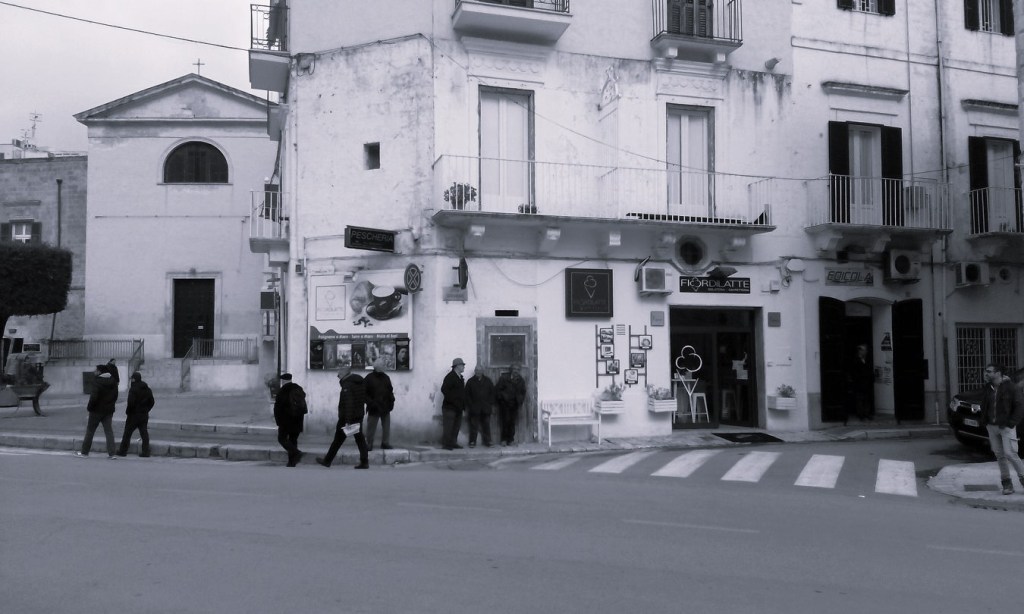
BUT THIS STORY is not about Cousin Frankie. This story is about Uncle Frank, and a certain Uncle Frank who happened to be the older brother of my grandfather Jerry’s mother Rosaria. I suppose to me, he would be a great great uncle. His real name was Francesco Petrellis, and he was born on a mountain top in Calabria in a village called San Giorgio Albanese overlooking the Ionian Sea, the same place where I once happened to spend the night watching Godzilla dubbed into Italian after almost sleeping in a furniture store. His birth year was 1889. It was a long time ago. At that time, America had not even yet formed itself on the lips of my predecessors. It’s interesting to imagine that if I rewound the clock back a century, most of my family was not speaking English. They were Italians, born and bred into the soil.
Uncle Frank emigrated to the United States with his family in 1900. It seems his father, whose name was Carmine Petrellis, and who came from an old Greek family in that little hilltop village of San Giorgio Albanese, had already crossed the mighty Atlantic once before, but this time decided to make the move with his whole family. There was Francesco, Rosaria, Maria Theresa, and their youngest sister Rosina.
It’s hard for me to imagine what the lives of this immigrant family was like because Carmine, the father, was illiterate, and when they later purchased a house in the town of Huntington on Long Island in the 1920s, where I was born, it was Carmine’s much younger wife, Anna Meringolo, who signed the contract, because her husband didn’t even know how to write. By that time, they had come to call themselves Peters, instead of Petrellis, to make their American lives more manageable. That was a fundamental aspect of American identity. Even if you were not born in America, and obviously were not an American, you could give yourself an American name. Petrellis became Peters. It was a cosmetic change though. Because a person can change their name, but that doesn’t change who they really are. A name is just a name.
The newly minted American “Frank Peters,” known to anyone within his circle of family and friends still as “Francesco Petrellis” was a loyal citizen of the United States but spoke Italian as a native tongue. He married, perchance, a Hungarian immigrant named Ethel, who was from a village called Nyírbátor near the Romanian border. I know much of this information because in 1920, she applied for a passport to visit Czechoslovakia. What I find fascinating about this is that she had never had a passport before then. In the early 1900s you could sail from country to country and settle with no documentation.
It seems that Uncle Frank and my grandfather Jerry had something of a rapport. Perhaps because my grandfather Jerry did not get on so well with his own father, Salvatore, which was understandable considering that he had once left him tied up in a basement cellar. According to my grandmother Margaret, they would go and visit Uncle Frank and share some coffee together. Maybe have cake.
Jerry had met my grandmother Margaret, who was not Italian, while working for a construction company in Virginia during the war. They were introduced by friends and married impulsively after knowing each other for just a few weeks. Margaret at that time was working as a school teacher. One can only imagine this young Virginian school teacher being introduced to the enigmatic Uncle Frank, with his fedora hat and thick Italian accent, and his equally mysterious Hungarian wife Ethel. He told the government whenever they asked him that he did odd jobs for a living. But according to various family members, Uncle Frank really made his living as a chauffeur for underworld figures. My father claims it was to Vito Genovese himself, “Don Vitone,” the founder of the Genovese crime syndicate who dominated the American mafia for most of the 20th century. Others claim that he drove around another mobster called Capone.
Whether true or not, Uncle Frank was well paid for whatever kind of work he was doing in his career of odd jobs. Then one day in early 1965, when he was already an old man with a cane, Uncle Frank paid his nephew Jerry a visit and gave him a $500 bill. This banknote, which is no longer in circulation, featured President William McKinley on the front. My father still recalls the scene of the old man in his fedora sitting in the family kitchen and handing his nephew the money. Uncle Frank visited all of his relatives that week and similarly gave each one of them a $500 bill. And this became the Uncle Frank Story, the old relative who showed up, handing out $500 left and right. He then departed the United States, ceased being Frank Peters, and resumed being Francesco Petrellis and died several months later in San Giorgio Albanese, his home village. After he died, my grandfather Jerry went over to his uncle’s house. Frank’s wife had died the previous year and the house was empty. To his surprise, he discovered bags of money, hidden in various places. There were several purses full of banknotes that had been stuffed in the oven.
***
AS AN ITALIAN-AMERICAN, such stories fascinated me. Not only because anything connected to the Mafia had been glamorized by Hollywood, or in glossy magazines that featured modern day bosses like John Gotti on their covers, but also because they were so distinct from neighbors or schoolmates, whose worldly predecessors might have been prominent attorneys, or perhaps the lieutenant governor of Massachusetts. What to make of this murky connection to murky people doing shady, shadowy things? And was I also one of them? Did the apple not fall from the tree? I had tried to be a respectable journalist, but respectability always seemed just out of grasp for my family. It was elusive. We were people who kept cash in ovens.
After I had returned to New York after an adventure in Calabria at the age of 30, I did show photos of San Giorgio Albanese to my Virginian grandmother, who was 91 years old then, and quite lucid, though fading mentally. This little old gray lady without a drop of Italian in her veins. Her body was trim and lean, and she had her own kind of measured or balanced energy that she carried with her. She spoke softly, and on the few occasions that I told her I loved her, she seemed a little embarrassed. Such was not the measured, restrained way of the Virginians. Her husband was gone, but here was his grandson asking questions.
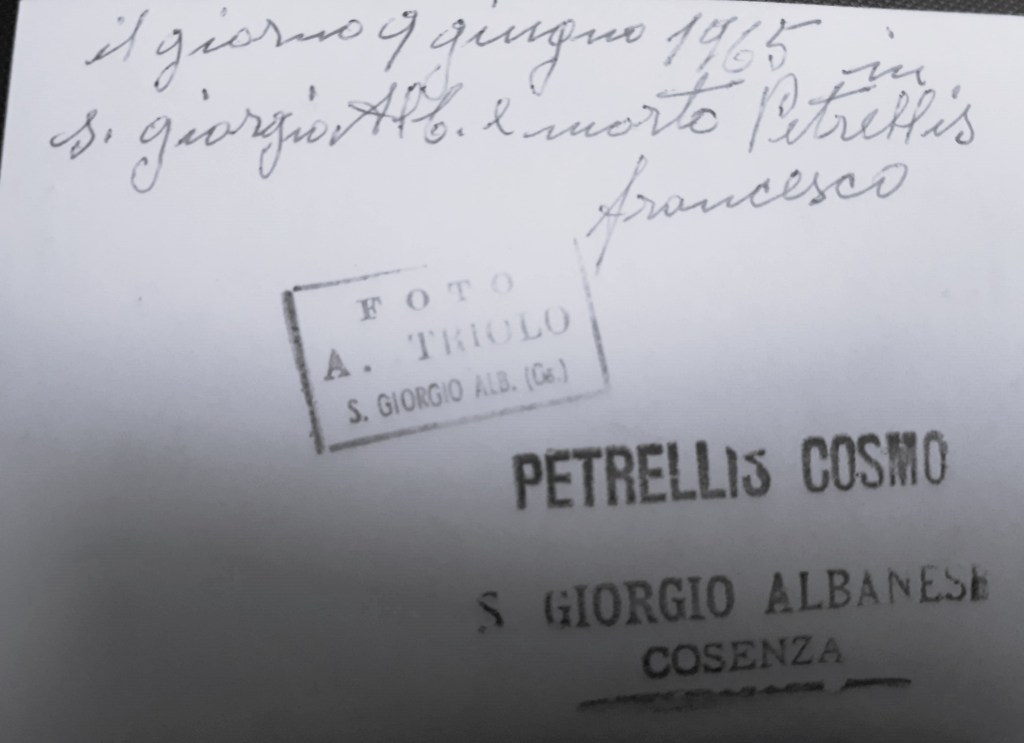
A few days later, she called the house to inform me and my father that she had found a curious photo. Later, when I saw it, I found it quite interesting indeed. For the black-and-white photo showed a dead man in a coffin, covered with bouquets of flowers. On the back of this photo read, in Italian, “On the 9th day of June 1965, in San Giorgio, died Petrellis Francesco.” The photo had been taken by A. Triolo, also of San Giorgio, and the photo was signed by Cosmo Petrellis.
This family curiosity had traveled across the Atlantic and across decades of forgotten memories, only to find its way into my hands, hands that had recently returned to that same village. In thinking about Uncle Frank with his fedora hat and bags full of mob money, I felt that I had understood something that perhaps only another Italian could understand. That whoever we were, and wherever we lived, and whatever names we called ourselves, we were still this illusory thing. Italians were just another unexplained meteorological phenomenon, like those tall waterspout tornadoes rising up like the mighty staff of Poseidon from the depths of the Ionian Sea. We came and we left, we appeared, vanished, and reappeared. One day, we might show up at your door in a crisp gray suit and fedora with a bag full of $500 bank notes. The next day we were gone. And weeks later, we might turn up in the old village, to greet our many relatives.
Just as I had done weeks before in the mountains of Calabria.
Uncle Frank was Frank Peters to the US government and Francesco Petrellis to the Italian one. His odd jobs were driving bigshot mobsters around. But Italians belonged to other kinds of systems. Governments didn’t mean as much as family. The mafia was just another kind of human organization, as legitimate or illegitimate as the local police. Laws were distant, arbitrary, written by strangers. Politics, like in the mafia, was personal, dangerous, and corrupt. And time was just imaginary. Everybody knew that it didn’t really exist.


 north!