MY YOUNGEST sent me a message. She wanted to meet me in the city. The city here being the City of New York, Manhattan, or however else you’d like to refer to it. She was barely a teenager and who knows what she was up to. I imagine it was quite a steamy jungle with all its open fire hydrants, pickpockets, uncollected trash piles, and Chinatown markets. I drove to the nearest train station, which, for whatever reason, was Freeport, Bellmore, Merrick. One of those. I parked the car and from the parking lot I could see the new Long Island Rail Road trains, which happened to look a lot like a Finnair fuselage. Or maybe Finnair and the LIRR had come to some special deal. The blue F of the Finnair logo was painted on the train exterior.
Inside, I discovered rows of Finnish passengers including my old friend Lasse. He was a good-natured older man, with dark, graying hair. He was seated there sipping on blueberry juice and paging through the day’s Helsingin Sanomat. I took a seat next to him and the train “took off,” rising into the air just like an airplane, only to “land” at the next station. “I don’t understand,” I told Lasse. “Is this a plane or a train?” Lasse grinned at me over the paper and said, “both!”
The train-plane though was heading in the wrong direction. I was supposed to be on my way to meet up with my teenage daughter in Manhattan, but the following stops were Bay Shore and, later, East Hampton. I disembarked the train and found a Finnair stewardess on the East Hampton station platform. “I’m supposed meet my daughter in the city,” I said. “Why are we in East Hampton?” The Finnair stewardess, a short, plump, blonde lady in the airline’s trademark blue outfit, said, “But this is a Montauk-bound joint Finnair-Long Island Rail Road service. You’ll have to wait for the westbound train to take you all the way to Pennsylvania Station.”
The East Hampton train station was enormous, cavernous, with escalators going every which way. The walls were made of thick blocks of red brick. One part of it had been fashioned for skateboarders, a little skate course, optimized for elevated tricks. As I clambered down the embankment to make my way over to the opposite track, I noticed that the grass was a little different here. It was golden, spongey. I was stepping on hand-sized potato chips, but soft ones, like those chewy chocolate chip cookies. I picked a few of these strange chewy potato chips and made my way over to the westbound track, munching on them all along the way.
THE CLOUD COVER above the gulf was dense, cottony. The plane continued its path south. The orange sun, a stripe in the west, extended its rays towards its eastern origin point, but a cool dusk was setting in. Below the clouds, I could see pinpricks of light, crackling red and yellow bursts, which I took to be fireworks or strikes of lightning. Then the captain told us to fasten our seatbelts because we were going to have to make an immediate emergency landing.
I made sure my daughters’ safety belts were buckled in place. As the plane dipped below the clouds, I could see the red tiled roofs of the Latvian capital. We were going to land on one of those long streets that carve up the city centrs, maybe Krišjāņa Valdemāra iela or Brīvības iela. Somehow the captain landed the aircraft softly, pleasantly. Through the windows I could see that truck traffic had stopped moving. Latvians in gray uniforms were positioning anti-drone and missile batteries to fend off incoming attacks. They were not entirely successful. Ambulatory crews carried stretchers of bloody civilians across the street. Several buildings were on fire. Another drone came floating in and the gray-uniformed Latvians neutralized it.
War. We were at war. The Russians had decided to do to Latvia what they had done to Ukraine. And it had started while I was up in the air. Who knew what was Estonia’s fate. A gray-suited Latvian with a golden mustache led me and other other passengers to a point of safety somewhere in the Old Town. I never knew what to make of these Latvians. They seemed like another breed all together. I suppose that if one mated an Estonian with a Frenchman, he might get a Latvian, but only after several attempts. But they took good care of us in Rīga. What surprised me was how matter-of-factly we took it all, as if it was an electrical storm. My children seemed nonplussed about the war. The youngest yawned and curled up in a blanket.
MY FIRST IMPRESSION is one of disorientation. I see faces emerging from the crowd, legs, arms, red lips. There are white headscarves, blue and red caps folded down on one side, the black-brimmed hats of the men’s costumes and all kinds of expressions, from the moody and pouting looks of the teenage girls in their traditional regalia to the yellow crooked-toothed grins of old men who need assistance walking. There are lines everywhere here. Lines of ladies moving like migratory birds in unison toward some far-off goal, be it an assembly point or a staging area. Some of them are in line for the toilets, hundreds maybe, others are in line for ice cream. Lines line the stadium steps, take their positions on the fields, and then form ornate and intricate shapes that one can only appreciate by watching the enormous stadium screen.
This is Kalevi Central Stadium in Tallinn, Estonia, on a brisk and windy Thursday evening in early July. Built in 1955, the stadium is said to accommodate 12,000 people, but looking in every direction, I have no way of determining how many people are really here at the Iseoma Song and Dance Festival. I try to do some quick calculations — I count about 100 people, and then trying to guess how many people might be here all together, but then I abandon this task completely. All I can say is that there are a lot of people here, many people. At one end of the stadium, beyond a grove of trees, I find myself inside a tent city of dancers. A man in a black robe, the kuub of the southern Estonian Mulks, is helping a young blonde woman get into her dress beside a tree. Her arms are up in the air and he’s tugging away on her belt. The woman doesn’t look comfortable, but I suppose that such sacrifices are necessary for the nation.
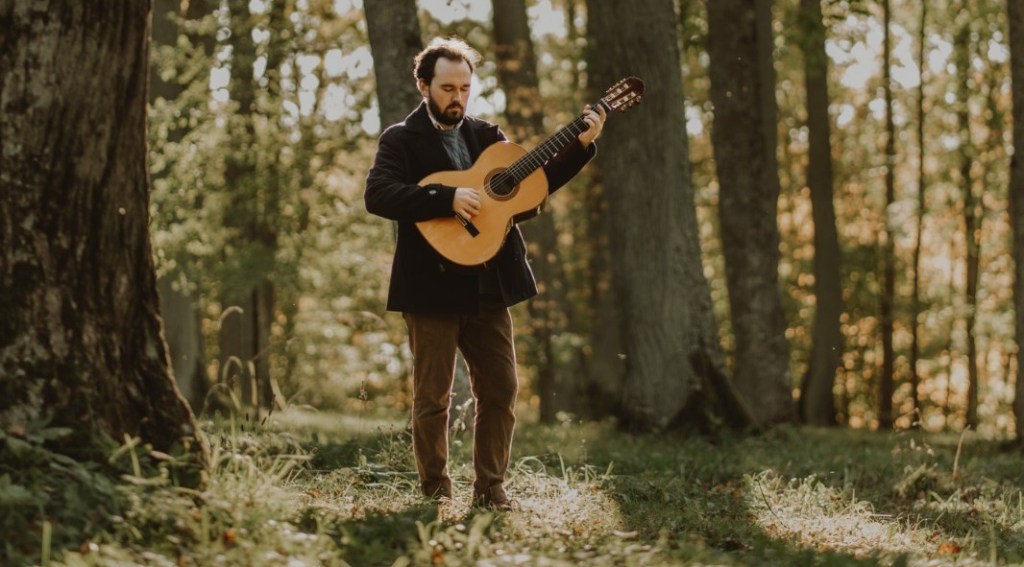
The wind flows over the crowds, chasing away any remaining heat and humidity. Near the podium at the front of the stadium, guitarist Andre Maaker is pacing anxiously with a guitar. I try to make a joke about all the nuns at the event, nodding to the white headscarves, but Maaker is in no mood for jokes. Singer Kelly Vask is standing nearby in a traditional dress waiting. A moment later, I see why, as they take the stage to perform the national anthem.
For me, Maaker’s compositions will turn out to be the most memorable of the dance festival. First there is one called “Lööme Loojanguni Lokku” (composed with Laura Võigemast) and then “Iseoma” which he helped Jaan Pehk arrange. The melodies of these songs are so sweet and so soft that they stick to me like sugar. There are no bold crescendos to them. There is no drama. Everything is just so nice and so tore. Thisis the Estonian word. Yes, everything is so tore that I almost start crying and I don’t know why. All night long, as I try to sleep off the first night of the festival in a friend’s Mustamäe apartment, I hear the verses of “Lööme Loojanguni Lokku” and feel a profound shift is underway, as if the stars have reached down and pulled me up into the euphoria of the cosmos. I think most people feel like this at the song and dance festival.
A world of delicate music
IN THE MORNING, I take the Number 84 bus back into the city center, sharing the ride with a group of dancers in Seto costume who have been sleeping 10 or 20 to a room in the Tallinna Saksa Gümnaasium. Once, when I was staying at the Sai Baba ashram in India, I happened to spend a few nights in an all-male dormitory that consisted of hundreds of bunk beds arranged in a gym. These beds were filled with Sai Baba devotees from all over the world, in whom I took an almost anthropological interest. One of them, an older Italian man, had discovered his guru through a leaflet, which claimed Sai Baba was the embodiment of god. “If he claims to be god, who am I to argue?” the old Italian told me. Another devotee, a comedian from New Jersey, carried miniature figurines of Hanuman and Ganesha and would worship them every morning. He was counting on these gods to help him with his career in show business. At night, the Indian dormitory was a curious place. Hungarian devotees would have nightmares and start screaming in Hungarian. While watching the dancers in Seto costumes on the bus, I can’t help but wonder if their experiences have been similar. Do the Seto men start yelling in Seto in their sleep? Have there been intriguing conversations about Peko, the thunder god?
I spend most of the day in the warm sun of the rahvamuusikapidu, or the National Music Festival, on Freedom Square, pondering such things while being serenaded by youths playing the violin, kannel, bagpipe, and karmoška. Again, the music is so soft and so sweet that I feel that familiar stirring sensation. Watching the young women strum their kannels, I wonder about their inner worlds too. I wonder what they dream about. How do they feel? What are the desires that they have hidden away behind this pleasant music? This is the only world that they have ever known, a world of EU-subsidized highways, of bountiful supermarkets, a world of choirs, ensembles, and festivals. Their lives are lived from event to event, from rehearsal to rehearsal. There’s no time for worry or existential questions in this world. Theirs is a world of delicate music, where there are no loud voices, no shouting, no despair, no angst, no ennui. The life of the lovely kannel player seems gentle, patient, even kind.
In the evening, I am back at the Kalevi stadium for the final performance of the dance festival. One of my friends is a dance enthusiast and has been vigorously documenting her dance group on social media. But trying to find her or anyone at the dance festival is impossible. Every woman has blonde hair done up in braids just like she does. They are all wearing those kinds of tights and those colored skirts that she wears. They all look like the Estonian dolls they sell in the airport souvenir shops, though I would never tell her she looks like that. Then, out of the corner of my eye, I see her flit by, with a big, beautiful smile on her face. She looks happy, happier than I’ve seen her in months. I worry it’s a happiness that can’t be sustained.
On the stage, there is a closing ceremony, and women and men in traditional garb ascend a steep staircase to be recognized for their contributions to the festival. The air is brisk, cool, calming. The sun is just peaking through the clouds over the distant skyline of the city. Behind the stage, there are stacks of what I think are evergreen Christmas wreaths, but these turn out to be made of oak leaves! Each person recognized has the oak wreath or tammepärg placed around his or her neck, so that soon it starts to look as if a whole forest of oaks is up on stage.
“But why do you use oak leaves?” I ask a woman behind the stage. “Because the oak is a very powerful tree,” she says, with an almost mystical glint in her eyes. I wonder about who creates the oak wreaths, where the branches are cut from and what becomes of them. Maybe someone mounts them on the wall of their sauna, to be revered for all time, or maybe they just wind up where everything else winds up in Estonia, as kindling for a fire in the furnace?
Soon our guitarist friend Maaker is also on stage with a wreath of oak leaves around his neck. When I ask him about the experience, he confirms that it was most pleasant. “Those oak wreaths just smell wonderful,” Maaker says. “And everyone at the dance festival was smiling.”
A rainy parade
I SPEND THE SECOND NIGHT of the festival in another friend’s apartment downtown. He’s just moved in and there is no furniture there, so my bed is a camping mattress, a sleeping bag, and a weak pillow. In the middle of the night, I hear people yelling and imagine that my friend is fighting with the police in the next room. I wait for the Estonian police to wake me up and interrogate me, but when I am at last roused from my sleep by the sound of a trumpet player somewhere nearby playing the national anthem at daybreak, I realize everything must have been taking place in the parking lot instead. My friend has in the meantime made a pot of coffee and when I ask him about the police, he says that he has no idea what I’m on about. “That’s just what life is like in Tallinn,” he says. “There are always people yelling at night.”
Tallinn life is a little bit different during the festival. My friend’s apartment is across from the Tallinna 21. Kool. At 10 am, there is a group of men in traditional black hats or kaabud and knickers seated around in front, like extras from the 2019 film Truth and Justice. I walk between these austere characters and enter the school to have a look around. In its atrium, about a hundred children are sitting and standing and sipping from juice boxes. On the second floor, the suitcases are piled up by the windows. Down the hall, I am greeted by a woman in a red headdress or tanu from Pärnumaa. Their group comes from Audru, she says, which isn’t too far from where my children’s grandmother was born. I have a complicated relationship with the Estonians. I am not one of them, nor do I wish to be, but my children are them. So we are relatives of a kind. Inside a classroom, I ask the dancers what it’s like to sleep in a school.
But you can forget any stories about loud nightmares. These people are tightknit and are used to each other’s company. They only respond with, “Noh, täitsa tore oli.” “Well, it was nice.”
The rongkäik or parade is tore, too, but it’s a challenge. One needs stamina, strength to march in this parade. Sheets of rain fall on us all along the route. The poncho I have brought along is quickly soaked, as are my pants. My hair is a wet mess, my skin is cold and damp. My journals are wet, the ink runs in places. My friend and I take refuge in Viru Keskus where I order a hot plate of Uzbek plov. My friend is not the kind of person who cries easily, or expresses any emotion without a joke or healthy skepticism. When you have lived as much as we have, those gentle, peaceful, fluttering kannel-music like moments are few and fleeting. But he admits that he can’t get through a rongkäik without shedding at least some tears. We’ve both been in Estonia for what feels like forever and talk about when Swedbank was Hansapank and when there was no Viru Keskus. Most changes are welcome, but we’re also worried that the Song and Dance Festival will eventually become a cultural attraction, where tourists buy up all the tickets and Estonians are only able to watch it at home. He considers that businesses might start sponsoring these events, so that one day there will be a Prisma, Rimi, or A. Le Coq Choir.
We agree that the festivals are an occasion for social renewal. All societies are made up of such tiny, bite-sized building blocks, like village choirs or dance groups, and of these smaller pieces, more elaborate superstructures are created. The festivals are necessary for society to function. They bond people together and the bonds created must last until the next festival. We hope that Tallinn never becomes another Venice or Barcelona, overrun by Jezz Bezos and other mindless tourists. It’s true that neither of us is Estonian. But we do have Estonian kids. We do worry for them.
The main event
IT’S A LONG MISTY WALK through Kadriorg to get to the song festival on Saturday. I take the Number 1 tram and then cross bridges and climb steps, eventually passing the Japanese Garden and exiting through a parking lot across from the Song Festival Grounds. When a person is caught up in those dense crowds, it becomes hard to construct a timeline of what happens. Even my journals become a mess of discombobulated, half-written entries, jotted down in spare moments and out of order. One thing I do see is a blonde, middle-aged woman running through the food area crying out, “Police! Police! Does anyone know where the police are?” Having seen some guards nearby, I point her in their direction. In chatting with some officers later, I find out that the number one issue they have to contend with is lost children. There’s even a pickup point where as many as 10 children might sit waiting for a parent to retrieve them. One wonders what life is like for the children in this makeshift “kindergarten.”
The police also have to deal with the occasional unruly attendee who has decided to “pregame” for the festival and either gotten drunk at home or hidden a flask of vodka in his underpants. (There is no alcohol on sale at the event). “It’s a shame,” one of the police tells me. “There are some who do not see this festival as a holy event, but as an opportunity to drink.”
The singing is here, but the singing and the songs are only a part of the experience. Yes, we have all come to hear these songs, to sing along, but the festival is also about the circus city that springs up around the stage, or the troupes of children in wet ponchos stumbling across the wet grass, following the instructions of some stern teacher who has commanded them here to participate in this grand event, or the meandering conversations in the press tent where French and Finnish journalists rub elbows and munch on free ice cream. There’s a lot to this thing, much more than any agile camera work or grinning selfie can ever do justice to.
After being drenched by rain for a day and a half, the appearance of the sun toward the end of the concert on Sunday does seem like a small miracle. Then come the best-known songs, “Tuljak,” which is conducted by choirmaster Triin Koch, and “Ta Lendab Mesipuu Poole,” which is conducted by composer Hirvo Surva. These musical personalities are treated with such reverence that every one of their moves is observed with an awesome curiosity. It’s almost like watching Wimbledon. Every flick of the wrist, every nod of the head is somehow meaningful. The conductors look as if they are holding back a mighty wave with the power of their hands.
What is it like to stand up there? I wonder. And how does one feel at the end? Neeme Järvi, the grand old conductor, now aged 88, knows this feeling well. His movements are tight, precise, controlled, but at the end, in a moment of triumph, Neeme Järvi topples over. From the back of the Song Festival Grounds, the Üldala, or general area, no one knows if he has just slipped or if really, being so caught up in the music, Järvi decided that this was his final day and he was going to go out with a cymbal crash. Throughout the entirety of the festival area, there is only silence and concern. This was obviously not planned. Is he alive? Has he died? What kind of festival even is this? But then we see that Neeme Järvi is alive and well and he jokes to the crowd as they chant, “Elagu! Elagu! Elagu!” Which means something like, “Long may you live!”
It is the final festival miracle.
The morning after
AND NOW IT’S THE MORNING of the day after. But when did this day even begin? When the light of the day is nearly seamless and the last people go home after the summer light returns, isn’t it hard to find a line between the two? After the festival, I have trouble sleeping. I awake at three and then five and then eight. I can hear the cries of the gulls and the muddle of downtown life at dawn. Like life, the trams creak back to work, back to normality. Even though my arms and legs are sore from standing for days, and my mouth is dry, my hair is greasy, there’s goop in my eyes, and I’m still wearing yesterday’s shirt, my other clothes piled up on the floor, my socks kicked across the room, the light of the new day is unrelenting. Even when I can’t bring myself to get up, and the euphoria of the festival is still pulsing in my blood, I get back on my feet, because the sunlight won’t leave me alone and life does move onward. Just as I do as I make my way to the Must Puudel cafe in the Old Town where I order a coffee and breakfast, first thing. Hungry city birds are perched, ready to peck at any discarded crumb.
After breakfast I go for a walk to stretch my legs, muddle through this new, post-festival reality that I have awakened to. Some tired singers are lounging in the sun of the Town Hall Square. Who knows when, or if, they ever went to sleep. On nearby Lai Street, I find a lillepärg or crown of flowers lying on the ground. Someone must have left it here in the early morning. I wonder who the woman was who left this flower crown here. I wonder what this crown has seen. By tomorrow, all of its petals will be dry, I think. By tomorrow, the festival will just be a memory.
An Estonian-language version of this piece was published online on 13 July 2025 in the magazine Edasi.
KLAUDIA AND I went walking along the docks. She stopped into small portside store, but complained about not having any money. She wasn’t in any kind of positive mood and she only had 50 cents to her name. “What am I supposed to buy with 50 cents?” Klaudia said. “Half a candy bar? A bite of a sandwich?” Quickly, I removed my laptop from its case and logged into my bank account with my personal ID card. The transfer happened effortlessly, instantaneously. “You have received €1.50 from so-and-so …” That’s what her notification must have read. It wasn’t an unserious sum of money. With €1.50 one might get a bowl of soup. At least the kind that you make in a cup in the microwave at a harbor convenience store.
We walked on through town. Klaudia was wearing a dark, puffy jacket. Her blonde, lion’s mane of hair was quite moist in the seaside drizzle. It was a maritime kind of place. Boats arriving, boats launching, the smell of chopped up bait and the whiff of luxury yacht interiors. We walked up a hill to an old house and went in. It was a well-preserved, Soviet-style habitation, though the wallpaper was slowly peeling from the walls. Old smelling furniture, old smelling bookcases. A woman sat on a couch watching TV. She was watching Wallace and Gromit.
“See,” I told Klaudia. “This is how people live outside of Tallinn.” “I know how people live outside of Tallinn, there are plenty of places like this in Tallinn anyway,” she said. “You’re right, you’re right,” I said. The old woman had dyed red hair that was white at the roots. She offered us a glass plate full of cookies. “Come and watch TV with me,” she said. “I do get lonely.” There we sat, watching Wallace and Gromit. The couch was comfortable. The film was entertaining. It made Klaudia laugh.
STEN GOT A NEW APARTMENT overlooking the capital city. I went to visit him to inspect the place with Riken, the Japanese mountaineer. We stood in a bare white kitchen lit by a skylight. There were unfamiliar varieties of Entenmann’s cakes that contained distinct Northern European flavors on the counter. Who knew that Entenmann’s made pumpkin cakes or ones flavored with lingonberries or cloudberries? I read and reread the ingredients on the boxes.
Sten was discussing with great detail the placement of a couch with Riken, but Riken was of another opinion. Riken rested an elbow against the mantle of the fireplace and nodded up and down as if studying the room and searching for an answer. Sten and Riken often got side-tracked by these kinds of minor details, such as where to put a piece of furniture, or for how long one should sauté the onions. “Hey, Sten,” I asked. “Can I try one of these cakes?” “Knock yourself out, man,” he said. Then he turned back to Riken, “The light from the window is best over here. The couch should go there.” “You’re wrong and you know it,” Riken countered him.
Sten’s girlfriend Pille-Riin stood all this time next to the couch in question with her arms folded and a particularly stiff-upper-lipped, “keep calm and carry on” expression on her face. She looked like a British nurse. Well, an attractive one, if such attractive British nurses still exist. Sten and Pille-Riin had acquired a bulldog in their time away from Estonia and the animal was pacing the apartment as Riken and Sten argued over the placement of the couch.
The dog ran over and licked Pille-Riin’s hand as she waited patiently.
After that, someone came into the apartment and cried out, “narcs!” You should have seen Sten’s face curl up in panic. “Everybody out!” he shouted. “Quick hide!” “What’s wrong?” I asked. “The cakes! The cakes! The cakes are all spiked with drugs!” “They are?” I said, with some cake crumbs on my lips. “Shit.” “Yes, out. Out!” I ran out of the building, only to glance down the street at Tallinn in the mist. It looked different, almost like Gothenburg, or some random Dutch city I had never seen before but knew existed. Rows and rows of red-tiled roofs with some sad-looking skyscrapers in the distance. Sten said he liked this part of town because he could get in and out of the city in a jiffy. Unlike Kalamaja, which had only one road in and out. This choice spot was being put to the test as we all fled the Estonian drug police.
I lost track of the others, of course, ambling across a rye field into a forest. I clambered over an old stone wall, found a sandy spot and began to bury myself in the moss and dirt. If I covered myself well enough, the drug police would never find me. Not long after though, I could hear Sten’s voice coming my way. He was being escorted by several Estonian police officers. He led them right to my hiding place. “There he is,” he said, pointing me out. “What are you doing, man?” I said. “I don’t want to go to jail!” Sten frowned. “It’s no use, man,” he said with a sorrowful voice. “They already know everything about us. The jig is up. We’re all going to jail.”
MY EDITOR CALLED ME. He said that he wanted me to write not one but two profiles of Sabrina Carpenter. “Sabrina Carpenter?” I said. “You mean that blonde lady with the fuzzy eyebrows?” “She’s an acclaimed singer-songwriter,” my editor said. “Men want her and women want to be her.” “If you say so,” I said. How out of touch was I becoming, or had I become? I had never even had a TikTok account. I had never heard one of Miss Carpenter’s songs, though I had heard her talking about a childhood crush on Paul McCartney on some American late night show. Paul McCartney, now that was someone I knew of. I was more of a Sir Paul person.
At that time, I was at my aunt’s house in Sand City, waiting for my father to pick me up. Or was I supposed to meet him at the conference center? There had been some miscommunication about the getting picked up or meeting up part. I kept calling him but each time he answered, I could only hear the sounds of the conference behind him, while he yelled, “Where are you?” through the phone. Then he would lose the call. I’d redial and then be met with that recorded message, “The mobile phone you’re trying to reach is either switched off or out of area.”
My aunt was stroking a new puppy all this time on the porch of her house out there in Sand City. To think, I had originated in this bucolic, waterside town. But that was a long time ago. “Why don’t we go visit the old dairy,” she said, referring to a farm down the street from my grandma’s house. Somehow this had become closer, even though it was in a different town. We started to walk to the old dairy together when a sky blue bus drove past and parked on an adjacent lawn. “That would be your Cousin Linda,” my aunt said. “She’s back from Amsterdam.”
Cousin Linda was living in the blue bus. She had a new daughter and was nursing her as she spoke to us. She had also got a new husband too, a Dutchman named Jan. When this goateed Dutchman came in to check on his wife and daughter, my cousin answered him back in Dutch. Linda was now fluent in Dutch. “Well, I haven’t seen you in a while,” Cousin Linda said. “What are you doing back in Sand City?” “I don’t know,” I told her. “My father left me here and went to a conference. Which is a pity because I’m supposed to be working on two profiles of Sabrina Carpenter for a magazine.” My cousin, who was even older than me, squinted. “Who’s Sabrina Carpenter?” she asked. “An acclaimed singer-songwriter,” I told her. “With fuzzy eyebrows.”
Just then the phone rang again. It was my father. I could hear the conference noise in the background. My father was trying to make himself heard. “Where are you?” he repeated. “Where the hell are you?”
AND THEN ONE DAY, I was working as usual, in my usual café, at my usual table, engrossed in dull, painstaking work, unaware of the time, and when I had last eaten, when I looked over the top of my laptop only to see a lovely Cheshire Cat face peering back at me. It was one it took a moment to recognize, considering I hadn’t seen her in almost two decades. Frida was grinning at me with that big pussycat face of hers. She looked the same as she had in college. She was wearing a white Nader-LaDuke 2000 t-shirt and a bright yellow raincoat. She said, “I came all the way to Estonia from Vancouver to find you,” and, “I brought my mother for protection.”
Frida nodded over her shoulder at her mother, who was wearing a matching yellow raincoat. It was a funny thing, because I didn’t notice it was raining that day. This being Estonia though it was poised to rain one moment or another. Not a day went by without some rainfall, snowfall, or intermediate precipitation. Her mother, a sort of older, grayer version of Frida, with glasses, stood silently behind her. She nodded. “There are some things we need to discuss,” Frida said, leading me away from my desk to the basement. “Different topics we all need to address now.”
I came down the stairs and noticed it had been converted into a comfortable, warmly lit meeting space. There were a few chairs arranged with a table in between them, some tea cups and a pot of tea. But what did we need to talk about? I thought we had talked through everything. What did we need to discuss again? I thought she had sworn to never speak to me, of me, or even think about me in any way again. When Frida had married she had become “the married woman,” engaged in a lifetime’s pursuit of self-censorship and border enforcement.
No other man could come between Frida and her legal partner.
Here we were though, taking seats opposite one another in the basement of an Estonian coffeehouse. They were still wearing their matching yellow raincoats. I was nervous. There was a lot to apologize for. I didn’t know where to start or what an apology could ever be worth. The tea was poured. That’s how that began.
IN STOCKHOLM on a peaceful July day– at last. Bryggartäppan is a children’s playground, the size of one city block approximately, with clusters of leaning red buildings set up to look like an old Swedish village. There’s even a wooden putka here where two fine-looking ladies make coffee for the parents, mostly mothers, even on a Sunday. Tiny birds flit around and one of the sellers is most fetching, a sturdy lass with silver hoop earrings. Her eyes are as blue as the sky and her hair is pulled back. Such Swedish playground baristas are the last respite of the recently divorced father.
But maybe it’s not just her that toys with my senses but that smell of baking waffles, coupled with all of those cream-colored buildings around us. There was even a little yellow fly that landed on my hand before. Have I ever seen an insect that color? Is everything in Stockholm made of gold? “I don’t want water, there’s juice there, there’s some juice over there!” This is what my youngest daughter, age 5, is shrieking in Bryggartäppan. Then she cries aloud in Estonian, “Ma saan nii kurjaks,” “I’m getting so angry!”, and punches her older sister, age 9. Then she begins to sulk and cry. The youngest is wearing a light blue headband from Copenhagen Tiger, and totes around a blue fairy balloon from Gröna Lund, the amusement park. This troubles her older sister. “I told you at the park that I also wanted you to get me a balloon but you didn’t get me one!”
At last the seller returns from making waffles and hands over a box of äppel juice. Quickly, the straw is in the little one’s mouth, and she is quiet for a moment. The other children here are Swedish. They are pale, thin, and have straw-colored hair. They are physically active, and on occasion expressive, but I have not witnessed the kind of seismic outbursts of which our children are so ready and capable. I search our family trees for some culprit — is it their mother’s Komi great grandfather? A plosive mix of Siberian and Greco-Roman blood? — but there is no answer.
The parents here at Bryggartäppan are, as a rule, older. Perhaps a few of them are actually grandparents. Swedes are a peculiar breed though. They are married to modernity. They are infatuated with their perfect civilized society, yet so haunted and repressed by this civilizational impulse that they have the emotional temperament of office wallpaper. They hide away their thoughts, dreams, dark sides behind apartment doors, sunglasses, and politely phrased, thoughtful sentences that implore only moderation. Rows and rows of perfectly symmetrical apartment windows, cascades of identical balconies, rising up and up and up, peaking in crescendos of tiled roofs and towers. The pursuit of wealth, the proper means to express it, these are the chief concerns of the Stockholm Swedes. Everything here must be perfect. A little girl with her face painted and her hair done up in cornrows goes skipping by, and another waits patiently for the five year old to dismount a small rocking horse. When she does get off the horse she sulks again and then announces to the lot, “I am so bored!” To which a little boy nearby, who understands English, chides her. “Be quiet,” he says. “You’re acting like a baby.” “I am not,” she says, and smacks at the air with her balloon. “I am not a baby,” the five year old sobs and then takes her apple juice and squeezes the liquid all over her older sister’s drawing on a table beside the playground café. “You are bad!” the nine year old scolds her, to which she only shouts, “I’m not bad!” “You poured juice on my picture — that’s bad.” “I did not.” “You did too.” “Tegid küll.” “Ei teinud. SA VALETAD!” “YOU LIE!” These are perhaps the loudest sentences that have been uttered on Swedish soil since Estonian pirates sacked the old Swedish capital Sigtuna in 1187. There are lots of pregnant Scandinavians in the park here today, paging through magazines and pretending not to hear this terrible squall. Their days will come.
“Here’s an idea for a good life,” my Swedish pal Erland said yesterday, skulking around the Pressbyrån at Slussen with his hands in his pockets and harbor wind in his hair. “Meet a girl, have a bunch of kids with her,” he said. “Then you can all be wonderfully miserable together for a few years. Doesn’t that just sound like the greatest idea?”
STORA BLECKTORNSPARKEN is an urban park a bit farther south on Södermalm with the same kinds of Bullerby buildings as Bryggartäppan. There is more graffiti here, though, and shreds of rubbish, broken glass shards, fruit peels, chipped paint and rust, the illusion of safety. “Dad? Dad? Dad!” “What?” “Look what I can do!” The nine year old swings away as the five year old arrives, panting. “Daddy, my knee hurts, look what happened. I slipped on the rocks.” I survey the wound only to be interrupted by, “Dad? Dad? Dad! Watch me swing!” And she swings higher and higher. Mothers sit around us tinkering with their phones. More wonderful park birds flit about. It feels good to breathe and write in Stockholm. To write without any project or desire for money. Just writing with feeling, without that evil thought looking over your shoulder, the one that says that every word has to count toward something. But maybe that thought came from the office or from some editor. Maybe it was never my thought to begin with.
“When you are with someone, you become someone else,” says Erland. “You change yourself. When I was with Henrietta I was someone else. And when I was with Agnetha I was someone different from that person. And when I was with Gunnhildur, that Icelandic football player, I was also someone else.” Erland has been a lot of people. “Dad? Dad? Dad! Come here, help me off this swing. Come, Dad. Come!” These children. They so crave my attention. If I only had some time off I could be such a better father to them. I could never have any more children. Not now. I would go crazy. That would just be the end of the story. Not with these thin Swedish women. Not a chance. Although the lady who made me coffee was rather nice and might get me to reconsider, especially if she turns out to be some Zelda Fitzgerald type who can ruin me and provide me with loads of material about her schizophrenia. This playground is a madhouse. All the sobbing, crying children. All the childhood drama and trauma. The pale thin mothers call after their offspring, their barn. One of the children steals the five year old’s balloon and I have to run after him and take it back, causing a puzzled look from the toddler, who thought the balloon was his.
In the meantime, a mouse ran over the nine year old’s shoes at the bottom of the slide. The parents here all look at each other. I suppose this is one way to pass the time at a playground on a hot day. A Muslim family arrives, the mother’s head covered, the daughters bare to the sun. They look truly happy, content, and I sense no disturbance or cultural conflict. The Swedes don’t dress so differently from Americans. They seem maybe more capitalistic though. A Swede is the sum of all he or she consumes. The patterned dresses, the well-groomed facial hair. A barber shop stands on every other corner, catering to the perfectionism of the Swedish man. The women shop for dresses at the boutiques in between. One must exude one’s wealth and value. A haircut, a shave, a flowing cut of textile, this is worth nothing alone. It’s the effort that goes into being Swedish. This is what pays the real dividends.
At night, we find ourselves at another playground nearby on Nytorget. Teenagers stand among the benches singing songs and playing ukuleles. “Södermalm is like the best place ever,” my nine year old says. “There is no traffic, the houses are pretty, and everyone has time to do whatever they want.” This is the fun of a playground in the dusky twilight of midnight in Stockholm. As the children play on, and the ukuleles strum, and I admire the lights from the cafes around the park, I read a sign about local history. This was once the site of a large garbage heap, it reads. And in the 18th century it also was the location of the gallows and a major site of public executions. I wish I could have seen Stockholm then when it was rough and tumble and full of pickpockets and convicts, truants and robbers, counterfeiters, highwaymen, gentlemen of the day and ladies of the night. Before the boutiques and barbers, there were wards of the state sentenced to hard time. Looking around nighttime Nytorget, this seems impossible. It’s as if it never happened.
ON KATARINA KYRKOBACKE, at 8:30 am or thereabouts. A small street winding with the cool air through the bluffs of Södermalm, damp and refreshing, creamy houses with mustardy finishes and black stovetop pipes protruding, cobblestones and fine hemmed in trees. These give way to red wooden dwellings with toys and yellow flowers in the windows and everywhere that faint chirping of Stockholm birds. In the distance the roar of construction by the locks of Slussen winds up. Outside a school, a father is gently combing through his daughter’s white-platinum hair and a black car breaks the silence, its wheels finessing the stones of the road. A man in a flat cap jaunts by, clears his throat loudly, spits on the street. Despite this, there is the feel of polished cleanliness everywhere, that well-to-do feeling, as if the Swedes have always known wealth and wealth is all they’ve ever known.
Back at the hotel, we have a good breakfast of scrambled eggs with chives and onions, big bowls of yogurt, dried banana, crisp dried coconuts, and three cups of the finest coffee there is. “Of course, you drink more coffee here,” says Erland, a steaming mug in his hands. “You’re in Sweden.” He says it as if we have all died and gone to heaven. This Swedish angel is proud of his homeland. He even approves of its bike paths and pedestrian walks. “It’s not like in Estonia where BMWs and Lexuses blow by you, splashing you with water,” he says bitterly. I am surprised he chooses to recall the makes of the cars, but Sweden is old money and the Estonians are nouveau riche. It’s that old old money, new money thing, along with some shared hand-me-down of clumsy woodsman’s poverty. I feel blessed to be here. I remember my first trip to Stockholm in ’01, staring up at the wreck of the Vasa in the VasaMuseet, a museum I had read about in a children’s book my grandparents once gave me but never expected to see with my own two eyes. After breakfast, we head to the Nordiska Museet, where my children make for the playroom first and never really leave, hoisting toy wooden buckets into an old make-pretend farm.
Maybe it wouldn’t be so bad to stay in Sweden, I consider, to elope with that redhead from the Pressbyrån in Slussen, to lie beside her at night, listening to ship’s horns in the harbor, and hear of the inner workings of this marvelous convenience store. “We were out of Maribou chocolate.” “It was time to refill the cups.” To lie sprawled in bed sheets with a woman who reeks of cinnamon buns, kanelbulle. In the mornings, she is off to the shop, to prepare the coffee, stor cappuccino, lite cappuccino, the whir of the machine, and there she is again behind the counter, processing people’s payments in her blue shirt and saying, varsågod. The blue of her shirt brings out the blue of her eyes, just like the water licks at the docks of Östermalm where we step off a boat later and are surprised by the golden glitz of the gilded Royal Drama Theatre.
I keep processing this idea for a children’s book, about a Stockholm teenage girl with a ne’er-do-well father who turns to petty theft to make ends meet. Then one day she is caught and sent away to Långholmen, the old prison island down the harbor. I play with this idea all the way to the ship that takes us back to Estonia, the front bar of which has been permanently converted into a playroom. The five year old’s balloon is still with us, believe it or not, this artifact from Gröna Lund. It may be the best balloon we have known collectively in all of our lives. It cannot be lost, deflated, or stolen. In the playroom, they play Estonian children’s disco music, oi-oi-oi, ai-ai-ai, a strobe light projects dancing rainbows across the floor, and I take a seat beside a Swedish mother whose hair is a mess and is probably as full of ice cream as mine is. She looks to be about as tired as I am, sapped, haggard, and so hungover by life. This is how we set sail on a gray day to face our decisions and memories.
More or less directly transcribed from a notebook I kept in the summer of 2017.
“HONEY,” SHE SAID. “I want to see if that tree will work over here.” We had bought a new house at the end of a road all the way out in the far north woods. But she said there wasn’t enough greenery up front to block out intrusive neighborly eyes. Her solution was to uproot a tree from another property and replant it on our own. You can imagine how much I grumbled doing this. It was one thing for someone to tell you to replant a tree, it was another thing to do it, even knowing that its position might not be satisfactory and that I might have to do it again.
Instead, I dug a hole and held the tree in place while she went out and examined it from different angles. The tree, an Estonian pine, was as tall as a Manhattan skyscraper. It just went up and up into the clouds, and it was very hard to keep erect. It would tilt from one side to another, its trunk was heavy, and, in a moment of distraction, I let the pine slip and watched it with some horror crash into the corrugated metal roof of a nearby house. Its sole inhabitant, an old woman with white hair held back in a headscarf, came out and surveyed the damage.
The old gray granny whistled loudly.
With enough strength, I was able to position the tree in the hole again, holding it aloft through sheer exertion so the lady of the house could at last decide if this was a suitable location. But by this time, the lady of the house had disappeared to somewhere to inquire about acquiring some rhododendrons. The tree, frustrated by the whole scene, wilted at this moment, drooping over like an unhappy flower. “There there,” I told the pine tree. “No need to get upset.” It was no use, in a flash the tree removed itself from my hands and ran quickly away.
Into the woods, I assume.
When the lady of the house returned she asked about the tree. “What kind of man loses a pine tree?” she scolded me. “Only you could lose a whole pine!” I told her that the pine tree was upset. It had been waiting to be replanted all day. “Very well then,” she said. Our daughters gathered around her and she went to the barrel sauna, immersing herself in its bubbling waters. Then, pounding upon the surface of the waters, she began to chant. “I know how to retrieve lost trees!” she said. The children watched their mother with some alarm. But soon enough the tree came out of its hiding place in the woods. Begrudgingly, meekly, sheepishly. Arborescently.
ONE DAY IN EARLY APRIL, when there was still fresh snow on the ground, I was walking down the street towards the seamstress’ place when I overheard two school boys singing a song outside the Lõuna-Mulgimaa Puuetega Inimeste Ühing, or the Association of People with Disabilities of South Mulgimaa, as it translates in English. The words of the familiar song they sang together went something like this, “Mi amore, espresso macchiato, macchiato, macchiato, por favore.”
The melody tumbled down into the street like big wet flakes of snow. I already knew it so well. Sometimes I think that “Espresso Macchiato” is always playing somewhere. I only happen to hear it now and then. When I am not hearing it, it is being played somewhere else or it’s replaying itself in someone’s mind. The song is always playing somewhere out in the universe. Maybe it has always existed then, and its creator merely channeled and recorded the song?
“Do you know that I am researching this song,” I told the young lads, who were perhaps 10 years old. They looked up at me with curious eyes, but they were not intimidated by the big stranger in a dark coat. Rather they were friendly and seemed to take me as just another, much larger school boy. One of the boys held his thumb up to me. “Good,” he said. “Because I love that song.” “Well, what else do you think about the song?” I asked the first boy. “It’s my favorite song,” he said. “Mine too,” said the other boy. “‘Espresso Macchiato’ is my favorite song too,” he added. “Very good,” I said. “Enjoy your favorite song.” “Oh, we will,” they said. At that, I left the boys at the corner, but I could hear them singing as they walked the other way.
‘You just have to watch it’
Everyone, I think, has now developed a special relationship with “Espresso Macchiato,” Estonia’s 2025 Eurovision entry, performed by Tommy Cash. For some, like those little Viljandi boys, it has become their new favorite. Seventy-five years from now, when they are living in some South Estonian hooldekodu, or nursing home, they might sit beside each other watching Aktuaalne kaamera and singing the song. “Mi casa very grandioso. Mi money numeroso.”
Everyone has their own story about how they first heard “Espresso Macchiato” and how it began to manifest itself in their lives. Think about it. Where were you when you first heard it? For me, I was sitting in a cafe in Tartu meeting an old friend in winter when she pulled out her phone and told me I just had to watch this video. “You just have to watch it,” she said. I didn’t know what to make of it at first. The friend, an Estonian journalist from Kuressaare, thought it was fantastic. I understood that to Estonians, I am something of an Italian, though not the genuine thing, and for them, it’s interesting how someone like me might respond to these stereotypes. Coffee, spaghetti, mafia. Screens displaying red-and-white checkered tablecloths.
There he stood, the mustachioed Tommy Cash, looking more like Dracula than any mafioso. The thin mustache, the shoulder-length hair, the pale skin. Was he not some kind of caffeinated disco nosferatu? But it was not blood upon the lips of this Estonian musician. It was a coffee drink. There he stood drinking another espresso macchiato. “Life is like spaghetti,” Cash sings. “It’s hard until you make it.” Then he sings, “No stresso, no stresso. It’s gonna be espresso.”
I had to wholeheartedly agree with him. Life is like spaghetti. More coffee is the answer. “Espresso Macchiato” is not just a Eurovision entry. It is a philosophical manifesto on life.
After my first encounter with “Espresso Macchiato,” baristas began to sing it to me. Nobody in Estonia could order an espresso anymore without someone asking if they didn’t want an espresso macchiato. “No stresso, no stresso,” the baristas said. “No need to be depresso!”
Did I really look so depressed?
Italians love to complain
There has also been controversy. An Italian consumer association appealed to the European Broadcasting Union suggesting that it was not fit to be included in the Eurovision competition. Some right-wing lawmakers were indignant and condemned it on social media. Not knowing how to process contrasting feelings of being offended but also honored, Italians dressed up like Estonians and made their own version about eating sprats. “Sööme sprotte!” The song had descended into a kind of transnational food fight, with Estonians throwing coffee cups and spaghetti over the continent at the Italians and the Italians tossing back cans of fish.
Maurizio D’Agapito, an Italian resident in Estonia who is also a musician and performer, has been asked to participate in numerous podcasts and radio programs, such as Spaghetti alla Chitarra, to weigh in on the merits of the song. Maurizio also provided his own analysis on his YouTube Channel, Itaallane Eestis, and so I decided to seek him out, arranging an interview at Fotografiska in Tallinn on a March day. I was intimidated of course, because I would have to do an interview in Italian. Maurizio is a Roman — he even looks like a Roman, with his coarse hair, broad shoulders — and did not mince his words when it came to Cash’s notorious song.
He approves of it. He performs it at his concerts. “Estonians go crazy when I play it,” he said.
“Italians have a word for a song that gets stuck in your head,” Maurizio added. “A tormentone.”
A tormentone torments its listener. Yet this torment is not necessarily bad. One learns to enjoy being tormented by a tormentone. There is something perversely satisfying about the torment. Here I must agree. If “Espresso Macchiato” had been too infectious, too catchy, it might have long ago burned itself out. But the song takes its time. It has a relaxed feel. You start to miss it.
“Mi amore, mi amore …”
Such is the nature of a tormentone. It is a phantom song, attaining a kind of immortality. One must be careful not to invoke the name of a tormentone. Otherwise it will begin to torment again.
And as for the controversy?
“But Espresso Macchiato is not Italian!” protested Maurizio. “It’s a big fucking mix of Spanish, Italian, English. Broccolino, no?” He laughs. The man is correct. Por favore is Spanish, not Italian. “It would be stupid to be offended by it.” He dismissed the idea with a hand gesture.
Some Italians were offended though, mostly by the use of the word ‘mafioso.’ The mafia is a very sensitive topic in Italy. Just three days ago, as I type this while drinking a coffee, the police arrested 24 in Naples for running a parking protection racketing scheme. They were also charged with possessing illegal weapons and drugs. “The mafia is a big issue,” said Maurizio.
The real issue though, as he put it, is that Italians just like to complain about things. If it’s hot, it’s too hot. If it is cold, it’s too cold. No matter the coffee or the meal, it could have been better. He is not the first Italian to acknowledge this national trait for complaining. If the Estonian way is to suffer quietly through real hardships then the Italian way is to complain loudly about imaginary ones. “Italians love to complain,” said Maurizio. “This gave them another reason to complain.”
Mostly, though, Maurizio is a fan of Mr. Cash. He said the marketing around the song, controversy included, had been perfect. “Oh, he was clever,” said Maurizio I imagine with a pinch of envy. “Very, very clever.”
The boy from Kopli
Of the author of this tormentone, I still know very little. He was born in Tallinn a dozen years after I was, and is of mixed ancestry. His home language was Russian and he speaks fluent Estonian having been educated in the Estonian language. He is therefore a multiethnic polyglot. Mr. Cash considers himself a post-Soviet rapper with an Eastern European soul and Scandinavian resume, they say. Perhaps that might be a good way of describing Tallinn to all. That’s the thing about artists, we hold them up as idols to better understand ourselves. Estonia in recent years has been worshipful of homegrown exotic heroes like Stefan, Alika, and Tommy.
I had thought that his birthname was probably “Toomas Sularaha,” or Tommy Cash in Estonian. In fact, it is Tomas — with one ‘o’ — Tammemets. He was raised in Kopli though, which tells me a lot. A long time ago, in the old days, when I was a 24-year-old recent arrival to Tallinn with a wife from Karksi-Nuia and a newborn baby who I would take on wintry excursions to Säästumarket, I also gave some English lessons in Kopli, which was a wooden ghetto of half-burnt buildings. There were no Argentinian steakhouses in those days, no boutiques or seaside breweries. There were characters who looked a lot like, well, Tommy Cash, in puffy jackets drinking vodka. Tommy Cash came out of Kopli, was a creature of its misty alleycat-inhabited back alleyways.
This idea, of a scrappy street performer who hustled his way into high-profile collaborations with Charli xcx and Diplo, has impressed even the most reticent Estonians. “You’ve got to hand it to him,” a bearded, Camus-obsessed Estonian told me on the street. “In a country where nobody wants to stand out, Tommy hasn’t been afraid to draw attention to himself, to stick his neck out.”
Another Estonian who is more aligned with the folk culture that colors Viljandi life, was similarly supportive of Mr. Cash. “I don’t know if I am down with ‘Pussy Money Weed’,” she said, referring to his 2018 single, which has garnered more than 15.4 million YouTube views since its release. “But if he is making fun of that kind of attitude, that lifestyle, then I can be supportive of that.”
It’s hard for me to understand the music world of which Tommy Cash is a character. I’m old school. I come from the world of concept albums, meticulously recorded in studios in the Bahamas or in Stockholm. Think Pink Floyd’s Dark Side of the Moon. Or Björk’s Homogenic. Think of Radiohead’s Kid A. I suppose in the old days, popularity was measured in units shipped, gold records gained. I’m not sure that 15.4 million views means something. What if one person just kept hitting refresh 15.4 million times? I don’t know what to make of these weirdly titled collaborations called “Zuccenberg,” “Ca$h Ready,” and “It’s Crazy, It’s Party.” I don’t know.
My old analog world of artistry did colide with Mr. Cash’s world of being a digital provocateur. That was the day when Kristiina Ehin, who writes paper books and paper poems, found herself in the Ankrusaal of Kopli unable to pay for a coffee, but rescued by a swashbuckling Mr. Cash. He promptly paid for the lady’s drink and informed her that, having already won Eurovision, at least in spirit, he had little better to do than to mill about Kopli cafes rescuing distressed poets.
“It did not change my life,” Kristiina later confided. “But it was fun and it was nice to see him.”
Kristiina’s husband, the esteemed musician Silver Sepp, also did not come away emptyhanded. Author of his own song about coffee, called “Kohvi,” in which he beat boxes using a microphone and coffee cup, Silver said he was not at all jealous of Mr. Cash after he rescued his wife in a Kopli cafe. “On the contrary,” he said. “After all, I got a coffee cup for myself,” he said. “A new instrument!”
The Kristiina Ehin Coffee Incident has been added to the lore around “Espresso Macchiato.” It is part of the story of the song, as much a part of it as the Italians who did a cover version about eating sprats. Such stories are as important as the songs, I think. All good songs have stories.
A parting drink
All across Estonia, espresso macchiato has either been added to the menu, or has risen to the top. At Sumi, young patrons from Kalamaja ask for it with a morning donut or pastry. At the Cafe Gustav in Solaris, they have even underlined the drink to make it more apparent to their clients.
“We’ve always offered it,” the barista said. “After the song came out, well, there was a wave.”
And at my local drinking establishment in Viljandi the drink, while not on the menu, is available upon request. I have been told to be careful. “It’s quite strong,” the barista warned me. “It’s just an espresso with just a little bit of milk.” The cup of espresso macchiato arrives and I sip it. It’s frothy and does have a certain kick. So this is the famed drink, I think. This tormenting coffee is the one that rules them all. This is the drink that could deliver Estonia a great Eurovision victory. One could get seriously addicted to a drink like this.