THEY TROOPED IN from a party and one of them was just perfect, fuzzy-haired and round, just like a fire spark. I still don’t know her name or who she was, and maybe there’s no reason to. She was probably a nobody with a nothing story. But maybe that was just me trying to write her out of my mind. Maybe she was the most vivid fire starter of all. I’m not afraid to get burned anymore, you know. I’ve got those sous-chef hands. I’m not afraid of fires. I like mine hot. I want my fires hot just like her, plump and flickering, orange, red, yellow and warm, rimmed with gold, and blue at the core, with eyes the same color that wink back to you just like a blueburst flame. Every oscillation is another step out of cold dark winter’s heartache.
Category: nordics/põhjamaa
little wooden towns

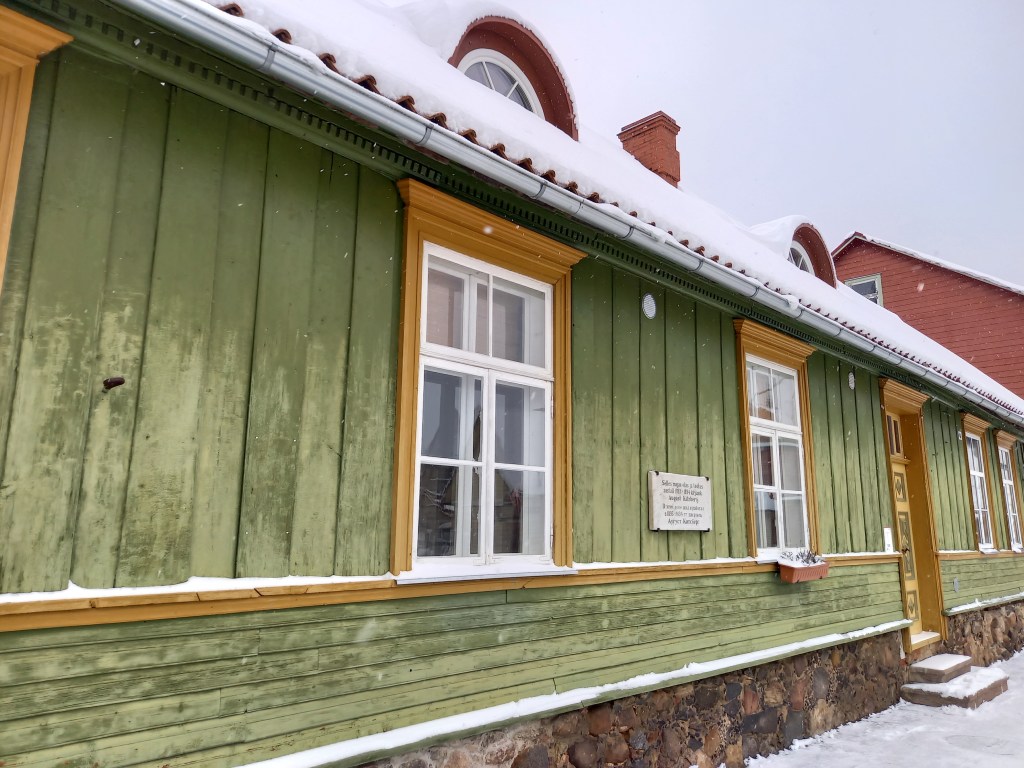
I LIVE IN A LITTLE WOODEN TOWN. Or so it’s been called by people who live in larger wooden towns. Each morning I rise and follow the same trajectories. I can see the milky light stirring behind the curtains, and I remember my third grade teacher telling us how there were places in the world where the sun never set in the summer and the winters were so dark.
Strange, I think, that I wound up living in one of these places. I wake up, shower and dress. I walk down one street toward one café, or I walk down another street to another. I cross by the courthouse, or that apartment building that used to be a dance school. There’s the park that used to host Joala, or the Konsum that used to be an A ja O. The preschool, the hairdresser’s, the Armenian restaurant. Estonian towns are full of bizarre surprises. In Viljandi, there’s an establishment called Suur Vend or “Big Brother” and another one called Sahara. There’s the Nuremberg Building, the façade of which is painted to look like it’s part of some German mountainside town. In three minutes you can travel from 1984 to Bavaria to North Africa. These small town trajectories are being engraved into my mental map. I call this my internal landscape. Your mind knows that the bank is here and the church and school are there.
Your mind knows, even when you aren’t paying attention.
DURING THE PANDEMIC, I started a writing project, one where I would write down my dreams in narrative form. I called this experiment “dream fiction.” What has resulted is a catalogue of stories, maybe a hundred already, that tell, in a way, my own story over the past five years. But it’s not only my story, it’s the story of the world. During the pandemic, I would have dreams about vaccines. When the war started, I had dreams about rockets. After Assad was overthrown, I had a dream about Russia surrendering to Estonia, and Koit Toome and Tanel Padar lounging in the Grand Kremlin Palace. There they sat stoking the flames in the fireplace beneath a torn portrait of Lavrov and complaining about how hard it is to be famous.
Another story was called, “Elon Musk’s Italian Restaurant.” I wonder how many of us are having dreams about Elon these days. I noticed in the dream that my mental landscape blended Viljandi with Stockholm, a city I have spent a lot of time in and that means a lot to me. In this combination of Stockholm and Viljandi — Stockholmdi? — Paalalinn and its lake were in Norrmalm. Elon Musk’s Il Colosseo was on one side of the lake, and his competitor’s was on the other. To get from one side of this lake, you had to take the metro, like you might in Stockholm. Viljandi had its own version of the T-Bana. Viljandi had its own Pressbyrån.
In another dream, Kihnu Island had merged with Viljandi, creating Kihlandi, so that all of the streets remained in their places, but the houses had been replaced by tall pines and red-painted wood barns, and the roads were gravel. There were fieldstone walls marking the boundaries of Joala Park. In another part of the town, San Diego was superimposed on Viljandi, creating Viljandiego. Viljandi was in the same layout, but all of the buildings were taken from the Gaslamp Quarter. There were even Kihnu women waiting for me on the other side of town, knitting in their red headscarves. I rode my bike past the mariachi bands and Mexican restaurants to get home. In this way, my town became half fantasy, half reality. I think that’s what happens when you live somewhere. Places get inside you. They fill your inner world.
***
People are arranged in such ways too. It’s not just streets and avenues, eateries and esoteric shops and lamp posts. Someone might be fixed in a certain place, such as the love of your life, for example. This woman is always there in that one spot, just like a mountain is always in one spot. You look up and see the mountain and it gives you a reassuring feeling, just like a certain person can reassure you through their presence. The mountain is always there and she is also always there in that place where she always has been. People become fixed in these places. Women become like mermaid statues spurting water. You go to visit them and to admire them.
It’s not easy to move mountains or mermaid statues and it’s not so easy to move people. This is how you can remain in love with the same person for years, even when it makes absolutely no sense, even when it causes you suffering. Buddhists call this attachment. They want to slip from place to place without ever paying these landscapes much notice. These people, these places, this yearning, it’s all like clouds drifting by. Do not get attached to women or to mermaid statues either, they say. Yet you do get attached. They are fixed in that place on your map, as much as Konstantin Päts’ enormous disembodied head is watching you from its perch beside the Estonian Theatre. You could try to move Päts’ head, but it’s too damn heavy. It’s been put there. So you just let it be. The woman you love is as fixed on your map as Päts’ head is fixed. It’s always just there, even if you don’t notice it every day. Sometimes you do notice it.
Some people do attempt to alter their inner landscapes through force. They get desperate and try to blow everything up with dynamite. I’m guilty as charged here and I have learned the hard way that it just doesn’t work. Movement creates countermovement, as the British-American philosopher and entertainer Alan Watts said in his lectures. Whatever you push against will push back against you doubly as hard. This creates balance and harmony, but people don’t want either. They want to be in control. They want this person here to be moved there. They want that person there to be erased. Out with the old and in with the new! From a cartographic perspective, this is like saying you would like Liivalaia to be relocated to Gonsiori. You want Rüütli Street in Tartu and Malmö Street in Pärnu to switch places. Let’s put Pirita in Kakumäe. Let’s move Rakvere to Karlova. But why? Because you think it will be better. You think that if you were able to redraw the map, everyone would be happier. You’re tired of loving that woman, or she doesn’t love you back. She has even said so. You want to exchange loyalties. You want to give your love to someone else, someone more deserving of your love.
But what happens in these ambitious inner world renewal projects? Things just fall back into place. Everything you did to rearrange your inner world was a total waste of time. There was no point in even trying. The world has its own natural order, just as towns do. In this way, whether you like it or not, she will remain the woman you love until one day, when there is a great earthquake or mudslide, or some other natural cataclysm that changes everything. This creates a before and after, just as burned cities only in part can be fully restored and rebuilt.
Estonian towns are full of such well-tended green parks that used to be grand structures. You walk through them all the time. Children play there, old women are out walking dogs there. Where there once were houses and hotels, there are now ice skating rinks. I wonder sometimes if we can still sense these places, even though they are no longer there, in the air about where the Golden Lion once stood before the March 1944 bombings, for example, in the same way we can still feel the presence of a woman in our lives through her long absence.
In this way, a lost person becomes both there and not there, just like the Golden Lion Hotel.
***
Recently I wrote down these words. I said that some things in life shattered us into pieces, leaving nothing in solid state. I said that in these situations, we become like free-floating mosaics, like the icy rings around Saturn or Neptune that, when viewed from a distance, almost look whole, but that upon closer inspection can be seen through. The light is visible between these leftover chunks of soul, feelings, and memory. They are suspended in time.
I wrote these words and then left to go to work on a rare sunny winter morning. On my left, I could see through some trees the spire of a small church, and on the right, I could see the sun on the windows of the courthouse. Often I am inspired to take photos of these little pieces of the town. I photograph sunlight against the wooden facades of old houses, I photograph frozen laundry strung across backyards, I capture the symmetry of the rail lines at Ülemiste.
Sometimes I see something interesting, like an old doll staring out a window at me. On that morning, my phone was dead and I could only watch the yellow light on the facades. A lot of people I know are nature enthusiasts. They ascribe to the Fred Jüssi School of Forest Asceticism. They try to fill the holes in themselves with birch juice, buckets of blueberries, and lake swims. For me, the sun on the facades of the buildings has become my own way of filling in those cracks, of gluing the pieces of myself together. Most people think we are all separate from each other and from our environments. I am me, you are you, this place is this place. I don’t think this is correct, because people are also places. This has become obvious. The universe is a continuum. I now know that this is true, but I am still trying to figure it all out.
*
An Estonian-language version of this piece appears in the magazine Edasi. Special thanks to Dea Paraskevopoulos for assisting with the Estonian translation, and to Casey Kochmer of Personal Tao for guidance.
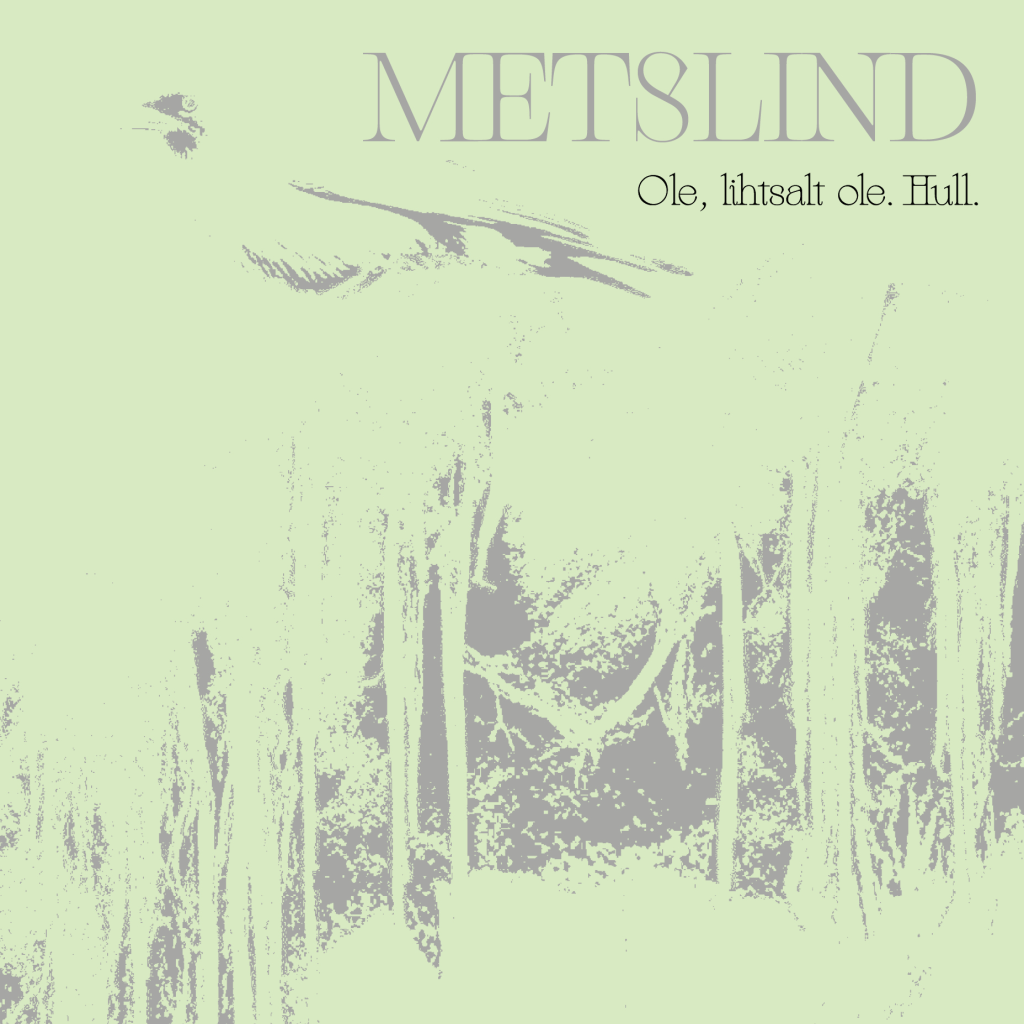
ole, lihtsalt ole. hull. by metslind

I’VE BEEN WAITING to write about this new Metslind record, because I am not sure how to approach it. In the early morning hours, as I began slurping down my first coffee of the day, I still had the somewhat jangly sounds of her guitar ringing between my ears. “She’s like The Smiths crossed with Fleetwood Mac,” I think. “As if Morrissey and Stevie Nicks had a baby.” Then I am somewhat terrified of the idea of a child with Morrissey’s face and Stevie Nicks’ hair and body. I don’t want anyone else to have that image pop into their heads. But maybe if Johnny Marr and Christine McVie had collaborated on an album in Estonian it might have sounded like this one. Maybe, but not really. Metslind is her own phenomenon. It’s a pitfall of Western and Estonian journalists alike that we look for these equivalents. Estonia must have its own Elvis, its own Michael Jackson, and its own Nokia, but there is only one Metslind. Not everything can be translated over.
Metslind’s record is two EPs combined. It arrived to me by Smartpost more than a month ago. I now have it on vinyl, but I gave my record player away, because it wasn’t very good. So now I just have an LP I cannot play. The album though is a kind of shrine, a shrine to the record player I will someday acquire. Then I will be able to play the album as intended. I will wake up and listen to Metslind at 7 am. In the meantime, I will listen to its conjoined EPs on Spotify. One is called Ole, lihtsalt ole (Be, just be) and the other one is called Hull (Crazy). The song titles paint a somber image. Other than the title tracks, there’s “Valu, Sa Oled Mul Jalus” (“Pain, You’re in My Way”), “Ära Sõdi” (“Don’t Fight”), and “Päris Inimesed” (“Real People”), along with “Rabalumm” (“Bog Enchantment”). There’s also “Tahan Olla Hea” (“I Want to Be Good”), “Ma Ei Tea Mis Saab” (“I Don’t Know What Will Happen”), “Mina Võin Ja Sina Võid Ka” (“I Can and So Can You”) and one more called “Elupuu Elab Mind Üle” (“The Tree of Life Will Outlive Me”).
This last title is the most puzzling one. Elupuu in Estonian refers to evergreens, but in my mind the name conjures up Yggdrasil, the tree of life in Norse mythology and the world tree of Estonian and Finnish mythology, which has stars in its branches and snakes at its roots. According to Metslind, the lyrics toy with Estonian trees like the evergreen (elupuu) and aspen (haavapuu, literally “wound tree”). “In the song, the Tree of Life outlives me,” says Metslind, “and the Wound Tree heals before I do. I say that it’s so good that I am no longer so young and that I don’t know what awaits me in life, though of course I would like to be younger and I would like to know what will happen. It’s about trying to have faith in the way things are.”
This is the Metslind musical universe. It’s a world of bogs, trees, and introspection. Her pop-infused indie guitar rock is expressed in dreamy tapestries of haunting vocals and layers of carefully selected sounds, but masks a kind of slow-burning inner torment.

According to Metslind, whose family calls her Maarja, a lot of this music came out of her separation from her long-time partner. In fact, “Hull” is about playing dumb when people would ask her uncomfortable questions about the split. “I started to give strange answers to their questions, so they wouldn’t know what to say or ask me about it anymore,” she says.
To this I have to agree. There are never satisfying answers to explain away life’s irrationality.
Metslind is fond of her name, which means “Wild Bird” in Estonian. “Every bird has its own song,” she says. “And I like it when a performer has a different name. They can be a different person.” Maarja also happens to be the name of a singer in Estonia, one that is trademarked.
But Maarja didn’t want to just be another singer named Maarja. Her Metslind persona was born. When she is not on stage, she is a music teacher, mostly of voice with some guitar teaching. She started attending music school at the age of seven in Kohila, and at her own instigation. Her family has supported her music, for which she considers herself lucky.
Other than the emotional tumult that led to sings like Ära Sõdi, which literally means “Don’t Wage War” and only coincidentally came out when the Ukrainian-Russian War intensified, Metslind is also somewhat unique in that she has chosen to sing in Estonian, rather than try to approach the international market with English-language songs. In fact, she used to write and compose her songs in English, but an encounter with Estonian musician Vaiko Eplik, who like Metslind is from Rapla, a town in North Estonia, encouraged her to switch back.
“You know, I have always listened to a lot of English-language music and singer songwriters,” she says. “I didn’t have a plan to write in Estonian, but then these songs just started to come.”
I would say it’s a welcome addition to the world of Estonian music. While listening to this record, I started to think about where Estonians listen to music, or where I hear Estonian music. Estonian-language music is played sometimes in major supermarkets, so that Estonian songs remind me of perusing produce, looking for good quality bell peppers. Estonian music is played at summer festivals, so that Estonian songs remind me of sitting outside in some amphitheater. And Estonian music is played during family get-togethers. So Estonian music reminds me of grilling šašlõkk while Kihnu Virve and Anne Veski’s golden hits are played.

Metslind’s music is not the soundtrack for supermarkets, summer festivals, or grilling šašlõkk. It’s more for long walks alone while you are trying to sort out various unresolved past issues. That, at least, was my experience of it. I don’t have a favorite song on the record, but I remember liking “Rabalumm” the most on the first listen. A good bog is medicine to the heart.
She herself mentions Joni Mitchell when asked about her approach. She uses Joni’s Open D tuning on her semi-acoustic Ibanez, which is as much a part of her look as her whiteblonde hair. She plays it with a chorus pedal which gives it that lovely atmospheric sound that almost reminds one of Peter Buck from REM. These are my own musical references, so bear with me.
The album was recorded in the studio at Linnahall in Tallinn, a sprawling stone monster of a building once called the VI Lenin Palace of Culture that was constructed for the 1980 Olympic Games (which the US boycotted on account of the then recent Soviet Invasion of Afghanistan).
“This is one of the last things that’s still functioning in that ruined old building,” says Metslind.
Metslind is an admirable character, I must conclude. She composes, she performs, she travels the roads with her Ibanez. She sings of the Tree of Life, bogs, and heartbreak. I find her to be an honest, direct artist. The Estonian word is siiras, but it doesn’t have an exact English-language equivalent either. And she will continue. “It would make more sense not to be a musician,” she says, “and I have tried many times to not be one. But when I tried, I started this new project That I called Metslind. What else can you do when your heart starts to sing?”
uueveski
On Kõrgemäe Street stands a faded sign that reads “18%” and shows an incline.
THE ROAD HERE shoots straight up and down, more or less, and even to traverse it by automobile requires a certain leap of faith as you release the break and pump hard on the gas. It reminds me of those high scary San Francisco hills, like on Divisadero Street, or Powell Street, where you rocket up to the precipice only to behold that gleaming beautiful San Francisco Bay below. Here Kõrgemäe winds down to a pacific lake, one cornered by soldierly lines of succulent shady green pines. On either side of Kõrgemäe Street, pretty Alpine-looking homes with great glass windows and red roofs and eaves and balconies frame this wondrous sharp descent. Yet there’s almost no-one here and those who are, are lost in their own stories.
In the distance, a couple walks a dog.
Down the way, a man takes a break and surveys the work to be done, a cigarette stub dangling and glowing from his rough hands. Terraces separate the homes, as do neat stacks of yellow firewood that line the peripheries of the properties. There are also the trampolines and tree houses, piles of rubbish from springtime renovation projects begun anew. German Shepherds crow at you from gates, but even their outbursts are a bit weary and resigned as the orange sun sinks in the sky, bringing the still nude tree branches of late April into sharp relief.
I step away from Kõrgemäe and head toward Peetrimõisa, crossing Jakobsoni Street, the main road that leads out of town, and heading toward the hills and the watery crash of the falls.
This part of Viljandi remains a mystery to me. I never come here, but I have no reason. Tonight though, I feel an itch to explore, to stretch my legs. I’d walk the whole world if I could, cross the frozen expanses of the Bering Straits. First I have to cross Jakobsoni, then turn onto Allika — “Spring Street” — and then turn again down a tiny side street — a põik — following it through the terraces and tidy homes and stacks of firewood, past lush hedges tailored and manicured to perfection — before turning up Pihlaka Street, and then crossing Uus, another major road here, before I begin to ascend Kalda Street, getting closer to the sounds of rushing crying water. Up, up, Kalda Street I rise, feeling the strain in my thighs, loving the strain.
Even as a child, I loved nothing more than to get lost like this, to follow the ways, disappear down the alleys. I loved nothing more than peering over fences, or overhearing the mothers scold their errant but deep-down good sons. “Mida sa tegid jälle?” “What did you do again?”
To hear it this evening in Estonian is a special treat.
At Kalda, the sound of the water grows stronger and I discover a path leading down to a small river that feeds a tiny body of water called “Kösti Lake” on maps. So there’s another lake in Viljandi? Nobody told me about this. Someone had built this staircase, a hardworking, resourceful local DIY type — hammered metal pipes into the ground and then placed cement blocks on top of them, creating a walk that leads down steep to the mossy muddy banks. I half expect it to give out on me as I amble down carefully, looking around and still seeing no one. When the stairs end, I walk as I did as a boy, keeping my feet against the incline as not to fall.
I look up at the houses, which loom above the woods. My brother-in-law used to live over here in this part of town, which is called “Uueveski,” or “New Mill,” years ago, before he died. He had mowed lawns like these, trimmed hedges like those. He had walked his dog here along the river bank. I had driven these same streets in the dark those nights. Yet that was all done now. He was gone, already for a long time, but the birds of Uueveski sing on.
I take in a great breath and go further down toward the waters enjoying their sound, hanging onto tree branches to slow my descent. I come up one side of the bank where the water swirls and consider traversing a line of rocks that leads to a little wooden staircase on the other side, and then see another line of rocks a bit of a ways down and try to cross that one too.
The space between the stones though is too great though, and the water is too deep, spinning in clear whirlpools, and I don’t feel like wading waist deep across. Lovely vibrant yellow flowers are in bloom here along the blank, as pert and ornamental as buttons on a beautiful woman’s waistcoat. I stoop to pick a few and put them away in my pocket. Think of all the trouble I saw in the forests when I was a boy, or how I would climb to the peaks of pines and descend with sap everywhere, and how my mother would use a solvent to get the tree sap off of my hands.
I just want to leap to the other side of the creek, but I don’t have the courage to do it. The rocks are too mossy. I’d be certain to fall in the water. My boyhood self would have done it gladly, and would have loved to fall. I am not my boyhood self though. I prefer to keep dry.
Defeated, I climb the steps to Kalda Street again, now high above the creek, and survey it as far as I can toward the other end. I still see no bridge to cross, but I keep walking down it anyway. If I had to, I would walk all the way around the little waterway, even to Rangoon. I’d love to walk, because I’m tired of writing and I have absolutely no use for people.
Down Kalda Street, the wooded banks of the creek open up to a large grassy park that rolls and rolls with small hills like the prairies of North Dakota. In the center of the park, someone has already set up a huge stack to be burned. I walk down past the bonfire pile, all wooden planks and discarded chairs, and come upon a new wooden bridge. The wood of the bridge is still yellow, and there is no marking on it, no graffiti, not even a pair of footprints. To think, I almost wound up swimming across the creek when this bridge had been placed here for me.
Just for me. I feel the wood of the railings, smooth and sanded perfect. Down and along the creek there is still no one. There are rows of castle-like homes rising on the other side, the part of town called “Peetrimõisa.” There are trampolines there and picnic tables, great green lawns, half moss, half grass. There is no one. This is dreamy solitude blanketed up in solitude.
At the center of the bridge, I pause a moment and listen to the water rush below me. I read recently in a book that what women most desire from men is that they would be present, that they would be there. Just there. Something to depend on. Something to latch on to. Not perfect, but present. There. We must be there. Our duty was to play the river bank, to lay perfectly still and muddy and mossy and calm and let their waters gurgle over us. When I first read it, I thought it was ridiculous. Nonsense! Why should I spend my life lying down on my back for someone else, all for her? Listening to the water singing and spurting beneath that wooden bridge, I acknowledge begrudgingly that it might be nice to get soaked now and then.
Sooner or later I was going to have to join up with another one of them. Some men try to ignore them, or to pretend they could have as many as they want. In their souls, they remain as only halves of hearts, yearning to unite with that something, as night is to day, light is to dark, heavy is to light, or struggling to remain autonomous, independent, which is a ruse. There was really no other way forward for me. I would have to reattach. “Women are like trolleys,” a tuttav, a friend, a mother of four children, had told me once. “One drops you off and another one comes and picks you up and takes you somewhere else. You just have to get on.”
The trolley of another woman would come by and open its doors and I would notice the conductor from beneath her cap and I would get on. “On the ovarian trolley,” as Henry Miller put it well way back in 1938 in Tropic of Capricorn. The water kept gushing. I would get on.
Written April 2018
i saw the sun a few days ago
I SAW THE SUN a few days ago. It was low in the sky but visible between some of the buildings on Posti Street. For a moment, I couldn’t quite understand what I was looking at. What was this strange orange glow? It cast its warmth on the wooden facades of the street. I stood there and wondered what I was dealing with. I knew it was sunlight and was amazed I had forgotten it. In the summer, there were whole 24-hour cycles where it was almost always by my side. In the summer, I took the sun for granted. I thought that it would never fade from my life. Little by little it was scissored away, until I forgot it even existed. I told my father it wasn’t so bad. “Just imagine that it’s night all the time. You get used to it. It’s like you’re always dreaming.” You do get used to it. You slow down inside. You trade away your White Nights for your Dark Days. One day, when you’re strolling down a street in a small wooden town in December, it appears.
The sun. Your old friend. The sun waves to you and you feel its presence. And then it vanishes.
***
When I think about the sun, I am reminded of a book of Greenlandic folk tales I have on my bookshelf at home. It’s one of my favorites. Inside, there is a story about the sun and the moon. According to this story, the moon slept with many women but was not satisfied by any of them. He then decided to sleep with his little sister, the sun. He disguised himself and slipped into her tent at night. The sun was very satisfied by her brother until she learned of his true identity. Then she cut off her breasts and mixed them in a bowl with urine and blood and gave this porridge to the moon to eat. “If you want to see how I taste,” the sun told the moon, “you can taste this.” The sun ran away. The moon paused to taste her breasts, of course, and then went after her. The lusty moon continues to chase her, but the sun is always faster than him. Because of this, night always follows day.
I’m not sure why I like this story so much, maybe because like most stories of the Greenlanders, it’s grotesque and involves incest and mutilation, but also because it says something about nature’s beauty and brutality. I feel it these December days. The lack of sunlight robs you of something, but so does the cold. Just walking from one end of the street to the other is a challenge. In summer, the sidewalk seemed as soft and warm as butter. In December, I am tending to the fire in my fireplace, listening to its assuring hot crackle. The sound of the fire is like Christmas music as I sit here reading about the moon and the sun.
***
A few days ago I found myself in an Orthodox chapel. There were icons on the wall of the Karelian saints. Colorful old men with beards enveloped in gold. I think I saw a few women there with their heads covered. I don’t know their names. A little research afterward yielded the name of Sergius, a Greek monk who had traveled the rivers northward to spread Christianity to the Finnic tribes in the forests. For some time, the Orthodox Church was a presence in my life. When I joined the church, I told the priests that I was an Italian, and therefore could not belong to any Estonian or Russian church. They informed me that it was all one church, and so this idea whether you belonged to one or to another was unimportant.
At the little Estonian chapel, I was told that they were an Estonian Orthodox chapel, not a Russian Orthodox chapel. There would be no risk of being forcibly abducted into the Russian World, or Russky Mir. Some of my friends are atheists. For them, these icons might as well be Legos or a woman’s lingerie catalog. They mean nothing to them, because they don’t believe in the idea of god or gods, let alone that a person, say Jesus, could be the son of a god, or have arrived to this world by a virgin. For me, there is no difference if his mother was a virgin and if his father was god. The icons of the Karelian saints are another window through which I might understand existence. Whether the Virgin Mary was a virgin or not makes no difference to me.
I went to confession once in the church after which the monk forbade me to have Communion for a year. “If I plant potatoes in sand, nothing will grow,” the monk had said. “But if I fertilize it for a year, you will see them take root.” Being forbidden from Communion pushed me more toward the world of animism and toward the blues in which voodoo also plays a part. In these worlds, I understood that I would be received as I was, without any kinds of expectations. Maybe I could learn something too, as I wandered among the seal hunters and the bluesmen.
***
By this point, you might start to wonder, what do all these things have to do with each other? How is the sun connected to weird Inuit folk stories? How are these connected to Karelian saints? How are Karelian saints connected to the blues? And what does any of this have to do with Christmas? For me, they are very connected. Christmas was created on top of pagan holidays to celebrate the winter solstice, the moment when light begans to grow again, or when the sun, everlastingly pursued by an oversexed moon, outruns him around the universe. Christmas is a celebration of the birth of Jesus, which makes it in a way a celebration of fertility. And in the American South, the blues were considered to be the Devil’s music, the opposite of Christianity. These are not extremes or polarities, but elements of a larger truth. Christmas connects them. Christmas is the needle. Different threads pass through its eye.
One does not need to choose one over the other, but rather embrace and combine all aspects. In the Greenlandic book, it is reported that in the time before memory, the heavens and earth were covered in darkness. According to the Greenlanders, the fox wished for sunlight, so that he could catch more seals. The bear was opposed. He was better at hunting at night. But the fox was better at witchcraft, and so sunlight came into being. This is why the Inuit don’t eat foxes. Now that I think about it, I have never heard of an Estonian who ate fox meat either.
As I write this, Estonian girls in folk costumes are spinning around a stage at a Christmas fair in Põltsamaa. There are also Estonians in top hats and knickers. Someone is wearing a cowboy hat. As they dance, I have been searching for a blues song about Christmas. John Lee Hooker has a good one called “Blues for Christmas.” He’s sad, he’s drunk, and he’s broke. He’s waiting for his rich girlfriend to come back to him. He’s begging Santa to send her back. I used to think BB King was one of the more respectable, well-mannered bluesmen, but he’s got a song called “Back Door Santa.” He comes around daybreak, while all of the fathers are asleep. He gives the children pennies to leave him and their mothers alone while they have some fun. And Santa Claus only comes once a year, but BB King comes all the time and his girlfriends do too.
These are real Christmas songs, I think. These are Christmas songs that tell the truth. According to Wikipedia, BB had between 15 and 18 children, none of them with his two wives. I’m sure he would have also been forbidden from taking Communion and for more than a year.
***
ON THE WAY to the Christmas Fair in Viljandi today I found myself listening again to the blues. I listen to the Rolling Stones perform “Parachute Woman” off of 1968’s Beggar’s Banquet. “Parachute woman, land on me tonight.” Inside the fair, everything smells like candles and happiness. The emcee is on stage speaking of gingerbread. There is something calming about the scene for me, and for a while I start to feel very tired of this rambling life. I have been running from everything, and sometimes I wonder where I am running to. My main goal is survival, I told my therapist. I’m running to survive. Hea küll siis, the lady said, very well then. But what will you do with your life if you survive?
Through my jumble of thoughts, feelings, and epiphanies, consciousness and truth begin to reassert themselves. If Christmas is the moment of regeneration, when darkness gives way to light, when the sun outruns her brother, and when all the points of light align through the positions of the stone circles, then might it be a similar moment for my own soul? Maybe Christmas could set me right. Or make me correct, as the Orthodox priest once said to me.
At the same Orthodox cloister, one of the Greek nuns did take pity on me while we were out gardening. She said I had a good soul, the soul of a saint. Another friend told me that I should listen more to the nuns and less to the monks. The Christians do like to talk about love. Only I wonder if it’s the same love that I understand it to be. The kind that flows through you and remakes you? That would be a worthy kind of love. That’s the love they sing about in the blues. The love that makes the moon chase his little sister through the cosmos, trying to catch her.
He never does, but he never stops trying.
*
An Estonian version of this story appears in Edasi.
Special thanks to Lawrence Millman, author of A Kayak Full of Ghosts.
eistneskt hús
AT THE GAS STATION on the edge of Tartu, a blue car pulled up containing two very over partied, overtired, hungover young women. They were red-headed sisters, and looked a little like the O’Mara sisters who used to live at the end of the street, except they were Estonians. I was standing there, obviously not minding my own business, when they invited me to pass the time with them and stay warm in the passenger seat. “We haven’t slept at all,” one of them said. “We came here straight from a party.”
They drove me down to the center of the city, where the Tartu Kaubamaja department store had been possessed by the university and where the former sites of Apollo, Tokumaru, Copenhagen Tiger, and Tommy Hilfiger had been replaced with seminar rooms. One of my classmates from elementary school, a nice Jewish girl who had since become a wildly successful Indian devotional singer, came out of one of the seminar rooms and I patted her on the sleeve. I was reminded that she had been, at one time, my square dancing partner. Tartu had been turning into a kind of mecca oasis. Everyone was here these days. Happening place.
BUT I WAS RESTLESS. School wasn’t for me, so I obtained a cheap ticket to Reykjavik. I arrived and took the bus into town from Keflavik and walked down to the harbor. It was a brisk, blue-skyed winter’s day. At the harbor master’s office I went inside, looking for the Icelandic Estonian House, Eesti Maja, or Eistneskt Hús. I was told it was on the eleventh floor, and I had to take a sophisticated in house funicular system to get there, one that also delivered the mail.
There at the top, I met up with the head of the Hús as well as a teacher. The director was a charming, younger lady, who looked as if she was Spanish. The teacher had affected a Robin Hood look, with a green beret and goatee. I thought then if I should contact Katla, if she still harbored ill will toward me. Maybe she did. Maybe it was better to let sleeping Icelanders lie.
north seas
NORTH SEAS. Or, to get from Point A to Point B. Or, riding public transport along the Scottish Coast, somewhere near John O’Groats. From there I could see, as the rain was breaking and giving way to a December sunset, an old ruined castle perched on a bluff of a nearby island, which the mapmakers tell me could be Stroma or Muckle Skerry. I disembarked the bus and lost my way snapping photographs and was lost for quite some time then wandering until I stumbled into the outskirts of what I thought was Edinburgh. A few fishermen encountered me and asked me where I was going. “Ireland,” I told them. “Ah,” one answered. “It’s over there.”
LATER, I wound up in the embrace of a voluptuous Inuit throat singer. Somehow she had become my girlfriend and somehow we were staying in a hotel room in Reykjavik that overlooked the entire city, which meant it must have been up by the Hallgrimskirkja. She had kakiniit sprawling all over the lower parts of her body like vines. I was coolly unsurprised that this was my new fate in this life, but having been denied emotional connection for so long, I found myself indifferent to this latest bedsheet romance. When she kissed me goodbye, I blinked. It wasn’t that I had no feelings for her. It was that I could barely remember my name.
After that my daughter came to live with me in the Hotel Reykjavik. We were there, wondering what on earth there was to do in Iceland other than visit hot springs and museums, when the lights went out. I thought it might just be the hotel electricity, but when I looked out the window, I could see the whole city of Reykjavik was dark. Then I began to hear a loud rumbling sound. “Maybe the Russians are attacking,” I told my daughter. “But why would they attack Reykjavik?” “I don’t know. Indefensible NATO country?” I said. I found an old radio and turned it on, but static came through. After adjusting the antennae, I was unable to pick up any signal.
the swedish rocket
MY FATHER CALLED ME. He said, “Look up!” I looked up and saw the rocket flying overhead. It traveled slowly. It was painted yellow and looked like a telescope except that its narrow end, where you would look into the telescope, was in front. There was a red light blinking near the front of the rocket. It had the appearance of an oversized child’s toy. “So that’s what those new Swedish ICBMs look like,” I said. The rocket traced its path beyond the island and landed somewhere on the mainland. But no explosion came. Maybe it was just being transferred to a more powerful launcher to protect against a Russian advance? “Did you see it?” my father asked through the phone. “I saw it,” I said. We all had seen the rocket soar by overhead.
All of Viljandi Town had been evacuated to this island in the Baltic for at least part of the year. It looked much like Gotland or Saaremaa, but I had never visited the place before we were forced to flee the war. Of course, we brought along with us all of our small-town drama which had continued on as if nothing happened. During the days, I would cycle along the gravel roads of the island, traveling from community to community. Sometimes I would go to the main island town and write there at a café on the square. Everyone seemed to be affected by a kind of midlife ennui. We were stuck in some apocalyptic version of St. Elmo’s Fire or The Big Chill.
All we needed was a more memorable soundtrack.
Unfortunately, I got caught up in some romantic hijinks. One day, I came home only to discover my friend’s wife wandering around in my kitchen wearing my underwear. Yes, my pale blue boxer briefs. I was surprised that they didn’t just slide right off of her. She had nothing else on, and was speaking to me in a very inflected accent. I don’t remember was she was saying, I just knew that she was trouble. Eventually I got her to leave, fully clothed. She was standing there in the main square when the Swedish rocket went over. “Did you see it?” I called out to her. “Did you see the rocket?” “Yes,” she nodded. She was wearing sunglasses and clutching a small bag, as if that might give her some peace in this harsh world. “Yes, I saw it.”
Just then her husband appeared, wearing a black hat, the kind that Zorro might have worn. He came walking in my direction like a hungry, impatient dog, but did not run. “I warned you,” he growled. “I warned you to leave my wife alone!” “I found her in my kitchen!” I protested. “She was totally naked. She was wearing my underwear!” I said this last part as if I had been the victim of this romantic island triangle. How dare she? How dare she even show up naked in my kitchen, with her lovely breasts all over the place. And to involve my underpants in this mess?
“I have no interest in your girl,” I told him.
The angry husband stopped there in his Zorro hat and eyed me. This was like a scene in some old Western. The Good, The Bad, and The Ugly. I was waiting for the man to draw and to shoot me dead. Instead he took off his black hat and gestured at the sky. “You know, I believe you this time,” he muttered. “We have more important things to worry about these days anyway.”
the vestergade music shop
ONCE UPON A TIME there was a music shop on Vestergade in Copenhagen. It was at an intersection in a white building, but lower than the street level inside, so that you could stand inside and look out the windows onto the sidewalk. On the wall there were maybe six sets of headphones and six sets of albums. New albums. One of these new albums was called Sound-Dust by a French-British outfit named Stereolab. It was released on 28 August 2001. A week later, Stereolab would play at Pumpehuset, a local city venue. I know this because I was there.
In the music shop on Vestergade there also worked a young woman who had in her possession at least one white-and-blue striped shirt. She was a quiet, aloof Danish lass, and had very light blonde hair and freckles. I can only barely remember the contours of her face, but I remember them because I have been looking for them ever since in the faces of other women. She would wear a black hat sometimes, a sort of floppy 1920s newsboy looking thing. I’m surprised by how intimidated I was by this quiet Danish record store girl. Who was she? Where is she? Almost every action of hers glided away with silent proficiency. She took my kroner, handed the music over to me in a paper bag. Only once I saw her outside the shop. She was either coming or going. She had on black stockings and black shoes and the white-and-blue shirt.
That was a gray, cool, somber Danish autumn. The leaves in the city turned yellow and orange and then fell into the yard of the Nicolaj church. The news cut right through all the skin and blood to the core of your bones. In the Albertslund communal kitchen, another American student was leafing through a magazine that showed Manhattanites leaping from the tower windows, their clothes fluttering in the wind. The student, who was from Maine or Washington State, or some other place with lots of pine trees, tossed the magazine across the table and announced, “I can’t stand to even look at this stuff anymore!” I picked up the magazine and looked at the photographs. They unsettled me in ways that I could not understand. I couldn’t articulate how they had unsettled me. I also put the magazine down.
Autumn turned to winter, and the sidewalks were covered in frost, and the windows of the shops and boutiques were strung with blinking Christmas lights. There were holiday parties in the streets. In the bookstore windows there were new editions of The Lord of the Rings, because the first film in the trilogy would soon be released. At the Vestergade music shop, the Danish mystery pige took down Stereolab’s Sound-Dust and replaced it with a newer record.
But which one did she choose next? Which record did she choose?
the 6 am circle k coffee

THERE’S NOTHING LIKE a 6 am coffee from Circle K. Actually there is something better, and it’s the special Finnair blueberry juice. During the flight over the Atlantic, they just leave it in the back of the plane in the kitchenette, and you can help yourself to as many cups as you like. I feel like Finnair is also my home in a way. And Helsinki Airport. Like I told my mom before I left, I don’t mind a layover in Helsinki, Finland.
I’ve spent half my life waiting in that airport.
I like Finland. Finnish, and by extension Estonian, women are super cute. I can see in my younger self, a sort of terrible but innate and unavoidable lecherousness, which is in and of itself a part of the biological condition. Such things can be ignored for only so long. Herein lies the conundrum of the suburbs. We are raised in comfort and expected to fall in line, but then things go haywire for so many of us and we do rather stupid and adventurous things. Restless people wind up in America, and you think that their descendants are somehow not like them? We are somehow more mellow and set in our ways, because we happened to be raised with a Nintendo and trusty pizza place up the way? I’ve got former classmates scattered all over the earth. You have to wonder, what went wrong here with all of us?
Or did anything go wrong at all?
Maybe things are just as they are.
Do you realize I have been crossing the North Atlantic by plane for more than two decades now? I’ve got grainy photos of me standing in Christiania in Copenhagen trying to pull a sword from a stone. Or that cold morning bus station in Stockholm, the day I fell ill and went to see the Vasa for the first time? I also remember my first trip to Iceland, which was in March 2001, and being on the Icelandair flight, which already had personal screens installed, and watching Coldplay’s “Don’t Panic” video, and the Icelandair attendant coming by and asking me if I wanted some coffee and knowing just by the look in her eyes that I was dealing with some other, non-American Icelandic lifeform.
Iceland had always intrigued me because I had been assigned to write a country report about it in the sixth grade. I had zero interest in this place. But it grew on me, the fermented shark meat, the geothermal pools. Among the first things I did on my first trip to Iceland was go to the supermarket and pick up some skyr, a yogurt that you can find tubs of in any American supermarket today, but was like an exotic food even back then. I put the skyr sticker in my passport like a souvenir, and you can imagine how the passport control officer looked at me when he went to stamp my passport and this sticker fell out.
Life just sort of went that way, and I went from Iceland to Denmark, and from Denmark, after some interludes in Norway and Sweden, to Finland, from which I predictably wound up in Estonia. I forget these things from time to time. I think when you are younger, maybe 25, you have a much shorter, more dynamic self narrative, but when you get to 44, there is so much time, and there were so many phases, that huge chunks of them can just drop off into the abyss like melted Greenlandic icebergs. You are reminded of stuff you did and think, “Oh yeah, I forgot about that.” Happens every day. Years melt into years.
I wonder about the vantage point of older people who talk about stuff that happened in the 1960s. Like that’s a whole other block of time removed from the present, and how can you recall stuff that happened in 1966 without it being repackaged into new narratives. I mean, does your recall remain the same, or are you rewriting those past moments every time to remember them? My parents are still cruising around Long Island listening to something called Yacht Rock Radio, where they play the Doobie Brothers, Michael McDonald, Steely Dan, and some DJ who sounds like a guest star on The Love Boat or Fantasy Island treats you to all the best yacht rock hits. “It was the era,” my father says with the wind in his hair listening to Michael McDonald. “The era!”
Anyway, where was I?
The Circle K 6 am coffee. Circle K is a lifeline to anyone past midnight in Estonia. Everything else is closed. French fries are the sole sustenance, unless you are brave enough to eat one of those double-barrelled hot dogs. The french fries, mind you, costed me only €1.50 per portion. In Sag Harbor, they would be like … $10. People keep asking me, do you ever think of moving back to Long Island? I say, sure, when I get my $7 million dollar advance on my next book, I’ll pick up a nice house next to Drew Barrymore’s and we can play tennis together. You’re all invited! I mean, come on. Let’s get real. Even diehard East End Long Islanders are fleeing because they have been driven to eating roadkill because of the ultra rich. The rich destroy almost everything they touch. They come into an area of cultural diversity, and the ‘just folks’ people who made it that way are eventually forced out, leaving behind executives with tennis courts.
So I am here, in Tallinn, with my 6 am coffee. I still call Circle K Statoil out of habit, and because I liked the Statoil branding better. Statoil also sounded better in Estonian. All kinds of characters exist in Statoil/Circle K in the early hours. There’s a kind of rough-edged party element in places like Tallinn, but also in Copenhagen, Reykjavik, especially in summer. In New York, the people sleeping in the train station are homeless, but in these places, they are more like young women (or men) who just had too much to drink last night. And also jetlagged people like myself who are hungry and on some weird inverted vampire sleep schedule, so that I want to sleep when everyone else is awake and vice versa. But, oh look, there’s the Linnahall. And there’s the spire of St. Olaf’s Church. This place. How did I even get here? I have no idea. Here I am, buying coffee.
To borrow a quote from Full Metal Jacket, “This is my Circle K 6 am coffee. There are many like it, but this one is mine.”