STEN GOT A NEW APARTMENT overlooking the capital city. I went to visit him to inspect the place with Riken, the Japanese mountaineer. We stood in a bare white kitchen lit by a skylight. There were unfamiliar varieties of Entenmann’s cakes that contained distinct Northern European flavors on the counter. Who knew that Entenmann’s made pumpkin cakes or ones flavored with lingonberries or cloudberries? I read and reread the ingredients on the boxes.
Sten was discussing with great detail the placement of a couch with Riken, but Riken was of another opinion. Riken rested an elbow against the mantle of the fireplace and nodded up and down as if studying the room and searching for an answer. Sten and Riken often got side-tracked by these kinds of minor details, such as where to put a piece of furniture, or for how long one should sauté the onions. “Hey, Sten,” I asked. “Can I try one of these cakes?” “Knock yourself out, man,” he said. Then he turned back to Riken, “The light from the window is best over here. The couch should go there.” “You’re wrong and you know it,” Riken countered him.
Sten’s girlfriend Pille-Riin stood all this time next to the couch in question with her arms folded and a particularly stiff-upper-lipped, “keep calm and carry on” expression on her face. She looked like a British nurse. Well, an attractive one, if such attractive British nurses still exist. Sten and Pille-Riin had acquired a bulldog in their time away from Estonia and the animal was pacing the apartment as Riken and Sten argued over the placement of the couch.
The dog ran over and licked Pille-Riin’s hand as she waited patiently.
After that, someone came into the apartment and cried out, “narcs!” You should have seen Sten’s face curl up in panic. “Everybody out!” he shouted. “Quick hide!” “What’s wrong?” I asked. “The cakes! The cakes! The cakes are all spiked with drugs!” “They are?” I said, with some cake crumbs on my lips. “Shit.” “Yes, out. Out!” I ran out of the building, only to glance down the street at Tallinn in the mist. It looked different, almost like Gothenburg, or some random Dutch city I had never seen before but knew existed. Rows and rows of red-tiled roofs with some sad-looking skyscrapers in the distance. Sten said he liked this part of town because he could get in and out of the city in a jiffy. Unlike Kalamaja, which had only one road in and out. This choice spot was being put to the test as we all fled the Estonian drug police.
I lost track of the others, of course, ambling across a rye field into a forest. I clambered over an old stone wall, found a sandy spot and began to bury myself in the moss and dirt. If I covered myself well enough, the drug police would never find me. Not long after though, I could hear Sten’s voice coming my way. He was being escorted by several Estonian police officers. He led them right to my hiding place. “There he is,” he said, pointing me out. “What are you doing, man?” I said. “I don’t want to go to jail!” Sten frowned. “It’s no use, man,” he said with a sorrowful voice. “They already know everything about us. The jig is up. We’re all going to jail.”
MY EDITOR CALLED ME. He said that he wanted me to write not one but two profiles of Sabrina Carpenter. “Sabrina Carpenter?” I said. “You mean that blonde lady with the fuzzy eyebrows?” “She’s an acclaimed singer-songwriter,” my editor said. “Men want her and women want to be her.” “If you say so,” I said. How out of touch was I becoming, or had I become? I had never even had a TikTok account. I had never heard one of Miss Carpenter’s songs, though I had heard her talking about a childhood crush on Paul McCartney on some American late night show. Paul McCartney, now that was someone I knew of. I was more of a Sir Paul person.
At that time, I was at my aunt’s house in Sand City, waiting for my father to pick me up. Or was I supposed to meet him at the conference center? There had been some miscommunication about the getting picked up or meeting up part. I kept calling him but each time he answered, I could only hear the sounds of the conference behind him, while he yelled, “Where are you?” through the phone. Then he would lose the call. I’d redial and then be met with that recorded message, “The mobile phone you’re trying to reach is either switched off or out of area.”
My aunt was stroking a new puppy all this time on the porch of her house out there in Sand City. To think, I had originated in this bucolic, waterside town. But that was a long time ago. “Why don’t we go visit the old dairy,” she said, referring to a farm down the street from my grandma’s house. Somehow this had become closer, even though it was in a different town. We started to walk to the old dairy together when a sky blue bus drove past and parked on an adjacent lawn. “That would be your Cousin Linda,” my aunt said. “She’s back from Amsterdam.”
Cousin Linda was living in the blue bus. She had a new daughter and was nursing her as she spoke to us. She had also got a new husband too, a Dutchman named Jan. When this goateed Dutchman came in to check on his wife and daughter, my cousin answered him back in Dutch. Linda was now fluent in Dutch. “Well, I haven’t seen you in a while,” Cousin Linda said. “What are you doing back in Sand City?” “I don’t know,” I told her. “My father left me here and went to a conference. Which is a pity because I’m supposed to be working on two profiles of Sabrina Carpenter for a magazine.” My cousin, who was even older than me, squinted. “Who’s Sabrina Carpenter?” she asked. “An acclaimed singer-songwriter,” I told her. “With fuzzy eyebrows.”
Just then the phone rang again. It was my father. I could hear the conference noise in the background. My father was trying to make himself heard. “Where are you?” he repeated. “Where the hell are you?”
AND THEN ONE DAY, I was working as usual, in my usual café, at my usual table, engrossed in dull, painstaking work, unaware of the time, and when I had last eaten, when I looked over the top of my laptop only to see a lovely Cheshire Cat face peering back at me. It was one it took a moment to recognize, considering I hadn’t seen her in almost two decades. Frida was grinning at me with that big pussycat face of hers. She looked the same as she had in college. She was wearing a white Nader-LaDuke 2000 t-shirt and a bright yellow raincoat. She said, “I came all the way to Estonia from Vancouver to find you,” and, “I brought my mother for protection.”
Frida nodded over her shoulder at her mother, who was wearing a matching yellow raincoat. It was a funny thing, because I didn’t notice it was raining that day. This being Estonia though it was poised to rain one moment or another. Not a day went by without some rainfall, snowfall, or intermediate precipitation. Her mother, a sort of older, grayer version of Frida, with glasses, stood silently behind her. She nodded. “There are some things we need to discuss,” Frida said, leading me away from my desk to the basement. “Different topics we all need to address now.”
I came down the stairs and noticed it had been converted into a comfortable, warmly lit meeting space. There were a few chairs arranged with a table in between them, some tea cups and a pot of tea. But what did we need to talk about? I thought we had talked through everything. What did we need to discuss again? I thought she had sworn to never speak to me, of me, or even think about me in any way again. When Frida had married she had become “the married woman,” engaged in a lifetime’s pursuit of self-censorship and border enforcement.
No other man could come between Frida and her legal partner.
Here we were though, taking seats opposite one another in the basement of an Estonian coffeehouse. They were still wearing their matching yellow raincoats. I was nervous. There was a lot to apologize for. I didn’t know where to start or what an apology could ever be worth. The tea was poured. That’s how that began.
IN STOCKHOLM on a peaceful July day– at last. Bryggartäppan is a children’s playground, the size of one city block approximately, with clusters of leaning red buildings set up to look like an old Swedish village. There’s even a wooden putka here where two fine-looking ladies make coffee for the parents, mostly mothers, even on a Sunday. Tiny birds flit around and one of the sellers is most fetching, a sturdy lass with silver hoop earrings. Her eyes are as blue as the sky and her hair is pulled back. Such Swedish playground baristas are the last respite of the recently divorced father.
But maybe it’s not just her that toys with my senses but that smell of baking waffles, coupled with all of those cream-colored buildings around us. There was even a little yellow fly that landed on my hand before. Have I ever seen an insect that color? Is everything in Stockholm made of gold? “I don’t want water, there’s juice there, there’s some juice over there!” This is what my youngest daughter, age 5, is shrieking in Bryggartäppan. Then she cries aloud in Estonian, “Ma saan nii kurjaks,” “I’m getting so angry!”, and punches her older sister, age 9. Then she begins to sulk and cry. The youngest is wearing a light blue headband from Copenhagen Tiger, and totes around a blue fairy balloon from Gröna Lund, the amusement park. This troubles her older sister. “I told you at the park that I also wanted you to get me a balloon but you didn’t get me one!”
At last the seller returns from making waffles and hands over a box of äppel juice. Quickly, the straw is in the little one’s mouth, and she is quiet for a moment. The other children here are Swedish. They are pale, thin, and have straw-colored hair. They are physically active, and on occasion expressive, but I have not witnessed the kind of seismic outbursts of which our children are so ready and capable. I search our family trees for some culprit — is it their mother’s Komi great grandfather? A plosive mix of Siberian and Greco-Roman blood? — but there is no answer.
The parents here at Bryggartäppan are, as a rule, older. Perhaps a few of them are actually grandparents. Swedes are a peculiar breed though. They are married to modernity. They are infatuated with their perfect civilized society, yet so haunted and repressed by this civilizational impulse that they have the emotional temperament of office wallpaper. They hide away their thoughts, dreams, dark sides behind apartment doors, sunglasses, and politely phrased, thoughtful sentences that implore only moderation. Rows and rows of perfectly symmetrical apartment windows, cascades of identical balconies, rising up and up and up, peaking in crescendos of tiled roofs and towers. The pursuit of wealth, the proper means to express it, these are the chief concerns of the Stockholm Swedes. Everything here must be perfect. A little girl with her face painted and her hair done up in cornrows goes skipping by, and another waits patiently for the five year old to dismount a small rocking horse. When she does get off the horse she sulks again and then announces to the lot, “I am so bored!” To which a little boy nearby, who understands English, chides her. “Be quiet,” he says. “You’re acting like a baby.” “I am not,” she says, and smacks at the air with her balloon. “I am not a baby,” the five year old sobs and then takes her apple juice and squeezes the liquid all over her older sister’s drawing on a table beside the playground café. “You are bad!” the nine year old scolds her, to which she only shouts, “I’m not bad!” “You poured juice on my picture — that’s bad.” “I did not.” “You did too.” “Tegid küll.” “Ei teinud. SA VALETAD!” “YOU LIE!” These are perhaps the loudest sentences that have been uttered on Swedish soil since Estonian pirates sacked the old Swedish capital Sigtuna in 1187. There are lots of pregnant Scandinavians in the park here today, paging through magazines and pretending not to hear this terrible squall. Their days will come.
“Here’s an idea for a good life,” my Swedish pal Erland said yesterday, skulking around the Pressbyrån at Slussen with his hands in his pockets and harbor wind in his hair. “Meet a girl, have a bunch of kids with her,” he said. “Then you can all be wonderfully miserable together for a few years. Doesn’t that just sound like the greatest idea?”
STORA BLECKTORNSPARKEN is an urban park a bit farther south on Södermalm with the same kinds of Bullerby buildings as Bryggartäppan. There is more graffiti here, though, and shreds of rubbish, broken glass shards, fruit peels, chipped paint and rust, the illusion of safety. “Dad? Dad? Dad!” “What?” “Look what I can do!” The nine year old swings away as the five year old arrives, panting. “Daddy, my knee hurts, look what happened. I slipped on the rocks.” I survey the wound only to be interrupted by, “Dad? Dad? Dad! Watch me swing!” And she swings higher and higher. Mothers sit around us tinkering with their phones. More wonderful park birds flit about. It feels good to breathe and write in Stockholm. To write without any project or desire for money. Just writing with feeling, without that evil thought looking over your shoulder, the one that says that every word has to count toward something. But maybe that thought came from the office or from some editor. Maybe it was never my thought to begin with.
“When you are with someone, you become someone else,” says Erland. “You change yourself. When I was with Henrietta I was someone else. And when I was with Agnetha I was someone different from that person. And when I was with Gunnhildur, that Icelandic football player, I was also someone else.” Erland has been a lot of people. “Dad? Dad? Dad! Come here, help me off this swing. Come, Dad. Come!” These children. They so crave my attention. If I only had some time off I could be such a better father to them. I could never have any more children. Not now. I would go crazy. That would just be the end of the story. Not with these thin Swedish women. Not a chance. Although the lady who made me coffee was rather nice and might get me to reconsider, especially if she turns out to be some Zelda Fitzgerald type who can ruin me and provide me with loads of material about her schizophrenia. This playground is a madhouse. All the sobbing, crying children. All the childhood drama and trauma. The pale thin mothers call after their offspring, their barn. One of the children steals the five year old’s balloon and I have to run after him and take it back, causing a puzzled look from the toddler, who thought the balloon was his.
In the meantime, a mouse ran over the nine year old’s shoes at the bottom of the slide. The parents here all look at each other. I suppose this is one way to pass the time at a playground on a hot day. A Muslim family arrives, the mother’s head covered, the daughters bare to the sun. They look truly happy, content, and I sense no disturbance or cultural conflict. The Swedes don’t dress so differently from Americans. They seem maybe more capitalistic though. A Swede is the sum of all he or she consumes. The patterned dresses, the well-groomed facial hair. A barber shop stands on every other corner, catering to the perfectionism of the Swedish man. The women shop for dresses at the boutiques in between. One must exude one’s wealth and value. A haircut, a shave, a flowing cut of textile, this is worth nothing alone. It’s the effort that goes into being Swedish. This is what pays the real dividends.
At night, we find ourselves at another playground nearby on Nytorget. Teenagers stand among the benches singing songs and playing ukuleles. “Södermalm is like the best place ever,” my nine year old says. “There is no traffic, the houses are pretty, and everyone has time to do whatever they want.” This is the fun of a playground in the dusky twilight of midnight in Stockholm. As the children play on, and the ukuleles strum, and I admire the lights from the cafes around the park, I read a sign about local history. This was once the site of a large garbage heap, it reads. And in the 18th century it also was the location of the gallows and a major site of public executions. I wish I could have seen Stockholm then when it was rough and tumble and full of pickpockets and convicts, truants and robbers, counterfeiters, highwaymen, gentlemen of the day and ladies of the night. Before the boutiques and barbers, there were wards of the state sentenced to hard time. Looking around nighttime Nytorget, this seems impossible. It’s as if it never happened.
ON KATARINA KYRKOBACKE, at 8:30 am or thereabouts. A small street winding with the cool air through the bluffs of Södermalm, damp and refreshing, creamy houses with mustardy finishes and black stovetop pipes protruding, cobblestones and fine hemmed in trees. These give way to red wooden dwellings with toys and yellow flowers in the windows and everywhere that faint chirping of Stockholm birds. In the distance the roar of construction by the locks of Slussen winds up. Outside a school, a father is gently combing through his daughter’s white-platinum hair and a black car breaks the silence, its wheels finessing the stones of the road. A man in a flat cap jaunts by, clears his throat loudly, spits on the street. Despite this, there is the feel of polished cleanliness everywhere, that well-to-do feeling, as if the Swedes have always known wealth and wealth is all they’ve ever known.
Back at the hotel, we have a good breakfast of scrambled eggs with chives and onions, big bowls of yogurt, dried banana, crisp dried coconuts, and three cups of the finest coffee there is. “Of course, you drink more coffee here,” says Erland, a steaming mug in his hands. “You’re in Sweden.” He says it as if we have all died and gone to heaven. This Swedish angel is proud of his homeland. He even approves of its bike paths and pedestrian walks. “It’s not like in Estonia where BMWs and Lexuses blow by you, splashing you with water,” he says bitterly. I am surprised he chooses to recall the makes of the cars, but Sweden is old money and the Estonians are nouveau riche. It’s that old old money, new money thing, along with some shared hand-me-down of clumsy woodsman’s poverty. I feel blessed to be here. I remember my first trip to Stockholm in ’01, staring up at the wreck of the Vasa in the VasaMuseet, a museum I had read about in a children’s book my grandparents once gave me but never expected to see with my own two eyes. After breakfast, we head to the Nordiska Museet, where my children make for the playroom first and never really leave, hoisting toy wooden buckets into an old make-pretend farm.
Maybe it wouldn’t be so bad to stay in Sweden, I consider, to elope with that redhead from the Pressbyrån in Slussen, to lie beside her at night, listening to ship’s horns in the harbor, and hear of the inner workings of this marvelous convenience store. “We were out of Maribou chocolate.” “It was time to refill the cups.” To lie sprawled in bed sheets with a woman who reeks of cinnamon buns, kanelbulle. In the mornings, she is off to the shop, to prepare the coffee, stor cappuccino, lite cappuccino, the whir of the machine, and there she is again behind the counter, processing people’s payments in her blue shirt and saying, varsågod. The blue of her shirt brings out the blue of her eyes, just like the water licks at the docks of Östermalm where we step off a boat later and are surprised by the golden glitz of the gilded Royal Drama Theatre.
I keep processing this idea for a children’s book, about a Stockholm teenage girl with a ne’er-do-well father who turns to petty theft to make ends meet. Then one day she is caught and sent away to Långholmen, the old prison island down the harbor. I play with this idea all the way to the ship that takes us back to Estonia, the front bar of which has been permanently converted into a playroom. The five year old’s balloon is still with us, believe it or not, this artifact from Gröna Lund. It may be the best balloon we have known collectively in all of our lives. It cannot be lost, deflated, or stolen. In the playroom, they play Estonian children’s disco music, oi-oi-oi, ai-ai-ai, a strobe light projects dancing rainbows across the floor, and I take a seat beside a Swedish mother whose hair is a mess and is probably as full of ice cream as mine is. She looks to be about as tired as I am, sapped, haggard, and so hungover by life. This is how we set sail on a gray day to face our decisions and memories.
More or less directly transcribed from a notebook I kept in the summer of 2017.
“HONEY,” SHE SAID. “I want to see if that tree will work over here.” We had bought a new house at the end of a road all the way out in the far north woods. But she said there wasn’t enough greenery up front to block out intrusive neighborly eyes. Her solution was to uproot a tree from another property and replant it on our own. You can imagine how much I grumbled doing this. It was one thing for someone to tell you to replant a tree, it was another thing to do it, even knowing that its position might not be satisfactory and that I might have to do it again.
Instead, I dug a hole and held the tree in place while she went out and examined it from different angles. The tree, an Estonian pine, was as tall as a Manhattan skyscraper. It just went up and up into the clouds, and it was very hard to keep erect. It would tilt from one side to another, its trunk was heavy, and, in a moment of distraction, I let the pine slip and watched it with some horror crash into the corrugated metal roof of a nearby house. Its sole inhabitant, an old woman with white hair held back in a headscarf, came out and surveyed the damage.
The old gray granny whistled loudly.
With enough strength, I was able to position the tree in the hole again, holding it aloft through sheer exertion so the lady of the house could at last decide if this was a suitable location. But by this time, the lady of the house had disappeared to somewhere to inquire about acquiring some rhododendrons. The tree, frustrated by the whole scene, wilted at this moment, drooping over like an unhappy flower. “There there,” I told the pine tree. “No need to get upset.” It was no use, in a flash the tree removed itself from my hands and ran quickly away.
Into the woods, I assume.
When the lady of the house returned she asked about the tree. “What kind of man loses a pine tree?” she scolded me. “Only you could lose a whole pine!” I told her that the pine tree was upset. It had been waiting to be replanted all day. “Very well then,” she said. Our daughters gathered around her and she went to the barrel sauna, immersing herself in its bubbling waters. Then, pounding upon the surface of the waters, she began to chant. “I know how to retrieve lost trees!” she said. The children watched their mother with some alarm. But soon enough the tree came out of its hiding place in the woods. Begrudgingly, meekly, sheepishly. Arborescently.
ONE DAY IN EARLY APRIL, when there was still fresh snow on the ground, I was walking down the street towards the seamstress’ place when I overheard two school boys singing a song outside the Lõuna-Mulgimaa Puuetega Inimeste Ühing, or the Association of People with Disabilities of South Mulgimaa, as it translates in English. The words of the familiar song they sang together went something like this, “Mi amore, espresso macchiato, macchiato, macchiato, por favore.”
The melody tumbled down into the street like big wet flakes of snow. I already knew it so well. Sometimes I think that “Espresso Macchiato” is always playing somewhere. I only happen to hear it now and then. When I am not hearing it, it is being played somewhere else or it’s replaying itself in someone’s mind. The song is always playing somewhere out in the universe. Maybe it has always existed then, and its creator merely channeled and recorded the song?
“Do you know that I am researching this song,” I told the young lads, who were perhaps 10 years old. They looked up at me with curious eyes, but they were not intimidated by the big stranger in a dark coat. Rather they were friendly and seemed to take me as just another, much larger school boy. One of the boys held his thumb up to me. “Good,” he said. “Because I love that song.” “Well, what else do you think about the song?” I asked the first boy. “It’s my favorite song,” he said. “Mine too,” said the other boy. “‘Espresso Macchiato’ is my favorite song too,” he added. “Very good,” I said. “Enjoy your favorite song.” “Oh, we will,” they said. At that, I left the boys at the corner, but I could hear them singing as they walked the other way.
‘You just have to watch it’
Everyone, I think, has now developed a special relationship with “Espresso Macchiato,” Estonia’s 2025 Eurovision entry, performed by Tommy Cash. For some, like those little Viljandi boys, it has become their new favorite. Seventy-five years from now, when they are living in some South Estonian hooldekodu, or nursing home, they might sit beside each other watching Aktuaalne kaamera and singing the song. “Mi casa very grandioso. Mi money numeroso.”
Everyone has their own story about how they first heard “Espresso Macchiato” and how it began to manifest itself in their lives. Think about it. Where were you when you first heard it? For me, I was sitting in a cafe in Tartu meeting an old friend in winter when she pulled out her phone and told me I just had to watch this video. “You just have to watch it,” she said. I didn’t know what to make of it at first. The friend, an Estonian journalist from Kuressaare, thought it was fantastic. I understood that to Estonians, I am something of an Italian, though not the genuine thing, and for them, it’s interesting how someone like me might respond to these stereotypes. Coffee, spaghetti, mafia. Screens displaying red-and-white checkered tablecloths.
There he stood, the mustachioed Tommy Cash, looking more like Dracula than any mafioso. The thin mustache, the shoulder-length hair, the pale skin. Was he not some kind of caffeinated disco nosferatu? But it was not blood upon the lips of this Estonian musician. It was a coffee drink. There he stood drinking another espresso macchiato. “Life is like spaghetti,” Cash sings. “It’s hard until you make it.” Then he sings, “No stresso, no stresso. It’s gonna be espresso.”
I had to wholeheartedly agree with him. Life is like spaghetti. More coffee is the answer. “Espresso Macchiato” is not just a Eurovision entry. It is a philosophical manifesto on life.
After my first encounter with “Espresso Macchiato,” baristas began to sing it to me. Nobody in Estonia could order an espresso anymore without someone asking if they didn’t want an espresso macchiato. “No stresso, no stresso,” the baristas said. “No need to be depresso!”
Did I really look so depressed?
Italians love to complain
There has also been controversy. An Italian consumer association appealed to the European Broadcasting Union suggesting that it was not fit to be included in the Eurovision competition. Some right-wing lawmakers were indignant and condemned it on social media. Not knowing how to process contrasting feelings of being offended but also honored, Italians dressed up like Estonians and made their own version about eating sprats. “Sööme sprotte!” The song had descended into a kind of transnational food fight, with Estonians throwing coffee cups and spaghetti over the continent at the Italians and the Italians tossing back cans of fish.
Maurizio D’Agapito, an Italian resident in Estonia who is also a musician and performer, has been asked to participate in numerous podcasts and radio programs, such as Spaghetti alla Chitarra, to weigh in on the merits of the song. Maurizio also provided his own analysis on his YouTube Channel, Itaallane Eestis, and so I decided to seek him out, arranging an interview at Fotografiska in Tallinn on a March day. I was intimidated of course, because I would have to do an interview in Italian. Maurizio is a Roman — he even looks like a Roman, with his coarse hair, broad shoulders — and did not mince his words when it came to Cash’s notorious song.
He approves of it. He performs it at his concerts. “Estonians go crazy when I play it,” he said.
“Italians have a word for a song that gets stuck in your head,” Maurizio added. “A tormentone.”
A tormentone torments its listener. Yet this torment is not necessarily bad. One learns to enjoy being tormented by a tormentone. There is something perversely satisfying about the torment. Here I must agree. If “Espresso Macchiato” had been too infectious, too catchy, it might have long ago burned itself out. But the song takes its time. It has a relaxed feel. You start to miss it.
“Mi amore, mi amore …”
Such is the nature of a tormentone. It is a phantom song, attaining a kind of immortality. One must be careful not to invoke the name of a tormentone. Otherwise it will begin to torment again.
And as for the controversy?
“But Espresso Macchiato is not Italian!” protested Maurizio. “It’s a big fucking mix of Spanish, Italian, English. Broccolino, no?” He laughs. The man is correct. Por favore is Spanish, not Italian. “It would be stupid to be offended by it.” He dismissed the idea with a hand gesture.
Some Italians were offended though, mostly by the use of the word ‘mafioso.’ The mafia is a very sensitive topic in Italy. Just three days ago, as I type this while drinking a coffee, the police arrested 24 in Naples for running a parking protection racketing scheme. They were also charged with possessing illegal weapons and drugs. “The mafia is a big issue,” said Maurizio.
The real issue though, as he put it, is that Italians just like to complain about things. If it’s hot, it’s too hot. If it is cold, it’s too cold. No matter the coffee or the meal, it could have been better. He is not the first Italian to acknowledge this national trait for complaining. If the Estonian way is to suffer quietly through real hardships then the Italian way is to complain loudly about imaginary ones. “Italians love to complain,” said Maurizio. “This gave them another reason to complain.”
Mostly, though, Maurizio is a fan of Mr. Cash. He said the marketing around the song, controversy included, had been perfect. “Oh, he was clever,” said Maurizio I imagine with a pinch of envy. “Very, very clever.”
The boy from Kopli
Of the author of this tormentone, I still know very little. He was born in Tallinn a dozen years after I was, and is of mixed ancestry. His home language was Russian and he speaks fluent Estonian having been educated in the Estonian language. He is therefore a multiethnic polyglot. Mr. Cash considers himself a post-Soviet rapper with an Eastern European soul and Scandinavian resume, they say. Perhaps that might be a good way of describing Tallinn to all. That’s the thing about artists, we hold them up as idols to better understand ourselves. Estonia in recent years has been worshipful of homegrown exotic heroes like Stefan, Alika, and Tommy.
I had thought that his birthname was probably “Toomas Sularaha,” or Tommy Cash in Estonian. In fact, it is Tomas — with one ‘o’ — Tammemets. He was raised in Kopli though, which tells me a lot. A long time ago, in the old days, when I was a 24-year-old recent arrival to Tallinn with a wife from Karksi-Nuia and a newborn baby who I would take on wintry excursions to Säästumarket, I also gave some English lessons in Kopli, which was a wooden ghetto of half-burnt buildings. There were no Argentinian steakhouses in those days, no boutiques or seaside breweries. There were characters who looked a lot like, well, Tommy Cash, in puffy jackets drinking vodka. Tommy Cash came out of Kopli, was a creature of its misty alleycat-inhabited back alleyways.
This idea, of a scrappy street performer who hustled his way into high-profile collaborations with Charli xcx and Diplo, has impressed even the most reticent Estonians. “You’ve got to hand it to him,” a bearded, Camus-obsessed Estonian told me on the street. “In a country where nobody wants to stand out, Tommy hasn’t been afraid to draw attention to himself, to stick his neck out.”
Another Estonian who is more aligned with the folk culture that colors Viljandi life, was similarly supportive of Mr. Cash. “I don’t know if I am down with ‘Pussy Money Weed’,” she said, referring to his 2018 single, which has garnered more than 15.4 million YouTube views since its release. “But if he is making fun of that kind of attitude, that lifestyle, then I can be supportive of that.”
It’s hard for me to understand the music world of which Tommy Cash is a character. I’m old school. I come from the world of concept albums, meticulously recorded in studios in the Bahamas or in Stockholm. Think Pink Floyd’s Dark Side of the Moon. Or Björk’s Homogenic. Think of Radiohead’s Kid A. I suppose in the old days, popularity was measured in units shipped, gold records gained. I’m not sure that 15.4 million views means something. What if one person just kept hitting refresh 15.4 million times? I don’t know what to make of these weirdly titled collaborations called “Zuccenberg,” “Ca$h Ready,” and “It’s Crazy, It’s Party.” I don’t know.
My old analog world of artistry did colide with Mr. Cash’s world of being a digital provocateur. That was the day when Kristiina Ehin, who writes paper books and paper poems, found herself in the Ankrusaal of Kopli unable to pay for a coffee, but rescued by a swashbuckling Mr. Cash. He promptly paid for the lady’s drink and informed her that, having already won Eurovision, at least in spirit, he had little better to do than to mill about Kopli cafes rescuing distressed poets.
“It did not change my life,” Kristiina later confided. “But it was fun and it was nice to see him.”
Kristiina’s husband, the esteemed musician Silver Sepp, also did not come away emptyhanded. Author of his own song about coffee, called “Kohvi,” in which he beat boxes using a microphone and coffee cup, Silver said he was not at all jealous of Mr. Cash after he rescued his wife in a Kopli cafe. “On the contrary,” he said. “After all, I got a coffee cup for myself,” he said. “A new instrument!”
The Kristiina Ehin Coffee Incident has been added to the lore around “Espresso Macchiato.” It is part of the story of the song, as much a part of it as the Italians who did a cover version about eating sprats. Such stories are as important as the songs, I think. All good songs have stories.
A parting drink
All across Estonia, espresso macchiato has either been added to the menu, or has risen to the top. At Sumi, young patrons from Kalamaja ask for it with a morning donut or pastry. At the Cafe Gustav in Solaris, they have even underlined the drink to make it more apparent to their clients.
“We’ve always offered it,” the barista said. “After the song came out, well, there was a wave.”
And at my local drinking establishment in Viljandi the drink, while not on the menu, is available upon request. I have been told to be careful. “It’s quite strong,” the barista warned me. “It’s just an espresso with just a little bit of milk.” The cup of espresso macchiato arrives and I sip it. It’s frothy and does have a certain kick. So this is the famed drink, I think. This tormenting coffee is the one that rules them all. This is the drink that could deliver Estonia a great Eurovision victory. One could get seriously addicted to a drink like this.
I DON’T RECALL the immediate circumstances around how I ingratiated myself with Dulcinea’s parents. What I do know is that at some point we became quite good friends if not just neighborhood acquaintances, and I would bring my daughter there to their house to watch TV with her younger siblings. I felt like a maniac, of course, though my best self-analysis yielded nothing. My motives remained a mystery. In the process of suppressing and lying to myself about what I had truly wanted from her, and from life in general, I had arrived at a strange situation where my own desires and feelings were obscured, inaccessible. Supposedly, this was for her own benefit, but as I was about to discover, it only made things much worse.
Things came to a head when her father, a bearded, fisherman-looking type, confronted me about the small pile of literature I had amassed, my so-called Dulcinea stories. “You,” he said shaking his head at me doubtfully, “I am just in shock, pure shock,” he said. He went into the back room to inform his wife, Dulcinea’s mother, that the “family friend” who was hanging around had been secretly in love with their daughter. “You,” he said again, shaking that head. “You are old enough to be her father!” “Technically, yes,” I said. “If we lived in a pre-industrial, illiterate society then maybe. It’s not all so black and white.” “I’m not going to be the judge of that,” her father said. “I’m going to let law enforcement take care of it.” “But nothing happened!” I repeated. “I just wrote some stories. It’s all just literature. Literary Fiction!”
After that, I quickly left the house with my daughter. She couldn’t understand why she was being dragged away from a comfortable couch and ushered into the back of a car and we began to drive as fast as we could. The police were after me for my ill-fortuned, undying love of Dulcinea. Her parents were incensed. But what was I supposed to do? She wasn’t a child, far from it. Why, maybe some women her age were already grandmothers in illiterate, pre-industrial societies somewhere. Whatever I told myself, it didn’t matter. I had been found out. This had been a particularly cursed case of unrequited love.
On the way down the country road from their country estate, I noticed a change in scenery and greenery. Suddenly, we weren’t in Estonia at all, but back on Long Island. I realized then, that this was Equestrian Court, so-called because an old horse farm where a young Justin once went riding many decades ago was still visible from its back decks and terraces. That was Will Hooker’s house over there and Zimmerman lived right there at the end of the street. Across the way, the O’Malleys with their many children. Everything had changed. The trees had grown so tall, I felt as if I was standing in an old-growth forest. The neighbors were bickering. Someone had neglected to mow their lawn, someone had skipped tree duty. The wind picked up and the snow began to fall. Stony Brook had become Narnia. “Where are we?” my daughter asked me from the backseat. “I don’t even know anymore,” I said, blinking. “I don’t even know.”
I REMEMBER THE GRAY LIGHT, streaming in through the windows in the earliest hours of what could be called a day. I hadn’t wanted this to happen, but such things become impossible to avoid, especially when the woman’s will to bed you is so strong. She was a pale mess of light skin, light hair, sweat and blue eyes. I felt like I was making love to HC Andersen’s Snow Queen.
This was not going to turn out well. That I already knew. Some kind of love story would manifest in her mind and it would become impossible to extricate myself from such a romantic morass. When I couldn’t summon any love feeling for her, I would be cast out, called all kinds of horrible names, denounced before her girlfriends, and, in general, take on a new layer of black sheep status in the community. “He was the one who broke her heart.” The mathematics behind such situations were ironclad. They followed a predictable score of seduction, sex, and disappointment. She surprised me however when she told me, with gray light in her blue eyes, that I had to leave soon. “Another man is coming at 11 o’clock,” she said in a melancholic way.
So that was that and I was back out in the streets, buttoning up my shirt as I walked the short distance home. When I opened the door to my apartment, I discovered that I had been away even longer than one evening and one morning. In my time away in bed with the snow queen, tree roots had invaded the house. Floorboards were popping up and a mouse had made his home in the rusted ruins of the old stove. I didn’t know what to tell the landlord about all of this, but I was sure she could fix it. “Just a little sawing here, some hammering there,” my handy landlord would say upon inspecting my uprooted home. “It will all be as good as new.”
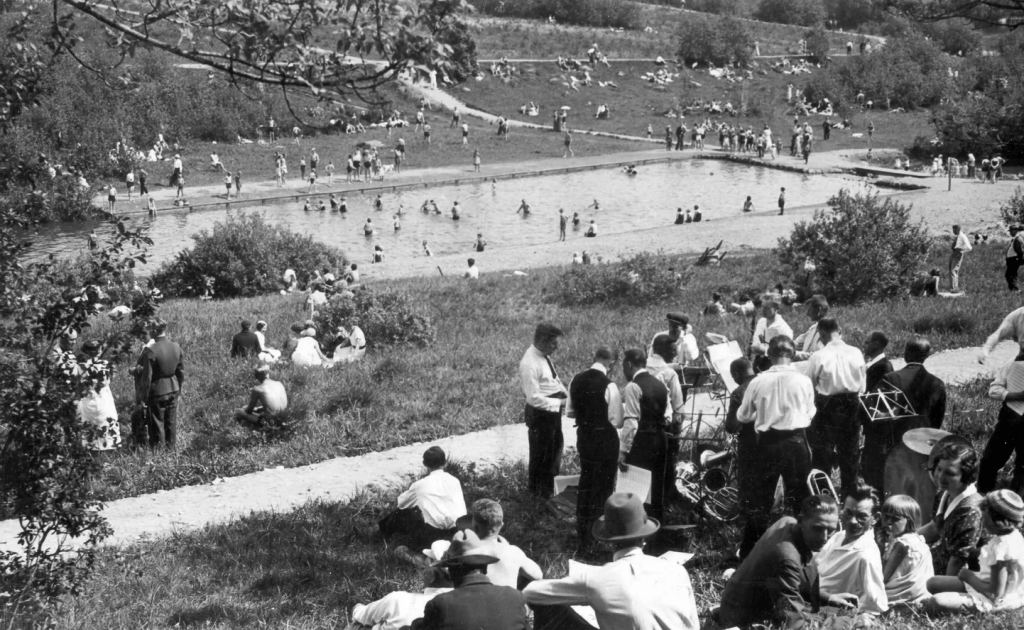
Those were the days. Viljandi’s Uueveski Valley in 1930.
FOR DAYS, IF NOT A WEEK, I had been planning to meet with Heiki to talk about Uueveski org or, as I call it, Uueveski Park. To me, it’s clear that this large natural area just adjacent to the center of the town is a town park, but on maps it is merely marked as an org or valley, as if it’s such a natural place that it has not yet been fenced in and given something like an official name or status. I had written to Heiki inquiring about the origins of this place and had been told we would have to meet face to face. Such information needed to be communicated in person, he said. This meeting of the minds proved elusive. I was in Tallinn or Tartu, or just too tired. The discussion of the valley’s origins was pushed off. Then one day at the supermarket, Heiki appeared with a basket in hand. It was one of those Viljandi moments, when the person you’ve been planning to see appears effortlessly, as if by magic. I had almost completely forgotten about Uueveski. There he was, ready to instruct. Heiki comes off as wily, clever. He seems to know who lived in each apartment and how they got along with their neighbors. Heiki just has a nose for these things.
In a few minutes, Heiki recounted the history of this sleepy place, which has belonged to the town for all of living memory and into which a series of swimming pools were built back in the 1930s. At that time, Viljandi Lake was a less attractive swimming hole, as it was full of pasture run-off. The pools on the stream that feeds Viljandi’s least known waterbody, Kösti Lake, were clean and cool and more appealing. There are photos of Viljandiers in old-time swimsuits having a wonderful time. These days it’s rare to see someone taking a dip in the pools, some of which have been renovated, but I have been told that vipers like to sun themselves on the stream’s banks. Each time I walk around those pools, I keep an eye out for those vipers.
When I first lived in Viljandi, some 15 years ago, I never visited Uueveski. I’m not sure why. Maybe because my children were small and I was a house husband. Viljandi to me at that time seemed like the Castle Ruins, the Green House Cafe, and maybe the Statoil on the way into town. There was no Uku shopping center then, there was no Kodukohvik, and there was definitely no Asia Billa Nepalese restaurant. During the pandemic, Uueveski Valley became a close refuge for me. It’s a shady, peaceful place. Many times I have found myself standing on one side of that bubbling stream, which they call the “Uueveski River,” wondering if it would be possible to cross it. There are some places where it seems possible, where the rocks are aligned in an almost perfect bridge. Yet I never attempt it. When I was a boy, I would have done it many times by now, but I lack that childhood bravery I once had. One of these days though I am going to try to traverse the stream, even if I get wet. Even if everyone here sees.
On the other side of the stream, closer to the Forest Cemetery, or Metsakalmistu, there’s a series of large villas that bring to mind the chalets of the French or Swiss Alps. For this reason, I have nicknamed this neighborhood “Little Switzerland.” I have no idea who lives in these palatial residences. Sometimes I see little blond children bouncing on trampolines from a far distance. These must be Swiss children, I think. Their fathers and mothers are involved in money laundering. For breakfast, bowls of müsli. For an afternoon snack, bars of Toblerone. In the evenings, they participate in mandatory military training in the grassy hills up there.
The great green lawn in front of Viljandi’s Little Switzerland is so long it must be trimmed by a robot. One day, I went there with my daughter’s dog, who eyed the robotic lawnmower with curiosity and suspicion. Back and forth it scuttled, like some kind of metallic crab, and the dog didn’t know if it should bark and chase it or not. In the end, we just walked on to the old mill.
I wonder who lives in those large chalets. I wonder who the Uueveski Valley Swiss even are. This is a town of hairdressers, of small shop owners, of cafe cashiers. Who are these wealthy denizens of Little Switzerland? Like so much of Viljandi, their stories remain hidden behind fences, trees, curtains. Northern European anonymity creates these kinds of funny fantasies. If you don’t know who your neighbors are, or what they do, then you just have to imagine it all.
Even if the Viljandi Swiss remain apart and mysterious, there are other friends to be made in the valley. Recently, I was walking up the hillside on the other side of the park when two squirrels came bounding in my direction. In New York where I grew up we have fat and lazy, overly satisfied gray squirrels, and in Washington, where I went to college, there are even social black squirrels lounging by the park benches. But these daredevil red squirrels are a feature of the Northern European forests, with their pointy ears and frisky, energetic pace.
Spending more time in nature, I have come to see the animals here as other people. They may not speak to me in a language that I can understand, but I can communicate with them. All around Viljandi, I’ve had run-ins with foxes, for example, who sometimes pause and watch me knowingly, as if they were my guardian angels. Then there are the poor, lost little hedgehogs, who never seem to know where they are going or why. These Uueveski squirrels were busy bodies. They chased each other around the base of an enormous pine. When they saw me, the squirrels froze. For a moment there, we all blinked at each other. Then they looked back at each other as if to say, What is this stranger doing here in our forest? For the Uueveski squirrels, we’re all just intrusive strangers. In their devilish little minds, they own the place. Maybe they do.
An Estonian version of this article, translated by Triin Loide, appeared in Sakala this week.
I USED TO TAKE THE TRAIN from Albertslund to Copenhagen Central Station, or Københavns Hovedbanegård, on the line that if you took it west, led all the way out to Høje Taastrup. I remember those sleepy gray mornings staring out the windows at sad-looking greenery and gray blue shadows on the trestles and tracks. At some point they must have created a similar environment as a part of the Rail Baltica project, because just yesterday I took a train that looked just like the Danish one from Pärnu to Tartu. When the Pärnu-Tartu train stopped at Viljandi, a host of Argentinian and Chilean musicians got on. From there we traveled east to Tartu, and again I stared out of the windows into that melancholy light, listening to the gentle lullaby of a slowly rocking northern train as it mechanically glided ever forward to infinity.
I must have fallen asleep, because by the time I opened my eyes, I was westbound again, rolling across the green plains outside of Tartu City. About 25 kilometers outside of town, I disembarked, not sure if I should just try to walk the distance, or if I should take a Bolt or even hitchhike. To my surprise, a music festival was being set up here, and there were a lot of people streaming out of the train and ambling down the steps to the dirt paths that led to a small country village. Celeste had even come with her children, although these “children” looked more like dolls. There she was, eyeing me with her blue eyes in small portions, while she combed the hair of her doll children. She was wearing a light blue summertime dress.
The dress seemed to blend into the sky with its clouds behind her.
At the center of the village, there was a church, just like all of the old churches that you can find out in the countryside. Inside, the pews were already filling up. There were two other priests waiting at the doorway. One of them looked like Pope Leo. He said, “Which one of us wants to be the first to start hearing confessions?” I volunteered and made my way down the aisle to the confession booth as everyone watched. It occurred to me that I wasn’t wearing a cassock or any other item that would represent the priesthood and that I didn’t even have a cross on my body and that I wasn’t quite sure if Jesus was the son of God, as they said. The Holy Trinity was a mystery to me still, but when Pope Leo commands, what else is there to do? Then, crossing myself in a brief moment of religious courtesy, I opened the door and went in.


 north!