SOMETIMES HELSINKI looks a lot like Long Island. I was heading to Kamppi, the impressive gray and gleaming shopping center in the middle of the Finnish capital, but I missed my tram and had to hitchhike. I scored a ride with an older gentleman who wore one of those sugarloaf pilgrim’s hats that were so fashionable in the 17th century, with the proud gold buckle, and shoulder-length greasy hair. During the entire ride, I never saw his face. Not one time. An adolescent boy or girl sat in the passenger’s side seat up front. I never saw his or her face either. It could have been a boy, because the blonde hair was cut so short, but there was something so sleight about the frame that suggested the passenger was a girl with short hair.
Like Mia Farrow in Rosemary’s Baby.
“Where can I take you?” the pilgrim man said in a Finnish accent. I told him I was trying to get to Kamppi. “Fair enough.” We drove along a rural road, making a turn that looked too much like the intersection of North Country Road, 25A, and Bennetts Road, near the Bagel Express and CVS Pharmacy (there used to be a Merrill Lynch on this corner, in an old house, but it was bulldozed long ago in the name of progress). The sky was a swirling, glowing psychedelic pink.
We made the left and the pilgrim Finn asked where he should leave me. None of the terrain looked anything like Helsinki. On one side, there were old farms, on the other side, a thick and tangled forest. I got out by the forest, thanked the driver, and began to search for my entry into the Kamppi shopping center. I came upon a series of white Scandinavian-style wooden houses here, and I went into one, thinking that Kamppi must just be on the other side of these houses. The house turned out to be some kind of preschool that wasn’t in session. It was tidy and all of the furniture had been fashioned out of wood. Hearts and horses had been carved into the cabinets and doors, and there were blankets draped across chairs that had been knitted in the traditional Swedish way. A strange place, and though there were multiple levels of the house, none of the doors led to Kamppi and, as I discovered, there was no way out.
I heard a rustling downstairs, then a whistling. One of the preschool teachers had apparently entered. Maybe this was one of those Swedish preschools in Helsinki. A daghemmet. But what would they do with a strange American if they found him snooping around a preschool for the Finlandsvenska? Surely, I would be publicly shamed or lugged off to prison. The cover of Iltalehti. “Hobo arrested.” I decided to hide myself in one of the cabinets. Before I did, I noticed there was a bowl full of shiny yellow delicious apples, ripe and ready. I took one of the golden apples, bit into it, and hid myself away, all while listening to the footsteps as they came closer.
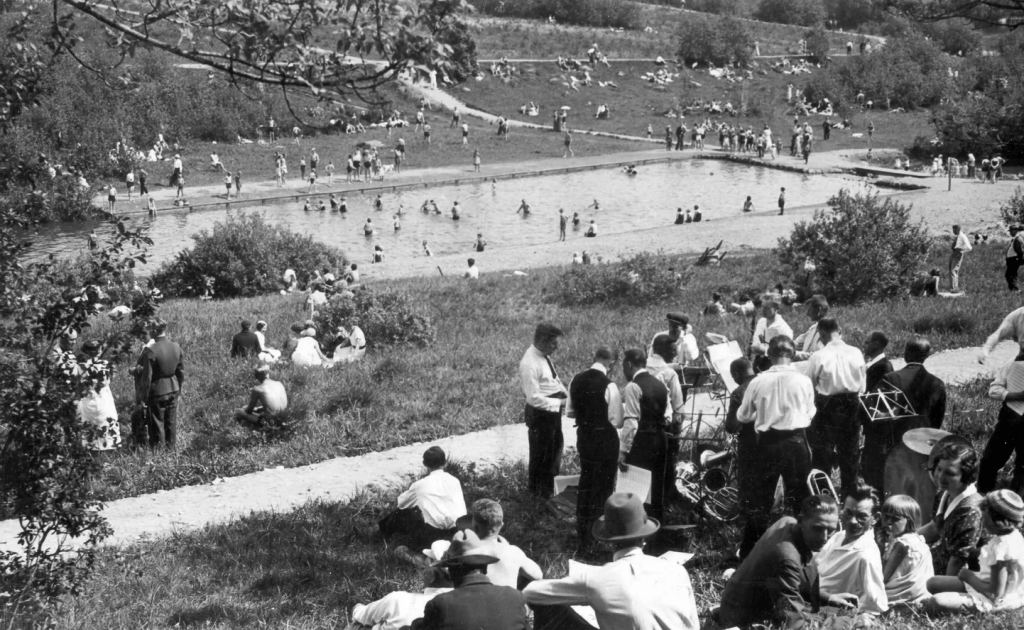
Those were the days. Viljandi’s Uueveski Valley in 1930.
FOR DAYS, IF NOT A WEEK, I had been planning to meet with Heiki to talk about Uueveski org or, as I call it, Uueveski Park. To me, it’s clear that this large natural area just adjacent to the center of the town is a town park, but on maps it is merely marked as an org or valley, as if it’s such a natural place that it has not yet been fenced in and given something like an official name or status. I had written to Heiki inquiring about the origins of this place and had been told we would have to meet face to face. Such information needed to be communicated in person, he said. This meeting of the minds proved elusive. I was in Tallinn or Tartu, or just too tired. The discussion of the valley’s origins was pushed off. Then one day at the supermarket, Heiki appeared with a basket in hand. It was one of those Viljandi moments, when the person you’ve been planning to see appears effortlessly, as if by magic. I had almost completely forgotten about Uueveski. There he was, ready to instruct. Heiki comes off as wily, clever. He seems to know who lived in each apartment and how they got along with their neighbors. Heiki just has a nose for these things.
In a few minutes, Heiki recounted the history of this sleepy place, which has belonged to the town for all of living memory and into which a series of swimming pools were built back in the 1930s. At that time, Viljandi Lake was a less attractive swimming hole, as it was full of pasture run-off. The pools on the stream that feeds Viljandi’s least known waterbody, Kösti Lake, were clean and cool and more appealing. There are photos of Viljandiers in old-time swimsuits having a wonderful time. These days it’s rare to see someone taking a dip in the pools, some of which have been renovated, but I have been told that vipers like to sun themselves on the stream’s banks. Each time I walk around those pools, I keep an eye out for those vipers.
When I first lived in Viljandi, some 15 years ago, I never visited Uueveski. I’m not sure why. Maybe because my children were small and I was a house husband. Viljandi to me at that time seemed like the Castle Ruins, the Green House Cafe, and maybe the Statoil on the way into town. There was no Uku shopping center then, there was no Kodukohvik, and there was definitely no Asia Billa Nepalese restaurant. During the pandemic, Uueveski Valley became a close refuge for me. It’s a shady, peaceful place. Many times I have found myself standing on one side of that bubbling stream, which they call the “Uueveski River,” wondering if it would be possible to cross it. There are some places where it seems possible, where the rocks are aligned in an almost perfect bridge. Yet I never attempt it. When I was a boy, I would have done it many times by now, but I lack that childhood bravery I once had. One of these days though I am going to try to traverse the stream, even if I get wet. Even if everyone here sees.
On the other side of the stream, closer to the Forest Cemetery, or Metsakalmistu, there’s a series of large villas that bring to mind the chalets of the French or Swiss Alps. For this reason, I have nicknamed this neighborhood “Little Switzerland.” I have no idea who lives in these palatial residences. Sometimes I see little blond children bouncing on trampolines from a far distance. These must be Swiss children, I think. Their fathers and mothers are involved in money laundering. For breakfast, bowls of müsli. For an afternoon snack, bars of Toblerone. In the evenings, they participate in mandatory military training in the grassy hills up there.
The great green lawn in front of Viljandi’s Little Switzerland is so long it must be trimmed by a robot. One day, I went there with my daughter’s dog, who eyed the robotic lawnmower with curiosity and suspicion. Back and forth it scuttled, like some kind of metallic crab, and the dog didn’t know if it should bark and chase it or not. In the end, we just walked on to the old mill.
I wonder who lives in those large chalets. I wonder who the Uueveski Valley Swiss even are. This is a town of hairdressers, of small shop owners, of cafe cashiers. Who are these wealthy denizens of Little Switzerland? Like so much of Viljandi, their stories remain hidden behind fences, trees, curtains. Northern European anonymity creates these kinds of funny fantasies. If you don’t know who your neighbors are, or what they do, then you just have to imagine it all.
Even if the Viljandi Swiss remain apart and mysterious, there are other friends to be made in the valley. Recently, I was walking up the hillside on the other side of the park when two squirrels came bounding in my direction. In New York where I grew up we have fat and lazy, overly satisfied gray squirrels, and in Washington, where I went to college, there are even social black squirrels lounging by the park benches. But these daredevil red squirrels are a feature of the Northern European forests, with their pointy ears and frisky, energetic pace.
Spending more time in nature, I have come to see the animals here as other people. They may not speak to me in a language that I can understand, but I can communicate with them. All around Viljandi, I’ve had run-ins with foxes, for example, who sometimes pause and watch me knowingly, as if they were my guardian angels. Then there are the poor, lost little hedgehogs, who never seem to know where they are going or why. These Uueveski squirrels were busy bodies. They chased each other around the base of an enormous pine. When they saw me, the squirrels froze. For a moment there, we all blinked at each other. Then they looked back at each other as if to say, What is this stranger doing here in our forest? For the Uueveski squirrels, we’re all just intrusive strangers. In their devilish little minds, they own the place. Maybe they do.
An Estonian version of this article, translated by Triin Loide, appeared in Sakala this week.

 north!