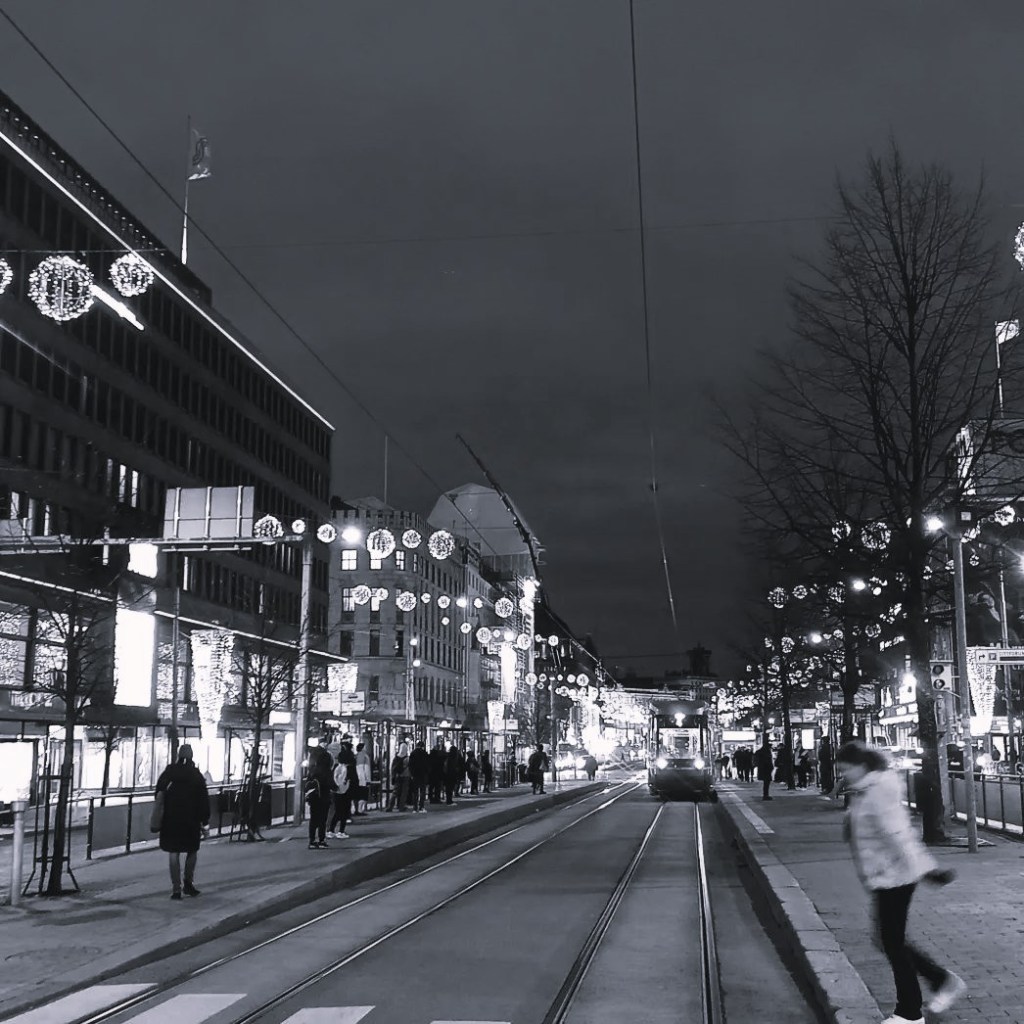
with bourdain and my new helsinki friends

BEFORE I MET BOURDAIN, I used to live somewhere else. Where exactly that was is not important to this story. Okay, it was in Estonia. But for various reasons I had to leave that country. That was when I hightailed it across the Gulf of Finland on the Tallink Megastar, and walked down into my new adopted home of Helsinki. That same night I met Bourdain at a burger restaurant on Lönnrotinkatu. I immediately fell in with Bourdain and his crew of Finnish degenerates. Gutter punks. Motorcycle gang rejects. Venture capitalists and angel investors. Tony always rolls with his crew, you see. Even if he hates people, even if he detests them, Bourdain needs to surround himself with a circus. Most of my free nights after that were spent right there in that madcap company, with Bourdain and my new Helsinki friends. 

***

Obviously, there is a problem with this story. Bourdain is dead, so they say. He hung himself in some provincial French town a few years ago. His last known meal was a Choucroute Garnie dish, which contained sauerkraut, sausages, and roasted ham. They said Bourdain was in low spirits when he took his own life. He hated his celebrity, his fame, and his relationships were struggling, especially one with a younger Italian actress who shall not be named. All of which is very true. However, if you hate everyone in your life and your life itself, there is actually no reason to commit suicide. Bourdain did not need to hang himself to get away from these pressures. He just needed to disappear to a place where nobody cares if you’re alive or dead. Helsinki, the capital of Finland. Bourdain recalled a newspaper story about an accountant named Otto Nieminen, aged 64, who had died at his desk in his office from a heart attack and had been left sitting there for days because nobody could tell if he was alive or dead. Nieminen was in the same position as always. That, Bourdain thought, is where I need to be.

*** 

If you have ever read Bourdain’s memoir Kitchen Confidential, you know that when Bourdain was young he worked in Provincetown, the bohemian enclave at the tip of Massachusetts’ Cape Cod. You may also recall that some rival chefs in 1970s Provincetown had affected an 18th century buccaneer swagger, and that Bourdain watched them with elements of terror and awe. This was exactly the new persona Bourdain took on with his new Helsinki friends at the burger restaurant. He even kept a colorful parrot, called Papukaija, or Papu for short, who would sit peacefully on Bourdain’s shoulder while he fed it crumbs of Gruyere cheese from his pocket. Then he would announce, in a pirate captain voice, “Seppo, Pasi, me thinks we should go to the A-Plus Karaoke Bar tonight and set us up with some buxom wenches. And fetch me my rum!”

Bourdain and his Helsinki friends had numerous scrapes with the law. Such as that time that they punched out an R-Kioski cashier because he put too much mustard on the kabanossi. Another cashier who worked at Aleppa was tarred, feathered, and forced to drink Lapin Kulta. All because the karjalanpiirakka or Karelian pies were a little undercooked. The Finnish police came around the burger joint on Lönnrotinkatu that night. I was seated with my favorite chef, a young Finnish woman who wore a t-shirt that read, “count orgasms, not calories.” I was having the double burger when they questioned me, while Bourdain fed Papu some fries with pesto aioli. But when it came down to it, I lied. I felt uncomfortable about Bourdain and his Finnish convenience store ultraviolence antics, but I valued our new-born friendship even more. When you are in with Bourdain’s gang, you’re in. There is no turning back.

***

This is all just background information, because what I am about to tell you might seem a little unbelievable. You might even be shocked. Even though Bourdain was hiding in plain sight in Helsinki, a cold city where he was free to indulge all of the sinister elements of his dark side, he was still Bourdain, of course, which meant he loved to eat. Often, we would go to Mr. Lee’s Great Wall Kitchen across from the A-Plus Karaoke Bar, enjoying hot bowls of beef or chicken noodles, heavy on the chili. Bourdain swore by the broth, claiming it to be as rich and satisfying as the homemade stuff he had tasted in villages along the Yellow River. Whenever Bourdain tasted the broth, he would start quoting Lao-tzu and rambling on about Wu-Wei. “When your body is not aligned, the inner power will not come. When you are not tranquil within, your mind will not be well ordered.” And so on and so on, etc.

There was a little TV on in the corner of Mr. Lee’s and it showed an image of the surface of the Baltic Sea frothing white as the methane from the Nord Stream pipeline made its way up into the atmosphere. Swedish investigators had concluded that the explosions were caused by sabotage, the report said, but they did not name the perpetrators.

Bourdain watched the news report quietly, spearing out some noodles with a pair of chopsticks. He sucked the noodles down and licked his lips. Then he said to me, in a very quiet voice. “Do you remember a few weeks ago when Pasi and Seppo and I went on that booze cruise to Mariehamn in the Åland Islands with Henna and her girlfriends?” 

“Yes, of course,” I told him. 

“Well,” he said. “The thing is, we didn’t actually go to the Åland Islands.”

“Really? Where did you go?” 

“Actually, we went to Bornholm, that island in Denmark. Then we took a boat out into the Baltic Sea and blew up the Nord Stream pipeline.”

***

It was just Bourdain, Pasi, and Seppo that carried out the mission, as far as I understand it. They put on their diving gear, synchronized watches, swam down, and laid the explosives. By the time they were detonated, they were back in bed with Henna & Co. at a quaint B&B.

“But why did you synchronize watches?” I asked Bourdain.

“That’s what you do when you blow shit up.”

I stared at the TV, then back at the world-famous undead chef.

“I must admit, I am a little hurt,” I said.

“Hurt? It’s not like you were benefiting from those pipelines.”

“No, no. It’s just. I thought I was one of your new Helsinki friends.”

“That’s why I am telling you this! Do you think I told anyone else?”

“Then how come you didn’t take me along!”

“Have you ever blown up a pipeline before, kid?”

“No.”

“Well, I have. At least now I have,” Tony said. He pinched his nose. I suppose it all bothered him, just a little bit. The faked death, the escape to Helsinki, and now this, international espionage and acts of terrorism. No matter where he went in this world, Bourdain just couldn’t stay out of trouble. If there was a red button, he pushed it. If there was a hot sausage, he ate it. If there was an explosive, then he dove to the bottom of the sea and nestled it nicely alongside concrete-coated steel pipes. Bourdain reached into his pocket with his gnarled chef’s hands and pulled out a few crumbs of savory Kaltbach. Papu the parrot dipped his head down and Bourdain fed him some of the cheese. Then Papu did something unexpected. He hopped on my shoulder. I could feel his claws and adjusted to the weight of the bird. 

“He’s warming to you. Papu doesn’t just sit on anybody’s shoulders. You have to be in the gang, be one of Tony Bourdain’s Helsinki Wild Ones.”

I said nothing but beamed with pride.

“Here, here, feed him some of the Kaltbach.”

“I thought Papu only ate Gruyere.”

“Papu’s like me. He’ll eat anything.” 

I held my hand up and Papu pecked at the chunks of Kaltbach.

“Tell you what,” said Bourdain. “I’m sorry we didn’t invite you. Next time we blow up a Russian gas pipeline, I’ll make sure you come along. They have other pipelines, you know. We’re planning a Turkish holiday.”

“Okay, okay,” I said. “It’s nothing really.” I smiled at Bourdain then, and he gave me a weird look. Bourdain doesn’t like being smiled at, you know. He hates people, detests them really, and honestly only likes parrots and food and vintage horror movies. And karaoke sometimes.

“Why are you looking at me like that? Are you happy I blew it up?”

“I don’t care about the pipeline, Tony. I’m just happy you’re still alive.”

the game of hockey

AFTER SHE HAD finally purged her life of her husband, Céleste invited me over. I wasn’t surprised they had gone their separate ways, but Céleste had often spoken lovingly of Georges, a man of business, a man of ideas, a man she could depend on. It was a relationship consecrated in a cathedral, celebrated at a manor, formalized with the necessary paperwork.

They also had a child.

Then, just like that, in a matter of eighteen months or so, there had been a crumbling, a dissolution, a reversing of the course. Everything she loved about Georges she now despised. She disliked the way he drove, especially. I wasn’t sure if infidelity was involved. I never dared to ask, but I had my suspicions. If anything, Georges was more married to Pierre on his hockey team than he was to his wife Céleste. As soon as she had banished him from the home, she invited me over to dinner. I went there accordingly. I had no idea what to wear or to expect.

When I arrived at their house, the door was open. I knocked and rang the bell and when no one answered, I went in. I could hear that someone was in the shower downstairs, and then Céleste’s mother came out from the kitchen, holding little Antoine in her arms. She invited me in, and I saw that Georges was very much still in the house, eating dinner together with Pierre. They said they were both going to play ice hockey, and then asked if I’d like to come along.

Naturally, I thought they were plotting to kill me. Georges must have known there was something going on between me and Céleste. Perhaps he had even read our erotically charged letters? Or seen some of the photos she had sent in her more vulnerable, early morning moments? I studied him as he walked toward the rink. He was no doubt regarded as handsome, I thought but at the same time, a rather stale, dry kind of character, the kind who breezes through life into positions of power, even ascends to the presidency, or who collects great wealth, but in person is rather a bore. Such a character is the very epitome of manhood by all metrics, yet lacks anything that would distinguish him as a man. The only thing that defined Georges was his love for hockey. He knew statistics associated with all of the players. He played hockey. He watched hockey. He was hockey. During that solemn walk, I did not dare mention his failed marriage, but the man never mentioned it. Instead he spoke of the game with Pierre, and they recalled with great accuracy different plays from the season. His only lament was a sore shoulder that was taking too much time to heal. I suggested he take some time to recuperate. Georges sneered at me as if I knew nothing and said one word: “Never.”

I left the two players at the rink and walked back to the house for my dinner with Céleste. The evening had just begun and yet had already taken a strange turn. Even the trees down the boulevard looked sinister. In a nearby park, a man tossed some breadcrumbs to some pigeons.

At the house, Céleste was waiting for me. She had put on a red dress, and draped herself in a white shawl. Her blonde hair was pulled back. She held a glass of red wine before her and stared at it in contemplation. I knew she wanted something from me, but did she want it all, and tonight? The grandmother had apparently left, and Antoine was sitting in his high chair.

“Well,” said Céleste. “At least you came.”

Dinner was nice. Afterward, she told me she wanted to show me the cellar. We came down an iron staircase to a series of underground rooms, full of antiques, magazines, and a plush bed in the corner beneath a ground floor window, through which shone some early evening sun. The child held to its mother. When she set him down on the ground, he started to scream.

“Please kiss me now,” said Céleste. I obliged and kissed her. She fumbled with my pants, grasping at my underwear. “Now I want you to make love to me,” she said. “Would you?”

Of course I said yes. “Please do it. Here, like this. Take me from behind.” I complied. Antoine kept sobbing. Then, from outside the window, I could see a shadowy figure approaching us.

“Don’t stop, ” Céleste said. “Whatever you do, do not stop.” “I am not stopping,” I told her. 

The figure put his face to the window and began to speak through it in hurried French. 

It was Georges! He had returned to the house to fetch a hockey stick. That was all he said. Céleste put her face up to the window and began to pelt him with obscenities. I tried to make myself invisible, but this was impossible. How do you make yourself invisible when you are servicing another man’s wife in a messy basement with a screaming child on the floor? I was wrapped up tight, deep inside the lady of the house. There was no way back or out of this thing. “Céleste, please come to your senses,” I heard Georges say through the small window.

“No, I want you to watch,” Céleste responded. “I want you to watch this all, Georges. This is how I feel now. This is exactly how I feel about you, and us, and about the game of hockey.”

honey

IT WAS SUMMER and splendidly hot. The white tower of the town hall looked like one of those old colonial administrative buildings in the Danish West Indies. If you’ve ever heard that old Muddy Waters tune, “Good Morning Little School Girl,” then you have heard this story. But I actually didn’t know she was a school girl, I swear. I thought she looked interesting. In retrospect, the skirt should have tipped me off. It looked like it had been stitched together from old curtains. And then the worn red blouse, the messy blonde hair. She was not one of those bank clerks. She was holding something in her hands too, bearing it in front of her, but whatever it was, I couldn’t see. I decided to follow her but to keep my distance, as if I just happened to be headed in the same direction. If she looked back, I could inspect a hedge, or stroke the little dog of a passerby. Pretend to be a legitimate pedestrian. She walked through the park and then down Hollow Street. At one of the old houses, she paused to chat with a young man who was sipping his coffee in the doorway. She laughed at his joke. Then she came up Trench Street and arrived to the intersection with the main road. It was here that I caught up to her. I felt guilty for following her. I should have just glanced her and let her go. Yet she waited for me there. It was as if she had known I had been following her. We stood there and she looked forward and then turned and cleared her throat, but said nothing. Instead, she showed me what was in her hands. A small container enclosing a honeycomb. “Would you like some of my honey?” the girl asked. She had such a pleasant air, and I said, “Of course, I’ll have some of your honey.” She smiled at me and pulled a dripping hunk from the container and handed it over. She took a separate chunk and slipped it in her mouth. “It is good, isn’t it?” said the girl. A touch of golden honey was on her lips. From the crest of the hill looking down the road, I could see the lake in the distance. I could see the beach and the pines. “It is,” I said. The youth said nothing and we crossed the street. The wind blew and toyed with her sunshine hair. It was that kind of day. Disarming. Innocent. Bluesy. Honeysweet.

tüütumaa park

I HAD TO GO to the airport to pick up a daughter flying in from Brussels (and there was panic about whether or not she was even on the plane). While at the gate, I was pacing in worry when she called out to me, “Dad. Dad! I’m right over here. God, what an idiot.” Then we had to go back home. All of Europe was arrayed in Scandinavian-style apartment blocks. You know those big yellow brick buildings you see in Stockholm, or Copenhagen especially. “Estonia” was merely at the end of one particularly long boulevard. It was dark and it was raining. When I got home, my woman friend was gone. She had come to see me but I had to leave her alone to attend to my family needs. Apparently, she didn’t have the patience to spend all day, leafing through old magazines. She had worn a special dress for me, but where was I? At the airport? She didn’t even bother to say goodbye. Not even a message. When I inquired after my female guest my other daughter said, “You mean the one with the breast implants?” “Breast implants? I thought they were real. When did she get breast implants?” I was not convinced about the fake breasts. But I also didn’t want to ask. They were fine, firm, very believable breasts anyway. Organic. I understood then that my other daughter was just trying to downgrade her in my mind. It was all about attention, you see. These daughters of mine, they wanted my attention. Another female interloper was just a drag on the attention stock. She needed to be pushed out of the picture. They sure were crafty. The next morning I had to go out with Morris for a meeting at a startup company on the other side of town. It was somehow impossible to get to this place on foot. I looked at the map. It said it was located in “Tüütumaa Park.” The river flowed straight toward the park, and we decided to commandeer a small vessel. It was this ramshackle wooden thing, leaking, but still seaworthy. The waterways were full of great sea lions, walruses, elephant seals. They floated by, big furry masses of dopey fish-feeding mammals. “There must be sharks in these waters,” I told Morris. “Where there are seals, there are sharks. I don’t like it one bit.” The water was incredibly clear, but I saw no great whites or hammerheads. They had to be down there somewhere. It was just so troublesome to get all the way down to Tüütumaa. Why were we even going? To visit another software company? Excuse me, ICT. Who cared anymore anyways? I really hoped that they had a food court down there. Maybe a coffee house that roasted its own beans. Something to make the trip worthwhile.

the traffic incident

AN ODD DREAM, involving a) driving through a city while Ukrainians and Russians shoot at each other, with bullets visible as almost lightning bug-like glowing orbs of light; b) somehow surviving this unscathed; c) driving a car down an icy road to escape a rather ferocious musk ox-like creature; d) parking my car in a field to allow another vehicle to pass; e) from which exits Woman No. 1, who informs me that it is illegal to park your car in a field in Estonia, and that she has to wait for the police to arrive; f) following Woman No. 1 into her office, the entry way of which is littered with shoes, while we await the arrival of the police; and g) passing through a kitchen, wherein a Sicilian dwarf is making dinner. I try to summon romantic feelings for Woman No. 1, but it comes to nothing. An ice queen, business type, her only vice is apparently the impartial and ruthless enforcement of the law. The relationship is never consummated.

pelé and ophelia

OPHELIA TURNED UP again. Just when I thought I was in a safe place, and I would never have to deal with her hands on hips and domineering personality and she had at last dissipated into the periphery of of my waking awareness, she came bounding into my apartment with her new boyfriend, a Brazilian football star who looked like a young Pelé, clad in his soccer shorts and socks, kicking a ball all around my living room. They demanded food at once and so I started making them dinner, slices of fried halloumi, cuts of plump tomatoes, platters of Greek olives, my usual fare. Ophelia put her legs up on my table and complained loudly that I did not seem happy to see her, and Pelé kept kicking his ball against the wall.

They opened the door and windows too and left them open, so that soon the room was quite cold. At one point, while frying some breaded eggplants, I attempted to engage Pelé in a friendly football exchange, but Ophelia intervened. “Don’t even try. Go back to cooking. You know you’ll never be the man that he is. It’s pathetic.”

Alas, such was my fate, to cook food for this woman, who gave her sex to some aloof Brazilian football star instead. After they ate, they left, and I was on my own. I cleaned up the dishes and put on an old song by the Canadian group, The Guess Who, called “No Time,” and went to sleep in a bundle of world weariness and misery. Who was she to treat me that way? And why did she have to bring Pelé along? To rub salt in the wounds of my heart?

Then one day, a month or two later, I was walking along the coastal road when I encountered beautiful Ophelia again. She was less imperious this time around, and actually seemed happy to see me. I let down my guard and told her that I knew how to fly. “Show me,” she said, with her gold hair dancing in the sea wind. It wasn’t easy, it never is, but with the right degree of concentration, I began to lift off the ground.

She wrapped her arms around me, and up we went into the sky. From the air, we could see the entire coastline, and all of the birds that shared it with us. When we landed, a man showed up with two small children. He was not Pelé. I guess they had broken up. This was a Welsh footballer. This, as I understood it, this man was the father of her children. They were headed to a picnic down the beach. “If you want, you can join us,” said Ophelia. I declined the offer, though I did consider it a second. Better to leave others to their stories. Better to leave old dreams alone.

misplaced toys

I WAS BACK IN ICELAND, in Reykjavik, of course. Erland was with me, as was Musi, and we decided to go to Sundhöllin to enjoy the hot baths. But none of my cards worked at the counter, and Erland and Musi went in without me. I decided to prowl around the harbor instead, walking by the old fishing cottages. I came across a warehouse that was full of wooden fishing boats and nets and decided to take a photo of it and send it back to Christa on the West Coast to remind her of the island and its history. Then I retired to my room on Freyjugata. There, in the early hours, I awoke to the sound of a small child playing on the floor beside me. Just playing with some blocks and sighing because he was so lonesome. Later, I got up and went out into the hallway. It was full of beautifully wrapped packages, and my neighbor’s apartment door was ajar. From inside, I could hear the sounds of a birthday party and I could hear my neighbor’s laughter. How disappointing, I thought, not to be invited. I glanced out the door into the street and happened to see a beautiful Icelandic girl with red hair painting her house. I watched each time as she bent over to wet her paint brush, and really marveled at her superb backside. What a lovely sight. Then I went back into my apartment to look for the lonely child I had seen before, but he had disappeared. Even his toys had vanished.

the black anchor

ONE NIGHT I DREAMT about a black anchor. It had been cast into the sea, in a place where the surf was calm, the water was clear, and the sand crystal white. There it stayed, at the bottom of the water, clear to the naked eye from the surface through the transparent ocean glisten, clean of all mollusks and other maritime creatures, well-forged iron, but a secret, for only I knew about it. Then once day I tried to conceal the anchor, and dove down into the waters, just a few meters, and tried to place a cinder block on top of it, and cover it up with sands. The Red Queen had arrived and sought transport to another isle, and I took her, even though I loathed the very sight of her but, as you know, I have an unfortunate weakness for arrogant, self-possessed women. We made it past the anchor and thankfully she never once looked down. At the isle, we parted ways, and I went into a cantina, where I met with Anouk and some other people I knew from the town. Anouk made some comment about me going bald and I was insulted, so I left the cantina and started to wander back down to the port along a dirt road. Ophelia came walking in the other direction and stopped me. She was in her black dress and seemed to be quite fine, girlish even. Her curly hair was loose around her shoulders. She held in her hands my journals, with the pages covered with notes about her. I was dismayed, shocked even, to see my mad ramblings held out into the light like that, and even more worried about what she would think of me if she was to read all of them. I felt bad for having written them, perhaps for having written anything at all.

everglades

I KNEW I WAS living in a place much like Colombia or the Everglades, a jungle setting, but I also knew someone had to take my daughter to Tallinn Airport. And then there was the problem that a business associate had buried a body under the brick terrace in the yard the night before and we were expected to dispose of the corpse on the way to the airport. I protested. “I am not driving all the way to the airport with my daughter in the car, and some sandy dead guy in the back seat!”

Fair enough. My father took the child to the airport, and we stayed behind to figure out what to do with the body. This was a scary, crime-ridden area we were in, made up of shanty houses built into the sides of the jungle hills. I remember that old reggae record, “Two Sevens Clash” by Culture, was playing from a PA system somewhere. A gunfight broke out at one point between two young women who lived at the top of the hill. And a local police detective started snooping around, and inquiring about “the man in the gray shirt,” ie. me. I was wearing my gray Greenport longsleeve.

So I needed to get out of there and started to fly away. Nobody believed me, that I could fly on my own, just via my powers of concentration, but I willed myself upwards, and soon enough I was floating over the Everglades and heading toward the west coast of the US, which didn’t seem so far away when I was up there in the sky. My plan was to make it to the piers in San Francisco and send a photo back to my accomplices in the jungles to show it was possible, but I only made it to San Diego and San Francisco proved elusive. I could barely make out the gleaming Transamerica Pyramid through the depressing smog of Los Angeles.

I settled for the beachfront in San Diego. I tried to find my way to the beach, but this was harder than it seemed. I went around a house, but the path led me into a thicket. The water here was ankle deep and warm, and someone had put shoes and riding helmets into the sand, to protect against erosion, I suppose. I still couldn’t make it to the ocean, though I could hear those big waves in the distance. I saw a deck, climbed up, and went into the house. This turned out to be someone’s home. Two little girls ran across the corridor, and cried, “Daddy, there’s a strange man in the house!” A man came out of the kitchen, your typical SoCal surfer type, with blond hair, muscles, etc. “Sorry,” I told him. “I got lost looking for the beach.” “No problem, dude!” the surfer man replied cheerfully in the local ‘hang ten, cowabunga’ vernacular. “It happens.”

I went out into the street. It was getting evening, and the restaurants and bistros of the Gaslamp were filling up. Haze filled the avenues and I at last felt tired and didn’t know what would happen next.

a bus full of books

I HAD TO GO TO PORTUGAL to pick up some books. The address was somewhere between Porto and Povoa de Varzim. It was a seaside street, ruled by proud white castles of houses. Matteo, of all people, answered the door and we shook hands. Then someone else, another Milanese writer, told me I should relocate to Portugal and that the beach here was “just full of people like us,” in other words other Italians. But I had to drive back to Estonia, I told them. Business demanded it.

On the other side of the street there was a canal, and some local yogis were filling it up with birthday cake. Channels of cake, cream, different kinds of colorful toppings, so that it almost resembled a floating chocolate garden. They were hanging decorations above the canal, too, in preparation for a major street festival. But I was expected back in Tallinn within days with a shipment of books, and so set out shortly after toward Madrid. When I got to Barcelona, I parked my car and went for a walk. On one back street, I passed an aerobics class in session. I could see Linnéa inside stretching. “You can stay and watch me,” she mouthed to me through the glass. “I don’t mind at all.” As she stretched, I caught sight of her undergarments. There was just something about the pattern of the lace on her skin, the way her golden braids dangled down her back. I decided to curl up right there, outside the window glass, and sit beside her as she stretched.

Later, a door opened and I watched Linnéa and the others file out of the class. A Catalan nurse had come to administer fresh COVID-19 booster shots. I remained at a distance, though I could see the tiny glass vials of the Pfizer vaccine piling up. I didn’t want anyone to know of my secret affection for Linnéa. An old colleague happened to turn up and we started to talk about people we had known from our days in New York. Good old Jankauskas! I told him about the bus full of books and the long ride in from Portugal. Jankauskas asked me the books and I told him all about them. You should have seen his eyes as I relayed their plot twists and turns, their heroes and villains. Jankauskas said it sounded like a lot of good reads.