
It begins with …
PIE IN THE SKY, gauzy cotton carpets, glides the plane toward Riga, the sun shining on its golden wing tip. In some places the clouds pile up like sand, mountains, valleys, crevasses, river deltas, a whole air world stacked on top of the land world. The self is a similar sort of shell game. Now you see it, poof! The Gulf of Riga, container ships slowly chugging somewhere with their cargo.

Upon arrival …
Kranj, Slovenia. #47 on this street or ulica is colored squash yellow, pumpkin orange, old chain-linked fences, weathered stones and concrete, pedestrian murmurings, grape vines, ivy vines, alpine balconies, a trumpet playing somewhere, a bicycle cycling something, whirrish whir displacing air. #16 on another ulica is painted hope-pink. Lekarna is a pharmacy and jaune santiarije is a public toilet, and ne must mean no, because that’s what a woman keeps saying to her dog.
Outside the bookstore, the sellers are smoking and sipping wine and saying something like koushka and Naked Lunch costs 16 euros inside, and outside a building under construction and covered in scaffolding a worker is yelling out “Matjas!” Later, the receptionist at the hotel informs me that the word I heard was kučki, which means two small dogs in Slovene, and prosim is please, of course, of course, a kuža is just a doggie, like the Estonian kutsu.
The next morning…

I DON’T KNOW what to say about Ljubljana, I have trouble spelling and saying the name. Slovenia has Mediterranean elements, Alpine elements, South Slavic elements. I like the way the language looks on signs and billboards and theater posters. In a funny way, it reminds me of Lithuanian, only because of the length and special characters (these languages are far removed). (Vzgojiteljica is ‘kindergarten teacher’).
Reading some genetic studies of the Slovenes, conveniently featured on their Wikipedia page, I learned that they are closer to Czechs than to “real” South Slavs, like Bulgarians and Macedonians. The language? I know nothing. Prosim (please, thank you) gets you everywhere in Slavic land, and “Cheers” is the familiar na zdravje… I forget at times what a vast hunk of Europe is populated by Slavs of all flavors, the Poles, the Slovenes, the Croatians, the Slovaks, the Bosnians, the Serbs, the Ukrainians, and then those more niche groups, like the Ruthenians. Or were the Ruthenians the Ukrainians? Try the Rum Raisin Slavs, the Butterscotch Pecan Slavs, while you’re at it. They’re out there somewhere, inhabiting some valley …
Bear in mind, at times people are just as at a loss when it comes to the Estonians, so they can be forgiven when it comes to distinguishing all of these cultures and subcultures. It takes time to study up on Slovenia.
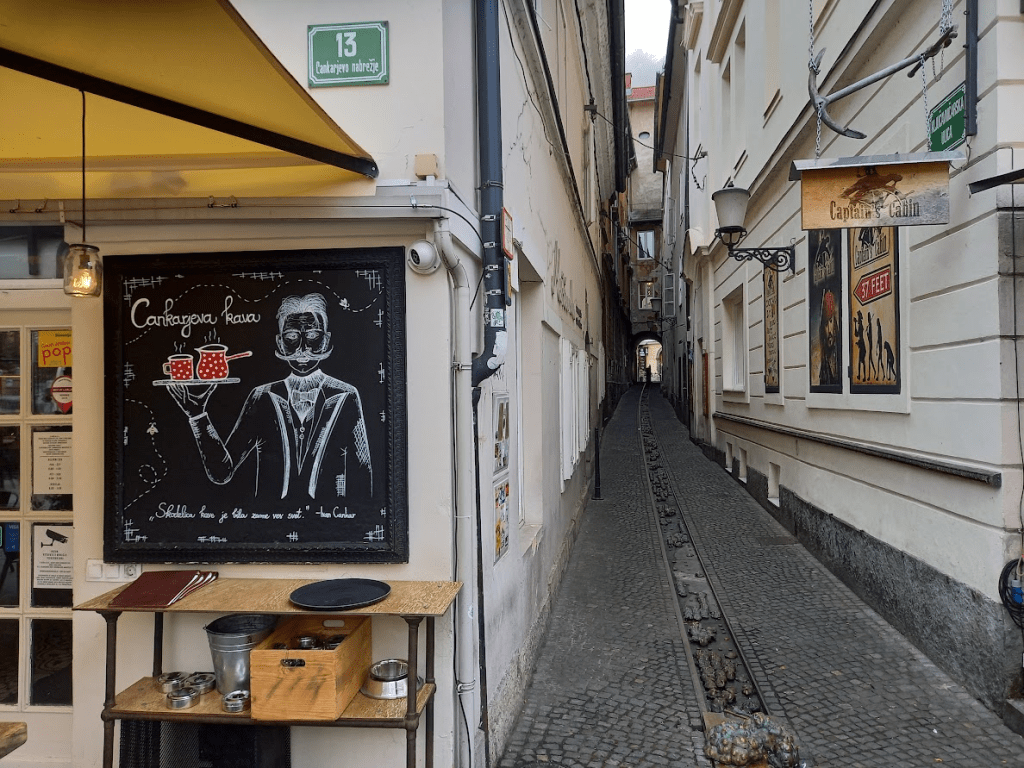
ANYWAY, this is a lively city. People are outside in the evening, riding bikes, strolling, talking loudly. It’s by population smaller than Tallinn, but even on its finest summer days, Tallinn just isn’t as lively. People just seem to pour into restaurants and out of supermarkets. A lot of Slovenians are tall, even taller than me, and there is a subset of the guys with really frizzy, nappy hair, which they grow out, so that they look like Thulsa Doom’s henchmen from Conan the Barbarian. Some of them cut it short and ride around on electric scooters wearing puffy black vests or jackets. The Slovenian girls are ranging in packs and talking loudly. Their jackets are also puffy.
How funny that for them, Ljubljana is the world, and they are having modern day street romances by the dozen, and breaking up, and someone is dating someone in Kranj, or someone moved to … where do Slovenes even move to? Probably Vienna. Yes. They split up, and she moved to Vienna for work. Broke his heart in two. All of this drama taking place in this foggy basin, people made born and lived, day by day in Slovenia, and the world shuffles by, barely taking notice.
The hotels (I’ve been spoiled) have retained some continental grace. Very Grand Budapest Hotel, the concierge is overly eager to help. In Estonia, they are too busy texting their friends, or just don’t want to make eye contact at all. There’s no, “Yes, sir,” “Anything else. sir?” Estonia could use a little more Monsieur Gustave H, I think. But who am I to judge?
***
Who was I when I was here 23 years ago? Am I still him at all? What has become of all that? Well, there’s no need to dwell on it. Yesterday went into yesterday, like krill into the belly of a baleen whale, and I don’t recall it all, nor should I.
***

THE LAST TIME I was in Slovenia, it was ’02. A lot of time has elapsed since then, but it doesn’t feel so far away. It hasn’t yet taken on the glow of nostalgia. I didn’t have a phone then, and nobody really knew where I was, although my father said he could track my movements according to the bank statements that were mailed home. It wasn’t a big issue.
I did have a journal with me, so somewhere in my closet, buried underneath all of my other journals*, I can find out more or less what happened, but since I have not retrieved these memories since about that time, I only have some recollections of the bus station, the hotel, some cool-looking teenagers sitting in a park, the church, the river, and not making it up the hill to the castle (which repeated again this time, as I did not hike all the way up. Maybe it will take 23 more years to get there?) And of course the trip to the caves, which are called jama in Slovenian, which means crap or bullshit in Estonian. But that’s about it. Maybe some more will resurface. I was only 23 years old the first time.
Enough about that. In Slovenia, when you walk into a shop, the shopkeepers will often greet you with “dan,” which means, “day,” as in “good day,” dober dan. I was thinking that if your name happened to be Dan, this would be a good city to live in, because every time you went to the supermarket or popped into the bookstore, the sellers would address you personally. “Dan!” Or imagine the unsuspecting Dan who ventured into Slovenia, only to hear strangers saying his name to each other. He walks into the bookstore, but all the girls keep saying his name, or maybe he thinks he’s hearing things. Onset schizophrenia.
“Dan,” they all whisper. “Dan, dan, dan!”

ON A SATURDAY NIGHT, Ljubljana was fairly lively into the late hours, though most boutiques and stores closed their doors by 9 pm. I wonder about these pretty faces through the windows, the Slovenian yuppie set, who do they work for, where do they get their nice sweaters? Some clubs remained open, and I heard all kinds of fun music from the speakers, including Dr. Dre and Snoop Dogg’s “Deep Cover,” followed by some vintage Michael Jackson (pre-Off the Wall, maybe Jackson 5?) and then Tom Jones’ rendition of “Burning Down the House,” followed by Lipps Inc.’s 1980 hit “Funky Town.” A guitar player was singing “Creep” by Radiohead but he couldn’t hit those Thom Yorke high notes.
There were also decent restaurants open late, serving fried seafood, Indian curries, and kebab, which is what you need if you want to get some deep sleep. In the earlier part of the evening, I attended a traveling Flemish production of Medea’s Children with Slovenian subtitles. I think I understood a few phrases in Flemish (their expression for “please,” alsjeblieft, is the same as it is in Dutch) but Slovenian was impenetrable. It looked like a cat had run across the keyboard. (Where are you from is od kod prihajaš? and thank you is hvala!) I was reminded of the fake “Eastern European” language from Ingmar Bergman’s 1963 film The Silence (where the Estonian word for hand, käsi is taught by the concierge to the little Swedish boy in the hotel).

And then he writes…
Oh, the melancholy sorrow of the pretty youths and sorrow over missing my own pretty youth, long gone and burned away, but can it be resurrected, just like the actress cries on demand for the camera, her cheeks wet and so sincere, the tenderness of lovely youth, and afterwards an after party of salami, prosciutto, Slovenian theatre life, as if I ever knew what I was doing ever.
The next day

SLOVENIA HAS MIXED/uncomfortable feelings about its southern neighbors, let’s call them that. Someone asked a friend something in Serbo-Croatian, which was taught to all Yugoslav school children prior to 1991 as a common state language. Old-school nationalism, everyone in a single geographic box, speaking the same language, believing in common myths that link their heritage with a mystery genetic component (it’s in our blood) while rooting for certain football teams, praying for Olympic glory, and engaging in armed border conflicts in cultural gray zones, seems antiquated and kind of silly. Yet this was the solution to the imperial collapses of 1914. Come feel the nationalism!
The same Ottoman Empire that once ruled over much of the southern Balkans also ruled over what is now called Israel and Palestine. But up here, this was all Austro-Hungary, Ljubljana is thus a provincial capital of the late Austro-Hungarian Empire. It’s odd, I think, that nobody is trying to resuscitate this particular empire these days. The Russians are still crying about theirs and “their ancient land” but the Austrians are, well, I am not sure what they are up to. Maybe bodybuilding. Or skiing. Maybe their beer is just better and so they have fewer complaints.
And just like that, it’s over …

AFTER LEAVING the mountains around Slovenia and Austria, ‘Europe’ is one big dusty plain of farms, roads, and shiny grain silos, and the occasional large settlement.
This rolls straight up into southern Latvia where things get woodsier north of the Daugava river, and Estonia is even more swampy and green. Also the road, farms, town pattern is less observable, in Estonia it looks like some giant sneezed and the houses went all over. A very dispersed settlement.
That river is the Jägala, I think. Do you know that in the reign of Ivan the Terrible, the Russians also tried to conquer this region? But that they lost and badly? And that even then the Swedes and Poles supported the governments in Estonia and Livonia because they didn’t want Ivan as a neighbor?
Some things never change.
- A compilation of journal entries (in italics) and Facebook-Instagram posts from a recent trip to Slovenia.
- Later, I uncovered my journal from ’02, only to discover I was mostly focused on creative projects and my relationship when I was in Slovenia, and barely wrote about the trip at all.
 north!