
MY FIRST IMPRESSION is one of disorientation. I see faces emerging from the crowd, legs, arms, red lips. There are white headscarves, blue and red caps folded down on one side, the black-brimmed hats of the men’s costumes and all kinds of expressions, from the moody and pouting looks of the teenage girls in their traditional regalia to the yellow crooked-toothed grins of old men who need assistance walking. There are lines everywhere here. Lines of ladies moving like migratory birds in unison toward some far-off goal, be it an assembly point or a staging area. Some of them are in line for the toilets, hundreds maybe, others are in line for ice cream. Lines line the stadium steps, take their positions on the fields, and then form ornate and intricate shapes that one can only appreciate by watching the enormous stadium screen.
This is Kalevi Central Stadium in Tallinn, Estonia, on a brisk and windy Thursday evening in early July. Built in 1955, the stadium is said to accommodate 12,000 people, but looking in every direction, I have no way of determining how many people are really here at the Iseoma Song and Dance Festival. I try to do some quick calculations — I count about 100 people, and then trying to guess how many people might be here all together, but then I abandon this task completely. All I can say is that there are a lot of people here, many people. At one end of the stadium, beyond a grove of trees, I find myself inside a tent city of dancers. A man in a black robe, the kuub of the southern Estonian Mulks, is helping a young blonde woman get into her dress beside a tree. Her arms are up in the air and he’s tugging away on her belt. The woman doesn’t look comfortable, but I suppose that such sacrifices are necessary for the nation.
The wind flows over the crowds, chasing away any remaining heat and humidity. Near the podium at the front of the stadium, guitarist Andre Maaker is pacing anxiously with a guitar. I try to make a joke about all the nuns at the event, nodding to the white headscarves, but Maaker is in no mood for jokes. Singer Kelly Vask is standing nearby in a traditional dress waiting. A moment later, I see why, as they take the stage to perform the national anthem.
For me, Maaker’s compositions will turn out to be the most memorable of the dance festival. First there is one called “Lööme Loojanguni Lokku” (composed with Laura Võigemast) and then “Iseoma” which he helped Jaan Pehk arrange. The melodies of these songs are so sweet and so soft that they stick to me like sugar. There are no bold crescendos to them. There is no drama. Everything is just so nice and so tore. This is the Estonian word. Yes, everything is so tore that I almost start crying and I don’t know why. All night long, as I try to sleep off the first night of the festival in a friend’s Mustamäe apartment, I hear the verses of “Lööme Loojanguni Lokku” and feel a profound shift is underway, as if the stars have reached down and pulled me up into the euphoria of the cosmos. I think most people feel like this at the song and dance festival.
A world of delicate music
IN THE MORNING, I take the Number 84 bus back into the city center, sharing the ride with a group of dancers in Seto costume who have been sleeping 10 or 20 to a room in the Tallinna Saksa Gümnaasium. Once, when I was staying at the Sai Baba ashram in India, I happened to spend a few nights in an all-male dormitory that consisted of hundreds of bunk beds arranged in a gym. These beds were filled with Sai Baba devotees from all over the world, in whom I took an almost anthropological interest. One of them, an older Italian man, had discovered his guru through a leaflet, which claimed Sai Baba was the embodiment of god. “If he claims to be god, who am I to argue?” the old Italian told me. Another devotee, a comedian from New Jersey, carried miniature figurines of Hanuman and Ganesha and would worship them every morning. He was counting on these gods to help him with his career in show business. At night, the Indian dormitory was a curious place. Hungarian devotees would have nightmares and start screaming in Hungarian. While watching the dancers in Seto costumes on the bus, I can’t help but wonder if their experiences have been similar. Do the Seto men start yelling in Seto in their sleep? Have there been intriguing conversations about Peko, the thunder god?
I spend most of the day in the warm sun of the rahvamuusikapidu, or the National Music Festival, on Freedom Square, pondering such things while being serenaded by youths playing the violin, kannel, bagpipe, and karmoška. Again, the music is so soft and so sweet that I feel that familiar stirring sensation. Watching the young women strum their kannels, I wonder about their inner worlds too. I wonder what they dream about. How do they feel? What are the desires that they have hidden away behind this pleasant music? This is the only world that they have ever known, a world of EU-subsidized highways, of bountiful supermarkets, a world of choirs, ensembles, and festivals. Their lives are lived from event to event, from rehearsal to rehearsal. There’s no time for worry or existential questions in this world. Theirs is a world of delicate music, where there are no loud voices, no shouting, no despair, no angst, no ennui. The life of the lovely kannel player seems gentle, patient, even kind.
In the evening, I am back at the Kalevi stadium for the final performance of the dance festival. One of my friends is a dance enthusiast and has been vigorously documenting her dance group on social media. But trying to find her or anyone at the dance festival is impossible. Every woman has blonde hair done up in braids just like she does. They are all wearing those kinds of tights and those colored skirts that she wears. They all look like the Estonian dolls they sell in the airport souvenir shops, though I would never tell her she looks like that. Then, out of the corner of my eye, I see her flit by, with a big, beautiful smile on her face. She looks happy, happier than I’ve seen her in months. I worry it’s a happiness that can’t be sustained.
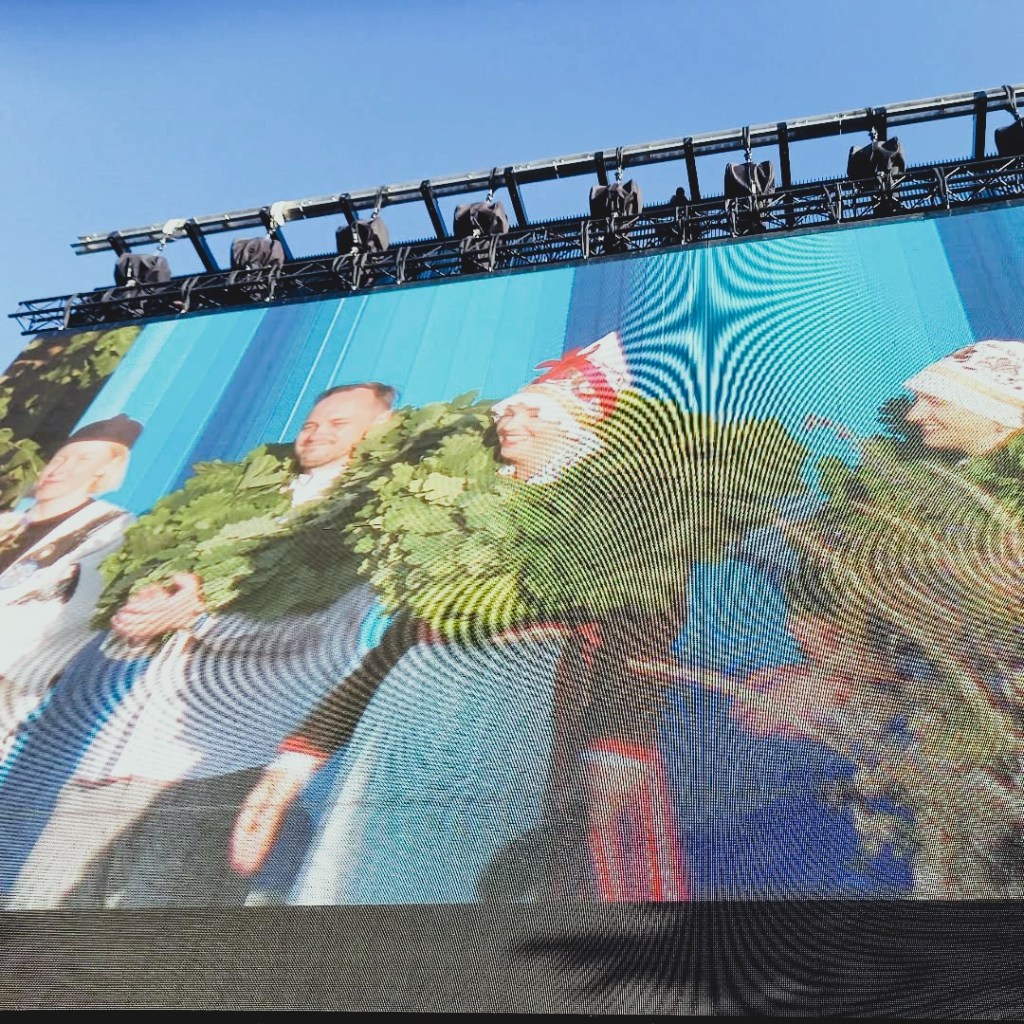
On the stage, there is a closing ceremony, and women and men in traditional garb ascend a steep staircase to be recognized for their contributions to the festival. The air is brisk, cool, calming. The sun is just peaking through the clouds over the distant skyline of the city. Behind the stage, there are stacks of what I think are evergreen Christmas wreaths, but these turn out to be made of oak leaves! Each person recognized has the oak wreath or tammepärg placed around his or her neck, so that soon it starts to look as if a whole forest of oaks is up on stage.
“But why do you use oak leaves?” I ask a woman behind the stage. “Because the oak is a very powerful tree,” she says, with an almost mystical glint in her eyes. I wonder about who creates the oak wreaths, where the branches are cut from and what becomes of them. Maybe someone mounts them on the wall of their sauna, to be revered for all time, or maybe they just wind up where everything else winds up in Estonia, as kindling for a fire in the furnace?
Soon our guitarist friend Maaker is also on stage with a wreath of oak leaves around his neck. When I ask him about the experience, he confirms that it was most pleasant. “Those oak wreaths just smell wonderful,” Maaker says. “And everyone at the dance festival was smiling.”
A rainy parade
I SPEND THE SECOND NIGHT of the festival in another friend’s apartment downtown. He’s just moved in and there is no furniture there, so my bed is a camping mattress, a sleeping bag, and a weak pillow. In the middle of the night, I hear people yelling and imagine that my friend is fighting with the police in the next room. I wait for the Estonian police to wake me up and interrogate me, but when I am at last roused from my sleep by the sound of a trumpet player somewhere nearby playing the national anthem at daybreak, I realize everything must have been taking place in the parking lot instead. My friend has in the meantime made a pot of coffee and when I ask him about the police, he says that he has no idea what I’m on about. “That’s just what life is like in Tallinn,” he says. “There are always people yelling at night.”
Tallinn life is a little bit different during the festival. My friend’s apartment is across from the Tallinna 21. Kool. At 10 am, there is a group of men in traditional black hats or kaabud and knickers seated around in front, like extras from the 2019 film Truth and Justice. I walk between these austere characters and enter the school to have a look around. In its atrium, about a hundred children are sitting and standing and sipping from juice boxes. On the second floor, the suitcases are piled up by the windows. Down the hall, I am greeted by a woman in a red headdress or tanu from Pärnumaa. Their group comes from Audru, she says, which isn’t too far from where my children’s grandmother was born. I have a complicated relationship with the Estonians. I am not one of them, nor do I wish to be, but my children are them. So we are relatives of a kind. Inside a classroom, I ask the dancers what it’s like to sleep in a school.
But you can forget any stories about loud nightmares. These people are tightknit and are used to each other’s company. They only respond with, “Noh, täitsa tore oli.” “Well, it was nice.”
The rongkäik or parade is tore, too, but it’s a challenge. One needs stamina, strength to march in this parade. Sheets of rain fall on us all along the route. The poncho I have brought along is quickly soaked, as are my pants. My hair is a wet mess, my skin is cold and damp. My journals are wet, the ink runs in places. My friend and I take refuge in Viru Keskus where I order a hot plate of Uzbek plov. My friend is not the kind of person who cries easily, or expresses any emotion without a joke or healthy skepticism. When you have lived as much as we have, those gentle, peaceful, fluttering kannel-music like moments are few and fleeting. But he admits that he can’t get through a rongkäik without shedding at least some tears. We’ve both been in Estonia for what feels like forever and talk about when Swedbank was Hansapank and when there was no Viru Keskus. Most changes are welcome, but we’re also worried that the Song and Dance Festival will eventually become a cultural attraction, where tourists buy up all the tickets and Estonians are only able to watch it at home. He considers that businesses might start sponsoring these events, so that one day there will be a Prisma, Rimi, or A. Le Coq Choir.
We agree that the festivals are an occasion for social renewal. All societies are made up of such tiny, bite-sized building blocks, like village choirs or dance groups, and of these smaller pieces, more elaborate superstructures are created. The festivals are necessary for society to function. They bond people together and the bonds created must last until the next festival. We hope that Tallinn never becomes another Venice or Barcelona, overrun by Jezz Bezos and other mindless tourists. It’s true that neither of us is Estonian. But we do have Estonian kids. We do worry for them.
The main event
IT’S A LONG MISTY WALK through Kadriorg to get to the song festival on Saturday. I take the Number 1 tram and then cross bridges and climb steps, eventually passing the Japanese Garden and exiting through a parking lot across from the Song Festival Grounds. When a person is caught up in those dense crowds, it becomes hard to construct a timeline of what happens. Even my journals become a mess of discombobulated, half-written entries, jotted down in spare moments and out of order. One thing I do see is a blonde, middle-aged woman running through the food area crying out, “Police! Police! Does anyone know where the police are?” Having seen some guards nearby, I point her in their direction. In chatting with some officers later, I find out that the number one issue they have to contend with is lost children. There’s even a pickup point where as many as 10 children might sit waiting for a parent to retrieve them. One wonders what life is like for the children in this makeshift “kindergarten.”
The police also have to deal with the occasional unruly attendee who has decided to “pregame” for the festival and either gotten drunk at home or hidden a flask of vodka in his underpants. (There is no alcohol on sale at the event). “It’s a shame,” one of the police tells me. “There are some who do not see this festival as a holy event, but as an opportunity to drink.”
The singing is here, but the singing and the songs are only a part of the experience. Yes, we have all come to hear these songs, to sing along, but the festival is also about the circus city that springs up around the stage, or the troupes of children in wet ponchos stumbling across the wet grass, following the instructions of some stern teacher who has commanded them here to participate in this grand event, or the meandering conversations in the press tent where French and Finnish journalists rub elbows and munch on free ice cream. There’s a lot to this thing, much more than any agile camera work or grinning selfie can ever do justice to.
After being drenched by rain for a day and a half, the appearance of the sun toward the end of the concert on Sunday does seem like a small miracle. Then come the best-known songs, “Tuljak,” which is conducted by choirmaster Triin Koch, and “Ta Lendab Mesipuu Poole,” which is conducted by composer Hirvo Surva. These musical personalities are treated with such reverence that every one of their moves is observed with an awesome curiosity. It’s almost like watching Wimbledon. Every flick of the wrist, every nod of the head is somehow meaningful. The conductors look as if they are holding back a mighty wave with the power of their hands.
What is it like to stand up there? I wonder. And how does one feel at the end? Neeme Järvi, the grand old conductor, now aged 88, knows this feeling well. His movements are tight, precise, controlled, but at the end, in a moment of triumph, Neeme Järvi topples over. From the back of the Song Festival Grounds, the Üldala, or general area, no one knows if he has just slipped or if really, being so caught up in the music, Järvi decided that this was his final day and he was going to go out with a cymbal crash. Throughout the entirety of the festival area, there is only silence and concern. This was obviously not planned. Is he alive? Has he died? What kind of festival even is this? But then we see that Neeme Järvi is alive and well and he jokes to the crowd as they chant, “Elagu! Elagu! Elagu!” Which means something like, “Long may you live!”
It is the final festival miracle.
The morning after
AND NOW IT’S THE MORNING of the day after. But when did this day even begin? When the light of the day is nearly seamless and the last people go home after the summer light returns, isn’t it hard to find a line between the two? After the festival, I have trouble sleeping. I awake at three and then five and then eight. I can hear the cries of the gulls and the muddle of downtown life at dawn. Like life, the trams creak back to work, back to normality. Even though my arms and legs are sore from standing for days, and my mouth is dry, my hair is greasy, there’s goop in my eyes, and I’m still wearing yesterday’s shirt, my other clothes piled up on the floor, my socks kicked across the room, the light of the new day is unrelenting. Even when I can’t bring myself to get up, and the euphoria of the festival is still pulsing in my blood, I get back on my feet, because the sunlight won’t leave me alone and life does move onward. Just as I do as I make my way to the Must Puudel cafe in the Old Town where I order a coffee and breakfast, first thing. Hungry city birds are perched, ready to peck at any discarded crumb.
After breakfast I go for a walk to stretch my legs, muddle through this new, post-festival reality that I have awakened to. Some tired singers are lounging in the sun of the Town Hall Square. Who knows when, or if, they ever went to sleep. On nearby Lai Street, I find a lillepärg or crown of flowers lying on the ground. Someone must have left it here in the early morning. I wonder who the woman was who left this flower crown here. I wonder what this crown has seen. By tomorrow, all of its petals will be dry, I think. By tomorrow, the festival will just be a memory.
An Estonian-language version of this piece was published online on 13 July 2025 in the magazine Edasi.
 north!
“Mesipuu” was conducted by Surva, just mentioning ☺️
See, and I wrote that down in my rain-splattered notebook as it was happening, and still got it wrong. Thanks, I updated it.