The presses were already rolling and the eight-column headlines said HELL’S ANGELS GANG RAPE. The Masons haven’t had that kind of publicity since the eighteenth century, when Casanova was climbing through windows and giving the brotherhood a bad name. Perhaps the Angels will follow the Freemasons into bourgeois senility, but by then some other group will be making outrage headlines: a Hovercraft gang, or some once-bland fraternal group tooling up even now for what the future might force on them.
What is the trend in Kiwanis? There are rumors in Oakland of a new militancy in that outfit, a radical ferment that could drastically alter the club’s image. In the drift and flux of these times it is easy enough to foresee a Sunday morning ten or twenty years hence when a group of middle-aged men wearing dark blazers with Hell’s Angels crests on the pockets will be pacing their mortgaged living-rooms and muttering sadly at a headline saying: KIWANIS GANG RAPE: FOUR HELD, OTHERS FLEE, RING LEADERS SOUGHT.
From Hell’s Angels by Hunter S. Thompson, published by Random House in 1966.
MY GRANDMOTHER’S NAME is Annabelle and she lives at 192 Lowell Lane in Northport Village on Long Island in the State of New York, United States of America, Western Hemisphere, the World. It’s a two-story shingled house with some lawn in the front and in the back. And Grandma lives there. That’s right, she’s 90 years old and she lives there. Other than my other grandmother, Peg, who is 96 and doesn’t remember who I am anymore, Grandma is the oldest living person I know.
Her mother Genevieve was the oldest person I have ever met in my life, period, meaning that she was the one who was born longest ago. Genevieve also lived at Grandma’s for a time, or so I remember. There was a room upstairs that was called “Great Grandma’s Room,” and it was about the size of a closet. To the right was Joe’s room and to the left was the bathroom and Bob’s room.
Joe and Bob were my uncles, but they did not like to be called “Uncle Joe” and “Uncle Bob” because they were in their twenties and “Uncle” sounded so serious, and they were a couple of happening young guys. So they were “just Joe” and “just Bob.” There was a pull-up bar in the doorway to Great Grandma’s room too. I am not sure if that was there when Great Grandma was alive. But that’s how mysterious Grandma’s House was. Each room held more questions, more personalities. There were Great Grandma, Joe, and Bob. And that was just on the second floor.
Genevieve was really old, in fact that’s all I can remember about her. I remember blue eyes and light hair. I was very small then and hearing about God in church, and somehow this really old lady and God got crisscrossed in my mind. Was Genevieve the same age as God, or even older than him?
Did she know him?
Genevieve knew her grandmother, Catherine, who was from Ireland and born in December 1839. It says so on the 1900 US Census, which is a document only true nerds and antisocial people bother to look at. Catherine came over on a ship. Later she ran a cotton brokerage on Water Street in Lower Manhattan. She kept scrapbooks for fun and Grandma Ann still has these keepsakes buried somewhere in her house. In the scrapbooks there were cut-out cartoons of an old strip called “The Katzenjammer Kids,” which the online encyclopedia Wikipedia tells me debuted in 1897 in William Randolph Hearst’s The New York Journal. Here is a picture of that old cartoon.
Rudolph Dirks’ The Katzenjammer Kids (1901)
Catherine died the year my grandmother was born. 1924. It was a long time ago. But her scrapbooks survive. Grandma showed them to me once or twice in her kitchen. They were thick old books with images of Victorian angels and newspaper clippings and pictures of flowers. Grandma’s house was full of these ancient treasures. It seemed like every thing in that place belonged to some long-forgotten time and had a story about how it had come into her possession. And Grandma was never forthcoming about the provenance of these goods. When I would ask her questions, she would squint just a tiny bit, with a telling sparkle in her blue eyes, as if she was on the witness stand or something. There was a lot more to all of these back stories and she only gave part of the answer.
Or so I imagined it.
***
I think Grandma was born in Queens – Forest Hills, I once thought I heard her say. I have driven through there a few times, but never noticed any forest or any hills. I saw a lot of apartment buildings though. I know Grandma is from New York City because of her manner of speaking. And yet she does not have the nasal New York accent that every gangster speaks with in the movies. She has this refined, slow, steady, transatlantic thing, like those old recordings of FDR’s Fireside Chats. There was no ‘r’ – it was ‘ahhh.’ “Father” was “Fah-thah” – and it is quite charming to hear her speak like this. I wish I could even imitate it, but it seems like only Grandma can speak that special way.
Grandma’s brothers spoke like that. Uncle Frank speaks like that too, and so does Aunt Doris.
Grandma had a lot of brothers. She was the only girl. She once told me how she wanted to wear “slacks,” which is what most of us call pants these days, or if we are feeling a little funny, trousers. But Great Grandma Genevieve just couldn’t bear to see her only daughter dressed in “slacks.” Her only daughter had to wear skirts or dresses. I think Great Grandma relented though, because I have seen pictures of Grandma wearing “slacks” and I think she wears her beloved “slacks” most days.
She also told me once that I had to be careful. How once when she was a little girl she was ice skating with other children in the city and one other little girl was abducted by a bad man. I am not sure if I remember this correctly, but when I think of Grandma as a little girl, I always imagine her on that rink. I’ve seen a picture of her when she was very young. It is black and white and blurry, but you can make out the light brown bangs and light eyes. It reminds me of our daughter Maria.
That makes me happy.
I can’t imagine what it was like for Grandma growing up in a house with all of those boys. In no particular order, there was Ken, Bob, John, Joe, Freddy, and Frank. Frank is the one I always forget. Of the gang, I knew Ken and John better and Joe the absolute best. I should spend just a little time on her brother Joe, because it was almost always at Grandma’s House that I saw Uncle Joe, or as she called him, “Father Joe.” He was a round, stocky man with a ruddy face and bright blue eyes, what I would later learn were common Irish features so that whenever I met an old man later in life who looked a bit like Father Joe, you could bet your life that his last name was McCarthy or O’Driscoll.
Father Joe once told me that they used to go swimming off Brooklyn and Queens when they were children, and that the water was very clean then. This is another imaginary memory I have of Grandma’s childhood, of them all in those old-fashioned swimming trunks swimming in Brooklyn.
When I was small, I didn’t even understand that “Father Joe” was a relative though. And why was he called “Father” if he was nobody’s father? To make things odder, he always seemed to show up at Christmas … just like “Father Christmas.” He would sit before the fireplace at Grandma’s House and hand out gifts. “Ah, yes, I see that this box says Ryan on it,” he would say and hand it over. Little cousin Ryan was so happy with his toy train. We were all so happy to be in the presence of this great “Father Joe.” Later, I was informed that our personal Santa Claus was actually Grandma’s brother. They called him “Father Joe” because he was a priest. And that portrait on the young priest with the yellow hair and the familiar blue eyes on the wall? That was Father Joe, many years ago.
But who painted the haunting portrait of Father Joe that still hangs on the wall? I just don’t know.
***
I don’t know who taught Grandma to cook, either, but whoever did thought that butter and sugar were the greatest ingredients ever created. If you drank Grandma’s lemonade, it was sweet, but not so sweet that you couldn’t stomach it – just sweet enough to make you want another glass. My cousin Brad called it something like “Meema’s Sunny Day,” and later they even named a boat the “Sunny Day,” all after Grandma’s not too sweet, extra lemony lemonade. Her pancakes were plump, textured, and delicious. They were also just a bit sweet, but tasted a thousand times better with some melted butter dripping on top that shone blue like an oil slick in the streams of dark maple syrup.
Grandma always got up very early. I swear, I would hear that radio alarm clock go off at 5 AM on some days. Or was it even earlier? Often, it was still dark out, and you would hear the sink water running. She would make herself coffee and listen to the news on the radio. The news was usually bad, but that did not slow Grandma’s bustle. The coffee was made, and soon the butter would be put to the pan to melt. Sometimes she would let the gray cat inside so that he could have breakfast, too.
The cat’s name was Mr. Snuffleupagus. “Snuffy” was a street-smart cat, and sometimes got into scuffles with other neighborhood cats. But no matter where the rough life of the Northport streets took Snuffy, he always came home for his bowl of crunchy cat food and a few pets from Grandma. Then Chloe the dog would come out from under the table sniffing good-humorously along for her food. Chloe was supposedly our dog Leroy’s sister, and they even said that Aunt Mary’s dog Brandon was Leroy’s son. Leroy and Chloe were a mix of golden retriever and black Labrador. Chloe came out all chocolate, and Leroy was black on top, with a gold belly. Leroy seemed more laid back to me, and Chloe high strung. Chloe enjoyed slurping loudly at the metal bowl of water, and Grandma pet her too, right behind the ears. Then she let Mr. Snuffleupagus back outside.
Grandma knew the eating habits of every member of our family. My mother, she said, liked to eat breakfast right away, while my Aunt Mary, she said, liked to wait a while before having her breakfast. My grandfather cut his pancakes into precise squares before eating them, a habit that Bob continued, and which I also have emulated. Once, many years after teaching me my grandfather’s pancake etiquette, Grandma noticed that I was cutting them up into squares. “You eat your pancakes just like your grandfather!” she said. I didn’t tell her that she was the one who taught me that. I wanted her to think the pancake thing was genetic. I also had a habit of spilling my food on the floor. Grandma would say that she always knew where Justin sat, because of all the crumbs.
I knew that my grandfather was dead, and that he had died somewhere in the house. I cannot tell you how I knew these things. I can’t remember anyone ever telling me about it, and yet I just knew it. Especially when I was in the downstairs bathroom, I would think about my grandfather. Was he still there? Could he see us? There was a picture of him and my grandmother on the table in her bedroom. It was black and white. Grandma’s hair was thick and appeared dark in the image. She looked very pretty. My grandfather had black hair and very big cheeks. He looked sort of like all of my male relatives on that side put together. Most of us have those big cheeks thanks to him. They flatten out over time, but only a little. Even my daughter Anna has those big fat cheeks.
Another one of Grandma’s specialties was something called “hard sauce.” This was put out at Thanksgiving and Christmas, and was some whipped-up combination of butter and whiskey, and even when I was a very small child I would dab a bit on my pumpkin pie and enjoy the steam of the whiskey coming out of my ears. I do not think that you can get drunk on hard sauce, but it always made our holidays more enjoyable. I think Great Grandma must have taught Grandma this recipe.
***
In Grandma’s kitchen, there was a big framed menu from a restaurant in Rome called “Aeneas’ Landing.” It was yellow with red lettering, as I remember it, and advertised traditional dishes, linguines, fettucines. Grandma was not an Italian but her husband was and she adored Italian culture and cuisine and even went to Italy several times. Sometimes I think Grandma wished secretly that she had been born as an Italian, but she loved Italy more than any true Italian can because of its problems. If you ask an Italian about Italy, they will complain. But Grandma never complained. Once we were watching TV and there was a sitcom on about four Italian brothers who liked eating a lot of pasta and saying “Baddabing!” to each other and stuff like that. Grandma seemed offended.
“Derogatory stereotypes,” she said and sighed to herself. “They … they are mocking Italians.”
Grandma met my grandfather at church. She told me that if it wasn’t for the Catholic Church, it would have been harder for Italian-Americans to integrate into mainstream society. In the Catholic Church many of the dark and exotic Italian men fell for the Irish and Polish girls with their blue eyes and red-blonde curls. The handsome blue-eyed men similarly seduced the olive-toned Italian ladies. This was how we wound up with cousins with names like Mary Ann and Stanley. But that didn’t matter. Cousin Mary Ann still made pignoli cookies at Christmas and we were all Italians inside. Still, it wasn’t always easy. Grandma said that all people did not look fondly upon such blonde-brown marriages. When I asked her what they did, she looked away and didn’t tell me.
Father Joe had more mixed feelings about the Italians. He was an old school type, who confided in me that he wished he had been born in the 19th century, where he could have sat around philosophizing with other intellectuals in a drawing room, smoking a pipe. When he found out that my father had some Greek heritage, Father Joe was delighted. “John, are you Greek? You never told me you were Greek!” he said. “The Greeks are a learned, cultured people. Greece is the cradle of Western Civilization. The Italians, on the other hand, pfff, are barbarians.” I think a lot of Italians would agree. There were so many Italians in New York back then, much closer to their origin country. I can imagine that it at times felt like the city had been besieged by pasta-eating invaders.
Baddabing.
***
In addition to the portrait of Father Joe that hung on the wall, there were other interesting pictures in Grandma’s House. Above the fireplace, there was a very old looking painting of the Virgin Mary and Infant Jesus. And just to the left of the fireplace, above the chair where Father Joe would sometimes sit, there was an image of a castle beside a mountain lake. Father Joe once told me a story about such a castle, perhaps in Germany, where they had found piles of gold that had been hastily dumped in a nearby lake by retreating Nazis. Father Joe had a book called Blitzkrieg in his room that was about the German advance in WWII. He seemed to know so many things, and I could listen to that old man talk. If he didn’t know something, he would hint as if he actually knew more and just didn’t want to let you in on all of his secrets. He would also encourage me in my probing and questioning, as if I was a detective or reporter. “Now you’re getting closer, now you’re getting closer,” he would say. If he strained to remember something, he would close both of his eyes tight as if in a trance, and then the memory would stir and the words would at last come to his lips.
His eyes would then reopen.
It was Grandma who actually first talked to me about World War II. Once I stayed at her house and fell ill, so she brought a book to cheer me up – children’s stories from the Second World War! There was the Italian girl who remembered seeing how her father was missing his fingernails – they had been pulled out during a police interrogation. And the little Estonian girl who was delighted whenever she had a cold, because the salt from her snot would make her unseasoned soup more savory. Food was rationed, and the real treat was a piece of bread with a teaspoon of sugar on top. Whenever anyone asks me about the first time I heard about Estonia these days, I always tell them the story about the book my grandmother gave me, and that little girl who her loved snotty soup.
***
So far I have told you about the second floor and the main floor, but I don’t think I have told you about the basement at Grandma’s House. Interesting. To get to the basement, you took a door from the kitchen, next to the rotary phone. No room in Grandma’s house was particularly bright, but the basement was the dimmest of all dims, and even when all lamps were on, there was nothing but a dull orange glow that you could make out from the top of the stairs to let you know it was safe to descend. On many Thanksgivings and Christmases my cousins and I were corralled in that basement with some light supervision from Bob or Joe. Bob preferred to slouch in the arm chair, while Joe would pace about with his hands behind his back or lie sprawled out on the old carpet, with his hands clutched on his chest. Each one of us had a nickname. My brother Ian was called “Eagen,” by Joe, Steven was “Ernest,” I was “Scooty” and Brad was “Piggly Poo” or just “Piggly.” Joe referred to us collectively as “vermin,” but with affection. “What’s up, vermin?” he would say. I did not know then what the word “vermin” meant, but Wikipedia defines it as “pests or nuisance animals, especially those that threaten human society by spreading diseases or destroying crops.”
Sometimes Uncle Steve would be there too and he would pace the floor or stand eyeing the chaos and catastrophe like an eagle. If we got too violent he would threaten us with outrageous punishments that could only make you laugh inside. “If you two don’t knock it off, I’m gonna …”
We all knew he wouldn’t do it.
I watched some interesting films down in that basement. Excalibur. The Clash of the Titans. Greystoke: the Legend of Tarzan, Lord of the Apes. These films were watched in silence, with total respect. To hear Bob say the name of the film made it impressive and gave it an awesome aura.
On the other side of the basement there was a door that led to what I assumed was a storage area. I think I only went there two times. Once, I walked in and it was full of bird houses that Bob had designed and had managed to sell through a magazine. So he was busy assembling dozens of bird houses for potential orders. Bob was a graphic designer in Manhattan, but when the catalog came out, we saw that the bird houses had been credited to a “New England architect.” To think that all of those unsuspecting buyers bought the cute bird houses thinking they were assembled in some Vermont barn by a Robert Frost type when it was just Bob in Grandma’s basement out in Northport.
Another time I walked into the backroom to discover a pool table there. My cousin Ryan was with me and he knew all about the pool table and was knocking the balls into the pockets with finesse. Aunt Mary’s kids spent more time at Grandma’s because they lived close by, and so they knew its secrets better than I ever could, and were most likely aware of the pool table the first day it arrived.
One other treasure in the basement was a mounted church text that looked as if it had been written in the Vatican in ink in the 16th century. It may have been in Latin, because I could not decipher what it said, but it had the requisite crosses and symbols. Grandma’s faith mystified me. She spoke with great knowledge about the Franciscans and Benedictines. I did not know who these bands of merry men were, but I imagined them in maroon-colored hooded robes, and that they would meet secretly under Rome to plot against each other. Later, Grandma would wear a shiny Celtic cross around her neck. As curious and labyrinthine as the Catholic faith seemed to me when I was young, Grandma’s belief in it was consistent, and I think it got her through a lot of troubled times.
***
Each summer on the first of August, there would be a party held in Grandma’s backyard. This was originally in celebration of Great Grandma’s birthday, but it continued on after she died. Many interesting characters ensconced in the shadows of Grandma’s House, some of whom were referred to by their surnames alone: The Graus, The Rupps. I had no idea what the criteria was for admittance to the annual summer party, but at least some of the attendees were relatives. We usually stuck to our own, the kids. There were great adventures in that backyard. Sometimes, we would just catch fireflies, also known as lightning bugs. You had to wait for their bio-luminescence to glow. It usually did so in a rhythm, so you had to train your vision on one corner of the yard and wait for them to light. Then you would swoop in and catch a few in your hands to keep as a short-term pet.
There were great battles in the backyard, too. The most memorable was the one when cousin Shane and cousin Conner, who were toddlers, went at it for a while. Usually, two warring children would be separated, yet we were transfixed by the primitive, brutal violence for some time.
In the front yard during those summer parties, we would play hide and seek among the thick hedges or even venture across the street to play with the neighbor girls. Sometimes I even went into their house. You could also climb up the tree that was planted right in the middle of the front yard. Once, Grandma caught me climbing up the tree and came out and told me, “Do you know, that tree was my mother’s day gift, from the first year we lived here?” I imagined it was just a sapling back then. Then it matured into a sturdy tree climbed by rambunctious grandchildren (there were so many).
And then, one day, I went to visit Grandma when I was an adult, and I noticed that the tree wasn’t there anymore. Nobody explained why, but I assumed it got sick and they decided to cut it down. Or maybe it came down in a storm. It’s just another mystery. But that was okay, because Grandma was still there, waiting for us at the front door. She had curly white hair that day and was smiling. Her Celtic cross glinted from around her neck through the glass, just like a content and joyous Irish saint.
Life,” said Emerson, “consists in what a man is thinking all day.” If that be so, then my life is nothing but a big intestine. I not only think about food all day, but I dream about it at night. But I don’t ask to go back to America, to be put in the double harness again, to work the treadmill. No, I prefer to be a poor man of Europe. God knows, I am poor enough; it only remains to be a man.
From Tropic of Cancer by Henry Miller, published in Paris by Obelisk Press in 1934.
No well-run yacht basin in Southern waters is complete without at least two sunburned, salt bleached-headed Esthonians who are waiting for a cheque from their last article. When it comes they will sail to another yacht basin and write another saga. They are happy too.
From Ernest Hemingway’s To Have and Have Not, published by Charles Scribner’s Sons in 1937.
Two Tlingit girls, Tsacotna and Natsanitna, pose for a photograph in 1903. The nose rings are common ornaments among Indians of the Northwestern tribes, jewelry being a symbol of status.
From The Encyclopedia of North American Indian Tribes by Bill Yenne, published by Arch Cape Press in 1986. The Tlingit are an Algonquian-Nadene speaking group in southern Alaska. In 1985, they numbered about 8,700.
A family in northern Italy. Many people of northern Italy are tall and fair-haired.Children of southern Italy. Many southern Italians are short, with dark hair and dark eyes.
Images taken from Life in Europe: Italy, published by The Fideler Company in 1957.
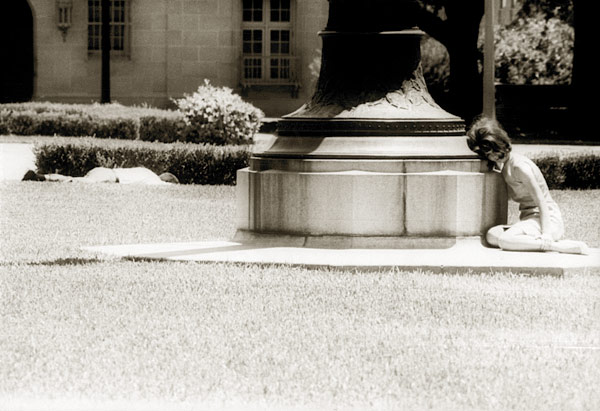
A woman cowers behind the base of a flagpole at the University of Texas at Austin on Aug. 1, 1966
The word “linn” in Estonian is translated as “city” in English, but it would be an exaggeration to call “Viljandi Linn” a city. It is more of a town, and not much of one at that, with somewhere between 15,000 and 20,000 inhabitants, depending on who is counting.
Situated in south Estonia, about two hours from Tallinn and an hour from Pärnu and Tartu, the fourth and second largest “cities” in this sparsely populated country, its main attractions are a well-preserved Old Town with colorful leaning wooden houses, a gorgeous lake view, mysterious castle ruins, and a cultural academy that attracts much of the country’s major musical and theatrical talent.
Every summer at the end of July, people from all across Estonia and many other places come to Viljandi to enjoy its annual folk music festival. It’s usually a peaceful event, and brings to mind Woodstock, with its carnival-like atmosphere and assortment of crazy characters and absurd and spontaneous happenings.
Every country has a bohemian hub like Viljandi, I guess. It’s where people who want to seek refuge from mainstream life disappear to. Women wear old-fashioned, homemade clothing, bake their own bread (when they feel like it), sit around fires in winter with their feet up against the soothing texture of wooden floors and spread village gossip while the men drink coffee or beer and make idle jokes about everything. The children play, too, with dolls or toy cars, and sometimes they strum their zithers and sing songs.
It’s about as ideal and enjoyable as life can get, but it’s only one part of Viljandi life.
Along with the cultural shakers, there is a rougher, left-behind, working-class edge to Viljandi. Just around the neighborhood where we used to live, one could hear the coarse voices of village drunks arguing behind houses and encounter bratty street kids smoking cigarettes and yelling obscenities at passersby. In my own time there, I watched a young couple graduate from high school in love, bring a baby into the world out of wedlock, and then separate. I have not seen the young woman in some time, but the last time I saw the young man, he was standing outside a liquor store drinking. So there is a ghetto-like undercurrent to Viljandi that few comment on or address, a specter of hopelessness that tiptoes right behind the folksy frivolity.
There is also atomization, an increase in the space between people, a devolution to perpetual disengagement, and this is a phenomenon that has occurred throughout Estonia, as it has around the world. Children who spend their free hours staring at screens while their parents stare at other screens chatting with other adults who stare at screens. My God. Nobody talks, nobody opens up, nobody shares what is in their hearts. Why share something personal with another person when you can satisfy your needs the way you want to with a tap of the fingers? Many nights in Viljandi I would work late at the office and walk home alongside the buildings and look up through the windows to see zombie-like young people seated in the intoxicating glow of a device.
I cannot tell you much about the school shooting that occurred this week in Viljandi beyond what you have already read in the news. I can tell you that my first instinct has been to not think about it or what it means, and to continue on with my life. We no longer live in Viljandi, which makes it a “there” even though it’s right “here,” just an hour west of where I type this in Tartu. But many of my friends are “there” and I know that they are in shock, as am I, and are probably ignoring it as well because it is so hard to process how a 15-year-old boy could walk into a school and murder a teacher.
We are shocked because we believe that it should not have happened in Viljandi, which is where people go to get away from the news, and also because we believe that it should not have happened in Estonia, which is not Finland or Norway or the US, but small and quaint, a kind of Viljandi of the world. We are also shocked because we just cannot fathom that kind of act of violence, even though it has happened again and again and again in our societies. While the Columbine shootings in 1999 seemed to announce a new era of violence in schools, these kinds of things have occurred before many times, such as at the University of Texas at Austin in 1966, when a 25-year-old man climbed to the top of a tower and shot and killed 16 people and wounded 32 before being killed himself.
The writer Hunter S. Thompson famously labeled the unrest of the 1960s as the manifestation of a second, downward half of the 20th Century. It seems today though that the trend for the 21st Century is not up again but rather the same direction. And so people moan to each other about a world circling the drain, of which the Viljandi shooting is just another dip lower toward some eventual bottom. Because if there is social movement it must be toward a bottom. Unless, of course, there is no bottom at all.
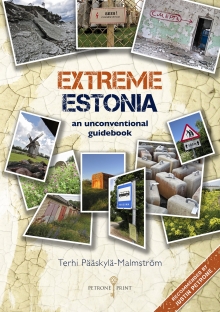
THE TERRIBLE TRUTH about the book Extreme Estonia is that I didn’t take it very seriously when it landed on my so-called desk. I was too biased, too doubtful, because the word “extreme” to me carried with it unwritten references to tattoos, piercings, snowboarding events sponsored by fast food companies, and bungee jumping.
And the pathetic thing about Estonia is that so much of it is not extreme in any way. There’s nothing particularly extreme about gazing at some fluffy white sheep under some fluffy white clouds on Saaremaa, is there, unless you happen to contract Lyme disease while doing it. Honestly, I almost fell asleep when I wrote about Saaremaa for Minu Eesti 2, because it was just such a relaxing place. But fortunately the extreme in Extreme Estonia refers more to the idea of being remote, outermost, farthest removed, and in this sense it is a very credible title for such an interesting book.
What Terhi Pääskyla-Malström does in Extreme Estonia is take readers to the extremities of this intriguing northern land. And what one learns while flipping through these 192 pages, is that there is a hell of a lot to experience up here. Sure, I have been to Haapsalu and to Narva and to Võru and to Pärnu, but I haven’t managed to get out to the Pakri Islands (and I probably never will). And given the pace of the book, the terrain covered, and the author’s wonderful sense of humor, one gets the sense that he or she has hitched a ride with Terhi and is finally going to all of those distant-feeling places, locations and settings I would bet that many Estonians have not even visited.
My favorite section of this book dealt with humorous place names in Estonia. Feel a sudden urge to visit Urge? Mustvee? Of course, we must! And why not say “I do” in Aidu? Good old Terhi! She’s a tremendously sympathetic writer. She can be honest and sarcastic at the same time, and her buoyant and informative text obliterated any doubts I had about this book. Doubt. It’s a peril that all writers face, that irritating question of who are you and why do you have any business writing a book about anything? Many readers ask authors this question, and the authors restrain themselves from answering back, “Well, if you have such doubts about my abilities, why don’t you go write a book yourself?”
But maybe Terhi doesn’t have these doubts. She seems like a courageous person, and her book inspired me to be more courageous too. Get out a bit more. See Estonia, see the world. Time to set away the laptop and trek out to that remotest, farthest removed, outermost point. And don’t forget to take along your copy of Extreme Estonia.
Independent People is also the name of a 1935 novel by Icelandic Nobel laureate Halldór Laxness. It has been sitting unread on my shelf for two years.
SEPTEMBER 1 it is and so so long to a summer of zero play dates. In New York, this was the key phrase, connoting two heavily supervised children comingling for a set period of time. “Daddy, can we have a play date?” How I rued the phrase, how it turned disgust over in my guts. When I was a kid, we never had play dates. We just got on a bike and rode away. As it is here in Estonia, where kids just come over and then they leave. Most have their own telephones and are reachable by them. I ran into my own daughter the other day on the other side of town. She was crossing the street with a friend. “Oh, hi Daddy, I’m going to so-and-so’s house,” she said. “That’s fine with me,” I said. And off they went. Just like that.
When I was in Orient, which is a little seaside village at the easternmost edge of Long Island, I did talk about my Viljandi friend Enn and his five children once in the general store, and about how Enn’s sons would climb a ladder up to the roof and then dive off onto the trampoline below. And the lady behind the counter said, “Oh, my, that does sound like Orient of yesteryear.”
I’m sure it did. I am sure that the children of decades ago played just as I played, and had those rough and tumble childhoods. Like I told my therapist, when I was a boy we would roam uncharted woods for hours in an attempt find our way back home. “It prepared you very well for this life,” she said. And hasn’t it. I’ve been lost everywhere, Helsinki, Beijing. I got lost outside the Summer Palace among the little stone shanty houses and cages of tiny yipping dogs kept for some special canine stew. And yet I’ve always found my way back home. But what of those children of today? I have wondered. Will they be able to find their way anywhere?
The fear culture has not yet gripped Estonia, and maybe it never will. Too small, too familiar, too many eyes, too many cameras. Sometimes here I think people know more about what’s going on in my inner life than I do myself. But there is also fatalistic trust in things, and in a free childhood, and with that freedom comes responsibility. Small, properly dressed children tote student identity cards on their first day of school, a document that will get them a discount anywhere when displayed. They learn to carry it with them, to identify with it, and to wield it out of self interest. This staircase of responsibilities leads upwards, so that my friend’s 15-year-old daughter spent most of the summer alone in Tallinn living with a friend.
“My friends in the States can’t believe it. They said, ‘Wait, you let your daughter live in Tallinn alone for the entire summer?’ And I said, ‘Yeah.'” My friend is an American too, but our childhoods happened a long time ago before the suffocating embrace of the play date clung tight. “Yes,” his wife said, with a bit of a satisfied smile on her face, “We do raise children to be independent and self sufficient in this country.” They do, that’s true. Estonia has its problems, as do other countries. Independence and self interest can lead to egomania and the complete abdication of any kind of social responsibility. I admit that I have thought from time to time that the personal motto of too many an Estonian is, “But, hey, what’s in it for me?”
Still I am impressed by local attitudes toward children in this little country. Help to self help. Sounds about right to me.
If you are in Carnegie Hall, you are somebody, even if nobody knows who you are.
ARVO PÄRT, ARVO PÄRT. Mr. Arvo Pärt. I’ve encountered you here and there and again and again. Such as that time at Helsinki-Vantaa Airport at the cafe counter where you were surveying some Karelian carrot pies and trying to determine which would sate your mystical appetite. You brushed by me and I turned to my eldest daughter and whispered, “There goes Arvo Pärt,” and she whispered back, with a bit more volume, “Who the heck is Arvo Pärt?” You turned around and looked at us and we pretended that we hadn’t said anything. Then you went through the rest of the day thinking you were hearing voices.
And yet at last we met in the flesh on the second floor of Carnegie Hall. “We’ve shared about five plane rides together,” I told you, shaking your composer’s hand. “Have we?” you answered, staring out into a crowd of bearded Orthodox priests. “Yes,” I said. “Oh, wow.” “So, I guess it’s time I finally introduced myself. I’m a writer and journalist…” “Oh, really.” Yes. But a writer of what? Funny tales about your homeland Estonia? Consumer genomics? No matter. If you are in Carnegie Hall, you are somebody, even if nobody knows who you are. The two hands continued to shake and then they were released and you were free of me. Mr. Pärt does not have a firm grip, but it’s not a fishy one either. There is something different about the frame, the movement of the ligaments that makes me wonder if he really is all human. How could he be? For I have shared much of the same human existence as him and have not produced anything as eternal or profound. How does it happen? Two babies. One matures into a wannabe Tintin, the other crystallizes into Arvo Pärt and invents his own minimalist style called Tintinnabuli.
It’s a miracle though that we met at all. In the weeks leading up the idea of attending the concert and special reception danced about us like light gusts of late spring wind. Then I heard that celebrities were coming in from the West Coast and that the Icelandic pop singer Björk would be there. My resolve was instantly stiffened. Two tickets were reserved, one for me and her, but what of our third party, a gently slumbering sometimes rumbling gnome. “Can you bring a two year old to Carnegie Hall?” The query went out to friends who had been there before. The cryptic answer came back, “Are you joking?” Were we? She was sleeping now but what if the child’s shriek would pierce the sublime sonic of Arvo Pärt’s “Cantus in Memory of Benjamin Britten?”
We’d never be let into another Arvo Pärt concert at Carnegie Hall again.
It was settled. They would head back to the hotel to recline and leaf through the books harvested from the booths of Book Expo America. I would remain to mingle and co-mingle. But to whom should we give our extra ticket? An older gentleman stood on the street corner with a handmade cardboard sign. “Need 1 Ticket for Arvo Pärt Concert.” Problem solved. “But the thing is,” he confessed to us with his somber urban humility. “I can’t afford to pay you for it.” “That’s fine,” we told him. “Today, we are your angels. You seem like you deserve it. ” “Oh, thank you, thank you, ” he gushed. “I have always loved Arvo Pärt’s music. Always. I can’t believe this is really coming true.”
In the back row of the orchestra, he told me his story. A nuclear physicist well acquainted with the strategic placement of ICBMs. Names were dropped. Henry Kissinger. Zbigniew Brzezinski. The more I looked at him and his white beard, the more I thought of Walt Whitman. And yet our conversation was pure Dr. Strangelove. He said he planned to go to Estonia in the summer, to visit the provenance of that little country’s greatest living national treasure. I imagined him strolling the cobblestone ways of the Old Town humming his music. And even when he dozed off beside me half way through the concert, I knew that Mr. Pärt had no truer a fan.
All the while I scouted the audience for famous heads. They said it was a historic event. Björk was supposedly there. Maybe Mike D from the Beastie Boys would also put in an appearance, fresh off the plane from Los Angeles. Then my life would be complete. And I wasn’t so different. Even as my physicist comrade recounted Cold War tensions in his Brooklyn brogue, he too scanned the rows until fixing on a person of importance. “Do you know who that is?” he whispered, gesturing to a middle-aged man with a black turtle neck and sports jacket in the row behind us. “No,” I said. “That’s Peter So-and-so from the New York Who’s-it, what’s-it.” Later, when the man asked me politely to lean to the right so that he could watch the concert from the left, the physicist took out his program and scribbled me a note. “Peter So-and-so just spoke to you!!!” I nodded yes. He had just spoken to me. It’s true that I didn’t know who he was, but he didn’t know me either. But what did it matter? On that night we were just the audience.
The thing about Arvo Pärt’s music is that it has been so embraced by the intelligentsia that you cannot really say anything intelligent about it anymore. Which is good in a way, because words can never do justice to sound. Words can become sound within someone’s mind, so that literature becomes its own kind of music, but to try and describe someone else’s music, especially a minimalist composer’s, becomes a ridiculous task. And I was ridiculed when I used the word “mystical” to describe it at the reception.
“It reminded me of the incense smoke that comes out of the thurible during mass,” I said, downing another free white wine. “The what?” A lady asked. “The thurible,” this former altar servant continued. “The priests burn incense in them and swing them from chains as they walk down the aisle. The music reminded me of that smoke. It was all quite mystical.” Several puzzled looks. “Well,” an Estonian lady interrupted, “I heard Arvo Pärt on NPR and he said that he hates it when people say his music is mystical.” “Really?” “Yes, he hates that word ‘mystical’ in particular. He absolutely despises it.” “Oh, he does. I see. Well, excuse me, but I am going to get another drink.”
As the evening wore on, I spoke with others and drank with others and circled the frivolity. I even encountered the Icelandic singer whose poster used to hang on my dorm room wall and about whom I have written several embarrassing columns. But that’s another story. For this story belongs to Arvo Pärt.