
YOU ARE THE MAN who has done it all wrong, right from the beginning. You are spoiled, ungrateful, remorseless and, worst of all, bad. Also inadequate. Never lived up to your potential, a failed experiment, but not much to work from. Flawed. Everything bad that has befallen you is your own doing. Anything bad that happens is, in some way, because of you, either by what you did at some moment in the past, or what you didn’t do, or should have done, at that key moment. Unfortunate, certainly. Most unfortunate! Why couldn’t you have been like X, or Z for that matter? They have done it all correctly, but your way has been incorrect. You feel bad? Well, I feel worse. Whatever calamity or distress you experience is your doing, and whatever is wrong with me is your fault too. And they won’t even talk to you, or barely look at you? Well, who could blame them, knowing everything you’ve done wrong, everything you’ve said wrong. Oh, you’ve apologized? Well, I will be the judge of whether or not your apology is sincere or not. I don’t feel it’s sincere though. You’re lucky I am even talking to you. You’re lucky anyone does. There’s nothing more to say, really. This is all your doing. You did this to yourself.
the northern tits
A SOLITARY BIRD appears, singing a sonorous song from the branch of a tree. She is wild red all over and speckled with silver and dashes of gold. They call her the great northern tihane or tit. She is indigenous to these parts. There are pieces of the world in her song, including pieces of you, the pieces of you that you give away so generously. These are just notes in her song. She stands on the branch and sings. At night, I take the bike out and encounter Sandra, who is riding home to her country estate on a white bicycle. We decide to ride along together, along the fields of rapeseed and strawberry patches, the sunset glowing like furnace embers behind the tree line. At the manor house, football is on the television, and the parents are awake, regaling each other with stories, laughter, and wine. They offer me peppermint tea and solidarity. Later I ride home through the black, straight down cemetery row, with its ancient trees hovering, planted neatly in the days of the Old Regime. The blood orange sun tucks into the horizon, preparing for its morning jaunt. I keep waiting for a frosty apparition or sinister phantasm to appear from behind some stone — an old baron perhaps, or matron of the old estate — someone to scold me for living an imperfect destitute life, for having a sordid, prurient, desperate mind. I keep waiting and I’m scared. I am scared to be alone in the dark on cemetery row. I’m waiting to be borne up into the air by some Baltic German poltergeist. But no ghosts appear to me. All is black and mostly silent out here in the night. The only noise comes from my wheels on the road and the northern tits perched on the boughs of the trees, burbling and chattering and singing away.
regrets
AND THEN THEY WERE ON ME, regrets. Tailing my car. Spotted in the rear view mirror, turning up in the kitchen at midnight like Los Angeles gangster hitmen. They wanted to have a word with me, a word or two about things, a word from the boss. Talk things over, talk things through. Talk about those regrets. Yet I did not have them, or at least not sufficiently. For if I did not feel the regret, the lament, the sadness over what might have been, if these grim wreaths of regret did not sprout organically within my being, then could I ever consider them genuine? They remained relentless, in hot pursuit. Watching me from the corner booths of midnight diners, over the tops of morning newspapers, whispering. They nipped at my heels like annoying tropical fish, hastening me to remove my hat at every juncture or circumstance, to drown people in apologies, condolences, outpourings, sorrows. I’m sorry for coming and I’m sorry for not coming. I’m sorry for saying and I’m sorry for not saying. I’m sorry for what I have done and for what I have left undone. Oh, Lord, if you only knew how sorry I was. Can you ever forgive me? Can you ever forgive me for what I’ve done? But I’m not sorry. Truly, I’m not. Not sorry at all. I took responsibility, sure, I told these surly underworld figures that I was behind all of it, but I was not sorry. Tell your boss that I can see the accident or the misfortune, the bend in the road, but I can’t regret taking it, I told them. Tell your boss that I’m just a sweating, sentient incarnation after all, a blood that rushes and pumps, is repulsed. You want me to be sorry for that? No. I’m not. I’m through with apologies. I’m through with regrets. I am through. If you want the truth, I relished it all and then some, all of the mistakes too. The drama, the outbursts, the chaos. I loved all of it, the worst, most godawful parts in particular. These parts I relished the absolute most. I loved them because I loved this life. I have no regrets. I’m not sorry. So sorry I’m not.
a world apart
ONE DAY BEFORE my artist friend went away, he told me in a somewhat excited voice that he had just seen the most beautiful woman working at a local bakery. Actually, he did not describe her as being beautiful. He said that she was hot. “You have to go see her,” he said. I told him I would. “Let me know what you think.” There were actually three women working in this bakery. Two of them were slender and dark haired, but the third woman, the one behind the counter in an apron, was voluptuous and blonde. She was of indeterminate age, but surely my age or older. It’s not always easy to tell. Something seemed rather soft and giving about her, and she must have wondered why this strange yet familiar man was peeking around and not buying any pirukad. Our eyes met, I waved, and was out the door.
Later, my friend asked me, “So, did you see her?” “Ah, yes, the blonde baker? She was pretty.” “What?” he said. “I barely noticed there was a blonde baker! I was talking about the slim one, with the dark hair.” “Oh,” I said. “I think there were two women with dark hair there.” “You think? How could you not even notice her?” “How could you not notice my sexy blonde baker?” “Right, I forgot about you,” he said. “You like fat girls.” “Not fat. Voluptuous,” I said. “Fertile.” The conversation ended there, in a morass of superficiality. Yet it revealed something interesting. How could two men walk into the same bakery and see things in such different ways?
I still walk by this bakery to check in on the blonde baker. Something about her fascinates me. She is there in the back, baking, working. She has a bit of a sad or melancholic look in her eyes, but I don’t think that is so unusual for Estonia. I remember years and years ago, when we lived in Tallinn, there was a young Estonian Russian woman who worked at the Central Market who looked very much the same, with the same round figure and blonde hair and sad, melancholic eyes, but was more dynamic, as Russians are known to be. She was enthusiastic when she was requested to hand over kilos of buckwheat or slice up some cheese for a client with her big knife. I wondered about her life then, where she lived, what she read, if she read books at all. If she listened to music in her room at night, what kind of music, maybe that pop duo t.A.T.u?
Just like I wonder about the Viljandi baker and what her life is like. Maybe she ends each night nibbling on the day’s leftovers and watching Eesti Televisioon? Or maybe she has fallen in with the hip crowd and would like to invite me to one of those tantra courses, where everybody is blindfolded and gets to touch each other, or even some ayahuasca retreat, so we can all hallucinate and vomit together? Perhaps she speaks to angels? I’ll never know. These people of the service economy belong to a tribe of their own. They fascinate me but we remain a world apart. The lofty and pretentious goals of creatives are probably nice to hear about, but would they ever choose a man like me? I doubt it. Usually, when I do see their partners arrive, for a quick interlude on a lunch break, they are local dudes who drive jeeps or motorcycles. Their plan is probably to make enough money for a house, or buy an old farm on the edge of town and fix it up and raise kids. Simple pleasures. They’re not so different from the people I grew up around in New York. They work for vacation, for the dream of tomorrow, or just to have some food on the table. Seldom in this life would they pause to admire the beauty of a baker, a florist, or a cashier.
But I have.
Sometimes I do dream about a life with such a person. Maybe it would be wonderful. Maybe it would balance me out. Wouldn’t it be good to come home and sit beside a baker, or a hairdresser and not worry about how their project is going, and if they have some creative block? It’s easy to get lost in such visions and illusions, and easier to write about them. In fact, that is in part what we writers are. Masters of illusions. Sometimes we are so good, we even fool ourselves. Yet these fantasies do reach their natural ends. The baker’s boyfriend arrives on his motorcycle, wearing a leather jacket and gold chain, smelling of cologne. She closes shop, gets on his bike and wraps her arms around his torso. Her golden hair dances in the wind. Then he starts it up and away they go.
Off and into the sunset.
like in one of those swedish films
LAKE WATER SWIM, under an azure sky, the water body enclosed in rolling fingers of pastures and hills, with two young women in bonnets and summer dresses navigating the lake’s surface in the far off distance in a row boat. At the other end, a nude dip. My fellow swimmer has enormous bare breasts that keep her at the surface. “Like balloons!” she says proudly. Without the buoyancy of salt, I struggle to float, and only the top of the water is warm, down below you can feel the cool waters off the bottom of the lake unfurling themselves in gusts of current, like curtains toyed with by a summer’s breeze. Down there are dark reeds and dark fish. Sometimes you can almost feel them glide by. Afterward we climb through a mossy cemetery to her place, where the rest of that stuff ensues. Everything is backward in these rituals though. Supposedly, we are the men, and we are the ones who want it, and they are the women, and they are the ones who give it, but in this interchange, there is both hesitance and curiosity on both parts. By the time it’s over, I have but a fleeting sense of self, my ego bashed like a soft yellow squash. I used to cry out in these moments, cry out for some idea of someone else, cry out for some idea of soul or of love, but these days I am just quiet and drink my cup of water and try to make some small talk. “This is just like in one of those Swedish films,” I tell her. “What do you mean exactly?” she asks me. I don’t say. She knows what I mean.
dulcinea
I MISS BEING SEDUCED. I miss being taken back to a room at 2 AM, the stereo set to play mood music, the understanding that the game is up, and there is no way back, only straight into the darkness. I’m tired of games of cat and mouse, tired of push and pull. I am tired of Messenger. I am tired of tradeoffs, if you give me this, then I will give you that, and if you give me a little more, then I want it all. The final trade off is your soul, of course, because that is the big love money, the big currency. Give me your soul, honey, and I’ll show you the way around the world.
But for the right price, anything and everything is for sale. This is how I find myself in a Nepalese restaurant on a hot summer evening, the tiny fan barely penetrating the swelter, the sticky heat, some uninteresting people milling about outside, doing uninteresting things, the little Nepali flags flapping in the displaced air of the fan, and some singer crying on the radio. Desperate and hot, waiting for her to arrive. For a bit of her peace, I will hand it over and more.
The drink arrives, I sip it, and make various deals with gods and devils. Any way to find my way out of this morass. I had tried so hard to remain unfettered, bold, brash, independent, all action, to know no love, to know no port, to be a brigand, a pirate, but I know there is only one way out. No one ever really talks about the hunger that men feel for their women, plus the cosmic black hole you pass through when you experience intimacy, the fluorescent traces of sensations, smells, and vibrations. Only few dare to write about it, but this is as close to god as it gets. Fewer have dared to get into the anatomy of the release, which brings you to the other side. It’s just here, perched at the door to bliss that the truth reveals itself.
You reach out in the darkness, you reach out for her soft hand. You are looking for something to hold onto. And here she comes with everything you need. The only price is your soul. This is how men commit themselves to their women. Love is a kind of indentured servitude. If you relieve my desperation, I’ll give you everything and more. I will be there at a moment’s notice to carry the weight. I will be there to comfort you when your nerves give out. I’ll be waiting at the end of the universe with some flowers and a pocket full of change for a taxi ride home. I’ll be there.
The women around you say they want no such thing, but they do. They are constantly searching for it. Too often they are searching for this treasure in all the wrong places.
This is how I wind up surrendering myself to Dulcinea in a Nepalese restaurant, a woman who is far too young for me, and has made this clear. The yellow-haired poetess Dulcinea in all her resplendence and indifferent beauty. She sits across from me and looks away. She hopes someone she knows will pass her by and save her from my overtures. Dulcinea is what a friend calls her, for the heroine in Cervantes’ Don Quixote. The perfect woman, a princess, a queen, with hair of gold, eyes of suns, a complexion fair as white snow, yet somehow unbelievable in her perfection. She’s just a youth after all. A kind of stand-in for the Virgin Mary, with the catch that there is nothing immaculate about her. Dulcinea is not interested, or so she says. She is not interested and yet I hand myself over like a couple of kopeks. Small currency. Just for a look from those eyes. Don’t even ask me why.
Oh, you can try to forget it all, move on as they say. You can drown yourself in other women, other experiences, other drinks, drink from other wells, hope that the marvelous Dulcinea will get lost in the fleeting memories of pleasure and flesh. Swim in the swamps and make love under mossy trees, or slink away for a midday rendezvous with a stranger. Maybe if you bury her beneath enough dirt, nonsense, and drama, both she and you will be liberated from the unbearable truth. Until you are brought to climax and her essence flashes through your psyche like lightning. Then be careful you don’t call her name when you are in the embrace of another. Funny isn’t it, these things? I’m only learning. Just learning. I do love my Dulcinea and admire her. She knows this, I think, and that is all that really matters.
dreams of a green city
I RECENTLY SPENT SOME TIME in the island city of Kuressaare. Estonians call these larger settlements cities, or linnad, but really they are towns. In my American mind, a city must have a few skyscrapers to merit the name. In Estonia, you might only consider a handful of such places to be proper cities. But this is neither here nor there. Kuressaare felt well cared for. The streets were clean, the stone walls that run the lengths of the avenues were intact, the central square was ornamented with a nice spurting fountain. It was pretty out there. I was so content in Kuressaare, that I didn’t even think about Viljandi for days on end. Viljandi was forgotten to me. I did grow up by the seaside you know, so this lakeside life takes getting used to. It’s foreign to me.
Then, as if plucked from a blissful wonderful sleep, the bus took us back over the causeway and by boat to the mainland, through the coastal lowlands to Pärnu, then up through the Soomaa swamps to Viljandi. This remote country town, known for its castle ruins and bagpipes. Viljandi did not feel as well cared for, I must admit, though it is improving, day by day, year by year. The streets are fixed, new traffic schemes are implemented, simple creature comforts arrive. Remember the gray days, only a decade ago, when one had to go to Tartu to see a movie?
There were other odd things in Viljandi. A large box stood aimlessly in a park near my home, encasing a singing disco monument. It had been shuttered in the winter and still stood there. I wondered if I had seen such a thing in Kuressaare, what would I have thought of it? It’s been about six months since this temporary situation regarding the Jaak Joala Monument was decided. What would be the long-term decision though? A few tourists stood in the park photographing the box. Someone even posed in front of it. The box, a site of vandalism, has been under 24 hour surveillance since someone briefly opened it, displaying the singing monument within. All of this was too bizarre to be real. Clearly, I had stumbled into an Ott Sepp-Märt Avandi comedy sketch. If it was comedy, then why hadn’t they emerged from behind the box and started rapping?
At Restoran Ormisson the next morning, someone casually passed a piece of paper to me, seeking money to support the restoration of an old war monument that had once stood at Freedom Square. The price tag was north of €600,000. Unfortunately, I did not have the money. The work done at Freedom Square so far has been good. Few people shed tears when the old Soviet building that used to block the view of the Viljandi Manor was demolished. I had been in the building multiple times, but it was hard to get nostalgic about waiting in line to chat with the Police and Border Guard. It was part of this positive trend, you see, the progress in Viljandi. Things were getting better. Someday people from Kuressaare would come here in awe.
The idea behind the war monument seems to be restoring Viljandi to its prewar glory. It made me wonder why people were so focused on that one moment in time though. Just those years before the war. What had been there in the 1830s? Or back in the 1730s? The 1630s? Why were they focused on restoring the city to that moment and not another point in time? And, if we were going back to the 1930s, could we at least get some of those awesome cars back too? Maybe there was a little money left in the city budget for a Steyr 100 and a Chrysler Imperial I could cruise around town in, listening to some of those jazz rhythms on the radio?
Readjusting to Viljandi life, I found myself drawn again to the Castle Ruins and the paths behind them. One thing I always liked about the old photos of Viljandi, even before the 1920s, is how green the city used to be. The sights of windmills and gardens in town. The photos from the 19th century are incredible, with trees sprouting up among the crowds at the old Song Festival Grounds. Such photos lend themselves to the idea of the Estonians being a forest people, or metsarahvas. This made me wonder, instead of spending all this money (and energy) on building monuments, maybe people could devote themselves simply to making Villjandi a greener city.
This wouldn’t only mean planting more flowers and trees. It wouldn’t only mean beautification projects. It could be a core component of the city’s mission to become a greener city in all modern ways, including reducing pollution, cutting emissions, and securing and maintaining Viljandi’s waterways. Maybe parts of the center should become simple pedestrian streets. Such walking streets and green parks are the best parts of any city, whether it’s Paris, Copenhagen, or Stockholm. Why couldn’t Viljandi join in? What was holding it back? It was a simple question. Why not? It didn’t just have to be a dream, you know. It could really happen.
tales of brave ulysses
‘WHERE HAVE YOU BEEN?’ So asked the cashier at the local supermarket. “I haven’t seen you around in a while.” I tried to remember where I had been, but the memories eluded me. I was in Kuressaare over the weekend, but there was a black hole in my recollections. I remembered most parts of the trip, but it was as if I had only been there in part. I remembered the end of the year party at the school, and a few things before that. I realized a package had been waiting for me at a parcel machine that I had ignored until yesterday. And there was an important letter, unanswered since May 28. On June 4, I had produced a significant work of fiction, and also in early June, I had rattled off a number of short stories. So I had clearly been engaged in something, yet it all felt so distant now. Rather sometime around 11 June, I had started to remember with great accuracy nearly every moment of my life. The visions came pouring in. All of a sudden it was 1985 and 1991 and 2006 and 2013, all at once. There was no distance between these times or events. They were all happening simultaneously, like many plates spinning concordantly in motion. I also began to understand how various influential figures, women I loved, had interacted with my life. I awakened to how so much of what the aggrieved might call gaslighting went on in the past, instances where I had been misled to believe things about my own feelings that were not true. I sent old loves sailing from the harbor of my heart, ships no longer allowed to port at my docks. Away they sailed, far into the ocean currents. New love gusted all through me, mirroring other moments in time when I had touched pure bliss and ecstasy. Strange happenings up here, in the mind, or in the universe. Touching the tapestry of cosmic time. Remembering the rickshaw drivers in Hyderabad, the driver pressing forward through the hot thick traffic. His woman behind him, arms wrapped around, black hair flowing in the wind. Forward through time and space. On the deck of a ship below the warm Mediterranean stars and breezes. All of eternity flowing through me. Shining Buddhas. Thirty-six million Hindu gods. I fumbled for foreign words. Rapture. Enlightenment. Nirvana. Euphoria. Slowly this grand awakening settled like sediments into sea bottoms. I remain shaken.
kuressaare, the saaremaa capital
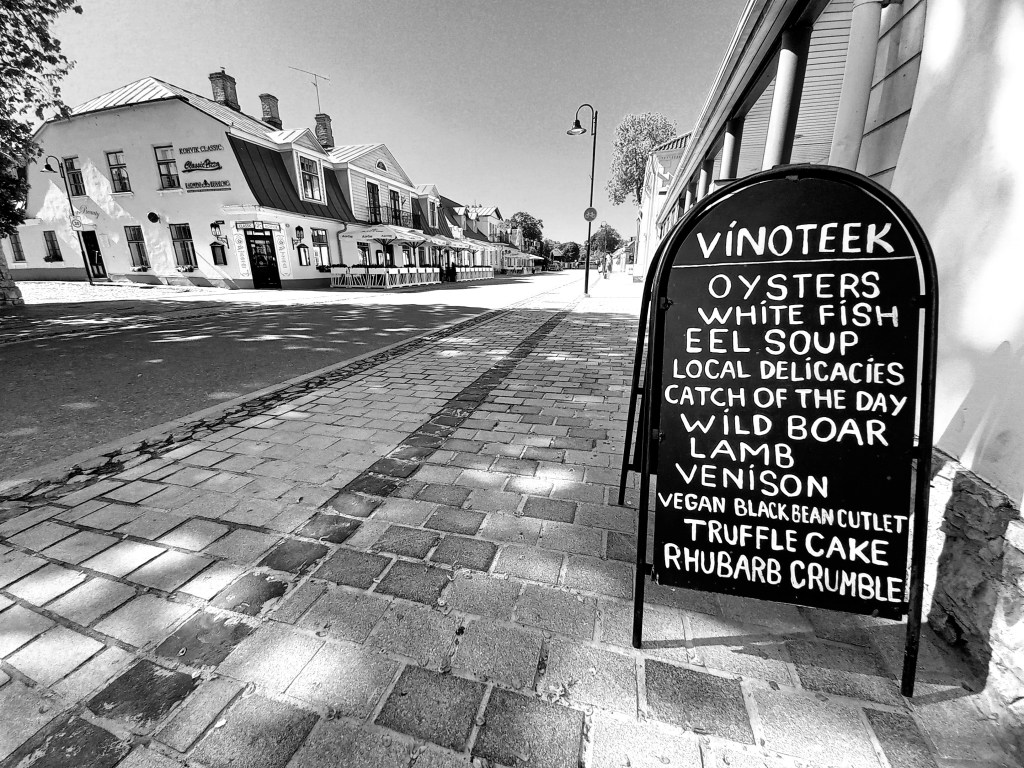
KURESSAARE HAS A RATHER swank, swish, monied feel to it, though not necessarily intentional. Just something about those spurting fountains, outdoor cafes, with patrons who reek of cosmetics and cologne and strawberry-flavored vape, all dressed in muted colors if not black. The speakers are a retro wonderland of Haddaway (‘What Is Love?’) and NKOTB (‘Step By Step’). The houses of the town are tidy, painted warm pastel tones, and cared for, and the Saaremaa capital reminds me of Skagen in Denmark, lots of hideaway getaway back yard gardens and the sea is never far. At the Vinoteek, the dim, candelabra-d interior of which looks like some Pyrenees mountainside tavern, the white bearded bartender informs me that he has no desire to leave the island of Saaremaa. ‘I only go to the mainland for weddings, funerals, and birthday parties,’ Whitebeard says while polishing off wine glasses at blue midnight, ‘and fortunately in recent years such events have been few and far between.’
the krishna sweet shop
‘EXCUSE ME, aren’t you that famous travel photographer who took the photo of the Dalai Lama blowing on his soup?’ Garcia was standing outside the door of the beloved Krishna Sweet Shop in Sag Harbor when he was again accosted. This time it was an older woman with a straw hat who had spotted him from afar as she came out of the Whaling Museum. There was nothing unusual about these kinds of run-ins with his growing divisions of fans, but this one was a bit more of an embarrassment because of the company he happened to keep. “Who is this very lovely young woman with you?” the woman nodded to Miss Enid Bryant, who stood at Garcia’s side with an amused look on her face and a hand on his arm. “Is this your daughter?” Enid Bryant’s blue eyes rolled back into some cavern within her skull and then resumed their default positions. She felt for a moment quite faint and then let out a nervous laugh, which the woman in the straw hat seemed to enjoy. “You look so familiar,” the woman said to Enid. “I swear I have seen you somewhere in Dan’s Papers. Or maybe in The Wall Street Journal weekend edition?” Garcia cleared his throat and removed his sunglasses. The June sun beat down upon his dark, shoulder-length hair, and he wiped away the accumulated perspiration with his shirt. “It’s true, I’m the one you think I am,” he acknowledged to the lady in the straw hat at last. “But this young woman beside me is not my daughter. We’re just friends.” “I see,” said the woman, looking directly into Enid’s eyes and then directly into Garcia’s as if waiting for them to divulge the truth. What could they tell her though? That they had been meeting secretly for weeks, roaming the sands of nearby Barcelona Point and reading each other stories and poems? That they would congregate on the neutral streets of Sag Harbor, far from the overbearing eye of Enid’s titan of industry father Ethan Bryant and stroll along the docks eating ice cream flavored with honey, turmeric, and ginger from the Krishna Sweet Shop? The proprietors, a father-daughter team named Rao and Geetha, paid these new regulars almost no attention, only happy to serve Mr. Javier Garcia his Hanuman Jungle Sundae, which came studded with nuts and banana chunks, while Enid liked the smooth and fruity Passionfruit Namaste Surprise. These they devoured while inspecting anchored yachts and chartered fishing vessels. Garcia would regale Enid with stories about Shiva and his special role in the Panchayatana puja. So far they had not kissed, but there had been one time when Garcia and Enid were so inspired by these constellations of Hindu deities that her soft, smooth hand had found its way into his larger, hairy one. Garcia had been startled by how aroused he had been at that moment, as was Enid. She did not especially seek the sexual company of a Galician photographer twice her age, nor did he seek out young women from prestigious families. Yet they were oddly complementary. A perfect mismatched fit. Their ears burned as red as temple candles. The curious woman on the street took note of that blood rush glow and continued to hawk over them, waiting for all of their prurient tales to be revealed. She had very light-colored hair and very light eyes, with a distant, eastern look to them, and few freckles, either natural or spotted by the sun. Garcia and Enid played dumb excellently though. It was as if they both held their breathe within. Sooner or later, this East End interloper would leave them on their own. “Well, your darling friend is very lovely, and you are a talented young man,” she informed Garcia. “Thank you, madam,” Garcia answered. “How did you even get that shot of His Holiness? The one with the soup? Did you have lunch with him? It’s been reproduced everywhere, you know. I think they are even selling t-shirts with that remarkable image.” “Oh,” Garcia shrugged. “You know us photographers. We have our ways.” “Well, you must exhibit in my husband’s gallery,” the woman said. “It’s just opening up and we would love to have you there.” “Where is it?” asked Garcia. “Out in Westhampton Beach.” “Oh,” said Garcia. It sounded like it was far away. “I guess I could consider it.” “You must exhibit with us,” the woman insisted. She tugged a card from her purse and tucked it into the front pocket of Garcia’s shirt. A moment later she was gone. Enid exhaled and let out an anxious laugh. Then she blew upward, lifting her dark hair in the breezeless day. When the woman was out of sight, Garcia pulled out the card and examined it in the sun. “Eeva Raamat,” it read. He turned it over. “The Raamat Gallery.” Strange name, he thought. All those vowels. Quite peculiar.
–
Other East End Stories

