THIS IS A TROPICAL STORY that takes place in a hotel in the tropics. But not really, because even though it was on the waterfront, it was the rainy season. Rain thrashed against the glass, and humidity made the outside world a cloud. We were all gathered there, along with our children. Brynhild’s children were also there, as was their father, who was a jazz trumpet player, but she wasn’t. I realized that she would arrive however at any moment, and arrive she did, while I was at the hotel restaurant getting a coffee. I walked back into the room and saw her, but only from behind. The jazz trumpeter was seated beside her. He was stroking her arm and talking to her gently. It was odd because they had been divorced for ages. She told me that he broke her heart. The old boy was in bright spirits. Said he was heading to San Francisco soon for a show. But Brynhild, she just sat there, staring through the humidity, in her tight shirt, with her red curly hair fastened in a clip. Brynhild sat there and never turned to face me.
After that, I went back to the hotel restaurant. There were two women having sandwiches at a table. They were older than me, maybe 10 or 15 years older, and were modeling the very latest in 1980s fashion. No one, it seems, had told them that it was the Twenties. One of these 1980s models was lighter, with golden hair. The other was a brunette. The lighter-haired one, who looked a little bit too much like Kylie Minogue in the ‘I Should Be So Lucky’ years, lifted her Benetton t-shirt and implored me to link her pink breasts, which I did with great haste. It seemed odd to me that I was licking a woman’s breasts in a hotel in the tropics while she conversed with a girlfriend over a club sandwich. That she looked like a young Kylie was, I guess, some kind of perverse bonus. After that, she asked me to come back to her suite.
A few days later, I went to a sweet shop in town. It had stopped raining and a rainbow was breaking over the harbor, I stopped in, and a young woman greeted me. She was dressed in the white uniform of a confectioner. The woman had red hair and looked nothing like the girl in the Benetton shirt at the hotel. But she claimed that she was the same woman. “Don’t you recognize me?” she said, taking my hand. “We’re in love.” We were? How could this be. It couldn’t be the same woman. Or could it? Maybe she was a shapeshifter. Kylie was also known for changing her style. It was rather odd that I had sucked on her breasts in a hotel restaurant. It was rather odd that she was still wearing Benetton. But stranger things had happened.
MORNING ON the Viking Line, Helsinki bound, the special Circle K discount line. It is good to be away from smalltown Estonia and all of the same smalltown faces, the faces that know you, or think they know you, the faces you think you know but do not know. You know what I mean.
Last night was spent in the company of Finnish tourists. They took over the sauna. Some of them looked like my children’s uncles, Priit and Aap. What is this parallel universe of Estonian lookalikes called Finland? What is this strange “speaking in tongues” language? In Estonia, sauna steam is called leili, but in Finland, it’s löyly. Try saying that word three times fast.
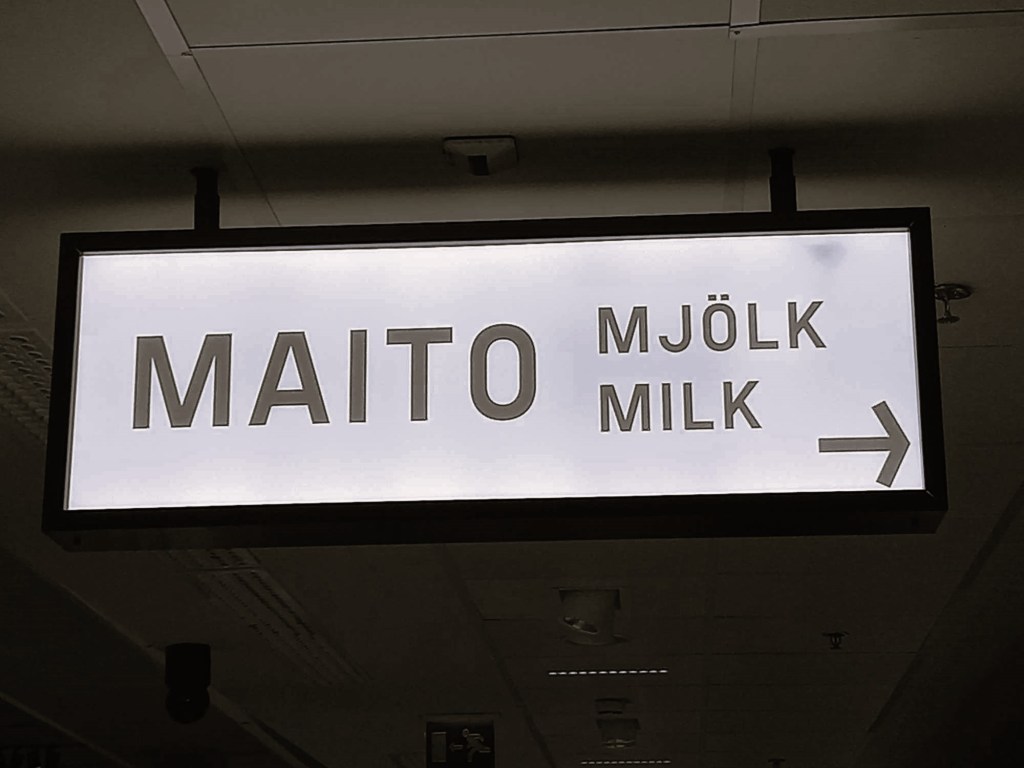
The Finns are so white and pale. Milk white. Maito white. I am always just a little pink. At least a little. The Finns need to supplement with iron and B vitamins. They are aloof, but pleasantly aloof. The men do not flatter the women. They are not Italian men, who blow kisses from passing scooters. The Finns are not lovers. This explains a lot. This may explain my entire life.
My soul is kind of foggy, udune, as the Estonians say, but my libido is strangely intact. It waxes and wanes with the moon. It is currently at full, full moon peak. It’s nice to sit in Stockmann though, just like this now. It’s nice to be anonymous. I like watching Finnish people. I like watching Finnish women. I wonder, which kinds of women do I like? I don’t like the women who wear a lot of cosmetics and have intricate manicures. They probably expect lots of money, and round-the-clock maintenance. This is my prejudice. That’s just how I see them.
I do like the women who seem a little shy, or to exist in their own worlds. There was a nice Finnish woman selling baked goods in Kamppi. She was wearing an apron and dressed in white, and was pleasant and round. And she had that beautiful white-blonde hair. There is something about hair like that. I also like the women who look a little strange, or even dangerous. I like the women who make unusual fashion statements, or look like they are members of a) some religious sect; b) obsessed with a musical group; c) forming a revolutionary cell. These women tend to be younger. When you are young, you can be bold.
At least they look interesting.
But then I have intrusive toxic thoughts. So intrusive and toxic as I sip my juice at Joe and the Juice. I don’t have enough money, I am going to be 44 soon. I have three children and have been classed out of the reproductive cycle. But I have actually written almost three books in the past few years. Doesn’t creativity count for anything? Or is it all about the money? These little thoughts are like like Stockmann shoppers. They elbow their way in, but they didn’t originate with me. Who put these intrusive thoughts in my head? Was it you? Or you?
Better to think of nice Finnish women selling baked goods. Something else. Something nice and cozy, or mõnus and hubane, as the Estonians say. The bookstore here is amazing, Akademiska. Bookshops will never be replaced by online. No way. There is just no way to replicate this sensation of drifting along, being drawn in by some book or its cover art, or title, or, “Hey, that’s Murakami!” I try to write like Murakami. I try to do a chapter a day. To punch in and punch out. I am not just satisfied with some ideas and a few paragraphs. But I am a father. I am running and I don’t always have the juice to do it.
It’s funny, I thought that if I came to Helsinki, I would be inspired. But I already know Helsinki intimately. I know what this city feels like. It’s in my bones. Turning 44 is somehow bothering me. It feels like the point of no return. Forty sounded kind of youthful. And these last four years just blew by. Gone. Around the corner from here is a bakery. I even once wrote a story about it, because one morning I was here, and I thought I saw Dulcinea working at the bakery. Yes, Dulcinea. I suppose she does look like a Finnish girl. I don’t have many love stories you know. Just a few. Sometimes, I would like to excise them. Sometimes, like with you, I buried them, and I can’t remember where I put them. Oh, I have tried to alter history. I have gone to psychologists, psychiatrists, healers, witches, tarot card readers, Hindu shrines, Orthodox retreats. Most people just tell me, as common knowledge, to leave the past in the past.
Things do fade but other things, and other people, they don’t always go fully away. Not 100%. They are just part of the scenery, the furniture. They are a room in the house of you.
I do want to get a new book before I go though. Some crime novel by a Harlem writer. I like crime fiction, it helps me with everything else, with structure, with pacing, with dialogue. I went to go buy it, but then the bookstore was closed. A milky white security guard with a beard said it was closed, kinni. The book was Cotton Comes to Harlem by Chester Hines.
After that, I went back to Stockmann and got another exorbitantly priced sandwich. Which is basically what an Estonian sandwich now costs. I watched the bourgeois Finnish couples coming and going, smelling of perfumes and colognes. Why was I not able to play that role in life? Who am I even writing to? And how come, no matter how much I write, nobody answers me? I feel like I am writing to a dead person. Maybe I am writing to Vahur Afanasjev. I remember that day, when I saw the headline about his death. Now I have become accustomed to disappearing acts, including by the living. Because when a friend leaves your life, alive or dead, it feels the same way, like a little death of sorts. I can’t say I am surprised by it anymore.
I WAS OUTSIDE when the helicopter came down. It was a military transport. I think it was from our side. The pilot tried to fly higher before it arched into a tailspin, eventually crashing nose first into some surrounding fields. There were sirens after that, and ambulances and stretchers, but there were no survivors. I was in the garden in front of the manor house when that happened. It was warm summer day. There was a gentle breeze and a bright sun was out.
The smell of the flowers was fragrant. It mingled with the smoke from the crash. I went inside.
There were many rooms in the manor house. In one of them, Celeste was sprawled out in a bed full of messy sheets. There was light on her face through the windows. She seemed unhappy, or at least restless. I took my place beside her. She said nothing at first, but there was a kind of hum or vibration that was familiar to me. I thought we were alone. She looked at me, and said, “I know you love me and have always loved me.” Her castle defenses were at last abandoned. Her walls came down and Celeste stared at me. “You are still here,” she said. “I don’t know why you are still here with me, waiting for me, after all this. Why are you here?”
I remembered that day in the garden, when the summer wind blew her dress above her waist. That had been years ago. Another lifetime. I had reached up and pulled the dress down, setting it back into place. Celeste looked at me again. We kissed. We had never kissed like this before. It was a passionate kiss, and I melted into her as deeply as was possible to disappear into another person. “But I am not sure,” she said, sitting up in bed. “I am not sure about so many things.” “You don’t have to be sure,” I told Celeste. “But I will still be here, waiting for you.”
It had been a weird afternoon. A helicopter crash. A kiss with Celeste. Her thick tangles of hair ran everywhere, over the pillows and blankets. I must have really been dreaming. The maid came into the room in the middle of this and saw us. She asked if we wanted her to make up the bed. I said no, that it could all wait. Then the maid asked if she could have a kiss from me. There were other women standing behind her. Lots of women. They were standing in the corners, and sitting in the bunk beds, glaring down at me madly like a dozen Cheshire cats.
“Just one time! Please, kiss me! Please!”
I only laughed in response and snuggled closer to Celeste. “You all must be joking,” I said.
I HAD NEVER been on a train like that before. It slumped along through the forests of the hills. It was cylindrical in design, but as far as I could tell had no kind of wheels or tracks. Instead, it was propelled downward by its weight, almost like a sled. It was red on the inside and on the outside. There were seats for passengers, but I was the only one. In the front, there was a conductor with an old-fashioned suit and handlebar mustache. He stared out the front window, and I could see the ships in the distance. Then the train slid into a dispatching point by the piers. Some men were loading up a sailing ship with cargo nearby. “This is Baltimore Harbor, Baltimore Harbor last stop,” the conductor announced. The doors opened. I got out.
How strange to be back in America. And why did I wind up in Baltimore Harbor? I could smell the frizzle fry of crabcakes from a restaurant somewhere. Ah, Chesapeake crabcakes. I began to walk along the seafront there, until I realized I was being trailed by some strange men, dark-haired characters, perhaps from the Medellin cartel. I turned up a side street to lose them, then went down another. I stepped up into an old building that I thought was a hotel. Inside, there was a sort of plump woman waiting for me outside a door. She had a gray and blue dress, she had long curly hair, and wasn’t particularly attractive. She told me that she had been sent by the cartel to poison me. I began to kiss her immediately, with passion, and we fell through the door into the room. What could be hotter or more arousing than a woman sent to kill you?
This room turned out to be part of a restaurant. It was dark inside, but there were small tables around which were seated couples talking about their previous relationships and career choices. One of them was familiar to me. It was Lea, a businesswoman from Tallinn. She was engaged in some date night talk with a man of Middle Eastern descent. She looked quite nice, and was dressed well. He had on a black turtleneck and jacket. I wondered where she had met him. The candlelight was reflected in her blue eyes and I could see the outline of her blonde hair. The man kept talking as if nothing was amiss. “Don’t mind us,” I said, as I shagged the plump assassin over a neighboring table. “We’re just discussing something.” We knocked over the candles and the utencils dropped from the table. Finally, we both climaxed. It was intense. Lea seemed slightly confused by the scene but continued to dig through her crabcakes.
After the plump assassin was vanquished, I went for a stroll. I took a train to Washington’s Union Station and started off toward Embassy Row. Maybe I should go see my family, I thought. They aren’t so far away. I passed a few embassies, protected by high walls and barbed wire, and armed guards. Flags flapped in the night. Just then, I became aware that I was being followed again. This time it was the Chinese. Maybe they had something to do with Medellin?
I couldn’t be sure.
Outside the Estonian Embassy, I noticed there was a family of rather ferocious chickens pecking about in a park. I induced the Mother Hen to attack this new team of assailants, and it tore into both of them in a cloud of feathers. They were killed. After that, I packed the bodies into a suitcase and tossed it into the Potomac River in Georgetown. There was little to tie me to the killings, and, besides, I hadn’t actually killed anyone. I was an accessory at best. The autopsy would reveal that both were murdered by a chicken. An open and shut case. The end.
WE WERE SWIMMING when we saw it. A long, dragon-like creature slithering toward the shore, its body half in the water and half outside of it. It had a kind of brown color, but its skin also had hues of orange and purple. It had a large, wide mouth, similar to a pike or freshwater bass. Its eyes were black and devoid of sentience. I didn’t feel immediately threatened, but didn’t want to stand in its way either. We huddled close to a cluster of rocks in the seawater.
We waited for it to leave.
What happened next surprised us. The creature went up on the sand, and I could see that it had developed some small feet that allowed it to move around on dry grounds. Some nearby sunbathers were frightened naturally, and a woman got it to move away by waving a towel. “Get away, you beast!” she cried. The creature arrived at the tree and began to climb it.
There were some very large squirrels up in that tree. I was worried about what the sea creature would do to those squirrels. I should have been more concerned for the sea creature. The sound of the way those squirrels attacked that poor thing would continue to haunt me. Five or six of them fell upon that snake-like freak of evolution, tearing into its skin. In a particularly fraught moment, I heard the sea creature groan out in pain. It came down the tree again, and vanished into the seas to lick its many wounds, if such wounds could ever be licked.
I later recounted this story to my old colleagues in New York. They had moved into an office on the 11th floor of a new building near Whitehead Hicks Park. We were so high up that I could feel the building sway with the wind, and I almost felt grateful I had left Manhattan in my past. Few cared to hear my outrageous tale. The newsroom now amounted to a bunch of elementary school desks arranged in long rows on both sides of the office. Jack, an English painter I know from Estonia, was there working diligently. Someone said he had taken my job.
On the bus back from the beach after the sea creature incident, I had recounted the story again and again to passengers. One teenager even forgot his bus ticket money, and I agreed to retell the story so that he would have free passage. In the office, I began to tell the story again.
As I said, almost nobody was listening.
My Swedish friend Erland was there too. He had recently gotten a job as a bike messenger, and was a little amused by the matter. His new employer had not forced him to cut his long hair. Celeste, an Estonian woman I had loved for many years, but who had not loved me back, and with whom now existed a state of what could be called “a lack of mutual recognition” in international diplomacy, was also there. She wore blue and her red curls looked magnificent.
Celeste laughed a little bit when I talked loudly about the sea creature and those monstrous squirrels. I happened to have Erland’s keys with me, and so I walked over to Celeste and handed her Erland’s keys. Celeste stared down into her palm at the key set and laughed again. I wasn’t sure what the symbolic value was, but at least she reacted. I had missed her very much.
HEIDI WAS STRETCHED out on some kind of wooden platform at the intersection of Sun and Moon Streets. It was right in front of the large brick edifice that once belonged to a local Jewish merchant. That was in the interwar years, before the Great Death. She was stretched out there in the sunlight, with her rear exposed and also her back. The rest of her bundles of clothes were bunched up around her knees and neck. The wind blew through her gold hair. I wondered what I should do about the whole scene. I walked around her on the platform and examined her. I wondered if I should take things a step further. But didn’t she have a boyfriend? Prince Hans of the Seven Isles? I left and walked farther down Moon Street.
Smith had opened a new café a few doors down from the Bhutanese restaurant. He called it “Smith’s Espresso.” A large ceramic cup was suspended from a hook above the door. Inside, there were just a few tables and a coffee machine. Smith wore an apron and a old-fashioned cap and fixed me the drink. There was another patron, a college student of about 19, who was from some other country, a Hungarian maybe. He wanted to know about Jack Kerouac. He was reading The Dharma Bums. I told him of my personal connections to the legendary beatnik, and how I had once interviewed the bartender who sold Jack many a drink in downtown Northport on Long Island. He had told me that Kerouac was a bad drunk. “And he gave me a copy of his book, Tristessa. I couldn’t make any sense of it,” he said. “I threw that junk away.”
“Can you imagine? The old fool bartender threw an autographed copy of Tristessa into the trash bin.” “Tragedy,” the Hungarian said. He had written a haiku to Gary Snyder but hadn’t heard back. He had on a sky blue scarf fixed around his neck, though it wasn’t particularly cold. He had light hair and blue eyes, and looked sort of like he belonged at a 1970s ski resort. I imagine that such stylish accoutrements were necessary for the up-and-coming hipster set.
After I left Smith’s Espresso, I decided to stretch out my legs. I peered down Moon Street and saw Heidi still sprawled out there, with her milk white buttocks in the air and autumnal sunshine, and went the other way. I found my way to the Botanical Gardens, and two ladies came out of the hedges and greeted me. They were both highly manicured and treated women, belonging to the town’s caste of the upwardly mobile and aspiring nouveau riche. The kinds of women who had marvellously sculpted eyebrows, buffed fingernails, and pants that seemed to perfectly stick to every contour of their legs and hindquarters. Friendly, but somehow of another tribe, as I too belonged to some other tribe, the Tribe of Kerouac.
They started to pepper me with questions. They wanted to know if I was good in bed or, rather, their friend Gunna, who worked in the market, who had red hair, and red paints, and red freckles, and barely spoke, needed to know. Badly. Somehow sex had never come up between us, but now I understood that it was actually all about sex. Everything had always been about the sex all along. The only question was if I would be willing to give it. The answer was a tentative yes, I told the two ladies outside the Botanical Garden. I doubted, for a second, just a second, in my lovemaking abilities, and if I would be able to please Gunna as she needed.
ACTUALLY, THE SONG IS CALLED, “Za Stalina, za rodinu” (“For Stalin and the homeland”) in Russian. Even I know these words, their meaning and context. I once saw a documentary about the Second World War, which contained a Soviet propaganda clip created at this time when the Soviet Union was no longer on friendly terms with Nazi Germany. And there they were, Red Army soldiers marching and singing about what they were fighting for. For their leader and their country. The only question is, where this homeland actually is, because sometimes it seems to me that, for Russians, “the homeland” is wherever they happen to lay their heads at the end of the day. Even New York could be their homeland. Once, I was parking my car in Brighton Beach, which has a large Russian community, and I asked a young man if I was allowed to park there. He stared at me with an odd look and said, “что?” (chto, “What” in Russian).
I drove on.
When I arrive to Tallinn, I often sing my own version of this old Russian song: “Za Tallina, za rodinu.” It’s a bit of a mean-spirited joke. I know that it would annoy the Estonians in Tallinn, who remain the city’s linguistic majority. More than half of Tallinn residents are Estonians. Russians are a third. But Estonians are somehow silent, or they are in their offices, or cars, or on the internet, or just don’t speak up, which means that I often hear Russian more frequently on the streets of Tallinn than I do Estonian. This bothers me, but not because I am a nationalist. I am not an Estonian, and I therefore can never be a nationalist. That would be funny. An American who is an Estonian nationalist. I would have to send myself home then.
No, I worry more that someone will ask me something in Russian, and while I speak English and Estonian, and some Swedish and Danish, and Italian and even a little Spanish, and could even tell you where to go in Portuguese — esquerda! — I don’t speak Russian, and I don’t feel like learning it either, because I came to Estonia and learned Estonian, and they can do the same.
And not just me. Swedes learn Estonian. Ukrainians, of course. Syrians. And also Russians. Recently, I was in a pharmacy at the Baltic Station Market where I heard another American ask for help from the seller in Estonian! He was totally unknown to me, an American who spoke Estonian with a California accent. So, we have learned, but why is this random Russian in Tallinn so special that he doesn’t have to? Yet it still happens that someone will ask me something in Russian, and he can’t understand that I can’t respond to him. Then he goes on his way, looking for help elsewhere. Of course, he will find it, but these experiences are confusing for me. How can you live so deeply in your own world that you cannot recognize that another world exists? How does it feel to live in a reality where you have to ignore the majority of people most of the time? To feel like a life-long tourist? I don’t know. I only know that I find myself singing some old Russian song from the last great war.
“Za Stalina, za rodinu.”
Or, in my version, “Za Tallina, za rodinu.”
***
Long ago, when I had just moved to Tallinn, and lived with an Estonian girl from Karksi-Nuia in the city center, we would go to the Central Market on weekends to buy fruits, buckwheat, cheese, butter, and milk, for example.
This was probably my first experience with Russians and Russian culture. Of course, I am a child of the Cold War, and Russians, or the Soviets rather, were always suspicious characters in our films. Later, when I was in college in Copenhagen, I had a classmate named Viktor, whom the police stopped one night, only because he looked like one of these suspicious Russian characters. Maybe he was a criminal? He was a great person though. Sometimes, when I would call him “comrade” as a joke, Viktor would shift uncomfortably in his seat, eye me, and inquire if I happened to be a Communist.
But in Tallinn I had to live among these suspicious characters. Old ladies at the market would sit around listening to Russian radio programs. I remember thinking that they existed in another reality. In our world, Estonia was part of Europe. Estonia was a small northern country, like Iceland or Denmark. Most people spoke Estonian, a close relative of Finnish. This was the year before Estonia joined the EU and NATO. A time when people dreamed of Schengen and the euro. But they were still sitting around and listening to the news from Russia, as if nothing had changed. For them, it was still 1990. This was the Russian world, or russki mir, about which I later heard so much. The only trouble was that other worlds, in addition to that one, also existed. What was I supposed to do about it?
In some ways, as a person who derives from another diaspora, the Italians who settled New York at the start of the last century, it’s not hard for me to understand them. My great grandparents probably did not know English very well. A neighbor girl taught my grandfather how to speak English. He was born in New York, but didn’t speak English until he was seven years old. At the same time, he learned it. He didn’t expect New Yorkers to learn Italian. In that sense, New Yorkers can be quite strict. I have witnessed conductors on trains who have refused to sell tickets to people who ask for them in Spanish.
Once, when I was speaking to that Karksi-Nuia girl in Estonian on the train, I noticed that some people gave me weird looks. How could I be so bold as to not speak English on the train? For them, it was probably uncomfortable. Which doesn’t mean that it was right, but that’s what I was accustomed to.
In Estonia, I learned the language in part because of this mentality. I thought that’s how things worked. But at the Central Market, the old ladies had different ideas about languages and cultures. That was 20 years ago. If they are still alive, maybe they are still there talking away and listening to the news in Russian. I do remember that a very beautiful young Russian woman worked in the market at that time. She had blonde hair and would wear a red apron. Even though she was about my age, she already had a look of resignation in her eyes, though resignation too can be a mark of beauty in its own way.
Sometimes I wonder what happened to her. Did she become a mother? Is she still selling there? Or has she found a better job? What was her life back then? Cheese, milk, and some weird American client? When Estonia’s Russians were part of an empire, their lives were still just milk and cheese, but they belonged to something greater, at least in their minds. In the Republic of Estonia, they were a minority. That young woman is at least 40 years old now. Does she wear a scarf on her head these days? She had the most melancholic blue eyes. Those lovely Russian eyes.
***
Today I arrived in Tallinn, mumbling “Za Tallina, za rodinu.” The bus was full of Estonians who don’t talk. In the bus station, I only heard Russian spoken, although there are lots of languages in Tallinn. People have come here from all over the world, but Russians are still the largest minority.
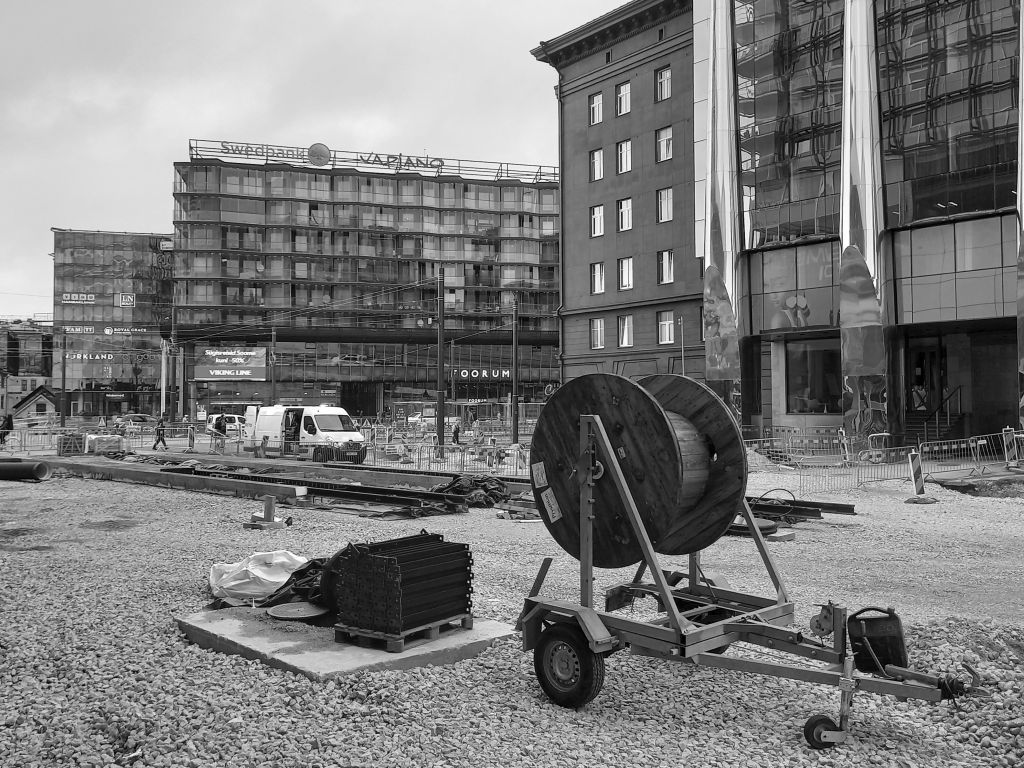
Tallinn is under construction, and I had to pull apart a few metal gates and step over a barrier to get to the conference. I felt like a little New York boy again. It gives me great satisfaction to break the rules. A few construction workers were shouting to each other in Russian. I hoped that they wouldn’t start talking to me. Imagine that something was about to explode, and they needed to tell me to run. How could I understand them? But what else is there to do? Most people in Tallinn speak Estonian. It’s actually their problem if they can’t make themselves understood, but also mine as well.
On the street, I saw a Russian teenager who was talking loudly in her phone. I realized that I had gotten accustomed to the silence of the Estonians. There was also an older woman who was wearing so much makeup, I thought at first that she was an actress from the Ugala Theatre. There are these little differences that for people in the Estonian world, or in my world, are not typical, but for them are everyday things. Europe remains a continent of tribes, and my tribes are nearer to me. For others, the Italians are, for example, utterly ridiculous, but for me, they seem completely normal. I feel the same way about the Estonians now, because my children are Estonians. Even if the Estonians have this weird thing that they won’t look you in the eye, or they always have this “no bullshit, get to the point” mentality, even when their conversations are so stupidly business-like and dull they are still, in a way, family to me.
Even in Helsinki I feel this sense of closeness, because many of the Finnish girls remind me of my daughters. Recently, I offered as a joke to my youngest daughter that she could get a job at Boost in some shopping center, because she likes their smoothies so much. She’s just 12, but she answered with sarcasm. “But I can’t work there because then I have to speak to clients in Russian.” Her cousin worked at Circle K in Tallinn and had to handle clients in Russian all the time, or at least she tried to. She is only 25. She doesn’t know Russian so well.
My daughter only complained more. “I don’t understand them. Why don’t they just use their Vladimir Putin Pocket Translator if they want to order something?” It made me sad to hear this, but I laughed when I imagined a gadget called the “Vladimir Putin Pocket Translator.” It’s not just sadness for a child who doesn’t want to work somewhere because she might have to speak Russian, but also for those Russians who, when faced with an Estonian server, can only blink at them like that kid in Brighton Beach and say, “что?”
There are, of course, loads of Russians who speak Estonian fluently. They also have to deal with the stereotypes perpetuated by their compatriots. And, as an American, I do know what it’s like to travel in a world where every other person has a negative opinion about you.
I once had a problem with a Russian man in Estonia, who thought that my car door had hit his car door. He was an older, self-confident character, who boasted that he had brought his wife from Russia, and that she knew not a word of the Estonian language. They lived together, mostly peacefully, in their own reality. People were afraid of him, but I wasn’t because I am not an Estonian and I don’t have the same kind of relationship with Russians and the Russian Empire. I can whistle “Za Tallina, za rodinu” with ease.
As a New Yorker, and a Mediterranean, I know that if someone threatens you, you have to threaten them back, naturally. He threatened to call the police if I did not give him any money, I told him to get the police and the army, he wouldn’t get a cent out of me. Instead, he left quietly and with empty pockets.
Fortunately, Italy is not located next to Russia. That would be really crazy.
***
Recently, I met a man who was born in Tallinn the same year that I was. His brother was baptized in the Orthodox church in the Old Town. But he was not granted citizenship automatically when they restored the state, because his family had arrived after 1940. His family left for the US instead in the early 1990s. They were poor. They had a lot of problems. But he managed. Today, he is a successful businessman. We sat together in a restaurant and I thought it was such a shame that he left Tallinn. He’s smart, talented. He could have been of great use to this country. His only problem was that he happened to be born into a complicated situation. I still don’t think the Russians fully understand who the Estonians are though. They understand that they are a people with a different language and culture, appearance. But the Estonians are actually an indigenous people. They are like one big, extended family. Becoming an Estonian is not as simple as learning the language and getting a passport. These are things I cannot change.
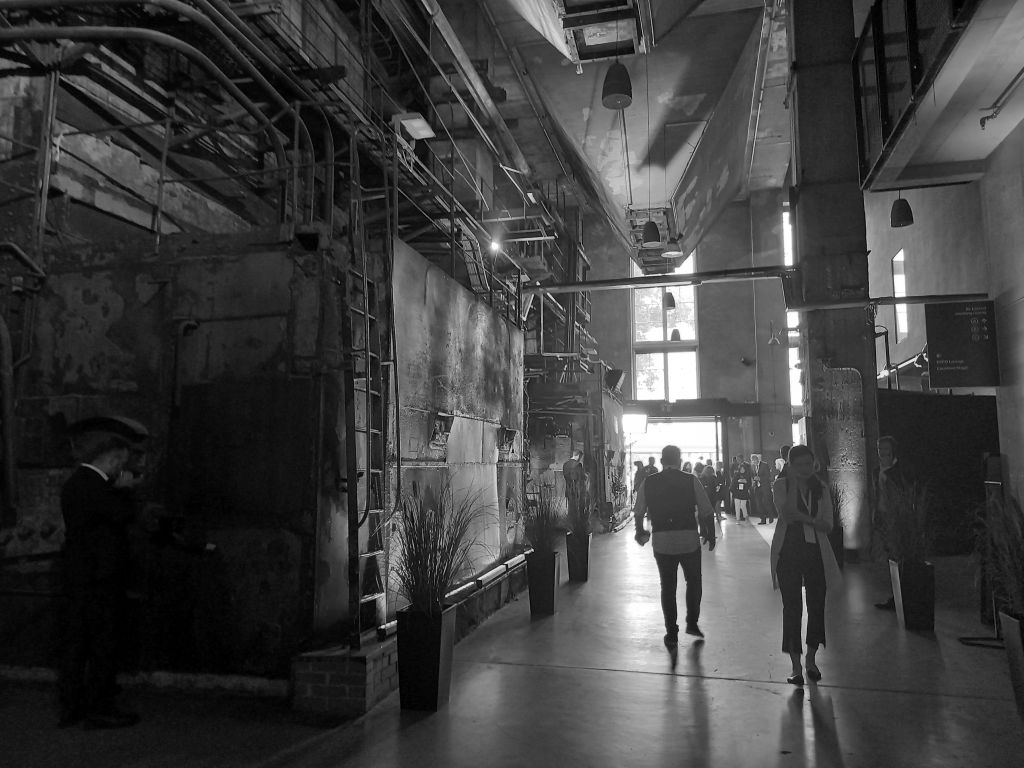
It’s still a shame that man left for America. But I am still here. I am in the Culture Hub at the Tallinn Digital Summit, where Danes and Lithuanians speak English to each other. I am sitting in the corner, listening to their English-language discussions and typing this up in Estonian. I have long since forgotten about that old Soviet war song. Everyone here is talking about the Nordics, about Europe. How interesting that it only takes a few steps. Just a few steps and you can leave the Russian world and arrive to the Nordic one.
Just a few hundred meters and everything is different.
–
An Estonian-language version of this article appears in Edasi. I wrote the Estonian-language version first and later translated it into English.
I HAD NEVER BEEN to one of these kinds of parties. If such an occasion can be called a party. Parties usually have music, don’t they? And food and drink? Parties also usually have a reason to be celebrated. Maybe it’s someone’s birthday, or someone graduated from college. Maybe.
But this party, if it can still be called a party, only existed for one reason: for a group of mostly strangers to gather in an uncomfortable place and have sex with each other. Yes, it was a swingers’ party, as they are called, and it was held in an apartment in downtown Tokyo. Don’t ask me where exactly, or in what prefecture. I can’t even begin to tell you how we arrived there, only that it was night and that it was raining. The neon lights of the business district were blinking, there were crowds on every corner, and we squeezed into a tight elevator.
I didn’t even know what was going to happen, until I saw what was happening. At once, a woman dropped to her knees and began pleasuring one of the other guests through his jeans. Then two people began rocking away right there on the carpet. It was a Roman scene, except in Japan. Tojo was there, and so was Elspet. Tojo took off his shirt and showed off his muscles. He was strongly built and must have been working out. I took it that he was the organizer of this impromptu group shagging. The apartment itself was stale, used up, an unhappy place. A dusty air hung over its furniture and its walls. The shelves were lined with compact discs.
It looked like an abandoned radio station.
There was a Spaniard nearby, breathing heavily into his partner’s ear, and a woman who looked just like Snow White stretched out beside me. She was even dressed like Snow White. Maybe she worked at Tokyo Disneyland? She was at least attractive, and also seemed kind of dazed, as if she also didn’t know how she got there. Who were these characters? How did I get here? I didn’t know what to do. I got down beside Snow White and we embraced anxiously.
AFTER I WOKE UP, I went next door into Paula’s apartment to fetch Anaís’ ex-husband’s towel. Don’t ask me how it had wound up there, or why I was tasked with retrieving it. To make matters more bizarre, it was a cartoon beach towel, with Rupert’s image printed all over it.
It even said “Rupert” in bubbly white script scrawled across the bottom.
The strangeness of the situation didn’t end there, because I was in my underwear, a pair of comfortable navy-blue boxer-briefs. I thought I could get in and out of the apartment without Paula catching me. I knew the towel was in her bathroom on the shelf. Just in and out, while she was asleep. But I was wrong. When I came into the main room, Paula was already awake, dressed in a glimmering silver dress and fixing her ears with shining silver ornaments.
There was a milky gray morning light in the room, and she stood facing a tall mirror. I stood opposite her, mostly naked. She combed her golden hair and observed herself in the mirror.
“But who is this Anaís, whose ex-husband’s towel you have been sent to fetch?”
“Anaís is a great writer. She is a woman who has led a colorful life, a life worthy of letters.”
Paula put down her hairbrush and turned to me in that silver dress. She said, “But my life has been so boring lately. All I do is work and work. Nothing ever happens. I am either here or at the workshop. Always working. I would also like to live a colorful life, a life worthy of letters.”
At once, I swept her off her feet, carrying her toward the bed. Paula gasped but was soon purring away like a kitten. The bed had a canvas canopy around it, and I took her to the sheets.
Her dress jingled.
“Come, come,” I said. “Come to bed with me, Paula. Let’s make your life a little more colorful.”
“I WAS STUCK IN GLASGOW once for 10 days. Really stuck in Glasgow. It was a weird situation. I had just joined the company. It was 2005. Actually, I was a young guy. I was still just 25 years old. I was with my wife and we had a baby. I was supposed to go to this tech conference in Europe, and they had canceled the conference at the last minute, but they didn’t tell anybody who had signed up for it that it was canceled. So, I had the plane tickets, and I was there, but there was no conference. So what did I do? I saw there was another conference Glasgow and I said, ‘I’m going to Glasgow.’ I was in Scotland already. I thought I might as well go to that conference, but it was 10 days in the future from that moment. So I was just hanging out in Glasgow for 10 days, but I got a very good taste for the city. At first, I hated Glasgow. Because I was coming from Edinburgh and I was expecting this sort of fairy tale castle magic and we rolled into the grim Glasgow bus station. But it really started to grow on me over time. The architecture. The weird, orange sunlight. Just this vibe. I can’t explain it. I started to really love it, especially on a Friday night, when Glasgow was like a war zone. There were fights and people getting sick and sleeping in the park. I can’t deny that it left a strong impression on me. Whenever I meet someone from Glasgow, I always think, what it was like to grow up in such a place. You know?”