on the road with kerouac

WHO IS YOUR FAVORITE WRITER? Or who has been the most important writer in your life? People have often asked me this question. My answers change. Sometimes I say Scott Fitzgerald, who wrote every morning, even when his wife Zelda was in the psychiatric hospital. Sometimes I answer Henry Miller, who dared to write so poetically about the darker side of men and of the world. And certainly Ernest Hemingway haunts me, as he haunts every writer, with his strange, adventurous life story. But honestly, my guardian angel has been to this day Jack Kerouac, the author of On the Road. I see my life through the prism of his life, I understand myself through his books. Jack inspires me. Jack cautions me. I would like to write as well as Kerouac wrote his books. But I don’t want my life to have the same trajectory. I don’t want us to have a shared fate.

***

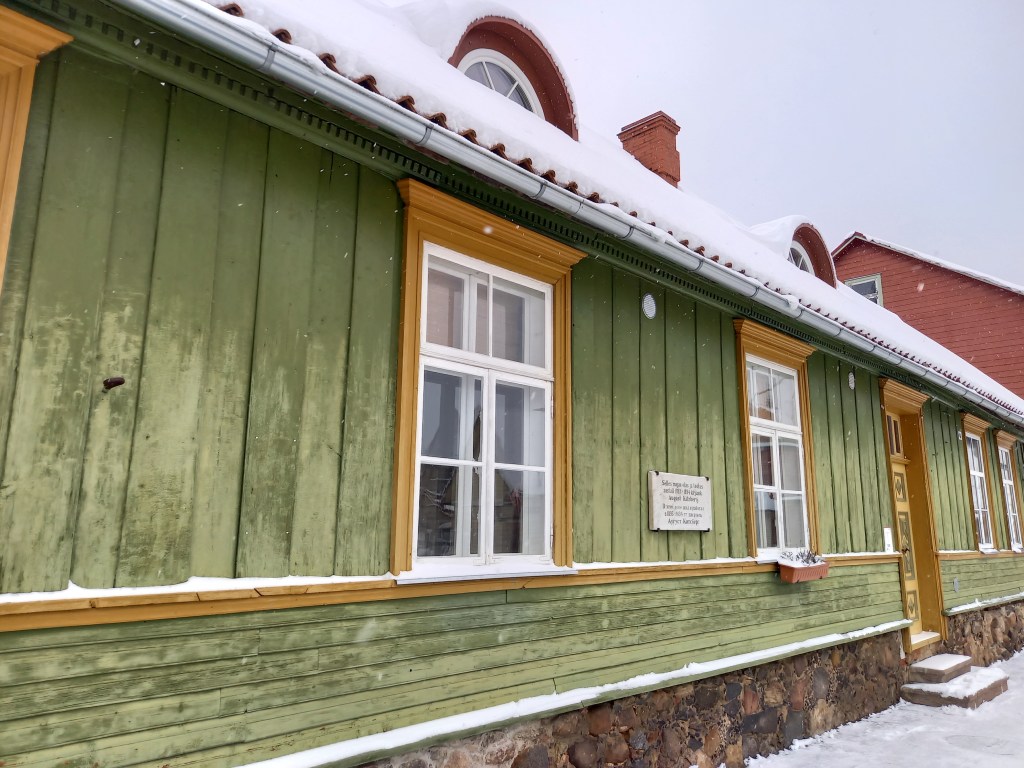
I was thinking about Jack one summery Saturday morning when I drove to Northport on Long Island. My parents live about half an hour east of there, but my mother is from Northport in part. Northport is a port town or perhaps village, about 70 kilometers from the center of Manhattan. It is drowning in greenery and there are lovely views. It used to be a summer place, to where city people would flee and go swimming. There were women with Victorian Era dresses and umbrellas to keep out of the sun and men in black top hats. You know what I’m talking about. They came from the city by train, to spend the summer by the sea. It reminds me of Haapsalu. But I went by car. When I got to Northport, I met up with some relatives. We went for a walk and told some stories. I’m not in the US so often. It was a nice summer morning and it was nice to spend time with my uncle and cousin and to drink some coffee. After our get together, I typed 34 Gilbert Street into the GPS and headed off in that direction. To get to Gilbert Street you have to take Main Street out of town, then turn onto Cherry Street and then again to Gilbert Street. It was interesting that I had been to Northport maybe a thousand times, but this was the first time I had ever been on this street. The house I had come to see was a white, wooden house, a typical working class house. The same kinds of houses are in Lowell, Massachusetts, where Jack was born. That’s why he wanted to live here, I’ve read. 

Jack moved to Northport in 1958. Eisenhower was the president of the US. Khrushchev was the leader of the Soviet Union. Mao was building Communism in China. The Korean War was over and the Vietnam War hadn’t started. Kerouac was looking for a peaceful place that wasn’t too far from New York. He was already famous by this time. A year earlier appeared his most famous novel, On the Road. Kerouac was everywhere. On television. On the radio. In newspapers. In night clubs. He was the Beat Generation’s greatest prophet. A dutiful Catholic, Kerouac brought his mother Gabrielle Ange Lévesque to live with him in Northport. An older lady. Conservative. She had been born in Quebec at the end of the 19th century. Religious. Different. The Cold War was at its height and Kerouac hated Communism. He was, at his core, a Catholic, regardless of the fact that he did not exactly follow the church’s rules in his personal life. But the Communists had no faith. Kerouac yelled at the TV when they showed Khrushchev. His mother was making his pancakes and washing his socks. He was typing away at his typewriter too, when he wasn’t talking to fans who had climbed over the back fence, or he wasn’t at the local bar drunk again. Sometimes I wonder if my grandmother and Kerouac’s mother went to church at the same time in the same town. It probably happened, I think.

***

Neighbors later reported that mother and son fought a lot. What about, I don’t know. Nobody knew, because the Kerouacs’ loud arguments were in French. The youth of the town learned rather quickly that their new neighbor was the famous Jack Kerouac. It was hard for him to find a spare moment to write. They turned up at the front door, or chatted with him through the basement window. Kerouac even wrote about this in his 1962 book Big Sur. This was the first Kerouac book that I ever read. My girlfriend gave it to me when I was 16. I don’t know how much she even knew about Kerouac. Maybe she just bought it because of the title? But it was the right book for me. I especially liked the beginning. The story starts with Kerouac in San Francisco, waking up with a hangover to the sound of church bells. I went that summer to San Francisco and Big Sur and read that book along the way. There is one scene where Jack Kerouac is in bed with a woman and the woman’s child comes into the bedroom and watches. That was probably the first time I had ever read something like that in a book. 

Through his life I learned that the world was much bigger and that adventures were waiting everywhere. That life was more of an interesting experience than anything else. Life was an experience, and a person could write about it as it happened, just like a photographer takes photos. His style was fluid, unique, and addictive. I think that once you get used to Jack Kerouac, it becomes harder to read more conventional literature. Books like Fifty Shades of Grey or The Da Vinci Code seem dull. Once you go on the road with Kerouac, there is no way back. And I am still on that road with Kerouac. In this way, I arrived at his old house, to take some photos of it and look it over. What did I expect anyway? That he would come outside, with garbage bags in his hands? That I would hear his mother yelling in the background? Ti Jean, my boy, your pancakes are ready! It was a hot, humid, and sunny day. Gilbert Street was quiet and empty. Some birds were singing away and there was a light breeze. The house is really just like any other. But when a writer like Kerouac has sat there with his typewriter, the importance of the house changes. People then come by and take pictures of it. They want to come face to face with the soul of that writer, at least just a little bit.

***

IT’S INTERESTING THAT Jack Kerouac wasn’t the only new inhabitant of Northport in 1958. Because my mother and her family showed up in town the same year. In some ways, my grandfather Frank and Kerouac were similar. Kerouac was born in 1922, and my grandfather Frank a year later. Kerouac’s home language was French. His parents were from Quebec and they moved to the US at the start of the 20th century to find work in New England, like many Quebecois did. Jack Kerouac’s real name was Jean-Louis Lebris de Kérouac. He attended Catholic school and his teachers were French-speaking nuns. Later, he praised the education he had received, and found that thanks to their rigid means of instruction, he had learned to write so well. I reminded my grandmother of this fact once when we spoke about Kerouac. To her, that crazy neighbor Kerouac wasn’t exactly an upstanding citizen, but the fact that he was a Catholic softened her position. Maybe he wasn’t so bad, she perhaps thought. If he was a Catholic, he was one of us. He just didn’t live his life the right way. Jack merely diverged from the road of Catholicism.

When he went to school, young Kerouac still didn’t speak English and had to learn as he went. He would study the dictionary to expand his vocabulary. It was the same for my grandfather. His parents were from Italy, and their home language was the Barese dialect. My grandfather also didn’t speak English until he started to go to school. A neighbor girl taught him how to speak it. My grandfather was ashamed of being different. He had a long Italian name. He had dark hair. For Americans, he was an outsider. Kerouac’s relationship with America was similar. He was an American in some regards, but he had a different perspective. He was both a local and a foreigner. But my grandfather lived a proper Catholic life. He was married by the age of 22. He had a job and five children. They lived on the edge of the City of New York, until one morning he took a ride out east to see what he could see. That’s how, one story goes, he discovered Northport, that same port town that Kerouac discovered around the same time. Both of them moved to Northport, and both took their mothers with them. Frank’s mother’s name was Maria. She made her son pizza, just like Kerouac’s mother Gabrielle made her son pancakes around the corner. In my mother’s home, they spoke both Italian and English. My mother is almost 77 now, and she still speaks English a bit differently. A professor of Italian once told her that she speaks like a child that has learned English from immigrants. The vocabulary and pronunciation are correct, but her sentence structure is a little off. The grammar is backwards, because she is using Italian grammar with English words. Sometimes I think that Kerouac’s bilingualism influenced his writing style. My mother never did meet with Kerouac, but her younger brother once recalled that on some nights he might have seen Kerouac, Neal Cassady, and Allen Ginsberg playing baseball. This was at the beginning of the 1960s. These were dangerous characters. Before there were punks, and before there were hippies, there were Beatniks. Ginsberg was a gay poet, and Cassady was simply a wild and crazy guy. Kerouac himself was not quite right. Some say that he hit his head too many times when he played football in school. Maybe that’s why he wrote so well? There are different theories.

I can only imagine how my uncle, then aged about nine, accidentally came across Kerouac, Cassady, and Ginsberg. Actually, they looked quite average. They just lived different lives. It was a warm summer’s night and he rode his bike by the baseball field and saw them playing. Just some Americans out playing baseball. Now that moment seems like a historical event.

***

Kerouac’s father died young, and when he was ill, a young Jack Kerouac promised his ailing father that he would care for his mother Gabrielle forever. This was a promise he made before God. So Jack was obliged to live with his mother. Or he was unable to leave her home really. Of course, he was married three times in his life, and he had one daughter (though he argued for a time that the child was not his, which was disproven by a blood test). A proper Catholic would have been married just once and stayed married. But Kerouac was unable to live that life. He had all kinds of worldly adventures, but the road always led Kerouac back home to his mother. His mother’s place was his main address. They lived in Northport until 1964.

They only lived on Gilbert Street for a year and a half before moving to Earl Avenue, into a small house on the edge of town with a Dutch roof. There they stayed for two years. Their last address was on Judy Ann Court, in a one-storey house. They spent three more years there. My mother’s family lived a few streets closer to the center of town. The story that my uncle claimed to have seen Kerouac playing baseball with the other Beats is probably true. Carolyn Cassady wrote in her memoir Off the Road how her husband Neil, Jack Kerouac and Ginsberg would go and play baseball together. For some time, Jack and Carolyn were even lovers. Neal was particularly supportive of their relationship, as he had cheated on his wife Carolyn many times. So if his wife had a lover, things would be more equal, he thought. Classic.

It’s interesting to read from time to time that Kerouac was gay, like Ginsberg. Even Gary Snyder, who is 94 at the moment, and who inspired Kerouac’s character Japhy Ruder in his novel The Dharma Bums said in a recent interview that Jack hated women and was probably gay. But then we have Carolyn Cassady who writes about her passionate relationship with her husband’s pal. I’ve also read Joyce Johnson’s book, The Voice is All: The Lonely Victory of Jack Kerouac. Johnson described a very charming character with blue eyes who whispered to her in French. Johnson, who is also a successful writer, was Kerouac’s girlfriend for several years. She once wrote that in the world of the Beat Generation, women were girlfriends or muses, but she wanted to be more. She also wanted to be a writer. This fact has really stuck with me, although I have been quite similar to my Beat predecessors in terms of my own perspective.

But Jack Kerouac always had some woman. Always. One of these was the Afroamerican Alene Lee, who inspired his character Mardou in The Subterraneans. This book has been translated into Estonian. Its Estonian title is Pilvealused and the translator was Triinu Pakk-Allmann. The second novel to appear in Estonian is On the Road, or Teel, translated by Peeter Sauter. The most colorful female character in On the Road is a Mexican woman named Terry with whom he lived a while in California. One of my favorite quotes in the book belongs to Terry when she says to Sal Paradise, the main character, “I love love.” Johnson wrote that this relationship was one of his most stable, and that Jack might have stayed together with Terry, who gave him the freedom to roam. But no. Kerouac promised his father that he would take care of his mother. True to his word, he did so. His responsibilities to his family were his priority.

The writer Gore Vidal once wrote that he had a relationship with Kerouac though. And Joyce Johnson acknowledged there had been some intrigues with Ginsberg. Sexuality among the Beats is an interesting topic, especially because at that time in the “hetero world” things were just different. Men would go to visit prostitutes together. Jack writes about spending time with Mexico City prostitutes. It was just a regular thing. “Guys, let’s go get some prostitutes!” Even Ginsberg went with them. What did he do there? Read some Mexican girl one of his poems?

One of Kerouac’s loves was certainly Tristessa, a young Mexican junkie. Her real name was Esperanza. It’s hard to think that a man who wrote so much about women was gay. But maybe it would be more honest to accept that things have changed since those days. In the 1950s, there was limited awareness of the LGBTQ+ community. There weren’t parades with rainbow flags. Neal Cassady could sleep with Ginsberg and his wife Carolyn and not lose any sleep wondering about which letter best described his sexual orientation. Was he bisexual? Pansexual? Omnisexual? Was he a G, a B, or maybe even a Q? Neal was just Neal, and Jack was Jack. It was just a different time. In Joyce Johnson’s book there is an interesting fact that Jack didn’t think of himself as being gay, but that he actually wanted to be gay. Most of the best writers of the day were gay. Gore Vidal. Truman Capote. James Baldwin. He was almost ashamed that he wasn’t, because everyone knew that gay writers wrote so well. This fact really astonished me. It was like an inverted reality. Maybe it’s inspired me to write more honestly about women. Men’s interest in women is deep, intriguing, at times terrifying, but inspiring. There is more to unearth from that treasure trove.

***

MY GRANDPARENTS WERE devout Catholics, but Kerouac had a long relationship with Buddhism. Carolyn Cassady recalls in her memoir how Jack found Buddhism and started to believe that the world was an illusion and that reality was just emptiness. He tried to live as the Buddha. He even wrote Wake Up: A Life of the Buddha and The Dharma Bums during this period, as well as Desolation Angels. I have read The Dharma Bums and Desolation Angels, but Wake Up hasn’t found a place on my bookshelf just yet. I understand that he had personal problems, especially with alcohol, but also within his family system, which kept him in a sort of personal prison in life. Other people got to enjoy their freedom, but he had responsibilities. He could travel and write, but his mother was still waiting for her boy at home.

Carolyn acknowledged in his memoir that the new, Buddhist Kerouac wasn’t exactly a barrel of laughs. He became very stern and serious. He went up to a mountaintop in the summer to contemplate emptiness. Kerouac no longer wrote to his friends about his thoughts, but about the dharma. He was looking to be liberated from himself. As a Catholic, his life was full of disappointment and guilt. In both the family and the church, there was a lot of confusion, stress. This I understand well. I started school in Northport, and my first school was a Catholic school. Kerouac was, by that time, dead. He died in the summer of 1969. He was 47. When I was younger, 47 sounded kind of old. Now, at the age of 44, it sounds like a teenager to me. I was born a decade after Kerouac died. I started school six years later, as I said, there in Northport. These facts are not so deeply connected to me or my life story. They are just a coincidence. Because I didn’t know anything about Jack Kerouac’s Northport period when I was a little boy.

Still, his world was familiar to me. My grandfather died in Northport two summers before Jack. A heart attack. My grandmother lived long. Her house was full of crosses and angels. Lots of shining angels. My father’s uncles had a bar in Northport, but Kerouac’s favorite bar was another one called Gunther’s Tap Room. These days, Northport is a wealthier place. At that time, in the 1950s and 1960s, it was a rougher, working class down. There was a sand and gravel company nearby, and on their lunch breaks the workers would come to town, eat and drink. There were a lot of drunken bar fights. Pete Gunther, the bartender, who was the original owner’s son, was a teenager when he started working. He’s now long dead, but when I was 25 and working for a local newspaper, I met up with him and interviewed him about Jack Kerouac. There was even a sign on the wall that said, “Kerouac Drank Here.” Apparently, his alcoholism intensified during this period. 

Pete Gunther, a bald older man with a round face, in general quite friendly. He told me straight that Jack Kerouac was a drunk. He was drunk every day of his life. This was like the scene in John Steinbeck’s East of Eden when the good son who believes his mother is dead finds out that she is very much alive and running a whorehouse in town. “Justin, your greatest hero was just some crazy drunk.” That’s what Pete Gunther related to me in our interview, more or less.

Jack once gave Gunther an autographed copy of one of his books in exchange for a beer, but Pete Gunther said he couldn’t make any sense of it. It was all crap, he said. He didn’t understand it. So he threw Kerouac’s book in the garbage. In some ways, I feel it was symbolic of how America treated him. Now that the original scroll of On the Road is displayed in museums, we can think that once upon a time a great writer lived in that small house over there. Or put up a sign that says, “Kerouac Drank Here.” Or try to collect memories of him from other people, people who once met him, or saw, perchance, him playing baseball with his friends. That summer when he died though people were more interested in hippies, the Vietnam War, and the Prague Spring. His best friend Neal had died a year prior in Mexico beside the railroad tracks. He was known to use drugs, but it was the rain and his lack of clothing that did him in.

When Neal died, Kerouac told his friends that he wanted to join his best friend in heaven. The writer and poet Gregory Corso, who you can see in Jack’s short film Pull My Daisy together with Ginsberg and the other Beats, recalled similarly. “Jack wanted to die,” he said. And so he did. He got into a bar fight and started bleeding inside. In the end, it was life-long alcoholism that took the life of Jack Kerouac. But he did want to be with the angels. Mr. Corso said so. 

That morning, as I was looking over his first Northport home, I sat in my car for a while. I wanted to tell my old friend Jack not to drink so much. Leave your mother Gabrielle behind and go live with that Mexican girl. The one who said she loved love. Or some other girl. Or maybe even multiple girls. Life is for living, Jack. It’s too soon for wrestling with those angels.

When I was 16 and my girlfriend gave me my first Kerouac book, Big Sur, I started to write. I had read how Jack always had a notebook on him, and that he would write everything down. I can now see traces of that book in everything I write. So Kerouac continues to live on, quietly. 

Here and there.

An Estonian version of this article, written by the author, appears here in the magazine Edasi.

Kerouac’s three Northport houses.

‘like a dream you don’t want to wake up from’

AT SOME MOMENT on Sunday evening I find myself in the grand hall of Viljandi’s Folk Music Center or Pärimusmuusika Ait looking for a good spot to rest a while and write. The hall is full of people, some standing, others gathering, talking and telling jokes. There are all kinds of people here, people with shaved faces and hairy chins, hippies, squares – but let’s be honest, most of them are a decade or more younger than I am. Beside the stage, three wonderfully light-haired girls are seated, one with shiny hoop earrings. I don’t know how old they are and don’t want to know. Two of them are looking at their phones, one has her head to her knees, apparently to just catch her breath. I watch them a moment more and then hoist myself up onto the edge of the stage. Every part of my body hurts: my legs, arms, back, and heart. My trustworthy satchel is wet from the rain, but my notebook is still dry. With a black pen, I begin to write. A few seconds later, a man appears before me, one with short hair and a brown sports jacket. He says he used to be my first daughter’s zoology teacher at the Viljandi Hobby School. That must have been a long time ago. His name is somewhat familiar, though I don’t recognize him. He has something in hand.

It’s a button. The kind you’d find on a jacket. There’s a trick too. There is something behind the button. This man goes around Viljandi installing these buttons on walls. When you tug the button, it pulls a piece of string behind it, and when the string goes back into the wall, the magic button plays beautiful music. “You just have to pull the button,” the man says. I don’t understand if I’m dreaming or not. I am at this moment so tired, that it all could be a hallucination. “That’s genius!” I say. The music is the same you would hear from a music box. “Why are you putting these buttons up?” I ask the man. “I wanted to bring a little more joy to the world,” he answers with a smile. Then the button man disappears into the crowds.

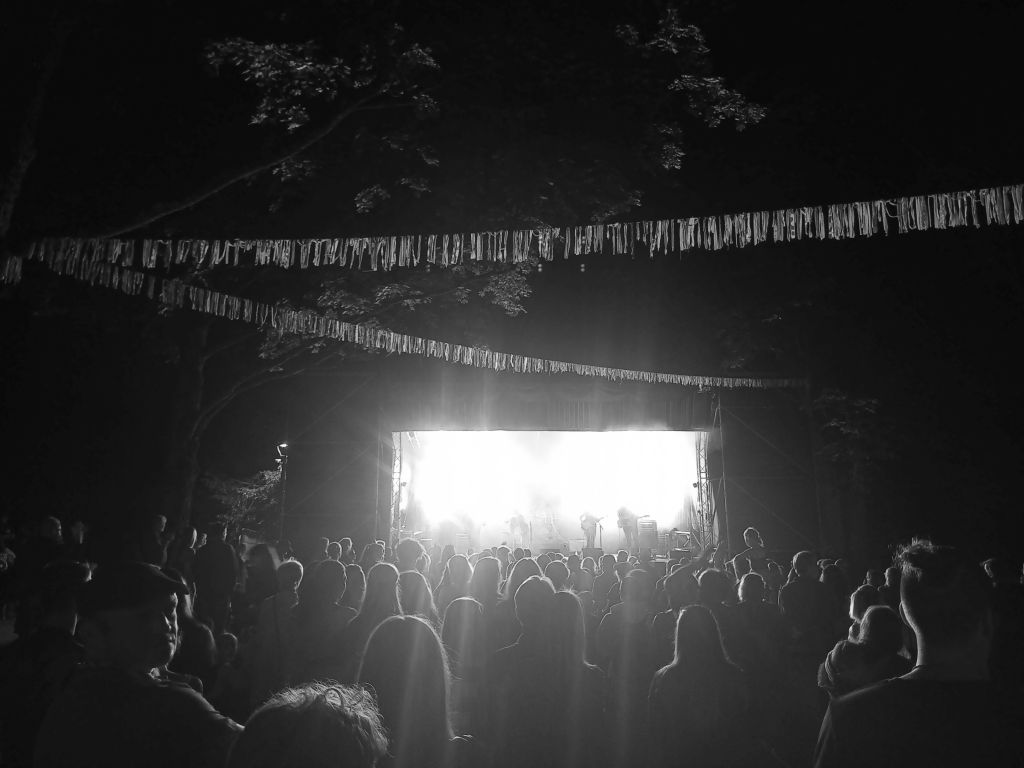
When the man is gone, I take some more time to unwind. The three girls are still sitting in the corner, looking half dead. It’s dark outside now. I actually have no idea what time it is, and only know, in a foggy way, that it is Sunday, which means that it’s the last day of Viljandi Folk. The concerts are still ongoing somewhere. And I promised Arno Tamm earlier that I would go see him during the final concert.  

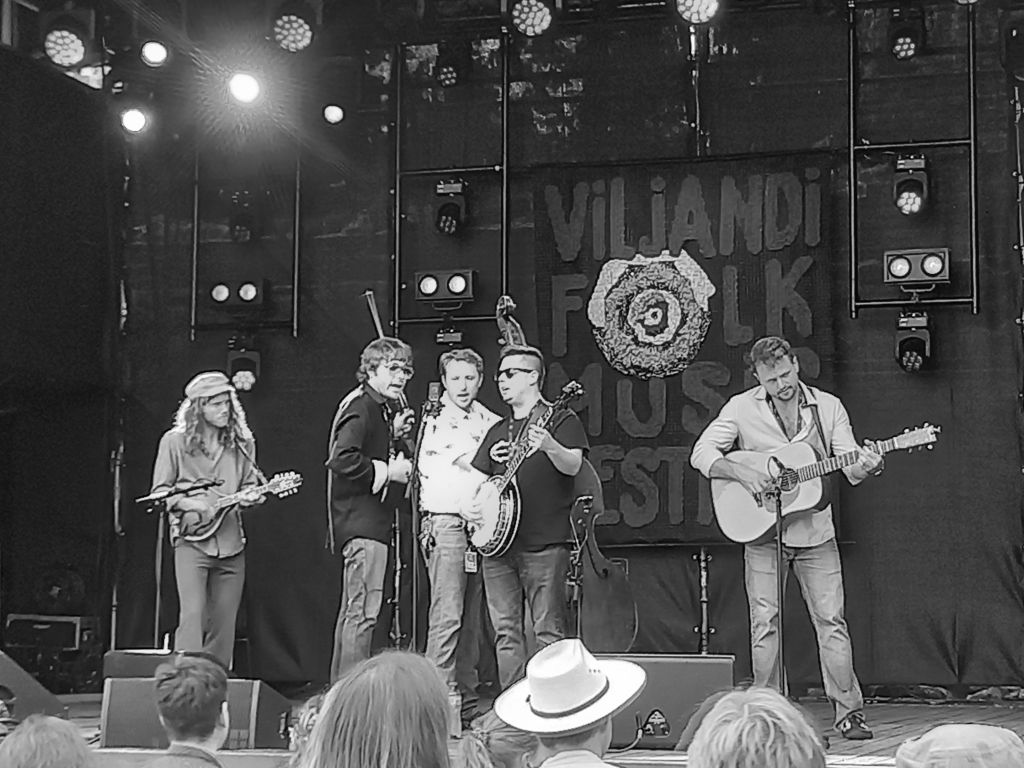
During one concert, I saw the American guitarist Jed Clark, who is from Arkansas and plays with the bluegrass band Midnight Ride, look out with tired eyes on Käevumägi, or the Well Hill, and a thousand or so beautiful people and say, “This festival is like a dream I don’t want to wake up from.” In the great hall of the Ait, I think that Jed is right. Earlier in the festival, I had a chat with him at the Green House Cafe. Jed told me in his soft Arkansas accent that Viljandi Folk was “just like paradise.”

I wasn’t so sure it was paradise. But a strange dream nonetheless. 

***

“PEOPLE COME HERE from the US, from Canada, and they have a hard time believing that this is all real,” Tomás del Real, a Chilean musician, tells me the day after his concert was well received at the Jaak Johanson Stage. He performed on Saturday night, and people praised his performance the following morning. “It was all so intimate and cosy and yet so grand and so global,” some gushed to me. I had planned to go there, but somehow got lost along the way, and must admit that I don’t know exactly where I was when Tomás played that night. I allowed myself to live a little that evening and so everything from that evening has already faded into the mist. But I survived and supposedly the music was good.

“They see the lake, the castle ruins, and they think, what place is this?” Tomás continued his story. “For a festival, it’s a really great place, and the way the festival uses the surroundings, the aesthetics, are done with incredible taste. Nothing is overdone, everything is very natural, and they simply fill out the environment,” he said. Tomás is in some ways like me. A foreigner who came to Viljandi and got stuck here. Years before we came, Ruslan Trochynskyi, the trombonist from Svjata Vatra, arrived here from Ukraine and was similarly seduced. We are now like one big Folk family and not just us, who have come from abroad. Estonians have arrived here the same way. They come to Folk, go for a swim, and stay. 

There is some kind of invisible pull. Even Tomás del Real, who is as clearheaded as they come, acknowledges this: “It is magnetic,” he admits.

I have of course heard criticism, that Estonian folk music is mostly fake and mostly synthetic, that the prices are too high, that this year’s Folk isn’t as good as last year’s, and so on. “These Folks are not like they used to be,” some say. 

It is true that before there were fences and passes, folk was an anarchic experience and all kinds of weird people turned up in town. I called them the “zombie army” at the time, the drunks, Nazis, and rednecks. But all was permitted and the people enjoyed that anarchy. At some point, it was decided that Folk would be a bit safer and those days drew to a close. But the magic continued. Gates or no gates, the spirit of Folk cannot be contained. And the security staff are only looking for alcohol, really. They give your bag a squeeze and then wave you through with a grin. You have been examined. Go on your merry way.

I wanted to say, in response to this criticism, that whatever they have, people never seem to be satisfied with it. Something’s always missing from the picture. Unfortunately, this phenomenon is too familiar to me. I find myself on a train south, staring from a window. I think, what am I doing here in Viljandimaa? My heart is full of disappointment and melancholy. Other people, such as those from Tallinn, have said to me, “Why are you wasting your life in some hole in Estonia?”

Viljandi indeed is an odd place, one you can only reach intentionally. No one shows up here by accident. Folk does offer a lot of reasons for people to come here. It is a rich and deep event. For those who are never satisfied, I would say, take a look around. There is some value here. There is something different at least. I had these thoughts as I hid myself away in the press room in the cellar of the Pärimusmuusika Ait. Outside there was rain and thunder, and the Ait was full of soaking wet people. In the corner of the press room sat my one true love, the object of my affection. But who is this quiet girl? What’s her name?

She’s a coffee machine, naturally.

***

THERE ARE ALL KINDS of stories shared in the press room during the folk music festival. One day, after a concert by Canzoniere Grecanico Salentino, I found myself seated again beside my beloved coffee machine listening to her purr. I must acknowledge that Folk is an exhausting experience. Even after just a few hours at Folk, a person is squeezed dry. All of that noise, all of those conversations and songs. Espressos are needed for a quick pick-me-up, so that one can still walk and write. The Italian group CGS is from Puglia, the province in Italy from which my mother’s family originates. One of their songs was about love, of course. This melancholic song describes a lovestruck man who sits beneath a woman’s window night after night, until the woman closes the window. But there he continues to wait until death, so devoted is he to the woman he loves. For me, this song was somehow refreshing. I have never heard of an Estonian who would do such a thing. Estonians are too practical for that. They wouldn’t waste their time in the name of Mediterranean love. But Mediterranean love is just like that. Passionate. Full of devotion.

“But in Estonia,” I tell a colleague in the press room, “if you sat underneath that window, the woman would call the police.” “Well, yeah,” she answered. “That could be really annoying.”

“But what do Estonians do when they fall in love?” I ask. “Does someone gift the other some potatoes? Or a bucket full of chanterelles?”

“No, no, they just enjoy their time together,” the woman explained.

“So that they are in the forest somewhere and one says to the other, ‘Nice day, isn’t it?’ Is that how they do it?”

The woman looked at me with her clear blue eyes. “If it’s love, then there’s no need to talk. You just have to feel it.” Simple. So, sitting underneath someone’s window isn’t especially welcome here in Estonia. But I have definitely wanted to sit beneath some women’s windows, at least a few times, whether I am allowed to or not.

***

LOVE WASN’T THE ONLY SUBJECT haunting me at Folk. Another was age, certainly. Not that I really needed to think about age so badly, but when most of the people around you are at least 20 years younger than you at least, and three of them are your own daughters, then it comes to mind. At some moment, Uncle Justin wound up in the company of some young ladies in their early-twenties and forgot for a while whether he was a responsible parent or just another one of the pack. So I went along with them. It was a good feeling. I started to feel like one of those older Beatniks, like the poet Allen Ginsberg or wild man Neal Cassady, when they joined forces with the young hippies of the 1960s. If things are moving in that direction, then why not go with it? Why not? Beautiful kids with beautiful eyes. Students who aren’t yet jaded or embittered. They still have hope. They go to sleep listening to music. They don’t make the sarcastic jokes of our generation. With them I am gentler, I listen more, and I’m supportive. 

As I told a friend at Folk, we are some kind of bridge generation. There are those important icons from the days of the Singing Revolution: Mart Laar, Edgar Savisaar, Siim Kallas, Tiit Vähi, and the others. And then there are these fresh young people who know nothing about that era and for whom it’s all just history. We are in between them, people like Margus Tsahkna or Jüri Ratas, who were both at Folk. We know where the bodies are buried, metaphorically, but we don’t want to share that information with the kids. Let them enjoy their youth. Let them run around holding hands when it’s raining and the Zetod are rocking. When someone comes by and reaches out, we take their hand in ours and run along together.

The Puuluup concert was a truly strange sight though. Their music is one that really does haunt you. The Hiiu kannel has the kind of sound that makes it hard to determine where it’s coming from. It sounds as if someone is playing with time. If I could ever play the sky and the clouds, it might just sound like the sound of a Hiiu kannel. There were so many people at the concert, it looked like a sea or bubbling soup. I watched and listened. Afterwards, I arrived at the idea that I no longer had an age. Age was just a number. But I felt in that moment, standing on that hilltop looking down, that I was more like some kind of Hindu deity. The embodiment of Shiva or Kali. Even when I was a child I knew it. The world told me what my age was, but inside myself I couldn’t tell the difference whether I was three or four years old. 

“I don’t feel old,” said the American folk musician David Crosby shortly before his death last year. “I feel the same way I have always felt. It’s just my body that has aged.”

I was and I am.

When Midnight Ride played on Kaevumägi, they called themselves the sons of Bill Monroe and Earl Scruggs. But I thought instead that nobody is actually the son of anybody. There is no before and there is no after. Music doesn’t age, just like souls do not age. Music is undying, as they say and exists at all times. All you have to do is to play it. I exist. In this way, we are all like music, undying, immortal. These were the thoughts I had during the Puuluup concert. 

***

A DAY AFTER THE CONCERT, I met up with Ramo Teder, half of Puuluup, who with his long white hair looks like he could be the managing director of Santa Claus’ elf toy factory at the North Pole. Maybe because he lived in Finland for so many years. Ramo is actually from Viljandi. On social media, one can see a photo of Ramo when he was a punk at the end of the 1980s. He looks quite stylish, a combination of Johnny Rotten and Wolfgang Amadeus Mozart. Puuluup is certainly not a punk group. There’s no “Anarchy in the UK” here, or in Estonia for that matter. But Ramo discussed how punk had influenced the ideas behind Puuluup.

“The idea that you have to overcome boundaries,” he said. The idea that all archetypes are tossed out the window. Estonian punk was different from American or British punk. Estonian punks were more like intellectuals. Most of the people in the Estonian SSR were standard issue. They wore the same clothes and had the same hairstyles. That some young man was walking around Viljandi with such hair was against the system. Hair, in this way, can be dangerous. There he now stands on stage, with a kannel in hand, age 53, singing about small birch trees. He also belongs to the tribe. Ramo is another brick in the Folk castle.

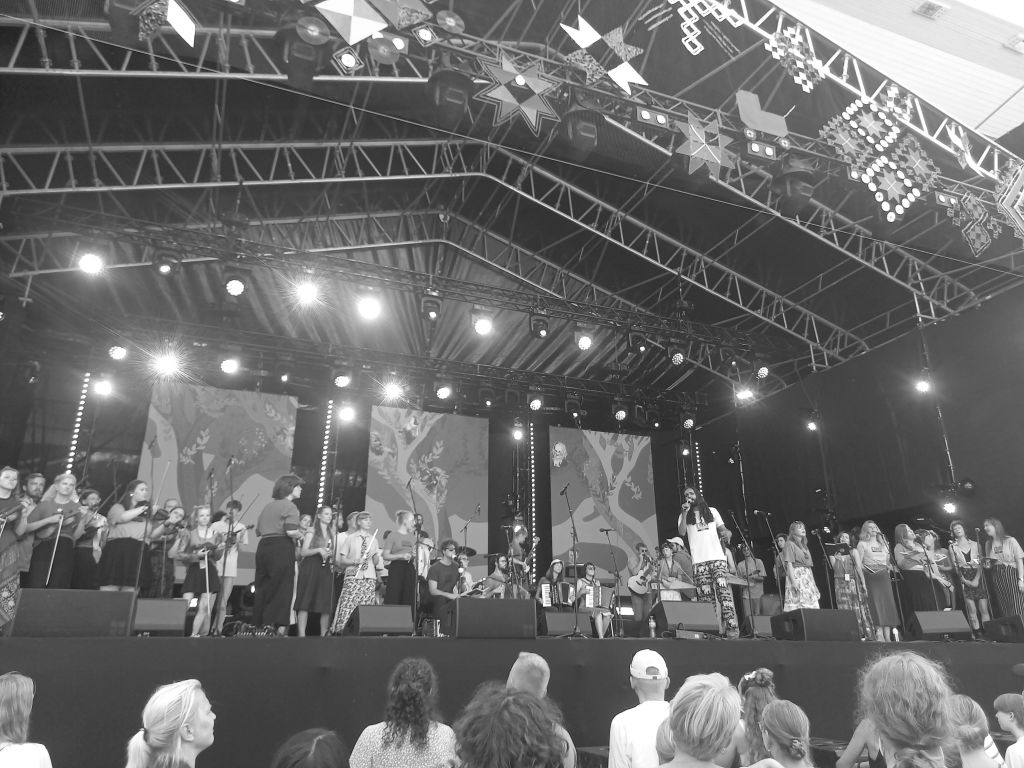
After the interview with Ramo, I found myself at the Eesti Etno concert. There were all kinds of musicians there, and they looked so happy. Were they too happy? I was dealing that week with the death of a high school friend. News about a friend’s suicide arrives slowly, even nowadays. Nobody talks about it on social media, only when you are famous. It took time to understand why this 43-year-old man had died “tragically and unexpectedly” as it said in a news article. But I eventually found out. So those Eesti Etno singers were singing and I was thinking about death and suicide.

One song did lift my mood. A young Indian was singing and the other sang along with him. At that point, I couldn’t really believe what I was seeing. Their clothes were so colorful. The music was so good. As sweet and satisfying as a mango lassi. It all looked like some kind of pajama party or Indian cult. Maybe some ashram had come to Estonia? Anyway, that was the right song for me at that moment, a person who was destabilized. Tragedy is like a little black cloud that follows you around everywhere. A song can help. Music can save lives. I would have liked to save my friend’s life the same way.

One night on the First Cherry Hill, as it is called, I thought I saw him, standing beneath a tree. But it was someone else.

***

DURING THE FESTIVAL, it becomes difficult to put one’s thoughts together. Looking through my notebook, I can find these kinds of scattered sentences and half-memories. “I left my journal in the press room, but Peeter the Estonian Swede came after me to tell me, and I ran back to get it, because my journal is full of kompromat that could make my life really difficult.” Or, “Some pharmacist from Tartu came up to me and started to talk about Paavo Matsin.” And, “Lauri Räpp was talking about resilience.”

The days melted together. There were a lot of concerts, for sure. The Italians. The Mexicans. The 6hunesseq-ians. Now that was a powerful concert, held in St. John’s Church at midnight. I fell asleep multiple times, because I was so tired, but the music was soft, warm, and enveloping, like a comfortable blanket. The musicians were out of view, because they were on the second floor, where the church’s orel is located. After they came down and people applauded. I guess I went home after that. I don’t quite remember. My friend found a rabbit in a park in Viljandi around the same time and took it into her tent. Later, she found the rabbit’s owner. These kinds of things happen during Folk. The mind no longer works. There is too much information, too much stimulation.  

Then one day I met a man who told me that Lennart Meri’s book Silver White is the Bible of the Estonians, and how the Estonians, or rather the Baltic Finns, are very special people, and how Meri, Uku Masing, and Valdur Mikita had written “philosophical diamonds!” The man is working with a project called Valge Laev, or White Ship, to develop the higher intellect of the Baltic Finns. “But if the Estonians are so smart,” I told him, “then why do you need me for your project?” “Because you can help us bring it to the wider world!” came the answer. He had a fur hat and a green shirt. A beard. Sparkling blue eyes. Like a photo from the collection of Johannes Pääsuke. The green shirt was inside out. Of course, I agreed to help. When the Land of Mary calls you, you heed that call. 

The following morning I have a slight hangover, because I thought the prior evening that I would allow myself to live a little. I asked myself, what would your favorite writer Scott Fitzgerald do if he was at Viljandi Folk? The answer arrived at once: start drinking wine! Life is for living! That night I wound up at the Untsakad concert at midnight. This was really like Anarchy in Estonia. I have never seen so many happy young people before. Untsakad are old men. They played at the first festival 31 years ago. But their fans are teenagers, or at university. I’m not sure what’s the attraction. Waltzes? Polkas? I like the Mexican band Kumbia Boruka more. They brought every cell in their bodies alive with their rhythms. They also appealed to writer Gert Kiiler, who said they reminded him of the show Miami Vice. “You know, they always have that kind of music playing somewhere in the background.” My friend, a Tallinn businesswoman who attends Folk regularly, recalled how she once had Don Johnson’s picture in her bathroom, so she could see him while she was taking a shower.

But Untsakad won over people’s hearts in the end. Even my 17-year-old daughter awoke the next morning and started to sing the “The Forest Brothers’ Song.” Ai-tsih, ai-tsah, ai velled, me metsavennad oleme! Which means something like, “we are the forest brothers, we are.” It really got inside her. For her the experience was also something like a dream. I received her rendition joyfully. “You’re a good forest brother’s daughter,” I thought, “even if your father is not a forest brother.”

***

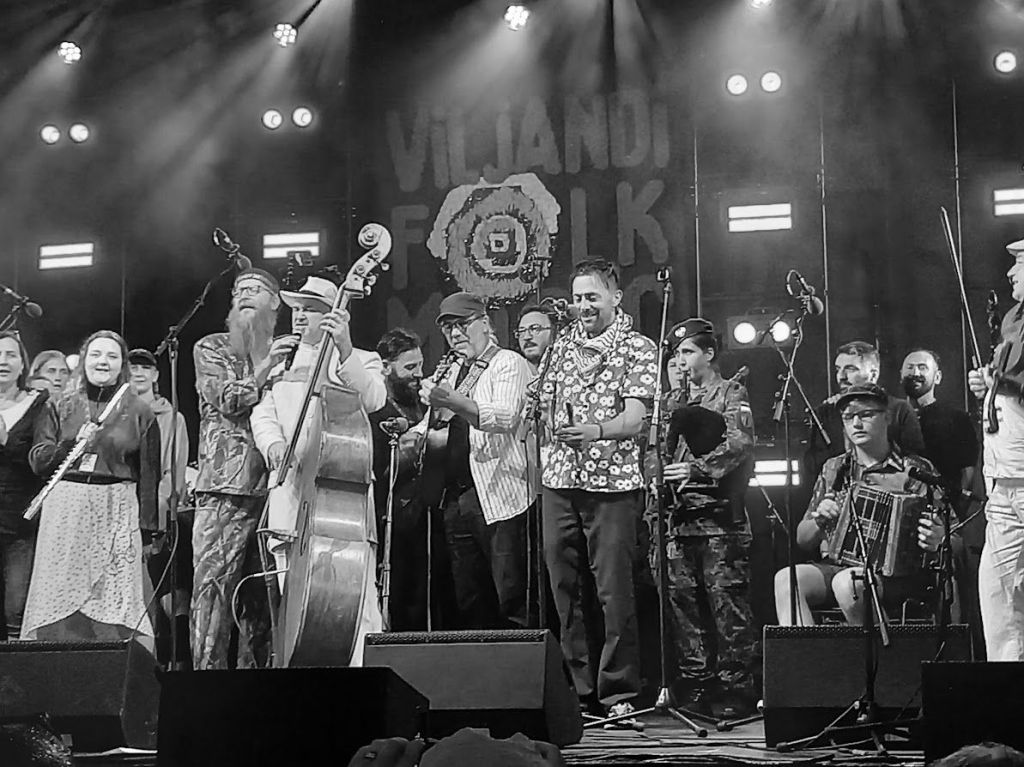
SOME PEOPLE COME and go during Folk, but then there are people like me who are folk soldiers and stay until the last concert. We gather in the rain as Ando and Friends sing. Ando Kiviberg is the founder of Folk and the festival usually falls on his birthday. This year, he’s 55! Ando and Friends is some kind of variety show. Every kind of band performs there. The man himself is a Leo, naturally. He is the king of the jungle. There he is with his fuzzy face in his white suit and white hat, looking like some kind of Latin American drug dealer. He plays the bass and sings along. It’s nice to see the king in his element. The leader role suits him well. Ando is neither arrogant nor pretentious. He doesn’t think that he’s better than the others, no. But still they come, like small house cats, with their offerings to the Great Lion! Neither dead birds or mice, but songs. Silver Sepp has taken Tony Rennis’ 1962 Italian pop song, “Quando, Quando, Quando,” and made it over. The song’s new name is “Ando, Ando, Ando.”

At some moment, I get tired of all those bagpipes and fiddles and go to the other side of the Second Cherry Hill. There I stand beneath an umbrella and put on my headphones. I’d like to hear a little Led Zeppelin now. I am done with all of this folk music! I’d rather listen to “When the Levee Breaks.” To my surprise, these two things suit each other surprisingly well. I look up at the big screen and see Ando singing. But instead I hear Robert Plant’s voice. Ando is singing, “Crying won’t help you, praying won’t do you no good!” It’s still raining. We are all soaked. Soon the levee really will break. An incredible combination. Ando and Zeppelin. My own levee really has broken. Then I realize that I have really lost it by now. I march over to the Ait. I look for a comfortable corner inside where a burned out writer can relax a little. Then that stranger appears with his magic button in hand. The three girls are in the corner and I am sitting on the edge of the stage. The man is showing me his button.

“That’s genius,” I say. My voice sounds distant, as if it belongs to someone else. “Just genius.”

An Estonian version of this article appears in Edasi, and the original was written by the author in Estonian and rewritten into English. The English and Estonian versions have some differences, so do read both!

like a european movie

IT’S EIGHT THIRTY AM, and I’m getting on board a northbound train in Viljandi. Two women sit nearby, waiting as well. Over their shoulders I can see that Lavazza instant coffee machine gleaming white in the sun. The last time I took a train here, I got an espresso in a paper cup, but by the end of the day, and after many coffees more, I looked like someone who had been on a nasty amphetamine binge, and so this time, I have decided to forego the morning espresso. The machine is nice though. It’s a welcome Italian brand. More than a few weeks ago, I decided to sojourn out to Vasknarva, which is at the very edge of the European Union, so I could take a hard look at the fearsome Russian Federation on the other side. Through swamps and forests I journeyed, until I at last saw the onion domes of the Vasknarva church, and trekked down to the harbor where I met some fishermen. They tried to speak to me in Russian, but since I don’t speak Russian, we got by with a few hand gestures and some Estonian words. “Kala,” one of them said. As I stood there, looking over the river at the smoky shanties on the other side, I saw it again. There was a Lavazza coffee machine in Vasknarva. 

I could drink coffee and watch Russia. 

“Estonski?” one of the fishermen asked me.

“Nyet, amerikanski,” I told him. 

His eyebrows raised upon hearing this and he gave me a puzzled smile.

Of course, I ordered myself an espresso from the machine. For me it served as proof that I was still standing in the civilized world, as I saw the border patrol glide up the river in a boat. This feeling of Europeanness means something to me. This is what Europe was supposed to be about. Efficiency, precision, the ability to use a chip card to order an Italian espresso from a machine at the murky riverside of the Western world. These small coffees do mean a lot. 

***

AN HOUR AND A HALF later and we pull into Saku. The grass is lush green and dotted with yellow marigolds. Odd new geometric buildings stand in circles near the approach to the town, like a jumble of Lego toys. Europeans like to live in these kinds of Lego buildings. Not too long ago, I was standing on this same platform in the snow cold when the train pulled up. The Estonians call these trains “carrots,” because of their orange color, but I still can’t bring myself to say I took the “carrot” to Tallinn. I was standing there and through the glass, I could see a young woman who I knew, just sitting on the train. There was something cinematic about that vision, of the train pulling up in the winter dark and seeing her seated there through the glass. After some time, I worked up the nerve to go and talk to her. She was on her way back to Viljandi. She’s very young, but she looked a bit sleepy, world weary. She keeps herself busy, I think. You have to appreciate the romance of these trains though. When I write to old friends back in the US, they especially like these kinds of details. How I saw a girl I knew on a train, or how someone came in on the train and left the same day. Or how someone missed the train. For them, it’s reminiscent of that old movie Before Sunrise with Ethan Hawke and Julie Delpy. 

In California, most people drive. In New York too. Here, I almost never drive anywhere.

Estonians, I think, wouldn’t make these connections. They don’t see how similar their lives are to the French and the Austrians and the “real Europeans.” I will admit that the country does feel mostly like a wilderness. Whenever I drive from Riga and begin to see those dense birch forests, I get the sense that I am heading to the very edge of the world. To leave these forests and go to a city like Rome or Barcelona or Paris is, in the Estonian mind, to go to Europe. But this same Europe also contains other far-flung corners, whether they be the Scottish Hebrides, or the Norwegian fjords, or the rocky Greek islands. The Estonian north woods are part of this larger experience, and through them one can travel on reliable little trains that some call “carrots.” The train pulls up and you can see someone you know through the glass.

***

NOW THERE ARE THE CRANES and graffiti of Tallinn. From here, Viljandi feels like a distant world. For me, Viljandi is just another provincial European town. It has its castle ruins, its old churches, its hotels and bars, its cafes and bakeries. Something about its sloppiness, those old falling-down fences and unpainted facades, makes it especially Gallic in feeling, as if I got lost somewhere outside of Lyon and turned up in this dusty place. Surely the fishing villages of Brittany must be home to similar layers of decay and renewal. Old barns renovated into cafes and bars. Haunted lost old factories. And did you know that there are three Americans living around the corner from me now? One from Florida, one from Massachusetts, and one from West Virginia. There’s an Argentine and a Dutchman too, and an Australian cycles by daily and waves. For the middle of nowhere, it’s some kind of somewhere. A small French town, as I said, that happens to be up in the north woods, and where they speak Estonian instead of French. 

Sadly, the wine and bread and cheese aren’t as cheap, but you can get other things at the markets here, and they are playing the same 1980s hits that they play everywhere in Europe. Here they sell cloudberries, black and red currants, and dead eels. In the fall, there are piles of chanterelles and buckets of golden potatoes. There are weird aspects to life here, for sure, but those weird aspects are in every place. The other day I parked my car, and a man started yelling something across the street at me, something about Estonians and parking. An older man with gray hair. I think he was drunk. But there are these kinds of people everywhere. I’m used to it. In America, they yell at you about Jesus and Trump and Obama, here they yell at you about Kalevipoeg and parking. Every society has its pressures, its idiosyncrasies. These things change wherever you go. Often in Estonia, I can feel the weight of the ideas of its people on me. They talk about things as if I know what they mean. My favorite is when Estonians tell you to “be normal,” or to “be concrete.” I imagine turning myself into a stony slab. Even better is when an Estonian will say to you, “but I’m a normal person.” Olen normaalne inimene. Yeah, right. I just shrug my shoulders. I have learned to. It’s too tiring to pay it any more attention.

I don’t take Estonia as a place that needs to satisfy my desire for everything I want. These days, I just take life here as it is. I do like those touches, the instant coffee machine on the Narva River, the smooth running trains gliding into Saku at night, the sleepy-eyed young people on their way to somewhere. I’ve been living in Europe off and on for two decades now, and I wonder if it has changed me, if I too have become a European in this time. I’m not sure what that means. I think my inner American appreciates these little scenes a bit too much for me to be a real European. I still think I am living in some European film. Sometimes it’s an erotic thriller. Sometimes it’s a comedy. More recently, it’s been turning into a historical drama about the lead up to a big war. It’s Midnight in Paris starring Owen Wilson, except Morning in Estonia, starring Justin Petrone. But you know what, I like this movie that I’m in right now.

I wouldn’t change a thing.

An Estonian version of this piece appeared in the newspaper Sakala this week.

the trumpet player from barcelona

AT THE START OF MARCH, our cat Kurru started behaving strangely. Kurru is a striped female cat, aged about 17 years. She’s thinned out in her elderhood and doesn’t eat with the same enthusiasm she once had, but she is still quite active, when she’s not sleeping the day away on the kitchen table. From time to time, I’d find her staring out the window. The winter was ferocious and long, but with the warmer weather, she’d become less intimidated by the idea of going outside.

She would usually sleep through the night, but when March began, she became more active in the early mornings. At about six, she would start to make odd noises that are difficult to transcribe. Let’s just say that all of Estonian’s lovely vowels were represented, such as ä, ö, ü, and õ. “Äöüõ! Äöüõ!”  This wasn’t your usual “meow.” It was different. Naturally, it got on my nerves and I would have preferred to slumber on in silence beneath my warm blanket. A few times I shouted at her to be quiet, and even threw a pillow at her. The cat Kurru then ran to the other window and continued with her cat’s lament. Then one morning I looked out the window and saw who she was talking to. There was a beautiful black male cat there, who was saying the same things to her in that same strange voice.

Our cat isn’t of child-, or kitten-, bearing age anymore. I think. She’s an old lady. Seventeen! This would be as if Meryl Streep or Helen Mirren got pregnant. Maybe it’s still possible, but it just doesn’t happen every day. But this reality doesn’t seem to make a difference to the other cats. Someone in the cat community has apparently spread the news that in this apartment — our apartment — lives a female cat. And so those male cats arrive at six in the morning and line up beneath our Kurru’s window. I can hear their agony through the glass. Cats apparently can’t masturbate. Or can they?

I don’t really want to know, but anyway, our cat has had to live with this constant torment, that the neighbor boys just won’t give up. Sometimes I think she even enjoys this little mating season drama. She is more waiting for it than fearing it. Sometimes the black cat is beneath the window, but other times there is a fat orange cat with a flat face that looks like Boris Yeltsin. These cavaliers are waiting, steadfast. They want Kurru to come away with them. They don’t seem to be ready to give up any time soon.

How come they never give up?

***

But enough about cats! I actually wanted to talk about music today and Barcelona. And not just about music, but about a certain musician. At the edge of our town dwells a certain family of considerable means, they are nouveau riche — as far as I know they lack an aristocratic pedigree — but they have learned to live like the old rich live, to sleep in the best hotels, to drink the best wines, to appreciate fine art, travel, and the good life. Some time ago, these travels brought the mother and daughter of the family to Barcelona, where they stayed in an exclusive hotel suite. From the windows, one could look out on all that Barcelona had to offer.

The mother of the family is a little older than me, a mature, beautiful and intelligent woman, who wears wonderful clothes. Her daughter is about 20 and is studying international affairs in Geneva. She has blond hair and has a good sense of humor. She’s also quite playful and likes to make jokes, like a puppy, I guess. It’s always fun to pal around with her. For me though she has always just been my friend’s youngest daughter. She has never been anything more.

This is an important fact, because one night she met a man who is about the same age as me. A little younger, but not much. This happened when they decided to visit a Barcelona jazz club called “Tony’s Swing Club.” In the band, there was an American who sang and played the trumpet. I don’t know where he really was from, but I like to think he came from New Orleans.

“I’m sorry,” my friend’s daughter said some time ago when she told me about him, “but that trumpet player looked a lot younger than you.” “Does he have three daughters,” I asked in response. “No, he has no children,” she answered and added, “and he’s never been married either.”

“Well, that’s why he looks so young,” I said. “Give him three daughters and a rough divorce and let’s see how young he looks.” “Yes, it’s hard to say what he’s done in his life,” the young lady agreed. “Apparently he’s just been playing the trumpet.”

He definitely played the trumpet and quite well. So well that my friend, the young lady’s mother, invited him to their hotel for a private concert. And that almost 40-year-old musician from New Orleans went along, of course. I don’t know what he looks like, but I imagine something like Harry Connick, Jr. At the hotel, he serenaded them. Maybe he performed something from the Louis Armstrong songbook. “And I say to myself, what a wonderful world …” The woman and her daughter sat and watched and listened. When the concert was over, they applauded.

Later they all drank some good Spanish red wine.

“I thought that musician was interested in me,” the mother of the family acknowledged to me later. She really is an attractive woman and charismatic, and these kinds of women are known to often drive men crazy. “But then I understood that he was actually in love with my daughter.”

I don’t know if this revelation disappointed her. The woman will soon turn 50. The daughter is in her early twenties. But, to borrow a line from the American President John F. Kennedy, “the torch was passed to a new generation, a generation born in this century.” Unfortunately, the musician’s young muse wasn’t interested in him. The trumpet player was sad about it, but he still didn’t give up.

***

Quite the opposite. A few weeks later he arrived to Estonia. Officially, he was here to attend a music festival, but he really came for the young lady. I have a hard time understanding just what exactly he was after. Love? That this young lady — half girl, half woman — would respond to his interests? But what would become of the young lady’s career in international affairs? Or did he want to marry her? Or maybe just to steal a kiss?

Here, I admit that I’ve had similar experiences. Because of that, I can tell you that he had no idea what he wanted. Sometimes a woman’s spirit gets so deep inside of you, it’s hard to exist without it. It takes over your whole body and soul. It’s even hard to breathe. It’s hard to think. It’s hard to be. It makes men do stupid things, not on purpose, but because if they don’t buy those plane tickets or send that love letter, they will go insane or explode. It’s such a big ball of energy, like crashing waves on a stormy ocean.

The waves will flow, whether you like it or not. The only question is how to navigate them.

This time, when my friend’s daughter’s musical suitor appeared in Estonia, she was quite direct with him. She told him all kinds of nasty things and then blocked him on every channel.

“I told him that I was sad that he was so old and had accomplished so little in his life,” the young lady told me. “I didn’t mean it, of course. I just wanted him to leave me alone.”

With a broken heart, the trumpet player dragged himself back to Barcelona. Maybe he even cried, as I have cried. Maybe he wrote to her, as I have written to women. Maybe he even lied to himself, as I have lied to myself.

“She was too young.” “She wasn’t the right one.” “Who wants to be with a woman who is still in college?” the trumpet player lied to himself. He went back to his jazz club, met some Spanish woman named Maria, got drunk and wound up in bed with her. But all through the night he spent with Maria, he was haunted by a tiny Estonian plika.

It’s not so easy to free yourself from a woman’s spirit.

In the morning, he grabbed his smartphone and tapped out some sentences to her and pressed send.

“Does he still write to you?” I asked the young lady recently. “No,” she answered but then whispered, “actually, he does, but I don’t respond. But, yes, he still writes.”

“See,” I said. “Some people just don’t give up.”

***

There are a lot of stories like this and I hear them all the time. Most women are tired of these characters. A real man should be like a Cleveron robot who goes where you want him to go and then says something when you press a button. When you say, ‘Don’t write to me,’ he won’t write because he’s a good robot.

But some still write. And not just men. Women too. This has become my strange hobby. I ask friends if their suitors are still writing them, or if they have given up. I am trying to understand their psychology and my own. I have a friend who left her partner long ago because he was smoking too much pot. She blocked him everywhere and told him she never wanted to see him again. The reasons for the split were clear. But the man kept on calling, until his number was blocked too. “I don’t understand what his problem is,” the woman said. “Do I really have to spend my whole life with my ex-boyfriend haunting me?” That guy just won’t give up though. He is stuck inside a prison he built for himself, where his thoughts spin round in circles. With all channels blocked, maybe he might send a message by carrier pigeon?

“Sometimes it seems to me that when a woman falls in love, it’s nice, but when a man falls in love, it can be catastrophic,” a famous Estonian singer once told me, who is considered to be something of a love expert.

One of my male friends though said that it’s programmed into the culture. “Women play hard to get. Are they flirting or not? In films we often see how the main characters hate each other at first but become lovers in the end.” This happens in many old and new movies, he noted.

“What else do people have left, when they can’t even believe in love?” asked another friend rhetorically, who has become a well-known actress. “People like to believe that they know what’s best for them. And if this good thing is this girl who tells you no all the time, they still believe that she will say yes in the end. That she will finally see the same things that you see, and that a happy ending still awaits.

“For me, the most interesting thing is that we still think we know what’s best for us,” the actress went on. “I certainly don’t think that I know what’s best for me. Life knows best. And if life doesn’t offer me that boy I want, then naturally he’s not the right one for me. That’s why I don’t pursue people in such a way.”

According to this actress, some people just don’t listen to life, but she acknowledged the game of love can be confusing. “Especially when all women supposedly want you to compete for their hearts,” she said. “Then you have to figure out if you should still compete for her love or just leave her alone.”

***

I don’t know what became of that trumpet player from Barcelona. It’s possible that he’s still performing in the same club. Or maybe he’s moved on, to Madrid or Paris. Maybe his heart was so broken that he moved back home to New Orleans. Maybe he met a nice person along the way and they’re now married and expecting a daughter. Maybe he doesn’t look so young anymore. If he still thinks of that Estonian girl, maybe she has inspired him to play the blues only better. Maybe his solos are more emotive now, more intense, richer and deeper. Maybe when he sings, his voice cracks as if he’s about to cry. Maybe it was necessary for him to get his heart broken, so that he would get to the next level.

In this way, pain can be a blessing. As I have found with my own pain. I could of course write about the person who broke my heart. I could write about her until the end of my days. Novels, short stories, and poems. Some part of this experience won’t ever leave me, no. Part of my heart just won’t give up on her.

I find myself still thinking of her, especially in those early mornings at first light, when the cat goes to the window to give her cat’s concert. Our sturdy, mature feline awaits her suitors on the other side of the glass. It’s terrifying sure, but also a little thrilling.

And there she sits. She sits and she waits and she never gives up.

An Estonian-language version of this piece recently appeared in Edasi.

the uncle frank story

Every Uncle Frank has his own Uncle Frank.     

EVERY ITALIAN FAMILY has at least one good Uncle Frank story. This is for the simple reason that there are so many Uncle Franks. Frank, or Francesco, continues to be one of the most popular Italian names, and even in the 2020s, it ranks second only behind Leonardo among new-born Italians.

My grandfather’s name was Frank, and so to all of his nieces and nephews, he was Uncle Frank. My mother’s brother is also called Frank. Believe me, we have a lot of Uncle Frank stories concerning this particular Uncle Frank. The funny thing is that all of those Uncle Franks also had their own Uncle Franks. It’s like looking through a kaleidoscope or prism; you point it at one Uncle Frank and then suddenly there are hundreds of them reflected in tiny pixels, a fantastic mosaic of Franks for the eyes.

This is not to be confused with Cousin Frank. Cousin Franks, sometimes nicknamed Frankie, are a different phenomenon. Thanks to Italian naming traditions, I have at least two Cousin Frankies that I know of, and there may be more. Years ago, when I briefly toyed with the idea of compiling a family biography, I began collecting stories. I knew that I had a Cousin Frankie who was in a rock band. Because of his dark and mysterious looks, he had at least for some time been nicknamed Cochise, after the Apache Indian guerrilla.

There was another cousin that I had heard of, however, who had ventured to the South Pole. And then there was a cousin who was running a pizza restaurant out in the Rocky Mountains The book project was going well, and I imagined all of these as three separate profile pieces. The rock musician, the Polar explorer, the pizza guy. After some investigation, however, it turned out that all of these cousins were the same person, Frankie Abbatecola, one of my great Uncle Vinny’s legions of grandchildren. Had I written the book, most of it would have been about the same person. This energetic Cousin Frankie is a Mötley Crüe devotee not much older than me, who slings pizza dough during the day, wakes up the neighbors with his electric at night and yes, even once made it to Antarctica, or at least some place where there happened to be lots of penguins. Today, Frankie runs a busy pizza restaurant in Massachusetts called “I Love Frankies.”

Whenever anyone questions my Italian identity, I just tell them about I Love Frankies.

 “That’s my Cousin Frankie’s place,” I say. They seem satisfied by this information.

***

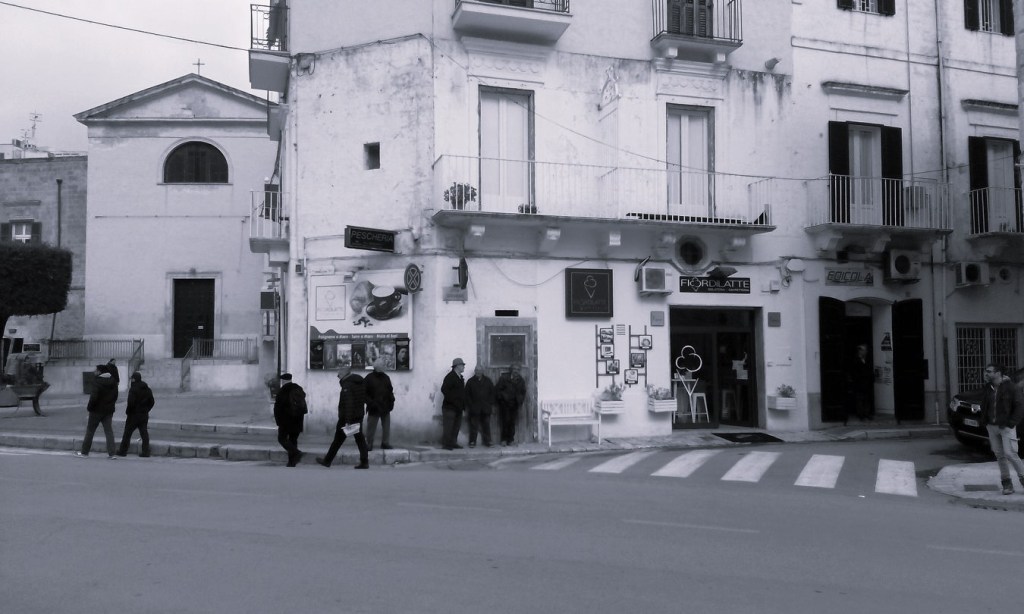
BUT THIS STORY is not about Cousin Frankie. This story is about Uncle Frank, and a certain Uncle Frank who happened to be the older brother of my grandfather Jerry’s mother Rosaria. I suppose to me, he would be a great great uncle. His real name was Francesco Petrellis, and he was born on a mountain top in Calabria in a village called San Giorgio Albanese overlooking the Ionian Sea, the same place where I once happened to spend the night watching Godzilla dubbed into Italian after almost sleeping in a furniture store. His birth year was 1889. It was a long time ago. At that time, America had not even yet formed itself on the lips of my predecessors. It’s interesting to imagine that if I rewound the clock back a century, most of my family was not speaking English. They were Italians, born and bred into the soil.

Uncle Frank emigrated to the United States with his family in 1900. It seems his father, whose name was Carmine Petrellis, and who came from an old Greek family in that little hilltop village of San Giorgio Albanese, had already crossed the mighty Atlantic once before, but this time decided to make the move with his whole family. There was Francesco, Rosaria, Maria Theresa, and their youngest sister Rosina.

It’s hard for me to imagine what the lives of this immigrant family was like because Carmine, the father, was illiterate, and when they later purchased a house in the town of Huntington on Long Island in the 1920s, where I was born, it was Carmine’s much younger wife, Anna Meringolo, who signed the contract, because her husband didn’t even know how to write. By that time, they had come to call themselves Peters, instead of Petrellis, to make their American lives more manageable. That was a fundamental aspect of American identity. Even if you were not born in America, and obviously were not an American, you could give yourself an American name. Petrellis became Peters. It was a cosmetic change though. Because a person can change their name, but that doesn’t change who they really are. A name is just a name.

The newly minted American “Frank Peters,” known to anyone within his circle of family and friends still as “Francesco Petrellis” was a loyal citizen of the United States but spoke Italian as a native tongue. He married, perchance, a Hungarian immigrant named Ethel, who was from a village called Nyírbátor near the Romanian border. I know much of this information because in 1920, she applied for a passport to visit Czechoslovakia. What I find fascinating about this is that she had never had a passport before then. In the early 1900s you could sail from country to country and settle with no documentation.

It seems that Uncle Frank and my grandfather Jerry had something of a rapport. Perhaps because my grandfather Jerry did not get on so well with his own father, Salvatore, which was understandable considering that he had once left him tied up in a basement cellar. According to my grandmother Margaret, they would go and visit Uncle Frank and share some coffee together. Maybe have cake.

Jerry had met my grandmother Margaret, who was not Italian, while working for a construction company in Virginia during the war. They were introduced by friends and married impulsively after knowing each other for just a few weeks. Margaret at that time was working as a school teacher. One can only imagine this young Virginian school teacher being introduced to the enigmatic Uncle Frank, with his fedora hat and thick Italian accent, and his equally mysterious Hungarian wife Ethel. He told the government whenever they asked him that he did odd jobs for a living. But according to various family members, Uncle Frank really made his living as a chauffeur for underworld figures. My father claims it was to Vito Genovese himself, “Don Vitone,” the founder of the Genovese crime syndicate who dominated the American mafia for most of the 20th century. Others claim that he drove around another mobster called Capone. 

Whether true or not, Uncle Frank was well paid for whatever kind of work he was doing in his career of odd jobs. Then one day in early 1965, when he was already an old man with a cane, Uncle Frank paid his nephew Jerry a visit and gave him a $500 bill. This banknote, which is no longer in circulation, featured President William McKinley on the front. My father still recalls the scene of the old man in his fedora sitting in the family kitchen and handing his nephew the money. Uncle Frank visited all of his relatives that week and similarly gave each one of them a $500 bill. And this became the Uncle Frank Story, the old relative who showed up, handing out $500 left and right. He then departed the United States, ceased being Frank Peters, and resumed being Francesco Petrellis and died several months later in San Giorgio Albanese, his home village. After he died, my grandfather Jerry went over to his uncle’s house. Frank’s wife had died the previous year and the house was empty. To his surprise, he discovered bags of money, hidden in various places. There were several purses full of banknotes that had been stuffed in the oven.

***

AS AN ITALIAN-AMERICAN, such stories fascinated me. Not only because anything connected to the Mafia had been glamorized by Hollywood, or in glossy magazines that featured modern day bosses like John Gotti on their covers, but also because they were so distinct from neighbors or schoolmates, whose worldly predecessors might have been prominent attorneys, or perhaps the lieutenant governor of Massachusetts. What to make of this murky connection to murky people doing shady, shadowy things? And was I also one of them? Did the apple not fall from the tree? I had tried to be a respectable journalist, but respectability always seemed just out of grasp for my family. It was elusive. We were people who kept cash in ovens.

After I had returned to New York after an adventure in Calabria at the age of 30, I did show photos of San Giorgio Albanese to my Virginian grandmother, who was 91 years old then, and quite lucid, though fading mentally. This little old gray lady without a drop of Italian in her veins. Her body was trim and lean, and she had her own kind of measured or balanced energy that she carried with her. She spoke softly, and on the few occasions that I told her I loved her, she seemed a little embarrassed. Such was not the measured, restrained way of the Virginians. Her husband was gone, but here was his grandson asking questions.

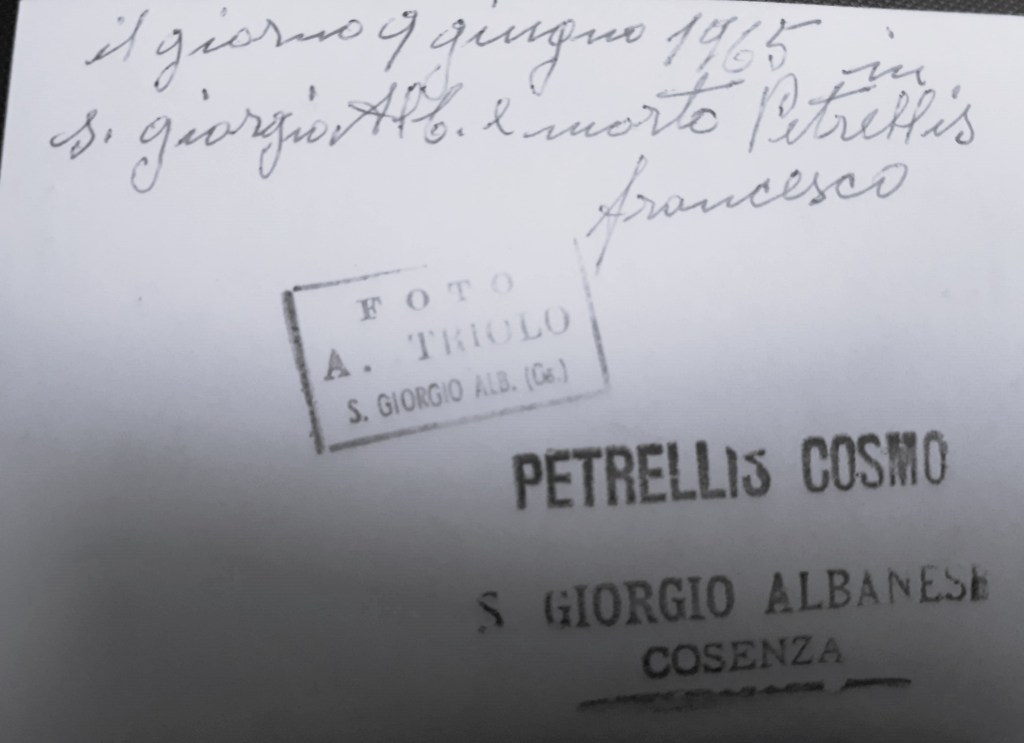
A few days later, she called the house to inform me and my father that she had found a curious photo. Later, when I saw it, I found it quite interesting indeed. For the black-and-white photo showed a dead man in a coffin, covered with bouquets of flowers. On the back of this photo read, in Italian, “On the 9th day of June 1965, in San Giorgio, died Petrellis Francesco.” The photo had been taken by A. Triolo, also of San Giorgio, and the photo was signed by Cosmo Petrellis. 

This family curiosity had traveled across the Atlantic and across decades of forgotten memories, only to find its way into my hands, hands that had recently returned to that same village. In thinking about Uncle Frank with his fedora hat and bags full of mob money, I felt that I had understood something that perhaps only another Italian could understand. That whoever we were, and wherever we lived, and whatever names we called ourselves, we were still this illusory thing. Italians were just another unexplained meteorological phenomenon, like those tall waterspout tornadoes rising up like the mighty staff of Poseidon from the depths of the Ionian Sea. We came and we left, we appeared, vanished, and reappeared. One day, we might show up at your door in a crisp gray suit and fedora with a bag full of $500 bank notes. The next day we were gone. And weeks later, we might turn up in the old village, to greet our many relatives. 

Just as I had done weeks before in the mountains of Calabria.

Uncle Frank was Frank Peters to the US government and Francesco Petrellis to the Italian one. His odd jobs were driving bigshot mobsters around. But Italians belonged to other kinds of systems. Governments didn’t mean as much as family. The mafia was just another kind of human organization, as legitimate or illegitimate as the local police. Laws were distant, arbitrary, written by strangers. Politics, like in the mafia, was personal, dangerous, and corrupt. And time was just imaginary. Everybody knew that it didn’t really exist.

soy loco por tí, estonia

SOMETIME IN THE BLEAK DEPTHS of the pandemic, I became aware of the arrival of some dark-haired, shadowy strangers in town, mysterious characters who would lurk at the margins of parties, or whose strumming of guitars might be overheard whenever I passed the room they were renting on Posti Street. The Chileans! The way people around me referred to them, it was as if a whole orchestra from Valparaíso had been shipwrecked on the shores of Lake Viljandi. In reality, there were just two: Tomás del Real and Javier Navarro. But they were important. They were part of something new: a little South American community in Viljandi.

Viljandi, despite its rather small size, has always hosted pocket-sized minority enclaves. One stretch of Pikk Street was once called “Jew Street,” because of the active Jewish community that dwelled there before the Soviets deported some and the Germans and their evil helpers murdered the rest. Viljandi’s Jews even had their own sauna and fire brigade. There are also stories about the Romani people, or mustlased, who once camped in the forests where the Metsakalmistu, or Forest Cemetery, is now located, and how the Romani women tried to convince Mayor Maramaa to buy them horses so that they could leave. As far as I know, there was never a Latin American community here, until the arrival of Tomás and Javier from Chile, and Pepi from Argentina, and Tito from Cuba, and Miguelito from Mexico too. Slowly, something new is coming into existence.

Of these Latin Viljandiers, musician Tomás del Real is perhaps among the better known. On August 26, he performed at the Pärimusmuusika Ait, or Folk Music Center, to celebrate the release of his latest album, Principios de Declaración. Del Real is no stranger to the iconic Ait. He even used to live in the cellar when he first arrived in Viljandi and got an artist’s residency.

“Downstairs is where my room used to be, and every time I go there, my heart skips a beat,” he says. “Next to it is the rehearsal room, and that also gets me emotional.” Tomás recalls staring at the stones in the wall, or looking out the windows of the Ait on winter days when everything about Estonia was new, and he would take long walks around the old castle ruins. “Every spot in the Ait contains memories,” he says. “Every time I perform in the Ait, I get nervous, because it matters to me.”

His own performance, in front of a mostly packed house, came off flawlessly. While the songs on the record have diverse origins, the quiet introspection of Viljandi life has seeped into all. He also structured his show in a unique way, with one half of the stage divided between a standing microphone, where he addressed the audience as would any singer songwriter, standing and at times, and  discussing the political situation at home in Chile. On the other part of the stage, he had a “living room,” where he played his tunes just as if he was at home. Tomás says this is part of the duality of being a character and a witness to music being created. He adds that during the “living room” segment of his show, he for a time felt like he was home, which, for now at least, means Viljandi’s Old Town. He even has a composition on the record called “Viljandi.” Though he grew up so far away, he also says there are certain commonalities between Chileans and Estonians. The era of the military dictatorship in Chile officially ended in 1990, while Estonians restored their independence the following year. 

Tomas del Real on stage in Viljandi on August 26. Photo by Kerttu Kruusla.

“We have both been oppressed and in difficult situations,” says Tomás. Because of that, he says, both cultures value friendships, because they have learned to rely on each other.  “It’s the only way that people who have suffered for so long can function as a society,” Tomás says. He adds that Chileans have also learned to be tight-lipped like Estonians, for the same reasons. 

Viljandi has also fostered a creative streak in Tomás, which is another reason why he has stayed here. At one point, he was writing one new song a day, some of which appeared on a record he cut with local musician Lee Taul last year, calling their duo Don’t Chase the Lizard. The rest of it populates the hypnotic tunes on his latest solo outing. But Tomás is not the only musician from South America in Viljandi these days. There is at least one other sudamericano

He is the one known to all as “Pepi”.

Indeed José “Pepi” Prieto might, in some future almanac authored by local historian Heiki Raudla, be considered the pioneer Latin American in Viljandi. He was the first to explore it, the same way that explorer Juan Diaz de Solis once dropped anchor in what is now Argentina in 1516. A native of Buenos Aires, Pepi had almost anything one could dream of by his early twenties: a steady girlfriend, a band, a career. He was restless though, and decided to go abroad for a spell, where he worked as a programmer in Indonesia. A chance encounter with an Estonian woman there inspired him to come to the northern margins of Europe, just as it once inspired a young American journalist to do the same. It was a decade ago, and just a few days before Christmas. “I was told that it was -30 degrees, but I had no idea of how cold it actually was,” he says of this frosty arrival. Like any true South American, he showed up in Estonia in December wearing shorts. “We went straight to the shop after that to buy a good coat and boots,” he says.

Then he came to Viljandi. Immediately, it struck him as a quiet, inspiring place, where his creativity for unknown reasons began to surge in the same way that it would for Tomás later. For years, Pepi kept a room in the Koit Seltsimaja, or Koit Society House, on the corner of Koidu and Jakobsoni Streets that once housed the Ugala Theatre from the 1920s until the 1980s. 

For a time he even managed a creative space there, called the Sama Sama Studios. 

“I started to feel like I was the guardian of that house,” says Pepi. “I was the person bringing people to the house, and always showing people the rooms.” It also inspired him to write new music, to invite people to collaborate on music and to perform.

Araukaaria, as seen through the gates of the Koit Society House. Pepi Prieto, Lee Taul, Johannes Eriste, Fedor Bezrukov, and Norbert De Varrene. Photo by Paul Meiesaar.

These days, Pepi performs with Araukaaria, a quintet that also features Lee Taul on violin and vocals, as well as percussionist Johannes Eriste, a guitarist called Norbert De Varrene, and a bassist from Narva named Fedor Bezrukov. The band’s music is informed by South American psychedelia from the 1960s and 1970s, as well as Estonian folk. They have an earnest but passionate sound. The band named itself after the sacred tree of the indigenous Mapuche people of Chile and Argentina, and araucano is a Spanish name for the Mapuches. “I grew up seeing these trees,” says Pepi, whose father was Chilean. “They have always been in my life.” Pepi sees other kinds of trees these days though. Birches, pines, and alders. He loads them into his wood-heated furnace. He also has a summer place outside town where he is raising cucumbers and potatoes with his Estonian family.

That’s right, Pepi, like myself, has contributed to population growth in the Republic of Estonia. He can now be seen walking a small blonde child down the street and speaking Spanish to her. Sometimes his friend Leandro, another programmer from Argentina whom he enticed to Estonia, tags along. Leandro is also a regular in town, but has opted to live in Tallinn full time. When I see both of them, I have to look twice. Latin Americans in Viljandi? How did it even happen?

“They are not like stereotypical South Americans, because they enjoy winter and silence, so in that sense they are in the right place,” says Lee Taul, who collaborates with Tomás and Pepi. “We are richer that they have come here, and they also know how to attract people with their energy,” she says, describing both del Real and Prieto as industrious, motivated musicians. 

“They love nature too,” says Lee of her respective bandmates. “That is perhaps one reason they are here, because the forest is in the city,” she says. “For every true artist, nature provides a rich environment, a golden nest from which to hatch something new to life.” 

Tomás for his part concurs with her assessment, calling the Estonians’ relationship with nature as “connected and profound.” “It’s absolutely true that I am more creative here because of the environment,” remarks Pepi. Here I would have to say they are correct, even if I am not a South American, or only in my heart. I am grateful for the arrival of these Southerners. Not only are they inspired by Viljandi, but they have inspired me. I agree with them, and wholeheartedly. 

Ma olen nõus. Estoy de acuerdo!

the 400 blows: an account of some months off social media

The 400 Blows | Blow movie, Film stills, Film

A scene from The 400 Blows (1959) directed by François Truffaut

TUESDAY, the 21st of September was my first day off social media. It also happened to be my father’s birthday, but these two events were not related. I did feel guilty for not being there to wish him a happy birthday in front of everybody, but this prompted another perplexing question: Where was this ‘there’ where I was supposed to be? It almost reads like an absurd poem. In the old days, I might get him a card. Nobody had to witness any moment of it. I did not go out in the street and loudly proclaim my sentiments. We might gather, yes, and he might be served a cake. Someone might take a picture. I have no idea where the ‘there’ is where I was supposed to be on that day, my father’s birthday, but I could sense that I was absent from that place. If it is a place.

Why I decided to leave social media is I guess of some interest. A simple answer is: addiction. Scrolling social media developed into my most sacred ritual over the years. It was the first thing I did in the mornings, the last thing I did at night. And if I had happened to wake up in the middle of the night, I would do it again. I would check posts, notifications. I felt some kind of pleasure when I saw that someone had liked something, or expressed something. I am sure this is correlated to a surge in dopamine, but I didn’t see it that way. In all my time spent as a mouse in that artificial labyrinth, I had barely noticed how it was all set up. Looking back I have to wonder if all of that time I spent there, in that place, wherever it is, was worth it. Perhaps a tenth. More likely 1 percent of the time I spent on social media platforms enriched my life in any way. Therefore I had wasted a part of my life using the 21st century version of an online bulletin board, or one of those usenet groups that emerged in the 1990s at the dawn of internet time. Yet for now at least, those days have come to a rest, if not an end. I had left the shared space. For many, it seemed, I had vanished. “Where did you go?” a concerned friend wrote to me. “But I didn’t go anywhere,” I told him truly. “I’m right here where I have always been all along. Here.”

***

There is a saying among the Irish for people who leave a family event without saying anything. They just feel like it’s time to go and then silently slip out the door. My grandmother was Irish, and so I’ve been made aware of this situation, particularly when one of my uncles just disappears, leaving people wondering where he went, and why he hadn’t bothered to kiss everyone, in the Italian fashion. They call it the “Irish Goodbye” and, in a way, I had given social media the Irish goodbye. One morning, I just wasn’t there. But it was necessary. Social media was not only an addiction. It had become a war zone. It perhaps had always been one, a virtual conurbation of unhappy people airing grievances and settling scores. In the year 2021, this became the terrain of a scorched earth war between new vaccine advocates and opponents. 

Feelings throughout the pandemic had been heated. Before the pandemic, it was the Trump presidency that gave lifeblood to the arguments. In the summer of ’21, it was now epidemiology. I began to feel my own psychosis set in as I was exposed to diatribes by social justice warriors turned vaccination advocates on one part, and conspiracy theorists trying to feed me livestock dewormers on the other. It was relentless and it was unhealthy. Data, data, data. One morning, I awoke to a friend describing his desire to load a tranquilizer gun with miRNA vaccines and drive around town shooting people. People from both sides accused the other of being accessories to murder. Being exposed to this daily torrent of discontent had a bad effect. Any remaining peace of mind was shattered. It would take me hours to shake off the feeling.

Social media also fed massive insecurity issues within me, I think, and reinforced a sense of isolation or apartness from others. When I was using it, I would tune out the people who were actually inhabiting the same physical space as me. I ignored the rich detail of real life, yes, real life, this one that one can taste, touch, and smell here now. When I deactivated my accounts, however, I felt a massive void open up. Somehow, I felt as if I had lost everything. I had lost nothing of course. Most of those people were not my real friends. In fact, I had never seen most of them in the flesh. So they were not “leaving” my life, as they never were in my life to begin with. The sense of loss was synthetic. Yet there was also this odd sensation of disconnecting from the world, because nobody knows where you are anymore, or what you are having for lunch, except the person who is seated next to you, or the server who brings it to you on a tray. 

I want you to think about this for a moment, because it is very important. How can you “leave the world” by deactivating an online account? Regardless, I felt this void open. Only in the evening on the second day off social media did I start to feel something like normal. That night I watched The 400 Blows by Francois Truffaut about some French kids in Paris in the 1950s. This was actually a beautiful film, one I couldn’t take my eyes off. Watching those little boys run around the city back in 1959, I began to realize that when I was 10 years old, circa 1989, my life wasn’t so different from theirs. In the past, I had thought 1959 was a very long time ago. Now it suddenly seemed comforting and familiar, even if it was in some other language.

I realized that I belonged to some other species, the people who had grown up before this. There had been a real life, one that came before the advent of social media. That was a world I used to inhabit. The real one, as I saw it, which was being displaced by this flimsy fake one.

 Going off social media isn’t a miracle cure though. It takes weeks, if not months, for one’s mind to return to its natural state. People don’t realize how much they have changed. How much it influences their identities, their self-concepts. One day in that first week off social media, I ran into the TV host and producer Teet Margna in a restaurant, and he wanted to tag me in a photo. He kept searching for my name from his friend list, but was frustrated because it wasn’t there. “But where are you?” said Teet, pressing the phone with his thumb in frustration. “Where did you disappear to?” “I’m right here, Teet,” I told him. “I am standing beside you.”

***  

On the third day off of social media, I even managed to read a book. It was called The Head in Edward Nugent’s Hand, and it was about failed English attempts to colonize the Atlantic coast of what is now the US in the 1580s. I didn’t realize that Sir Francis Drake landed 300 Central American indigenous women and 200 Africans and Turks in the Outer Banks of North Carolina and just set them loose. They disappeared into the wilds and perhaps were assimilated by Indians. Nobody knows what happened to them. In Haiti around the same time, English adventurers discovered dozens of skeletons scattered on a beach, perhaps bodies from a shipwreck. Nobody knows what happened to them either, and there is no record of who they were. Nobody had marked themselves as safe during the Great Haitian Shipwreck of 1590. It was just lost to time. That same night, I dreamt I was in the Russian Embassy in Tallinn. I needed a special visa to enter the embassy, and my visa was only valid for three hours. The inside of the embassy was rather posh, like a nice boutique hotel in Rome, with carpets on the staircases. There was also a nice buffet with croissants and freshly squeezed orange juice. In the back, I discovered, the Russians had constructed an indoor water park, and I decided to go for a swim. Later I asked the concierge at the embassy where my eldest daughter, who would soon be 18, was, and he said that she was last seen getting into Mr. Putin’s car wearing an orange dress. I did not like the thought of my daughter alone with Mr. Putin, and ran into the street in my swimsuit. When I awoke from the dream, I wrote some memories down into my notebook. I have actually been maintaining handwritten journals for more than 20 years, old-fashioned some say, but in these days off of the social media machine, I have suddenly found them more relevant in my life. I notice how the books feel in my hands, and enjoy the sensation of writing for my eyes only. I read somewhere that Haruki Murakami, one of my favorite writers, had once dived head first into the social media universe, only to also retreat into solitude, and hide himself away from that world. In an interview, he said he had to leave social media behind because the writing was so bad. As a good writer, he needed to read other good writing to continue to produce good writing. 

This made perfect sense to me. It sounded like a good idea. There is something counterintuitive to all this, of course. For writers, social media is actually a blessing. It’s a lightning quick way to reach more readers. But to be a good writer, you must stay very far away.

***

Of course, I cheated a few days after that and checked my Instagram account. It seemed like a harmless vice. At first glance, Instagram is less addictive and menacing than Facebook, with its deluge of angry political outbursts, but it also peddles in illusions of people who are so beautiful doing such wonderful things. Somehow someone named Brigitte Susanne Hunt had been added to my feed. I had no idea who that was. Also Kelly Sildaru was there. I sort of knew who she was. I used to follow Anu Saagim, but I got tired of all the posing and pictures of the sweet life. In my real life, my cat had just thrown up again in the kitchen. The bubble of fantasy had burst. 

If you leave Instagram for a while and return, you will notice how strange people look in their selfies. They have an odd gleam in their eyes, a kind of satisfaction as they transmit some photo of themself doing something to the rest of the world. If you are away from it for a while, such photos start to look stupid and absurd. There is a perversness there, a narcissism you don’t notice until you are away. This is what 21st Century life has been reduced to. And I mean, almost all of 21st Century life. I have a stream of content posted going back to at least 2008, when I was convinced to get a Facebook account. It hangs there suspended in time, accessible at almost from any point in the future. This has blurred my sense of time. If all these images are accessible at any moment, then at what moment on the time continuum are we? If I can look through 2008 and 2018 at the same time, in different windows of the same browser, it all becomes part of the same experience of reality. But it isn’t actually how we remember our lives or experience them really. 

Even days off of socal media won’t heal a fractured mind. You still remember things you have seen, comments people made. Arguments that happen online continue in your mind when you step off line. You go for a long walk in the woods, replaying these dialogues and then see a bird or a tree and want to share it. Then you realize the depths of your addiction. One night, a week or two after I had quit social media, I went out for a walk and turned off my phone data. I wondered where I was in 2001 at this time, 20 years ago? I had no mobile phone, I only used the internet at a university computer lounge. In the year 1998, before I left for college, I did not use the internet at all. I worked in a music shop that summer and I can recall a woman asking me for something called an email address, which I did not have. I remember how my family went out to the islands that summer and I spent my days searching around in used records and book shops. 

If we can access photo albums from 2008 with a click, perhaps I can access that time? If I can leave this place called social media, perhaps I can go back to that place too. That’s where I want to go. I don’t want to go back in time. I want to resume time as I once knew it and leave everyone behind, floating away into the depths of black digital space. I’ve just got to get away.

***

It actually took about a month for me to forget about social media altogether. It was during this time that I came down with Covid-19 and was locked away in isolation for about two weeks. I’m somehow glad that my bout with this illness was private, and that I did not provide status updates on every cough, runny nose, ache or pain or feeling of weakness or sense of disorientation. 

Sickness is now political and invites the rabble to comb through your behavior (“Did you wear two masks? Did you get your booster?”) or to score your own illness according to symptoms and play doctor (“I would say it was a mild case”). When I was ill, I needed none of that in my life at all, because illness is personal and doesn’t actually involve people on the internet. They aren’t there with you in bed as you sleep sick. When I awoke from the fever dream of Covid-19, I saw on the news there had been a rally in Freedom Square led by the Helmes and Igor Mang had also made an appearance. It seemed so distant and irrelevant to my real life, but apparently the incessant arguments had continued, the neverending social media war. I had left it, but it had gone on. Think of all the energy expended, the sleepless nights, the unhappy arguments. This was how much of humanity was spending its life. I was in bed recovering and people were arguing on their phones about the sickness I had. It seemed too strange to be true.

As I said, I was completely off social media and had even forgotten about it. Before the local elections, I had heard a friend talking about a mutual acquaintance who was running for city government in Tallinn and I said I hadn’t heard about her campaign. “But how could you not know?” the friend said. “It’s everywhere!” Interesting, I thought. Where was this “everywhere?” Because in Viljandi it was nowhere, as there were no signs for Tallinn candidates here, especially those a bit farther down the list who were more interested in boosting their popularity online.  People would start conversations with me on the presumption that I had seen their morning post, then act agitated when I said that I had not seen it, as if it was my job to be on Facebook all the time. It may be hard to believe, but I forgot that Facebook even existed. The word was strange. Face? Book? A book of faces? It sounded like an old catalogue for a modeling agency. If they even make those anymore. Sometimes I would see people in cafes with that ugly layout open on their screens. It was really like something out of a science fiction film. Each person deep in that space, that idea of “there,” this fictive place where they felt they needed to be all the time. 

They had become robots.

***

Other than being ill, those months off of social media brought me feelings of balance and clarity. I felt my mind realign itself to a more natural tempo, and I was more creative too. So you might ask, why on earth would I reactivate my account? The answer was simple: to sell more books. 

Yes, social media, the marketplace for attention. I had a new book coming out, and felt I must do everything to support its launch. If the eyes of the world were on Facebook, then that is where my book needed to be. Part of this is my livelihood and my children depend on this, so I cannot just write it off as a need for greed, or a desire for attention. There was a material need. 

Going back onto Facebook at first seemed harmless. Its layout is horrible, by the way, and it is a pain to navigate. It’s odd to think that so many people have spent part of their lives staring at this ugly thing. All of these little boxes, strips of text, windows of images, a headache. If I had to look at it any longer, I thought, I might go insane or blind. But I did. The first days back, I used it judiciously. Slowly though, I began to check it again and again, and engage in the same arguments I once loathed. Once again, I was checking it in the mornings, and at night, and at all points in between. Once again, a grown man could be seen standing alone in a forest, or in the aisle of a supermarket, staring at a small rectangular object and pressing it with his thumbs. The access to other people’s personal lives was also offputting. Suddenly I had living dossiers on virtually any person of interest. If you saw a pretty girl and knew her name, you could find out almost anything about her with a few clicks, which felt somehow deeply wrong and unfair, not only to her, but to yourself and the natural flow of life. It felt like you were cheating life, using social media, and yet being cheated yourself in the end, as technology made the very prospect of a naturally manifesting existence impossible. Everything and nothing were at your fingertips. The same disappointment in the experience began to haunt me, and I decided to go away again. It happened to be my ex-girlfriend’s birthday, the 3rd of February, when I pulled the plug again. The two events were not connected, and yet I could no longer spy on her life, even if I wanted to. It also happened to be a new moon, supposedly the time for new beginnings and fresh new starts. 

We shall see, of course, how long it will last this time. We shall see.

coffee with mati

ALMOST EVERY MORNING, I have coffee with Mati in town. We have no set arrangement; we just happen to visit the same cafe when it opens. Mati likes to drink his coffee black and gets it refilled in his own half-broken mug. I typically have a cappuccino. We look quite different. He looks like an old painter, with his long beard. But we are growing more similar over time. We both make absurd jokes to the women behind the counter who smile but don’t understand us. I must admit that sometimes, most times, actually, I don’t understand Mati’s jokes. He tells me that I am incapable of understanding them though because I am not a native Estonian speaker.

“Your small Indo-European mind is incapable of understanding the deep nuances of Estonian,” Mati has said. He may be right. If my Indo-European mind is so different, how could I ever grasp the intelligence of the Baltic Finns?

These are the kinds of conversations you have in Estonia though. In the United States, I don’t recall having these kinds of conversations. What did we even talk about when I lived back in America? For starters, I never even thought of myself as being back in America. America was a vast, sprawling entity, consisting of different regional identities, each with its own history. One commonality in American thought though, is the idea that the United States is a kind of great social project. More than being a country, consisting of the people who live there, America is an idea, a concept, and the United States is supposed to be the greatest country to ever exist, or so I am told.

As such, a lot of American discourse revolves around how this greatest country disappoints, or has not yet lived up to its promise. This is why you have these strange far-right vigilante groups, like the Oath Keepers and Proud Boys who ransacked the Capitol when Trump lost the election. On the left side of the spectrum it’s the same. How can the greatest country in the world have once enslaved a sizable part of its population? Could it be that it is actually not so great? We are all living in an imaginary world, where a mythical America has been promised to us. When we gather together at cafes, people talk about how the country is going in the wrong way. And baseball. Nobody talks about the small minds of Indo-Europeans, or ancient Finnic beliefs.

Estonia instead is very tribal and that word rahvas, which gets translated as “people” or “nation” seems to have some greater meaning that I can’t fully intuit, given my own pathetic Indo-European roots. When someone says that a person is of different ethnicities, or nationalities, or peoples, for Estonians, it’s almost as if a cow and a pig got together and had a baby. A Norwegian? And a Greek? Got together? And had children? I don’t understand what the reason for the surprise is. Even in the town where I live, a new race of Estonian children has emerged, who are half Swedish, half Japanese, half Argentinian, half Ghanaian. As I have predicted, in the future, the most popular Estonian names will be Trochynskyi, Keränen, and Petrone.

Of course, to be an Estonian, they say all you have to do is know the Estonian language. Once you speak Estonian, you become one of them, in which case, I am well on my way to becoming a member of this superior race, the Estonians, the Finns, the Karelians and Veps. I find it funny that the word for language and tongue are the same: keel. Estonians might say that someone has “keel suus,” meaning they know the language. But in English, this would translate as the person has a tongue in their mouth. Mati keeps telling me over coffee, but you still don’t have the Estonian tongue in your mouth, “Sul pole veel eesti keel suus.” I tell Mati that I have had plenty of Estonian tongues in my mouth, just not my own tongue. This makes him laugh so hard that he nearly chokes on his drink and even has to wipe away a tear of joy.

“Oh, you Indo-Europeans,” says Mati, “with your stupid Indo-European jokes.”

a gray day in town; or, the irish poets

IT’S A GRAY DAY IN TOWN today, and I still haven’t ordered firewood for the winter. I keep waiting for the price to drop, but there is no drop in sight, and so I wait and put it off, as I do with most things. At an intersection, I paused to watch a half-torn paper bag float down the sidewalk in the wind, along with some rustling red leaves. There is an old house there that hasn’t been renovated, a grand 19th century ruin, and someone has spray painted an image of a man screaming on it.

On Sunday, I was in Treimani down on the southwest coast for a friend’s birthday. We went into the forest, and he brought along a friend who knows about forestry and what the names of the trees are and how to manage them. Treimani is a peaceful place, and I like that nearby there is a village called Metsapoole, “into the woods,” because I can think of no better name for a village, or the circumstances of my life. We learned about ash trees, and there were a few baby spruces we were urged not to step on. My friend recently inherited his farm, and when we went there, relatives turned up and gave him buckets of potatoes. My friend is different from me; he still lives with his family. In the field there in Treimani, there are mushrooms as big as saucers.

Recently, I had something like a panic attack. I did not know what to call it, because I was never taught words for these things. This is actually a problem for men, naming our feelings. We certainly feel things, we just were never taught what they were. This is why the default emotion shown by men is typically anger. This feeling though I have decided to describe as a panic attack. First, there is a wave of energy that makes it hard to focus on anything else. It can happen after being reminded of something or seeing someone you’d rather not wish to see. There you are, trying to write, and it just appears in the distance, a storm of bad feelings, then swoops in with lightning. I try to ignore it, but to manage them, I go home, lie in bed, and caress myself, rubbing my arms, and saying soothing things. I talk to myself — it’s almost like another person is speaking to me. Then I say, “Don’t worry, this will pass. Of course it will! You’ll get through this, you always do.” 

For whatever reason, thinking of Wes Anderson films helps me to survive these situations. I like to think of Isle of Dogs and Rushmore, I like to think of Grand Budapest Hotel and The French Dispatch. Sometimes I think that I am just one of these characters from one of his films. My life is just a film, and so I don’t need to worry about what happens in the film and should rather enjoy it as an observer. I think of Federico Fellini movies too, like 8 1/2. That one is my favorite. The main character might as well be me, lost in fantasy, memory, reality.

Flying up in the air. 

In a world shaped by external circumstances, in which there are few certainties, and role models are hard to come by, any kind of help I can get is therefore appreciated. One day, I came across an old article about the Irish poet William Butler Yeats, who underwent a special procedure at the age of 69 that reinvigorated his sexual appetite, and he spent the rest of his days bedding young radical poets and journalists. His erotic adventures fed his creative output and he died happier, if not a truly happy man. Something about this story helped me to imagine a future in which I was not a dispossessed soul at the whims of panic but one who could enjoy life. Maybe there was another way, the way of Yeats, the way of the debauched and lascivious Irish poets. History might remember them as bastards, but to survive in this cold, cruel and windy world, one has to be a bit of a bastard it seems.

An Estonian version of this column appears in the November 2022 issue of the magazine Anne ja Stiil.

a glass half full

FOR MOST PEOPLE, COVID-19 was a negative experience. It was the virus that made them ill. It kept them bedridden. They could not go to meetings, or on trips, or perform at concerts. It took away their senses, made it hard to breathe, left them fatigued to the point where they could barely walk. It obviously killed many people, including my cousin, who would not get vaccinated, made a trip to visit her sister in a different state, and died in a hospital intensive care unit after being on a ventilator for weeks. My experience last autumn was mild in comparison to what so many have gone through, but it was an intense two-week-long journey. It also changed me in profound ways.

To begin, I didn’t even know that I was sick. I had somehow made it through the Harvest Party, an annual folk music event, where I had heard from friends that many had been infected, and came out unscathed. I had started to believe that I was immune, or that I had already had the infection. I had, after all, been sitting in cafes throughout the pandemic while visitors coughed and sneezed their way to their next espresso or piece of cake. That Friday, I went to see the new James Bond movie at the cinema. I have a feeling that it was there that I met the virus. The name of the film was No Time to Die.

Two days later, I drove down to Karksi to deliver some supplies to my former father-in-law and his wife, who were laid up with the virus for the second time. I left the small bag of vitamins at the doorstep, called to them, and got into my car to drive home. It was then that I began to start coughing. It was a strange, dry cough. It felt as if all the oxygen had been sucked out of my lungs. It was worrying enough for me to get a rapid antigen test done the next day at a shopping center. That evening the result came back. I was negative. Of course, I went back to the cafes the next day, even as I began to develop a tremendous head cold. But something else was wrong. I just did not feel completely myself. I felt slower and a little sad. My doctor helped secure a PCR testing appointment, and the following day I walked, yes, walked, to the white tent to have my nose swabbed. Later I got a call informing me of the result. I was positive.

The next 10 days are a blur. The only other person I interacted with was the Bolt delivery man, who left orders of hot curry on the other side of the door. I did not lose my sense of taste or smell, and I credit that spicy curry with helping me get through the experience. I binge watched old James Bond movies. Hours and even days were swallowed up by sleep. I could do, at most, three things a day. Wash a few dishes, maybe a load of laundry. I tried to write. The rest of the time I slept in my bed or stared at the ceiling. At one point, I was almost certain that a young woman I knew was in the room and had brought me a glass of water. I even remember taking the water from her hand and drinking it. When I awoke, she was gone. I also thought I was driving Bond’s Aston Martin DB5. This turned out to be a sweaty blanket.

At some point, I became so disoriented, that I only had a marginal idea of who I was. I knew, in a sort of roundabout way, what my name was, and where I had been born and when, who my parents were. I had some memories, but these memories seemed irrelevant to who I was. My name was just a bunch of sounds put together. Memories were just things that had happened. Thoughts had originated from beyond me. Those were things that other people had told me, or that I had read. As such, thoughts, ideas, and theories had nothing to do with me. They were fake, pieced together in elaborate ways, but not really tied to the act of being alive.

Almost a year later, this transcendence of consciousness has had a positive impact. I can no longer judge others by their words, because I know that their words, or attitudes, are not really who they are. They are just words. They come and go. Likewise, I can recognize connections with others that are significant and powerful, but do not need words to define them. If you do feel for someone, what is the use in telling them, because they probably feel the same. I remember the morning the virus left me though, and the sensation of it leaving my body, as if it was tired of messing with me and was hungry for a new victim. It was like possession. The spirit sat up and floated away out the door. A few days later, I came out of isolation and went to the shop. The girl who had brought me water was there, looking at me. I told her about my vision and thanked her for bringing me that glass of imaginary water. The girl gave me a weird look, but I think she understood that I was just grateful that she existed.

*

An Estonian version of this column appears in the September 2022 issue of the magazine Anne & Stiil.