
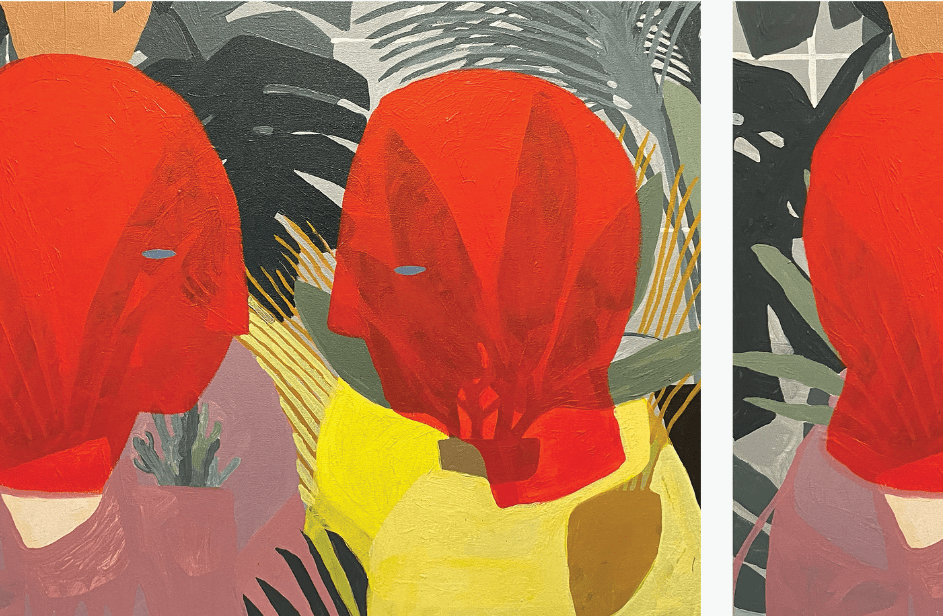
THE TEMPERATURE has remained below freezing this winter, but artist and illustrator Kristi Kangilaski has brought some warm tropical colors to Viljandi with her new exhibition, “However It Feels.” The exhibition opened on 15 January at the Rüki Gallery on Tartu Street and will last until the end of February.
Kangilaski was born in 1982, the same year that Brezhnev died, though before his death which means that, in all likelihood, she is not the reincarnation of Leonid Brezhnev. In fact, it’s the opposite: our Kangilaski is no fat, hairy Communist. Rather, she’s a tall, charming woman who at some point tattooed the words “left” and “right” on her wrists so that she wouldn’t forget which was which. With her hat and long dark coat, this Estonian Academy of Arts-educated artist resembles Mary Poppins from a distance. Her well-marked, magical hands never rest.
When she is not at work as the Viljandi city artist, Kangilaski has created a whole exhibition-full of acrylic paintings. She works at home, somewhere between the bedroom and kitchen, and her warehouse is a corner in her daughter’s room. She uses acrylic paints because she likes to work quickly and acrylic paints dry quickly. “I’m an impatient, restless person,” she says. The paintings emerged according to how she happened to feel. She had no certain plans or preconceptions. Slowly, the collection assembled itself. Almost all of the paintings were undertaken in 2025 — one of them was even finished this January.
At the opening, wine and grapes were served.
At the exhibition, a visitor encounters images of people, horses, elephants, black cats, crocodiles, birds, and bears. In part, the atmosphere is playful and childlike. When I arrived to the gallery the second time to view the exhibition, an entire art school class was there and some little boys even hid themselves beneath the gallery couch and still wouldn’t come out, even when I tried to join them there.
Yet, as another viewer remarked to me, there are also more serious themes. The painting “Black Cat” depicts a mother’s difficult daily life, and “Crocodile” shows a woman seated at a table, with a man’s shadow in back, and that fearsome creature behind them. There is also “Fire Heads,” two red heads in opposition, which brings to mind an argument.
The style is interesting. I was reminded of Picasso and Modigliano’s primitivism as well as Viljandi’s own Paul Kondas, the godfather of naïve art. But Kangilaski herself can’t say exactly what style it is or what inspired it. “I’m especially inspired by different arrangements or compositions that happen appear before me,” she says. “And I have always loved colors,” she adds. “Inspiration is drawn from everything around me.”
Kangilaski agrees that the current colorful exhibition does leave one feeling as if they’re in the jungle. And in the jungle, one can experience all kinds of emotions. The artist has even considered bringing some palm trees to the gallery next time she has an exhibition and I have agreed in principle to help her move them. When she is not out looking for palm trees in Estonia, Kangilaski paints on. As an illustrator, she is just about to begin a new book project.
An Estonian version of this review appears this month in the Estonian magazine Edasi.
 north!