a part of history

helsinki anna
Anna at Linnanmäki in Helsinki on her fifth birthday, 2012

FOR SOME TIME NOW, our mornings have begun with the same question: “Did my results come yet?”

I check my email again and answer: “No, they haven’t. We have to wait a bit longer.”

“How long?”

“I don’t know. The system shows that they are analyzing your sample and preparing your reports. Maybe this week they’ll be ready.”

“You said that last week!”

“I am sure they will come soon.”

“But I have already waited for so long! What do you think, am I more Finnish than Marta?” asks my daughter Anna.

Marta is her sister, who is almost 15. I bought both daughters DNA tests at a good price. The process is simple: the person spits in a vial and sends it via mail to the laboratory. Numbers are printed on the vial that are entered into the system. This makes the process more or less anonymous. In the lab, they analyze your DNA and compare it to reference samples from different populations. In this way, they can determine how much of your genome is Finnish.

This is very interesting for people these days, especially for children who want to know their origins. Numerous companies sell tests in Estonia, including 23andMe, AncestryDNA, Family Tree DNA, Insitome, and others. Some of them also provide information about your health, including data about your genetic risk for certain cancers or neurological diseases. Since our children are so young, they haven’t expressed interest in their health data, only in their ancestry. They want to know more about their identity, for example, what soccer/football team to support. If they are 6 percent Swedish, then why not support the Swedish team?

I decided to use 23andMe this time because my mother and my children’s mother have both taken the test. At last, the long-awaited results arrived for Marta. She found out that 31 percent of her DNA comes from my mother, her grandmother, while she got 19 percent from my father. Inheritance is indeed arbitrary.

Since we have an international family, I wondered if this would be at all interesting for Estonians. They already know that they are “Estonians,” so why should they waste their money on a test that would only confirm it? But when my children’s mother’s test came back, someone who should be a “pure Estonian,” it said that she was only half Estonian.

A quarter of her ancestry was actually Finnish.

I had read that after the Great Northern War, there were so few Estonians in Virumaa that many Finns moved there to work. I know that my daughter’s mother’s grandfather was from somewhere near there. Maybe that’s why she has so much Finnish blood? Or is every Estonian a bit Finnish? Who knows. For my daughters, this was very interesting. Though their mother was a quarter Finnish, it showed that Marta was 8 percent Finnish.

Now Marta’s sister Anna can’t wait to find out how much Finnish ancestry she has.

“I think you have a bit more,” I told her.

“Why?”

“Because when we were in Helsinki, I noticed you looked like the other Finnish girls.”

“Aha. But have my results come yet?”

“Let me check. No, they haven’t come yet. But maybe tomorrow.”

I don’t know why this is so interesting for our kids, but maybe because family trees are so complicated and connected to history. For children, it’s very hard to understand why something happened in history and how that can impact our identities to this day. But when you can show them a chart that shows them that they are 10 percent Finnish, for instance, then history is somehow closer. It isn’t just history anymore. It’s a part of you.

You are a part of history.

Note. This story was originally written in Estonian and posted on the Parim Aeg family blog. Shortly afterward, we learned that Anna was 44 percent Estonian, 17 percent Italian, 7 percent British & Irish, 5 percent Balkan, and just 3 percent Finnish. She was also more than 3 percent Middle Eastern.  The remainder was classified as generic “Southern European” and “Northwest European.” It meant she was just 96 percent European according to the test.

If you believe it.
the swimming palace

swimming
WANDERING THE BACK STREETS of Reykjavik just a few weeks ago, I was faced with a decision. Would I head over to the national museum and spend the rest of a rainy afternoon looking at Viking exhibits, or would I return to the Sundhöll Reykjavikur for another long warm soak?

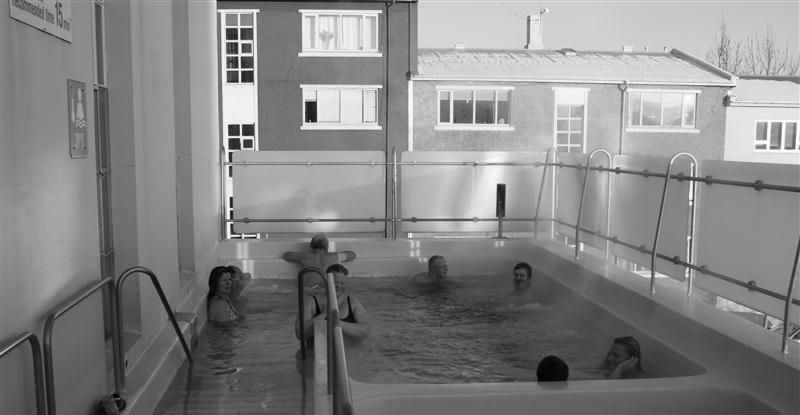
It was a gray evening, a fine mist besieged the city, and water dripped from the corrugated metal siding of the wonderful buildings, which are painted in pastel dreamy yellows and salmon pinks. My sweater was heavy and thick with the moisture. I decided to forego the museum and to return to Sundhöllin, as it is called by Icelanders, “the swimming palace.” These are Reykjavik’s oldest public baths. Built in 1937 in a palatial art deco style, it reminds one very much of the Kalma Saun in Tallinn’s Kalamaja district.

There are several hot baths at Sundhöllin, heated by geothermal energy like the rest of Iceland. The first and hottest is 42 degrees. A second is a milder 39 degrees. They are both outside, each painted a light blue. Above them, a sign reads, “Recommended time: 15 minutes” in black lettering. After spending the recommended time in the 42 degree bath, I sank into the 39 degree bath and tried to relax. It had been a long conference, I had enjoyed many free coffees, done too many interviews, and I have to say that even after taking a long walk, I found it hard to unwind.

I found it difficult to even feel like myself.

My only company was a pair of Icelandic teenage girls, engaged in conversation on the other side of the bath. One of them, with freckles and hoop earrings, seemed to be lecturing the other one, a pale, yellow-haired, sad-looking girl, about the more important things in life. I followed their conversation for sometime while glancing over them at the line of rooftops visible beyond the deck of the pool and after some more time, an elusive peace came to me. The Icelandic girls’ lulling, undulating voices, the warmth of the bath, the white architecture, the coolness of the air, and the mist on my face at last soothed me and I plunged my head into the hot bath waters. Creative thoughts started to surface. Wouldn’t it be nice to write a whole novel set only in an Icelandic swimming pool?

The conference was the inaugural meeting of a new Nordic medical society. The Estonians had been invited to attend as one of the six founding members, even if their tricolor looked slightly out of place among the crosses of Iceland, Norway, Denmark, Sweden, and Finland. But the Estonians, having their own biobank and advanced personalized medicine programs could not be ignored. They were now part of this northern region, part of the story, and so they were invited.

I recalled a design I had once seen for an Estonian flag with the national colors arrayed in a black cross outlined by white set on a field of somber blue. In design, it reminded one of the Norwegian flag the most, but stitched of blue, black, and white. I remember how much I had liked that flag and wondered why they hadn’t chosen it in 1919 when it had been suggested. There was something about the color scheme that reminded me of the blue baths and white walls of Sundhöllin, the black lettering on the walls. The cool air and mist on the faces, the soft muttering monotonous song of the people’s voices. There was something that linked these places.

What was it?

At the meeting, a scientist had asked me if the Estonians did consider themselves to be a Nordic country. I had said, yes, in fact, but I had a hard time explaining why. Was the Estonian Biobank at University of Tartu really the outcome of Swedish King Gustav Adolf founding the university nearly 400 years ago? Could it all be explained with historical facts, or cultural generalizations? Perhaps it could be discovered among the runes of the sagas, clearly spelling out the connection? In the baths at Sundhöllin, I fumbled for more explanations, but none of them could satisfy me and I at last gave in fully to a pleasant, clear-headed mood. Whatever the answer was, it could no longer bother me.

What mattered was that I knew that this was exactly the place I needed to be.

cold sweat

cold sweat photoWHAT’S THE DIFFERENCE between writing and music? Writing takes and music gives.

Writing is like an old-fashioned bloodletting, I think. Writers spill their blood all over the pages. This is why writers need to take breaks. One can only spill so much per day. If you give too much, you will feel dry and tired. Squeezed like a lemon. It takes a while to recover until you are ready to give again. Good writers take time to restore their energy. Many take long walks to mull things over in their minds. Then they return to the keyboard to bleed some more, to squeeze out more juice.

Music is the opposite. If you perform for people, the energy that you give off returns. This is why bands can tour for months. The music actually gives musicians energy. The songs only get better.

When I was a teenager I knew this. I had just acquired a bass guitar, which was an instrument that fit perfectly for me and my hands. The complex chords of the guitar were almost painful to construct, and the drums were a chaotic landscape of cymbals and tom-toms, but the bass was heavy. I loved to reach for a low F, at the very end of the neck. It felt as if I was reaching into the watery depths to hit that dark note, which didn’t resound as much as it throbbed and vibrated.

At that time, I would play along with a live album by James Brown that had been recorded at the Apollo Theatre in New York in June 1967. At that time, his music was changing from its earlier classic soul style to the funk of his later records. There was one stretch where James Brown led the band through a medley of tunes before breaking into one of his better known songs of the times, “Cold Sweat.” I thought it was the best name for the song, because by that time in the jam, I really would be sweating. There was something otherworldly, almost religious about those rhythms. The way the sweat ran into my eyes.  I couldn’t imagine how his band felt on stage on that hot summer night, dressed in their matching suits, swinging through those endless songs.

Sometimes I would even play past midnight. Yet no matter how much I sweat, no matter how hot I got, or how much my fingers hurt, I never felt drained or tired after letting James Brown guide me. Instead I felt even more energized. When “Cold Sweat” finished at last, I was ready to run. My shirt was drenched, but I felt a humid thunderstorm of adrenaline break out all over. I was dripping. This music, soul music, could do that. It might be the deepest spiritual experience I have had to date, and I’ve been to every kind of church, and spent times in cloisters and ashrams.

These days I write mostly, which means I bleed. This is my profession, and my musician friends mostly prefer to see me this way. Besides, they are real musicians. I asked guitarist Andre Maaker if he wanted to be in a band, but he was already booked, and then I asked Silver Sepp if he would be our drummer, but I think he had to fly off to Uzbekistan or Israel for a concert.

“Aren’t you a writer?” one of my musician friends chided me. I am. I bleed the blood, I squeeze the juice. Yet I still have a bass guitar. It’s an acoustic fretless one that I bought on impulse. It makes the deepest, most wonderful sounds. Whenever I tire of what writing takes out of me, I pick up my bass guitar and play, because music never takes, music always gives back.

An Estonian-language version of this column appears in the summer 2018 issue of the magazine Hingele Pai.

a house in the country

ON MONDAY, I DROVE DOWN TO OBINITSA to clean out the outhouse, a special treat. This is a bio-kompost, a composting toilet — Finnish made, with a white and blue cross on it, and a black plastic chimney puncturing the wood roof.

In the back, a small, transparent rubber hose dives down into the grass for filtering out liquids. It’s almost impossible to see but magnificent to watch in action. At the base of the composting toilet, there is a small door. This is unlatched for the removal of rich black soil, for over the course of the seasons, all that was left behind here has been turned to premium muld.

I shoveled out the compost and placed it around the base of the fragrant apple trees, at last in bloom with white flowers. I have heard that it helps.

The apple orchard. I had nearly forgotten it. Just as I had forgotten about so many other things down here. The well. The mattresses on the second floor. The ladder up. The grill idling on the terrace. The windows, the swing, and the writing desk. That lovely sea-like view and the unusual silence. At one point, we had thought of building a larger house, and there were conversations with local businessmen at dimly lit pubs who wanted to sell us high-quality logs.

In the end, we kept the same structure, but adorned it with new wallpaper, and painted the floors. I spent a few summer nights sleeping in the barn, and painting all day. I came to know every rough groove in those floors. I stained the floors in the sleeping barn too. Somehow, I had forgotten it all.

Inside the outhouse, the frame I put in place roughly a decade ago is still standing, built of young saplings, now all hard and gray. Around this, a team of real builders constructed the outhouse, joking to each other about the job I had tried to do. I remember how I had gone to my friend’s outhouse, just down the road, and studied its structure, observing how effortlessly the beams interlocked. It looked so easy. Just some wood and a few nails here. “Lebo,” as the Estonians say. “Piece of cake.”

Yet it was never very lebo. Just a few yards from the outhouse is the smoke sauna that I never used. Not once. It just sat there solemnly, with that black witches cauldron at its center, the true purpose of which I never understood until I observed how a neighbor had washed his child in a wooden bucket with steaming water drawn from the metal bowl. For them, this was natural. The child Seto thought nothing of bathing in a dark sauna in an old bucket.

I gave up on the idea of describing any of this to people back in New York.

After I finished emptying the composting toilet, I removed some dirt from around the barn doors so that they would open more easily, and then I finished painting a few shelves for the kitchen. So much labor went into the dream of a house in the country. It’s a dream shared by many in this country. Like most great projects, though, some come suddenly to life, propelled by some unseen force, and others never seem to materialize fully.

The whole of the country is dotted with such abandoned efforts: factories that never came to be. Unfinished hotels. A broken, disregarded storefront. Sometimes having the money, vision, and even energy is just not enough. You need that extra cosmic push.

When I was done with the work, I locked up the house, but not before giving the place another look over. This was the fruit of a decade’s worth of energy. Was it all misplaced? Or had it been worth it for me, just for the experience?

I glanced at the two corner shelves I built for Orthodox icons. Ikooninulkad. Most Seto houses have one, but this one has two. They are decorated with colorful textiles that I bought from a street vendor in Crete and a piece of the monastery of Saint Irene from the same island. I used to have a beautiful icon of Saint Peter that I would carry around with me, too.

Somewhere here, a few years ago, it fell out of my pocket and I lost it.

the trampoline diaries

trampolineIT WAS JUST A FEW YEARS AGO that a young father went to the store to buy a trampoline. A trampoline! That wonderful round thing that stands in the corner of almost every Estonian yard. I got a big box from the store, went home, and started to put the new attraction together. The neighbor just stared and smiled – fathers and their silly challenges! It’s true the trampoline fell apart a few times, but finally it was ready. The exciting assembly process attracted not only our own children, but the neighbors too.
And this was my first lesson – when you buy a trampoline, it doesn’t just belong to your children, but all the children within a certain radius.

Unfortunately, not all of the children were good ones. One of the visitors to our new trampoline was an 11-year-old boy from a troubled family. Later I heard that his mother was struggling with alcoholism and his father was in jail. Already at age 11, the young man smoked. Which meant that there was a rather unwelcome guest in our yard who would use our family trampoline, smoking and jumping at the same time. He enjoyed it, but our daughters were terrified. I went outside and told the character that it wasn’t his trampoline and he had to leave. The young man thought otherwise. He decided to show off his English language skills instead.

Fak ju, asshoo!” was his response. 

I laughed and answered back: “I can see that you already know a little English and are a very intelligent boy. Maybe one day you could be the foreign minister of Estonia!”

The boy didn’t know what to say, but finally he left. Later, I heard about two local boys who had robbed an ice cream stand. I couldn’t help but think that he was one of them.

My second lesson – someone always starts crying.

Most trampolines have nets that keep the children from falling, but they still get hurt anyway, because there are usually four or five of them on there at the same time. When the bigger kids jump higher and the smaller ones topple, someone always starts crying. We of course had a firm rule that only two or three could jump at a time, but older kids like to grab attention by doing tricks, which invites even more attention from other kids in the neighborhood, who don’t follow our rules. Then someone is already crying again. Sadly, this someone is usually six-year-old Maria Petrone, for whom this is still her trampoline, the one her father bought and put together.

For Estonian children though, no one actually owns trampolines. They are as universal as playgrounds.

It’s very easy to understand why Estonian children love trampolines, but at the same time life has shown that even while trampolines give children plenty of joy, they can cause problems and dangerous situations too.

A few years ago, I sent my nephew in New Jersey a trampoline for his birthday. The boy was very grateful and happy, but my brother started to worry. What would happen if something happened to one of his kids on the trampoline? Would his insurance cover it? How interesting, I thought, that the Estonians I know never seemed to worry about it.

This post first appeared in Estonian on the Parim Aeg family blog.

drum lessons

sticksWE LIVE IN VILJANDI,  a small town in the south of Estonia. Certainly, you have heard of this place. We means me, Justin, a writer or journalist, and daughter Anna, who is 10 years old and goes to school, at the moment attending the fourth grade.

–  “Why do you live in Viljandi?” People ask. “The capital is bigger, greater, richer, better!”

Maybe so, but children in Viljandi enjoy a lot of freedom. They go to school on their own in the morning, return home the same way, and then head onward to some after-school activity. They go on foot to sports and activities all over town. This is the luxury of living in a small town. Cars and trams aren’t necessary. This is how their weeks are booked.

Is our daughter a drummer or a guitarist?

When the school year began in the fall, I told Anna that she had to pick a musical instrument to study. Actually, she started to take violin lessons in the first grade when we lived in New York, but didn’t continue. There were so many options now. I offered her the stereotypical “girl” instruments. Would she like to play the flute? Clarinet? Piano maybe? Or the violin again? No, no, no! Then I found out that the Viljandi Hobby School was offering both guitar and drum lessons. She had to decide on one of these.

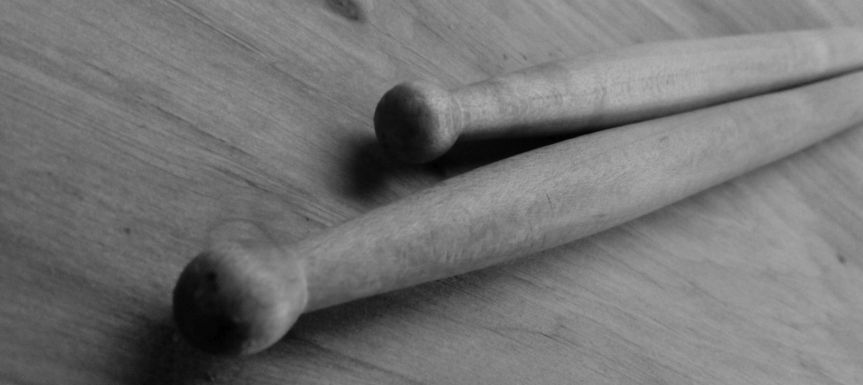
Honestly, I thought that drums would be a cooler choice. I play guitar and bass guitar and I know how complicated it can be. Drums are not easy, but it seemed like a better fit for Anna. Yet she had to try. That was the first step. She was put in a group with two other girls. Often people think that it’s better if the boys are with the boys and the girls learn alongside other girls. Anna didn’t notice this at all though, because to her the drums were far more important. She enjoyed playing right away and only speaks highly of her teacher Kevin Lilleleht. When I was a child, it was my greatest wish to play the drums! Ringo Starr was my favorite.

I remember how I begged by parents to take me to his concert. It was August 1989. We were standing in line at the concert when someone asked my mother and father:

– “You wanted to introduce your son to the music of our youth, eh?” And my parents answered “No, he dragged us here to hear Ringo play. It was him not us!” they said.

Do parents fulfill their own childhood dreams vicariously through their children?

I also remember how I begged my mother to buy me a drum kit, but it didn’t happen. Too noisy! The neighbors would definitely complain! Sad. But when Anna started to play, I decided that if she really wanted, I would buy her a kit. Let the neighbors enjoy the music! Now Anna comes home from drum lessons and even has homework. She has to listen to songs by the Beatles, Doors, and Green Day.

– “It’s so hard to tell which songs are the Beatles and which ones are the Doors,” she complains.

Recently there was an exam in the hobby school. The teacher played the students songs and they had to say who the artists were.

– “I thought that ‘Hey Jude’ was the Doors, but I was wrong!”

She really likes Green Day. Now, when she showers, one can hear her singing “Basket Case.” Smash Mouth is another favorite, because Smash Mouth’s song “All Star” was in Shrek. She has even learned how to play this song. She has such funny questions:

– “Is Green Day’s singer Billie Joe Armstrong related to that astronaut, Neil Armstrong?”

– “I’m not sure,” I replied.

– “What does Billie Joe Armstrong look like today?”

We decided to search for him on Google. Apparently he looks the same as he always has. Nothing has changed.

– “He’s only a few years older than me,” I told Anna. Anna looked me over.

– “Actually,” she said, “he looks a lot younger than you, Daddy.”

This post first appeared in Estonian on the Parim Aeg family blog.

the estonian aesthetic

ON THE ROAD between Sõmerpalu and Sangaste, I stopped my car and got out to take in the view. No matter how many times I travel this stretch of highway, the effect is the same, especially in spring. I love the grassy hills that roll like seas, the trim green forest line, the air that’s so fresh it hurts to breathe it, the farm buildings clumped together here and there, each one forming a perfect minimalist island. This is the Estonian aesthetic razed into the landscape: pure, sparse, spread out. It reminds me of that famous Arvo Pärt quote, “In art, everything is possible, but everything is not necessary.”

This point came up recently in conversation at a cafe with a newer arrived foreigner who wanted to know about the origins of the peculiar local names “Tiit” and “Priit.” “Tiit,” I told him, probably comes from the German name ‘Dietrich.’ Maybe one of the Order knights was named Dietrich, you know, in the 13th century? The Estonians probably called this knight ‘Tiidrik.’ Then they shortened that to ‘Tiit.’ It’s the same with Friedrich. Friedrich, Priidik, Priit. The Estonians are practical people. They only need one syllable.”

Practical yes, but that’s only part of it. Rather, Estonians value the beauty of efficiency. In trying to describe the national aesthetic to outsiders I have often relied on the metaphor of the Japanese zen rock garden, where rocks are carefully selected and arranged in order. It’s an assembly where every component serves a purpose, and any part that does not complement or support that specific purpose detracts from it. It idealizes restraint. Simplicity. Less is more. Everything is possible, but everything is not necessary. This is their philosophy. It governs all. It’s why people won’t return your letters if there was no overwhelming reason to. It’s why people won’t go to the same store twice in the same day if they can help it. It’s just too much. The ideal Estonian day would hum along with tones of minimalist perfection ringing out like one of Arvo Pärt’s compositions.

As clean and tidy as the Estonian countryside itself.

How strange then that this fondness for less is more hasn’t carried over into the commercial culture. For if the nature of the land and its people is one of restraint, of austerity, of less is more, the world of commerce has embraced the exact opposite. In the supermarkets of this country, more is simply more, and you must have more and more of it. Every holiday centers on total excess. Come Saint John’s Day, not only are the bonfire piles stacked high with wood, but the shopping carts are full of products and packaging.

Who knows how many plastic tubs full of fatty kebab meat, or how many cans of lukewarm amber beer, pass through the intestines of the Estonian nation on these feast days of gluttony. I imagine mountains of pork, lakes of alcohol, or swamps of greasy salads. When it’s all over, the cans and plastic containers and utensils are tossed away, removed to somewhere out of sight.

Yet just because it’s out of sight does not mean that it’s out of existence. It just goes somewhere else in Estonia. So that even if you stop on the side of the road in the middle of nowhere to marvel at the countryside, you may be rankled when an empty bag of potato chips happens to float by in the wind. Which is what happened on the road between Sõmerpalu and Sangaste.

I chased the bag down and picked it up, and put it in my car to throw out later. There was already a ton of trash in there anyway. An empty plastic bag of popcorn, a plastic container of nuts. There was even an empty bag of olives. Then I looked at the scenery of the Estonian countryside again, breathed in that wonderful air, so heavy on the lungs, and understood better why I enjoyed it all so much. The land was natural, ordered, and (mostly) spotless. It was uncluttered and ascetic. Everything that my life wasn’t.

greenport before the storm


IT’S WEDNESDAY NIGHT in Greenport and a storm is about to hit. Deserted streets, dusted in snow, most of the shops shuttered. This is the winter off-season out here. The most vibrant signs of life are the strings of Christmas lights that rustle in the wind.

In the summer, Greenport is crowded over with tourists. All the restaurants are open, the boutiques bustle, the ferry horn honks. There’s no parking and city people roller blade down the street on new skates. Yet I prefer Greenport, and other summer spots like it, in winter. I like it cold and vacant because then I can savor its true character. Any summer destination is best experienced in the cold season, when there are only locals around.

On Front Street, Aldo Maoirana is closing up. He runs his cafe out of an old wooden building with a cream-colored facade. Here Aldo sells homemade biscotti and roasts his own coffee, filling the streets with a stinging white smoke. The floors of Aldo’s are true maritime Greenport distressed wood, and fishermen come in here daily, but the walls are a Mediterranean red, and Aldo plays Italian folk music for his clients. This is where the New World meets the old. Out beyond Greenport‘s piers, it’s just ocean and ocean.

All the way back to Europe.

The man himself has a mop of curly white hair and sports a dark turtleneck. He is known all over by his first name alone. His staff are often newer arrivals to Greenport from Central America — dark-haired Salvadorans, Guatemalans — whose happiness is contagious. “I’m more used to speaking Spanish and English now than I am French and Italian,” Aldo says and shrugs. Aldo was born in Sicily, raised in France. So why is he out here at the tip of this island, in what feels like the middle of nowhere, in deep winter?

“But this is the best time to be here!” he insists.

Aldo’s good company, but even he is closing up and heading home before the storm hits. He pushes some crisp biscotti my way though before he goes. “Here, take two,” he says.

Outside the windows of the coffee house, a kids’ hockey team is making use of the rink, which is set up right next to the harbor. There are only eight kids on the team — there aren’t that many kids who live around here year round. Round and round they skate under the white lights. Greenport hockey. Beside them the old-fashioned carousel, a never-ending source of summertime amusement, is nothing but a stable full of ghosts.

Few ever see Greenport as it looks tonight, so desolate and stark. It’s the last major settlement on Long Island, the largest island in the continental United States. Known for its fish shape, the island’s tail terminates in two peninsulas, the South Fork, home to the glitzy Hamptons, and the more subdued North Fork, known for its farms and dairies, as well as the many vineyards that line the road all the way to its terminus — Greenport.

It’s a mostly easy ride from Manhattan here, and buses will take you out here for a good price and give you wireless Internet and free drinks along the way. Locals soak up the tourist income all summer long, and farmers even sell jam on the road sides at extortionate prices. Then the winter comes and the farmers huddle by their fires and most of the shops shut. That’s when you get to know who really lives in Greenport.

If you ask any of them, they will tell you, they prefer it lonesome. They came out here to get away from people. They came for the silence, for the solitude. They put up with the tourists, just so they can last the dreamy winter with some money in their pockets.

By the pier, an old fishing shop has been converted to an oyster bar. All of Greenport is closed now, but Little Creek Oysters is still steaming shellfish and serving up bowls of scallop chowder. Outside, little boys play on frozen puddles in an alleyway. “Don’t play too rough,” a mother scolds them through a window and then shuts it and the boys’ game goes on. It’s the most Old World, European thing I have seen in New York.

Inside, there is warmth and music and hospitality. Patrons in old sweaters and coats huddle around rough wooden tables and the puckered gray oysters come out on platters. Then someone announces that school has been cancelled for the following day on account of the coming storm and great cheers ring out. Supposedly the storm is supposed to hit at midnight, but that’s hours away. That means there’s time for more oysters, beer.

The bartender, a young woman with hair as rich and dark as chocolate pudding, tells me how much she loves living here, especially at this time of year. She is from Queens, I think she says over the music and voices, or Brooklyn. She’s another urban refugee in search of that elusive mix of fishing village silence and genuine camaraderie, another Greenporter waiting for the storm to hit. “It’s still the same island,” she says. That’s true, but so far from its other, busier end.  I can’t help but like her as she takes my order and I sit down in a corner with a notebook and pen. Soon push them aside. I don’t want to write any more about Greenport tonight, I decide in the corner. I want to enjoy it as it is.

***
A shorter, Estonian-language version of this piece appeared in the spring-summer issue of Traveller, Estravel’s new magazine, out in shops now.

all that was left behind

osse

WE PULLED INTO the village at about noon on the afternoon of the 24th of February. It was a clear, brisk day and the sun spotlit the piazzas and ancient churches of the settlement on the periphery of Bari with a pale orange glow.

Bari is a seaport city on the Adriatic known best perhaps as the final resting place of Saint Nicholas, whose bones lie in a crypt in a basilica by the sea’s gray waters. It has about as many inhabitants as Tallinn, yet even in a country like Italy, which is devoured by insatiable tourists year round, it’s still somehow out of the way, a mystery obscured from view.

Ringing Bari are a series of provincial communities with names like Toritto, Grumo, Sannicandro, and Adelfia. This is almond, grape, and olive country. In the past, most of the people of this area, which is engulfed by green plantations of flowering olive groves, were involved in or influenced by agriculture. The soil here is black, red, and pungent and divided by stone walls into uneven patches, giving the area the appearance of one lush and fragrant country garden.

In the village of Toritto, I came upon a group of older men standing outside a church and asked them for directions to the local cemetery. “I am from America,” I explained in Italian, “but my roots are from here.” The tallest of the men, a blue-eyed, cheerful soul named Gianni, tipped his flat cap to us and got in our car, just like that, to show us the way. He gave directions, though not in Italian, but in the curious Barese dialect, a delicious mix of French and Greek. This is the language my grandfather spoke as a child, a tongue that is utterly alien to me and for which I hold no key.

The cemetery happened to be closed, this being the Mezzogiorno, where even cemetery gates are locked at lunch time, so we returned later that day to study the stacks of interments. This soil may be suitable for olives, but not people. Everyone here is buried above ground. The markers for Giovanna and Lazzaro, the siblings of my great grandmother Maria, were found almost immediately, in one of the older vaults. As long as we searched though we could not find the markers for their parents — the grandparents of my grandfather — Angela and Francesco.

I knew these people on sight, as their images hang on the wall of my parents’ house in New York. The old man with the gray hair and mustache. The old woman with the dark hair and sad face. She had taught her daughter Maria how to cook, and Maria had taught my mother how to cook. My mother had taught me.

In the cemetery office, I asked for help in locating their graves. Two locals, both with the dark hair and olive eyes of the ancient Greek settlers of the region, passed dilapidated books bearing the names of Toritto’s dead citizens between them. In Tallinn, people were dancing to celebrate the 100th anniversary of independence. We were sitting in a dusty office, thinking of our own past.

Anna, our 10-year-old daughter, also wanted to find Angela and Francesco. She had been a brave traveler in this land of her roots, and even tried to explain to her somewhat bewildered Italian relatives how her friends like to collect deer antler sheds in the forests of Estonia for fun.

At last, I glanced a familiar name in the old book. It was our Angela, who had departed this life on the 15th of January 1922. But where was our Angela buried, we inquired from the men? “Well, she is no longer buried,” one frowned. “Her remains were transferred to the ossuary.”

“What ossuary?” I asked.

He stood and grabbed a large flashlight. “Here, come with me.”

Beneath one of the chapels in the cemetery, he shone a light through a grate, outlining piles of bones and dust. Because of limited space in the cemetery at times, they removed all the old burials and deposited them into a common dark mass grave. The ossuary! I gaped at the skulls and femurs.

This is what had become of Angela, and what became of her husband Francesco. This is what had become of our flesh and blood. This is what had become of the past. A whole century had since passed and the names had survived, the dates, old photographs, and some memories.

Yet all that was left behind was this.

“It’s just so sad,” Anna said to me as we exited the cemetery, “that there’s no marker for them.”

I took a long look at the olive groves surrounding the cemetery, flowering even in winter, and let out a sigh. “That’s just how life is,” I said. “When you’re gone, you’re gone. There’s nothing else left.”