weed world

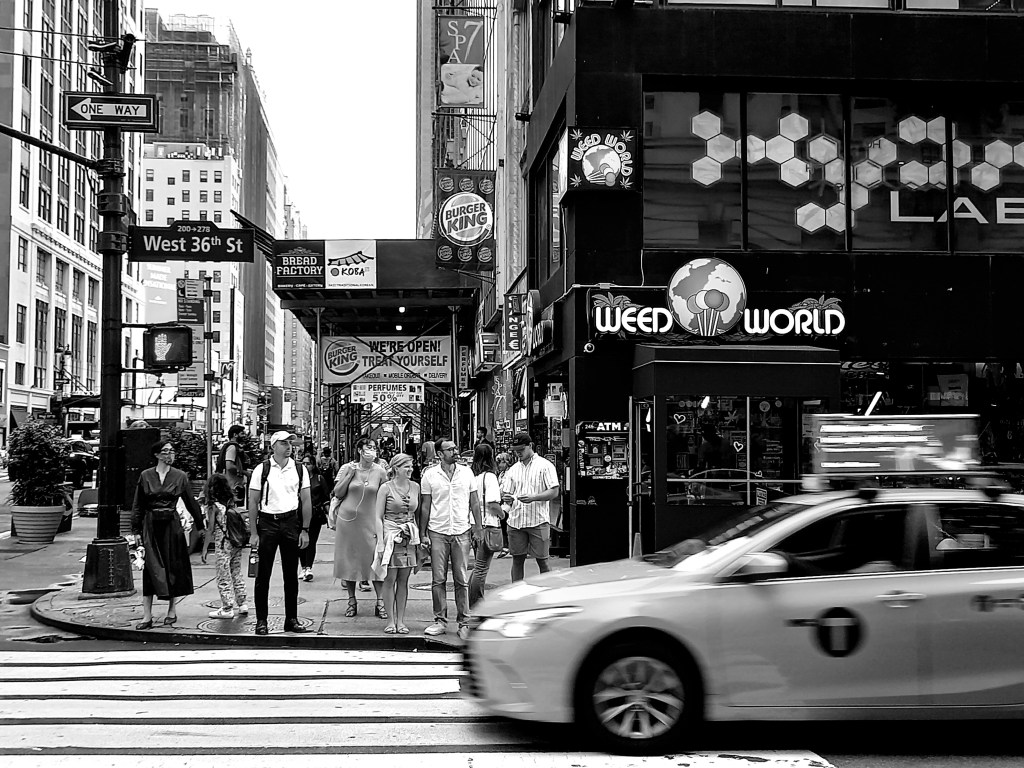
WEED, WEED, tufts of weed. Rolling through the streets, gathering dust like in the Old West. Wyatt Earp’s weed. Doc Holiday’s ganja. The holy sacrament of Jah! Ever living, ever fearful. Bat Masterson’s dank nuggets. Wild Bill Hickok’s satchel of chronic. The fragrant stink of green. It arrives, a plenitude of stenches. It stings, it hits high and sweet and then low and pungent, heavy, somehow melancholic and sad too. It floats over the heads of Texan tourists through Times Square, hugs the indigent people with tattoos who are laughing at their own jokes, and hovers over the local New Yorkers out for a jog, and the business ladies with their manicures at the corner table on East 81st Street. On 31 March 2021, cannabis was decriminalized in New York, and its potent winds wind across avenues, down side streets, up museum steps, down kitchen basements, linger about in taxis, chase kids into 99 cent pizza parlors. The weed wraps around the shanty tents promising immediate COVID-19 testing, even same day PCR. It’s different from the New York I left behind many years ago. New York smells different nowadays.

The trains rattle in, shake along, dive under the East River. They are worn and rusty, and there is no free wireless internet. New York is not about giving things away for free. New York is about charging you two times as much, if not three, and making you feel like you somehow got a good deal, because someone else is charging ten times as much. It is worth remarking that every piece of Manhattan island has been made over and remade, sculpted, hollowed out, reconstructed, and that even the wilds of Central Park were cultivated out of earth that was moved from elsewhere to make way for an elevated train. Once upon a time, this beatific isle was unspoiled nature. There were no property rights, nor air rights. You must take a moment to let that sink in. Nobody owned the land of New York State, and there was no New York State. There was no state, no governor, no avenues, no Subway, and you could smoke anything you wanted, if you could get your hands on it, or trade for it, maybe with one of those long clay Dutch pipes of the Henry Hudson days, or maybe a local Indian one. There was no line where one man’s tract ended and another began. It was all seamless. Land rolled into land. Such was Manhattan of old.

At Madame Tussauds, I took a selfie with Donald Trump and then another with Sean Combs. At the Met, I saw Van Gogh trees and Monet seasides. Winslow Homer had a thing for bare-chested Bahamanian men. George O’Keefe had a thing for desert bones. My favorite painting was The Three Sisters by Léon Frédéric, a Belgian, anno 1896. It is interesting for sure that they dragged all of this European art, Chinese and Egyptian art, and Japanese art, and even the furnishings of hotels and palaces in France, and set it up for us to see here in New York, a city that bulldozed nature and chased remnant Algonquian culture away. New York in this sense is a funny place. It is both everywhere and nowhere. Everything is here, but everything that is here came from somewhere else. Even the name was borrowed from the North of England.

That’s why people need weed. They need it to make sense of the humidity and appropriation.

three years away

THREE YEARS I was away. Almost exactly, to the date. The last days I remember being here were in July. It was the time of the Green Corn Festival, hosted by the local Indian nation. I went to the powwow and talked to the head woman. We both knew her predecessor, Chief Ted. She told me she was disappointed in him, because he died and left her to run things.

I knew not what to say, but that was three years ago.

In the August after my return to Estonia, I traveled to Stockholm, and that fall, the fall of ’19, I turned 40 years old and took a ship to Helsinki the following day to participate in Slush, a major meeting of startups. I was supposed to have a meeting with an important source regarding a book, but she stayed in Paris and changed her plans. I don’t even remember coming back on the ship. It would be the last time I would leave Estonia for almost three years.

Then the new decade dawned, and the pandemic with it. I welcomed the first lockdown and slept through those weeks in late March and April. But there were others, and I cannot really say where the time went. 2020. 2021. It was only in May 2022, that my car crossed the Latvian border, and we drove all the way to Riga and flew to Copenhagen, like normal people, like the way it once was. And in June, they finally allowed American citizens to travel to the US without showing any kind of COVID-19 test result. So our flight back went smoothly. There were no additional hurdles. There we were, after three years, in John F. Kennedy International Airport.

THE FIRST THING that I probably noticed in New York that struck me as strange was the clerk at the airport shop asking me about my shirt. He asked me where the North Fork was, and I explained to him that Long Island, the same island we both stood on at the time, had two forks at its end, and one fork was the North Fork and the other was the South Fork. The North Fork had Orient Point and the ferry to Connecticut and the South Fork had the Hamptons. It occurred to me that in Estonia, nobody would start a conversation with a client like that.

The following day yielded a few more surprises. In the liquor store, I watched as a man greeted the owner with, “God bless you and God bless this great country!” The seller was taken slightly aback but welcomed the blessing. I was then trying to determine the price of a bottle of prosecco with my father. Almost as soon as I had stepped off the plane, the US Supreme Court had repealed Roe vs. Wade. “Oops, we were wrong about that one.” What was going on in this country? Later, former President Donald Trump was quoted as saying the ruling was the will of God. How did he know what God wanted? And what did God have to do with a Long Island liquor store? None of these things seemed to make sense. These were my thoughts as I stood outside Carvel beneath a great poster celebrating the 45th birthday of Fudgie the Whale.

“A whale of an ice cream cake.”

MOST NEW YORKERS are foreign in provenance. The Republican primary for governor was between Lee Zeldin, a “Trump won” denialist who is Jewish, and Andrew Giuliani, who is Italian. New Yorkers don’t notice these things. They are trained to ignore them or to pretend that they don’t matter. For someone who has lived abroad for many years, you cannot help but notice that nearly all the inhabitants of this place arrived, mainly by ship, within the past 150 years. Within a generation, they had stripped themselves of their languages and roots, and became Homo americanus. Zeldin won, but Giuliani got to raise his profile in the press. Their signs were everywhere on the island. Giuliani, Zeldin. Zeldin, Giuliani. They love America. Did we love our predecessor countries as much? Was there once a contest featuring an ancient Zeldin proclaiming his love for Minsk, or a Giuliani kissing the blessed vineyards of Tuscany?

The land my parents live on was part of a land grant to British settlers made out by the local Indian nation in the 1660s, the same one that celebrates the Green Corn Festival every July. They are still here. For the ensuring three centuries, it remained mostly undeveloped farmland and forest. The postwar boom brought city dwellers east. The land was carved up into small estates of an acre or two. Each homestead has a manicured lawn, carefully placed trees and shrubberies, often a swimming pool. Food is imported from local farms or from California or Mexico. To get anywhere, you need to drive there, but rising gas prices are starting to bite. It is an inherently unsustainable way of life, but it limps forward, nurtured by sprinkler systems, tended to by cheap Central American labor. Hefty trucks, driven by contractors, rule the roads. Nobody wants to accept that it is unsustainable, even if it is. They want lower gas prices and a Fudgie the Whale the cake. They want god to bless their prosecco and this great country too.

It certainly is great, but how and in what ways, that I cannot yet discern. More vast than great. That’s how it seems to me.

white nights

WHITE NIGHTS HAVE long since set in, or rather expanded, a kind of blissful surprise and yet all portended and predicted. They have been here before and now are here again. As my friend told me in the spring when the storks had just arrived and their cries could be heard along the streams and in the valleys, if you live long enough you will see the spring and if you live longer, you will see summer. The only choice then is to live, because this is the very fruit of living here, the forests so rich, green and thick, they bring to mind the savage equatorial jungles. The day grows from both sides, one side touching the other, like two arms squeezing out the dark.

Last night I went out for a walk at midnight. One local was in the yard searching for her cat as her neighbor stood on a second-floor balcony talking down to her about town gossip. From each house in the neighborhood, lanterns glowed, mingling with the stars. It occurred to me that such sights are only visible in the warm months, the search for a cat in the underbrush, the sky smashed into bloody purples, whites, and light oranges. What a treat it is to hear music coming from a party, any party, to hear voices behind the windows and gates. People gather together, to reminisce, to shake, to dance. They make such noise, they annoy the neighbors who are trying to sleep. There is a ferocity to it, that rattled energy, those early summer parties, a stirring vibration that sandblasts its way through the moisture of the evening.

Outside a local pub, a beautiful blonde came out through the backdoor, hoop earrings dangling, clad in red billowing pants, looking like a suspect in a detective novel, or the girlfriend of a suspect, asking me what I was doing there and what I was looking for? Or was she so beautiful? I can’t even remember now. One must be careful with such words. Each person is an experience, a breath savored for a moment in the lungs. Each person has a story. Where does hers go? Back to the bar? Back to the party? Back to the noise and the bottle? 

I told her I was just looking around and was on my way. I crossed the street and came through the park with its macabre stone statues. Two Ukrainian kids were out riding skateboards and I listened to them laugh at each other’s jokes. Then I turned another corner and then the next. This was it then, the spirit of summer, the summer we had all been waiting for. At last, I arrived at the familiar house and went inside. She was already waiting patiently for me in the kitchen.

The next morning I woke up goopy-eyed on the couch, the day fully dawned. I had some name on my lips, but I couldn’t remember whose name it was. I couldn’t remember who I was or how I had got home. All the memories of the night were faint, and they had stayed there, belonging already to history. It was so bright outside. A neighbor was already cutting wood with a saw. “Where am I?” I said. My daughter was up and about and said, “It’s 7 am and could you please make some coffee.” There it was, another day. What would this day bring, where would it lead?

At the cafe, I wrote to a friend about the predicament of man. The desire had been building in me for days, I said, that white nights ache, and I was afraid if I didn’t find a safe conduit, I might burst. Maybe I had. Maybe there would be only more hi-jinks and misadventures. Summer was just getting started. I was tired of society, anyway. I was tired of restraint. I was tired of trying to do things the right way. The world had been overdirected to extol control and perfection, but I was hungry and aimless and the endless days were only making me more restless. Those wildcat impulses. That craving and yearning. Summer was calling out to me. It was calling me out to its suspect blondes, its backyards parties, and into its midnight kitchens.

Once when I was riding around with the naturalist Fred Jüssi, he told me that he thought summer was the most sinister of the seasons. It was a time when people lost their senses, he said, a time when they broke their promises, lost their good faith. He was right, I think, but I would say that summer’s evil is a good kind of evil, a necessary kind of evil. Sometimes you have to give in to temptation. Sometimes you have to let it all go. That’s the kind of evil I like.

the town that time forgot

EVERY TIME I am in Riga, I have a car accident. This is because the traffic system, if it can be called that, is a little confusing. I type the address into Google Maps — Igaunija — and the little voice starts directing me, “go left, then go right, then make a left, and then a right, then go back,” and I look down at the screen, just to see this weird geometric pattern I have drive to get out of Riga, and in the meantime traffic has stopped and my car has hit the one in front of me, which is driven by either a Latvian Latvian or a Russian Latvian, either of whom is displeased. 

Fortunately this time, there was no damage, and the driver, a Latvian Latvian, I think, drove away looking miserable, but not miserable enough to call the criminal police, or the traffic police, or whomever is responsible for such mishaps in this country. The driver was an older man in a sports jacket with white whiskers and sharp eyes. He looked like a wolf. I was left to drive away, to “turn left, slight right, turn left,” all the way back to Igaunija. Actually, I saw no sign for Estonia. Instead, there was a sign pointing to Ainaži. Heinaste. That was where I needed to be.

There is actually a pleasantness to Riga, though, with its lush spring greenery draped across the colorful buildings that remind one of Prague and other points south. Once you get out of Riga, you encounter the forests that seem to guard the border areas between the countries. It had never occurred to me that forests could also be a physical border, but we were driving through this area. After being in Denmark for the week, the sight of such vast misty pine forests was stirring. I thought of those Teutonic Knights who once rode on horses through this landscape. 

How did they even do it?

I HAD SPENT most of my week in Copenhagen, where I once studied as a young undergraduate two decades ago. Not much has changed in Denmark’s capital city since then. There is a new metro system, and many of the old restaurants have changed hands. The people look the same though, posh and blonde, and somehow very satisfied with their lives, and the feel of the city is exuberant, and lively, more so than Tallinn. Copenhagen is walkable and thick with diversity and somehow true to its Danishness. The pretty girls on bicycles are still there, except now they are texting and cycling at the same time. The smell of cannabis and sizzling falafel is in the air. Something about Copenhagen reminds me of Tallinn though, the same way that something about Amsterdam reminds me of New York. It has the same feel, and I could only conclude that Estonia was still in its soul a Danish colony. But the Estonians are not Scandinavians, they are something else. Just weeks ago I had stood on Uus Street in Viljandi and passed by a house where the entire roof had collapsed. How long would it stand there, rotting in the weather? Until someone approves a renovation plan? Or the owners have enough money to fix it? Would the Danes allow their country to fall to pieces like that? Wouldn’t it break some safety ordinance? 

I HAD SOMEHOW forgotten of this poverty while in Copenhagen, which has a different kind of poverty, the poverty of old trains covered in graffiti, of city street sidewalks littered with trash, of indigent people who smoke hashish, rather than drink vodka, and sleep on benches, undisturbed. Even when we passed over the border into Estonia, where the traffic situation seemed to snap back into place, and I felt everything was more efficiently run, familiar, comprehensible, we still saw nothing really, even on the road past Kilingi-Nõmme, and then up through Kõpu to Viljandi. Our first sights of Viljandi were the waste station, the police station, a gas station, and then some derelict houses of Kantreküla, then the Old Cemetery, and Ugala Theatre, and the road back up toward the center. Our street, Posti Street, is riddled with holes, the sidewalks are broken. Piece by piece, the city is being put back together but this zest for restoration has not yet reached us. There have been projects on Tallinn Street and on Pikk Street, but one has to ask, how did it even get this way? Was it a lack of money or consensus? It’s been 30 years since 1991. How long can we blame Communism for this shantytown life?

Through this well-lived-in shanty town called Viljandi, the town that time forgot, drifted some strange and exotic characters, whom I recognized as the läänemeresoomlased, the Baltic Finns. They were all actually the same big nation, the Estonians and the Finns and Karelians and others. I was back in their nation, and would have to readjust my mindset to theirs, the same way one moves the arms of a clock. The cool wind toyed with the straw-colored hair of the young women of the town, who walked by aloof, each in her own world. Packs of young boys roved the lanes on bicycles, yelling out “Satan,” Kurat. In the evening, I went for a walk by the lake. It was mid-May and still so cold. The wind moved the waters of the lake and the castle hills were growing greener. I came up by the Airplane Factory, and the old building across from it, which is being renovated into apartments. Slowly, ever so slowly, things were coming together. Viljandi felt like the sleepiest, dreamiest place there was though. Perhaps a good place to write a novel, or do anything creative. To disappear from the world, to focus one’s energies within.

Something like that.

*

This article appears in Estonian, translated by Triin Loide, in the 19 May 2022 edition of Sakala.

enghave plads

10.30 PM, PASHA KEBAB. I have no idea what this neighborhood is called, Enghavevej, I think. There is a park here, and it is ringed by fine cafes, cocktail bars, shawarma joints, etc. My daughters went to the concert early, there was a line around the block of 15-year-old Danish girls with chipped black nail polish smoking cigarettes, their eyes painted up like Cleopatra. It was really a moment, and I could see why I was prohibited from attending the show, and as soon as they got in line, I was banished. I saw one other adult person in line, a Danish mother, and we looked at each other, as if to say, “I feel your pain.” There were Swedish girls as well sitting around, maybe from Malmö, and then I did hear a few American voices. But then I disappeared and left them alone, and wound up here, at the kebab house.

From here I ventured to a nearby kaffe, where I downed an espresso, two bags of potato chips, and two teas (actually a third, but it was a refill). Nice kids at the bar, one, a young man, is from the south of Sjælland, and the other, a pretty young lady in a white blouse who spoke both American and British English is from who knows where. I eavesdropped on her conversation, she had just broken up with her boyfriend, “And now I’m living the life!” she said, and her mother told her that in the scheme of things, her relationship was just parentheses, “And it’s true, you know. It’s really true.” I started to develop a slight rapport with these two, the kid from the south, the pretty girl. I told her about how I studied Danish years ago, after she said that speaking Danish makes your voice lower over time. My favorite Danish word was the word for nurse, sygeplejerske. Her favorite German word is the word for ambulance, krankenwagen. She absolutely loves, loves the word for ambulance in German. “It captures the drama of an ambulance,” she says. If only the German krakenwagen was transporting a group of Danish nurses, or sygeplejersker? This is our shared dream. I like talking to the Danish baristas at the kaffe.

Beside me, there is a woman approximately my age that looks dead bored, checks her phone, and digs through a mound of chocolate cake. Before, another writer type about my age came in with a pen and pad of paper and ordered a cappuccino and also checked his phone and wrote nothing. This made my very basic attempts to write dialogue and some concepts for my novel seem like a stunning achievement, and yet I also felt like a colossal failure, because I just couldn’t get it all done in two hours with a pen and paper in Denmark. I wanted to get it all done!

I love and loved the view from the window of the people talking underneath the umbrellas, and how just a bit of sun crushes the gray clouds at Scandinavian dusk, and turns the whole sky red. The people keep talking, and gesturing with their cigarettes, and dogs scurry by, and more bikes come, and some bikes leave, and other people come into the kaffe, and others leave. One man tells the barista who likes ambulances that he hasn’t touched coffee in 40 days. Forty days! An Indian student with a beard and long coat. Our krankenwagen barista loves this too. “I just love that you even counted the days,” she says.

Ah, the lush exuberance of youth.

mikkel bryggers redux

LAGKAGEHUSET, a Copenhagen bakery facing Buka, another Copenhagen bakery, facing a money exchange, cornered by pedestrians, pigeons, cappuccino foam drying in ceramic cups on little tables in the hot sun, and an old(er) bum sleeping on a bench nearby, which reminds me of another bum I saw this morning by the train station, sunburned and adrift, long greasy hair, indigent garbage picker, laughing at the joke of the world, amid the commuter crunch rush onslaught, and an impromptu business meeting in a café corner meantime overheard, the English catchphrase being, ‘exactly, exactly,’ all hours ago now, but a short distance from this Bum No. 2, under the God Smag, God Tid sign of the bakery, slumbering beside a peeling concert poster for an event that took place in April. This street is called Mikkel Bryggers Gade. It terminates with the Grand Teatret, gilded cinema venue of yore, wherein Young Justin and Young Patrick once watched Apocalypse Now: Redux in ’01. Patrick was unimpressed, as I remember, Young Justin was nonplussed. (‘Some more people die, and everyone gets laid,’ Pat’s review.) There used to be a little deli here too, run by an aspiring Dane in a chef’s hat and his wife selling smørrebrød. Today, their dream is dead, but the cinema survives, as well as a Vietnamese eatery. Across the way, an erotic boutique called Lust. The bum sleeps on, wonderfully.

sunny afternoon

Copenhagen, Denmark, 7 May 2022

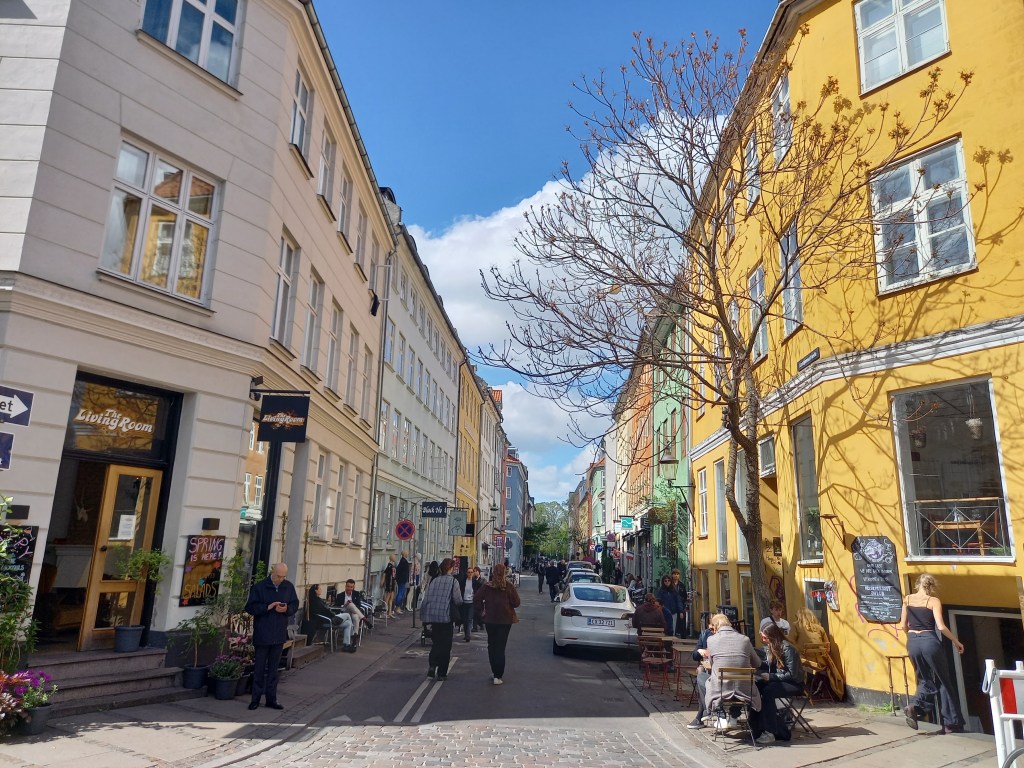
HOW TO DESCRIBE a place like this? Tang of cannabis smoke, thick, white, and familiar, bicycles (many) and of all kinds, bearing all kinds of cyclists, young families (for example) with carts, Muslim businessmen, men with both ears pierced who are deeply in love, strawberry-haired girls as sweet as soft-serve ice cream, that choppy, guttural, lively language, spoken between shopkeepers watering flowers, or shoppers thumbing vintage clothes between the Homoware sex boutique and Café Dubrovnik, all of this at Studiestræde and Larsbjørnsstræde on a sunny May afternoon in Copenhagen.

servant of the people

I AM JUST LIKE YOU. I’ve been watching Zelenskiy on TV every night on my couch. Not wartime Zelenskiy — I get my updates from wartime Zelenskiy on my phone — but peacetime Zelenskiy, when he starred in Servant of the People from 2015 to 2019. It’s almost painful to watch the opening credits, where he cycles to the presidential administration building through a clean-looking, sunlit Kyiv, winking at pedestrians, being watched by old couples, past leafy parks and old stone monuments. This was the Ukraine that still existed just a few months ago, I suppose, the freewheeling, post-Euromaidan Ukraine, the Ukraine where a comedian was elected president. That Ukraine, before the missiles, the deportations. Now it all seems like a lost world. 

When the war came, I was gripped not only by panic, but by a crisis of conscience, or a collapsing sense of self. The American writer Scott Fitzgerald’s first book, This Side of Paradise, published in 1920, described the development of his self-modeled protagonist from what he called an “egoist” to a “personage.” We have a core self, the self we have always been, and then a second self, a personage, or persona, a self we have created, one that is not necessarily an illusion, but the face we show to the world. Zelenskiy’s character in Servant of the People was very much his “second self,” just as my identity as a writer is my own. It’s a jacket I can wear all day and take off at night. Just as I put my feet on the couch and watch Zelenskiy and try to forget about the war, he once came home from the studio, kissed his wife and did the same things. Comedy, entertainment. It was just a job, but it wasn’t necessarily who he was.

Then when the war started something happened. I could no longer write. I searched for inspiration, words, but nothing came. Fiction? Columns? Articles? This wistful quasi-romantic bric-a-brac I have been serving up for years, like baked potatoes? Nothing materialized. I missed deadlines. I went missing in action. My editors pestered me, badgered me, waited for me, anxiously, and I had no idea what to say. I blamed it on the war, of course, because I could not write because nothing I could write could measure up to the terrors of this world. What need was there for writing anymore? What need was there for comedy? What need was there for fiction? What need? Within a few weeks, I had lost all desire to be whoever I thought I was. It had disturbed everything.

These sound like first-world problems, I know, but writing seems to be my sole surviving talent. If I cannot write, I cannot work. If I cannot work, I will not get paid and I will run out of money. If I have no money, I can’t support my family and we won’t eat, or I will have to borrow money and steal firewood from the neighbor. So whatever was happening out there, I had to pull myself together and push through the storm. Even if my core self was struggling, my second self, this writer character I had long ago devised, he had to see things through. That person had to keep writing, even if I didn’t feel like it.

I think a lot of other people have had to go through this process. In a war, it seems that all is needed are more soldiers, tanks, missiles, planes, better messaging. There is no need for books, no need for fiction, indeed, no need for comedy or TV shows. There is no need for anything, if you think about it. No need for concerts. No need for yoga classes. No need for finely prepared meals. No need for a walk in the park. Nothing, but to keep breathing, is necessary in a war. Yet if we cannot live our lives, then what exactly are we fighting to protect? Exactly that, our right to live our own lives, to write, to make jokes. To continue on without the dark threat of war.

This is the mindset I have adopted to keep myself in some kind of balance: that no matter what happens, life must go on. Even if they put me in a deportation camp, I shall steal a pen from a guard, and write my book on the back of a political poster. For I am a writer, and that is what I must do. For Volodymyr Zelenskiy, I believe it is the same. Right now, he is being the president, just as he once was a comedian. He is a father and a husband, too, and I hope that someday he will know a day without fear and frustration. One day Zelenskiy’s country will be rebuilt, and for a few moments his family will sit in a Kyiv park and forget it. Just a few moments. I don’t think any of us will forget about it, but for a few moments we can not think about it, I think. That is my hope.

araukaaria, live in viljandi

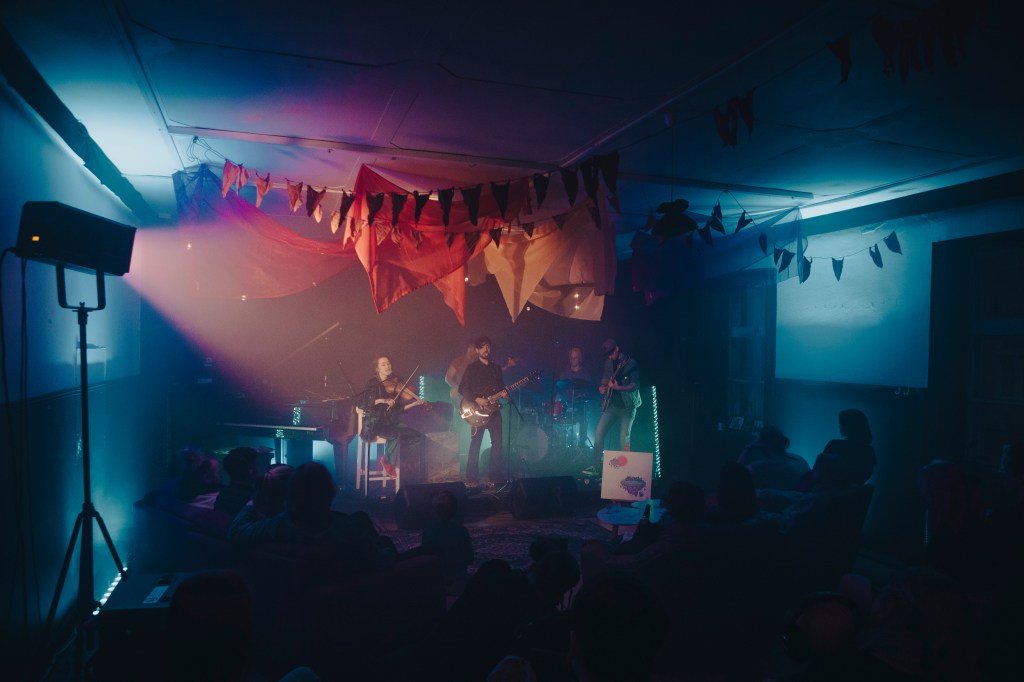
Araukaaria playing to a captivated audience in Viljandi, 15 April 2022, photo by Kerttu Kruusla

THE CITY OF VILJANDI, Estonia, has become in recent years a sort of hub or draw for artists and musicians from Latin America. It is the Santiago de Compostela of Latinoamericanos in search of something. More arrive each day, from Chile, Cuba, Mexico, Argentina, and other places. One of the first arrivals though was José Prieto, known to all as Pepi, who has been here for a decade.

Pepi is a programmer, teacher, and musician originally from Buenos Aires, but with roots in Chile. Lately he has been channeling his creative energies into several new projects, among them a band called Araukaaria, after the genus of great coniferous trees that grow in South America. He has also continued to innovate via samasama.studio, a digital production enterprise that recently rented the space of a former Viljandi jazz club called JASM, where it serves not only as a coworking space, and location for workshops and lectures, but also as a music venue at night.  

It was here last week that Araukaaria performed a 10-song set. The quintet is led by Pepi on vocals, guitar, and keyboards, with Lee Taul on vocals and violin, Harri Heinsoo on guitar, Cuban bassist Liosdán Herández (“Tito”), and Johannes Eriste on drums. This is a group in its infancy, and yet, perhaps because of it, a lot of fun to watch. One must remember that all bands in the world start out just like that, as a bunch of friends and accomplices on a small stage, surrounded by friends and curious onlookers. Even the Beatles themselves started out like this. 

During the performance Pepi began to develop a frontman persona which is somewhat apart from his usual thoughtful, insightful presence, engaging the crowd, telling stories about the songs, and also introducing the art of Argentinian Juan Yañez, also based now in Estonia, who has developed artwork to accompany each one of Araukaaria’s songs. All of this, complemented by good lighting (by Rommi Rutas) and sound design (Laura Sinimäe), made Araukaaria’s performance fun and a bit unpredictable.

The music has a variety of influences, pop, folk, progressive rock, and Argentinian sounds, like Vox Dei, Sui Generis, Seru Girán, Divididos, and Babasónicos, to name a few. Pepi’s acknowledged greatest influence is Pink Floyd, and one can hear some traces of David Gilmour in the guitar work and song composition. Lee Taul (Don’t Chase the Lizard, Black Bread Gone Mad) brings Estonian folk sensibilities with her contributions and helps to balance the vocals. 

This is a unique group that is just starting out and has some good things going for it. One is its links to savory Latin American music and culture, as well as its blending of those influences with local sounds, and another is strong compositions and memorable melodies and lyrics, sometimes sung in English, other times performed in Spanish. But above all this band benefits from reliable musicianship. Lee Taul is a charismatic, widely sought after performer, and Harri Heinsoo is a fiery, impressive guitarist. Tito and Eriste proved themselves to be a seasoned and sensitive rhythm section. And then there is Pepi, who has provided the outfit with vision and direction. 

We will all hear more from Araukaaria. I am sure of it.

kuivastu harbor blues

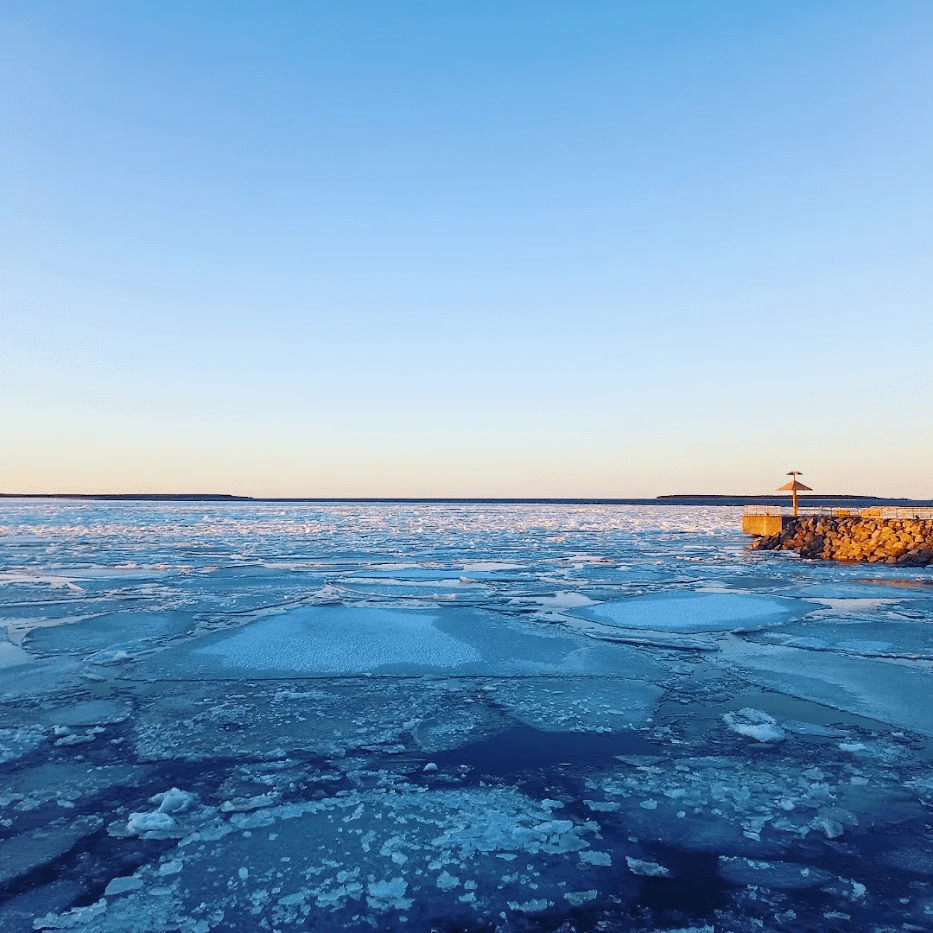
Kuivastu Harbor, Muhu Island, Estonia, March 2022

I PULLED THE CAR into the lane at Kuivastu Harbor to wait for the ferry to the mainland. It was still officially winter, and even though the Estonian islands were already warmer and sunnier, and there was the specific promise of springtime in the air, the waters around the docks were full of heavy pieces of ice, and the orange sunset on the horizon only made the place seem more like the Arctic. I love harbors, and found myself wandering the halls of the harbor building, and venturing upstairs to the café, where music was playing, but all the tables were empty, and there was no one at the bar. These places like Muhu and Saaremaa felt farther away from the war, safer. Still, at the Kuressaare Castle, there had been an exhibition about all of the battles that had been fought out in the islands, and some of the weapons that had been left behind were on display, machine guns and the like. There was also a mannequin of a man in a wooden boat that had actually been used to row across the Baltic Sea. He had an old-fashioned hat, a newsboy’s hat, as my children would say, just like the one I have. The same hat I held onto as I walked around the dock at Kuivastu, hoping for a peaceful spring.

I had been trying to keep my mind calm during the war, but this had proved impossible. For the first week of the war, all I did was check the news, from the moment I woke up until the moment I decided I could stand no more. Work completely halted for me, editors sent me assignments, but I could not do them. Who wanted to read about anything else other than the war? How could whatever it was I was supposed to do be any more important than what was going on down there? People across the ocean were bombarding me with letters, urging me to flee this dangerous part of the world. There were serious discussions about where to go, should we have to eventually escape. When would we know when it was time to go? When the government or the embassy said so?

In the castle museum, we had looked at all of those exhibits about Soviet life in Saaremaa. My children asked me questions. What was a Pioneer? What is a kolhoos? What was the komsomol? Of all people in the world, I was left with the task of explaining this complicated system, one in which I had never lived. There were images of Estonian Communists, of Estonians who collaborated with the Germans, of Forest Brothers, who stashed their belongings in milk containers in the countryside to keep them safe. To think, in some ways this conflict between them never ended. Some people are still fighting. But what was it even about? Why were Communism or fascism so important, that so many people needed to die for them? “Which side were the Estonians on?” my eldest daughter asked me. A good question. Every side. I tried to keep my calm, though the war continued to trouble me. The kids sensed this unease, but calmed themselves by wandering around through the gift shop.

I stared once again at the display with the man with the hat in the boat. Now, with the war breathing down our necks, I started to wonder how long it might be before I had to row across the sea. My neighbor back in Viljandi, a Kihnu girl, said that her great grandfather had helped take Estonians to safety by boat. If we were going to be forced to relive history, would we also be reliving this history?

The hotel in Kuressaare where we stayed had long been popular among Russian tourists, but this time, I only heard Russian spoken by a single dark-haired man outside, who was smoking and who looked like someone from the Caucuses. In the halls, there was a young woman vacuuming. When I asked her about the hotel breakfast, she just stared at me, and then said that she only spoke “vuh-nuh keel,” vene keel in Estonian, meaning Russian.

Another woman who worked in the hotel told me the girl was a Ukrainian who had fled the war. She now spent her days changing beds and sheets, washing bathrooms, and getting updates from relatives who were behind. To think, she had fled here for safety, and yet we still felt afraid too. Maybe soon enough we might all have to get on a ship together and go somewhere to get away from it. Like it or not, we were now all in the same boat.