how i learned to love nastja

An Estonian friend recently moved back to Tallinn from abroad and complained to me, “God, I wish I had paid more attention in Russian class in school.”

Man, that burned me up. Just the idea of it. Here we had an Estonian in the capital of Estonia lamenting her lack of Russian skills. It seemed to challenge the fundamental idea of the state, but also the relationship between majorities and minorities. I was from New York, where one could hear any language spoken. But everyone was supposed to be functional in English, and if they weren’t, well, that was their own problem.

Not so in Estonia. Here people are more polite about such matters. And my friend didn’t want to upset her neighbors, with whom I understand she has had some significant communication problems. Maybe there was a question about who takes out the trash, or where it would be possible to park one’s car. Whatever the issue, the inability of one Tallinner to make herself understood to another Tallinner is frustrating to her.

Now, this friend is from Hiiumaa, the most Estonian place in Estonia. Had she grown up in Tallinn, she probably wouldn’t have these communication problems. Just observing my other friends in Tallinn — those who probably never needed a Russian class — has enlightened me to their linguistic skills. They remind me of cartoon superheroes in a way, their multilingualism is part of their secret identity. The way Bruce Wayne was a playboy by day and Batman by night, my friends can be Estonians to me but Russians to their neighbors. It comes as a surprise to me every time, to learn of an acquaintance’s secret Russian talent. Everything is in Estonian, but when the lady down the hall asks a question about the plumbing, Katrin suddenly becomes Ekaterina and “Jah, jah, jah,” becomes “Da, da, da.”

For Estonians, such situations are what they call “normaalne.” But they offended me in part, not only as an American who has read Mart Laar’s history books, but as someone who had made an effort to learn the world’s second smallest fully functional language.

“How the hell do you expect that lady to learn Estonian if you always speak to her in Russian?” I have said to more than one Estonian. But when I pester my Estonian friends about indulging their Russian neighbors’ monolingualism, they usually shrug. Estonians relish efficiency, you see. They are more interested in getting things done than linguistic power politics, they say.

Still, I think there is actually more to it than that. There are hidden elements of compassion and fear in the Estonians’ approach to communicating with their monolingual Russian neighbors. Compassion in that they feel bad that this great nationality should have to learn their small and unusual language, even to acquire a passport, and fear because of historical reasons, the way most of them arrived a few decades ago, and because the leader of their former mother country is a Judo-practicing former KGB man who nurtures a paranoid world view, and who would probably like nothing more than to see Mart Laar and the entire leadership of IRL in jail alongside Mikhail Khodorkovsky and Yulia Tymoshenko, on corruption charges, of course.

Living in Estonia, I acquired this mix of pity and fear for the local Russian community and maintained it. Until one fateful day at the supermarket.

On that day, my cart was full with Estonian produce, küüslauguvõi, leib, mereväik, and all the other wonderful things you people eat and drink. No, there was no sült, (and there never is!)  I was just about to unload my groceries at the checkout line, when an old man in a leather cap cut in front of me and started unloading his. I tried to flank him to regain my old slot in line, but he made some angry gestures with his arms and grunted what I took were some Russian obscenities at me and continued on his way. Of course, he managed to evince some pained beginner’s level Russian from the stuttering Estonian cashier, and then he was on his way, another old asshole grunting and pushing his way into the abyss.

Something changed in me that day. Something hardened, something crystallized. I lost all of my compassion and all of my fear. What was left was pure self centeredness, the same disregard for others that the Russian man in the supermarket had shown me, a true foreigner in his land. For years I had thought about Estonia’s Russian “issue” and argued with wannabe intellectuals and propagandists on websites about official languages and citizenship laws. In all of my reading and arguing, I had hoped that I would happen upon a solution that would make every human being in the universe, or at least Estonia, happy. Why not to adopt the European Charter for Regional or Minority Languages? Or why not to ease citizenship requirements for certain groups? If it could keep meddling bureaucrats out of Estonia’s affairs, and keep the local minority happy, then wouldn’t it all be worth it, not to mention more Scandinavian-like  and egalitarian?

But after that day in the supermarket, I just couldn’t be bothered to care. I thought of all the nights I had spent with my notebook watching Andrus Ansip on the news and copying down his magnificent vocabulary, rewriting the words ten times so that they would stick in my mind. And then I thought of all those disenfranchised monolingual Russians in Tallinn watching Russian state-owned media and wondered if one of them had ever lost a second of sleep over the integration and accomodation of real newcomers to Estonia, people like me and Abdul Turay and João Lopes Marques and the many others who write columns about them who are living just next door. I thought of the asshole at the supermarket, cursing at me and bullying the checkout girl.  I didn’t care anymore if he had citizenship or spoke Estonian or felt at home in Estonia or was waiting for the Red Army tanks to return. He was on his own, as was I, in this little cold harsh land.

Indifference. It’s supposed to be the scourge of mankind, the very opposite of good Christian empathy.  But in my case, it was liberating. It felt great. I would have opened the windows and sang, if it hadn’t been so cold outside. A vast rock called the “Russian question” had been dislodged from my chest. And for the first time, Estonia’s Russians stopped being a “question” or an “issue” or a “situation” to ponder or worry about and argue on the Internet about. All Estonian Russians became merely individuals to me, after that encounter in the supermarket. Some were upstanding citizens, some of them were assholes, but they were all different, and there was preciously little I could do about it either way. They were all just people living their lives, worthy of equal respect and courtesy (and intense disdain, if one happened to cut me off in the supermarket).

It was around this time that my first book came out, and it displaced a volume entitled Selgeltnägija by an individual named Nastja from the top of the bestseller lists. My friend told me in private  that some Estonians were happy to see it happen, not only “because she’s a Russian,” but “because that witch has been number one for too long.” This caught my interest. Who was this Nastja? What was that book about? Apparently, she really was a witch, but there are a lot of witches in Estonia. So, I think that her fame was at least in part due to her wholly non-Estonian image. And I have to say that I liked her. I liked the insolent look on her face on that book cover, her stormy eyes, her frisbee-sized earrings. She was just so refreshingly … Russian, so different from the milquetoast Estonians I had to contend with day after day, a ray of light in the winter gray.

And yet she was also an Estonian, wasn’t she? How could anyone challenge that? Nastja, as I found out much later, was competent enough in the language that I saw her laugh at some inside joke about men and reindeer antlers on a talk show. Not that I am an nationalist, but it always feels good when I see that someone else has wasted her time learning the second-smallest fully functional language in the world. And history and politics and communication troubles aside, I was was really happy that someone like Nastja lived in Estonia. She made it much more interesting.

five-thousand-year-old woman

A journey back in time.

I saw a ghost the other day and I haven’t been able to shake it since. It stays with me wherever I go, sleeps beside me, drinks coffee with me in the mornings, and asks me to fix fallen curtain rods.

The encounter happened at a children’s museum in Tallinn called Miia Milla Manda. It’s a very sweet, gingerbread, Astrid Lindgren kind of retreat. The walls are all yellow and they sell paper dolls there, the pretty ladies who staff it are dressed like apothecary assistants from the first years of the last century. There is a sweet-smelling bakery that serves coffee and hot chocolate, and a garbage can that thanks the children when they throw away candy wrappers and snotty tissues. “Mmm! Garbage! Delicious!” a voice recording says, munching away. “Thank you!”

Inside there is a mock post office from the year 1940, with a quill and an inkwell and filing cabinets for letters. The children can dress up in old-fashioned clothing and sort mail and even send a real letter to one of their friends, if they know the address. One can also listen to a postal worker from long ago tell of his daily routine from a set of headphones on the wall. And above the headphones there is a portrait of Konstantin Päts, Estonia’s dictator from the 1930s, that was put up there for the true period effect but is actually confusing because my children think that he is the one that they hear speaking about mailmen’s lives 70 years ago.

“See, Daddy, that’s the postman who’s talking in the headphones.” My daughter Marta has told me this both times we have visited, gesturing at the ancient dictator. I look up and there is the deceased pater patriae himself with all his presidential regalia, an apparition in black and white. I just nod though when she says it. Who am I to mess with my children’s fantasies? The truth will come out someday.

On the wall there is another image, one of three women working in a post office. There are two old ladies in dark dresses with crooked fingers, perhaps from sorting too many fallen apples in fall. But in the middle there is a more familiar woman with hair that hangs in curls and nestles on her shoulders.

That woman. I noticed her the last time too. The woman is looking down in the old picture, sorting those old letters, but I can make out the lines of her eyebrows, her nose, her cheeks. The woman in the picture is not beautiful in any modern, conventional way but for some reason I feel drawn to her each time I see her, though I can’t figure out why.

The last time I was there I stared at the woman for a while, maybe stared at her for too long. And I ogled her so because after looking at that face for so long, I understood at last of whom she reminded me.

My wife’s mother.

I shivered when I realized it. It wasn’t her, of course. That woman, my mother-in-law, was born a good decade and a half after the old post office photo was taken. But it looked so much like her, and like my wife too, for a very simple reason: because she was an Estonian and they were Estonians.

Estonians. They were a people from a place who had their own capital, their own children’s museums and post offices, their own way of speaking to one another, and their own kinds of faces. And I was married to one of them. I was married to an Estonian. We had made more Estonians together. And though I would never know the woman in that photo with the familiar face, I knew her quite well in another and very eternal way.

This was the point where I nearly started to cry and I cannot exactly say why. I almost never cry and I didn’t this time either. I’m a guy from New York, so I’ve been trained to restrain myself from showing emotion in public. But it couldn’t stop all of these feelings from welling up in me and rumbling and vibrating like some undersea earthquake. That’s really the worst, I think. When you feel the moisture in your eyes and you don’t even know why it’s there.

I think it was because it had been a long time since I had even seen the Estonians as Estonians, as a group of people who came not only with a language and a history, but with a certain set of faces. I had spent so much time in their company that they had only become individuals to me with hard-to-remember names, some odd habits, and a peculiar, often bloody, cuisine.

In fact, if I ever thought about Estonians these days, it was with a mix of disappointment and disgust. Why were those guys always standing around smoking and drinking beer? Why were the women such task masters? Why is there a commemorative book about a Nazi war hero at the supermarket?

There was quiet hatred in there too, nipping at and pestering me. I raked my leaves and shoveled my snow to the best of my ability, just so that I could avoid some dreaded comment or smug look or other expression of Nordic anal retentiveness, because everything had to be nice and neat and within the lines in Estonia. That’s how my wife said that things were done around here.

“Damn perfectionist Estonians.” I had uttered it hotly under my breath many times. “Snow-shoveling fascists!”

Yet despite the beer and the chores and the Harald Nugiseks coffee table book, the leaf raking and snow shoveling and Nordic anal retentiveness, the truth was that I spent most of my nights sleeping beside an Estonian. I had never met this Estonian’s mother and never will, because she is dead, but I knew her in some way because she was an Estonian too. In a way, I had been just as intimate with the ghost of the woman in the picture in the museum.

“What are you looking at, Daddy?”

“What? Huh?” My daughter Marta startled me and when I looked down I saw her again. Another Estonian.

“Um, I’m going to go play in the other room, okay?”

“Sure thing, kid.”

The eight year old skipped away.

How many of them have there been? I wondered. How many women have been born in Estonia who looked just like them? They were all individuals sure, one sorted mail in the 1940s and the other was a librarian in 1980s and the third was a writer in the 2010s. Maybe one was a bit more neurotic than the other, or another preferred French pop music and a third liked to swim. Yet, in this base, bottom line way, at the end-of-it-all way, they were all the same person.

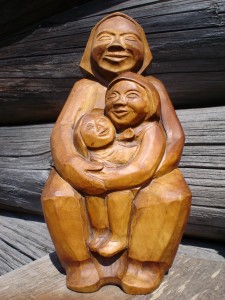
There probably had been many more of them. For 5,000 years, they say, the Estonians had occupied this little patch of land by the Baltic Sea. They had come here from the Ural Mountains long ago and handed down not only their looks, but also their language and songs, their knitting patterns and fish-smoking techniques. This, of course, is all well documented, the domain of archaeologists and linguists, most of it kept away in museums.

In this museum, though, I began to suspect that they had also handed down something else — their souls. Her soul. It was a thought that was both sweet and disturbing. Maybe I wasn’t just sleeping beside a 38-year-old woman at night. Maybe, in some other, more mystical way, I was  sleeping with a 5,000-year-old woman too.

“Daddy, what’s her name?” my other daughter Anna asked and tugged at my shirt.

“Whose name?”

“That lady who looks like Mommy. In that picture.”

“What difference does it make?” I said and shrugged, and then I saw Anna’s little five-year-old lips curl into a frown. “Well, maybe her name was Miia,” I tried to sound more positive. “Or Milla. It could have been Manda too!”

“Ah,” said Anna. “So this is her museum?”

“Yes, honey. This is her museum.”

That’s just what life gives you. In one flash you are in the Ural Mountains and the next you are sorting mail and the third you are waiting for your husband and daughters to get back from the children’s museum in Tallinn. Life gives you the most important things — your name, your language, your looks — and there is little you can do or change about it. The Estonians were who they had always been, and I couldn’t change them nor could they change me.

The thought awakened in my soul a long dormant affection.

golden hands

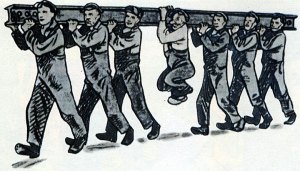
Konstantin Rotov: False Shock Worker at the Work Site (1932)

My wife was annoyed with me because I walked past the hammer that was laying on the kitchen counter three times. “I decided that I wouldn’t put it away,” she said, “because, you know, in most households it is the man who takes care of the tools.” With that my face tightened, like a cat about to wretch, and I mocked her in a high noxious voice, “It’s the man who takes care of the tools.”

“Why are you mocking me?” she demanded an answer, “It’s true. In most households it is the man who takes care of the tools. It is your hammer, isn’t it?” “It is my hammer.” “Yes, it is your hammer, so it is your responsibility, as man of the house, to put it away.” “Yes, I am the man of the house.”

And with that I dutifully deposited the hammer into the toolbox and was on my way.

I don’t think it’s the hammer that made her mad though. It’s the fact that we have to pay a handyman to paint our rooms and build our shelves. Her father is a builder who knows how to do these things, and she has respect for such men with “golden hands” as they are called in Estonia. Our friend Kerttu also goes on and on about her Latvian father who built the house she grew up in with his “golden hands,” and then there is Margit whose golden-handed grandfather built the house she lives in. Let’s not forget Kersti’s husband, whose hands are so golden that they “shine when he goes outside in the dark.”

And they sort of blush as they praise these golden men and don’t understand that Mr. Justin’s golden hands write books and columns and articles about complicated shit, and he doesn’t have time to paint the office door.

“So, you don’t have golden hands,” one Estonian woman consoled me. “You have a golden pen.”

But it’s not the same thing, not in this society at least. Here, physical labor is more revered. Maybe these are agrarian Lutheran ideals that have survived into the 21st century. Or maybe the Estonians still have a bit of that Stalinist Stakhanov “shock worker” mindset lingering in their collective unconsciousness. But when I finish an article, my wife usually does nothing. Creative writing receives more praise, because she’s also a writer. But when I do some physical work around the house she leaps into my arms and wraps her thighs around my waist and kisses me with a hot fever like a French teenager rescued from Nazi henchmen by Le Resistance, “Oh thank you, thank you, thank you, thank you. You are a good man. You are so kind. Have I told you how much I love you?” Her cheeks grow as rosy as red delicious apples. There are tears in the corners of her eyes. And then more kisses. I have to tug her off of me. “Hey, look, honey, uh, all I did was put a nail in a wall.”

Yeah, maybe I am exaggerating, but only just a little. And I am not alone in viewing things this way. “Estonian women prefer Estonian men and it is normal and natural that they should,” writes British Estonian columnist Abdul Turay. And for those Estonian women whom fate has dealt a foreign man? “Simple, they Estonianize them,” Turay says. “Any guy with an Estonian woman will eventually learn how to chop wood or put up shelves.”

This may be shocking, but since I met Epp, I have chopped wood and put up shelves. Ikea shelves at least.

Anyway, I think the reason that “golden hands” annoys me is the same reason that it makes the Estonian women around me so proud. In my pop psychology interpretation of things, everything can all be explained by those all-important early childhood years. And when you look at my early childhood years and my wife’s early childhood years, very different pictures emerge.

When I came into the world, many women in America were burning their bras. They called it a feminist “revolution” or a “liberation,” but whatever it was, young ones like myself were the guinea pigs of the social experiment of the day. Traditional gender roles were reversed. Boys were encouraged to show their feelings, even to have dolls if they wanted them. Yes, it’s true, there was a popular children’s song called “William Wants a Doll.” Want to play with dolls instead of hammers? It was perfectly normal by the standards of the day.

Girls were encouraged to achieve, to be ambitious, to be athletic and tough. Want to be the only girl on the football team? Here’s your helmet. See you at practice! And if there were any gender conflicts in childrens programming, it was the clever girls who always outsmarted the stupid boys. Always. So now, 30 years later, it comes as a surprise when studies show that many men of my generation in America are regarded as excellent cooks. Women our age in turn have successful careers, many of them making up the managerial class, boasting about what terrible cooks they are.

And we tell ourselves that these things just happen.

Yet one of these wayward, sensitive, gourmet chefs now finds himself in a land where showing one’s feelings and making delicious dinners isn’t worth so much. There were no bras burned in Tuhalaane, where my wife spent her formative years. There was no “revolution.” Boys didn’t have dolls. Girls didn’t always win. That didn’t mean they were all passive. “She is of the rare breed of industrious farmer’s daughters,” one of my Estonian friends once said of my wife. “Mostly it’s these kinds of women who can land themselves a foreign husband.” Yes, she is clever, tough, resilient, all of these wonderful things that I was taught to value.

But she also expects that if there is a hammer lying around, any hammer, that I put it away.

This is another country. I have to try to fit in, play by their rules, not vomit everytime I hear women gush about some guy’s “golden hands.” And even if it’s my “golden pen” that pays the bills, I must find some time each day to do a little home renovation, just to show that I haven’t forgotten what’s really important in life — painting doors, chopping wood, and putting up shelves. And if it so happens that I walk by a hammer in the kitchen, any hammer, then I know I must seize it at once and start hammering everything in sight, for as long as I can muster, like a Tuhalaane farmer of old, or Comrade Stakhanov himself, until my hands are so golden with sweat that they shine in the dark.

Reviewing a Review

While looking for the free online text of one of my favorite books, I happened upon Jeanette Winterson’s review of Renegade: Henry Miller and the ‘Making of Tropic of Cancer.’ Winterson is not pleased with author Frederick Turner for not answering the central question that she feels is raised by Tropic of Cancer‘s enduring popularity, that being, “Why do men revel in the degradation of women?”

I guess it is a pity that this book has been as influential as it has been, because here it is held up as offering some perspective on the “male mystique” of the author, or even of all American men. There are some interesting parallels between Miller’s inability to connect his own whoring with the ills of the capitalist machine against which he rails with such venom, but such connections are probably lost on most readers unfamiliar with various social theories.

Anyway, all of this, I feel, is very much missing the point. What I liked about that book was its bald honesty, and Winterson’s review made me question the interplay between various movements, including the feminist movements, and literature. What is literature? Is it the duty of literature to make the world a better, more ideal place? Should we shame literature that portrays the world in its current ugly state, that does not strive to change the way things are, but merely reflects them? Is the only good literature activist literature?

What I mean here is, if Henry Miller, the fictional protagonist of Tropic of Cancer, really was a frequenter of whorehouses, then so what? If such places exist, and such men frequent them, then in what way is it incorrect to write about the mindset of such men in a book? The reason why I liked this book so much is because I know such men, have grown up alongside them, heard their tales of degradation. To actually have a narrator laying out his imperfections for me was a welcome respite from the unbelievable characters who dominate so much of fiction. He may be wrong, but at least he’s not lying to me.

And I am not sure the prostitute is so innocent in this discussion because Miller doesn’t always portray himself as some user of women’s bodies. If anything, he is the sucker who falls for the con of what they are selling. The character in the book digs through garbage pails searching for something to eat. But when accosted by prostitutes, he gladly gives up his last pennies for the promise of pleasure. Here, he reveals himself to be a fool. This begs the question, who is using whom? I think theprotagonist here is no champion at all — he is degraded himself. The whole world around him is degraded, and he is just a mere part of this degraded setting.

Of course, once the book is in print, it is open season for critiques, including Winterson’s. But I am grateful to Miller for writing so openly, and poetically, about the Paris he encountered. I urge other authors to write with such honesty.

No Matter What, Gaga Will Find a Way

“Do you want to know what’s my style, Daddy?” asked my eldest daughter as we headed toward the stage of the Song Festival Grounds. “Goth.”

“Goth?” I was perplexed. Why would this kid want to dye her hair black, wear make-up to make her face look pale, or get her eyebrow pierced? And where did she hear about goths anyway?

“Hey, why do you want to look like you are dead?” I said. “I think you like fine just as you are. Many women pay to have hair that looks like yours, you know. And you are going to dye it black? That doesn’t make any sense to me.”

“Well, um, I don’t think I’ll dye my hair black,” she seemed to reconsider. “Maybe just wear black clothes.”

We were surrounded by legions of black-wearing youth that night, because it was the Lady Gaga concert. I bought three tickets: one for me, one for my daughter, and one for a friend, knowing only that they liked to sing Lady Gaga’s songs, a few of which I recognized from the radio, and that they would be so happy to see her. I also thought of it from a historical context. This was something of her generation. A significant event. Years from now she could tell people, “I saw Lady Gaga. I was there.”

So, you could say, I was unprepared for what was about to unfold. Not like I was alone. There were plenty of other kids there with their parents. And in the crowd I spied some respectable people too. There was the talented writer Loone Ots. And in the more expensive seats I glimpsed Tallinn Mayor Edgar Savisaar, flanked by two young beautiful women drinking champagne. I can only wonder how Savisaar felt when he watched Gaga arrive in bondage gear on a horse borne by half-nude dancers, or when Gaga danced around with a fake machine gun flanked by plastic dead cows, or when she pulled up her skirt to show the crowd her ass and told them all that she, “Just didn’t give a fuck.”

“Daddy, she said the ‘f’ word again!” Marta squealed in half delight when she said it. “Why does she use the ‘f’ word so much?” “Because Lady Gaga is a bad girl,” I told her. “Bad girls like Gaga use that word.”

How did I like Gaga? The show reminded me a lot of Madonna circa 1991 when she came out with Erotica and her book Sex, though a bit less raunchy and more accessible for the masses, many of whom were probably not even alive in 1991. But the kids certainly didn’t care if she had stolen half her act from the Material Girl. They bopped their heads through “Alejandro,” “Poker Face,” and “Paparazzi.”

“Bad Romance” seemed to draw the most applause, and this is the song my daughter and her friends like to sing together most when they walk home from the Viljandi Waldorf School. I hoped there weren’t any parents from the Waldorf School in attendance at the concert. Maybe they would see me and scold me for taking my daughter to see Lady Gaga and not teaching her how to play the zither or recite poetry instead. Or maybe they were there, hiding from me the same way I was hiding from them, feeling guilty for indulging their children in such a guilty pleasure.

It made me wonder, was I a bad parent for bringing my child to such a place? Or would I have been a bad parent if I had not taken my daughter to see Lady Gaga just for the sake of trying not to be a bad parent? What is a bad parent anyway? Being a parent sure is confusing. But I have a feeling that even if I sent my daughter off to a nunnery in rural France, she’d still manage to scrap together a handmade communications device so that she could watch Lady Gaga videos on YouTube. In this way, Lady Gaga is not a yes or no choice. It’s more of a choice of how a parent reacts to Lady Gaga than if he or she allows Gaga into a child’s life because, no matter what, Gaga will find a way.

I do feel often that I am locked in a struggle between a desire to see my daughter grow up unscathed by the sordid side of life, and a mainstream culture that tells her major focuses should be style, hair color, finger nails, make-up, and pop music. How to find the balance? I don’t want to be a rigid father who she will loathe for the rest of her life, and I don’t want her to spend too much time playing Barbie dress-up online.

As a defensive act, I recently signed her up for a co-ed soccer team. I had hoped that by playing a rougher sport with boys, she might shed some of this image-obsessed girlie posturing that she has soaked up from the commercial glitz around her and nurture some other hardworking, goal-focused character traits. Instead, she told me that she doesn’t want to play soccer at all and would much prefer to go to dance class.

“Want to see my moves?” she asks with a twirl. It troubles me that she so flatly rejects soccer in favor of learning new dance moves but my wife says not to worry and that I should just embrace her for who she is. “Who knows,” she says with a shrug, “maybe she will grow up to be the next Lady Gaga …”

the good old days

Aitüma entered my vocabulary at some point in the recent past. I don’t know when and I honestly have no idea what the etymological difference is between aitüma and aitäh because as far as I can tell they mean the same exact thing, “thank you.”

So I started saying it to everyone, to the cashiers in Tallinn and the telemarketers trying to sell me cookbooks and the guy who delivered my boots. They didn’t seem to mind but a few were amused to see this foreign guy standing before them saying this archaic word.

My guess was that aitüma was just one of those funky South Estonian words making a comeback like hüva and hää and too. I asked my friend Silver about this and he explained that I was only half right. “Only ökoinimesed say aitüma,” Silver said. “Why?” I asked. “Because it’s so cool and old,” he said, “and ökoinimesed love anything that is old.” (Ökoinimesed translating as “ecopeople,” people who wear old-fashioned clothes and eat only organic foods, people like a lot of our friends, people like us.)

I liked this dialogue with Silver because it was the first time that someone in my group of friends had expressed irony about the popularity of anything aged among the young people of Estonia. But it’s true. Call it the öko lifestyle or just retro infatuation, the adults around me seem obsessed with traditional life. Öko in this sense is nothing new, but rather old, öko is the food your grandmother’s grandmother ate, öko is the clothes your grandmother’s grandmother wore. In Viljandi, they advertise dance nights at the Pärimusmuusika Ait (the happening folk music center) with images of men and women who look like they could be characters at a wedding from a hundred years ago with their old caps and whiskers and braids and granny dresses.

Mind you, not just anything ancient will do. No one is trying to harken back to the days of the Black Plague or the Napoleonic Wars. Instead, Estonians have settled on an optimal period of nostalgia centered on the 1920s. I hypothesize that this makes life more convenient because the Estonians of the 1920s lived in a sort of limbo betwen the archaic and modern eras. That is to say that they lived in wooden houses and spoke their various local dialects and largely ate food that they grew on their own and had homespun clothing and milled around drinking homebrewed beers and moonshine, but they also had radios and cars and bicycles and tennis rackets and went swimming in Pärnu and sometimes even holidayed outside of the country. And I think this is what these öko people are aiming for: the 1920s plus wireless Internet, for the Internet is the one modern thing that öko people will never abandon.

There is a deep irony here. To hear oldtimers tell it, nobody wanted to live in the dark, crooked old wooden houses of Kalamaja and Karlova and Supilinn in the 1950s and 1960s. They dreamed of a life beyond those ramshackle old neighborhoods, in newer projects like Mustamäe or Annelinn, a comfortable existence of organized building maintenance and central heating with vacuum cleaners to pick up dust and gas-heated stoves to do the cooking, and television to entertain.

Now their grandchildren boast about the virtues of wood-heated furnaces, think the crooked old wooden houses are charming, clean the house with brooms and wet rags, gave the TV away long ago, and cook pork and potatoes or porridges or bread in the fireplace. And it’s the pensioners, the very people who were the little children during this vaunted golden age and the only ones who actually remember it, who are living alone in the apartment blocks of Estonia with their eyes glued to Latin soap operas eating canned meats and vegetables and factory-made bread.

This has led me to wonder — will any of our current creature comforts become fashionable in the same way, 50 or 100 years from now? Maybe our grandchildren will astonish us by trying to imitate life as my generation lived it as children in the 1980s, with no Internet (because there was no Internet), no mobile phones (because there were no mobile phones), no piercings or tattoos (because only junkie guitarists had tattoos), no GPS (only foldable paper roadmaps), and no bicycle helmets (because nobody wore bike helmets back then). Some might argue that this has already happened. As my friend Hannes, a former music label owner, informed me, nobody wants to buy CDs anymore, but vinyl is making a comeback. I haven’t relied on vinyl for music since I was eight years old, but chances are I will be playing records again.

Or maybe the 1980s will be forgotten, and it is the 2000s we will aspire to recreate, the “good old days” when people had laptops for computing, mobile phones for calling, and iPods for listening to music, not just one high-tech instrument for doing all of these things. In Estonia, future generations may yearn for “good old” euroremont, ah, those vinyl floors, those styrofoam ceilings, those plastic windows, “just like grandma and grandpa.” Or maybe they will scower the Internet looking for “vintage” versions of programs like Skype, not the modern one, but the first version, just so they can feel like an earlier, more idealistic, more genuine denizen of the web.

I am sure such sights will elicit a few chuckles from old geezers like us, and maybe more than a little Déjà vu.

Striving for Perfection

There is an old Estonian saying, “Once we get going, we can’t be stopped,” and the same could be said of me, in any endeavor. I love traveling, and once I get traveling, I just want to keep on going, every few days a new hotel, a new city, more planes, trains, buses, boats, cable cars. When I get home I am disappointed. I don’t know what to do with myself until the glow wears thin.

Eating is the same for me, that insatiable appetite. Bring me a salad, bring me a main course, and dessert, and a few more drinks. Ah, yes, drinking, now that’s a real disaster. One beer leads to another. By early morning, I don’t want to remember, though I always do.

Some say I lack self discipline, and I have to say that I agree, 100 percent. But I don’t want to be this person. I dream of the perfect, balanced week, a week of measured consumption and regular exercise. I think we all dream of such a life, for this is the modern ideal, the image of what is the perfect person of our era.

Maybe for our grandparents the ideal person wore certain clothes and lived in a certain neighborhood and had a nice car, but we’ve taken it a step further, the ideal person of 2012 is so much more than clothes or possessions, he is everything, always working and yet always enjoying life to its fullest, always consuming delicious and exotic foods and beverages, and yet — most of all — always physically fit.

Here I am reminded of our dear friend Kaja who runs marketing for a telecommunications company, has six children, goes mountain climbing, and is remodeling her apartment in her spare time. Or our neighbor Janek, who manages a beverage company, goes on business sojourns to Japan, and makes sure to run around Viljandi Lake at every opportunity, even when it’s minus 30 degrees Celsius outside, because Janek is smart, he has special clothes for running in Arctic temperatures, and special shoes for running on ice. This modern woman won’t let work or home life keep her off mountain tops. This modern man will not let mere weather get in the way of his quest to fulfill his ideals.

I am jealous of people like Kaja and Janek and all the others who are in better shape than me. I tell myself that they are older, and that one day I might wake up and start running every day, eat only healthy foods, enjoy a good drink or two but know when to stop, work like a machine, read my children to sleep, surprise my wife with something romantic, and smile all the time, as any ideal person does, because regular exercise does wonders for the find and so the ideal person is always happy.

But, alas, I am not there yet. I lack the self discipline to see the project of “me” through, to master all elements of being an ideal modern human being, including getting in shape. While Kaja repels off of mountains and Janek charges up another hill, I am trying to convince myself to not eat that very delicious piece of pepperoni pizza, to not log in to my time-sucking Facebook account and instead go out for a jog, though I never find the time.

Years ago the English band Radiohead included a track on their seminal album O.K. Computer where a modulated electronic voice recited the words, “Fitter, happier, more productive, comfortable, not drinking too much, regular exercise at the gym (3 days a week), getting on better with colleagues at work …” Singer Thom Yorke called it the most depressing thing he had ever written, but I saw it as a satire of us, modern adults, and our ideal images of who we should be, happy people who work hard and then take off for luxurious holidays, where we can refresh our tans and take wonderful photos of our bodies in the sun to show everyone at home just how fit and perfect we are.

It’s easy to be a mocker, and I am, but I also accept that without some ideal vision of who I should be, I would probably still be living with my parents. Early on in life, I developed my own idea of who the ideal person was, largely pieced together from my father’s stories and books and Hollywood films. My ideal person was some kind of hybrid of an action hero and an artist, taking off for remote areas of the world where he got into memorable adventures and perhaps fell for a love interest before spinning the tales into fiction.

These ideals got me this far but, unfortunately, when I was developing my ideal self, I left out a few things. I forgot to code in moderation, and, especially, moderate, regular exercise, something I now yearn for, but never seem to find the self discipline to attain. Like a lot of people, I see other people doing it every day, but can’t find the will to just wake up and do it myself.

Here, I wonder about my friends Kaja and Janek. Maybe they were different. Maybe when they were children, they had different visions of who they would become. Maybe little Kaja had fantasies of mountain climbing. Or perhaps young Janek looked wistfully at the lake on extremely cold days, and dreamed of the day when he would run around it. But young Justin was too busy stuffing his face with pizza and watching Indiana Jones movies and now he can’t manage to do what millions of other people do every day: get out of bed early and go for a run.

So now, later in life, I have to reprogram myself to fulfill these new ideals, so that I too can be “fitter, happier and more productive.”  And it’s not just a matter of going down and running around the lake, because you know I’ll wear the wrong shoes and overdo it (like everything else) and hurt myself in the process. No, I am going to need to do some research into proper foot attire and training methods, how many minutes to do it every day, what kind of terrain is most suitable for beginners. I’ve got to tackle this thing the way an ideal person would.

My friend in Belfast who is a runner says that it makes sense to go to a special shop where running shoes will be selected by a computer based on the shape of my foot and the way that I run. So, it’s going to take some time. But, sooner or later, I am sure that my new ideal will be fulfilled —  albeit it a moderate, perfect, 2012 kind of way. So watch your backs Janek and Kaja. Soon enough —   I hope — I will be right behind you.

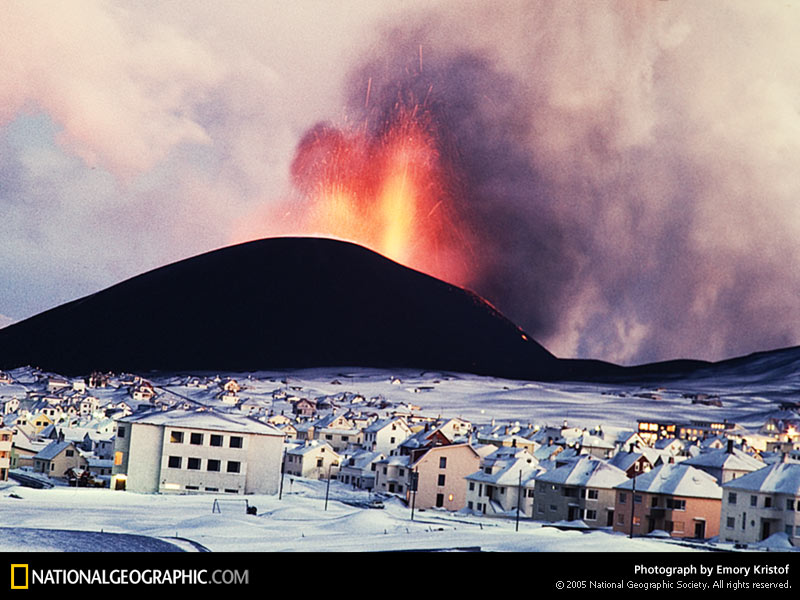
saved by a volcano

I came through a crowd of protestors on a hot day in Philadelphia, it was the Republic National Convention, the year was 2000, there were anarchists breaking things, and socialists selling newspapers, and college kids chanting. In the melee, I saw her face on a t-shirt, like some kind of albino seal pup. The slanty eyes. Those fat cheeks. It was her! The man wearing the shirt began to converse with me, we discussed our love of the singer, her music. He was chubby, in his thirties, wore glasses, and looked like a mole.

But there was something different, soft about his demeanor, elusive, as if he was afraid of me. The man was peculiar in other ways. His shoulders weren’t very wide, he talked with a lisp. He asked me if I wanted to get a cup of coffee. And then I realized that he was gay, and I had to tell him no, there would be no coffee. I was renaissance enough to admit I loved the singer, but that didn’t mean that I was playing for the other team – maybe he wanted to be Björk, you see, but I wanted to be with her.

A poster of the singer hung on my dorm-room wall, naked, tongue out, covered only in a leaf, like some nymph out of Eden. But I was afraid of her because she was like some kind of vaginal Icelandic volcano that could erupt at any time and bury my soul like Pompeii in hot lava. To hang her on my wall, to see her flesh each day was to me a political statement, a weapon, a way of retaliating against commercial ideals of feminine beauty around me.

As men we were told to worship Baywatch, to drool over Pamela Anderson, buy her posters, hang her on our walls. Maybe our real-life girlfriends bore no resemblance to the curvy models, but we were supposed to be thinking about them secretly, kissing our girlfriends in New York or Washington, DC, but really thinking that we were on a beach in Hawaii or California locking lips with Pamela Anderson. It was a lie and it disgusted me because Pamela Anderson never did anything for me, never has, this embodiment of these sort of livestock-like qualities within with Western womanhood has been constrained, a world of faces and torsos and measurements and nail jobs, the ideal of the perfect bone structure and hourglass figure, a regime under which all females will be ranked according to their conformance to the babe ideal, like cattle ranked for milk output, and our role as men in the equation was not to ask any questions and to support the commercial ideal of what a woman should be. It was our duty.

And then along comes Björk, a little wrecking ball who sang of “big time sensuality” and “emotional landscapes.” She wasn’t “perfect,” sometimes she was actually quite grotesque, and I couldn’t really look at her without thinking that her breath must smell like that fermented whale meat they eat in Iceland, but at least she was genuine, creative, honest — a genuine communicator, an immediate vision of primitive femininity, this kind of womanhood that is buried in the back of each man and woman’s brain. I knew on first sight that the woman liked to have sex, such a wonderful, sugar-glazed feeling for any man, not that she was flaunting her sexuality like Madonna with her stupid conical bra just to prove something, but that she simply liked sex, the way we all like strawberries because they are delicious.

And the problem was that there were far too few of her. There was just one Björk. There were some imitators, but, mostly, she was considered some kind of demented freak. Maybe it was because she was inbred, or her Hippie parents smoked too much pot, or she was dropped on the head as a child. And did you see how she attacked that journalist? Or that music video were she sewed pearls into her skin? When a friend saw her singing Dancing in the Dark, he thought she was a mentally handicapped person. “What the hell is this shit?” he grunted. “Turn it off.” He wanted to watch a football game on TV. My friend was a sergeant in Pamela Anderson’s army, you see. The pint-sized witch from the big island with no trees had no place in mainstream society.

But when I fell ill with depression in college and didn’t leave my dorm room for two weeks, the little volcano came to my rescue. The days came and went. It would be dark and then light and then dark again and I would still be in bed. One morning though I happened to open a magazine beside my bed, one that I hadn’t looked through before. And she was inside it, dressed up like some kind of surrealistic flower. And I thought, “This is a person who is not afraid of life.” Then I got out of bed, took a shower, and went outside.

An Earthworm and a Rhinoceros

There are a lot of good reasons not to have sex with your cousin, but probably the best reason is that you put your potential offspring at a higher risk of inheriting a genetic disease. I know this because I spend a lot of time at genetics conferences. These events are always fun – you get to see old friends and drink wine and eat stuffed mushrooms and listen to talks about the genetics of different forms of cancer.

The liveliest sessions though concern what the geneticists politely call “consangunity” – the sharing of blood, the state of being inbred. This is actually a big headache for clinicians. They run the child’s sample to identify the genetic variant that might be causing the disease, and then they run samples from both parents to see if they also carry the variant. Then, to their surprise, they discover that significant blocks of the child’s genome and the parents’ genomes are the same. A child born of an incestuous relationship, say between a father and daughter or a brother and sister or a mother and son, may carry 25 percent of the same genome as the parent. This, the geneticists say so politely, is an example of “consanguinity in the first degree.”

Watching all these presentations about incest gets me thinking about my Estonian friends. How come so many of them look the same? And, more importantly, how do they know that they aren’t related? Especially today, when so many children are born out of wedlock, it is entirely possible that some randy wayfarer could father a child in Pärnu and one in Jõhvi and they would grow up and have a midnight tryst in a parking lot somewhere in Paide and unwittingly have a kid with a genetic disorder.

I ran my suspicion of Estonian inbreeding by my friends Enn and Kaari, but was rebuffed when I insinuated that it was possible that they might be related. They know they are not closely related said Kaari, because they had genetic ancestral testing done. At the time, there were two main tests for ancestry in the market. Men can have their Y chromosome tested: tracing their paternal line back, as well as their mitochondrial DNA tested, tracing their maternal line back. Women, having no Y chromosome, can only trace their maternal line back. According to their test results, Enn’s forefathers apparently got to Estonia by way of India, while Kaari’s mtDNA was found in highest percentages in Sami women. They weren’t related afterall. See, Enn is actually Hindu and Kaari is actually Sami. Viljandi is a diverse town!

I have always been a little proud that there is little chance that Epp and I are related. Some people are proud of being all one thing, but my kids count among their ancestors Estonians, Italians, Irish, Scots, Russians, English, Germans, Dutch, Greeks and Albanians. Sometimes, when my father drinks his coffee and gets excited, he starts adding others to the list. “You know, my German great grandfather came from a town on the Czech border,” he says. “We could be Czech!” He says it as if I should go out and buy a six-pack of pilsner and place a framed picture of Vaclav Havel on the shelf.

Needless to say, no one can say what nationality my children most resemble. One of our friends, a world traveler, says that it is impossible to say what they look like. “Your kids are like an earthworm crossed with a rhinoceros,” he says. Still, after hearing Enn and Kaari’s story, I decided that we should also get tested, if only to have something to talk about in their cafe. I tested my Y chromosome first, tracing my forefathers back to the beginnings of time. These men were from southern Italy, so I thought that the results would show a migration through Greece or Turkey. Or maybe even Africa! Wouldn’t it be terrific, I thought, to discover that I was actually black? Perhaps it would explain my love of African music.

Instead, my forefathers apparently came from northern Italy, southern France, or northern Spain, where the same results are found in the highest percentages. I do have a geneticist friend named Ernesto whose family comes from northern Spain and I have always noticed how we have a similar appearance. At last, I had an explanation! We descended from the same dark-haired, spear-chucking barbarian. Then I ordered Epp’s mtDNA test. Her friend, the same world traveler, has seen a photo of Epp’s grandmother and insists that she is Jewish. It’s in the curly hair, the eyes, and, most of all, the nose, he says. This friend is from the same part of Estonia on the west coast, and tells tale of a caravan of Jewish families who settled long ago north of Pärnu and over time became Estonians.

When asked about it, Epp’s grandmother said she had never heard of such a thing, and expressed a general disinterest in our modern genetic adventure, but Epp remained very excited by the idea that she could be Jewish. While waiting for Epp’s results, I took long walks near Viljandi Lake and pondered what the discovery of my wife’s Jewish ancestry would mean for our family. Would I have to familiarize myself with the Torah? Start eating unleavened breads? Could we still celebrate Christmas? Maybe it would be good for us, I thought, because once Stephen Spielberg found out you could count on seeing My Estonia the movie in every theater in the world, starring Adrian Brody and Natalie Portman.

But, alas, Epp had the same results as Kaari, a maternal lineage suggesting an origin in Finnic populations and found at its highest percentage in the Sami. We were confused. What about the Jewish settlers in Pärnu? But Kaari was very pleased to know that she and Epp both descended from the same little Sami woman.”You know, I always knew you were Sami,” Kaari said putting an arm around my wife. “You did?” Epp said. “Of course,” said Kaari. “You look just like one!”

So I Married a Writer …

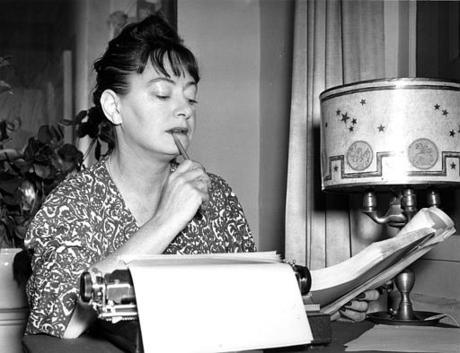
At first glance, it all seems quite romantic. One might think of Jane Austen and the stirring melancholia of England in the 19th century. Or perhaps Anaïs Nin springs to mind and with her the Paris of the ’30s, bohemian and erotic. Everyone knows that writers are a little crazy. In my experience, they are, but not in the way you think. Because if there is one thing writers adore more than sleazy affairs, cisterns of alcohol, and mindless self-destruction, it’s sitting in one place for a really, really, really long time and writing. Writing is what writers do, and they do it all the time.

Here I am reminded of the lamentable suicide of the great Ernest Hemingway, a man famous for fighting in wars and hunting wild animals, but who was plagued to the end of his life by simple hemorrhoids. Think about it. It may not have been the ghosts of the battlefield that drove Hem to the brink, but sitting on his ass all those years, writing!

And the disease of the pen is contagious. Consider this. While my writer was working on her latest book, I would awake at strange hours in the night with a feeling that something was not quite right. I’d drift through the darkness of our bedroom to the top of the stairs, from which I would sense the orange glow of electric lighting on the first floor. Who could have left the lights on? I’d wonder. Then I would descend the stairs to the dining room. And there she would be, behind the table, punching away at the keyboard, hair in her face. “What time is it, honey?” I would ask. “I don’t know,” she’d mumble. Then I’d look up at the clock on the kitchen wall. “It’s 3 am.”

Her latest idée fixe is a travel novel, a story of strange men and exotic islands, of scrapping everything in frustration and rebuilding your life piece by piece. When I read the draft, I felt the usual way, like a small boat on top of an enormous tide. From sentence to sentence I felt the water rushing, rushing and rushing, and I kept reading and reading. And the most mysterious thing is that all this water, all these words, all this electricity slipped simply from her fingers in our dining room in the middle of the night.

When I catch her during one of her zombie writing spells, I am grateful that I too am some kind of writer. I lack the near religious devotion to the art that she does, but I imagine that if I didn’t comprehend the narcotic-like allure of a creative project, living with such a person would drive me or any other reasonable person mad. And the interesting thing is this: few people write about what living with a writer is like. Everyone wants to read their great books. Who needs to know about the sleepless nights spent laboring behind the keyboard?

There is one more detail. When you live with a writer, you are not only a caretaker who provides energy-sustaining coffees, or midnight editor who cheers the creator on with her endeavors. Often times you are a character in the books too. In this world of reality television, there are now reality books, because who doesn’t want to read a story that’s at least partly true? And so there you find yourself, in fine print, described from another’s perspective with lines of insightful dialog that you may or may not recall ever saying.

How does it feel to be a character in a book? You’ll know it when it happens. I’ve come to understand the huge gap that exists between what is written and what is reality. I now understand that even if the scene is constructed perfectly, the dialog edited from a digital recording, it still is not and will never be a precise rendering of what happened. No matter how hard you try, fiction always finds a way in.

I think I am the kind of person who enjoys living with an artist. There are different types of people in this world. Some are analytical academics. Others are fiery activists. But a small group of them are artists; people who can make water rush from their finger tips. It’s not easy being married to one of these characters, but it’s worth it. After weeks of devotion and labor, her she said her manuscript was finished. An eerie blanket of calm fell upon our household. Could it be? Was her book done? She insisted that it was, but I didn’t believe her. Some part of me still doesn’t.