prague spring

PragueSpring2
Soviet tanks roll into Prague, Czechoslovakia, 21 August 1968

IT’S TOO COMMON that we spend our whole lives in the company of our closest relatives and friends and still know little about their experiences. I knew my father had been drafted into the US Army on November 15, 1966 — he still remembers the date. I had heard a lot of stories about that time — mostly about the worry young men my father’s age felt about the prospect of being sent to fight in the jungles of Vietnam. Some drank poison to get sent home, others injured themselves so that they would no longer be fit for service. It was my father’s fortune that he was sent to what was then called West Germany: he had enrolled in radio operator school during training, and the previous class of operators had already been sent to Southeast Asia before him.

There was also a helpful hint supplied by a commanding officer while out drinking: If you cannot type more than 15 words per minute of Morse code, you will not be sent to Vietnam. I like to think that my father slyly evaded an almost certain death by slowing his performance, but according to the man himself, he actually couldn’t type that fast.

I knew a lot of stories about my father’s time in Germany that he shared over the years, but I didn’t know until just a few weeks ago that at 4 am on the morning of August 21, 1968, he and his fellow soldiers were awakened in the barracks and dispatched from their base to the Czech border. “We had had these kinds of drills before, but what surprised me was that even the commanding officers were caught off guard,” he told me recently. A full armored convoy moved through the Black Forest toward that invisible dotted-line that at the time separated the West from the East. “We were fully armed with tanks, mounted machine guns, ammunition,” he said.

The convoy disappeared into the forests along the border, until it had nearly lost its bearings. “I had no idea where we were,” he said. There they waited, in the dark woods, for orders to come.

On the other side of the border at that exact time was Arvi, like my father, also 20 years old. A young athlete from Viljandi, Estonia, who had been drafted into the Soviet Army on November 13, 1967 — he also remembers the exact date. “Of course, I remember it,” he told me on the night of August 21, just a few weeks ago, when I went to visit him. “That’s the date from which they calculated my monthly salary.” Arvi was sent to Kaliningrad for basic training. It was there that he, just like my father, enrolled in radio operator school to learn Morse code. The job came with perks — avoiding heavy labor, for instance, because radio operators were too valuable to risk injury.

From Kaliningrad, in 1968, as the crisis in the relationship between the Czechoslovakian government and its “brother nations” in the Warsaw Pact deepened, Arvi was sent to Poland for nearly a month, before they were dispatched to East Germany and then finally into Czechoslovakia. He rode in the same car as the commander, with two other radio operators. “That was one of the most depressing moments, when we crossed the Czech border,” he recalled. “Someone had painted a skull and crossbones on a boulder at the border in white paint, and underneath it, ‘USSR.’ The commander had traveled the whole time without a helmet. Then he turned and asked, ‘But where is my helmet?'”

They were sent to the border with West Germany where they were stationed guarding a Czechoslovak tank battalion. Each morning after he stood watch, from 6 am to 8 am, he would tune his high-powered radio to pick up the news from Estonia. “The Russians had incredibly strong radios,” he said. One morning he heard that someone had hoisted a satirical protest sign on a street in Tallinn that showed a Russian tank chasing a Czech JAWA motorcycle. And Arvi was there on the Czech side of the border that same morning that my father was in the woods on the German side. Waiting there for orders. Waiting. Then, later that morning, the order came to the American troops to stand down and return to base. The two men never saw combat, and both are today grandfathers to many grandchildren. They never had to fight each other in the woods.

Yet the memory of that time haunts them.

“It was horrible,” my father said. “Almost a hundred people were killed, many hundreds were injured. But as I found out later, President Johnson told the Russians they could do what they wanted with Czechoslovakia. He was more interested in negotiations on reducing nuclear arms.”

One thing that I really understood from talking to my father and Arvi about those events 50 years ago is how young they were. Both of them were 20 years old, both of them had been drafted into the army, both of them were at the will of commanding officers. In almost every conflict it is the young men, some of them still teenagers, who are awakened suddenly at 4 am, who wind up having to give their lives for the decisions of men many times older than them. Brezhnev and Johnson are long gone, but others have taken their places. As conflicts continue to rage, from the sands of Syria to the fields of Ukraine, it’s something I believe we must always keep in mind.

calliope

20180808_085132SOMETIME IN THE WINTER (or was it spring?) I was approached by two Americans from the Pacific Northwest who had holed up in Tallinn’s Old Town for weeks, trying to put together the second issue of a new literary magazine they had christened Calliope.
In one of those fortuitous events, one of the editors had encountered one of my books, read it cover to cover, and decided to contact me, not only for a submission, but for the contacts of other writers in Estonia who might be on the look out for new opportunities. Some of the names I provided made it into the Tallinn issue of Calliope, I’m happy to say.

In writing my own piece, ‘All Those Restless Souls’, I thought of the magazine’s readers, many of whom might be in the Pacific Northwest, and a recent visit from an old friend to Tallinn came to mind. The story began to write itself:

This is Adam Fish’s new life. He wakes up at the Hotel Europa with the wind howling something ferocious against the glass, and a moist streaky vision of Tallinn Harbor visible through the gray sliver of light that separates two carpetty-looking burgundy hotel curtains. Through it, one can see the rows of discount liquor stores, and beyond that, the great jutting jaw-like shape of the bow of one the white ships that goes to Helsinki, as if poised to swallow the whole scene up.

Originally titled, ‘This is Adam Fish’s New Life,’ ‘All Those Restless Souls’ tries to draw out some of the paradoxes in the expatriate dream of leaving it all behind. “I’m already so bored with it,” Adam opines in the story. “Just sitting there, sitting there. Drinking wine. Eating cheese. Sitting there. Drinking wine. Eating cheese. Sitting there. Drinking …”

We’re in class talking about our bright futures. It’s 1988. Czechoslovakia still exists. Estonia is a republic of that massive red country that eats up most the map. “I will become a Slovak salesman,” says Adam proudly. “And I will become an Estonian writer,” says I.

There is so much more to it, isn’t there? If you want to read this piece and others, including haunting work by Eia Uus and Adam Cullen, be sure to invest in a copy of Calliope. And many thanks to Lauren Schwab and Matthew Conyers — our editors, curators and publishers — for this opportunity to be read in a wonderful new context.

the long hot summer

stockholm

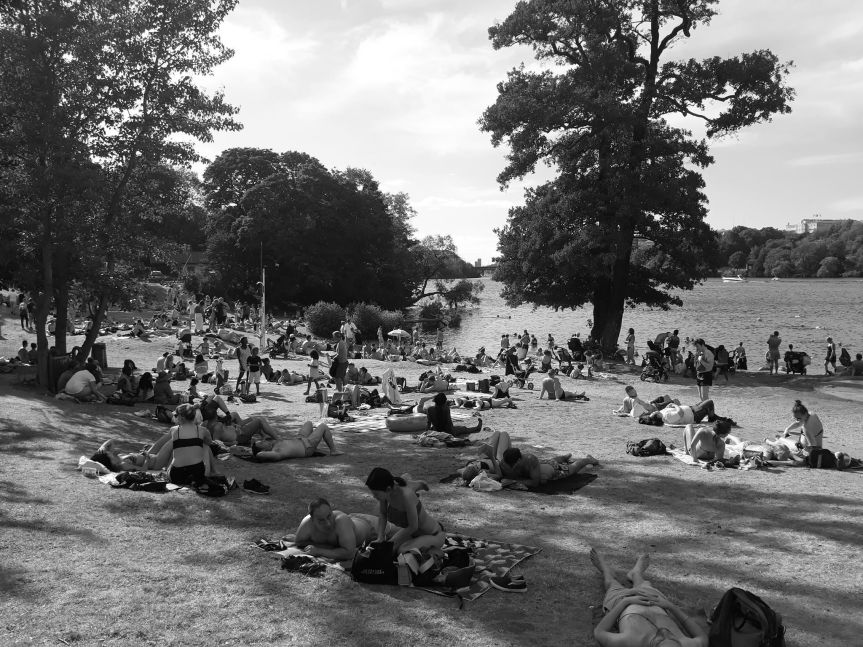
Långholmen, Stockholm, Sweden – July 2018

FOR WEEKS, we have been beset by heat and haze. The temperature reaches 30 degrees Celsius on some afternoons, and the land bakes in the never-ending sun, awaiting thunderstorms that either never come or blow through too fast. There is absolutely no way that any person from this notoriously frosty region could complain about a drawn-out July heatwave, even as the hospital emergency rooms fill up with sweaty old ladies on stretchers holding ice cubes to their temples.

The Estonians’ industriousness continues. My own neighbor — a thirty-something woman — can be seen sawing wood almost until midnight, propelled by that inborn desire to get as much done as possible before the snows return. At 6 AM, the neighbor starts mowing the lawn, or sawing wood. It’s hard to tell the difference, though I train my ears on the sounds of the machines.

For my part, I have found it impossible to do anything. I cannot read, I cannot write, I can barely think. My dreams are a frayed network of primitive impulses, bizarre scenarios, drama and suspense. My waking life is equally as strange. At the promenade in Pärnu just a few days ago, I came across two men cycling around on bicycles, one wearing a rubber Putin mask, the other wearing a Trump mask, and blasting out Kukerpillid’s “Pole Sul Tarvis” from a portable speaker.

This is a famous country tune, the refrain of which is Pole sul tarvis teada mida ma teen. “There’s no need for you to know what I’m doing …”

There is a kind of madness that engulfs people during a heat wave. We lose our bearings, our sense of right and wrong, even our sense of self. We give in to wickedness and it feels wonderful. The sensation of sweating 24 hours a day brings out our most animal instincts. The political debates do continue, the chaos of the world spins on, but all we really need is a glass of water.

The Helsinki Summit between Putin and Trump has just been another surreal part of this heatwave, I think, as off-kilter and mirage-like as those masked cyclists in Pärnu playing Kukerpillid. The farcical press conference that followed the two-hour meeting between the two men, the uproar over Trump’s backing of Putin’s assessment that the Russians did not meddle in the elections, then the ridiculous pivot that he simply misspoke, all blend into the carnival blur of summer. People do say stupid things in summer after all. Why not just blame it all on the heat?

Maybe there was no air-conditioning in Helsinki?

Putin and Trump are what the Estonians would call pensionärid, pensioners, men above a certain age. You might expect to find them playing a chess in a park somewhere and arguing about Vietnam. Yet the extent of their old-age narcissism and vanity has been startling and perhaps only matched in recent times by leaders of certain southern countries who might decorate themselves in leopard skins. Trump has gone from being a loud-mouthed, pasty-faced real estate developer to a bloated, doughy creature given to childlike outbursts, very much resembling the giant baby blimp that hovered London during his visit. The slender face of Putin’s secret police days in East Germany is barely visible beneath his mounds of thick makeup and flabs of flesh. Looking at images of this duo at their respective podiums, one might think that he’s not witnessing a moment of international statesmanship, but rather lost in an exhibit at Madame Tussaud’s. In this heat, is it any surprise, that these outlandish wax figures have started to melt?

This is when one longs for another glass of water. That’s all we humans really are, just water. The world may seem nonsensical and run by narcissists and its form and substance might seem as permanent as a gooey chocolate left out on a dish to melt in the sun. But relax, just drink water. Stay hydrated. Together, we’ll all get through this.

a part of history

helsinki anna
Anna at Linnanmäki in Helsinki on her fifth birthday, 2012

FOR SOME TIME NOW, our mornings have begun with the same question: “Did my results come yet?”

I check my email again and answer: “No, they haven’t. We have to wait a bit longer.”

“How long?”

“I don’t know. The system shows that they are analyzing your sample and preparing your reports. Maybe this week they’ll be ready.”

“You said that last week!”

“I am sure they will come soon.”

“But I have already waited for so long! What do you think, am I more Finnish than Marta?” asks my daughter Anna.

Marta is her sister, who is almost 15. I bought both daughters DNA tests at a good price. The process is simple: the person spits in a vial and sends it via mail to the laboratory. Numbers are printed on the vial that are entered into the system. This makes the process more or less anonymous. In the lab, they analyze your DNA and compare it to reference samples from different populations. In this way, they can determine how much of your genome is Finnish.

This is very interesting for people these days, especially for children who want to know their origins. Numerous companies sell tests in Estonia, including 23andMe, AncestryDNA, Family Tree DNA, Insitome, and others. Some of them also provide information about your health, including data about your genetic risk for certain cancers or neurological diseases. Since our children are so young, they haven’t expressed interest in their health data, only in their ancestry. They want to know more about their identity, for example, what soccer/football team to support. If they are 6 percent Swedish, then why not support the Swedish team?

I decided to use 23andMe this time because my mother and my children’s mother have both taken the test. At last, the long-awaited results arrived for Marta. She found out that 31 percent of her DNA comes from my mother, her grandmother, while she got 19 percent from my father. Inheritance is indeed arbitrary.

Since we have an international family, I wondered if this would be at all interesting for Estonians. They already know that they are “Estonians,” so why should they waste their money on a test that would only confirm it? But when my children’s mother’s test came back, someone who should be a “pure Estonian,” it said that she was only half Estonian.

A quarter of her ancestry was actually Finnish.

I had read that after the Great Northern War, there were so few Estonians in Virumaa that many Finns moved there to work. I know that my daughter’s mother’s grandfather was from somewhere near there. Maybe that’s why she has so much Finnish blood? Or is every Estonian a bit Finnish? Who knows. For my daughters, this was very interesting. Though their mother was a quarter Finnish, it showed that Marta was 8 percent Finnish.

Now Marta’s sister Anna can’t wait to find out how much Finnish ancestry she has.

“I think you have a bit more,” I told her.

“Why?”

“Because when we were in Helsinki, I noticed you looked like the other Finnish girls.”

“Aha. But have my results come yet?”

“Let me check. No, they haven’t come yet. But maybe tomorrow.”

I don’t know why this is so interesting for our kids, but maybe because family trees are so complicated and connected to history. For children, it’s very hard to understand why something happened in history and how that can impact our identities to this day. But when you can show them a chart that shows them that they are 10 percent Finnish, for instance, then history is somehow closer. It isn’t just history anymore. It’s a part of you.

You are a part of history.

Note. This story was originally written in Estonian and posted on the Parim Aeg family blog. Shortly afterward, we learned that Anna was 44 percent Estonian, 17 percent Italian, 7 percent British & Irish, 5 percent Balkan, and just 3 percent Finnish. She was also more than 3 percent Middle Eastern.  The remainder was classified as generic “Southern European” and “Northwest European.” It meant she was just 96 percent European according to the test.

If you believe it.

the swimming palace

swimming
WANDERING THE BACK STREETS of Reykjavik just a few weeks ago, I was faced with a decision. Would I head over to the national museum and spend the rest of a rainy afternoon looking at Viking exhibits, or would I return to the Sundhöll Reykjavikur for another long warm soak?

It was a gray evening, a fine mist besieged the city, and water dripped from the corrugated metal siding of the wonderful buildings, which are painted in pastel dreamy yellows and salmon pinks. My sweater was heavy and thick with the moisture. I decided to forego the museum and to return to Sundhöllin, as it is called by Icelanders, “the swimming palace.” These are Reykjavik’s oldest public baths. Built in 1937 in a palatial art deco style, it reminds one very much of the Kalma Saun in Tallinn’s Kalamaja district.

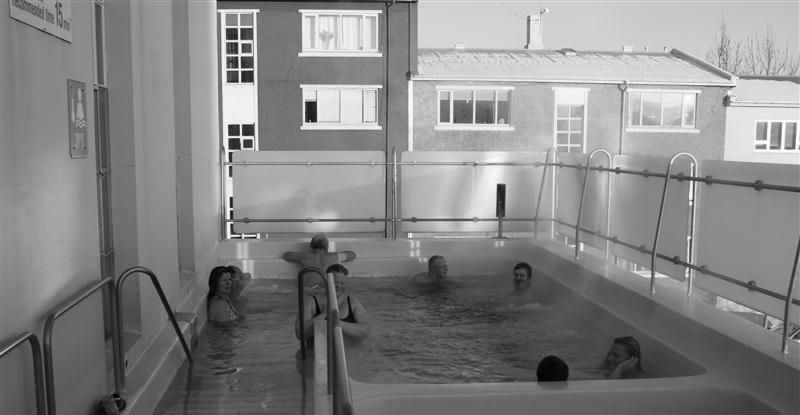
There are several hot baths at Sundhöllin, heated by geothermal energy like the rest of Iceland. The first and hottest is 42 degrees. A second is a milder 39 degrees. They are both outside, each painted a light blue. Above them, a sign reads, “Recommended time: 15 minutes” in black lettering. After spending the recommended time in the 42 degree bath, I sank into the 39 degree bath and tried to relax. It had been a long conference, I had enjoyed many free coffees, done too many interviews, and I have to say that even after taking a long walk, I found it hard to unwind.

I found it difficult to even feel like myself.

My only company was a pair of Icelandic teenage girls, engaged in conversation on the other side of the bath. One of them, with freckles and hoop earrings, seemed to be lecturing the other one, a pale, yellow-haired, sad-looking girl, about the more important things in life. I followed their conversation for sometime while glancing over them at the line of rooftops visible beyond the deck of the pool and after some more time, an elusive peace came to me. The Icelandic girls’ lulling, undulating voices, the warmth of the bath, the white architecture, the coolness of the air, and the mist on my face at last soothed me and I plunged my head into the hot bath waters. Creative thoughts started to surface. Wouldn’t it be nice to write a whole novel set only in an Icelandic swimming pool?

The conference was the inaugural meeting of a new Nordic medical society. The Estonians had been invited to attend as one of the six founding members, even if their tricolor looked slightly out of place among the crosses of Iceland, Norway, Denmark, Sweden, and Finland. But the Estonians, having their own biobank and advanced personalized medicine programs could not be ignored. They were now part of this northern region, part of the story, and so they were invited.

I recalled a design I had once seen for an Estonian flag with the national colors arrayed in a black cross outlined by white set on a field of somber blue. In design, it reminded one of the Norwegian flag the most, but stitched of blue, black, and white. I remember how much I had liked that flag and wondered why they hadn’t chosen it in 1919 when it had been suggested. There was something about the color scheme that reminded me of the blue baths and white walls of Sundhöllin, the black lettering on the walls. The cool air and mist on the faces, the soft muttering monotonous song of the people’s voices. There was something that linked these places.

What was it?

At the meeting, a scientist had asked me if the Estonians did consider themselves to be a Nordic country. I had said, yes, in fact, but I had a hard time explaining why. Was the Estonian Biobank at University of Tartu really the outcome of Swedish King Gustav Adolf founding the university nearly 400 years ago? Could it all be explained with historical facts, or cultural generalizations? Perhaps it could be discovered among the runes of the sagas, clearly spelling out the connection? In the baths at Sundhöllin, I fumbled for more explanations, but none of them could satisfy me and I at last gave in fully to a pleasant, clear-headed mood. Whatever the answer was, it could no longer bother me.

What mattered was that I knew that this was exactly the place I needed to be.

cold sweat

cold sweat photoWHAT’S THE DIFFERENCE between writing and music? Writing takes and music gives.

Writing is like an old-fashioned bloodletting, I think. Writers spill their blood all over the pages. This is why writers need to take breaks. One can only spill so much per day. If you give too much, you will feel dry and tired. Squeezed like a lemon. It takes a while to recover until you are ready to give again. Good writers take time to restore their energy. Many take long walks to mull things over in their minds. Then they return to the keyboard to bleed some more, to squeeze out more juice.

Music is the opposite. If you perform for people, the energy that you give off returns. This is why bands can tour for months. The music actually gives musicians energy. The songs only get better.

When I was a teenager I knew this. I had just acquired a bass guitar, which was an instrument that fit perfectly for me and my hands. The complex chords of the guitar were almost painful to construct, and the drums were a chaotic landscape of cymbals and tom-toms, but the bass was heavy. I loved to reach for a low F, at the very end of the neck. It felt as if I was reaching into the watery depths to hit that dark note, which didn’t resound as much as it throbbed and vibrated.

At that time, I would play along with a live album by James Brown that had been recorded at the Apollo Theatre in New York in June 1967. At that time, his music was changing from its earlier classic soul style to the funk of his later records. There was one stretch where James Brown led the band through a medley of tunes before breaking into one of his better known songs of the times, “Cold Sweat.” I thought it was the best name for the song, because by that time in the jam, I really would be sweating. There was something otherworldly, almost religious about those rhythms. The way the sweat ran into my eyes.  I couldn’t imagine how his band felt on stage on that hot summer night, dressed in their matching suits, swinging through those endless songs.

Sometimes I would even play past midnight. Yet no matter how much I sweat, no matter how hot I got, or how much my fingers hurt, I never felt drained or tired after letting James Brown guide me. Instead I felt even more energized. When “Cold Sweat” finished at last, I was ready to run. My shirt was drenched, but I felt a humid thunderstorm of adrenaline break out all over. I was dripping. This music, soul music, could do that. It might be the deepest spiritual experience I have had to date, and I’ve been to every kind of church, and spent times in cloisters and ashrams.

These days I write mostly, which means I bleed. This is my profession, and my musician friends mostly prefer to see me this way. Besides, they are real musicians. I asked guitarist Andre Maaker if he wanted to be in a band, but he was already booked, and then I asked Silver Sepp if he would be our drummer, but I think he had to fly off to Uzbekistan or Israel for a concert.

“Aren’t you a writer?” one of my musician friends chided me. I am. I bleed the blood, I squeeze the juice. Yet I still have a bass guitar. It’s an acoustic fretless one that I bought on impulse. It makes the deepest, most wonderful sounds. Whenever I tire of what writing takes out of me, I pick up my bass guitar and play, because music never takes, music always gives back.

An Estonian-language version of this column appears in the summer 2018 issue of the magazine Hingele Pai.

a house in the country

ON MONDAY, I DROVE DOWN TO OBINITSA to clean out the outhouse, a special treat. This is a bio-kompost, a composting toilet — Finnish made, with a white and blue cross on it, and a black plastic chimney puncturing the wood roof.

In the back, a small, transparent rubber hose dives down into the grass for filtering out liquids. It’s almost impossible to see but magnificent to watch in action. At the base of the composting toilet, there is a small door. This is unlatched for the removal of rich black soil, for over the course of the seasons, all that was left behind here has been turned to premium muld.

I shoveled out the compost and placed it around the base of the fragrant apple trees, at last in bloom with white flowers. I have heard that it helps.

The apple orchard. I had nearly forgotten it. Just as I had forgotten about so many other things down here. The well. The mattresses on the second floor. The ladder up. The grill idling on the terrace. The windows, the swing, and the writing desk. That lovely sea-like view and the unusual silence. At one point, we had thought of building a larger house, and there were conversations with local businessmen at dimly lit pubs who wanted to sell us high-quality logs.

In the end, we kept the same structure, but adorned it with new wallpaper, and painted the floors. I spent a few summer nights sleeping in the barn, and painting all day. I came to know every rough groove in those floors. I stained the floors in the sleeping barn too. Somehow, I had forgotten it all.

Inside the outhouse, the frame I put in place roughly a decade ago is still standing, built of young saplings, now all hard and gray. Around this, a team of real builders constructed the outhouse, joking to each other about the job I had tried to do. I remember how I had gone to my friend’s outhouse, just down the road, and studied its structure, observing how effortlessly the beams interlocked. It looked so easy. Just some wood and a few nails here. “Lebo,” as the Estonians say. “Piece of cake.”

Yet it was never very lebo. Just a few yards from the outhouse is the smoke sauna that I never used. Not once. It just sat there solemnly, with that black witches cauldron at its center, the true purpose of which I never understood until I observed how a neighbor had washed his child in a wooden bucket with steaming water drawn from the metal bowl. For them, this was natural. The child Seto thought nothing of bathing in a dark sauna in an old bucket.

I gave up on the idea of describing any of this to people back in New York.

After I finished emptying the composting toilet, I removed some dirt from around the barn doors so that they would open more easily, and then I finished painting a few shelves for the kitchen. So much labor went into the dream of a house in the country. It’s a dream shared by many in this country. Like most great projects, though, some come suddenly to life, propelled by some unseen force, and others never seem to materialize fully.

The whole of the country is dotted with such abandoned efforts: factories that never came to be. Unfinished hotels. A broken, disregarded storefront. Sometimes having the money, vision, and even energy is just not enough. You need that extra cosmic push.

When I was done with the work, I locked up the house, but not before giving the place another look over. This was the fruit of a decade’s worth of energy. Was it all misplaced? Or had it been worth it for me, just for the experience?

I glanced at the two corner shelves I built for Orthodox icons. Ikooninulkad. Most Seto houses have one, but this one has two. They are decorated with colorful textiles that I bought from a street vendor in Crete and a piece of the monastery of Saint Irene from the same island. I used to have a beautiful icon of Saint Peter that I would carry around with me, too.

Somewhere here, a few years ago, it fell out of my pocket and I lost it.

the trampoline diaries

trampolineIT WAS JUST A FEW YEARS AGO that a young father went to the store to buy a trampoline. A trampoline! That wonderful round thing that stands in the corner of almost every Estonian yard. I got a big box from the store, went home, and started to put the new attraction together. The neighbor just stared and smiled – fathers and their silly challenges! It’s true the trampoline fell apart a few times, but finally it was ready. The exciting assembly process attracted not only our own children, but the neighbors too.
And this was my first lesson – when you buy a trampoline, it doesn’t just belong to your children, but all the children within a certain radius.

Unfortunately, not all of the children were good ones. One of the visitors to our new trampoline was an 11-year-old boy from a troubled family. Later I heard that his mother was struggling with alcoholism and his father was in jail. Already at age 11, the young man smoked. Which meant that there was a rather unwelcome guest in our yard who would use our family trampoline, smoking and jumping at the same time. He enjoyed it, but our daughters were terrified. I went outside and told the character that it wasn’t his trampoline and he had to leave. The young man thought otherwise. He decided to show off his English language skills instead.

Fak ju, asshoo!” was his response. 

I laughed and answered back: “I can see that you already know a little English and are a very intelligent boy. Maybe one day you could be the foreign minister of Estonia!”

The boy didn’t know what to say, but finally he left. Later, I heard about two local boys who had robbed an ice cream stand. I couldn’t help but think that he was one of them.

My second lesson – someone always starts crying.

Most trampolines have nets that keep the children from falling, but they still get hurt anyway, because there are usually four or five of them on there at the same time. When the bigger kids jump higher and the smaller ones topple, someone always starts crying. We of course had a firm rule that only two or three could jump at a time, but older kids like to grab attention by doing tricks, which invites even more attention from other kids in the neighborhood, who don’t follow our rules. Then someone is already crying again. Sadly, this someone is usually six-year-old Maria Petrone, for whom this is still her trampoline, the one her father bought and put together.

For Estonian children though, no one actually owns trampolines. They are as universal as playgrounds.

It’s very easy to understand why Estonian children love trampolines, but at the same time life has shown that even while trampolines give children plenty of joy, they can cause problems and dangerous situations too.

A few years ago, I sent my nephew in New Jersey a trampoline for his birthday. The boy was very grateful and happy, but my brother started to worry. What would happen if something happened to one of his kids on the trampoline? Would his insurance cover it? How interesting, I thought, that the Estonians I know never seemed to worry about it.

This post first appeared in Estonian on the Parim Aeg family blog.

drum lessons

sticksWE LIVE IN VILJANDI,  a small town in the south of Estonia. Certainly, you have heard of this place. We means me, Justin, a writer or journalist, and daughter Anna, who is 10 years old and goes to school, at the moment attending the fourth grade.

–  “Why do you live in Viljandi?” People ask. “The capital is bigger, greater, richer, better!”

Maybe so, but children in Viljandi enjoy a lot of freedom. They go to school on their own in the morning, return home the same way, and then head onward to some after-school activity. They go on foot to sports and activities all over town. This is the luxury of living in a small town. Cars and trams aren’t necessary. This is how their weeks are booked.

Is our daughter a drummer or a guitarist?

When the school year began in the fall, I told Anna that she had to pick a musical instrument to study. Actually, she started to take violin lessons in the first grade when we lived in New York, but didn’t continue. There were so many options now. I offered her the stereotypical “girl” instruments. Would she like to play the flute? Clarinet? Piano maybe? Or the violin again? No, no, no! Then I found out that the Viljandi Hobby School was offering both guitar and drum lessons. She had to decide on one of these.

Honestly, I thought that drums would be a cooler choice. I play guitar and bass guitar and I know how complicated it can be. Drums are not easy, but it seemed like a better fit for Anna. Yet she had to try. That was the first step. She was put in a group with two other girls. Often people think that it’s better if the boys are with the boys and the girls learn alongside other girls. Anna didn’t notice this at all though, because to her the drums were far more important. She enjoyed playing right away and only speaks highly of her teacher Kevin Lilleleht. When I was a child, it was my greatest wish to play the drums! Ringo Starr was my favorite.

I remember how I begged by parents to take me to his concert. It was August 1989. We were standing in line at the concert when someone asked my mother and father:

– “You wanted to introduce your son to the music of our youth, eh?” And my parents answered “No, he dragged us here to hear Ringo play. It was him not us!” they said.

Do parents fulfill their own childhood dreams vicariously through their children?

I also remember how I begged my mother to buy me a drum kit, but it didn’t happen. Too noisy! The neighbors would definitely complain! Sad. But when Anna started to play, I decided that if she really wanted, I would buy her a kit. Let the neighbors enjoy the music! Now Anna comes home from drum lessons and even has homework. She has to listen to songs by the Beatles, Doors, and Green Day.

– “It’s so hard to tell which songs are the Beatles and which ones are the Doors,” she complains.

Recently there was an exam in the hobby school. The teacher played the students songs and they had to say who the artists were.

– “I thought that ‘Hey Jude’ was the Doors, but I was wrong!”

She really likes Green Day. Now, when she showers, one can hear her singing “Basket Case.” Smash Mouth is another favorite, because Smash Mouth’s song “All Star” was in Shrek. She has even learned how to play this song. She has such funny questions:

– “Is Green Day’s singer Billie Joe Armstrong related to that astronaut, Neil Armstrong?”

– “I’m not sure,” I replied.

– “What does Billie Joe Armstrong look like today?”

We decided to search for him on Google. Apparently he looks the same as he always has. Nothing has changed.

– “He’s only a few years older than me,” I told Anna. Anna looked me over.

– “Actually,” she said, “he looks a lot younger than you, Daddy.”

This post first appeared in Estonian on the Parim Aeg family blog.