I SWAM OUT to the end of the bay, to where it connects with the sound, just off the point. The water was darker and deeper here and the current was just too strong. Turning back was hopeless, so I let the water carry me all the way around the point to Sand Street Beach. Remember Sand Street Beach? Wasn’t there even a little shelter there, at least in the old days? Maybe it’s still there, with the names of aspiring lovers carved into its sturdy wooden walls.
Joanie loves Chachi.
It was there there that I emerged, dripping salt water and sand. It wasn’t such a long walk home, but a storm was setting in, and the air was thick with thunder and that ominous grayblue feeling. The wind picked up and danced with the cedar branches and I began the hike. Sand Street connected to Christian Avenue. Christian Avenue intersected with Quaker Path. I had this feeling all along that a hundred eyeballs were watching me through the windows of white clapboard houses that had once belonged to dead whaling ship captains.
DR. STERN’S HOUSE was at the end of Crane Neck. He was a gynecologist, I think. Or an orthodontist. Something like that. He wasn’t home when I arrived to this cedar-shaked masterpiece of architectural fusion, a crisscross of colonial and modernist influences. The property was green, the driveway pebbled. Birds glared down silently from the oaks and the maples. The taxi driver left me at the gate and I walked up to the house and went inside.
Inside the house, there were various characters hanging out and passing through. One of them was a businessman of the old breed, with a pocket watch and pince-nez glasses. He said he had made a fortune rigging baseball games in his day, but had discovered a new source of wealth and materiel: diamonds. He had on a red coat and was walking through the kitchen talking about his dealings in the gem business. There was a skylight and the gray light of the day shone down on his whiskers. “Indeed, the gem business is the best business, if I say so.”
Behind him, my grandmother emerged. Her hair had taken on a golden hue and she was more animate than ever. “Grandma? Is that really you?” She grabbed me by both hands and we spun in circles. “I’m 106 years old,” she said, “and I haven’t felt this good since the New York Yankees won the 1941 World Series!” There were others behind her carousing and I wondered what kind of parallel reality was dawning on me. Grandma kept telling me how great she felt and looked now that she was dead. She said so in her very genteel and proper Virginia accent.
Grandma let go of my hands and like that, I was out in the garden and the grounds were covered in snow. I was with my daughter and we began walk through a series of stalls, not unlike the little putkad that dot the Town Hall Square in Tallinn during the Christmas Fair. Everywhere I looked though, I only saw stacks of baked goods. Flour, flour, and more flour, covered with sugar, sugar, and more sugar and some chocolate. I bought my daughter some tasty candied quince in a paper bag and we walked away from the market, only to be chased down by several wild big black dogs. When a hellhound like that falls on you, it’s a real terror. My daughter fell in the snow as the dogs got closer, so I ran over and pulled her back into the house by her arm. I remember just seizing her by the hand and pulling the girl back inside.
And then I opened my eyes. We were back in the kitchen of the house and the sunlight was on our faces. Someone announced, “Dr. Stern is here to take you home now.” We went outside and there he was, standing beside a black 1934 Buick Victoria. It was a beauty of an automobile. He was wearing a purple tie-dye Grateful Dead shirt and had on a pair of khaki shorts. He had curly hair and seemed like the kind of doctor who had smoked a lot of dope back in med school. “Well, what are you all waiting for?” said Dr. Stern, opening the door to the black Buick. “Just get in!”
I NEVER KNEW there were so many islands in Long Island Sound. Long, stretching, sandy islands, islets, and shoals covered with driftwood, birds, seals, and poison ivy. No mariner’s map demarcated them but they were there, about halfway between Drowned Meadow and Connecticut. Maybe the Navy was using them for bombing practice, just like Nomans Land off the coast of Martha’s Vineyard. I know the islands in Long Island Sound are real though. I saw them when we crossed the sea by ferry on our long journey up into New England and Canada.
When we returned it was a sunny day in Bridgeport and, to my surprise, the harbor was full of cranes and trucks. They were building a bridge to Long Island from Bridgeport, which would now live up to its name. A high, winding four-lane highway to carry car traffic from Connecticut to its younger brother Long Island. There were also pedestrian paths along the sides of this to-be completed highway and I hiked up them with my family. The first third of the Connecticut-Long Island Highway came down on one of the secret isles. Here we paused to rest, picnic, and admire its dreamy, desert-like beaches and nesting terns and cormorants.
I WAS MARRIED AGAIN, this time to Gunna. Funny that I couldn’t remember the courtship, or even the ceremony. How had it even happened? There it was, the certificate, lying at the top of a wastepaper basket. I took it out and examined it. It seemed to be legitimate. Gunna was in the other room packing for our big trip. She had taken some time off from work for our long-haul to the Americas. She was a kind woman and all, a bit sarcastic, and very cute, with that haircut of hers, and she could fill up a dress, but I didn’t feel well about the whole thing. Marriage? I hoped she hadn’t changed her name. How many more women would carry this heavy name around with them by the time the story was over? It even translated as “Big Rock.”
On the certificate, I could see that she had kept her original name. That provided a sparse moment of relief. Just a moment. There was a date of marriage there though. From that date, all things would be calculated. A marriage was like a loaf of bread. At some point, it would go stale. There were tricks to keep it fresh, maybe moisten the loaf and bake it in the oven for a while, or just deep freeze it and consume it later on? Gunna kept packing. Packing, packing, packing. She had a fine beige suitcase. I boiled up the last small yellow potatoes before we left.
I didn’t want them to go bad.
“We’re going to be late to the airport,” she said. “Why are you wasting time with those?”
“We can eat them on the way. Tell you what, why don’t you fly ahead? I’ll take the next plane.”
“Don’t be silly,” she said, grinning and gently slapping at my hand. “We’re married now.”
AFTER WE ARRIVED IN PARADISE, we took a long drive down a beach road. There was some kind of tourist workshop happening in an old barn. Maybe it had been a fisherman’s shack. It wasn’t very warm that day. Gunna was wearing a black pants, a long-sleeved shirt. Where were we anyway? It was only September. Maybe we had turned left somewhere and wound up in Prince Edward Island. Newfoundland? One of the Maritimes. To be honest, it looked a lot like Long Island back home. But why would anyone go there on vacation? We were gathered outside the fisherman’s hut as a local guide gave us a demonstration of the old folk ways.
I heard some commotion coming from the roadside. We walked over and in the sand dunes, we could see hundreds of wild rabbits scurrying in the sand. They were black or dark-furred rabbits. Just when you thought you had seen every rabbit, you noticed about 20 more of them hopping in from some other location. Why were they all running toward the sea? Did rabbits drown themselves like whales beached themselves? Some of the other tourists were delighted. “We’ll eat good tonight,” one man said. Gunna took out her camera. It was one of those disposable cameras, flat and long, like the kinds we had back in the 1980s. She stood there taking pictures of the beach rabbits. This would be a memorable moment of our honeymoon.
I stood there too, watching her take photos. In the distance, I could hear the sound of the sea.
THE HUNTINGTON Y was under construction again. There were just beams and cement floors. I was given a tour by an old friend whom I did not recognize but who seemed to know me quite well. He had on a blue jacket, his hair was cut short, and he wore glasses. In short, he looked rather like a real estate agent, or Mormon missionary lite. There he was, showing me around. The entire floor plan of the old Y.M.C.A. was recognizable to me. I remembered the first day I went to that school. How I had promised myself that I would not be a baby like the others and would not cry for my mother. I could remember it all so clearly. Like yesterday.
That was at least one day I had succeeded. We walked together to the room, which was the first on the left, or actually the right, because we entered from the rear side of the building. It looked smaller there. I could see its outline, and had a vague memory of doing some kind of arts and crafts at a table there. I remembered one of the girls, who had platinum blonde hair.
This girl seemed to stick out in my memory.
The place had been gutted of course, but in a way it was refreshing. The sunlight poured through the beams. I could look out on that part of Huntington and see the athletic fields. The breeze smelled fresh. After, we walked to the end of the hall. That’s where we had classes our second year of preschool at the Y. I remembered many things from that room, especially a small book called Ten Little Indians and an accompanying cassette. I could remember some of the lyrics from the song, “one lost his prayer-stick …” When Thanksgiving came, we were all divided up into Pilgrims and Indians. I wanted to be an Indian. They got to wear feathers. But the teachers put me into the Pilgrim group. I got the Pilgrim black hat with the gold buckle.
Looking around this empty room, it was hard to believe that it had all happened here. Those memories seemed so cloudy, they seemed to be submerged in in a gray haze of time. The 1980s? When was that? But now all had been reduced to its bare essence. Only the walls were left, with some scattered wires too. My friend and I decided to walk down the hall toward the pool. It at least was still there. Entirely intact. There were still people swimming in the pool.
Later, we descended the steps of the Huntington Y to the first floor. This had been turned into a sort of open air market, like the one at Balti Jaama Turg in Tallinn, or the Baltic Station Market, as it’s called in English. A woman, who looked something like a flapper from the 1920s, or at least had that kind of haircut, came up to me, and asked me if I would go fetch her dress. I went into a back hallway, which was also well lit, and saw an array of silver dresses hanging suspended from hooks along the wall in the light. Those 1920s la garçonne dresses. Which silver dress would fit the woman? I didn’t know anything about dresses. Which one would fit?
WHO IS YOUR FAVORITE WRITER? Or who has been the most important writer in your life? People have often asked me this question. My answers change. Sometimes I say Scott Fitzgerald, who wrote every morning, even when his wife Zelda was in the psychiatric hospital. Sometimes I answer Henry Miller, who dared to write so poetically about the darker side of men and of the world. And certainly Ernest Hemingway haunts me, as he haunts every writer, with his strange, adventurous life story. But honestly, my guardian angel has been to this day Jack Kerouac, the author of On the Road. I see my life through the prism of his life, I understand myself through his books. Jack inspires me. Jack cautions me. I would like to write as well as Kerouac wrote his books. But I don’t want my life to have the same trajectory. I don’t want us to have a shared fate.
***
I was thinking about Jack one summery Saturday morning when I drove to Northport on Long Island. My parents live about half an hour east of there, but my mother is from Northport in part. Northport is a port town or perhaps village, about 70 kilometers from the center of Manhattan. It is drowning in greenery and there are lovely views. It used to be a summer place, to where city people would flee and go swimming. There were women with Victorian Era dresses and umbrellas to keep out of the sun and men in black top hats. You know what I’m talking about. They came from the city by train, to spend the summer by the sea. It reminds me of Haapsalu. But I went by car. When I got to Northport, I met up with some relatives. We went for a walk and told some stories. I’m not in the US so often. It was a nice summer morning and it was nice to spend time with my uncle and cousin and to drink some coffee. After our get together, I typed 34 Gilbert Street into the GPS and headed off in that direction. To get to Gilbert Street you have to take Main Street out of town, then turn onto Cherry Street and then again to Gilbert Street. It was interesting that I had been to Northport maybe a thousand times, but this was the first time I had ever been on this street. The house I had come to see was a white, wooden house, a typical working class house. The same kinds of houses are in Lowell, Massachusetts, where Jack was born. That’s why he wanted to live here, I’ve read.
Jack moved to Northport in 1958. Eisenhower was the president of the US. Khrushchev was the leader of the Soviet Union. Mao was building Communism in China. The Korean War was over and the Vietnam War hadn’t started. Kerouac was looking for a peaceful place that wasn’t too far from New York. He was already famous by this time. A year earlier appeared his most famous novel, On the Road. Kerouac was everywhere. On television. On the radio. In newspapers. In night clubs. He was the Beat Generation’s greatest prophet. A dutiful Catholic, Kerouac brought his mother Gabrielle Ange Lévesque to live with him in Northport. An older lady. Conservative. She had been born in Quebec at the end of the 19th century. Religious. Different. The Cold War was at its height and Kerouac hated Communism. He was, at his core, a Catholic, regardless of the fact that he did not exactly follow the church’s rules in his personal life. But the Communists had no faith. Kerouac yelled at the TV when they showed Khrushchev. His mother was making his pancakes and washing his socks. He was typing away at his typewriter too, when he wasn’t talking to fans who had climbed over the back fence, or he wasn’t at the local bar drunk again. Sometimes I wonder if my grandmother and Kerouac’s mother went to church at the same time in the same town. It probably happened, I think.
***
Neighbors later reported that mother and son fought a lot. What about, I don’t know. Nobody knew, because the Kerouacs’ loud arguments were in French. The youth of the town learned rather quickly that their new neighbor was the famous Jack Kerouac. It was hard for him to find a spare moment to write. They turned up at the front door, or chatted with him through the basement window. Kerouac even wrote about this in his 1962 book Big Sur. This was the first Kerouac book that I ever read. My girlfriend gave it to me when I was 16. I don’t know how much she even knew about Kerouac. Maybe she just bought it because of the title? But it was the right book for me. I especially liked the beginning. The story starts with Kerouac in San Francisco, waking up with a hangover to the sound of church bells. I went that summer to San Francisco and Big Sur and read that book along the way. There is one scene where Jack Kerouac is in bed with a woman and the woman’s child comes into the bedroom and watches. That was probably the first time I had ever read something like that in a book.
Through his life I learned that the world was much bigger and that adventures were waiting everywhere. That life was more of an interesting experience than anything else. Life was an experience, and a person could write about it as it happened, just like a photographer takes photos. His style was fluid, unique, and addictive. I think that once you get used to Jack Kerouac, it becomes harder to read more conventional literature. Books like Fifty Shades of Grey or The Da Vinci Code seem dull. Once you go on the road with Kerouac, there is no way back. And I am still on that road with Kerouac. In this way, I arrived at his old house, to take some photos of it and look it over. What did I expect anyway? That he would come outside, with garbage bags in his hands? That I would hear his mother yelling in the background? Ti Jean, my boy, your pancakes are ready! It was a hot, humid, and sunny day. Gilbert Street was quiet and empty. Some birds were singing away and there was a light breeze. The house is really just like any other. But when a writer like Kerouac has sat there with his typewriter, the importance of the house changes. People then come by and take pictures of it. They want to come face to face with the soul of that writer, at least just a little bit.
***
IT’S INTERESTING THAT Jack Kerouac wasn’t the only new inhabitant of Northport in 1958. Because my mother and her family showed up in town the same year. In some ways, my grandfather Frank and Kerouac were similar. Kerouac was born in 1922, and my grandfather Frank a year later. Kerouac’s home language was French. His parents were from Quebec and they moved to the US at the start of the 20th century to find work in New England, like many Quebecois did. Jack Kerouac’s real name was Jean-Louis Lebris de Kérouac. He attended Catholic school and his teachers were French-speaking nuns. Later, he praised the education he had received, and found that thanks to their rigid means of instruction, he had learned to write so well. I reminded my grandmother of this fact once when we spoke about Kerouac. To her, that crazy neighbor Kerouac wasn’t exactly an upstanding citizen, but the fact that he was a Catholic softened her position. Maybe he wasn’t so bad, she perhaps thought. If he was a Catholic, he was one of us. He just didn’t live his life the right way. Jack merely diverged from the road of Catholicism.
When he went to school, young Kerouac still didn’t speak English and had to learn as he went. He would study the dictionary to expand his vocabulary. It was the same for my grandfather. His parents were from Italy, and their home language was the Barese dialect. My grandfather also didn’t speak English until he started to go to school. A neighbor girl taught him how to speak it. My grandfather was ashamed of being different. He had a long Italian name. He had dark hair. For Americans, he was an outsider. Kerouac’s relationship with America was similar. He was an American in some regards, but he had a different perspective. He was both a local and a foreigner. But my grandfather lived a proper Catholic life. He was married by the age of 22. He had a job and five children. They lived on the edge of the City of New York, until one morning he took a ride out east to see what he could see. That’s how, one story goes, he discovered Northport, that same port town that Kerouac discovered around the same time. Both of them moved to Northport, and both took their mothers with them. Frank’s mother’s name was Maria. She made her son pizza, just like Kerouac’s mother Gabrielle made her son pancakes around the corner. In my mother’s home, they spoke both Italian and English. My mother is almost 77 now, and she still speaks English a bit differently. A professor of Italian once told her that she speaks like a child that has learned English from immigrants. The vocabulary and pronunciation are correct, but her sentence structure is a little off. The grammar is backwards, because she is using Italian grammar with English words. Sometimes I think that Kerouac’s bilingualism influenced his writing style. My mother never did meet with Kerouac, but her younger brother once recalled that on some nights he might have seen Kerouac, Neal Cassady, and Allen Ginsberg playing baseball. This was at the beginning of the 1960s. These were dangerous characters. Before there were punks, and before there were hippies, there were Beatniks. Ginsberg was a gay poet, and Cassady was simply a wild and crazy guy. Kerouac himself was not quite right. Some say that he hit his head too many times when he played football in school. Maybe that’s why he wrote so well? There are different theories.
I can only imagine how my uncle, then aged about nine, accidentally came across Kerouac, Cassady, and Ginsberg. Actually, they looked quite average. They just lived different lives. It was a warm summer’s night and he rode his bike by the baseball field and saw them playing. Just some Americans out playing baseball. Now that moment seems like a historical event.
***
Kerouac’s father died young, and when he was ill, a young Jack Kerouac promised his ailing father that he would care for his mother Gabrielle forever. This was a promise he made before God. So Jack was obliged to live with his mother. Or he was unable to leave her home really. Of course, he was married three times in his life, and he had one daughter (though he argued for a time that the child was not his, which was disproven by a blood test). A proper Catholic would have been married just once and stayed married. But Kerouac was unable to live that life. He had all kinds of worldly adventures, but the road always led Kerouac back home to his mother. His mother’s place was his main address. They lived in Northport until 1964.
They only lived on Gilbert Street for a year and a half before moving to Earl Avenue, into a small house on the edge of town with a Dutch roof. There they stayed for two years. Their last address was on Judy Ann Court, in a one-storey house. They spent three more years there. My mother’s family lived a few streets closer to the center of town. The story that my uncle claimed to have seen Kerouac playing baseball with the other Beats is probably true. Carolyn Cassady wrote in her memoir Off the Road how her husband Neil, Jack Kerouac and Ginsberg would go and play baseball together. For some time, Jack and Carolyn were even lovers. Neal was particularly supportive of their relationship, as he had cheated on his wife Carolyn many times. So if his wife had a lover, things would be more equal, he thought. Classic.
It’s interesting to read from time to time that Kerouac was gay, like Ginsberg. Even Gary Snyder, who is 94 at the moment, and who inspired Kerouac’s character Japhy Ruder in his novel The Dharma Bums said in a recent interview that Jack hated women and was probably gay. But then we have Carolyn Cassady who writes about her passionate relationship with her husband’s pal. I’ve also read Joyce Johnson’s book, The Voice is All: The Lonely Victory of Jack Kerouac. Johnson described a very charming character with blue eyes who whispered to her in French. Johnson, who is also a successful writer, was Kerouac’s girlfriend for several years. She once wrote that in the world of the Beat Generation, women were girlfriends or muses, but she wanted to be more. She also wanted to be a writer. This fact has really stuck with me, although I have been quite similar to my Beat predecessors in terms of my own perspective.
But Jack Kerouac always had some woman. Always. One of these was the Afroamerican Alene Lee, who inspired his character Mardou in The Subterraneans. This book has been translated into Estonian. Its Estonian title is Pilvealused and the translator was Triinu Pakk-Allmann. The second novel to appear in Estonian is On the Road, or Teel, translated by Peeter Sauter. The most colorful female character in On the Road is a Mexican woman named Terry with whom he lived a while in California. One of my favorite quotes in the book belongs to Terry when she says to Sal Paradise, the main character, “I love love.” Johnson wrote that this relationship was one of his most stable, and that Jack might have stayed together with Terry, who gave him the freedom to roam. But no. Kerouac promised his father that he would take care of his mother. True to his word, he did so. His responsibilities to his family were his priority.
The writer Gore Vidal once wrote that he had a relationship with Kerouac though. And Joyce Johnson acknowledged there had been some intrigues with Ginsberg. Sexuality among the Beats is an interesting topic, especially because at that time in the “hetero world” things were just different. Men would go to visit prostitutes together. Jack writes about spending time with Mexico City prostitutes. It was just a regular thing. “Guys, let’s go get some prostitutes!” Even Ginsberg went with them. What did he do there? Read some Mexican girl one of his poems?
One of Kerouac’s loves was certainly Tristessa, a young Mexican junkie. Her real name was Esperanza. It’s hard to think that a man who wrote so much about women was gay. But maybe it would be more honest to accept that things have changed since those days. In the 1950s, there was limited awareness of the LGBTQ+ community. There weren’t parades with rainbow flags. Neal Cassady could sleep with Ginsberg and his wife Carolyn and not lose any sleep wondering about which letter best described his sexual orientation. Was he bisexual? Pansexual? Omnisexual? Was he a G, a B, or maybe even a Q? Neal was just Neal, and Jack was Jack. It was just a different time. In Joyce Johnson’s book there is an interesting fact that Jack didn’t think of himself as being gay, but that he actually wanted to be gay. Most of the best writers of the day were gay. Gore Vidal. Truman Capote. James Baldwin. He was almost ashamed that he wasn’t, because everyone knew that gay writers wrote so well. This fact really astonished me. It was like an inverted reality. Maybe it’s inspired me to write more honestly about women. Men’s interest in women is deep, intriguing, at times terrifying, but inspiring. There is more to unearth from that treasure trove.
***
MY GRANDPARENTS WERE devout Catholics, but Kerouac had a long relationship with Buddhism. Carolyn Cassady recalls in her memoir how Jack found Buddhism and started to believe that the world was an illusion and that reality was just emptiness. He tried to live as the Buddha. He even wrote Wake Up: A Life of the Buddha and The Dharma Bums during this period, as well as Desolation Angels. I have read The Dharma Bums and Desolation Angels, but Wake Up hasn’t found a place on my bookshelf just yet. I understand that he had personal problems, especially with alcohol, but also within his family system, which kept him in a sort of personal prison in life. Other people got to enjoy their freedom, but he had responsibilities. He could travel and write, but his mother was still waiting for her boy at home.
Carolyn acknowledged in his memoir that the new, Buddhist Kerouac wasn’t exactly a barrel of laughs. He became very stern and serious. He went up to a mountaintop in the summer to contemplate emptiness. Kerouac no longer wrote to his friends about his thoughts, but about the dharma. He was looking to be liberated from himself. As a Catholic, his life was full of disappointment and guilt. In both the family and the church, there was a lot of confusion, stress. This I understand well. I started school in Northport, and my first school was a Catholic school. Kerouac was, by that time, dead. He died in the summer of 1969. He was 47. When I was younger, 47 sounded kind of old. Now, at the age of 44, it sounds like a teenager to me. I was born a decade after Kerouac died. I started school six years later, as I said, there in Northport. These facts are not so deeply connected to me or my life story. They are just a coincidence. Because I didn’t know anything about Jack Kerouac’s Northport period when I was a little boy.
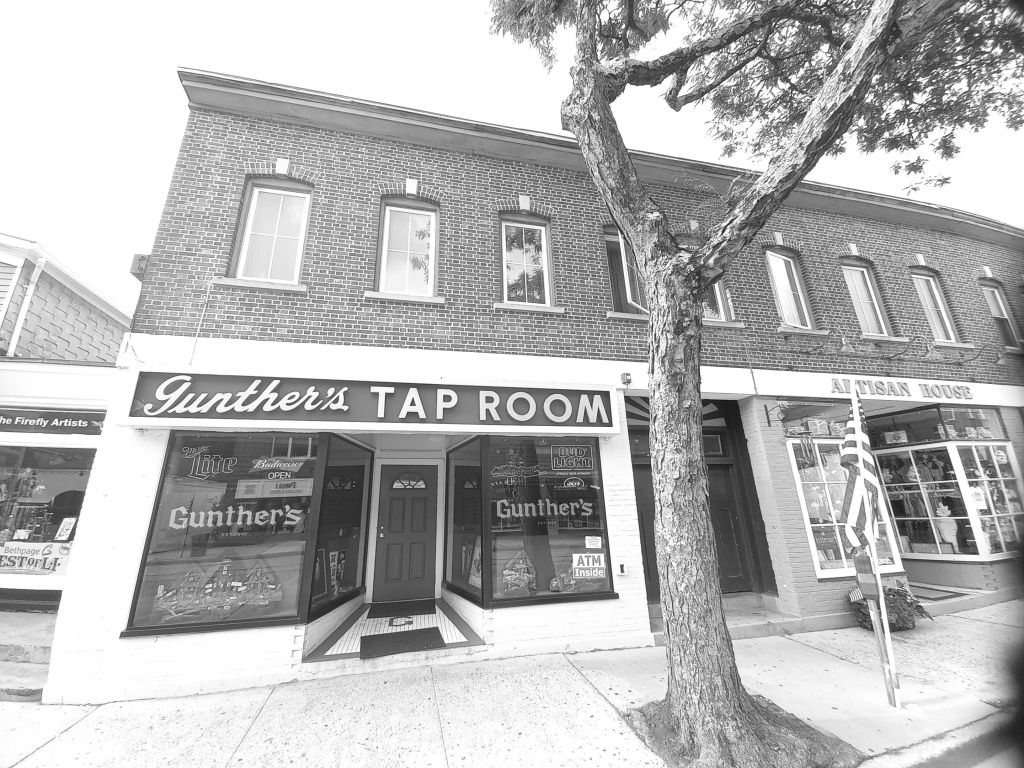
Still, his world was familiar to me. My grandfather died in Northport two summers before Jack. A heart attack. My grandmother lived long. Her house was full of crosses and angels. Lots of shining angels. My father’s uncles had a bar in Northport, but Kerouac’s favorite bar was another one called Gunther’s Tap Room. These days, Northport is a wealthier place. At that time, in the 1950s and 1960s, it was a rougher, working class down. There was a sand and gravel company nearby, and on their lunch breaks the workers would come to town, eat and drink. There were a lot of drunken bar fights. Pete Gunther, the bartender, who was the original owner’s son, was a teenager when he started working. He’s now long dead, but when I was 25 and working for a local newspaper, I met up with him and interviewed him about Jack Kerouac. There was even a sign on the wall that said, “Kerouac Drank Here.” Apparently, his alcoholism intensified during this period.
Pete Gunther, a bald older man with a round face, in general quite friendly. He told me straight that Jack Kerouac was a drunk. He was drunk every day of his life. This was like the scene in John Steinbeck’s East of Eden when the good son who believes his mother is dead finds out that she is very much alive and running a whorehouse in town. “Justin, your greatest hero was just some crazy drunk.” That’s what Pete Gunther related to me in our interview, more or less.
Jack once gave Gunther an autographed copy of one of his books in exchange for a beer, but Pete Gunther said he couldn’t make any sense of it. It was all crap, he said. He didn’t understand it. So he threw Kerouac’s book in the garbage. In some ways, I feel it was symbolic of how America treated him. Now that the original scroll of On the Road is displayed in museums, we can think that once upon a time a great writer lived in that small house over there. Or put up a sign that says, “Kerouac Drank Here.” Or try to collect memories of him from other people, people who once met him, or saw, perchance, him playing baseball with his friends. That summer when he died though people were more interested in hippies, the Vietnam War, and the Prague Spring. His best friend Neal had died a year prior in Mexico beside the railroad tracks. He was known to use drugs, but it was the rain and his lack of clothing that did him in.
When Neal died, Kerouac told his friends that he wanted to join his best friend in heaven. The writer and poet Gregory Corso, who you can see in Jack’s short film Pull My Daisy together with Ginsberg and the other Beats, recalled similarly. “Jack wanted to die,” he said. And so he did. He got into a bar fight and started bleeding inside. In the end, it was life-long alcoholism that took the life of Jack Kerouac. But he did want to be with the angels. Mr. Corso said so.
That morning, as I was looking over his first Northport home, I sat in my car for a while. I wanted to tell my old friend Jack not to drink so much. Leave your mother Gabrielle behind and go live with that Mexican girl. The one who said she loved love. Or some other girl. Or maybe even multiple girls. Life is for living, Jack. It’s too soon for wrestling with those angels.
When I was 16 and my girlfriend gave me my first Kerouac book, Big Sur, I started to write. I had read how Jack always had a notebook on him, and that he would write everything down. I can now see traces of that book in everything I write. So Kerouac continues to live on, quietly.
Here and there.
An Estonian version of this article, written by the author, appears here in the magazine Edasi.
I WAS INVOLVED WITH THE MOB. Or Mafia. Cosa Nostra. Take your pick. I was supposed to run some money but I didn’t know who was delivering or who was retrieving. They sent me out to some industrial area to stand inside an old telephone booth at night. It seemed like a rather uncreative pick-up spot. There I stood, pretending to talk to someone on the old phone, which didn’t work. I had two soldiers for backup, who were hidden in some nearby reeds. Soon a car pulled up — I couldn’t see the model through the dark — and a stranger got out. I was ready to hand over the cash, but as he got closer, I saw him pull a gun. Everyone started shooting. Bullets pierced the glass of the telephone booth. There was a gunman in the car too, and I could hear the bullets piercing the metal of the car. After about five minutes, everyone else was dead. It was just me and a suitcase full of cash in a bullet-ridden telephone booth.
Naturally, I was shaken up. Then I realized, I had enough money to buy a house on Long Island.
CHRISTMASTIME, some months later. I kept running around the house while I was preparing the meal. I would go out the front door, slide down the alley on one side of the house, cut across the back, and then wind around the driveway and porch until I reached the front door. I would go inside, check on the pasta, and then repeat this ‘running around the house’ motif. The house looked almost exactly like my parents’ house, except it was situated in a slightly more elevated area. The weather was cool but not cold and it was dark. I knew that they were expecting traditional American fare at Christmas, but I only knew how to make Italian food.
I checked the spaghetti again. It wasn’t yet al dente. Another quick run around the house.
Soon the guests began to arrive. I hadn’t seen them in years. Cousin Prescott came in with his family. He was an academic and wore dark-rimmed glasses. He used to have hair, but this had long since been reduced. It made him look more distinguished. “I’ve missed you, Prescott,” I said, patting him on the back. “Don’t tell the others, but you’re my favorite.” “Of course, I am,” he said and entered the house. My wife came down on the landing and waved to everyone.
At last my brother roared up. This moment brought me great anxiety. Would he approve of my new life? This was doubtful. He looked strange though. He had tattoos on both arms, and was wearing a leather jacket that said, Hells Angels. When did my big brother join a biker gang? My brother looked over everything and said, “Nice house.” “Thanks,” I said. “I paid for it in cash.”
IT’S KIND OF FITTING that we finally get to the fifth track on this six-track EP in this third and final installation of the review, because in my opinion, “Only Lonely” is the most Seattle-sounding song in the set. Seattle plays a big role in Bern Band lore. Bassist Dave Trump lives there, and drummer Cody Rahn is a self-described “West Coast person.” I’ve been to Seattle plenty of times myself, and can’t yet describe myself as a devotee or not. I’m not in love with the place, but I don’t hate it. I did find it amusing when, on an overcast cold day, I saw people there beaming about the “sunshine.” Seattle continues to filter into musical culture. Some people swear by Seattle, and want to parade you down to the original Starbucks, or even show you some club where Kurt Cobain took a dump back before Nirvana got big. The scene, man.
The scene!
There used to be more West Coast people in my life, with starry utopias in their eyes.
Plus all that weed.
I actually don’t know if the Bern Band used drugs in the making of this record.
D. TRUMP:The difference in Seattle-New York or the East-West sound is tough for me to pinpoint. My perspective is a bit diluted by now, but I still think I know it when I hear it. One aspect would be the sense of urgency that comes out of NY music — deciding on the direction then making the groove happen. Whereas the Seattle sound might be more inclined to let the direction and sound develop. Of course, there are exceptions that could blow that concept out of the water.
C. RAHN: For me being a West Coast person my whole life until moving to New York City in 2010, the energy in rock music out there when I was growing up had a powerful groove that always felt comfortable and laid back even when the music was exploding with intensity. Slower, never frantic. Always space to think in between the notes.
Of course, we have to mention Pearl Jam. The Bern Band’s last record, Just Not Today, was recorded in Seattle in the final days of 2019, before the pandemic reared its head. They recorded at Stone Gossard’s studio, which was once Pearl Jam’s rehearsal studio. Soundgarden’s Down on the Upside was also recorded there, guitarist Hackett recalls.
B. HACKETT: There was just a real Seattle feel to the whole recording. We recorded all the basic tracks ‘live, live,’ meaning there was no click track and we were all playing live in a big room, baffling was the only isolation we used. So they are all one take, live. Which adds such an amazing feel to that album. However, the downside to that recording was that we had a small window to capture everything in the studio, not much time to think through all that we would have liked.
One thing that’s come up with Hackett in talking about the guitar distortion on this record is the weather where we grew up on Long Island, and how the distortion reminds me of the fog that rolls in off the inlet where we used to hang out, known as Conscience Bay.
A more writerly name could not have been selected for a body of water adjacent to such introspective, philosophical lads as ourselves. Most of the houses in the area were built postwar, and in dialogue with a local historian, I learned that the area where we lived had once hosted a hospital during a smallpox outbreak in the 1770s. This rather melancholy detail has only made the guitar distortion seem more ghostly and ominous. Perhaps soldiers during the conflict with Britain had bathed their pox sores in the bay. The same bay we would frequent in our youth, when Pearl Jam and Soundgarden ruled. There’s definitely some “Fell on Black Days” in “Only Lonely.”
This one is more like a Hackett solo number, I have to admit. The acoustic guitar, the festive chorus. Even his voice sounds more like him here. This is him, with no masks or shields. Just him. I have to think, it got me wondering about how I even met Hackett. There is a class photo of us together in second grade, but I barely remember him from those years. We definitely were in band — school band — in fifth grade. He was also in my class from fourth through sixth grade. There was a particularly raucous sleepover party which must have been in 1990, because I gifted Hackett a cassette of Vanilla Ice’s hip hop masterpiece, To the Extreme, and we were so animated and sugar high that Hackett’s dad, “Jim,” took us all out jogging.
Later, I remember Jim being taken aback by listening to Vanilla Ice rap about “handcuffs and chains” on “Stop That Train.”
Things probably started to mesh around this point.
But Hackett is a Sagittarius. His birthday is before Christmas, as this festive number informs. What that means is something like this. You go to visit Hackett, but he’s not there, because he’s somewhere else. You go to Point B, but he’s also not there, because he’s too busy smoking something with Jimmy Buffett at an Allman Brothers concert. You go to the concert, but it’s over already. Jimi Hendrix was a Sagittarius. Remember that tune, “Highway Chile”?
“His guitar slung across his back. His dusty boots is his Cadillac. A flamin’ hair just a blowin’ in the wind. Ain’t seen a bed in so long, it’s a sin.” That’s him.
They call him the breeze, he keeps blowing down the road.
I like to think of Hackett as sort of an early breezy guitar hero. He was just that kind of kid. But his guitar heroics earned him enemies. And so one day, while I was standing in the auditorium of Paul J. Gelinas junior high school, someone pressed into my hand a cassette recorded by some Primus devotees — the kinds of kids who wore baggy pants, with expansive “wallet chains” — that was called “Bury the Hackett.” Whose side was I going to be on?
This was the circa 1995 musical equivalent of the Drake-Kendrick feud.
A whole cassette full of diss tracks.
Or at least Nirvana-Pearl Jam.
The hand-drawn cover of the Hackett diss project showed a guitar neck sticking out of some grass.
Not all was well on Long Island. Evil was lurking along those muddy inlets.
Would I betray my lifelong friend, and come over to the dark side, the sinister Primus side? Would I disavow jeans that fit, and a wallet I trusted enough to stay put in my pocket, or would I get those big pants and keep my wallet on a chain? Could I strike some kind of balance between these packs of musical rogues emerging in my midst? Danger, danger. No, it wasn’t always easy being loyal to the Breeze. But he’s still out playing his guitar, ain’t he? And those snotty Primus kids are accountants or something. Their wallet chains have gone crusty.
To borrow a line from Good Will Hunting, “How do you like them apples?”
A LOT HAD CHANGED. The school used to sit on the top of a hill overlooking a nice green park, with tennis courts and such, and a baseball diamond, but in the intervening years, some genius had decided to expand it, so that it now resembled some sort of horrible municipal building erected in Philadelphia or Boston, or some other godforsaken concrete nightmare built with state money, and the green park was long gone, as was its murmuring pretty creek, to which our preschool teachers would take us in those happy new years for sunny picnics.
Yes, the happy years. The first day there was one of holding my breath, just so that I wouldn’t be the only little boy who cried for mother. I made it through that day and others. My first classroom was to the left, I remember, and the second one was down the hall. The swimming pool was down at the far right. It was here where we would change, and I still have a memory of a little boy telling me that he knew how we could spy on our swim instructors as they changed into their bathing suits. This was the first time this particular idea of voyeurism even popped into my young mind. The thought had just never occurred to me. Naked teachers?
Anyway, there I was again, at the entrance to the school. Somehow I got inside the building. The walls were all paneled, and there was a dry, beige carpet that ran the length of the hallways and corridors. There were some people seated at desks. I walked right by them, as well as beneath a large metal clock. What had happened to the place since I left? Almost nothing was familiar to me, but the shape of the building had been retained. Down the hall toward the swimming pool, I encountered a man with a moustache and and the baseball cap of a team that is generally ignored by the New York fans. Maybe it was the Montreal Expos? He had glasses and curly red hair. He said, “Excuse me, sir. Are you looking for something here?”
“I’m looking for the swimming pool,” I told the man in the Expos cap. “I used to go swimming here, when it was a preschool.” The man looked at me oddly. “Oh right, I have heard it used to be a preschool,” he said. “But I have never heard about a swimming pool. Oh well, nobody goes down to that end of the building anymore.” “Oh,” I said, imagining a caved-in swimming pool behind locked wooden doors, slowly being reclaimed by nature. Maybe at some point during the George W. Bush administration they had just forgotten it, left it to rot, focused on expanding the building over the nice green park and creek. Now only the squirrels knew of it.
“When did you go to school here, might I ask?” the man in the Expos hat asked me in the hallway there. “In 1984 or so,” I said and shrugged. “Probably 1983 to 1985 was when I was here,” I told the strange man. “Oh,” he said with a frown. “But that was before I was born, you know. That was before any of us were born.”
If I had to pinpoint one moment when the ’90s began for me, it might have been seeing Jesus Jones’ “Right Here, Right Now” on MTV before heading off to play outfield in Little League. And if I had to pinpoint another moment, it was probably watching the introduction to the first episode of The X-Files on Fox, which debuted on 10 September 1993. A more unremarkable moment was probably watching Dave Trump and a friend storming into the locker room at Paul J. Gelinas Junior High School one morning wearing Soundgarden t-shirts and singing “Spoonman.”
This was probably the first time I even became aware of Dave Trump’s existence. He sort of stumbled through the door of my life like Kramer on Seinfeld and would always lurk after that. I do not know the provenance of this branch of the Trump family. I assumed some Irish or Scottish connection because of his remarkable orange afro, which has since either fallen out, been shaved away, or remains hidden beneath a series of ‘Jimmy the Newsboy’-style flat caps.
Trump was mostly soft spoken, observant and intelligent. He had an older brother who also lurked. He was there, at the edge of the 7/11 parking lot in his red truck, listening to The Clash. The older brother was supposedly responsible for introducing many younger kids in the community to good music. According to lore, students even older than him had given him crackly cassettes of groups like The Specials. There might have been a chain of musical command stretching back deep into the 1980s. Remember, as I said before, the internet at this time was nascent. These kinds of personal connections helped to guide one’s development.
How else would you hear The Specials in the early-ish ’90s? Those were the Ace of Base days. The Specials never guest starred on The X-Files. Or did they? Did Terry Hall get abducted?
“A Message to you, E.T.”?
I must have missed that episode.
Trump was even the bassist for a ska band. But on the new Bern Band EP he is solidly rock.
D. TRUMP: “Why rock as a genre? It allows us to pull from all our interests, leaving space for interpretation while giving us common ground to land on. There is an opportunity for each instrument to shine. For me, variety of genres has always been key and if you do choose to work in one specific genre, the challenge is to keep it interesting without being too frenetic. I want to find a contrast of tone or rhythm or emotion to enhance a song’s starting position. Sometimes it works, other times we circle back to the original idea. At a minimum, hopefully this pushes us to find the core of the song. That tension has been a central part of writing music with Brendan through the years: we can push each other in a direction that the other might not have initially intended.
Trump has been playing with Brendan Hackett more or less forever. They are bonded by common experiences, lots of them, and a near perfect ability to recall any line from Top Secret. In the early Oh-Ohs, they were in a rock group called Runna Muck, which made a rather dirty form of rock music. Later, Trump was in a group called War Pigeon with drummer Cody Rahn.
They specialized in songs about birds and conflicts.
According to Hackett, the trio actually cut some tracks between 2006 and 2008 called the Brendan and the Bandolero Sessions. Rahn and Hackett also worked together with Wendy Johnson in the Wendy Hackett Band, which was an alt-country outfit. The Bern Band developed out of a desire amongst Hackett and Rahn to rock out smelly dive bars on the Upper West Side. “Bern” was a nickname bestowed upon Hackett by Microsoft, which autocorrects his nickname “Bren” to Bern. The first Bern Band EP, Just Not Today, was recorded by the trio back in 2020. As you can see, their relationship and indeed its chemistry goes back much longer than that.
I actually filled in for Trump on some shows in the late ’90s with Hackett. We played the Allman Brothers’ “Statesboro Blues” and drunk Class of ’97 high school grads even danced on a deck. That’s about all I remember. I also remember that Trump was reading Welcome to the Monkey House by Kurt Vonnegut when we all went skiing back in ’96, and that was the moment when I first learned about Vonnegut. Like I said, those Trump brothers could turn you on to new things.
D. TRUMP: I’ve spent countless hours digesting records with these guys. Driving in vans, sitting in dorm rooms, hanging by train tracks — we shared songs that informed each other’s passions and what drives our creative engines. I hesitate to get more specific as influence lists can be be too on the nose, meant to impress, or simply buried too deeply to be clearly heard in the music.
Trump lives in Seattle these days, having moved to the City of Spoonmen long ago. This has presented recording challenges for the bicoastal Bern Band, but ones that have not been insurmountable and, indeed, may have led to unexpected bursts of creativity in the studio.
In the previous part of this review, I remarked on the first two tracks on the EP. Now we shall explore the next two songs, “Slow Siren” and “Only Alright.” “Slow Siren” has foggy atmospherics. As I told Hackett, it reminded me of the autumn mist that wraps itself around the trees and inlets of Long Island where we all grew up, but might as well be inspired by the rainy weather at Trump’s newer home on Puget Sound. Trump was mostly responsible for this tune, I’ve heard. The song’s structure is familiar, but the Wall of Sound created is really inspiring. The tune trails off with what could be a wail of feedback, like a wind carrying the music away with it.
According to Hackett, Trump has become quite the producer since his orange afro, singing Soundgarden in the junior high locker room whilst reading Kurt Vonnegut days, and has become a sound chemist, sort of like the Beastie Boys were in their peak, Hello Nasty late ’90s period.
“Slow Siren” is just one potion from the lab.
“Only Alright” follows it right up with this really lovely slow number. I don’t want to overemphasize the Petty influence here — after all Tom was stealing left and right from Roger McGuinn of The Byrds — but man, it makes me sad to hear anything that sounds like Petty these days. “Sometimes the worst it gets is only alright,” well yeah, but that ain’t going to bring back Petty, Hackett. “And in the end, no one wins, we all lose …” Thanks a lot. Are you reading my mind? And the solo is just what you need, as sugartasty as a slice of pie at an Oklahoma truck stop diner.
Not like I have ever had one of those, but I have read about them.
B. HACKETT:(For) the album No One Wins, because it was started in COVID, we had nothing but time. I would demo the songs on a Roland 8-track (because I loathe computers) and send them to Dave, he would make comments and we would go from there. He would do the same, send me something he was working on and so forth. Then Cody and I would go to the studio (The Bunker, in Brooklyn) and record the drums and basic guitars together and then bounce the track to Dave who would add bass, or guitar or synth, et cetera. It was not an ideal way to work but we were able to really craft the songs. I have never been prouder of a group of songs we have done than this last endeavor.
C. RAHN:This music takes me back to late 60s and 70s rock sounds and everything from Deep Purple to The Doors to Led Zeppelin and that kind of energy informs the sounds I go for with the drums as well as how hard I hit, what embellishments I choose, and where I consider leaving space for the other guys to get out front and play. I want the performance to harken back to the music that influenced us as kids and display how it informed the music we make today.
D. TRUMP:I think we all get pretty introspective about our parts to a degree that people outside the project might not care about or notice. We talk about adding a bit of Nashville lead before the lyrics take us to Texas. What about if Lemmy played bass on an AC/DC song? Is the giant cowbell too big? Early Sabbath…but Ozzy was from Long Island. Is that backing vocal too Lennon-y? Yes, the big purple drum kit is essential to the sound. Was that too much or too little? I feel like we do this for ourselves. We’ve built a catalog of music going back about 18 years. That’s gotta be worth something.
SIDE NOTE: If you are a bass guitarist, you’ll need to hear Trump’s lines on this record. There is not one misplaced note. Those of you from the Jack Bruce “I’ll play what I want and clean it up later” school, take note. This guy knows what he’s doing. I do not say this lightly, or out of eternal gratitude for Vonnegut. Honest.




 north!