THAT NIGHT I went out for a stroll in the early evening snow. I walked up by the new church and then turned left and came around by the great department store or shopping center or ostukeskus. Whatever they are calling it these days. Half a dozen underwear models fawned over me from a lit-up billboard and Christmas lights were blinking everywhere. At the crosswalk, there was a red light and I stood and waited in the cold. There was a girl waiting on the other side of the street, in the snow and wind, all dressed in white. She wore a white parka, which was pulled up over her golden hair, and she had on white pants and white snow boots.
For a moment, I was reminded of Dulcinea. Dulcinea, love of loves, muse of muses. She always had such a brisk and wild energy to her. She was like a little chunk of sunlight, warming everything wherever she went. I then wished that Dulcinea was the one standing across from me. I imagined how beautiful she would look with such a white parka and such white boots. When was the last time I saw her? In the summer. She walked by me in the park, and her eyes were the same. They were always so kind, her eyes. Dulcinea’s eyes are impossible to forget.
They’re like stars.
I remembered those words she had typed out to me long ago. “With you, it’s always some kind of soup.” But the girl standing across from me wasn’t her. It was just someone else. Some random pedestrian. The light turned green and we walked by each other. The girl in the white parka wasn’t Dulcinea. She looked nothing like her.
WE WERE TRYING to escape. From what I don’t know. It was through some kind of cave system, or tunnel. I cannot say if it was man-made or not. What I do remember is that I was surrounded by Ingrian girls. Dozens of them, maybe. Hundreds. There were so many of them, and they were all trying to climb out of the passageway and get out into the cold but welcoming December air. I don’t know what their names were, but they seemed to have been of uniform age and appearance. They had red curly hair and their skin was milk white. They wore black shirts and blue jeans. They were beautiful but desperate and very aggressive.
One Ingrian girl climbed up my back and then sort of pushed herself over my head, as if doing some kind of acrobatic trick. and another pushed by my arms. There were just so many of them. I can’t say anything was really inviting about the thing. It was a stampede. Ingria was the historical name of the territory connecting what is now Estonia with the current Finnish border. It covers the swampy area where Peter the Great decided to build his imperial city.
The only hint at civilization in the cave was an old monument that had been built into the walls. Words were chiselled into the granite, maybe about the Estonian War of Independence, or perhaps the Finnish Winter War, but I could not read them. I only gripped the stone as I pulled myself out into the light. A dozen or so Ingrian girls were already standing there looking down at me. I remember their curly red hair, the slope of their faces, those haunting blue eyes.
MORNING ON the Viking Line, Helsinki bound, the special Circle K discount line. It is good to be away from smalltown Estonia and all of the same smalltown faces, the faces that know you, or think they know you, the faces you think you know but do not know. You know what I mean.
Last night was spent in the company of Finnish tourists. They took over the sauna. Some of them looked like my children’s uncles, Priit and Aap. What is this parallel universe of Estonian lookalikes called Finland? What is this strange “speaking in tongues” language? In Estonia, sauna steam is called leili, but in Finland, it’s löyly. Try saying that word three times fast.
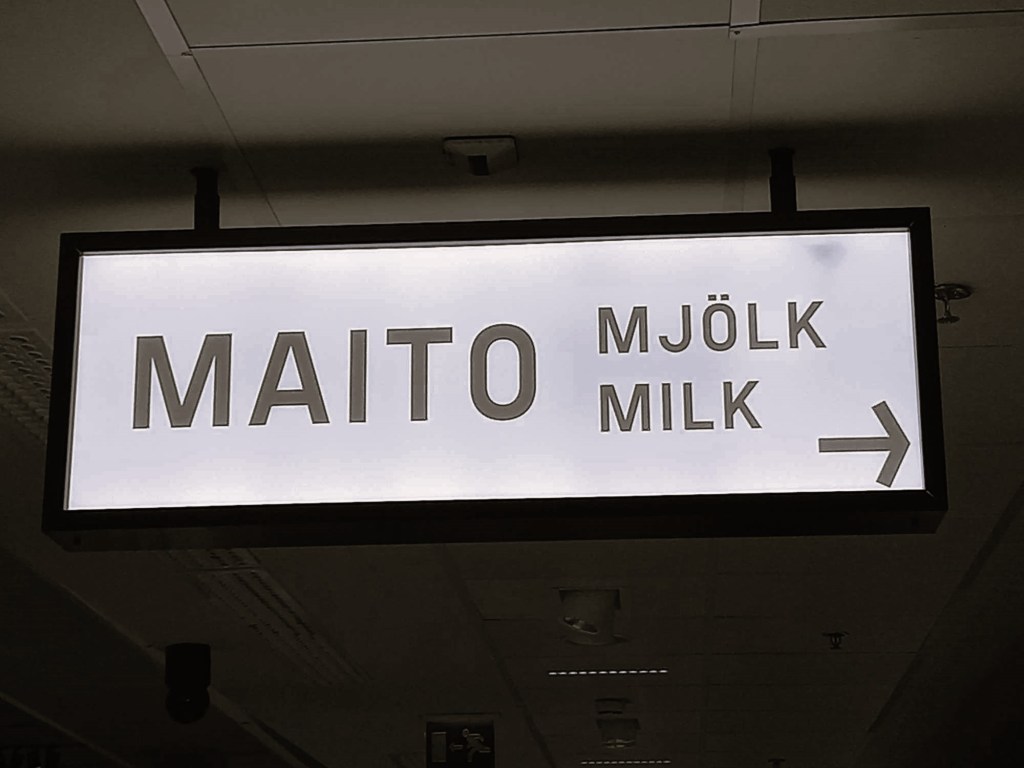
The Finns are so white and pale. Milk white. Maito white. I am always just a little pink. At least a little. The Finns need to supplement with iron and B vitamins. They are aloof, but pleasantly aloof. The men do not flatter the women. They are not Italian men, who blow kisses from passing scooters. The Finns are not lovers. This explains a lot. This may explain my entire life.
My soul is kind of foggy, udune, as the Estonians say, but my libido is strangely intact. It waxes and wanes with the moon. It is currently at full, full moon peak. It’s nice to sit in Stockmann though, just like this now. It’s nice to be anonymous. I like watching Finnish people. I like watching Finnish women. I wonder, which kinds of women do I like? I don’t like the women who wear a lot of cosmetics and have intricate manicures. They probably expect lots of money, and round-the-clock maintenance. This is my prejudice. That’s just how I see them.
I do like the women who seem a little shy, or to exist in their own worlds. There was a nice Finnish woman selling baked goods in Kamppi. She was wearing an apron and dressed in white, and was pleasant and round. And she had that beautiful white-blonde hair. There is something about hair like that. I also like the women who look a little strange, or even dangerous. I like the women who make unusual fashion statements, or look like they are members of a) some religious sect; b) obsessed with a musical group; c) forming a revolutionary cell. These women tend to be younger. When you are young, you can be bold.
At least they look interesting.
But then I have intrusive toxic thoughts. So intrusive and toxic as I sip my juice at Joe and the Juice. I don’t have enough money, I am going to be 44 soon. I have three children and have been classed out of the reproductive cycle. But I have actually written almost three books in the past few years. Doesn’t creativity count for anything? Or is it all about the money? These little thoughts are like like Stockmann shoppers. They elbow their way in, but they didn’t originate with me. Who put these intrusive thoughts in my head? Was it you? Or you?
Better to think of nice Finnish women selling baked goods. Something else. Something nice and cozy, or mõnus and hubane, as the Estonians say. The bookstore here is amazing, Akademiska. Bookshops will never be replaced by online. No way. There is just no way to replicate this sensation of drifting along, being drawn in by some book or its cover art, or title, or, “Hey, that’s Murakami!” I try to write like Murakami. I try to do a chapter a day. To punch in and punch out. I am not just satisfied with some ideas and a few paragraphs. But I am a father. I am running and I don’t always have the juice to do it.
It’s funny, I thought that if I came to Helsinki, I would be inspired. But I already know Helsinki intimately. I know what this city feels like. It’s in my bones. Turning 44 is somehow bothering me. It feels like the point of no return. Forty sounded kind of youthful. And these last four years just blew by. Gone. Around the corner from here is a bakery. I even once wrote a story about it, because one morning I was here, and I thought I saw Dulcinea working at the bakery. Yes, Dulcinea. I suppose she does look like a Finnish girl. I don’t have many love stories you know. Just a few. Sometimes, I would like to excise them. Sometimes, like with you, I buried them, and I can’t remember where I put them. Oh, I have tried to alter history. I have gone to psychologists, psychiatrists, healers, witches, tarot card readers, Hindu shrines, Orthodox retreats. Most people just tell me, as common knowledge, to leave the past in the past.
Things do fade but other things, and other people, they don’t always go fully away. Not 100%. They are just part of the scenery, the furniture. They are a room in the house of you.
I do want to get a new book before I go though. Some crime novel by a Harlem writer. I like crime fiction, it helps me with everything else, with structure, with pacing, with dialogue. I went to go buy it, but then the bookstore was closed. A milky white security guard with a beard said it was closed, kinni. The book was Cotton Comes to Harlem by Chester Hines.
After that, I went back to Stockmann and got another exorbitantly priced sandwich. Which is basically what an Estonian sandwich now costs. I watched the bourgeois Finnish couples coming and going, smelling of perfumes and colognes. Why was I not able to play that role in life? Who am I even writing to? And how come, no matter how much I write, nobody answers me? I feel like I am writing to a dead person. Maybe I am writing to Vahur Afanasjev. I remember that day, when I saw the headline about his death. Now I have become accustomed to disappearing acts, including by the living. Because when a friend leaves your life, alive or dead, it feels the same way, like a little death of sorts. I can’t say I am surprised by it anymore.
ON SOME DAYS, I like to hike out to Karula Lake outside of Viljandi. It’s about eight kilometers door to door and it’s very pretty. The fields of rapeseed are in bloom, blanketing everything in delicious yellow. Agricultural laborers toil away in the fields. The Estonian countryside does have a certain desperate, Depression-era flavor to it though. Those abandoned, splintering houses, lost to time and graffiti. That empty bottle of whiskey tossed carelessly into a farmer’s field at some particularly fraught moment in the cold winter, only to be revealed later by the thaw, like the corpse of some ancient mastodon.
Sometimes I wonder about the local indigent people who might shelter in these discarded structures on the outskirts of Estonia’s country towns. Maybe they make bonfires at night and play harmonica like the bluesmen of the past? What kinds of horrors have these walls seen? In India, I once saw a man sleeping curled up in a rug by the roadside. I imagine it was something like that here. The countryside is mostly quiet, but one can always hear the birds singing. The Estonian birds are social and talkative. The people not so much. I have done this route many times, down to the lake, past the Baltic German cemetery. Then it’s back out onto the highway.
Other walkers come by, but nobody looks at you out here. It would seem that this would be the most opportune occasion to exchange some kind of pleasantries, or to acknowledge each other’s existence. Two strangers meet along a lonely highway on a hot summer’s day. I don’t expect much, you know. I understand that this is not California, and there will be no “have a terrific day!” wished upon me by some life-loving passing jogger. Still, a nod might do. Or some eye contact. There is nothing.
Yesterday, a young woman walked right past me. She was within arm’s distance. I looked to her, just to acknowledge that we existed along the same plane of reality. Was I really here? Was she? The wind was playing with her straw-colored hair. Her face was pale, as were her eyes. She looked like an extra from one of those Netflix Viking dramas. I wondered what she was thinking about. It must have been very important. Maybe she was wondering about what classes she should take, or how much her cousin Tõnu’s new car cost. “I wonder how much it cost? I wonder, I wonder.” Then it occurred to me that maybe she didn’t see me. Maybe I was invisible. What other explanation could there be? I didn’t know when my invisibility began to manifest itself in Estonia. Naturally, she didn’t say hi. She couldn’t see me.
***
A day later, I recounted the story to a friend in a local cafe in town. Well, at least I consider her to be a friend. Estonian is a Finnic language, which means it’s not at all related to Indo-European languages, though there are plenty of loan words. In Estonian, though, the word for “friend” is “sõber.” An Estonian sõber, however, is not exactly like an English friend. A friend in English is sort of like a person with whom you feel a kind of rapport or affinity and have shared some times together. A fellow traveler. A companion in life. Maybe sometimes you meet for a drink. An Estonian sõber demands more from you. If their car breaks down, they expect you to come and help. If they run out of money, they will ask you to loan them a hundred euros. If you say no, they might be disappointed. “But I thought we were friends” your Estonian friend will say.
An Estonian friend might also ask you for strange things, with no context for the request. You might be at home making coffee in the morning and receive a mysterious message, such as “Do you have a hammer?” To which you might wonder if it’s a trick question, or maybe it’s a state survey. Is Statistics Estonia compiling data on hammer ownership? It also happened once that a friend contacted me at midnight to inquire if I had any ice. “Do you have any ice?” I remember staring at the weird message. This kind of thing only happened in Haruki Murakami novels, I thought. Where could this request for ice lead? Maybe I would soon be blackmailed or drawn into some erotic thriller? I turned over and went back to sleep. It later turned out that she was at a neighbor’s making cocktails with friends. Had I known this, I might have really brought them some ice.
I just don’t understand these things. How does being friends mean that you have the right to borrow my hammer at a moment’s notice, or to go through my refrigerator for cocktail ice?
***
These are the kinds of things that happen to you when Estonians know you and consider you a friend, or at least an acquaintance or tuttav. In Estonia, personal relationships are very precise. Sometimes even if you have been in the same class, you are just called a classmate, or kursaõde or kursavend, a “class sister” or “class brother.” I am unsure if class sisters qualify as acquaintances. I can speak this language, but it still makes no sense to me. Sometimes I try to understand the roots of words to fish out their deeper meanings. That might help me understand Estonians better.
When I told my Estonian friend about my experiences on the lonesome highways, where everybody ignores each other and walks by as if you are invisible, she did not seem surprised.
“But of course, they didn’t say hello to you,” my Estonian friend said. “You’re võõras.”
Võõras. A word that translates roughly as “foreign,” “strange,” and “unknown.”
“That’s not true,” I said. “Everyone here in town knows who I am.”
“Yes, but they don’t really know you.”
There it was. I was a known unknown. I would only have to wait until a mutual Estonian friend introduced us in a social situation, or if we happened to take part in the same shared activity, maybe a kannel or folk dancing class, to say hello to these strangers. Then we would know each other. Only once we had been formally introduced could I greet them alone on the road. Until that time, we would remain apart. I could not, for example, walk across the road and actually introduce myself to the others. That would be alarming. I would have to wait until we knew each other. Then I would no longer be a stranger.
Selge pilt. A clear picture.
That word started to haunt me though. Võõras, võõras. Where did it come from? The word “stranger” in English derives from the Latin, “extra” and French estrangier, meaning “outsider.” “Foreign” similarly derives from a Latin word meaning “door,” so, again, an outsider. “Unknown” has a Germanic root in cnāwan, which means to identify, or to recognize.
This word might be closest in meaning to the Estonian word võõras.
I am not a linguist though, so I contacted the Estonian Language Institute to ask about the origins of the word võõras. I was then referred by someone to a special online query form where I could submit a question to the institute. I checked the online resources, and then plied my luck with the new translation tool for Finno-Ugric languages made recently available from the University of Tartu. It seemed that the Estonian word võõras exists in Karelian, where it is vieras, in Veps, where it is veraz, and in Livonian, where it is vȭrõz. This was a shared Finnic word, which meant that it developed from the shared mindset of the Baltic Finns. They had their own ways of determining who was known and who was unknown, who was a friend and who wasn’t. These people had their own systems for intuiting the world, and their language was just one manifestation of it. To be a friend was to be available at any moment to loan a hammer or give them some ice. If you had not been introduced, then you would always just be a stranger.
***
I started to ask around though. I wanted to see if anyone could provide more information on the Estonians’ behavior, on their determination of who was võõras and who wasn’t. At the café, I queried the esteemed diplomat Jaak Jõerüüt and his consort, the poetess Viivi Luik.
Jõerüüt blamed the Soviet regime. “This is Soviet stuff,” he said. In the old days, before Estonia fell to Comrade Stalin, before the war, collectivization, and Georg Ots’ singing career really got going, the Estonians were a jollier lot, Jõerüüt said. They were sitting around with big steins of beer and playing accordions and if you saw one in the countryside, he would call you over, and maybe cut you a slice of black bread. The horror years of Communism had done away with all of that. Who knows. I could be a bloodthirsty metsavend or “forest brother” out on that country highway. Or even NKVD.
“It’s better not to bother with other people,” said Jõerüüt. “It’s best to avoid contact.”
Jõerüüt offered another hypothesis. He noted that Northern Europeans have a tendency toward introversion. There are, I admit, some famous photos of Swedes and Finns waiting for buses and trains, where each one leaves plenty of distance between each other, and they don’t talk to each other either. This is the precious personal space that Northerners relish. They love nothing more than being alone, so that they can think lonesomely about things that affect them only. Their anthem is Depeche Mode’s 1990 hit “Enjoy the Silence.” “Words are very unnecessary. They can only do harm.” Depeche Mode played this August at the Song Festival Grounds in Tallinn.
They have a lot of fans here.
There are other theories. One musician friend blamed the cold weather. “People don’t want to waste energy communicating if they don’t want to,” she said. “Every ounce of energy is needed for the long winter.” Another musician friend said it had nothing to do with the Soviets at all. This woman, who is about 30 years old, was born after the restoration of independence. She said that she was taught in the 1990s that you always greeted people you saw in the countryside. In urban settings, anonymity was the rule. It had more to do with new technology. To be fair, many times I passed fellow walkers, they were staring at their phones.
They had vanished into a virtual existence. That’s what was happening.
One fellow cafe goer, who is from Australia, had his own theory about the Estonians that he was only too happy to share. “Oh, I think it’s clear that everyone in Estonia is suffering from a mild version of Asperger’s syndrome,” he said. He’s even been checking the scientific literature, but the Estonian Genome Center has yet to put out a paper on the high prevalence of autism in Estonians. Or maybe they already know about it and are merely hiding the truth from all of us?
About a year ago, I went to Copenhagen for a few days and was overwhelmed by the gregariousness of the Danes. I had conversations with people in cafes, in museums, on the trains. I talked with bartenders and waiters. The Danes seemed much livelier, earning their reputation as the Latinos of the Nordics. Then I returned to gray, quiet Estonia, only to stand in line at the supermarket, where every shopper stood apart from the other. None of them interacted, and when the time came to pay the cashier, one woman looked away as she deposited the money into the plastic dish, to avoid all possible eye contact. What was wrong with these people? I thought. Why do they behave in such a way? They won’t look you in the eye, and then they will ask you for ice at midnight. They’ll take your hammer and won’t say thank you. Yet a few days later, I too stood apart from the others. I was lost in my thoughts. I ignored eye contact with the cashier.
Three days. That’s all it took to become one of them.
***
Years ago, after returning from New York, I took the long train ride down into the South Estonia countryside and wondered again how I had even wound up living in such a place, though the scenery was nice. It seemed so far away from everything though, and I almost couldn’t believe that Estonia really existed. There were those familiar bales of hay though, rolled up and covered in tarps. Some Estonian farmers had covered their hay in blue, black, and white.
One night, I took a drive down to Abja-Paluoja to go to the sports and health center. I bought my ticket, went into the changing room, disrobed, and headed into the sauna to get a good sweat. Inside, there were four or five naked Estonian men sitting on the sauna benches, their red legs dangling. Not one of them looked at the others and not one of them said a word. They didn’t know each other, you see. They had not been introduced at a folk dancing course yet. They were all võõrad. Strangers. As was I.
The sauna had a speaker installed, and it was playing Radio Elmar, a national radio station, that evening. The song on the radio was “Pole Sul Tarvis” by Kukerpillid, a legendary Estonian country music act. The refrain to the song translates roughly as, “It’s not necessary for you to know what I’m doing.” That was just it. Forget “Mu Isamaa” or “My Fatherland,” the official national anthem. Kukerpillid’s “Pole Sul Tarvis” was the real one. I looked at the others. They did not look at me. What else was there to do than toss another ladle full of water on the sauna and listen to Kukerpillid in contemplative silence? We may have all been naked and in close proximity, but that’s where any familiarity ended. One more ladle full.
My notes from this year’s Viljandi Folk Music Festival, held 27-30 July 2023 in Viljandi, Estonia
THURSDAY, YESTERDAY, was the first day. Festivals are difficult to cover, because you cannot be in every place at every time. Concerts or events overlap, and so you just cannot see everything. Of the concerts I saw yesterday, my favorite was Mari Kalkun’s performance, which happened at Kaevumägi, or the Well Hill, one of the festival’s primary stages.
I have probably either known or known of Mari Kalkun for more than a decade. She is a popular folk singer, and specializes in songs sung in the South Estonian Võro dialect or language.
I think what makes Mari special as a performer is her ability to sustain intensity over what can be atmospheric and amorphous compositions. She plays with all of the foreboding of purple rain clouds in the distance. She comes in and leaves like a thick white fog. There is sunshine sometimes too.
Many folk artists can provide nonstop, horn-blaring, bass-drum-pounding, action-packed intensity, while others are capable of crafting beautiful lullaby-like landscapes. Those landscapes though will soon lull you to sleep, just as that intensity will wear you down quickly.
Rare is the artist who can sustain such intensity wrapped up in lush and haunting melodies, and across an entire set list.
For this performance, Mari was joined by Australian bassist Nathan Riki Thomson, and most of the material was off her latest album Stoonia Lood, released on Real World Records this year.
They also performed later in the evening at the Folk 30 concert which celebrated three decades of the Viljandi Folk Music Festival.
OTHER THOUGHTS OF FOLK
One thing I notice every year when I attend this festival is the lack of American performers. I think it might be because American folk music is popular music. When an American says “folk,” he thinks probably immediately of Bob Dylan. But Bob Dylan isn’t hurting for gigs and it would be hard to entice Bob to come on down to Viljandi to sing to us. There is also this issue of the American folk blues tradition. Estonia has a blues festival too. Should American traditional acts perform there instead?
“Folk” in Viljandi is blended with something called etno or “ethno.” It’s very fusion, and in line with the general philosophy of the Viljandi Culture Academy to make the old new again, or to build off of Estonian and other folk traditions. So “Folk” is not exactly “folk” as an American might understand folk to be. The Estonians have taken the English word “folk” and changed the meaning slightly. The Estonian word is pärimus, which means something more like original or traditional. There are always different ways to translate English words into Estonian, but the meanings are not always exactly equivalent.
I like the size of this festival. It’s very cozy, and I am glad it has not become a Coachella, Glastonbury, Roskilde-like event. It’s a social gathering. Old friends get together. It is distinctly for the locals, and in that way, its reach is limited. Combining international artists with this Estonian content must be a challenge.
For example, the opening ceremony was entirely in the Estonian language, as it should be, but I found myself wondering how an outsider might see it. I am not arguing that there should be simultaneous translations or anything like that, but this is a niche festival. At the same time, people who have visited just for one festival have often returned for the unique vibe. It has that effect on visitors.
OF LEIK, ANDRE MAAKER, AND BUBBLES
Leik is a duo consisting of Kelly Veinberg and Elina Kasesalu who (mostly) sing and play violin, but also add viola and the special hiiu kannel.
I have seen Elina and Kelly a lot in Viljandi, and on trains to Viljandi, and from Viljandi, and also once in a shopping center in Tartu. And probably other places, toting their instruments.
Andre Maaker is a guitarist. I could call him a virtuoso, but he’s not really, and I could call him a guitar slinger, but really, he’s just a guitarist. He’s the kind of guy who sleeps next to his guitar, “just in case he gets a good idea.” He loves guitars, and based on the set they played yesterday at Käevumägi, he has a whole toy shop full of stringed instruments at home, such as the acoustic “world stick” he pulled out of nowhere, or the four-stringed tenor guitar. He filled out Leik’s sonics best with a 12-string acoustic, which has that lovely, dulcimer-like ring to it, and has always been used in folk music, as he noted to me afterward (yes, it has, and should be used more often).
According to Leik, the addition of Maaker has allowed them more room to focus on their vocals and instruments, as in the past, they often had to work to fill out the depth of the pieces. With that guitar, there’s just more sound.
Andre used to teach Kelly and Elina, and they asked him to partner on this project, which has seen them recently tour the islands. Much of their repertoire includes songs from Saaremaa, Hiiumaa, and Vormsi, as well as some self-penned compositions, and they carried them all well. There’s something wonderful about the blend of voice and strings here that continued to ring in memory for hours.
According to the musicians themselves, they were well received in the islands and were again yesterday.
This was probably the best concert I saw yesterday. It provided some sorely needed introspection during a festival that can get tiring quickly, with all the people, music, food, and conversations.
FRIDAY
Friday raised the question, is it possible to overdose on bagpipe music? According to radio journalist Arp Müller, who was diligently assembling his kit in the press room, it’s possible to overdose on anything.
Cätlin Mägi and the VKA bagpipers begged this question with their afternoon performance. At best, the bagpipe evoked misty landscapes and ancient moods. It has a kind of cleansing quality to it. At worst, it can sound like a flock of angry ducks. According to a German folk journalist (yes, they really exist), Estonian bagpipes are unique, as is the Estonian bagpipe tradition. He came all the way up from Scholzland to write about it.
He also noted that the Folk audience is unique, in that it is concentrated among younger people. In other countries, its an older person’s genre. Even the musicians of Trad.Attack!, Jalmar, Sandra, and the incredible percussionist Tubli, are in their mid-to-late 30s and considered old hands.
Trad.Attack! puts on a mobbed, flashy, wall-of-sound show. Unfortunately for an outsider, a lot of the runo song-based melodies are lost on someone who isn’t from here.
I will add here, that I did not witness one drunken brawl or act of violence yesterday. Folk does not invite the quasi-white nationalist biker crowd to brawl over grilled meat, beer, and heavy metal. They are somewhere else. One feels safer here.
The last concert I saw last night was Tintura, which is really one of the weirdest groups out there. They offered up a contrabass, violin, keyboards and electric guitar, turntables, and then, of course, a blazing saxophone solo. This was funk, folk, electronica, and wedding band fusion. Or as a friend put it, “kompott,” a jam.
PS. I am also proud to report that I survived an entire Irish folk music concert given by Flook yesterday, though I initially doubted in my fortitude. After a few numbers though, I actually started to like it. One might say that it’s an acquired taste.
SATURDAY
SATURDAY. Let me choose my words carefully. On Friday night, someone I know started drinking. On Saturday, he was still drinking. If you are reading this, you probably think you know this person, but the fact is, it applies to multiple people at this festival. They may still be out there drinking, somewhere.
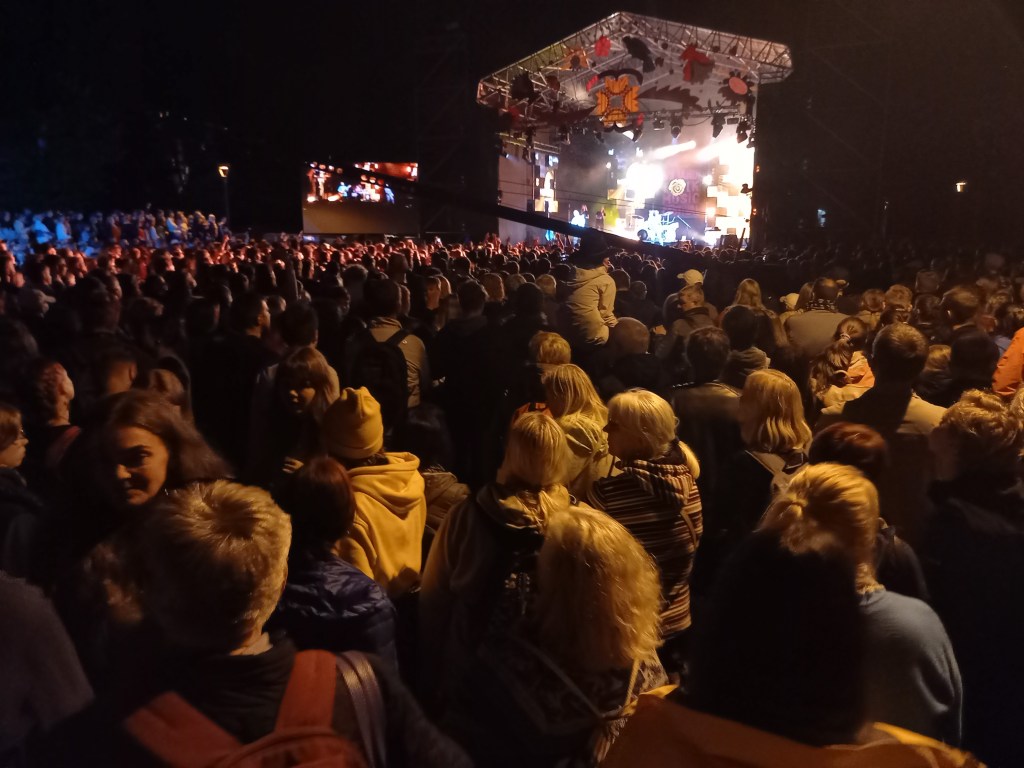
Music. It is impossible to see all of the concerts. You must choose. Often, the choice is not yours. The line for the Kaisa Kuslapuu Trio was out the door. Supposedly, I missed a great concert, but I couldn’t attend it. Instead I saw Svjata Vatra and Rute Trochynskyi and also Julia Kozakova, which is a Romani act from Slovakia. You really have to appreciate Svjata Vatra (one of these photos is of the crowd at the concert). Ruslan is just so funky, and his daughter is brave and can sing. I told my daughter that next year we should perform just like Ruslan and Rute, but she was not amused.
Other interesting finds were Le Diable à Cinq, a furiously intense Quebecois band, and Rahu the Fool, from Latvia. I have this bias against Latvians from living here. It’s as if we ignore them, because they are so close, sort of the way that New Yorkers ignore the Quebecois. “Oh, right, them. They’re over there.” This group was fun. They even played “Mack the Knife.” People want to be entertained, you know. You can be the best accordionist in the world, but if you can’t entertain people, then so what. Latvians do seem a shade darker than Estonians, and about 1000 percent livelier. I think I had written once about a lost Roman legion that had settled the banks of the Daugava. This performance reminded me of that myth.
At some moment yesterday, I became overcome by exhaustion. I could barely walk, really, and just sort of stood against a tree reading the obits for Sinead O’Connor on my phone. I disappeared into the press office, where I ate most of the cherries and zoned out and dreamed of certain things. There were too many people, and there was too much going on. It’s enough to drive a man to drink.
VÄGILASED
So, this was Vägilased on Saturday night. The Estonian word “vägi” means something like “force,” “might,” or “energy.” Perhaps Vägilased could be called “the mighty ones.”
This is one of the old guard bands that used to play the festival many years ago but reunited for this year’s concert. It consists of Meelika Hainsoo on violin and vocals, Reigo Ahven on drums, Cätlin Mägi, who also sings and plays bagpipes and the jaw harp, Jan Viileberg on guitars, and Marti Tärn on bass. They were joined by Andre Maaker on guitars, Leik’s Kelly Veinberg and Elina Kasesalu on violins and vocals, and Francois Archango on percussion. They were also joined by graybearded Aapo Ilves playing a wolf (although my daughter said he looks like Jesus), Toomas Valk on karmoška, Kristjan Priks, an emcee named Päär Pärenson, and a whole school of percussionists.
This concert started at 21.30, and I was already tired. The long, flowing dresses of the performers reminded me of night gowns, so I came to think of the Vägilased concert as a sort of pajama party. Of course Meelika is a captivating singer (she is so soulful and sincere, commented Lauri Räpp), but I was also impressed by the outstanding bounce of the rhythm session. Whoever did the sound for the concert deserves credit. It was balanced, light, and funky.
Also, just when you thought this concert was over, it wasn’t. There was another song, and another. The concert ended with the vast audience holding hands and singing the chorus to one of the songs.
Like most Estonian folk acts, this one relies on traditional runo song structures as a foundational element, but there’s a subtle reggae influence to the way the compositions are performed. I was just very happy when it was all over, and the yellow moon was waxing watchfully in the sky, soon to reach its most potent and illimitable size and shape.
Apparently, this was a one-off concert, and there won’t be anymore Vägilased for some time to come. If you were there last night though, you were there. Easily one of the best concerts I have been to in recent years. There is an emotional depth here that is lacking in a lot of other groups. Vägilased make you feel things.
SUNDAY
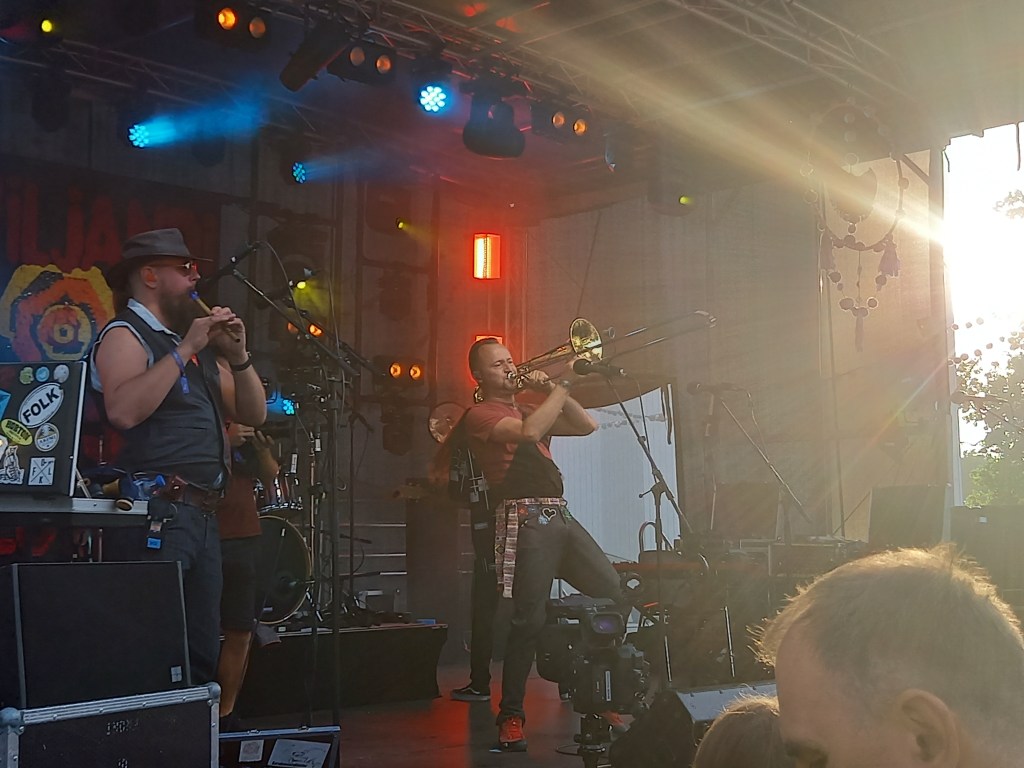
Technically, Sunday began at the stroke of midnight, meaning that this photo taken of Untsakad performing was made around that time.
As a person without roots here, all of these indigenous rhythms are at times lost on me. As a friend recounted, once an Estonian hears them, something goes off in his brain, and he starts to dance. The Estonian can be anywhere, cutting the grass for example, but after hearing a few bars of an Untsakad song, he will go into a trance and start to dance a jig.
Sunday morning started off with sunshine, but halfway through the day, it began to rain and never stopped. I saw the Quebecois again, and the Slovakian act again. There was also some atonal folk music from the Middle East performed by a cat called El Khat.
I don’t really remember what else I did or saw, just a lot of truncated conversations. It seems like Folk is one big therapy session, where people confide in each other about their relationship problems, or seek out advice from others. Women advise bold gestures of love. The men in the know say you must remain aloof. “It drives them crazy. They will chase you for years!” I will only comment that it is interesting to have nearly every love interest you have had in a seven-year timespan confined into a small area patrolled by security and catered by mobile kebab vendors.
All of the bands are different. Some are more purist at heart. Julia Kozakova’s group made me feel as if I was at a traditional Roma wedding. Zetod are traditional fusion supreme, mixing in rock, funk and reggae, and basically everything else.
We should probably talk about Jalmar Vabarna too. Years ago, he was just this earnest folk music kid, but now, I can barely get near him because he has a little entourage of Seto bodyguards around him and wears sunglasses at almost all times. Well, not completely true, because the last time I saw him, he was handing out strawberries at a high school graduation in Setomaa. He is most himself on stage, I think. I have never seen him more natural, more happy, than on a rainy stage at midnight. When you see him perform, as he did closing out this year’s festival, you get the true Jalmar.
THE APARTMENT was on the central square in an old pre-war building constructed during some period of authoritarian government. I got the keys from a friend who lives abroad. Her grandmother recently died and she said she would allow me to stay there while I was visiting the city. I just needed to know the number to open the front door, and the keys would be waiting for me in the mailbox. The flat was at the top of the first flight of stairs. The door was heavy, wooden. I worked both keys until the ancient lock turned and the door creaked open.
I went in.
The apartment was being renovated. All of the kitchen appliances had been unplugged from the walls. One of the rooms was completely being refinished and the workman’s ladder still stood in place. Two rooms were overflowing with stacks of old books. In the library, they still were ordered across the shelves. In a second room, they were stacked into seas of old boxes, one toppling over into another. The old woman had been religious and there was Christian imagery everywhere. There was also a tall, stained glass art nouveau lamp in the library. I paid almost no attention to this lamp as I spread my sheets out on the couch and went to sleep. When I woke up again, the lamp was shimmying back and forth and had grown a set of eyes.
The air was different too, thicker, as dense as water, and yet breathable. The art nouveau lamp was glowing and dancing and I stumbled past it to the corridor. The old woman’s cane was set against the wall in the corner, beside a silver crucifix. I felt up the side of the wall until I found the light switch and turned it on. With that first burst of electric light, the room became stationary, and the lamp returned to its usual form and shape. I noticed, as I walked back to the couch, that it was covered in a fine layer of dust. It must have all been my imagination.
The second time I woke up, the art nouveau lamp was glowing again and staring at me. It was brighter in the room again, and the air was even denser than before, like maple syrup. Books were removing themselves from the shelves and then reshelving themselves. An old wood spinning wheel in the corner was spitting out thread all by itself, as if run by some invisible hand. The light in the corridor was off again, but the room was so noisy and alive with flying books that I couldn’t even make my way across it. That’s when the woman fell out of the wall.
She was dressed in a cotton nightgown and was thin. Her hair was long and so blonde it was almost white. I couldn’t see her face because it was covered with her hair. She sat down beside me and was still, quiet. This, as I understood it, was Woman Number 2. She thus began to admonish me. “You have not been treating women well,” she said. “You have one in your heart and yet you entertain and use the others. It’s just not right!” She was clutching at a ball of white yarn and knitting away with a pair of soft, sun-browned hands. The room continued to pulse with light, and when I looked over at the art nouveau lamp, it winked at me and swayed.
Thereafter arrived Katla with two of her favorite girlfriends. They all went into the bathroom, where they disrobed. They were standing there under the spray of the shower and soaping up each other’s beautiful breasts. The women were younger than Katla, and one had very curly hair. After the lesbian shower, Katla dried off and put on some white clothes. She came into the room with the lamp, and I noticed that a small café had opened up in the corner. In fact, the entire side of the room had been replaced by the side of a street. Katla sat there with her blouse halfway open and ordered a coffee. A French waiter stepped quickly and brought it to her on a tray. Katla began to read through the morning’s newspaper in the August sunshine.
“But you have such beautiful eyes,” I told Katla. She only squinted at me over the paper. “Won’t you have me?” I implored her. “Please, tonight?” Katla only shook her head. “You have another woman in your heart now,” she said. “So go be with her.” “But I can’t be with her.” “She’s just your little saint now, isn’t she?” “You don’t even know who she is!” “I know everything already,” Katla said, sipping her coffee, “besides, I have no use for you anyway. You’re just a silly boy.”
I stepped away from her table at the café and was back in the room with the art nouveau lamp. The books were still flying off the shelves and landing again, like tiny birds in a park. The old gramophone in the corner began to spin, and a jazz song was playing through the dust. Woman Number 2 was now lying on the couch before me. She had pulled her ropey, yarny hair back from her strange blue eyes. I could see her face. She had pleasant features but almost look frightened. “Take me,” she whispered, as I crawled on top of her. “Take me, you bastard!”
When I woke up again, I noticed the dust on the lamp in the corner. Everything was back in its proper place. It had been a dream. Someone had turned off the light in the corridor though, and so I went to turn it back on. I was beginning to suspect the old woman’s apartment was haunted. Supposedly, it had once belonged to a pair of long-dead Lutheran deacons, and most of the religious art had belonged to them and not to her. Who were they, and what did they have to do with all of this? As I passed the lamp, it began to glow brilliantly and I saw its big eyes again. The room turned orange and the air was thick. The gramophone spun back to life and the lights began to flicker violently. I bolted for the door. It was ajar, and there were neighbors standing in the hall who had come to see what was up. They were in their pajamas.
Looking back, I saw Woman Number 2 sitting on the bed, waiting patiently for me in her nightgown. Katla was behind her, reading her newspaper at the boulevard café. She lifted her cup of coffee and the books began to fly off the shelves again. The works of Balzac, or that faded special commemorative volume about the ’84 Sarajevo Olympics. The books began to swarm in my direction as the door to the apartment shut. The lost old woman’s cane flew up from the corner and wedged itself in the door. I turned around and the jazz only played louder.
The orange light was so intense, I could no longer see.
THE RAPID DESCENT was unexpected. It was an evening flight, and one could see the full moon shining through the gauzy clouds, which were rolled up in cottony layers across the expanse of the night time sky. There were plenty of stars in the sky, but these were distant, and looked more like holes in the fabric of a dark blanket. The plane had just reached cruising altitude when it began to descend. I was concerned. I didn’t know why we were landing, or where we were landing. But the descent was smooth. The plane’s pilots were still in control.
We landed at Kastrup. Jones was with me. His afrobeat group had a show there, and he was letting me listen to some new tunes through one end of a pair of headphones, while we rode the airport escalators. Jones then had to leave, but he forgot the headphones and his smartphone with me, so I was walking around listening to afrobeat music. I picked up the wrong bag from the luggage carousel, then returned it and got the right one. Mine was green, but the other bag had an orange logo on it. And then I was out in the morning sunshine of Copenhagen. There were Arabic fruit sellers in stations along the elevated railroad platform, selling bananas and oranges. Somewhere, a tiny radio was playing Basement Jaxx or Daft Punk.
I remembered then how at home I had once felt in that city, so long ago, and about how I once went to a club around Christmas and watched a teenage Danish girl with mermaid curly hair, who had obviously lied her way into the dance hall, get swirled around by some gruff executive from Maersk or Danske Bank while the DJ played Wham’s “Last Christmas.” In my mind, they were still dancing while George Michael sang. Love was in the air in Copenhagen, always.
I rode the train into Københavns Hovedbanegård, the central station, and disembarked, leaving my luggage downstairs. I didn’t know where to go next. Should I go to Christiania? Or to Christian’s Church to visit the tomb of Link Wray? Or maybe just head down the Strøget and get a cup of coffee somewhere? Some Danish girls went by on bikes and I could hear the bells of their bicycles ringing. It was an exuberant, holiday sound. The bells’ sound made me happy.
THAT SUMMER I was cast in a film where I was set to play the father of a large family.
Filming would be at a warehouse in Tallinn, somewhere out by the airport and downwind of Lake Ülemiste. Koidu, my agent, got me the job. It didn’t pay especially well but she promised me that it might lead to steadier, more reliable work.
Though it was summer, much of the film would take place during winter. A traditional family Christmas dinner scene was planned, for example. Part of the role called on me to play Santa Claus too. I was expected to burst through the door with a big and bulky joulupukki outfit acquired during a summer sale at a Helsinki supermarket with a bag full of gifts for everyone. Fazer was sponsoring the production and Geisha chocolates would tumble out like gold coins. Playing the pater familias sure seemed like an easy gig but then everything went shit wrong.
To start, Koidu is an Estonian agent, which means she suffers from some mild communication impediments. She assumes beforehand that information is known and therefore believes there is no need to reiterate certain points, because telling me again what time I was expected on set would be, in her mind, a waste of time and energy. As such, I had no idea what time I was supposed to be there. I tried to reach out to Koidu that morning, but she was in an important meeting out at Noblessner, and didn’t respond. The timing of the filming was probably mentioned off-hand in some list. Everyone else had read every message, naturally, but me.
There was a second problem. I had lost my phone. It just disappeared from my fingers at the Sõõrikukohvik on Kentmanni Street. It was the strangest thing. I had just tapped out a message to Koidu, and then tried to scan the message list for more information, but found none. I sent a quick message to the director, but it went unread. He was understandably busy doing something else. A woman walked by and saw the day’s copy of Postimees spread before me and asked if I was done reading it. I said I was and handed her the newspaper and then, that was it. The phone was just gone. It wasn’t on the table, or under it. It wasn’t in my pocket, it wasn’t under my plate of widely-acclaimed and extra soft and sugary donuts. It was just gone, and I had this suspicion that I was already late. I ran out the door, got in my car, and drove off.
The rest of the cast was a group of twentysomething actresses from Nukuteater, one of whom was supposed to play my wife. Her name was Johanna and she had curly yellow-gold hair and a childlike look to her. Maybe they would need to age her face with AI, the same way that they de-aged Harrison Ford in the new Indiana Jones movie. We had met once to go over our lines. In the film, our marriage was on the rocks, but it was saved by the Christmas festivities. I had only seen the photos of the actresses who were set to play our daughters on social media. I imagined the whole production as a modern day version of Little Women, except with Estonians cast in all the main roles. Estonian Women? They were all on set at the right time, I was sure, but then I was upset by a third logistical issue: my car broke down near the Liivalaia Selver and I had to trudge the rest of the way to the set through a tropical July downpour.
By the time I reached the set, I was soaked and the door was locked. I could see Johanna through the glass. She was on the phone with someone and pacing. She came to the door and handed the phone over to me. “Koidu would like to speak with you,” was all she said. I held the phone up to my ear. “What’s going on?” “Where were you?” Koidu said. “They have been waiting for you for hours!” “I had some car trouble.” “So what! Couldn’t you have also taken a Bolt?” “I also had some phone trouble. Anyway I am here now. I am ready for my role.” There was a pause. “You’ve sabotaged your career again,” said Koidu. “There’s no role left for you anymore.” “What do you mean no role? I was supposed to play the father of the family. I even have my joulupukki costume!” “It doesn’t matter,” Koidu remarked. “They got some other guy to play the father. It’s not such a hard role to recast, you know. All of you guys are the same.”
I handed the phone back to Johanna who just stared at me. Then she disappeared behind the glass door again. I could see her walk across the set, talking to some man I didn’t know. He must have cracked a joke, because I saw Johanna laugh. I had never seen her laugh that way.
After that I walked alone for a while. It was a hot day and I decided to stop into a gas station. I skimmed through an issue of Kroonika. The cover story was about the exploits of middle-aged actor and his new 25-year-old love. I bought a bag of potato chips and a drink and stood reading about this new pair. They looked happy in the photos at least. I had to give them that.
I WANT TO TELL YOU about my friend Tomás del Real. Today is his 30th birthday and he will celebrate it here in Viljandi, Estonia, which is the small, spacious and at times inspiring Estonian town we both happen to live in.
Tomás also has a new album out called Principios de Declaración. It is inarguably his most achieved and most mature work as a songwriter to date. His first two records, Tomando Forma(2014) and Tiempo (2017) featured bands, but over his past few records, Sembrar de Nuevo (2020) and Huracán (2022) with the folk music group Don’t Chase the Lizard, has has become a devotee of the guitar and opted for a sparser, stripped back, minimalistic sound.
The 13 compositions on Principios de Declaración are therefore built on his voice and guitar, with some light additional instrumentation added to fill out the atmospherics. He claims it is the perfect midnight record, but it also has the sound of a new morning to it, or even a late-afternoon stroll. It is a beautiful work of art created in a beautiful place. The melodies are earnest, haunting, and they stay with you.
Tomás chalks up the changes in songcraft to living in a small northern town, where one feels a stirring kind of isolation. Viljandi does attract its share of musicians, poets, writers, artists, and other outside thinkers for this very reason. He arrived during the pandemic, leaving behind political uncertainty and upheaval in his native Chile, and seeking out something fresh and new. Like a lot of artists from the New World, he has found inspiration in the Old World. They call it reverse emigration.
“The way I communicate with people now is different,” Tomás says of how the Estonian environment changed him. “The pauses, the space, the connection with nature, every part of Estonian culture and what I have been living during these years has got into my songwriting.” It is no wonder then that the songs on his new album have titles like “Los Momentos”, “Silente,” “Pausar”, and, of course “Viljandi.”
Kerttu Kruusla, a Viljandi-associated photographer and visual artist also provided the memorable artwork for the record. “She is a close friend of mine, I trust her,” Tomás says. “I knew she was someone who would be emotionally involved during the process.”
Being in front of non-Spanish speaking audiences also allowed him to let his hair down, so to speak. He felt less pressured to deliver topical lyrics intended to wow and impress audiences. “I could be super honest with myself and not filter anything that I need to share in the shape of a song,” he says of this phenomenon. In the past he might have avoided some things, but in an international context, there is no need to avoid anything he feels. That, some might argue, is actually the perfect environment in which to create anything of significance.
You really have to appreciate the work ethic that Tomás del Real has. After putting out and touring Huracán last year with creative partner Lee Taul, one might have expected a pause or a vacation. Instead he came up with 13 new compositions which, honestly, rank among his best, or most developed songs. Some personal favorites on Principios de Declaración are the gorgeous “Canción de Huída” in which he trades vocals with Darla Eno, a British singer he met 10 years ago.
“We were both very young and we met somewhere in Scotland,” del Real says of the collaboration. “During that period, some of the Edinburgh folk people would do singing circles and singing sessions, where everybody would learn some folk songs and sing along. Everything in Europe seemed so new and exciting to me, so I was listening very carefully.”
The foundation of “Canción de Huída” is actually a verse that Eno shared with him from an old folk standard called “The Butcher Boy” (check out Irish legends The Clancy Brothers performing the same tune in 1965). He said the chorus was so “nostalgic and profound” that he had to remake it in his own way.
“I basically wrote a song around it so I could sing the song as well,” said del Real.
Eno isn’t the only collaborator on Principios de Declaración. He also partnered with Chilean musician Javier Barría, who duets with him on the song “Acantilado,” and the album was mastered by Chilean sound engineer Jorge Fortune in Chilean Patagonia.
A personal favorite song of mine on the record is “Las Campanas,” which means “the bells.” Tomás said this particular tune developed out of a sense of isolation and anxiety about the world during the pandemic. “I was in a very dark place, and even music wasn’t flowing,” he says of this time. To survive, he indulged in classic 1960s and 1970s folk singers, Bob Dylan, Joni Mitchell, James Taylor, Leonard Cohen, and Paul Simon among them.
“I just needed something to give me a little bit of light,” he says. The concept underlying the song is that no matter the pressures of the day, there will always be tomorrow, and the bells will once again ring.
And then there is “Los Momentos,” which is the sparse and hypnotic debut single from the album, and at the beginning of which one can hear del Real striking a match to start a fire.
“This was one of the last songs I wrote that made it to the album,” he says. “After processing all that happened, and the songs I wrote along the way, I was exhausted, and found myself sitting by the fire, contemplating what I had been through.”
Most of the songs on Principios de Declaración were written during the long and introspective Estonian winter, and so the imagery of fire as a cleansing phenomenon that does away with the past after a long journey is at the front of “Los Momentos.”
“You summon the fire to clean it all out, and finish the trip the same way, making the album a very cyclical trip in my opinion,” says del Real. The guitar lines in the tune helped to ground him after many adventures. “I just wanted to explore that feeling of being grounded and just being.”
There is also the album title. Tomás says that he decided to call his new record Principios de Declaración for a variety of reasons. He sees it as a sort of personal constitution, one that communicates his principles, the fundamentals of what he wants to share with the world. “It reminds me of Blue by Joni Mitchell,” he says. “The way she says, ‘If I am going to do this as a living, then there will be no more disguises or costumes. This is it.'”
But the Spanish word principios can also means “beginnings” in this context. So these songs are merely the start of his declaration. That means, hopefully, there will be much more music to come.
AFTER SONJA STOLE my lost book of erotica, she continued her music studies, later becoming a rather impressive jazz singer and all around chanteuse. She gave concerts on the top of the tallest hotel in Tallinn, which is not that tall, but still pretty tall. From there, on summer evenings, one could feel the brisk winds of the north and stare off into a Matisse swirl of stars and purple orange sunset fused into a stellar blue stardust trail of Baltic melancholy. It was pretty, in other words, and she was beautiful. She played with a little Finnish trio. They were not as beautiful as blonde Sonja was, but they played beautifully. There was a drum solo.
I started attending the rooftop jazz concerts around the time I returned from America, where I had to visit family with Jane and her new lover Hans, the Dutch screenwriter. They got to stay in the guest bedroom while I was there, and, well, I had no place to sleep. To make matters worse, nobody could understand why this fact bothered me. “Why are you so moody? You again with your moods! You should go see a psychologist! You seem to have a lot of issues.” Hans and her shacked up in my parents house, and I went and slept in the guesthouse. Agnetha was there, with her young daughter, and I gave them my bed. I curled up to sleep beside them on the hard floor. It was uncomfortable and I went back to Europe after that.
That was how I stumbled upon Sonja and the hotel concerts. She was a good singer. Usually this kind of elevator jazz bores me, but hers was a more ambrosial blend. But jazz alone doesn’t pay the bills, does it. Sonja was also working as a waitress at the hotel bar. At breakfast, she brought me a glass of freshly squeezed orange juice. In Islam, orange juice is a rich and promising symbol. If you are poor, you will become rich if you drink enough orange juice. If your heart is broken and you have suffered many hardships, your pain will be relieved by the tang of this tropical nectar. I don’t think Sonja knew this though. She just needed the money. Then she walked over to the elevator and took it back up to the roof for some rooftop jazz.








 north!