like a european movie

IT’S EIGHT THIRTY AM, and I’m getting on board a northbound train in Viljandi. Two women sit nearby, waiting as well. Over their shoulders I can see that Lavazza instant coffee machine gleaming white in the sun. The last time I took a train here, I got an espresso in a paper cup, but by the end of the day, and after many coffees more, I looked like someone who had been on a nasty amphetamine binge, and so this time, I have decided to forego the morning espresso. The machine is nice though. It’s a welcome Italian brand. More than a few weeks ago, I decided to sojourn out to Vasknarva, which is at the very edge of the European Union, so I could take a hard look at the fearsome Russian Federation on the other side. Through swamps and forests I journeyed, until I at last saw the onion domes of the Vasknarva church, and trekked down to the harbor where I met some fishermen. They tried to speak to me in Russian, but since I don’t speak Russian, we got by with a few hand gestures and some Estonian words. “Kala,” one of them said. As I stood there, looking over the river at the smoky shanties on the other side, I saw it again. There was a Lavazza coffee machine in Vasknarva. 

I could drink coffee and watch Russia. 

“Estonski?” one of the fishermen asked me.

“Nyet, amerikanski,” I told him. 

His eyebrows raised upon hearing this and he gave me a puzzled smile.

Of course, I ordered myself an espresso from the machine. For me it served as proof that I was still standing in the civilized world, as I saw the border patrol glide up the river in a boat. This feeling of Europeanness means something to me. This is what Europe was supposed to be about. Efficiency, precision, the ability to use a chip card to order an Italian espresso from a machine at the murky riverside of the Western world. These small coffees do mean a lot. 

***

AN HOUR AND A HALF later and we pull into Saku. The grass is lush green and dotted with yellow marigolds. Odd new geometric buildings stand in circles near the approach to the town, like a jumble of Lego toys. Europeans like to live in these kinds of Lego buildings. Not too long ago, I was standing on this same platform in the snow cold when the train pulled up. The Estonians call these trains “carrots,” because of their orange color, but I still can’t bring myself to say I took the “carrot” to Tallinn. I was standing there and through the glass, I could see a young woman who I knew, just sitting on the train. There was something cinematic about that vision, of the train pulling up in the winter dark and seeing her seated there through the glass. After some time, I worked up the nerve to go and talk to her. She was on her way back to Viljandi. She’s very young, but she looked a bit sleepy, world weary. She keeps herself busy, I think. You have to appreciate the romance of these trains though. When I write to old friends back in the US, they especially like these kinds of details. How I saw a girl I knew on a train, or how someone came in on the train and left the same day. Or how someone missed the train. For them, it’s reminiscent of that old movie Before Sunrise with Ethan Hawke and Julie Delpy. 

In California, most people drive. In New York too. Here, I almost never drive anywhere.

Estonians, I think, wouldn’t make these connections. They don’t see how similar their lives are to the French and the Austrians and the “real Europeans.” I will admit that the country does feel mostly like a wilderness. Whenever I drive from Riga and begin to see those dense birch forests, I get the sense that I am heading to the very edge of the world. To leave these forests and go to a city like Rome or Barcelona or Paris is, in the Estonian mind, to go to Europe. But this same Europe also contains other far-flung corners, whether they be the Scottish Hebrides, or the Norwegian fjords, or the rocky Greek islands. The Estonian north woods are part of this larger experience, and through them one can travel on reliable little trains that some call “carrots.” The train pulls up and you can see someone you know through the glass.

***

NOW THERE ARE THE CRANES and graffiti of Tallinn. From here, Viljandi feels like a distant world. For me, Viljandi is just another provincial European town. It has its castle ruins, its old churches, its hotels and bars, its cafes and bakeries. Something about its sloppiness, those old falling-down fences and unpainted facades, makes it especially Gallic in feeling, as if I got lost somewhere outside of Lyon and turned up in this dusty place. Surely the fishing villages of Brittany must be home to similar layers of decay and renewal. Old barns renovated into cafes and bars. Haunted lost old factories. And did you know that there are three Americans living around the corner from me now? One from Florida, one from Massachusetts, and one from West Virginia. There’s an Argentine and a Dutchman too, and an Australian cycles by daily and waves. For the middle of nowhere, it’s some kind of somewhere. A small French town, as I said, that happens to be up in the north woods, and where they speak Estonian instead of French. 

Sadly, the wine and bread and cheese aren’t as cheap, but you can get other things at the markets here, and they are playing the same 1980s hits that they play everywhere in Europe. Here they sell cloudberries, black and red currants, and dead eels. In the fall, there are piles of chanterelles and buckets of golden potatoes. There are weird aspects to life here, for sure, but those weird aspects are in every place. The other day I parked my car, and a man started yelling something across the street at me, something about Estonians and parking. An older man with gray hair. I think he was drunk. But there are these kinds of people everywhere. I’m used to it. In America, they yell at you about Jesus and Trump and Obama, here they yell at you about Kalevipoeg and parking. Every society has its pressures, its idiosyncrasies. These things change wherever you go. Often in Estonia, I can feel the weight of the ideas of its people on me. They talk about things as if I know what they mean. My favorite is when Estonians tell you to “be normal,” or to “be concrete.” I imagine turning myself into a stony slab. Even better is when an Estonian will say to you, “but I’m a normal person.” Olen normaalne inimene. Yeah, right. I just shrug my shoulders. I have learned to. It’s too tiring to pay it any more attention.

I don’t take Estonia as a place that needs to satisfy my desire for everything I want. These days, I just take life here as it is. I do like those touches, the instant coffee machine on the Narva River, the smooth running trains gliding into Saku at night, the sleepy-eyed young people on their way to somewhere. I’ve been living in Europe off and on for two decades now, and I wonder if it has changed me, if I too have become a European in this time. I’m not sure what that means. I think my inner American appreciates these little scenes a bit too much for me to be a real European. I still think I am living in some European film. Sometimes it’s an erotic thriller. Sometimes it’s a comedy. More recently, it’s been turning into a historical drama about the lead up to a big war. It’s Midnight in Paris starring Owen Wilson, except Morning in Estonia, starring Justin Petrone. But you know what, I like this movie that I’m in right now.

I wouldn’t change a thing.

An Estonian version of this piece appeared in the newspaper Sakala this week.

finland, finland

IT WAS A KIND OF RESORT, in Finland. In one part, there was a dining area, but very dim because the lights had been turned off. When you turned them back on, the lights were too bright and harsh. I was waiting there at the old bar. Later that afternoon, I was supposed to give a lecture on Estonians at the University of Helsinki. Sanna Marin was going to be there. A young couple arrived to the dining area next. The man was shorter, with dark brushy hair and was wearing a suit with a bowtie, and the woman had on a light blue dress and had light brown shoulder-length hair. A young, newly wed couple full of cake, if not hope. The girl was carrying with her an umbrella, to keep away from the rain, the sun, and the dining area light bulbs too.

THEY ASKED ME if I would take some photos of them together, but the lighting was either too bright or too dark. We played around with positions, “You sit there, now turn your head this way,” and then turned on the bar lights, but turned off the rest of the lights in the room, but it was still impossible to get a shot. After a while, I just gave up. I couldn’t get one good photograph of this newly married Finnish couple. They just could not be photographed.

INSTEAD, I WANDERED DEEPER into the resort, to where there was a kind of food street open, or concessions area. It was early in the morning, and most of the restaurants and kiosks were closed. But there was an espresso machine. Success! The small recycled cardboard cup was filled with the hot black drink. I decided I needed something sweet for my little Finnish fika, but all of the shops and kiosks were still closed. So I stole a few pieces of Fazer chocolate from one that hadn’t opened up yet but then, after some deliberation, put them back. Finland was a respectable, law-abiding kind of place, where one just did not steal Fazer chocolates.

AROUND THE CORNER, I encountered some people. A woman went walking by me with some kind of “euro burrito” served on a tray and drowning in white and red sauces. A line led to one little pop-up restaurant, where I could see the corpses of whole chickens that had been deep fried in grease, sprawled about in tins like dead boiled lobsters. The man behind the counter looked like a cross between Ryan Gosling and Steve Carrell. He was American for sure, and had a mustache and was wearing a red vest. “What can I get you?” the man said. “The list of specials is written right up there.” He gestured at a chalkboard and a list of greasy, meaty, deep fried fare. “Actually, I’m just looking for some chocolate.” “Well, if you get hungry for a real meal, come back,” he said. “But whatever you do, don’t get food from the lady next door. Her food sucks.” Behind him, I could see the fry cooks salting a fresh batch of tasty golden fries.

Someone called out the number for an order. I slinked away.

WHO WAS THAT Finnish university lecturer I once knew? I thought as I wandered back through the resort. Was his name Ahto? Ahti? Antti? Aki! Aki was his name. What was he up to today? Maybe he could help me prepare for my upcoming talk at the university. I only had 10 minutes, 10 minutes to bedazzle them with tales of the Estonians. Sanna Marin, as I said before, was going to be there. I wanted to impress her. When I reached the dining area, I could see that the newly wedded couple had already separated. The young man was still seated at the table. The woman was in the corner.

“Marriage just didn’t work for us,” she told me, while twirling her umbrella. “We were just too different.” “That’s too bad,” I said. “Here, quick, would you please feel my breasts?” the Finnish bride said. She pulled down the front of her blue dress, exposing herself. I reached over and felt her breasts. “Very soft,” I said. “Just lovely.” The Finnish bride smiled. “That’s what you get when you come to Finland,” the Finnish girl told me. She had large and friendly beautiful eyes.

Somewhere on a nearby bandstand, a children’s choir had assembled. They were singing a haunting tune. I couldn’t make out the words, but I think they were saying, “Finland, Finland.”

petrograd

WE TOOK THE NIGHT BUS up to Saint Petersburg. I was surprised they even gave us visas, or allowed us over the border. When we got there, it was still night, or perhaps it was already dawn. There was a kind of blue hazy light along the canals. The city was as I imagined it would be. It had had many names in its history, among them Petrograd and Leningrad. I knew the locals just called it “Peter,” or “Piiter,” as the Estonians put it. I was standing around with some Estonian women outside of our hotel and one of them, an artist who I thought was my friend, was talking. But when I managed to say something, to ask a question, she told me to shut up. “Nothing you have to say is interesting,” she said to me. “God, why are you so damn annoying.”

After that I went and hid myself away in the shadows. The rest of them were shown to their rooms. Later, the proprietor came back, Irina, and I asked if I too could be shown to my room, or at least given a place where I could sleep. Irina, who was a young blonde woman, understood me a little, because I could not speak Russian, and managed to say, “All the Estonians are sleeping on the third floor.” She led me up a few back staircases until I came to the door or where everyone else was staying. A half-naked Estonian woman opened the door a crack and said, “You? No. You’re not allowed in here with us.” “Don’t you dare let him in,” I could hear another say. “He’s not allowed to be with us.” I could hear them whispering more.

I realized that I would be sleeping outside that night, and made a place in the hall outside. On one side there was just an old metal barrier that looked out into a courtyard. I stretched out there with my bag under my head and tried to sleep. It was a lonely feeling to be there in Saint Petersburg or Leningrad or Petrograd. Whatever they were calling it this days. A cold feeling.

rotermanni sketch

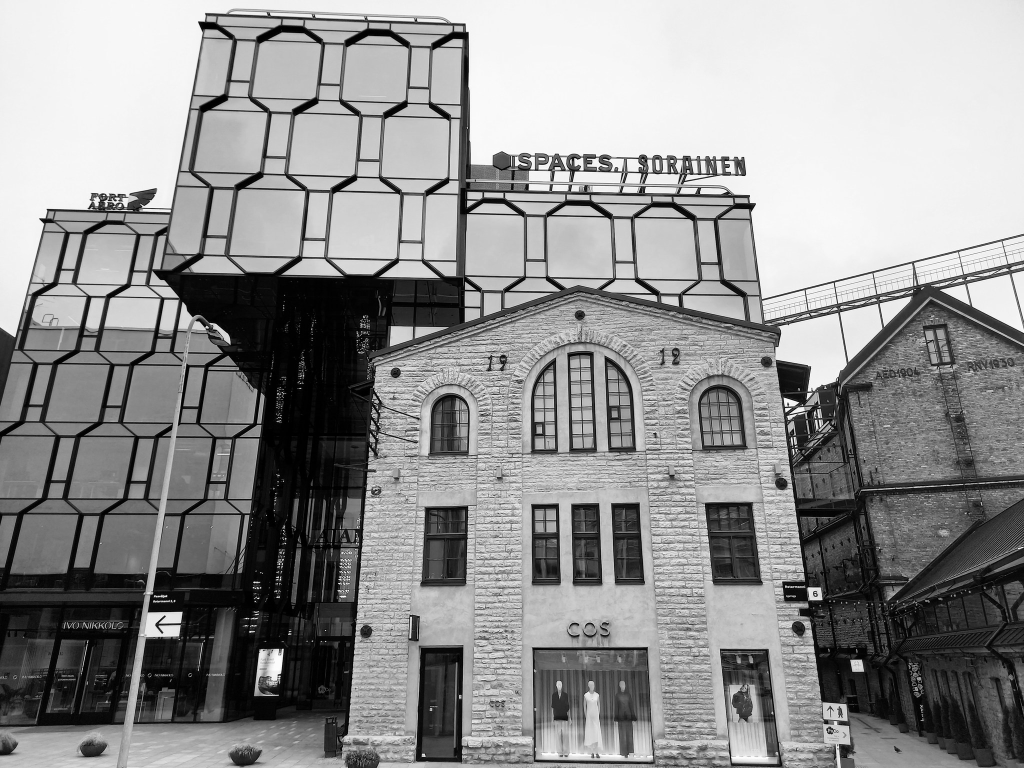
I ARRIVED TO TALLINN and was again surprised (pleasantly) by the way the port area has developed. It looks like a real city. When I came here the first time in ’02, none of this was here. Now Rotermanni kvartal is as bourgeois as it gets. Why not shop for a new suit while listening to gurgling electronic music and sipping on a smoothie, or noshing on some fresh sourdough bread from RØST while imbibing a warm cappuccino with coconut milk? Everyone in the window advertisements is lean, beautiful, effortlessly wealthy, and has lots of sex, most likely in fine hotels or in the back of sports cars. If that’s not what life is about, then what is?

But despite all the trimmings of the nordic nouveau riche, one cannot escape the cold sea wind or the gray sky. Sometimes the sun does come out though. It is odd that we are supposedly considered under threat from the Russian Federation, as if they were going to lob missiles into the nearby H&M. You would like to think that all of these things would protect you, but they don’t. It did make me think though what an angry, regressive energy is Putinism. How could anyone long for a day when half of Europe was under surveillance and home arrest? Age is a factor. He’s a post-1989 headcase and never really adjusted. He wants it back.

And the reason I am bringing this up is that so much has changed in Tallinn, and in Estonia, since that time that the country is due a narrative revision. A rewriting of the story. The Soviet period is slipping away into the past. It’s like watching those last pieces of the Titanic slip into the ocean. How can you define the story of a country by referencing something that doesn’t seem to matter that much anymore? This place is Hanseatic materialism redux. I continuously feel like I am in a mini-Stockholm or some other such northerly place where men in glasses who part their hair on the side sit around doing business deals with a stiff upper lip while wearing scarves inside, and weary eyed women walk their small dogs in the morning, bearing a cup of coffee before them as if it was a flashlight or rosary beads and looking as if they don’t have time for anyone or anything and whatever you have to say to them, they really don’t care.

tokumaru

I MOVED INTO an apartment that happened to be located inside a Tokumaru Japanese restaurant in Helsinki. The interior design was white and spotless. I didn’t mind sharing my living quarters with the clientele nor the smell of gyoza being served in ceramic bowls. Then one day, Jonas came to find me so he could threaten me about talking to his girlfriend Margot. He stood outside the Helsinki Tokumaru with his face against the glass. I wasn’t sure how he had even found me. I had moved out of my last apartment for the same reason. There he was. His white, angry face was pressed against the window, and his teeth were clenched. I could see the steam of fury in his dark-rimmed glasses. His hair was combed neatly. Margot stood nearby, staring into space. Her eyes were black with mascara and shame-terror. “How dare you, how dare you write to my girlfriend!” he stormed. The Finnish owner offered Jonas some black coffee and tried to soothe his jilted nerves. I was unaware that Tokumaru served coffee.

Supposedly, the Tokumaru coffee was very good.

While Jonas was distracted, I fled out the back door. I wanted to take the ship back to Tallinn to get away, but there had been a major storm. The waters of the Baltic Sea had flooded the city, and there, at the foot of Korkeavuorenkatu, I looked up, only to see an enormous Tallink cruise ship come crashing down the street, crushing every building in its way. I looked the other way, and saw another Eckerö Line ship floating on its side. There was nowhere to run and the waters rushed into the Helsinki Tokumaru, washing away everyone with them. Jonas, Margot, the Finnish-Japanese owner. They were all drowned in the sea. I grabbed onto a floating navigation buoy that had washed in from the archipelago and survived. Later, the storm calmed and the sun came out and the waves died down. I could even hear birds singing.

the end of the approach

FIRST ABOVE GERMANY. Fluffy foamy carpets, white, and between them rolling hills or knolls, nubs, crests, with little motherboard looking settlements below, and lines of wind turbines churning. The mind ping-pongs, skirting memories, realities. The clouds turn to a frosty desert, layered upon other deserts. You think of her dreamy eyes that can give you a thousand blisses. You think of other people and then you think of yourself, a change in focus.

Below is nothing, not a road, not a corner, not a coast, or a line of white trees. The sea seems endless. The clouds absorb the orange and pink from that slowly-slipping January sunset. There is an almost fascinating rainbow glow. Then rolls of milk white that crest like sugary whipped cream. The clouds suddenly look gray and somehow cold. They are lower here, lying in a sort of cloud valley beyond. Big gray hunks of gray coldness drifting, almost like that shattered ice in the Gulf of Finland. No signs of civilization, no planes, no tiny houses, no little glowing lights below. It feels as if we are getting closer to the North Pole. Maybe we passed it?

Then, for a while, nothing, just purple. White clouds spin beyond. They look like French crullers. They are arranged, moving in gentle circles, like gears. Bigger clouds drift in, chunky and heavy, like fists. The longest descent ever. The clouds are so low here that they drift around the tops of houses. The color is almost navy blue fading into gray, an almost depthless bleak fog. The houses are faint and gold, like fire embers. By the time we finally dip below the cloud cover, I can read the signs on the buildings. I can see the icy lunar surface of the lake.

This is the end of the approach.

the conjurer

SOME KIND OF GURU or shaman came to these shores and so we set about arranging an event to host him. This conjurer from Jaipur was booked for an evening at Helsinki’s Royal Sibelius Hall. Petra, my wife, played an important role in organizing the conjurer’s airfare, found him a place to stay, made sure his dressing room was outfitted with Ravi Shankar records and mounds of rice and chana masala. My job was simple enough, to make sure the concessions operated smoothly, but of course I botched this too, like everything I touch, and the price list wasn’t posted properly and a fist fight broke out over the sweet gulab jamun.

Petra was annoyed. “I give you one little thing to organize and you mess that up too! No wonder I’m divorced you!” I apologized and slinked away, but started to question things. Why was I always apologizing to people who had hurt me and humiliated me? Was there a limit? It was shameful to experience. But there was a time before them all, before all of this. I had been a person then too. Psychological terror. It had scarred me, but I was still there, beneath it all.

Outside people gathered after the conjurer’s talk. A tango group had been commissioned and began to play the square in front of the Royal Sibelius. El Scorcho, the Chilean guitarist, was there, with some friends. They began to dance the tango. Petra also began to move to the music. She was standing right next to me. Did she want to reconcile? Did she even want to dance? Of course not. A few minutes later, her date arrived. He was tall and pale and all dressed in black, with a cowboy hat to top it off. She said he was from the countryside. His name was Tex. Petra and Tex disappeared into the crowd and began to tango, tango away.

Then the wind picked up. It was a strong gust. I tried to hold onto the iron fence outside the hall, but it was no use. I began to drift away toward the head of the Esplanaadi. It was here where I had met Petra, years ago when we were younger. That was where it all began, by that fountain right there. And this is how it ended. Soon I was over the Swedish Theatre. I tried to move in some direction, maybe I could float over to the Eira neighborhood? It was no use. I was at the wind’s mercy. I was tired of people anyway. I was tired of the evil of the human heart. It seemed every heart around me was poisoned. They went to fists over Indian sweets.

the last time

THE LAST TIME I saw Dulcinea, it was December. It had been snowing for weeks, and even when the sky was clear, it seemed like thousands of little perfect snowflakes continued to flutter down and dance along the breeze. At night, it was the same, and I wondered if it was just the wind passing around the snow, or if it was fresh snowfall. It was cold at night, deathly cold, but I decided to go for one long walk by the lake. I needed to think about a few things.

I was over by the abandoned factory when she jumped me. When she leaped on top of me, I slid and fell. I had never been stabbed in the heart before, especially by a beautiful blonde girl with an icicle, but the icy blade found its mark. I let her cut me, and the steam of my suffering rose up into the air like ghosts. She said a few things, but I could only understand a few of them. She kept talking about how our age difference made her uncomfortable. “Such a big age difference! Such a big age difference!” I reminded her that Donald Trump’s wife was 25 years younger than him. We had a far lesser gap between us both. This didn’t seem to soften her blows. There were more. “Don’t ever write to me again!” “With you, I don’t feel like I’m free!”

I just lied back and took it, like a man, I suppose. I felt like I was having the very life pulled from my body. I curled up with my knees to my chest and I faced the forest. I remember staring at those birch trees, all covered in snow and ice. Dulcinea finally took from me what she had come for and ran off toward town. When I reached up and felt my chest, all I could feel was a bloody wound on the left. My heart was gone. She had cut out my heart! She had cut it free from my body with an icicle and ran with it into the snow. There I was, bleeding out in some kind of agony. This was really the last time. The last time I would cross paths with Dulcinea. I summoned all my strength and stood with my half-frozen aching heartless body. Then I stumbled towards the lake. The way was black and ran by the woods. I kept walking.

To where, I did not know.

white parka

THAT NIGHT I went out for a stroll in the early evening snow. I walked up by the new church and then turned left and came around by the great department store or shopping center or ostukeskus. Whatever they are calling it these days. Half a dozen underwear models fawned over me from a lit-up billboard and Christmas lights were blinking everywhere. At the crosswalk, there was a red light and I stood and waited in the cold. There was a girl waiting on the other side of the street, in the snow and wind, all dressed in white. She wore a white parka, which was pulled up over her golden hair, and she had on white pants and white snow boots.

For a moment, I was reminded of Dulcinea. Dulcinea, love of loves, muse of muses. She always had such a brisk and wild energy to her. She was like a little chunk of sunlight, warming everything wherever she went. I then wished that Dulcinea was the one standing across from me. I imagined how beautiful she would look with such a white parka and such white boots. When was the last time I saw her? In the summer. She walked by me in the park, and her eyes were the same. They were always so kind, her eyes. Dulcinea’s eyes are impossible to forget.

They’re like stars.

I remembered those words she had typed out to me long ago. “With you, it’s always some kind of soup.” But the girl standing across from me wasn’t her. It was just someone else. Some random pedestrian. The light turned green and we walked by each other. The girl in the white parka wasn’t Dulcinea. She looked nothing like her.

ingrian girls

WE WERE TRYING to escape. From what I don’t know. It was through some kind of cave system, or tunnel. I cannot say if it was man-made or not. What I do remember is that I was surrounded by Ingrian girls. Dozens of them, maybe. Hundreds. There were so many of them, and they were all trying to climb out of the passageway and get out into the cold but welcoming December air. I don’t know what their names were, but they seemed to have been of uniform age and appearance. They had red curly hair and their skin was milk white. They wore black shirts and blue jeans. They were beautiful but desperate and very aggressive.

One Ingrian girl climbed up my back and then sort of pushed herself over my head, as if doing some kind of acrobatic trick. and another pushed by my arms. There were just so many of them. I can’t say anything was really inviting about the thing. It was a stampede. Ingria was the historical name of the territory connecting what is now Estonia with the current Finnish border. It covers the swampy area where Peter the Great decided to build his imperial city.

The only hint at civilization in the cave was an old monument that had been built into the walls. Words were chiselled into the granite, maybe about the Estonian War of Independence, or perhaps the Finnish Winter War, but I could not read them. I only gripped the stone as I pulled myself out into the light. A dozen or so Ingrian girls were already standing there looking down at me. I remember their curly red hair, the slope of their faces, those haunting blue eyes.

I remember how uncompromising they all were.