‘like a dream you don’t want to wake up from’

AT SOME MOMENT on Sunday evening I find myself in the grand hall of Viljandi’s Folk Music Center or Pärimusmuusika Ait looking for a good spot to rest a while and write. The hall is full of people, some standing, others gathering, talking and telling jokes. There are all kinds of people here, people with shaved faces and hairy chins, hippies, squares – but let’s be honest, most of them are a decade or more younger than I am. Beside the stage, three wonderfully light-haired girls are seated, one with shiny hoop earrings. I don’t know how old they are and don’t want to know. Two of them are looking at their phones, one has her head to her knees, apparently to just catch her breath. I watch them a moment more and then hoist myself up onto the edge of the stage. Every part of my body hurts: my legs, arms, back, and heart. My trustworthy satchel is wet from the rain, but my notebook is still dry. With a black pen, I begin to write. A few seconds later, a man appears before me, one with short hair and a brown sports jacket. He says he used to be my first daughter’s zoology teacher at the Viljandi Hobby School. That must have been a long time ago. His name is somewhat familiar, though I don’t recognize him. He has something in hand.

It’s a button. The kind you’d find on a jacket. There’s a trick too. There is something behind the button. This man goes around Viljandi installing these buttons on walls. When you tug the button, it pulls a piece of string behind it, and when the string goes back into the wall, the magic button plays beautiful music. “You just have to pull the button,” the man says. I don’t understand if I’m dreaming or not. I am at this moment so tired, that it all could be a hallucination. “That’s genius!” I say. The music is the same you would hear from a music box. “Why are you putting these buttons up?” I ask the man. “I wanted to bring a little more joy to the world,” he answers with a smile. Then the button man disappears into the crowds.

When the man is gone, I take some more time to unwind. The three girls are still sitting in the corner, looking half dead. It’s dark outside now. I actually have no idea what time it is, and only know, in a foggy way, that it is Sunday, which means that it’s the last day of Viljandi Folk. The concerts are still ongoing somewhere. And I promised Arno Tamm earlier that I would go see him during the final concert.  

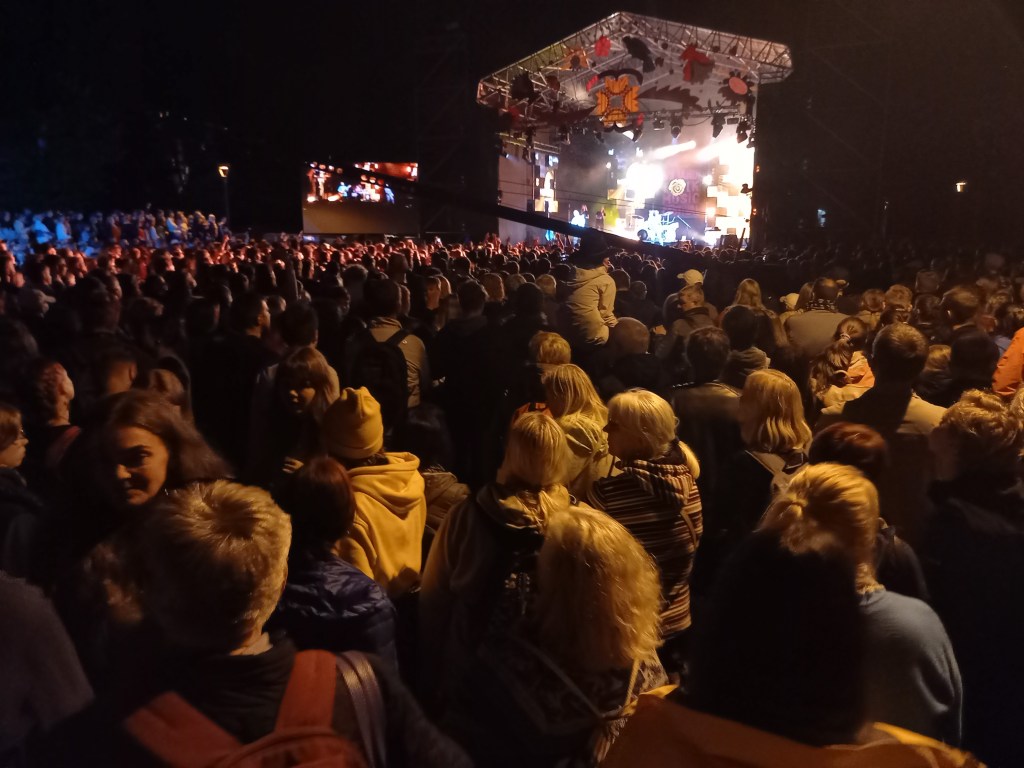
During one concert, I saw the American guitarist Jed Clark, who is from Arkansas and plays with the bluegrass band Midnight Ride, look out with tired eyes on Käevumägi, or the Well Hill, and a thousand or so beautiful people and say, “This festival is like a dream I don’t want to wake up from.” In the great hall of the Ait, I think that Jed is right. Earlier in the festival, I had a chat with him at the Green House Cafe. Jed told me in his soft Arkansas accent that Viljandi Folk was “just like paradise.”

I wasn’t so sure it was paradise. But a strange dream nonetheless. 

***
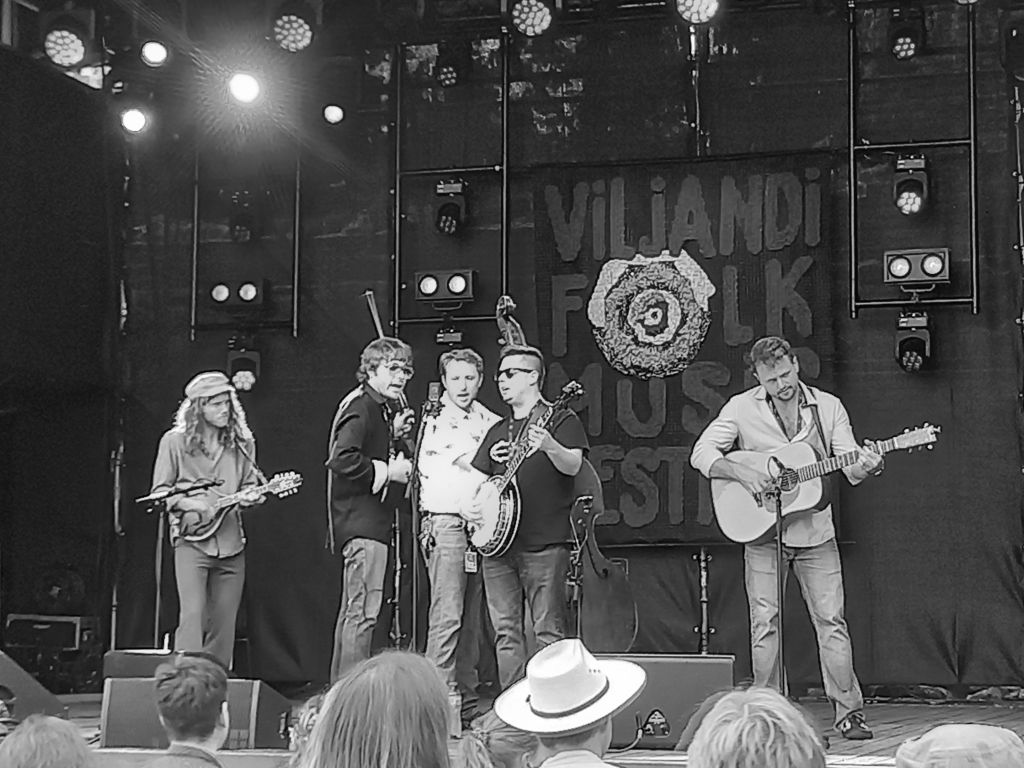
“PEOPLE COME HERE from the US, from Canada, and they have a hard time believing that this is all real,” Tomás del Real, a Chilean musician, tells me the day after his concert was well received at the Jaak Johanson Stage. He performed on Saturday night, and people praised his performance the following morning. “It was all so intimate and cosy and yet so grand and so global,” some gushed to me. I had planned to go there, but somehow got lost along the way, and must admit that I don’t know exactly where I was when Tomás played that night. I allowed myself to live a little that evening and so everything from that evening has already faded into the mist. But I survived and supposedly the music was good.

“They see the lake, the castle ruins, and they think, what place is this?” Tomás continued his story. “For a festival, it’s a really great place, and the way the festival uses the surroundings, the aesthetics, are done with incredible taste. Nothing is overdone, everything is very natural, and they simply fill out the environment,” he said. Tomás is in some ways like me. A foreigner who came to Viljandi and got stuck here. Years before we came, Ruslan Trochynskyi, the trombonist from Svjata Vatra, arrived here from Ukraine and was similarly seduced. We are now like one big Folk family and not just us, who have come from abroad. Estonians have arrived here the same way. They come to Folk, go for a swim, and stay. 

There is some kind of invisible pull. Even Tomás del Real, who is as clearheaded as they come, acknowledges this: “It is magnetic,” he admits.

I have of course heard criticism, that Estonian folk music is mostly fake and mostly synthetic, that the prices are too high, that this year’s Folk isn’t as good as last year’s, and so on. “These Folks are not like they used to be,” some say. 

It is true that before there were fences and passes, folk was an anarchic experience and all kinds of weird people turned up in town. I called them the “zombie army” at the time, the drunks, Nazis, and rednecks. But all was permitted and the people enjoyed that anarchy. At some point, it was decided that Folk would be a bit safer and those days drew to a close. But the magic continued. Gates or no gates, the spirit of Folk cannot be contained. And the security staff are only looking for alcohol, really. They give your bag a squeeze and then wave you through with a grin. You have been examined. Go on your merry way.

I wanted to say, in response to this criticism, that whatever they have, people never seem to be satisfied with it. Something’s always missing from the picture. Unfortunately, this phenomenon is too familiar to me. I find myself on a train south, staring from a window. I think, what am I doing here in Viljandimaa? My heart is full of disappointment and melancholy. Other people, such as those from Tallinn, have said to me, “Why are you wasting your life in some hole in Estonia?”

Viljandi indeed is an odd place, one you can only reach intentionally. No one shows up here by accident. Folk does offer a lot of reasons for people to come here. It is a rich and deep event. For those who are never satisfied, I would say, take a look around. There is some value here. There is something different at least. I had these thoughts as I hid myself away in the press room in the cellar of the Pärimusmuusika Ait. Outside there was rain and thunder, and the Ait was full of soaking wet people. In the corner of the press room sat my one true love, the object of my affection. But who is this quiet girl? What’s her name?

She’s a coffee machine, naturally.

***

THERE ARE ALL KINDS of stories shared in the press room during the folk music festival. One day, after a concert by Canzoniere Grecanico Salentino, I found myself seated again beside my beloved coffee machine listening to her purr. I must acknowledge that Folk is an exhausting experience. Even after just a few hours at Folk, a person is squeezed dry. All of that noise, all of those conversations and songs. Espressos are needed for a quick pick-me-up, so that one can still walk and write. The Italian group CGS is from Puglia, the province in Italy from which my mother’s family originates. One of their songs was about love, of course. This melancholic song describes a lovestruck man who sits beneath a woman’s window night after night, until the woman closes the window. But there he continues to wait until death, so devoted is he to the woman he loves. For me, this song was somehow refreshing. I have never heard of an Estonian who would do such a thing. Estonians are too practical for that. They wouldn’t waste their time in the name of Mediterranean love. But Mediterranean love is just like that. Passionate. Full of devotion.

“But in Estonia,” I tell a colleague in the press room, “if you sat underneath that window, the woman would call the police.” “Well, yeah,” she answered. “That could be really annoying.”

“But what do Estonians do when they fall in love?” I ask. “Does someone gift the other some potatoes? Or a bucket full of chanterelles?”

“No, no, they just enjoy their time together,” the woman explained.

“So that they are in the forest somewhere and one says to the other, ‘Nice day, isn’t it?’ Is that how they do it?”

The woman looked at me with her clear blue eyes. “If it’s love, then there’s no need to talk. You just have to feel it.” Simple. So, sitting underneath someone’s window isn’t especially welcome here in Estonia. But I have definitely wanted to sit beneath some women’s windows, at least a few times, whether I am allowed to or not.

***

LOVE WASN’T THE ONLY SUBJECT haunting me at Folk. Another was age, certainly. Not that I really needed to think about age so badly, but when most of the people around you are at least 20 years younger than you at least, and three of them are your own daughters, then it comes to mind. At some moment, Uncle Justin wound up in the company of some young ladies in their early-twenties and forgot for a while whether he was a responsible parent or just another one of the pack. So I went along with them. It was a good feeling. I started to feel like one of those older Beatniks, like the poet Allen Ginsberg or wild man Neal Cassady, when they joined forces with the young hippies of the 1960s. If things are moving in that direction, then why not go with it? Why not? Beautiful kids with beautiful eyes. Students who aren’t yet jaded or embittered. They still have hope. They go to sleep listening to music. They don’t make the sarcastic jokes of our generation. With them I am gentler, I listen more, and I’m supportive. 

As I told a friend at Folk, we are some kind of bridge generation. There are those important icons from the days of the Singing Revolution: Mart Laar, Edgar Savisaar, Siim Kallas, Tiit Vähi, and the others. And then there are these fresh young people who know nothing about that era and for whom it’s all just history. We are in between them, people like Margus Tsahkna or Jüri Ratas, who were both at Folk. We know where the bodies are buried, metaphorically, but we don’t want to share that information with the kids. Let them enjoy their youth. Let them run around holding hands when it’s raining and the Zetod are rocking. When someone comes by and reaches out, we take their hand in ours and run along together.

The Puuluup concert was a truly strange sight though. Their music is one that really does haunt you. The Hiiu kannel has the kind of sound that makes it hard to determine where it’s coming from. It sounds as if someone is playing with time. If I could ever play the sky and the clouds, it might just sound like the sound of a Hiiu kannel. There were so many people at the concert, it looked like a sea or bubbling soup. I watched and listened. Afterwards, I arrived at the idea that I no longer had an age. Age was just a number. But I felt in that moment, standing on that hilltop looking down, that I was more like some kind of Hindu deity. The embodiment of Shiva or Kali. Even when I was a child I knew it. The world told me what my age was, but inside myself I couldn’t tell the difference whether I was three or four years old. 

“I don’t feel old,” said the American folk musician David Crosby shortly before his death last year. “I feel the same way I have always felt. It’s just my body that has aged.”

I was and I am.

When Midnight Ride played on Kaevumägi, they called themselves the sons of Bill Monroe and Earl Scruggs. But I thought instead that nobody is actually the son of anybody. There is no before and there is no after. Music doesn’t age, just like souls do not age. Music is undying, as they say and exists at all times. All you have to do is to play it. I exist. In this way, we are all like music, undying, immortal. These were the thoughts I had during the Puuluup concert. 

***

A DAY AFTER THE CONCERT, I met up with Ramo Teder, half of Puuluup, who with his long white hair looks like he could be the managing director of Santa Claus’ elf toy factory at the North Pole. Maybe because he lived in Finland for so many years. Ramo is actually from Viljandi. On social media, one can see a photo of Ramo when he was a punk at the end of the 1980s. He looks quite stylish, a combination of Johnny Rotten and Wolfgang Amadeus Mozart. Puuluup is certainly not a punk group. There’s no “Anarchy in the UK” here, or in Estonia for that matter. But Ramo discussed how punk had influenced the ideas behind Puuluup.

“The idea that you have to overcome boundaries,” he said. The idea that all archetypes are tossed out the window. Estonian punk was different from American or British punk. Estonian punks were more like intellectuals. Most of the people in the Estonian SSR were standard issue. They wore the same clothes and had the same hairstyles. That some young man was walking around Viljandi with such hair was against the system. Hair, in this way, can be dangerous. There he now stands on stage, with a kannel in hand, age 53, singing about small birch trees. He also belongs to the tribe. Ramo is another brick in the Folk castle.

After the interview with Ramo, I found myself at the Eesti Etno concert. There were all kinds of musicians there, and they looked so happy. Were they too happy? I was dealing that week with the death of a high school friend. News about a friend’s suicide arrives slowly, even nowadays. Nobody talks about it on social media, only when you are famous. It took time to understand why this 43-year-old man had died “tragically and unexpectedly” as it said in a news article. But I eventually found out. So those Eesti Etno singers were singing and I was thinking about death and suicide.

One song did lift my mood. A young Indian was singing and the other sang along with him. At that point, I couldn’t really believe what I was seeing. Their clothes were so colorful. The music was so good. As sweet and satisfying as a mango lassi. It all looked like some kind of pajama party or Indian cult. Maybe some ashram had come to Estonia? Anyway, that was the right song for me at that moment, a person who was destabilized. Tragedy is like a little black cloud that follows you around everywhere. A song can help. Music can save lives. I would have liked to save my friend’s life the same way.

One night on the First Cherry Hill, as it is called, I thought I saw him, standing beneath a tree. But it was someone else.

***
DURING THE FESTIVAL, it becomes difficult to put one’s thoughts together. Looking through my notebook, I can find these kinds of scattered sentences and half-memories. “I left my journal in the press room, but Peeter the Estonian Swede came after me to tell me, and I ran back to get it, because my journal is full of kompromat that could make my life really difficult.” Or, “Some pharmacist from Tartu came up to me and started to talk about Paavo Matsin.” And, “Lauri Räpp was talking about resilience.”

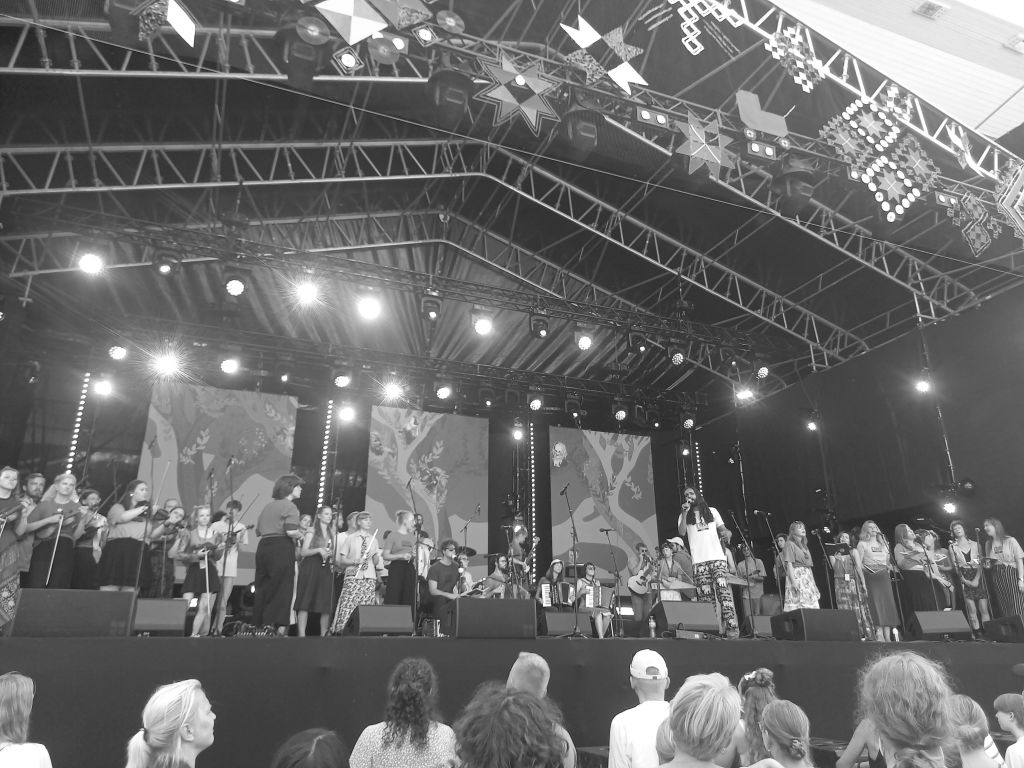
The days melted together. There were a lot of concerts, for sure. The Italians. The Mexicans. The 6hunesseq-ians. Now that was a powerful concert, held in St. John’s Church at midnight. I fell asleep multiple times, because I was so tired, but the music was soft, warm, and enveloping, like a comfortable blanket. The musicians were out of view, because they were on the second floor, where the church’s orel is located. After they came down and people applauded. I guess I went home after that. I don’t quite remember. My friend found a rabbit in a park in Viljandi around the same time and took it into her tent. Later, she found the rabbit’s owner. These kinds of things happen during Folk. The mind no longer works. There is too much information, too much stimulation.  

Then one day I met a man who told me that Lennart Meri’s book Silver White is the Bible of the Estonians, and how the Estonians, or rather the Baltic Finns, are very special people, and how Meri, Uku Masing, and Valdur Mikita had written “philosophical diamonds!” The man is working with a project called Valge Laev, or White Ship, to develop the higher intellect of the Baltic Finns. “But if the Estonians are so smart,” I told him, “then why do you need me for your project?” “Because you can help us bring it to the wider world!” came the answer. He had a fur hat and a green shirt. A beard. Sparkling blue eyes. Like a photo from the collection of Johannes Pääsuke. The green shirt was inside out. Of course, I agreed to help. When the Land of Mary calls you, you heed that call. 

The following morning I have a slight hangover, because I thought the prior evening that I would allow myself to live a little. I asked myself, what would your favorite writer Scott Fitzgerald do if he was at Viljandi Folk? The answer arrived at once: start drinking wine! Life is for living! That night I wound up at the Untsakad concert at midnight. This was really like Anarchy in Estonia. I have never seen so many happy young people before. Untsakad are old men. They played at the first festival 31 years ago. But their fans are teenagers, or at university. I’m not sure what’s the attraction. Waltzes? Polkas? I like the Mexican band Kumbia Boruka more. They brought every cell in their bodies alive with their rhythms. They also appealed to writer Gert Kiiler, who said they reminded him of the show Miami Vice. “You know, they always have that kind of music playing somewhere in the background.” My friend, a Tallinn businesswoman who attends Folk regularly, recalled how she once had Don Johnson’s picture in her bathroom, so she could see him while she was taking a shower.

But Untsakad won over people’s hearts in the end. Even my 17-year-old daughter awoke the next morning and started to sing the “The Forest Brothers’ Song.” Ai-tsih, ai-tsah, ai velled, me metsavennad oleme! Which means something like, “we are the forest brothers, we are.” It really got inside her. For her the experience was also something like a dream. I received her rendition joyfully. “You’re a good forest brother’s daughter,” I thought, “even if your father is not a forest brother.”

***
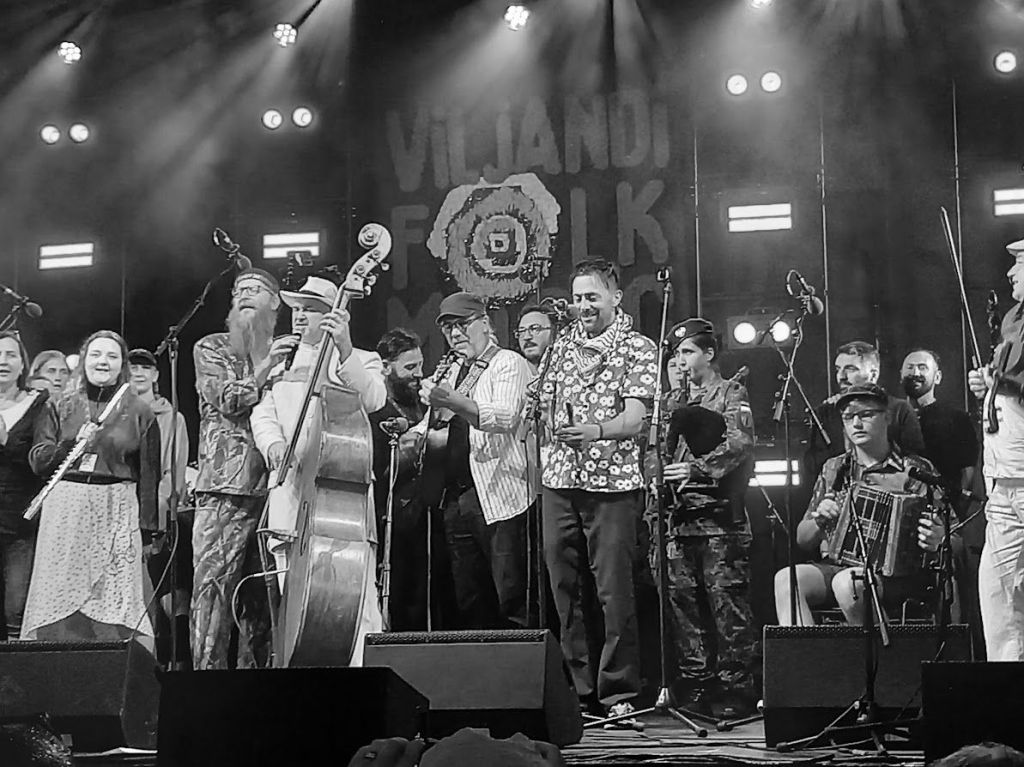
SOME PEOPLE COME and go during Folk, but then there are people like me who are folk soldiers and stay until the last concert. We gather in the rain as Ando and Friends sing. Ando Kiviberg is the founder of Folk and the festival usually falls on his birthday. This year, he’s 55! Ando and Friends is some kind of variety show. Every kind of band performs there. The man himself is a Leo, naturally. He is the king of the jungle. There he is with his fuzzy face in his white suit and white hat, looking like some kind of Latin American drug dealer. He plays the bass and sings along. It’s nice to see the king in his element. The leader role suits him well. Ando is neither arrogant nor pretentious. He doesn’t think that he’s better than the others, no. But still they come, like small house cats, with their offerings to the Great Lion! Neither dead birds or mice, but songs. Silver Sepp has taken Tony Rennis’ 1962 Italian pop song, “Quando, Quando, Quando,” and made it over. The song’s new name is “Ando, Ando, Ando.”

At some moment, I get tired of all those bagpipes and fiddles and go to the other side of the Second Cherry Hill. There I stand beneath an umbrella and put on my headphones. I’d like to hear a little Led Zeppelin now. I am done with all of this folk music! I’d rather listen to “When the Levee Breaks.” To my surprise, these two things suit each other surprisingly well. I look up at the big screen and see Ando singing. But instead I hear Robert Plant’s voice. Ando is singing, “Crying won’t help you, praying won’t do you no good!” It’s still raining. We are all soaked. Soon the levee really will break. An incredible combination. Ando and Zeppelin. My own levee really has broken. Then I realize that I have really lost it by now. I march over to the Ait. I look for a comfortable corner inside where a burned out writer can relax a little. Then that stranger appears with his magic button in hand. The three girls are in the corner and I am sitting on the edge of the stage. The man is showing me his button.

“That’s genius,” I say. My voice sounds distant, as if it belongs to someone else. “Just genius.”

An Estonian version of this article appears in Edasi, and the original was written by the author in Estonian and rewritten into English. The English and Estonian versions have some differences, so do read both!

traditional music

I ALWAYS KNEW they had rooms for rent, or stay, in the cellar of the Pärimusmuusika Ait, or Traditional Music Center, but I did not know they had these kinds of exclusive suites, or that a woman had been living down there for some time. I didn’t even know how I happened to get into that room, or into her bed for that matter. We were lying together in a queen-sized bed, with messy beige sheets. The frame of the bed was made of a darker wood, and there were some shelves across from us lined with vinyls and compact discs of groups and solo performers supported in one way or another by the center, plus thick compilations of runo songs collected from various rural municipalities over the preceding century and a half.

None of that matters though. What matters I think is the quality of those kisses in that basement bed. She was a younger woman, she had a round face, freckles, blue eyes, and inside of those eyes was kindness. In situations like these, you don’t even need to kiss, you don’t even need to touch, you can just look at each other. It’s better than a kiss. There we both were, beneath the blankets, perched in some kind of euphoria. The young lady said, “Mother was right about you. She said you were a good kisser. And so good in bed.” This of course was fluff to my ears, and I almost found myself adopting a Sean Connery accent, “Yes, yes. Of course, Domino. Of course.” But that word that preceded it, mother, made me sit straight like a rock.

“Who is your mother?” I asked the beautiful girl. “You know very well who she is,” she said, in a playful way. “She’ll be here soon.” But didn’t even know that she had an adult daughter, and still was confused about it. Sexual anxiety throbbed in my veins. I pulled my trousers from a chair, buttoned up my blue shirt, and ran upstairs, the girl’s warm kisses still all over me. In the garderoob or coat room of the center, a number of folk musicians were arriving, among them the mother. She was so busy talking to a guitar player though that she didn’t see me as I grabbed my things and was out the door. I felt bad for her. I felt bad for everyone. I felt like I had done something wrong. I hoped that she would never know about this. She should remain blissfully unaware of the cellar tryst with her daughter. And it was still a loving experience.

You can’t deny that.

soy loco por tí, estonia

SOMETIME IN THE BLEAK DEPTHS of the pandemic, I became aware of the arrival of some dark-haired, shadowy strangers in town, mysterious characters who would lurk at the margins of parties, or whose strumming of guitars might be overheard whenever I passed the room they were renting on Posti Street. The Chileans! The way people around me referred to them, it was as if a whole orchestra from Valparaíso had been shipwrecked on the shores of Lake Viljandi. In reality, there were just two: Tomás del Real and Javier Navarro. But they were important. They were part of something new: a little South American community in Viljandi.

Viljandi, despite its rather small size, has always hosted pocket-sized minority enclaves. One stretch of Pikk Street was once called “Jew Street,” because of the active Jewish community that dwelled there before the Soviets deported some and the Germans and their evil helpers murdered the rest. Viljandi’s Jews even had their own sauna and fire brigade. There are also stories about the Romani people, or mustlased, who once camped in the forests where the Metsakalmistu, or Forest Cemetery, is now located, and how the Romani women tried to convince Mayor Maramaa to buy them horses so that they could leave. As far as I know, there was never a Latin American community here, until the arrival of Tomás and Javier from Chile, and Pepi from Argentina, and Tito from Cuba, and Miguelito from Mexico too. Slowly, something new is coming into existence.

Of these Latin Viljandiers, musician Tomás del Real is perhaps among the better known. On August 26, he performed at the Pärimusmuusika Ait, or Folk Music Center, to celebrate the release of his latest album, Principios de Declaración. Del Real is no stranger to the iconic Ait. He even used to live in the cellar when he first arrived in Viljandi and got an artist’s residency.

“Downstairs is where my room used to be, and every time I go there, my heart skips a beat,” he says. “Next to it is the rehearsal room, and that also gets me emotional.” Tomás recalls staring at the stones in the wall, or looking out the windows of the Ait on winter days when everything about Estonia was new, and he would take long walks around the old castle ruins. “Every spot in the Ait contains memories,” he says. “Every time I perform in the Ait, I get nervous, because it matters to me.”

His own performance, in front of a mostly packed house, came off flawlessly. While the songs on the record have diverse origins, the quiet introspection of Viljandi life has seeped into all. He also structured his show in a unique way, with one half of the stage divided between a standing microphone, where he addressed the audience as would any singer songwriter, standing and at times, and  discussing the political situation at home in Chile. On the other part of the stage, he had a “living room,” where he played his tunes just as if he was at home. Tomás says this is part of the duality of being a character and a witness to music being created. He adds that during the “living room” segment of his show, he for a time felt like he was home, which, for now at least, means Viljandi’s Old Town. He even has a composition on the record called “Viljandi.” Though he grew up so far away, he also says there are certain commonalities between Chileans and Estonians. The era of the military dictatorship in Chile officially ended in 1990, while Estonians restored their independence the following year. 

Tomas del Real on stage in Viljandi on August 26. Photo by Kerttu Kruusla.

“We have both been oppressed and in difficult situations,” says Tomás. Because of that, he says, both cultures value friendships, because they have learned to rely on each other.  “It’s the only way that people who have suffered for so long can function as a society,” Tomás says. He adds that Chileans have also learned to be tight-lipped like Estonians, for the same reasons. 

Viljandi has also fostered a creative streak in Tomás, which is another reason why he has stayed here. At one point, he was writing one new song a day, some of which appeared on a record he cut with local musician Lee Taul last year, calling their duo Don’t Chase the Lizard. The rest of it populates the hypnotic tunes on his latest solo outing. But Tomás is not the only musician from South America in Viljandi these days. There is at least one other sudamericano

He is the one known to all as “Pepi”.

Indeed José “Pepi” Prieto might, in some future almanac authored by local historian Heiki Raudla, be considered the pioneer Latin American in Viljandi. He was the first to explore it, the same way that explorer Juan Diaz de Solis once dropped anchor in what is now Argentina in 1516. A native of Buenos Aires, Pepi had almost anything one could dream of by his early twenties: a steady girlfriend, a band, a career. He was restless though, and decided to go abroad for a spell, where he worked as a programmer in Indonesia. A chance encounter with an Estonian woman there inspired him to come to the northern margins of Europe, just as it once inspired a young American journalist to do the same. It was a decade ago, and just a few days before Christmas. “I was told that it was -30 degrees, but I had no idea of how cold it actually was,” he says of this frosty arrival. Like any true South American, he showed up in Estonia in December wearing shorts. “We went straight to the shop after that to buy a good coat and boots,” he says.

Then he came to Viljandi. Immediately, it struck him as a quiet, inspiring place, where his creativity for unknown reasons began to surge in the same way that it would for Tomás later. For years, Pepi kept a room in the Koit Seltsimaja, or Koit Society House, on the corner of Koidu and Jakobsoni Streets that once housed the Ugala Theatre from the 1920s until the 1980s. 

For a time he even managed a creative space there, called the Sama Sama Studios. 

“I started to feel like I was the guardian of that house,” says Pepi. “I was the person bringing people to the house, and always showing people the rooms.” It also inspired him to write new music, to invite people to collaborate on music and to perform.

Araukaaria, as seen through the gates of the Koit Society House. Pepi Prieto, Lee Taul, Johannes Eriste, Fedor Bezrukov, and Norbert De Varrene. Photo by Paul Meiesaar.

These days, Pepi performs with Araukaaria, a quintet that also features Lee Taul on violin and vocals, as well as percussionist Johannes Eriste, a guitarist called Norbert De Varrene, and a bassist from Narva named Fedor Bezrukov. The band’s music is informed by South American psychedelia from the 1960s and 1970s, as well as Estonian folk. They have an earnest but passionate sound. The band named itself after the sacred tree of the indigenous Mapuche people of Chile and Argentina, and araucano is a Spanish name for the Mapuches. “I grew up seeing these trees,” says Pepi, whose father was Chilean. “They have always been in my life.” Pepi sees other kinds of trees these days though. Birches, pines, and alders. He loads them into his wood-heated furnace. He also has a summer place outside town where he is raising cucumbers and potatoes with his Estonian family.

That’s right, Pepi, like myself, has contributed to population growth in the Republic of Estonia. He can now be seen walking a small blonde child down the street and speaking Spanish to her. Sometimes his friend Leandro, another programmer from Argentina whom he enticed to Estonia, tags along. Leandro is also a regular in town, but has opted to live in Tallinn full time. When I see both of them, I have to look twice. Latin Americans in Viljandi? How did it even happen?

“They are not like stereotypical South Americans, because they enjoy winter and silence, so in that sense they are in the right place,” says Lee Taul, who collaborates with Tomás and Pepi. “We are richer that they have come here, and they also know how to attract people with their energy,” she says, describing both del Real and Prieto as industrious, motivated musicians. 

“They love nature too,” says Lee of her respective bandmates. “That is perhaps one reason they are here, because the forest is in the city,” she says. “For every true artist, nature provides a rich environment, a golden nest from which to hatch something new to life.” 

Tomás for his part concurs with her assessment, calling the Estonians’ relationship with nature as “connected and profound.” “It’s absolutely true that I am more creative here because of the environment,” remarks Pepi. Here I would have to say they are correct, even if I am not a South American, or only in my heart. I am grateful for the arrival of these Southerners. Not only are they inspired by Viljandi, but they have inspired me. I agree with them, and wholeheartedly. 

Ma olen nõus. Estoy de acuerdo!

folk reportage

My notes from this year’s Viljandi Folk Music Festival, held 27-30 July 2023 in Viljandi, Estonia

THURSDAY, YESTERDAY, was the first day. Festivals are difficult to cover, because you cannot be in every place at every time. Concerts or events overlap, and so you just cannot see everything. Of the concerts I saw yesterday, my favorite was Mari Kalkun’s performance, which happened at Kaevumägi, or the Well Hill, one of the festival’s primary stages.

I have probably either known or known of Mari Kalkun for more than a decade. She is a popular folk singer, and specializes in songs sung in the South Estonian Võro dialect or language.

I think what makes Mari special as a performer is her ability to sustain intensity over what can be atmospheric and amorphous compositions. She plays with all of the foreboding of purple rain clouds in the distance. She comes in and leaves like a thick white fog. There is sunshine sometimes too.

Many folk artists can provide nonstop, horn-blaring, bass-drum-pounding, action-packed intensity, while others are capable of crafting beautiful lullaby-like landscapes. Those landscapes though will soon lull you to sleep, just as that intensity will wear you down quickly.

Rare is the artist who can sustain such intensity wrapped up in lush and haunting melodies, and across an entire set list.

For this performance, Mari was joined by Australian bassist Nathan Riki Thomson, and most of the material was off her latest album Stoonia Lood, released on Real World Records this year.

They also performed later in the evening at the Folk 30 concert which celebrated three decades of the Viljandi Folk Music Festival.

OTHER THOUGHTS OF FOLK

One thing I notice every year when I attend this festival is the lack of American performers. I think it might be because American folk music is popular music. When an American says “folk,” he thinks probably immediately of Bob Dylan. But Bob Dylan isn’t hurting for gigs and it would be hard to entice Bob to come on down to Viljandi to sing to us. There is also this issue of the American folk blues tradition. Estonia has a blues festival too. Should American traditional acts perform there instead?

“Folk” in Viljandi is blended with something called etno or “ethno.” It’s very fusion, and in line with the general philosophy of the Viljandi Culture Academy to make the old new again, or to build off of Estonian and other folk traditions. So “Folk” is not exactly “folk” as an American might understand folk to be. The Estonians have taken the English word “folk” and changed the meaning slightly. The Estonian word is pärimus, which means something more like original or traditional. There are always different ways to translate English words into Estonian, but the meanings are not always exactly equivalent.

I like the size of this festival. It’s very cozy, and I am glad it has not become a Coachella, Glastonbury, Roskilde-like event. It’s a social gathering. Old friends get together. It is distinctly for the locals, and in that way, its reach is limited. Combining international artists with this Estonian content must be a challenge.

For example, the opening ceremony was entirely in the Estonian language, as it should be, but I found myself wondering how an outsider might see it. I am not arguing that there should be simultaneous translations or anything like that, but this is a niche festival. At the same time, people who have visited just for one festival have often returned for the unique vibe. It has that effect on visitors.

OF LEIK, ANDRE MAAKER, AND BUBBLES

Leik is a duo consisting of Kelly Veinberg and Elina Kasesalu who (mostly) sing and play violin, but also add viola and the special hiiu kannel.

I have seen Elina and Kelly a lot in Viljandi, and on trains to Viljandi, and from Viljandi, and also once in a shopping center in Tartu. And probably other places, toting their instruments.

Andre Maaker is a guitarist. I could call him a virtuoso, but he’s not really, and I could call him a guitar slinger, but really, he’s just a guitarist. He’s the kind of guy who sleeps next to his guitar, “just in case he gets a good idea.” He loves guitars, and based on the set they played yesterday at Käevumägi, he has a whole toy shop full of stringed instruments at home, such as the acoustic “world stick” he pulled out of nowhere, or the four-stringed tenor guitar. He filled out Leik’s sonics best with a 12-string acoustic, which has that lovely, dulcimer-like ring to it, and has always been used in folk music, as he noted to me afterward (yes, it has, and should be used more often).

According to Leik, the addition of Maaker has allowed them more room to focus on their vocals and instruments, as in the past, they often had to work to fill out the depth of the pieces. With that guitar, there’s just more sound.

Andre used to teach Kelly and Elina, and they asked him to partner on this project, which has seen them recently tour the islands. Much of their repertoire includes songs from Saaremaa, Hiiumaa, and Vormsi, as well as some self-penned compositions, and they carried them all well. There’s something wonderful about the blend of voice and strings here that continued to ring in memory for hours.

According to the musicians themselves, they were well received in the islands and were again yesterday.

This was probably the best concert I saw yesterday. It provided some sorely needed introspection during a festival that can get tiring quickly, with all the people, music, food, and conversations.

FRIDAY

Friday raised the question, is it possible to overdose on bagpipe music? According to radio journalist Arp Müller, who was diligently assembling his kit in the press room, it’s possible to overdose on anything.

Cätlin Mägi and the VKA bagpipers begged this question with their afternoon performance. At best, the bagpipe evoked misty landscapes and ancient moods. It has a kind of cleansing quality to it. At worst, it can sound like a flock of angry ducks. According to a German folk journalist (yes, they really exist), Estonian bagpipes are unique, as is the Estonian bagpipe tradition. He came all the way up from Scholzland to write about it.

He also noted that the Folk audience is unique, in that it is concentrated among younger people. In other countries, its an older person’s genre. Even the musicians of Trad.Attack!, Jalmar, Sandra, and the incredible percussionist Tubli, are in their mid-to-late 30s and considered old hands.

Trad.Attack! puts on a mobbed, flashy, wall-of-sound show. Unfortunately for an outsider, a lot of the runo song-based melodies are lost on someone who isn’t from here.

I will add here, that I did not witness one drunken brawl or act of violence yesterday. Folk does not invite the quasi-white nationalist biker crowd to brawl over grilled meat, beer, and heavy metal. They are somewhere else. One feels safer here.

The last concert I saw last night was Tintura, which is really one of the weirdest groups out there. They offered up a contrabass, violin, keyboards and electric guitar, turntables, and then, of course, a blazing saxophone solo. This was funk, folk, electronica, and wedding band fusion. Or as a friend put it, “kompott,” a jam.

PS. I am also proud to report that I survived an entire Irish folk music concert given by Flook yesterday, though I initially doubted in my fortitude. After a few numbers though, I actually started to like it. One might say that it’s an acquired taste.

SATURDAY

SATURDAY. Let me choose my words carefully. On Friday night, someone I know started drinking. On Saturday, he was still drinking. If you are reading this, you probably think you know this person, but the fact is, it applies to multiple people at this festival. They may still be out there drinking, somewhere.

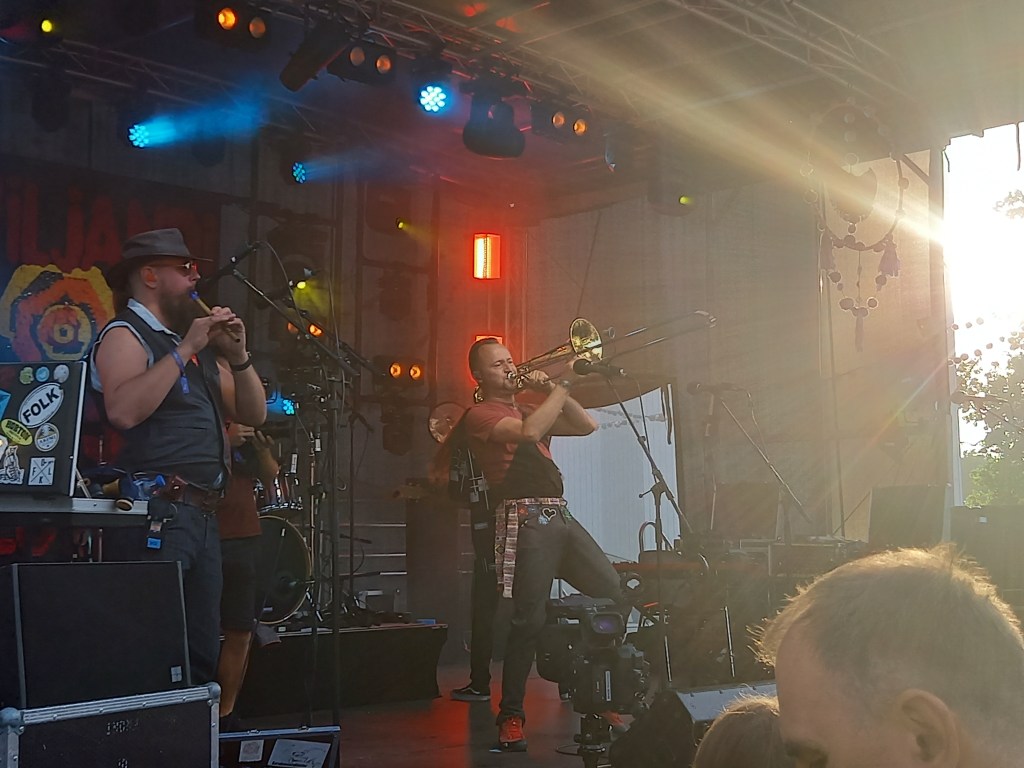
Music. It is impossible to see all of the concerts. You must choose. Often, the choice is not yours. The line for the Kaisa Kuslapuu Trio was out the door. Supposedly, I missed a great concert, but I couldn’t attend it. Instead I saw Svjata Vatra and Rute Trochynskyi and also Julia Kozakova, which is a Romani act from Slovakia. You really have to appreciate Svjata Vatra (one of these photos is of the crowd at the concert). Ruslan is just so funky, and his daughter is brave and can sing. I told my daughter that next year we should perform just like Ruslan and Rute, but she was not amused.

Other interesting finds were Le Diable à Cinq, a furiously intense Quebecois band, and Rahu the Fool, from Latvia. I have this bias against Latvians from living here. It’s as if we ignore them, because they are so close, sort of the way that New Yorkers ignore the Quebecois. “Oh, right, them. They’re over there.” This group was fun. They even played “Mack the Knife.” People want to be entertained, you know. You can be the best accordionist in the world, but if you can’t entertain people, then so what. Latvians do seem a shade darker than Estonians, and about 1000 percent livelier. I think I had written once about a lost Roman legion that had settled the banks of the Daugava. This performance reminded me of that myth.

At some moment yesterday, I became overcome by exhaustion. I could barely walk, really, and just sort of stood against a tree reading the obits for Sinead O’Connor on my phone. I disappeared into the press office, where I ate most of the cherries and zoned out and dreamed of certain things. There were too many people, and there was too much going on. It’s enough to drive a man to drink.

VÄGILASED

So, this was Vägilased on Saturday night. The Estonian word “vägi” means something like “force,” “might,” or “energy.” Perhaps Vägilased could be called “the mighty ones.”

This is one of the old guard bands that used to play the festival many years ago but reunited for this year’s concert. It consists of Meelika Hainsoo on violin and vocals, Reigo Ahven on drums, Cätlin Mägi, who also sings and plays bagpipes and the jaw harp, Jan Viileberg on guitars, and Marti Tärn on bass. They were joined by Andre Maaker on guitars, Leik’s Kelly Veinberg and Elina Kasesalu on violins and vocals, and Francois Archango on percussion. They were also joined by graybearded Aapo Ilves playing a wolf (although my daughter said he looks like Jesus), Toomas Valk on karmoška, Kristjan Priks, an emcee named Päär Pärenson, and a whole school of percussionists.

This concert started at 21.30, and I was already tired. The long, flowing dresses of the performers reminded me of night gowns, so I came to think of the Vägilased concert as a sort of pajama party. Of course Meelika is a captivating singer (she is so soulful and sincere, commented Lauri Räpp), but I was also impressed by the outstanding bounce of the rhythm session. Whoever did the sound for the concert deserves credit. It was balanced, light, and funky.

Also, just when you thought this concert was over, it wasn’t. There was another song, and another. The concert ended with the vast audience holding hands and singing the chorus to one of the songs.

Like most Estonian folk acts, this one relies on traditional runo song structures as a foundational element, but there’s a subtle reggae influence to the way the compositions are performed. I was just very happy when it was all over, and the yellow moon was waxing watchfully in the sky, soon to reach its most potent and illimitable size and shape.

Apparently, this was a one-off concert, and there won’t be anymore Vägilased for some time to come. If you were there last night though, you were there. Easily one of the best concerts I have been to in recent years. There is an emotional depth here that is lacking in a lot of other groups. Vägilased make you feel things.

SUNDAY

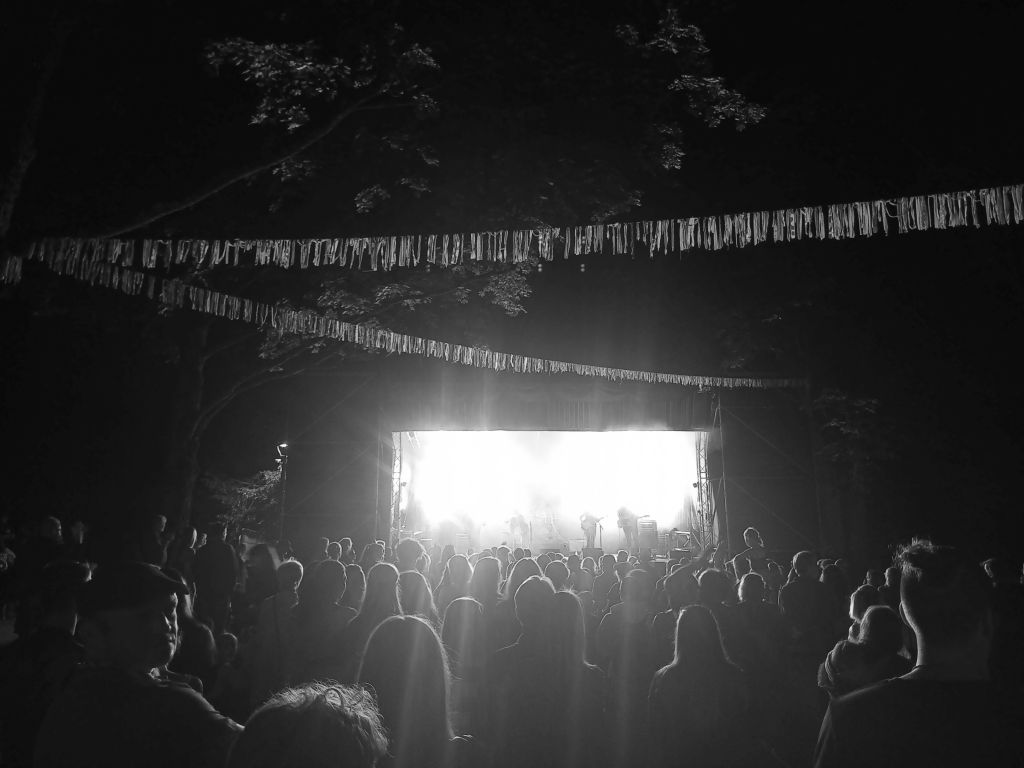
Technically, Sunday began at the stroke of midnight, meaning that this photo taken of Untsakad performing was made around that time.

As a person without roots here, all of these indigenous rhythms are at times lost on me. As a friend recounted, once an Estonian hears them, something goes off in his brain, and he starts to dance. The Estonian can be anywhere, cutting the grass for example, but after hearing a few bars of an Untsakad song, he will go into a trance and start to dance a jig.

Sunday morning started off with sunshine, but halfway through the day, it began to rain and never stopped. I saw the Quebecois again, and the Slovakian act again. There was also some atonal folk music from the Middle East performed by a cat called El Khat.

I don’t really remember what else I did or saw, just a lot of truncated conversations. It seems like Folk is one big therapy session, where people confide in each other about their relationship problems, or seek out advice from others. Women advise bold gestures of love. The men in the know say you must remain aloof. “It drives them crazy. They will chase you for years!” I will only comment that it is interesting to have nearly every love interest you have had in a seven-year timespan confined into a small area patrolled by security and catered by mobile kebab vendors.

All of the bands are different. Some are more purist at heart. Julia Kozakova’s group made me feel as if I was at a traditional Roma wedding. Zetod are traditional fusion supreme, mixing in rock, funk and reggae, and basically everything else.

We should probably talk about Jalmar Vabarna too. Years ago, he was just this earnest folk music kid, but now, I can barely get near him because he has a little entourage of Seto bodyguards around him and wears sunglasses at almost all times. Well, not completely true, because the last time I saw him, he was handing out strawberries at a high school graduation in Setomaa. He is most himself on stage, I think. I have never seen him more natural, more happy, than on a rainy stage at midnight. When you see him perform, as he did closing out this year’s festival, you get the true Jalmar.