WE WERE ALL TRYING to escape. From what I do not know. Some kind of cave system, or tunnel. I cannot say if it was made by man or naturally formed. What I do remember is that I was surrounded by Ingrian girls. Dozens of them. Hundreds, maybe. There were just so many of them, and they were all trying to climb out of that passageway and into the daylight. I don’t know what any of their names were, or what villages they came from, but they looked like sisters. Their hair was red and their skin was milky white. Black shirts, blue trousers, blue eyes.
Then one of the Ingrian girls climbed up my back and sort of pushed herself over my head, as if she was doing an acrobatic trick. Another pushed by my arms. There were so many Ingrians. They were crawling all over everything.
The only hint at civilization in the cave was a monument that had been cut into the walls. Words were chiselled into granite, maybe about the War of Independence, maybe about the Winter War. I couldn’t read anything in the darkness, but with my fingers, I could trace out the number 1918. I gripped the stone as I pulled myself into the light. A dozen Ingrian girls were already standing there looking haughtily down at me. I remember the menace of that hair, as if it was on fire and the feel of the northern sun as it at last laid its pleasant hands upon my face.
SOMEHOW, I wound up visiting Kermit Haas at his art studio on the opposite side of the lake. I think he picked me up after a plane connected to a local agricultural company had flown over the coastal plain and sprayed it with pesticides. I happened to be outside when that happened, by a lake-side vacation home, and standing among the golden reeds at sunset when that goop rained down upon me. I remember reaching and touching the back of my neck and scraping off a handful of green slime from the pesticide plane. It was like Agent Orange or something. I began to worry about my health after that and if I had been exposed to something really toxic.
But then Kermit picked me up in his car and we drove off.
It was actually a single-storey, Scandinavian style art studio. I didn’t realize that Kermit had so many people working for him. He gave me a towel to clean myself from the green goop, and his young assistant brought me a mug of coffee. A simple, spare, well-lit place. It was almost as if Ikea had done the interior, but the quality of the desks and bookshelves was many times higher, and I am sure he had designed every cranny of that place. Kermit is this kind of engaging character. He’s about 10 years older than me. He studied at an art school in France. He has long, graying hair, and likes to wear sweaters and scarves, when the weather requires it. Kermit has this vague sort of Europeanness about him. He’s not really Estonian or French. He is sort of like one of those in-flight magazines on Finnair or Lufthansa. It feels European, it looks European, and it even smells European, but you can’t really say why it’s so European.
The coffee was good and strong, but a little too hot, and I was clumsy after the plane pesticide incident. I spilled some coffee on a nearby table, and a little ran off onto the floor, where it pooled. Urmas’s assistant immediately went to fetch a towel to clean it up, and I began to apologize. But then I noticed that the wet spot was only growing, and soon a clear water began to roll into the studio. It was the water from the lake! It was rising! The water was rolling in, and it was warm and ankle deep. This had not been from the coffee. “We need to get out of here,” said Kermit. “And quick!” We ran to his car. He stuffed a dozen precious canvases into the trunk. My computer bag was already soaked, and I was sure the electronics were ruined. “Good thing all of my work is on Google Docs,” I said. “I am sure your things will be fine,” Kermit responded. I tossed my guitar in the back too. It was in an odd, turtle-shaped case I had never seen before. Then we all jumped into the car and sped away, to escape the flood.
I don’t know what happened to that assistant though. She was too willing to resolve all of our problems. Maybe she stayed behind? Maybe she was tasked with cleaning up after the flood?
THE SCHOOL was constructed in the Colonial Revival style sometime at the tail-end of the 1930s, financed by a local tycoon. It featured four large white columns, and incorporated elements of Federal and Georgian architecture. At its founding, it served as a public school for local students in Sowassetville and adjacent communities, from kindergarten through 12th grade, but eventually, as the population grew, it was developed into a middle school in the 1960s. I hadn’t been there in years, but when I was invited back, along with other members of the ninth grade class of 1995, I decided to return, to see if it could inspire any memories.
To my surprise, the interior of the school had been completely redone, and a large stone-surfaced park had been installed, along with a bronze memorial to the Estonian War of Independence (1918-1920). A solemn soldier stood at its precipice, holding a sword up into the air. His head was decorated with a wreath. In the front of the school, there was a new staircase leading to a second level. From this level, one could take a glass-enclosed corridor into a new extension of the school. It was like something from an aquarium. “I don’t remember any of this,” I told an old classmate, who was clutching unreturned library books, such as The Great Gatsby. “None of this was here when we were. It’s like the entire school has been changed.”
I went down a back staircase into a cafeteria. But only more confusion ensued. It was like a big billowing cloud of confusion. I was reminded of a New Order song by the same name. Because Raivo, my faithful translator, was seated at one of the booths in the cafeteria. He was there in a button-down shirt in one of the booths, digging through a Caesar salad. Raivo said that we had to get a translated version of one my short stories to the editors as soon as possible. I still was baffled to see him there. And then when I turned my head, I noticed that the lovely Atlacamani, the mysterious Azteca goddess of storms, was also seated in the cafeteria. She was wearing a red shirt and blue pants and was seated with musicians from the Viljandi Cultural Academy.
They were all eating fries.
El Scorcho, a Chilean folk singer with a slight mustache who lives and thrives in V Town, arrived with a tray full of food and drink. His guitar was slung across his back. He was wearing one of those gray ponchos they wear down in the Andes. He said, “You look so funny. You should see your face.” I said, “What’s going on? What are you all doing here?” El Scorcho just smiled. “A lot has changed since you went to junior high school,” he said. “Todo es diferente.”
HEIDI WAS STRETCHED out on some kind of wooden platform at the intersection of Sun and Moon Streets. It was right in front of the large brick edifice that once belonged to a local Jewish merchant. That was in the interwar years, before the Great Death. She was stretched out there in the sunlight, with her rear exposed and also her back. The rest of her bundles of clothes were bunched up around her knees and neck. The wind blew through her gold hair. I wondered what I should do about the whole scene. I walked around her on the platform and examined her. I wondered if I should take things a step further. But didn’t she have a boyfriend? Prince Hans of the Seven Isles? I left and walked farther down Moon Street.
Smith had opened a new café a few doors down from the Bhutanese restaurant. He called it “Smith’s Espresso.” A large ceramic cup was suspended from a hook above the door. Inside, there were just a few tables and a coffee machine. Smith wore an apron and a old-fashioned cap and fixed me the drink. There was another patron, a college student of about 19, who was from some other country, a Hungarian maybe. He wanted to know about Jack Kerouac. He was reading The Dharma Bums. I told him of my personal connections to the legendary beatnik, and how I had once interviewed the bartender who sold Jack many a drink in downtown Northport on Long Island. He had told me that Kerouac was a bad drunk. “And he gave me a copy of his book, Tristessa. I couldn’t make any sense of it,” he said. “I threw that junk away.”
“Can you imagine? The old fool bartender threw an autographed copy of Tristessa into the trash bin.” “Tragedy,” the Hungarian said. He had written a haiku to Gary Snyder but hadn’t heard back. He had on a sky blue scarf fixed around his neck, though it wasn’t particularly cold. He had light hair and blue eyes, and looked sort of like he belonged at a 1970s ski resort. I imagine that such stylish accoutrements were necessary for the up-and-coming hipster set.
After I left Smith’s Espresso, I decided to stretch out my legs. I peered down Moon Street and saw Heidi still sprawled out there, with her milk white buttocks in the air and autumnal sunshine, and went the other way. I found my way to the Botanical Gardens, and two ladies came out of the hedges and greeted me. They were both highly manicured and treated women, belonging to the town’s caste of the upwardly mobile and aspiring nouveau riche. The kinds of women who had marvellously sculpted eyebrows, buffed fingernails, and pants that seemed to perfectly stick to every contour of their legs and hindquarters. Friendly, but somehow of another tribe, as I too belonged to some other tribe, the Tribe of Kerouac.
They started to pepper me with questions. They wanted to know if I was good in bed or, rather, their friend Gunna, who worked in the market, who had red hair, and red paints, and red freckles, and barely spoke, needed to know. Badly. Somehow sex had never come up between us, but now I understood that it was actually all about sex. Everything had always been about the sex all along. The only question was if I would be willing to give it. The answer was a tentative yes, I told the two ladies outside the Botanical Garden. I doubted, for a second, just a second, in my lovemaking abilities, and if I would be able to please Gunna as she needed.
SOMETIME IN THE BLEAK DEPTHS of the pandemic, I became aware of the arrival of some dark-haired, shadowy strangers in town, mysterious characters who would lurk at the margins of parties, or whose strumming of guitars might be overheard whenever I passed the room they were renting on Posti Street. The Chileans! The way people around me referred to them, it was as if a whole orchestra from Valparaíso had been shipwrecked on the shores of Lake Viljandi. In reality, there were just two: Tomás del Real and Javier Navarro. But they were important. They were part of something new: a little South American community in Viljandi.
Viljandi, despite its rather small size, has always hosted pocket-sized minority enclaves. One stretch of Pikk Street was once called “Jew Street,” because of the active Jewish community that dwelled there before the Soviets deported some and the Germans and their evil helpers murdered the rest. Viljandi’s Jews even had their own sauna and fire brigade. There are also stories about the Romani people, or mustlased, who once camped in the forests where the Metsakalmistu, or Forest Cemetery, is now located, and how the Romani women tried to convince Mayor Maramaa to buy them horses so that they could leave. As far as I know, there was never a Latin American community here, until the arrival of Tomás and Javier from Chile, and Pepi from Argentina, and Tito from Cuba, and Miguelito from Mexico too. Slowly, something new is coming into existence.
Of these Latin Viljandiers, musician Tomás del Real is perhaps among the better known. On August 26, he performed at the Pärimusmuusika Ait, or Folk Music Center, to celebrate the release of his latest album, Principios de Declaración. Del Real is no stranger to the iconic Ait. He even used to live in the cellar when he first arrived in Viljandi and got an artist’s residency.
“Downstairs is where my room used to be, and every time I go there, my heart skips a beat,” he says. “Next to it is the rehearsal room, and that also gets me emotional.” Tomás recalls staring at the stones in the wall, or looking out the windows of the Ait on winter days when everything about Estonia was new, and he would take long walks around the old castle ruins. “Every spot in the Ait contains memories,” he says. “Every time I perform in the Ait, I get nervous, because it matters to me.”
His own performance, in front of a mostly packed house, came off flawlessly. While the songs on the record have diverse origins, the quiet introspection of Viljandi life has seeped into all. He also structured his show in a unique way, with one half of the stage divided between a standing microphone, where he addressed the audience as would any singer songwriter, standing and at times, and discussing the political situation at home in Chile. On the other part of the stage, he had a “living room,” where he played his tunes just as if he was at home. Tomás says this is part of the duality of being a character and a witness to music being created. He adds that during the “living room” segment of his show, he for a time felt like he was home, which, for now at least, means Viljandi’s Old Town. He even has a composition on the record called “Viljandi.” Though he grew up so far away, he also says there are certain commonalities between Chileans and Estonians. The era of the military dictatorship in Chile officially ended in 1990, while Estonians restored their independence the following year.
Tomas del Real on stage in Viljandi on August 26. Photo by Kerttu Kruusla.
“We have both been oppressed and in difficult situations,” says Tomás. Because of that, he says, both cultures value friendships, because they have learned to rely on each other. “It’s the only way that people who have suffered for so long can function as a society,” Tomás says. He adds that Chileans have also learned to be tight-lipped like Estonians, for the same reasons.
Viljandi has also fostered a creative streak in Tomás, which is another reason why he has stayed here. At one point, he was writing one new song a day, some of which appeared on a record he cut with local musician Lee Taul last year, calling their duo Don’t Chase the Lizard. The rest of it populates the hypnotic tunes on his latest solo outing. But Tomás is not the only musician from South America in Viljandi these days. There is at least one other sudamericano.
He is the one known to all as “Pepi”.
Indeed José “Pepi” Prieto might, in some future almanac authored by local historian Heiki Raudla, be considered the pioneer Latin American in Viljandi. He was the first to explore it, the same way that explorer Juan Diaz de Solis once dropped anchor in what is now Argentina in 1516. A native of Buenos Aires, Pepi had almost anything one could dream of by his early twenties: a steady girlfriend, a band, a career. He was restless though, and decided to go abroad for a spell, where he worked as a programmer in Indonesia. A chance encounter with an Estonian woman there inspired him to come to the northern margins of Europe, just as it once inspired a young American journalist to do the same. It was a decade ago, and just a few days before Christmas. “I was told that it was -30 degrees, but I had no idea of how cold it actually was,” he says of this frosty arrival. Like any true South American, he showed up in Estonia in December wearing shorts. “We went straight to the shop after that to buy a good coat and boots,” he says.
Then he came to Viljandi. Immediately, it struck him as a quiet, inspiring place, where his creativity for unknown reasons began to surge in the same way that it would for Tomás later. For years, Pepi kept a room in the Koit Seltsimaja, or Koit Society House, on the corner of Koidu and Jakobsoni Streets that once housed the Ugala Theatre from the 1920s until the 1980s.
For a time he even managed a creative space there, called the Sama Sama Studios.
“I started to feel like I was the guardian of that house,” says Pepi. “I was the person bringing people to the house, and always showing people the rooms.” It also inspired him to write new music, to invite people to collaborate on music and to perform.
Araukaaria, as seen through the gates of the Koit Society House. Pepi Prieto, Lee Taul, Johannes Eriste, Fedor Bezrukov, and Norbert De Varrene. Photo by Paul Meiesaar.
These days, Pepi performs with Araukaaria, a quintet that also features Lee Taul on violin and vocals, as well as percussionist Johannes Eriste, a guitarist called Norbert De Varrene, and a bassist from Narva named Fedor Bezrukov. The band’s music is informed by South American psychedelia from the 1960s and 1970s, as well as Estonian folk. They have an earnest but passionate sound. The band named itself after the sacred tree of the indigenous Mapuche people of Chile and Argentina, and araucano is a Spanish name for the Mapuches. “I grew up seeing these trees,” says Pepi, whose father was Chilean. “They have always been in my life.” Pepi sees other kinds of trees these days though. Birches, pines, and alders. He loads them into his wood-heated furnace. He also has a summer place outside town where he is raising cucumbers and potatoes with his Estonian family.
That’s right, Pepi, like myself, has contributed to population growth in the Republic of Estonia. He can now be seen walking a small blonde child down the street and speaking Spanish to her. Sometimes his friend Leandro, another programmer from Argentina whom he enticed to Estonia, tags along. Leandro is also a regular in town, but has opted to live in Tallinn full time. When I see both of them, I have to look twice. Latin Americans in Viljandi? How did it even happen?
“They are not like stereotypical South Americans, because they enjoy winter and silence, so in that sense they are in the right place,” says Lee Taul, who collaborates with Tomás and Pepi. “We are richer that they have come here, and they also know how to attract people with their energy,” she says, describing both del Real and Prieto as industrious, motivated musicians.
“They love nature too,” says Lee of her respective bandmates. “That is perhaps one reason they are here, because the forest is in the city,” she says. “For every true artist, nature provides a rich environment, a golden nest from which to hatch something new to life.”
Tomás for his part concurs with her assessment, calling the Estonians’ relationship with nature as “connected and profound.” “It’s absolutely true that I am more creative here because of the environment,” remarks Pepi. Here I would have to say they are correct, even if I am not a South American, or only in my heart. I am grateful for the arrival of these Southerners. Not only are they inspired by Viljandi, but they have inspired me. I agree with them, and wholeheartedly.
ON SOME DAYS, I like to hike out to Karula Lake outside of Viljandi. It’s about eight kilometers door to door and it’s very pretty. The fields of rapeseed are in bloom, blanketing everything in delicious yellow. Agricultural laborers toil away in the fields. The Estonian countryside does have a certain desperate, Depression-era flavor to it though. Those abandoned, splintering houses, lost to time and graffiti. That empty bottle of whiskey tossed carelessly into a farmer’s field at some particularly fraught moment in the cold winter, only to be revealed later by the thaw, like the corpse of some ancient mastodon.
Sometimes I wonder about the local indigent people who might shelter in these discarded structures on the outskirts of Estonia’s country towns. Maybe they make bonfires at night and play harmonica like the bluesmen of the past? What kinds of horrors have these walls seen? In India, I once saw a man sleeping curled up in a rug by the roadside. I imagine it was something like that here. The countryside is mostly quiet, but one can always hear the birds singing. The Estonian birds are social and talkative. The people not so much. I have done this route many times, down to the lake, past the Baltic German cemetery. Then it’s back out onto the highway.
Other walkers come by, but nobody looks at you out here. It would seem that this would be the most opportune occasion to exchange some kind of pleasantries, or to acknowledge each other’s existence. Two strangers meet along a lonely highway on a hot summer’s day. I don’t expect much, you know. I understand that this is not California, and there will be no “have a terrific day!” wished upon me by some life-loving passing jogger. Still, a nod might do. Or some eye contact. There is nothing.
Yesterday, a young woman walked right past me. She was within arm’s distance. I looked to her, just to acknowledge that we existed along the same plane of reality. Was I really here? Was she? The wind was playing with her straw-colored hair. Her face was pale, as were her eyes. She looked like an extra from one of those Netflix Viking dramas. I wondered what she was thinking about. It must have been very important. Maybe she was wondering about what classes she should take, or how much her cousin Tõnu’s new car cost. “I wonder how much it cost? I wonder, I wonder.” Then it occurred to me that maybe she didn’t see me. Maybe I was invisible. What other explanation could there be? I didn’t know when my invisibility began to manifest itself in Estonia. Naturally, she didn’t say hi. She couldn’t see me.
***
A day later, I recounted the story to a friend in a local cafe in town. Well, at least I consider her to be a friend. Estonian is a Finnic language, which means it’s not at all related to Indo-European languages, though there are plenty of loan words. In Estonian, though, the word for “friend” is “sõber.” An Estonian sõber, however, is not exactly like an English friend. A friend in English is sort of like a person with whom you feel a kind of rapport or affinity and have shared some times together. A fellow traveler. A companion in life. Maybe sometimes you meet for a drink. An Estonian sõber demands more from you. If their car breaks down, they expect you to come and help. If they run out of money, they will ask you to loan them a hundred euros. If you say no, they might be disappointed. “But I thought we were friends” your Estonian friend will say.
An Estonian friend might also ask you for strange things, with no context for the request. You might be at home making coffee in the morning and receive a mysterious message, such as “Do you have a hammer?” To which you might wonder if it’s a trick question, or maybe it’s a state survey. Is Statistics Estonia compiling data on hammer ownership? It also happened once that a friend contacted me at midnight to inquire if I had any ice. “Do you have any ice?” I remember staring at the weird message. This kind of thing only happened in Haruki Murakami novels, I thought. Where could this request for ice lead? Maybe I would soon be blackmailed or drawn into some erotic thriller? I turned over and went back to sleep. It later turned out that she was at a neighbor’s making cocktails with friends. Had I known this, I might have really brought them some ice.
I just don’t understand these things. How does being friends mean that you have the right to borrow my hammer at a moment’s notice, or to go through my refrigerator for cocktail ice?
***
These are the kinds of things that happen to you when Estonians know you and consider you a friend, or at least an acquaintance or tuttav. In Estonia, personal relationships are very precise. Sometimes even if you have been in the same class, you are just called a classmate, or kursaõde or kursavend, a “class sister” or “class brother.” I am unsure if class sisters qualify as acquaintances. I can speak this language, but it still makes no sense to me. Sometimes I try to understand the roots of words to fish out their deeper meanings. That might help me understand Estonians better.
When I told my Estonian friend about my experiences on the lonesome highways, where everybody ignores each other and walks by as if you are invisible, she did not seem surprised.
“But of course, they didn’t say hello to you,” my Estonian friend said. “You’re võõras.”
Võõras. A word that translates roughly as “foreign,” “strange,” and “unknown.”
“That’s not true,” I said. “Everyone here in town knows who I am.”
“Yes, but they don’t really know you.”
There it was. I was a known unknown. I would only have to wait until a mutual Estonian friend introduced us in a social situation, or if we happened to take part in the same shared activity, maybe a kannel or folk dancing class, to say hello to these strangers. Then we would know each other. Only once we had been formally introduced could I greet them alone on the road. Until that time, we would remain apart. I could not, for example, walk across the road and actually introduce myself to the others. That would be alarming. I would have to wait until we knew each other. Then I would no longer be a stranger.
Selge pilt. A clear picture.
That word started to haunt me though. Võõras, võõras. Where did it come from? The word “stranger” in English derives from the Latin, “extra” and French estrangier, meaning “outsider.” “Foreign” similarly derives from a Latin word meaning “door,” so, again, an outsider. “Unknown” has a Germanic root in cnāwan, which means to identify, or to recognize.
This word might be closest in meaning to the Estonian word võõras.
I am not a linguist though, so I contacted the Estonian Language Institute to ask about the origins of the word võõras. I was then referred by someone to a special online query form where I could submit a question to the institute. I checked the online resources, and then plied my luck with the new translation tool for Finno-Ugric languages made recently available from the University of Tartu. It seemed that the Estonian word võõras exists in Karelian, where it is vieras, in Veps, where it is veraz, and in Livonian, where it is vȭrõz. This was a shared Finnic word, which meant that it developed from the shared mindset of the Baltic Finns. They had their own ways of determining who was known and who was unknown, who was a friend and who wasn’t. These people had their own systems for intuiting the world, and their language was just one manifestation of it. To be a friend was to be available at any moment to loan a hammer or give them some ice. If you had not been introduced, then you would always just be a stranger.
***
I started to ask around though. I wanted to see if anyone could provide more information on the Estonians’ behavior, on their determination of who was võõras and who wasn’t. At the café, I queried the esteemed diplomat Jaak Jõerüüt and his consort, the poetess Viivi Luik.
Jõerüüt blamed the Soviet regime. “This is Soviet stuff,” he said. In the old days, before Estonia fell to Comrade Stalin, before the war, collectivization, and Georg Ots’ singing career really got going, the Estonians were a jollier lot, Jõerüüt said. They were sitting around with big steins of beer and playing accordions and if you saw one in the countryside, he would call you over, and maybe cut you a slice of black bread. The horror years of Communism had done away with all of that. Who knows. I could be a bloodthirsty metsavend or “forest brother” out on that country highway. Or even NKVD.
“It’s better not to bother with other people,” said Jõerüüt. “It’s best to avoid contact.”
Jõerüüt offered another hypothesis. He noted that Northern Europeans have a tendency toward introversion. There are, I admit, some famous photos of Swedes and Finns waiting for buses and trains, where each one leaves plenty of distance between each other, and they don’t talk to each other either. This is the precious personal space that Northerners relish. They love nothing more than being alone, so that they can think lonesomely about things that affect them only. Their anthem is Depeche Mode’s 1990 hit “Enjoy the Silence.” “Words are very unnecessary. They can only do harm.” Depeche Mode played this August at the Song Festival Grounds in Tallinn.
They have a lot of fans here.
There are other theories. One musician friend blamed the cold weather. “People don’t want to waste energy communicating if they don’t want to,” she said. “Every ounce of energy is needed for the long winter.” Another musician friend said it had nothing to do with the Soviets at all. This woman, who is about 30 years old, was born after the restoration of independence. She said that she was taught in the 1990s that you always greeted people you saw in the countryside. In urban settings, anonymity was the rule. It had more to do with new technology. To be fair, many times I passed fellow walkers, they were staring at their phones.
They had vanished into a virtual existence. That’s what was happening.
One fellow cafe goer, who is from Australia, had his own theory about the Estonians that he was only too happy to share. “Oh, I think it’s clear that everyone in Estonia is suffering from a mild version of Asperger’s syndrome,” he said. He’s even been checking the scientific literature, but the Estonian Genome Center has yet to put out a paper on the high prevalence of autism in Estonians. Or maybe they already know about it and are merely hiding the truth from all of us?
About a year ago, I went to Copenhagen for a few days and was overwhelmed by the gregariousness of the Danes. I had conversations with people in cafes, in museums, on the trains. I talked with bartenders and waiters. The Danes seemed much livelier, earning their reputation as the Latinos of the Nordics. Then I returned to gray, quiet Estonia, only to stand in line at the supermarket, where every shopper stood apart from the other. None of them interacted, and when the time came to pay the cashier, one woman looked away as she deposited the money into the plastic dish, to avoid all possible eye contact. What was wrong with these people? I thought. Why do they behave in such a way? They won’t look you in the eye, and then they will ask you for ice at midnight. They’ll take your hammer and won’t say thank you. Yet a few days later, I too stood apart from the others. I was lost in my thoughts. I ignored eye contact with the cashier.
Three days. That’s all it took to become one of them.
***
Years ago, after returning from New York, I took the long train ride down into the South Estonia countryside and wondered again how I had even wound up living in such a place, though the scenery was nice. It seemed so far away from everything though, and I almost couldn’t believe that Estonia really existed. There were those familiar bales of hay though, rolled up and covered in tarps. Some Estonian farmers had covered their hay in blue, black, and white.
One night, I took a drive down to Abja-Paluoja to go to the sports and health center. I bought my ticket, went into the changing room, disrobed, and headed into the sauna to get a good sweat. Inside, there were four or five naked Estonian men sitting on the sauna benches, their red legs dangling. Not one of them looked at the others and not one of them said a word. They didn’t know each other, you see. They had not been introduced at a folk dancing course yet. They were all võõrad. Strangers. As was I.
The sauna had a speaker installed, and it was playing Radio Elmar, a national radio station, that evening. The song on the radio was “Pole Sul Tarvis” by Kukerpillid, a legendary Estonian country music act. The refrain to the song translates roughly as, “It’s not necessary for you to know what I’m doing.” That was just it. Forget “Mu Isamaa” or “My Fatherland,” the official national anthem. Kukerpillid’s “Pole Sul Tarvis” was the real one. I looked at the others. They did not look at me. What else was there to do than toss another ladle full of water on the sauna and listen to Kukerpillid in contemplative silence? We may have all been naked and in close proximity, but that’s where any familiarity ended. One more ladle full.
AFTER THE ESTONIAN WRITER Paavo Matsin sold the movie rights to his books Gogoli Disko and Kongo Tango to Christopher Nolan, he found himself flush with cash, and invested in an estate up the Emajõgi River which he christened “Kongo Disko” in homage to his novels.
This was an old manor house that had belonged to the de la Gardie family, which Matsin promptly fashioned into a genteel plantation, modeled on the Greek Revival architecture of the Old South. Wild, anything-goes parties were held there, and Matsin’s notoriety for anything lewd, vulgar, and unbecoming of a European Man of Letters was only enhanced. He also used his plum perch on the river’s edge to engage in export of cotton, molasses, tar, tobacco, and local folk instruments, such as the Hiiu Kannel, which he shipped to a merchant in Equatorial Guinea. There was also a whiskey distillery at Kongo Disko, another solid source of revenue for Matsin Enterprises. King Charles was said to be fond of Kongo Disko whiskey.
There was no road to Kongo Disko though, and the approach was a stony path through the swamps and forests that divided this backwoods outpost from the Tähtvere Spordipark and the Supilinna Tiik. To get there, I had to rent an all-terrain vehicle and roll through the high grasses, being careful not to get upsot by any of the felled tree branches or jagged rocks along the way. It was an eerie, witchy place, and there was moss on the trees. Yet the yard of Kongo Disko was full of partygoers when I arrived, and a group of enslaved laborers from Viljandi were planting the next season’s crop of cotton and tobacco. One could hear their mournful Viljandi slave songs from the fields, and Mr. Matsin descended the steps of the plantation with a glass of whiskey in his hand. He was wearing his black top hat and pince-nez spectacles.
“Welcome to Kongo Disko!” he said.
“Paavo!” I said.
The man winced. “I’m afraid not. I’m not Paavo. If you like, I can take you to see the real Paavo.”
“That’s why I’m here. But I have to say, I am really confused. I mean, you look just like him.”
“Yes, but there are subtle differences, subtle differences,” the man who looked like Matsin said. “See these glasses? The real Paavo doesn’t wear glasses like these. Come. We’ll find Paavo now. Care for a drink?”
“Yes.”
He poured me a glass of smoky Kongo Disko whiskey, and we went around one side of the plantation. A fiddle and banjo duo had just started to pluck out a tune, and from behind, I could see the enormous and unmistakable frame of Paavo Matsin. He was wearing suspenders and a plaid shirt and directing his Viljandi laborers as they loaded ceramic jugs of molasses into a donkey-drawn wagon that would take them down to the wooden river docks for export. The man was perspiring in the sun and looked up.
“Paavo!”
The man squinted at me, and then grinned to the first man who looked exactly like him, the one in the top hat. “But I’m not Paavo Matsin,” said the man in the suspenders. “You’re joking!”
“But you also look just like him.”
“Yes, but there are subtle differences, very subtle differences,” the man in the suspenders said. “For one, Paavo Matsin wouldn’t be caught dead in a pair of suspenders.”
“I see.”
“He also does not own a plaid shirt.”
“I also see.”
“Do you want to meet the real Paavo though?”
“Yes, of course. That’s why I came here. We were supposed to talk about literature.”
“Very good. Take him to see the real Matsin then,” the man in the suspenders said to the man in the top hat. He nodded and took another sip of his whiskey. The man in the suspenders uncorked a bottle of molasses. “Before you go, you just have to try it,” he said. I took a swig of the strong, sweet stuff. The man in the suspenders grinned at me. “Oh, I told you it was good. Now you are really ready to see old Matsin!”
The man in the top hat led me back to the yard. From the corner of the property, I watched as a 1916 Model 34 Marmon automobile skidded and bounced over the fields and stones until it reached the edge of a tent, where a bar had been set out for the plantation’s many guests. The man in the top hat led me over to the side of the car. He plucked an umbrella from a bucket. The top hat man opened it in the hot sun and stood ready.
The door opened, and from its plush interior emerged the man I had been seeking all of this time. He looked just like the man with the top hat and the man with the suspenders. They all looked the same. There were only subtle differences between them. Subtle differences. The real Paavo Matsin drew a handkerchief from his front pocket and wiped the sweat from his brow. He stared at me and squinted. When he recognized me, he nodded, but only just so.
“Well butter my butt and call me a biscuit,” he said. “If it ain’t the American writer.”
“I made it, Paavo.”
“Good. Come with me. Let’s have another drink.”
At the tent, Matsin informed the bartender to fix him a mint julep, toot sweet.
“But who were those two men who looked like you?”
The bartender slid Matsin his drink and he peered into it. He took a sip and stared at the lawn. “Simple. Those are my pseudonyms,” he said.
“Your pseudonyms?“
“Yeah, pseudonyms. Pen names. Alter egos. Look, Gogoli Disko was not authored by Paavo Matsin, was it? It’s credited to Paša Matšinov. He is the one in the top hat. Matšinov is my butler. Must Päike, ‘Black Sun,’ is credited to Friederich Reinhold Kreutzmatsin,” he went on. “He’s in charge of my export business. Pseudonyms are wonderful. They’ll do anything for you.”
“Kreutzmatsin,” I repeated, dumbfounded. “That man in the plaid shirt and suspenders.”
Matsin just chuckled. “You’re still such a young writer,” he said. “You need to stay at Kongo Disko. Hang out. Learn the tricks of the trade. I’ll school you in the art of dystopian magical realism.” Matsin snapped his fingers at the bartender, who stood ready to serve us both.
“Yes, boss?”
“Villem,” he said. “I want you to fix our writer here a dystopian magical realist mint julep.”
“Sure thing, boss. Anything you say, boss.”
The bartender mixed the drink and slid it across the bar to me. I looked into its murky contents and then took a sip. It was very minty. Paavo was chewing on a stalk of wheat, pondering. From the fields, I could hear the chants and songs of the poor Viljandi laborers. Their sweet lamentations echoed to the river with blues and soul, melancholy and torment.
My notes from this year’s Viljandi Folk Music Festival, held 27-30 July 2023 in Viljandi, Estonia
THURSDAY, YESTERDAY, was the first day. Festivals are difficult to cover, because you cannot be in every place at every time. Concerts or events overlap, and so you just cannot see everything. Of the concerts I saw yesterday, my favorite was Mari Kalkun’s performance, which happened at Kaevumägi, or the Well Hill, one of the festival’s primary stages.
I have probably either known or known of Mari Kalkun for more than a decade. She is a popular folk singer, and specializes in songs sung in the South Estonian Võro dialect or language.
I think what makes Mari special as a performer is her ability to sustain intensity over what can be atmospheric and amorphous compositions. She plays with all of the foreboding of purple rain clouds in the distance. She comes in and leaves like a thick white fog. There is sunshine sometimes too.
Many folk artists can provide nonstop, horn-blaring, bass-drum-pounding, action-packed intensity, while others are capable of crafting beautiful lullaby-like landscapes. Those landscapes though will soon lull you to sleep, just as that intensity will wear you down quickly.
Rare is the artist who can sustain such intensity wrapped up in lush and haunting melodies, and across an entire set list.
For this performance, Mari was joined by Australian bassist Nathan Riki Thomson, and most of the material was off her latest album Stoonia Lood, released on Real World Records this year.
They also performed later in the evening at the Folk 30 concert which celebrated three decades of the Viljandi Folk Music Festival.
OTHER THOUGHTS OF FOLK
One thing I notice every year when I attend this festival is the lack of American performers. I think it might be because American folk music is popular music. When an American says “folk,” he thinks probably immediately of Bob Dylan. But Bob Dylan isn’t hurting for gigs and it would be hard to entice Bob to come on down to Viljandi to sing to us. There is also this issue of the American folk blues tradition. Estonia has a blues festival too. Should American traditional acts perform there instead?
“Folk” in Viljandi is blended with something called etno or “ethno.” It’s very fusion, and in line with the general philosophy of the Viljandi Culture Academy to make the old new again, or to build off of Estonian and other folk traditions. So “Folk” is not exactly “folk” as an American might understand folk to be. The Estonians have taken the English word “folk” and changed the meaning slightly. The Estonian word is pärimus, which means something more like original or traditional. There are always different ways to translate English words into Estonian, but the meanings are not always exactly equivalent.
I like the size of this festival. It’s very cozy, and I am glad it has not become a Coachella, Glastonbury, Roskilde-like event. It’s a social gathering. Old friends get together. It is distinctly for the locals, and in that way, its reach is limited. Combining international artists with this Estonian content must be a challenge.
For example, the opening ceremony was entirely in the Estonian language, as it should be, but I found myself wondering how an outsider might see it. I am not arguing that there should be simultaneous translations or anything like that, but this is a niche festival. At the same time, people who have visited just for one festival have often returned for the unique vibe. It has that effect on visitors.
OF LEIK, ANDRE MAAKER, AND BUBBLES
Leik is a duo consisting of Kelly Veinberg and Elina Kasesalu who (mostly) sing and play violin, but also add viola and the special hiiu kannel.
I have seen Elina and Kelly a lot in Viljandi, and on trains to Viljandi, and from Viljandi, and also once in a shopping center in Tartu. And probably other places, toting their instruments.
Andre Maaker is a guitarist. I could call him a virtuoso, but he’s not really, and I could call him a guitar slinger, but really, he’s just a guitarist. He’s the kind of guy who sleeps next to his guitar, “just in case he gets a good idea.” He loves guitars, and based on the set they played yesterday at Käevumägi, he has a whole toy shop full of stringed instruments at home, such as the acoustic “world stick” he pulled out of nowhere, or the four-stringed tenor guitar. He filled out Leik’s sonics best with a 12-string acoustic, which has that lovely, dulcimer-like ring to it, and has always been used in folk music, as he noted to me afterward (yes, it has, and should be used more often).
According to Leik, the addition of Maaker has allowed them more room to focus on their vocals and instruments, as in the past, they often had to work to fill out the depth of the pieces. With that guitar, there’s just more sound.
Andre used to teach Kelly and Elina, and they asked him to partner on this project, which has seen them recently tour the islands. Much of their repertoire includes songs from Saaremaa, Hiiumaa, and Vormsi, as well as some self-penned compositions, and they carried them all well. There’s something wonderful about the blend of voice and strings here that continued to ring in memory for hours.
According to the musicians themselves, they were well received in the islands and were again yesterday.
This was probably the best concert I saw yesterday. It provided some sorely needed introspection during a festival that can get tiring quickly, with all the people, music, food, and conversations.
FRIDAY
Friday raised the question, is it possible to overdose on bagpipe music? According to radio journalist Arp Müller, who was diligently assembling his kit in the press room, it’s possible to overdose on anything.
Cätlin Mägi and the VKA bagpipers begged this question with their afternoon performance. At best, the bagpipe evoked misty landscapes and ancient moods. It has a kind of cleansing quality to it. At worst, it can sound like a flock of angry ducks. According to a German folk journalist (yes, they really exist), Estonian bagpipes are unique, as is the Estonian bagpipe tradition. He came all the way up from Scholzland to write about it.
He also noted that the Folk audience is unique, in that it is concentrated among younger people. In other countries, its an older person’s genre. Even the musicians of Trad.Attack!, Jalmar, Sandra, and the incredible percussionist Tubli, are in their mid-to-late 30s and considered old hands.
Trad.Attack! puts on a mobbed, flashy, wall-of-sound show. Unfortunately for an outsider, a lot of the runo song-based melodies are lost on someone who isn’t from here.
I will add here, that I did not witness one drunken brawl or act of violence yesterday. Folk does not invite the quasi-white nationalist biker crowd to brawl over grilled meat, beer, and heavy metal. They are somewhere else. One feels safer here.
The last concert I saw last night was Tintura, which is really one of the weirdest groups out there. They offered up a contrabass, violin, keyboards and electric guitar, turntables, and then, of course, a blazing saxophone solo. This was funk, folk, electronica, and wedding band fusion. Or as a friend put it, “kompott,” a jam.
PS. I am also proud to report that I survived an entire Irish folk music concert given by Flook yesterday, though I initially doubted in my fortitude. After a few numbers though, I actually started to like it. One might say that it’s an acquired taste.
SATURDAY
SATURDAY. Let me choose my words carefully. On Friday night, someone I know started drinking. On Saturday, he was still drinking. If you are reading this, you probably think you know this person, but the fact is, it applies to multiple people at this festival. They may still be out there drinking, somewhere.
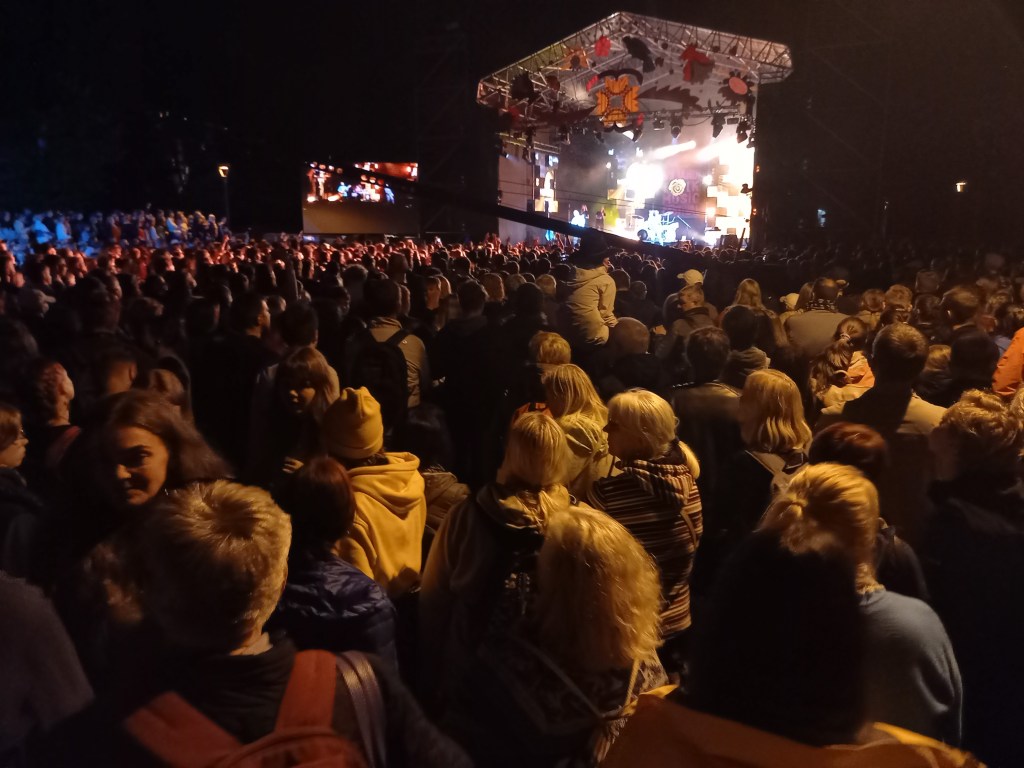
Music. It is impossible to see all of the concerts. You must choose. Often, the choice is not yours. The line for the Kaisa Kuslapuu Trio was out the door. Supposedly, I missed a great concert, but I couldn’t attend it. Instead I saw Svjata Vatra and Rute Trochynskyi and also Julia Kozakova, which is a Romani act from Slovakia. You really have to appreciate Svjata Vatra (one of these photos is of the crowd at the concert). Ruslan is just so funky, and his daughter is brave and can sing. I told my daughter that next year we should perform just like Ruslan and Rute, but she was not amused.
Other interesting finds were Le Diable à Cinq, a furiously intense Quebecois band, and Rahu the Fool, from Latvia. I have this bias against Latvians from living here. It’s as if we ignore them, because they are so close, sort of the way that New Yorkers ignore the Quebecois. “Oh, right, them. They’re over there.” This group was fun. They even played “Mack the Knife.” People want to be entertained, you know. You can be the best accordionist in the world, but if you can’t entertain people, then so what. Latvians do seem a shade darker than Estonians, and about 1000 percent livelier. I think I had written once about a lost Roman legion that had settled the banks of the Daugava. This performance reminded me of that myth.
At some moment yesterday, I became overcome by exhaustion. I could barely walk, really, and just sort of stood against a tree reading the obits for Sinead O’Connor on my phone. I disappeared into the press office, where I ate most of the cherries and zoned out and dreamed of certain things. There were too many people, and there was too much going on. It’s enough to drive a man to drink.
VÄGILASED
So, this was Vägilased on Saturday night. The Estonian word “vägi” means something like “force,” “might,” or “energy.” Perhaps Vägilased could be called “the mighty ones.”
This is one of the old guard bands that used to play the festival many years ago but reunited for this year’s concert. It consists of Meelika Hainsoo on violin and vocals, Reigo Ahven on drums, Cätlin Mägi, who also sings and plays bagpipes and the jaw harp, Jan Viileberg on guitars, and Marti Tärn on bass. They were joined by Andre Maaker on guitars, Leik’s Kelly Veinberg and Elina Kasesalu on violins and vocals, and Francois Archango on percussion. They were also joined by graybearded Aapo Ilves playing a wolf (although my daughter said he looks like Jesus), Toomas Valk on karmoška, Kristjan Priks, an emcee named Päär Pärenson, and a whole school of percussionists.
This concert started at 21.30, and I was already tired. The long, flowing dresses of the performers reminded me of night gowns, so I came to think of the Vägilased concert as a sort of pajama party. Of course Meelika is a captivating singer (she is so soulful and sincere, commented Lauri Räpp), but I was also impressed by the outstanding bounce of the rhythm session. Whoever did the sound for the concert deserves credit. It was balanced, light, and funky.
Also, just when you thought this concert was over, it wasn’t. There was another song, and another. The concert ended with the vast audience holding hands and singing the chorus to one of the songs.
Like most Estonian folk acts, this one relies on traditional runo song structures as a foundational element, but there’s a subtle reggae influence to the way the compositions are performed. I was just very happy when it was all over, and the yellow moon was waxing watchfully in the sky, soon to reach its most potent and illimitable size and shape.
Apparently, this was a one-off concert, and there won’t be anymore Vägilased for some time to come. If you were there last night though, you were there. Easily one of the best concerts I have been to in recent years. There is an emotional depth here that is lacking in a lot of other groups. Vägilased make you feel things.
SUNDAY
Technically, Sunday began at the stroke of midnight, meaning that this photo taken of Untsakad performing was made around that time.
As a person without roots here, all of these indigenous rhythms are at times lost on me. As a friend recounted, once an Estonian hears them, something goes off in his brain, and he starts to dance. The Estonian can be anywhere, cutting the grass for example, but after hearing a few bars of an Untsakad song, he will go into a trance and start to dance a jig.
Sunday morning started off with sunshine, but halfway through the day, it began to rain and never stopped. I saw the Quebecois again, and the Slovakian act again. There was also some atonal folk music from the Middle East performed by a cat called El Khat.
I don’t really remember what else I did or saw, just a lot of truncated conversations. It seems like Folk is one big therapy session, where people confide in each other about their relationship problems, or seek out advice from others. Women advise bold gestures of love. The men in the know say you must remain aloof. “It drives them crazy. They will chase you for years!” I will only comment that it is interesting to have nearly every love interest you have had in a seven-year timespan confined into a small area patrolled by security and catered by mobile kebab vendors.
All of the bands are different. Some are more purist at heart. Julia Kozakova’s group made me feel as if I was at a traditional Roma wedding. Zetod are traditional fusion supreme, mixing in rock, funk and reggae, and basically everything else.
We should probably talk about Jalmar Vabarna too. Years ago, he was just this earnest folk music kid, but now, I can barely get near him because he has a little entourage of Seto bodyguards around him and wears sunglasses at almost all times. Well, not completely true, because the last time I saw him, he was handing out strawberries at a high school graduation in Setomaa. He is most himself on stage, I think. I have never seen him more natural, more happy, than on a rainy stage at midnight. When you see him perform, as he did closing out this year’s festival, you get the true Jalmar.
I HAVE HAD MANY FOLKS by now, and each one of them has been different. The first Viljandi Folk Music Festival I ever saw was more than a decade ago. That was the year that Zetod tried to integrate a DJ into their set. I remember how I sent my New York friends clips of these serious-looking young men in their funny white outfits with the DJ scratching his vinyls away. “This,” I had said, “is Estonian culture.”
There was also the Folk where my daughter ate about eight ice creams in one day, and I wound up holding her by the arm and leg and spinning her around because she was so high on sugar. That might have been the Folk where we went home early and fell asleep together, only to be awakened by Silver Sepp banging on the window at 4 AM, asking me to come out and party.
My house used to be a motel, you know, and friends of friends would wind up sleeping there. Once someone crawled up the ladder we had in the kitchen and slept up in the loft. I remember walking into the kitchen the next day, only to see his feet dangling over the edge in the harsh noon sunlight. It was as if a vampire was resting in my kitchen. Last year’s Folk has gone down in family lore as the Folk when daddy drank too much cognac on the last night and didn’t bring his daughters churros from the food vendor as had been agreed. For some reason, they always remind me of this. “Remember how you were drunk and we didn’t get churros?”
I suppose I have been a bad father.
For me, all of these festivals are just points in time that can be stitched or connected together. This year’s Folk was the 30th anniversary, but it’s the sum of all of those festivals that creates that sense of camaraderie and shared history. Those who revisit the festival develop a tapestry of relationships and experiences. There is also something so gentle, so special, so fragile about the little community that has developed around this festival. Year after year, you see the same faces returning to the Castle Ruins. The ones you loved, the ones you still love, the ones you will always love and, also, the ones who didn’t love you. There are the old loves, and the new loves, and some loves leave, and new ones arrive and restore love to your heart. Everyone who goes to the festivals has these kinds of stories. Within this tight-knit community, all kinds of things can happen between people, but it is at this gathering that differences are set aside.
The festival also abounds with weird instances and sights that, in hindsight, are difficult to recollect. I remember how last year, during the Trad.Attack! concert, I looked out across the oceans of heads to see one young woman staring at me from across the space of the Second Cherry Hill in the twilight. We had only met once, but there she was, staring at me and smiling. Her eyes were so full of something, maybe promise, but whatever they promised was never revealed. This year, she happened to pass me again, on maybe the same day, and during the same concert, and I took her hand for a second. It reminded me of a time when I was in India, and saw a monkey staring at me from the top of a temple. We just stood there, staring at each other through the humidity of the subcontinent, just like that girl watched me on the hill.
There are other odd situations. A man appeared the last night of the festival out of nowhere and invited me and a friend to see Voldemar Kuslap sing in Rakvere. Aapo Ilves stood by the cocktail truck looking like a cross between a werewolf and Jesus and talking about Trochynskyi. “He is our Ukrainian,” Aapo Ilves said, generously, “and you are our American.”
On Sunday night, during the Zetod concert, I saw two teenage girls performing ritualistic dances by the trash bins. When the music became more intense, they pretended as if they were wild animals. They went around in circles, pawing at the air, as if they were two bears fighting each other in the forests. I stood there beneath a tree with a certain businessman and his daughters and watched them. I wondered if anyone was paying attention to the bear fight.
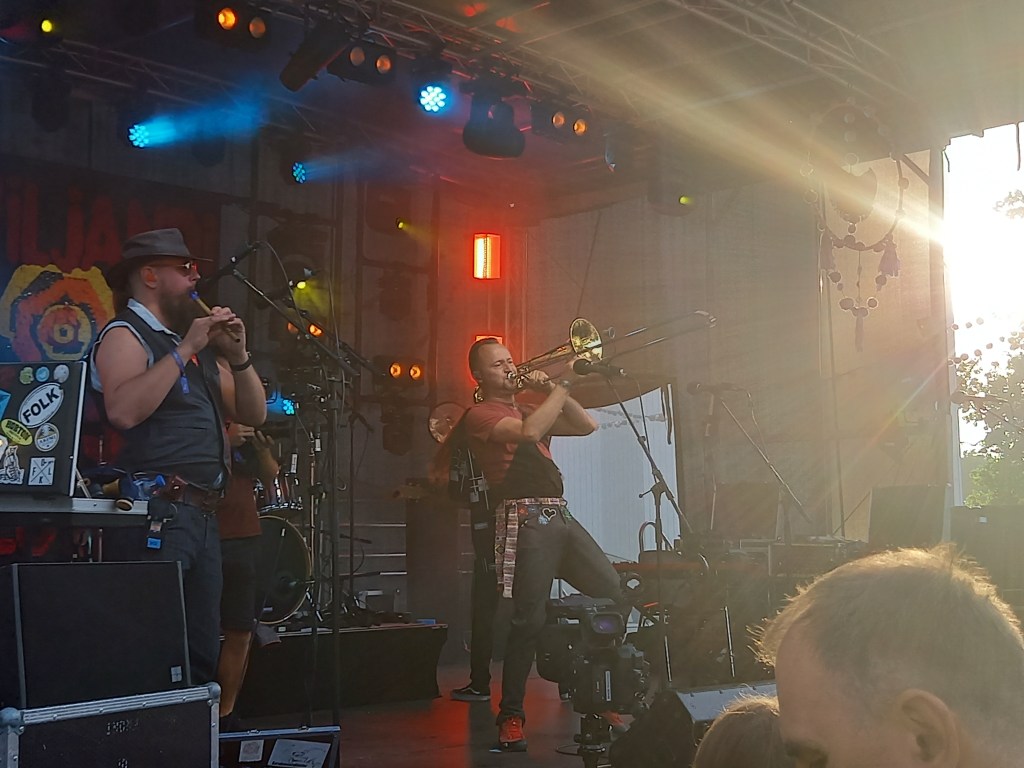
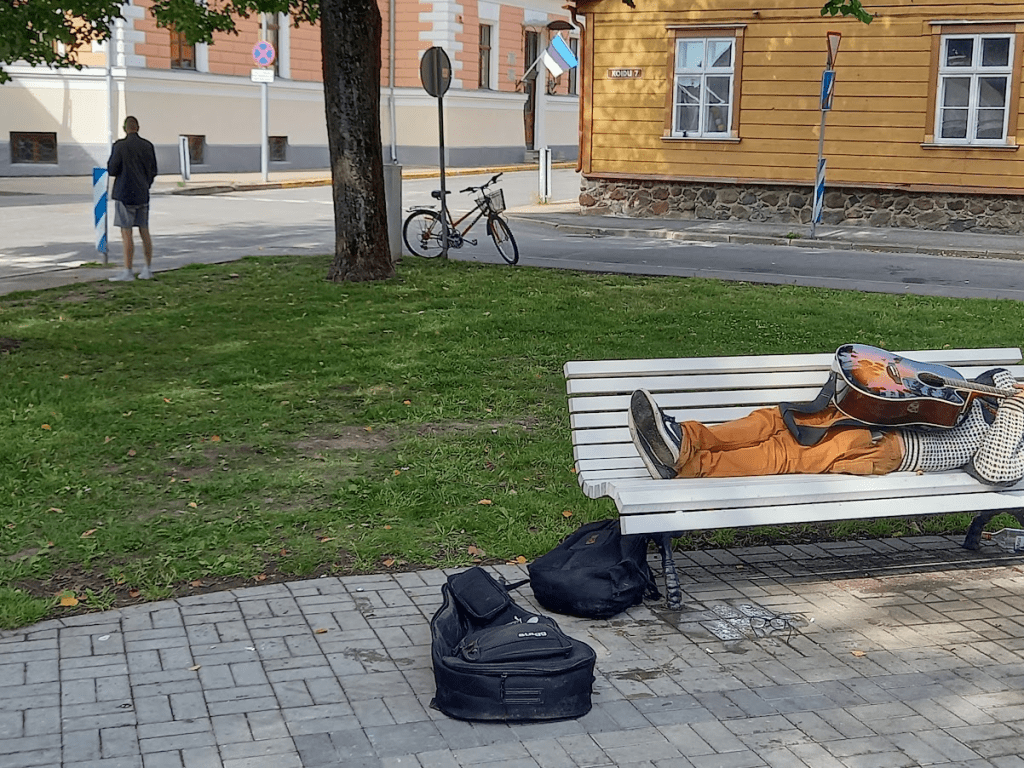
There is also the exhaustion that sets in. You try to see everything and fail, and then you can’t even make sense of what is happening around you. Some brass band was playing by my house one morning, but I have no idea who they were. When I walked to the festival on Sunday morning, I encountered a man sprawled on a bench while clutching his guitar in his sleep. His glasses lay beside him. Nearby, another man was smoking and watching the scene with tired blue eyes and nodding, as if trying to reassure himself that it wasn’t all a dream. It’s such a small festival, you know. It’s a small festival, in a small town, in a small country, playing music that is, mostly, enjoyed by a small group of people. Some people I know put down the Folk community. They would prefer to listen to the blues in Haapsalu, or operas in Kuressaare.
It’s not their thing.
When you are inside of this world, it slowly takes you over. Things start to seem larger, even legendary. As a writer, I am quite guilty of blowing almost every experience I have had out of proportion. Yet I must relate to you, as sincerely and as truly as possible, just how overwhelming the festival is. On Saturday, I hid out in the press room, munching on cherries and staring at the bookshelves while others scurried in and out on their way to see the Québécois act Le Diable à Cinq. From the corner, I heard someone talking about an interview with Kanal 2. All the people and sounds faded to the blurry margins. Everything was out of focus for a while. “There’s only so much information the mind can process,” a friend remarked. “So many faces, so much music.” I had been obliterated by accordions, drums, and bagpipes.
In the evenings, the Ait filled up with strangers. People huddled in shadowy corners, discussing things. Young men with facial hair and glasses, girls with interesting tattoos. It was as if they were all waiting for a train. Then Andre Maaker came in and I tried to help him with his guitars, only to realize that I was so tired that I was incapable of forming coherent sentences. I walked home in the glow of a waxing moon, with a head full of music, and a heart full of good feelings. I had, in time, become a part of this world and it had become a part of me and would stay. It reminded me of lines penned by the great American poet E.E. Cummings back in 1952. “I fear no fate, for you are my fate,” he wrote. “I want no world, for beautiful you are my world. You are whatever a moon has always meant and whatever a sun will always sing is you.” The morning after the folk festival, as I wrote this, I felt that I at last understood him.
THE APARTMENT was on the central square in an old pre-war building constructed during some period of authoritarian government. I got the keys from a friend who lives abroad. Her grandmother recently died and she said she would allow me to stay there while I was visiting the city. I just needed to know the number to open the front door, and the keys would be waiting for me in the mailbox. The flat was at the top of the first flight of stairs. The door was heavy, wooden. I worked both keys until the ancient lock turned and the door creaked open.
I went in.
The apartment was being renovated. All of the kitchen appliances had been unplugged from the walls. One of the rooms was completely being refinished and the workman’s ladder still stood in place. Two rooms were overflowing with stacks of old books. In the library, they still were ordered across the shelves. In a second room, they were stacked into seas of old boxes, one toppling over into another. The old woman had been religious and there was Christian imagery everywhere. There was also a tall, stained glass art nouveau lamp in the library. I paid almost no attention to this lamp as I spread my sheets out on the couch and went to sleep. When I woke up again, the lamp was shimmying back and forth and had grown a set of eyes.
The air was different too, thicker, as dense as water, and yet breathable. The art nouveau lamp was glowing and dancing and I stumbled past it to the corridor. The old woman’s cane was set against the wall in the corner, beside a silver crucifix. I felt up the side of the wall until I found the light switch and turned it on. With that first burst of electric light, the room became stationary, and the lamp returned to its usual form and shape. I noticed, as I walked back to the couch, that it was covered in a fine layer of dust. It must have all been my imagination.
The second time I woke up, the art nouveau lamp was glowing again and staring at me. It was brighter in the room again, and the air was even denser than before, like maple syrup. Books were removing themselves from the shelves and then reshelving themselves. An old wood spinning wheel in the corner was spitting out thread all by itself, as if run by some invisible hand. The light in the corridor was off again, but the room was so noisy and alive with flying books that I couldn’t even make my way across it. That’s when the woman fell out of the wall.
She was dressed in a cotton nightgown and was thin. Her hair was long and so blonde it was almost white. I couldn’t see her face because it was covered with her hair. She sat down beside me and was still, quiet. This, as I understood it, was Woman Number 2. She thus began to admonish me. “You have not been treating women well,” she said. “You have one in your heart and yet you entertain and use the others. It’s just not right!” She was clutching at a ball of white yarn and knitting away with a pair of soft, sun-browned hands. The room continued to pulse with light, and when I looked over at the art nouveau lamp, it winked at me and swayed.
Thereafter arrived Katla with two of her favorite girlfriends. They all went into the bathroom, where they disrobed. They were standing there under the spray of the shower and soaping up each other’s beautiful breasts. The women were younger than Katla, and one had very curly hair. After the lesbian shower, Katla dried off and put on some white clothes. She came into the room with the lamp, and I noticed that a small café had opened up in the corner. In fact, the entire side of the room had been replaced by the side of a street. Katla sat there with her blouse halfway open and ordered a coffee. A French waiter stepped quickly and brought it to her on a tray. Katla began to read through the morning’s newspaper in the August sunshine.
“But you have such beautiful eyes,” I told Katla. She only squinted at me over the paper. “Won’t you have me?” I implored her. “Please, tonight?” Katla only shook her head. “You have another woman in your heart now,” she said. “So go be with her.” “But I can’t be with her.” “She’s just your little saint now, isn’t she?” “You don’t even know who she is!” “I know everything already,” Katla said, sipping her coffee, “besides, I have no use for you anyway. You’re just a silly boy.”
I stepped away from her table at the café and was back in the room with the art nouveau lamp. The books were still flying off the shelves and landing again, like tiny birds in a park. The old gramophone in the corner began to spin, and a jazz song was playing through the dust. Woman Number 2 was now lying on the couch before me. She had pulled her ropey, yarny hair back from her strange blue eyes. I could see her face. She had pleasant features but almost look frightened. “Take me,” she whispered, as I crawled on top of her. “Take me, you bastard!”
When I woke up again, I noticed the dust on the lamp in the corner. Everything was back in its proper place. It had been a dream. Someone had turned off the light in the corridor though, and so I went to turn it back on. I was beginning to suspect the old woman’s apartment was haunted. Supposedly, it had once belonged to a pair of long-dead Lutheran deacons, and most of the religious art had belonged to them and not to her. Who were they, and what did they have to do with all of this? As I passed the lamp, it began to glow brilliantly and I saw its big eyes again. The room turned orange and the air was thick. The gramophone spun back to life and the lights began to flicker violently. I bolted for the door. It was ajar, and there were neighbors standing in the hall who had come to see what was up. They were in their pajamas.
Looking back, I saw Woman Number 2 sitting on the bed, waiting patiently for me in her nightgown. Katla was behind her, reading her newspaper at the boulevard café. She lifted her cup of coffee and the books began to fly off the shelves again. The works of Balzac, or that faded special commemorative volume about the ’84 Sarajevo Olympics. The books began to swarm in my direction as the door to the apartment shut. The lost old woman’s cane flew up from the corner and wedged itself in the door. I turned around and the jazz only played louder.
The orange light was so intense, I could no longer see.