ONCE IN A WHILE you need to write some romantic fluff. I once saw a girl here, whom I would remember as päikesekiir. Which means “ray of sunlight,” but sounds better in Estonian.
She was as pale and yellow as straw, and was trying to do yoga, of course.
Later she came over and spoke to me, because she knew who I was, and afterward my daughter said, “Who was that girl you were talking to?” And I said, “Girl?! That was a woman!”
After that I saw her somewhere else staring off into the distance. She was both light as air but thick with a heavy, desperate feeling. I wanted to run after her, but she was gone in a blink.
Which goes to show you that you can’t chase after sunlight.
WE HAD TO GO to a conference in Austria, or Switzerland? Some place with mountains in the heart of Europe, where people go skiing, with Alpine villages. We flew Swedbank Airlines, which became the new national carrier after the latest venture to create an Estonian airline went bankrupt and belly up. It had the symbol of Swedbank painted on the fuselage and all elements of its interior were true to Swedbank’s branding. We had a layover in Zurich, I think. That’s where things started to go awry.
For one, my eldest daughter got lost, and when I found her, she was eating pizza with some family friends at a local ski chalet. By the time we got back to the airport, my family was standing at the gate and they were calling our names. There was also a conference at this airport, which made it particularly overcrowded. The attendees were packed into an open air theatre, where the seats were constructed of servers. Someone told me that all of the data in Europe was being filtered through this one data center. From there, one could watch the planes approach and depart through the valley. It was snowing a lot too. It looked dangerous.
At last the sky cleared, and we boarded our plane to our final destination, arriving without incident. The hotel room was clean, in fact there was no furniture in it except for a bed. A familiar cat was in the room. With orange and white spots. She ran to the window and leaped up onto the window sill, and a gray cat came to the other side of the window and they began to communicate in their Austrian cat language. My wife also went to the window and leaned over, and that’s when desire overcame me and you know what happened next. “I hate you,” she kept saying. “You could never satisfy me. You’re not a real man.” But her words fell on deaf ears. The next destination was the big bed, the only furniture there. After she got to the bed, she shut up. The cats were still at the window and those wet snowflakes kept fluttering down.
I WAS MARRIED AGAIN, this time to Gunna. Funny that I couldn’t remember the courtship, or even the ceremony. How had it even happened? There it was, the certificate, lying at the top of a wastepaper basket. I took it out and examined it. It seemed to be legitimate. Gunna was in the other room packing for our big trip. She had taken some time off from work for our long-haul to the Americas. She was a kind woman and all, a bit sarcastic, and very cute, with that haircut of hers, and she could fill up a dress, but I didn’t feel well about the whole thing. Marriage? I hoped she hadn’t changed her name. How many more women would carry this heavy name around with them by the time the story was over? It even translated as “Big Rock.”
On the certificate, I could see that she had kept her original name. That provided a sparse moment of relief. Just a moment. There was a date of marriage there though. From that date, all things would be calculated. A marriage was like a loaf of bread. At some point, it would go stale. There were tricks to keep it fresh, maybe moisten the loaf and bake it in the oven for a while, or just deep freeze it and consume it later on? Gunna kept packing. Packing, packing, packing. She had a fine beige suitcase. I boiled up the last small yellow potatoes before we left.
I didn’t want them to go bad.
“We’re going to be late to the airport,” she said. “Why are you wasting time with those?”
“We can eat them on the way. Tell you what, why don’t you fly ahead? I’ll take the next plane.”
“Don’t be silly,” she said, grinning and gently slapping at my hand. “We’re married now.”
AFTER WE ARRIVED IN PARADISE, we took a long drive down a beach road. There was some kind of tourist workshop happening in an old barn. Maybe it had been a fisherman’s shack. It wasn’t very warm that day. Gunna was wearing a black pants, a long-sleeved shirt. Where were we anyway? It was only September. Maybe we had turned left somewhere and wound up in Prince Edward Island. Newfoundland? One of the Maritimes. To be honest, it looked a lot like Long Island back home. But why would anyone go there on vacation? We were gathered outside the fisherman’s hut as a local guide gave us a demonstration of the old folk ways.
I heard some commotion coming from the roadside. We walked over and in the sand dunes, we could see hundreds of wild rabbits scurrying in the sand. They were black or dark-furred rabbits. Just when you thought you had seen every rabbit, you noticed about 20 more of them hopping in from some other location. Why were they all running toward the sea? Did rabbits drown themselves like whales beached themselves? Some of the other tourists were delighted. “We’ll eat good tonight,” one man said. Gunna took out her camera. It was one of those disposable cameras, flat and long, like the kinds we had back in the 1980s. She stood there taking pictures of the beach rabbits. This would be a memorable moment of our honeymoon.
I stood there too, watching her take photos. In the distance, I could hear the sound of the sea.
I WAS LOOKING FOR A DRUMMER. Someone told me I could find one in this particular white Victorian on the corner of whatever street this was. Somewhere in the older part of town. I came up the hill and could already hear him rehearsing. All of the windows were open, but I couldn’t see anyone inside. I could only hear the beat of those drums. I couldn’t tell if they were coming from upstairs or downstairs. Once inside, I walked into the second-floor apartment, only to find it vacant. There was no furniture upstairs. The floors were spotless. Downstairs, I went into the kitchen. That was when it seemed all hell, as they say, broke loose.
There were, I suppose, seven or eight of them. Some might call them squatters, others might call them hippies. It’s hard for me to describe for you what kinds of outfits they had on. It looked like a combination of traditional mid-1960s Hells Angels biker garb crossed with The Adventures of Buckaroo Banzai Across the 8th Dimension. They were not happy with me for intruding in their musicians-squatters den. It looked like a summary execution was being planned. I didn’t know how to get out of this predicament, but, unfortunately, the war came.
It had been a sunny, clear day, but on the horizon, at the end of the street, I saw an orange glow, then a column of darkness. I realized that it was a missile being launched from over the Russian border. There were more of them, spirals of black surrounded in a kind of orange, fiery haze. “Zelenskiy must have hit some targets within Russia,” I thought, “and now Putin is retaliating.” He had said he would strike NATO. But NATO was all, or most, of Europe. Maybe some of those missiles were headed toward Oslo, I thought. Or maybe toward Germany. Some certainly would hit Estonia. Putin hated Estonia. He wanted to kill us all. Wipe us off the map.
At the end of the street, I began to hear more drums, this time in the form of a marching band. It was some kind of Estonian military victory day parade. And here came Kaitseliit, the defense league, marching along to the sounds of drums and bagpipes. From the other end of the street, I watched as a Russian rocket turned into a kind of red fire dragon and sprouted wings. It sailed by the windows of the Victorian. By this time, about a dozen or so pensioners had taken refuge in the house and the squabble with the squatters had been forgotten, for now. We stood there by the windows as the parade went up in flames. Because I was taller, I could see more. The length of the street was now frozen over with ice and snow. Was this what they called Armageddon Time, I thought? Where could we even run to? Where could we go hide?
“What do you see?” an old man asked. “What’s going on?” “It’s over now,” I said. “It’s all over.”
THE HUNTINGTON Y was under construction again. There were just beams and cement floors. I was given a tour by an old friend whom I did not recognize but who seemed to know me quite well. He had on a blue jacket, his hair was cut short, and he wore glasses. In short, he looked rather like a real estate agent, or Mormon missionary lite. There he was, showing me around. The entire floor plan of the old Y.M.C.A. was recognizable to me. I remembered the first day I went to that school. How I had promised myself that I would not be a baby like the others and would not cry for my mother. I could remember it all so clearly. Like yesterday.
That was at least one day I had succeeded. We walked together to the room, which was the first on the left, or actually the right, because we entered from the rear side of the building. It looked smaller there. I could see its outline, and had a vague memory of doing some kind of arts and crafts at a table there. I remembered one of the girls, who had platinum blonde hair.
This girl seemed to stick out in my memory.
The place had been gutted of course, but in a way it was refreshing. The sunlight poured through the beams. I could look out on that part of Huntington and see the athletic fields. The breeze smelled fresh. After, we walked to the end of the hall. That’s where we had classes our second year of preschool at the Y. I remembered many things from that room, especially a small book called Ten Little Indians and an accompanying cassette. I could remember some of the lyrics from the song, “one lost his prayer-stick …” When Thanksgiving came, we were all divided up into Pilgrims and Indians. I wanted to be an Indian. They got to wear feathers. But the teachers put me into the Pilgrim group. I got the Pilgrim black hat with the gold buckle.
Looking around this empty room, it was hard to believe that it had all happened here. Those memories seemed so cloudy, they seemed to be submerged in in a gray haze of time. The 1980s? When was that? But now all had been reduced to its bare essence. Only the walls were left, with some scattered wires too. My friend and I decided to walk down the hall toward the pool. It at least was still there. Entirely intact. There were still people swimming in the pool.
Later, we descended the steps of the Huntington Y to the first floor. This had been turned into a sort of open air market, like the one at Balti Jaama Turg in Tallinn, or the Baltic Station Market, as it’s called in English. A woman, who looked something like a flapper from the 1920s, or at least had that kind of haircut, came up to me, and asked me if I would go fetch her dress. I went into a back hallway, which was also well lit, and saw an array of silver dresses hanging suspended from hooks along the wall in the light. Those 1920s la garçonne dresses. Which silver dress would fit the woman? I didn’t know anything about dresses. Which one would fit?
IGRAYNE TOOK A JOB teaching at an old manor house in the countryside. Her classroom was in the cellar. It had vaulted brick ceilings and no natural lighting. Supposedly these were part of an older system of fortifications erected during the Swedish Era. But they had been plastered white, thanks in part to EU funding which had provided for the entire upgrade and upkeep of the school. It was Christmas when I went there to help her with the students. The entire school had been decorated, and there was even a small tree in the corner of her room. She was an attractive though tormented young woman. The torment was the star attraction.
Yes, I liked her very much.
After the final lesson before the break, we walked to the elevator. As soon as the door shut behind us, or in front of us, our hands were all over each other. It was a nice, natural, and passionate feeling. I’m not sure if it could be called love, but it was certainly a form or manifestation of love. It was warm, it was soft. On the first floor, the elevator doors opened. There was a small crowd of Japanese tourists there, waiting. At first they were shocked. Naturally, they started taking pictures. Igrayne didn’t care. “Just keep going,” Igrayne told me. “Just keep going.”
THE TOWN HAD CHANGED while I was away, and I had only been away for a short while. Tall pines and birches has sprouted up in every park. Locals had put up field stone walls to demarcate their properties. The streets had crumbled too, and the roots of the trees had grown over the roads, so that it almost made it impossible to ride your bicycle from one end to another. But the inhabitants did ride their bikes. And scooters. Two little boys were doing tricks on their scooters at the corner of Posti Street and Koidu. There was a large barn set back some ways where there once was a series of apartment houses. It had been painted Swedish red. On the other side of the street, the Joala Park side, was a stone wall. Trees towered over every piece of prime town real estate. It was as if they were blocking out the sun.
When I arrived at my house, I was surprised to find Veikko, our old neighbor, working in the yard. I didn’t realize that we had become neighbors again. There he was spinning his metal saw round and round, cutting his wood silently. “Working?” I said to him. “I am,” came the answer, his nose close to the saw. Inside my house, I noticed that Saare Kika was there. He was standing in the kitchen, washing the floors. Then he picked up a large wooden pizza peel, the kind that looks like a shovel and that they use in places like Napoli to slide pizzas into wood-fired ovens. The pizza peel was just dripping with red sauce. Saare Kika tossed it into the sink. He has this stoic, silent-type, iron man aura to him. Rugged, determined features. He turned.
“Your life is a complete mess,” he said. “And I’ve come here to help you clean it up.”
I nodded along and looked him over. Then I noticed that Saare Kika had sprouted a pair of gray wings. Were they real wings? Or just part of an elaborate Halloween costume? This I could not really say for sure. But they were wings, dangling from his back as he scrubbed down the pizza peel in my sink. It reminded me of legends I had heard about The Mothman in both West Virginia and in and around Chicago. Dark, insect-like creatures with the bodies of men but the wings of moths. They called them ‘winged humanoids.’ One woman claimed to have seen several of them. I asked Saare Kika if he was the Mothman, but he just laughed at the question.
“Mothman? No,” he said, pulling the peel from my sink. “I am Batman,” Kika said. “I am Batman.”
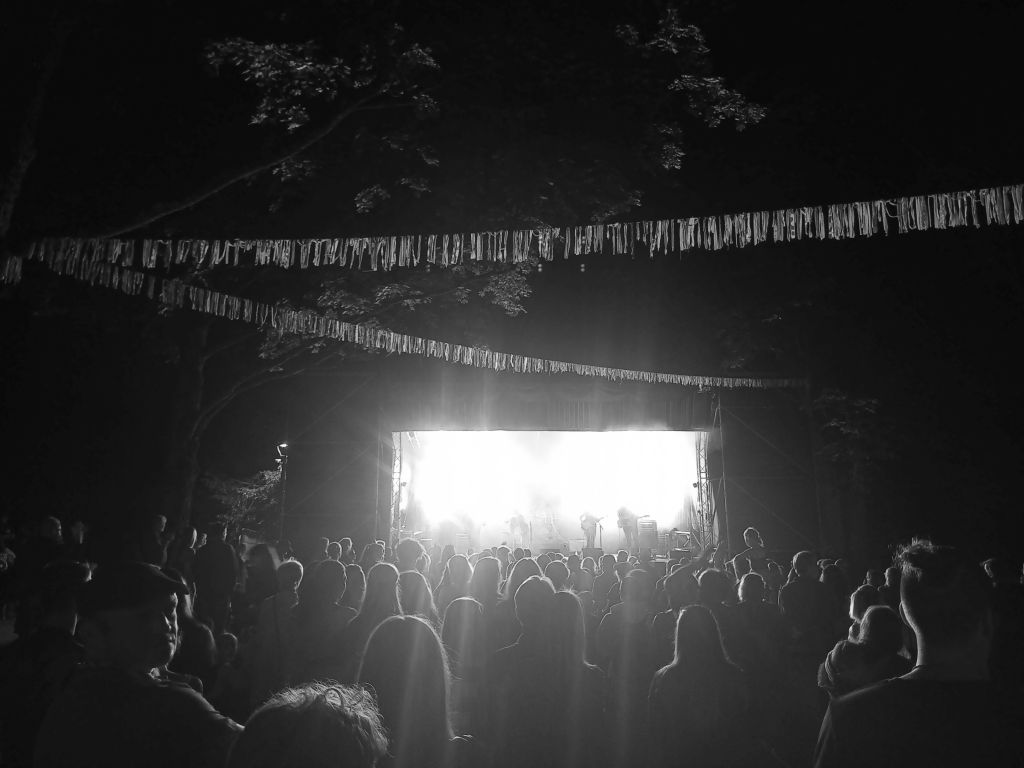
AT SOME MOMENT on Sunday evening I find myself in the grand hall of Viljandi’s Folk Music Center or Pärimusmuusika Ait looking for a good spot to rest a while and write. The hall is full of people, some standing, others gathering, talking and telling jokes. There are all kinds of people here, people with shaved faces and hairy chins, hippies, squares – but let’s be honest, most of them are a decade or more younger than I am. Beside the stage, three wonderfully light-haired girls are seated, one with shiny hoop earrings. I don’t know how old they are and don’t want to know. Two of them are looking at their phones, one has her head to her knees, apparently to just catch her breath. I watch them a moment more and then hoist myself up onto the edge of the stage. Every part of my body hurts: my legs, arms, back, and heart. My trustworthy satchel is wet from the rain, but my notebook is still dry. With a black pen, I begin to write. A few seconds later, a man appears before me, one with short hair and a brown sports jacket. He says he used to be my first daughter’s zoology teacher at the Viljandi Hobby School. That must have been a long time ago. His name is somewhat familiar, though I don’t recognize him. He has something in hand.
It’s a button. The kind you’d find on a jacket. There’s a trick too. There is something behind the button. This man goes around Viljandi installing these buttons on walls. When you tug the button, it pulls a piece of string behind it, and when the string goes back into the wall, the magic button plays beautiful music. “You just have to pull the button,” the man says. I don’t understand if I’m dreaming or not. I am at this moment so tired, that it all could be a hallucination. “That’s genius!” I say. The music is the same you would hear from a music box. “Why are you putting these buttons up?” I ask the man. “I wanted to bring a little more joy to the world,” he answers with a smile. Then the button man disappears into the crowds.
When the man is gone, I take some more time to unwind. The three girls are still sitting in the corner, looking half dead. It’s dark outside now. I actually have no idea what time it is, and only know, in a foggy way, that it is Sunday, which means that it’s the last day of Viljandi Folk. The concerts are still ongoing somewhere. And I promised Arno Tamm earlier that I would go see him during the final concert.
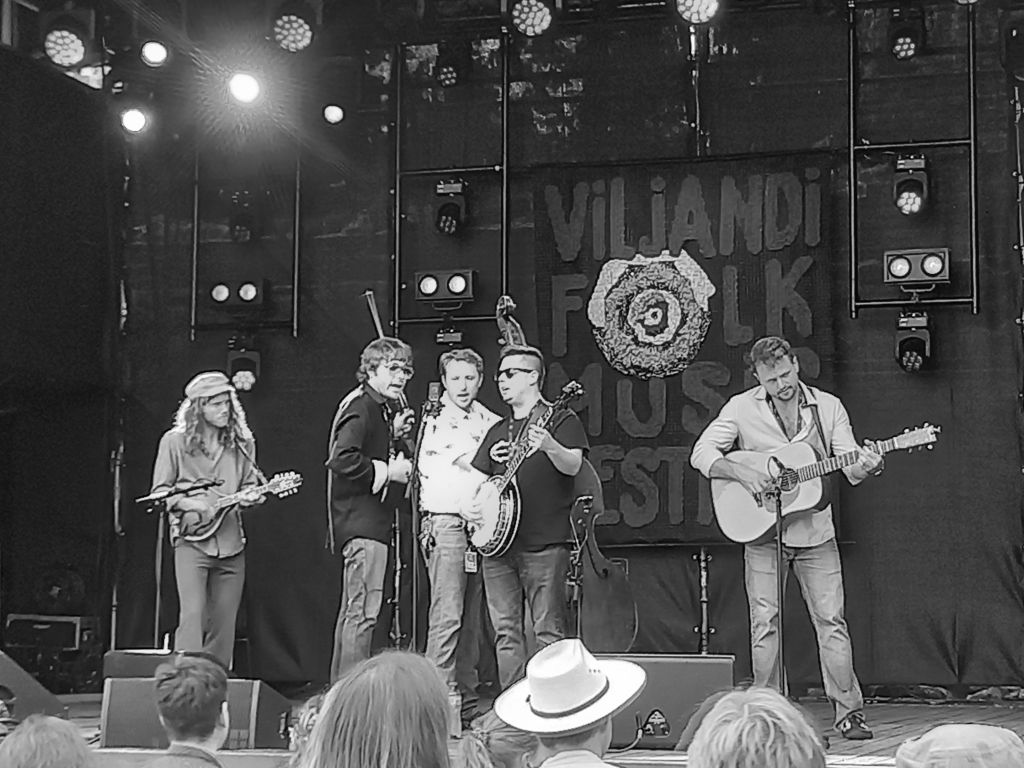
During one concert, I saw the American guitarist Jed Clark, who is from Arkansas and plays with the bluegrass band Midnight Ride, look out with tired eyes on Käevumägi, or the Well Hill, and a thousand or so beautiful people and say, “This festival is like a dream I don’t want to wake up from.” In the great hall of the Ait, I think that Jed is right. Earlier in the festival, I had a chat with him at the Green House Cafe. Jed told me in his soft Arkansas accent that Viljandi Folk was “just like paradise.”
I wasn’t so sure it was paradise. But a strange dream nonetheless.
***
“PEOPLE COME HERE from the US, from Canada, and they have a hard time believing that this is all real,” Tomás del Real, a Chilean musician, tells me the day after his concert was well received at the Jaak Johanson Stage. He performed on Saturday night, and people praised his performance the following morning. “It was all so intimate and cosy and yet so grand and so global,” some gushed to me. I had planned to go there, but somehow got lost along the way, and must admit that I don’t know exactly where I was when Tomás played that night. I allowed myself to live a little that evening and so everything from that evening has already faded into the mist. But I survived and supposedly the music was good.
“They see the lake, the castle ruins, and they think, what place is this?” Tomás continued his story. “For a festival, it’s a really great place, and the way the festival uses the surroundings, the aesthetics, are done with incredible taste. Nothing is overdone, everything is very natural, and they simply fill out the environment,” he said. Tomás is in some ways like me. A foreigner who came to Viljandi and got stuck here. Years before we came, Ruslan Trochynskyi, the trombonist from Svjata Vatra, arrived here from Ukraine and was similarly seduced. We are now like one big Folk family and not just us, who have come from abroad. Estonians have arrived here the same way. They come to Folk, go for a swim, and stay.
There is some kind of invisible pull. Even Tomás del Real, who is as clearheaded as they come, acknowledges this: “It is magnetic,” he admits.
I have of course heard criticism, that Estonian folk music is mostly fake and mostly synthetic, that the prices are too high, that this year’s Folk isn’t as good as last year’s, and so on. “These Folks are not like they used to be,” some say.
It is true that before there were fences and passes, folk was an anarchic experience and all kinds of weird people turned up in town. I called them the “zombie army” at the time, the drunks, Nazis, and rednecks. But all was permitted and the people enjoyed that anarchy. At some point, it was decided that Folk would be a bit safer and those days drew to a close. But the magic continued. Gates or no gates, the spirit of Folk cannot be contained. And the security staff are only looking for alcohol, really. They give your bag a squeeze and then wave you through with a grin. You have been examined. Go on your merry way.
I wanted to say, in response to this criticism, that whatever they have, people never seem to be satisfied with it. Something’s always missing from the picture. Unfortunately, this phenomenon is too familiar to me. I find myself on a train south, staring from a window. I think, what am I doing here in Viljandimaa? My heart is full of disappointment and melancholy. Other people, such as those from Tallinn, have said to me, “Why are you wasting your life in some hole in Estonia?”
Viljandi indeed is an odd place, one you can only reach intentionally. No one shows up here by accident. Folk does offer a lot of reasons for people to come here. It is a rich and deep event. For those who are never satisfied, I would say, take a look around. There is some value here. There is something different at least. I had these thoughts as I hid myself away in the press room in the cellar of the Pärimusmuusika Ait. Outside there was rain and thunder, and the Ait was full of soaking wet people. In the corner of the press room sat my one true love, the object of my affection. But who is this quiet girl? What’s her name?
She’s a coffee machine, naturally.
***
THERE ARE ALL KINDS of stories shared in the press room during the folk music festival. One day, after a concert by Canzoniere Grecanico Salentino, I found myself seated again beside my beloved coffee machine listening to her purr. I must acknowledge that Folk is an exhausting experience. Even after just a few hours at Folk, a person is squeezed dry. All of that noise, all of those conversations and songs. Espressos are needed for a quick pick-me-up, so that one can still walk and write. The Italian group CGS is from Puglia, the province in Italy from which my mother’s family originates. One of their songs was about love, of course. This melancholic song describes a lovestruck man who sits beneath a woman’s window night after night, until the woman closes the window. But there he continues to wait until death, so devoted is he to the woman he loves. For me, this song was somehow refreshing. I have never heard of an Estonian who would do such a thing. Estonians are too practical for that. They wouldn’t waste their time in the name of Mediterranean love. But Mediterranean love is just like that. Passionate. Full of devotion.
“But in Estonia,” I tell a colleague in the press room, “if you sat underneath that window, the woman would call the police.” “Well, yeah,” she answered. “That could be really annoying.”
“But what do Estonians do when they fall in love?” I ask. “Does someone gift the other some potatoes? Or a bucket full of chanterelles?”
“No, no, they just enjoy their time together,” the woman explained.
“So that they are in the forest somewhere and one says to the other, ‘Nice day, isn’t it?’ Is that how they do it?”
The woman looked at me with her clear blue eyes. “If it’s love, then there’s no need to talk. You just have to feel it.” Simple. So, sitting underneath someone’s window isn’t especially welcome here in Estonia. But I have definitely wanted to sit beneath some women’s windows, at least a few times, whether I am allowed to or not.
***
LOVE WASN’T THE ONLY SUBJECT haunting me at Folk. Another was age, certainly. Not that I really needed to think about age so badly, but when most of the people around you are at least 20 years younger than you at least, and three of them are your own daughters, then it comes to mind. At some moment, Uncle Justin wound up in the company of some young ladies in their early-twenties and forgot for a while whether he was a responsible parent or just another one of the pack. So I went along with them. It was a good feeling. I started to feel like one of those older Beatniks, like the poet Allen Ginsberg or wild man Neal Cassady, when they joined forces with the young hippies of the 1960s. If things are moving in that direction, then why not go with it? Why not? Beautiful kids with beautiful eyes. Students who aren’t yet jaded or embittered. They still have hope. They go to sleep listening to music. They don’t make the sarcastic jokes of our generation. With them I am gentler, I listen more, and I’m supportive.
As I told a friend at Folk, we are some kind of bridge generation. There are those important icons from the days of the Singing Revolution: Mart Laar, Edgar Savisaar, Siim Kallas, Tiit Vähi, and the others. And then there are these fresh young people who know nothing about that era and for whom it’s all just history. We are in between them, people like Margus Tsahkna or Jüri Ratas, who were both at Folk. We know where the bodies are buried, metaphorically, but we don’t want to share that information with the kids. Let them enjoy their youth. Let them run around holding hands when it’s raining and the Zetod are rocking. When someone comes by and reaches out, we take their hand in ours and run along together.
The Puuluup concert was a truly strange sight though. Their music is one that really does haunt you. The Hiiu kannel has the kind of sound that makes it hard to determine where it’s coming from. It sounds as if someone is playing with time. If I could ever play the sky and the clouds, it might just sound like the sound of a Hiiu kannel. There were so many people at the concert, it looked like a sea or bubbling soup. I watched and listened. Afterwards, I arrived at the idea that I no longer had an age. Age was just a number. But I felt in that moment, standing on that hilltop looking down, that I was more like some kind of Hindu deity. The embodiment of Shiva or Kali. Even when I was a child I knew it. The world told me what my age was, but inside myself I couldn’t tell the difference whether I was three or four years old.
“I don’t feel old,” said the American folk musician David Crosby shortly before his death last year. “I feel the same way I have always felt. It’s just my body that has aged.”
I was and I am.
When Midnight Ride played on Kaevumägi, they called themselves the sons of Bill Monroe and Earl Scruggs. But I thought instead that nobody is actually the son of anybody. There is no before and there is no after. Music doesn’t age, just like souls do not age. Music is undying, as they say and exists at all times. All you have to do is to play it. I exist. In this way, we are all like music, undying, immortal. These were the thoughts I had during the Puuluup concert.
***
A DAY AFTER THE CONCERT, I met up with Ramo Teder, half of Puuluup, who with his long white hair looks like he could be the managing director of Santa Claus’ elf toy factory at the North Pole. Maybe because he lived in Finland for so many years. Ramo is actually from Viljandi. On social media, one can see a photo of Ramo when he was a punk at the end of the 1980s. He looks quite stylish, a combination of Johnny Rotten and Wolfgang Amadeus Mozart. Puuluup is certainly not a punk group. There’s no “Anarchy in the UK” here, or in Estonia for that matter. But Ramo discussed how punk had influenced the ideas behind Puuluup.
“The idea that you have to overcome boundaries,” he said. The idea that all archetypes are tossed out the window. Estonian punk was different from American or British punk. Estonian punks were more like intellectuals. Most of the people in the Estonian SSR were standard issue. They wore the same clothes and had the same hairstyles. That some young man was walking around Viljandi with such hair was against the system. Hair, in this way, can be dangerous. There he now stands on stage, with a kannel in hand, age 53, singing about small birch trees. He also belongs to the tribe. Ramo is another brick in the Folk castle.
After the interview with Ramo, I found myself at the Eesti Etno concert. There were all kinds of musicians there, and they looked so happy. Were they too happy? I was dealing that week with the death of a high school friend. News about a friend’s suicide arrives slowly, even nowadays. Nobody talks about it on social media, only when you are famous. It took time to understand why this 43-year-old man had died “tragically and unexpectedly” as it said in a news article. But I eventually found out. So those Eesti Etno singers were singing and I was thinking about death and suicide.
One song did lift my mood. A young Indian was singing and the other sang along with him. At that point, I couldn’t really believe what I was seeing. Their clothes were so colorful. The music was so good. As sweet and satisfying as a mango lassi. It all looked like some kind of pajama party or Indian cult. Maybe some ashram had come to Estonia? Anyway, that was the right song for me at that moment, a person who was destabilized. Tragedy is like a little black cloud that follows you around everywhere. A song can help. Music can save lives. I would have liked to save my friend’s life the same way.
One night on the First Cherry Hill, as it is called, I thought I saw him, standing beneath a tree. But it was someone else.
***
DURING THE FESTIVAL, it becomes difficult to put one’s thoughts together. Looking through my notebook, I can find these kinds of scattered sentences and half-memories. “I left my journal in the press room, but Peeter the Estonian Swede came after me to tell me, and I ran back to get it, because my journal is full of kompromat that could make my life really difficult.” Or, “Some pharmacist from Tartu came up to me and started to talk about Paavo Matsin.” And, “Lauri Räpp was talking about resilience.”
The days melted together. There were a lot of concerts, for sure. The Italians. The Mexicans. The 6hunesseq-ians. Now that was a powerful concert, held in St. John’s Church at midnight. I fell asleep multiple times, because I was so tired, but the music was soft, warm, and enveloping, like a comfortable blanket. The musicians were out of view, because they were on the second floor, where the church’s orel is located. After they came down and people applauded. I guess I went home after that. I don’t quite remember. My friend found a rabbit in a park in Viljandi around the same time and took it into her tent. Later, she found the rabbit’s owner. These kinds of things happen during Folk. The mind no longer works. There is too much information, too much stimulation.
Then one day I met a man who told me that Lennart Meri’s book Silver White is the Bible of the Estonians, and how the Estonians, or rather the Baltic Finns, are very special people, and how Meri, Uku Masing, and Valdur Mikita had written “philosophical diamonds!” The man is working with a project called Valge Laev, or White Ship, to develop the higher intellect of the Baltic Finns. “But if the Estonians are so smart,” I told him, “then why do you need me for your project?” “Because you can help us bring it to the wider world!” came the answer. He had a fur hat and a green shirt. A beard. Sparkling blue eyes. Like a photo from the collection of Johannes Pääsuke. The green shirt was inside out. Of course, I agreed to help. When the Land of Mary calls you, you heed that call.
The following morning I have a slight hangover, because I thought the prior evening that I would allow myself to live a little. I asked myself, what would your favorite writer Scott Fitzgerald do if he was at Viljandi Folk? The answer arrived at once: start drinking wine! Life is for living! That night I wound up at the Untsakad concert at midnight. This was really like Anarchy in Estonia. I have never seen so many happy young people before. Untsakad are old men. They played at the first festival 31 years ago. But their fans are teenagers, or at university. I’m not sure what’s the attraction. Waltzes? Polkas? I like the Mexican band Kumbia Boruka more. They brought every cell in their bodies alive with their rhythms. They also appealed to writer Gert Kiiler, who said they reminded him of the show Miami Vice. “You know, they always have that kind of music playing somewhere in the background.” My friend, a Tallinn businesswoman who attends Folk regularly, recalled how she once had Don Johnson’s picture in her bathroom, so she could see him while she was taking a shower.
But Untsakad won over people’s hearts in the end. Even my 17-year-old daughter awoke the next morning and started to sing the “The Forest Brothers’ Song.” Ai-tsih, ai-tsah, ai velled, me metsavennad oleme! Which means something like, “we are the forest brothers, we are.” It really got inside her. For her the experience was also something like a dream. I received her rendition joyfully. “You’re a good forest brother’s daughter,” I thought, “even if your father is not a forest brother.”
***
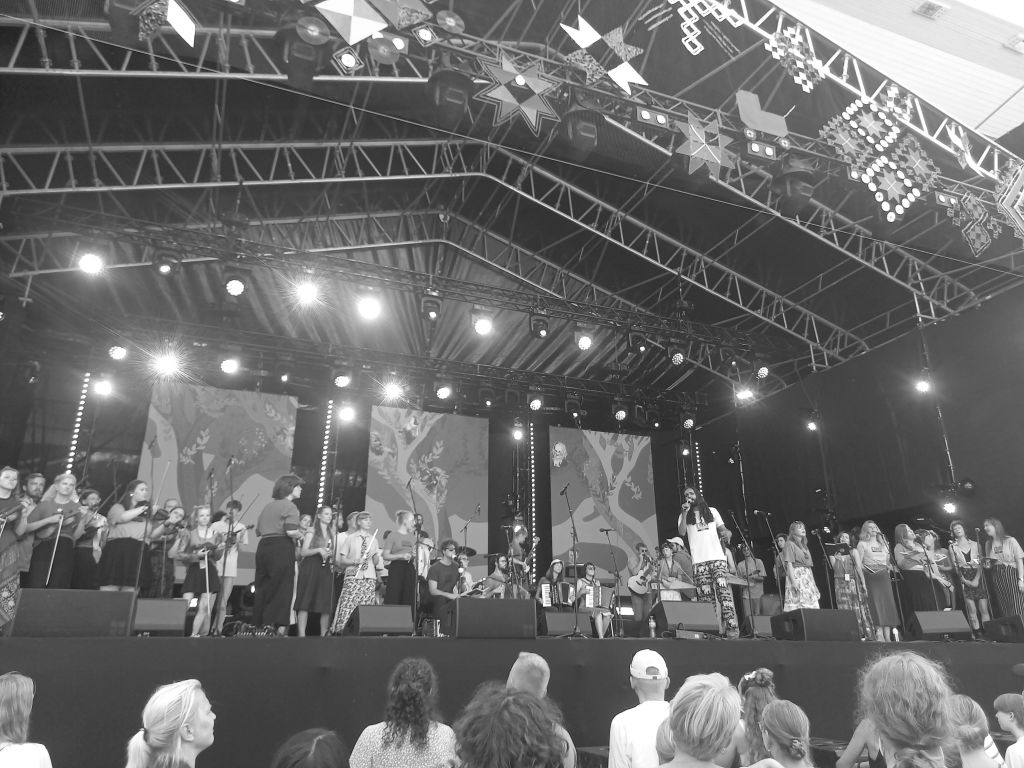
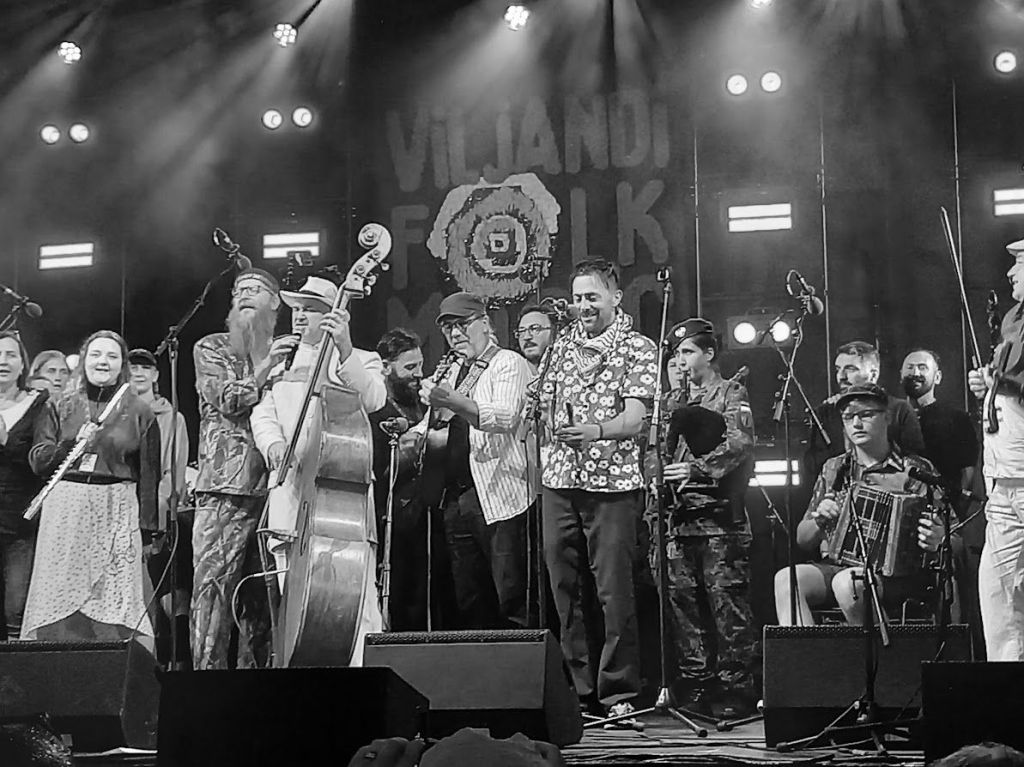
SOME PEOPLE COME and go during Folk, but then there are people like me who are folk soldiers and stay until the last concert. We gather in the rain as Ando and Friends sing. Ando Kiviberg is the founder of Folk and the festival usually falls on his birthday. This year, he’s 55! Ando and Friends is some kind of variety show. Every kind of band performs there. The man himself is a Leo, naturally. He is the king of the jungle. There he is with his fuzzy face in his white suit and white hat, looking like some kind of Latin American drug dealer. He plays the bass and sings along. It’s nice to see the king in his element. The leader role suits him well. Ando is neither arrogant nor pretentious. He doesn’t think that he’s better than the others, no. But still they come, like small house cats, with their offerings to the Great Lion! Neither dead birds or mice, but songs. Silver Sepp has taken Tony Rennis’ 1962 Italian pop song, “Quando, Quando, Quando,” and made it over. The song’s new name is “Ando, Ando, Ando.”
At some moment, I get tired of all those bagpipes and fiddles and go to the other side of the Second Cherry Hill. There I stand beneath an umbrella and put on my headphones. I’d like to hear a little Led Zeppelin now. I am done with all of this folk music! I’d rather listen to “When the Levee Breaks.” To my surprise, these two things suit each other surprisingly well. I look up at the big screen and see Ando singing. But instead I hear Robert Plant’s voice. Ando is singing, “Crying won’t help you, praying won’t do you no good!” It’s still raining. We are all soaked. Soon the levee really will break. An incredible combination. Ando and Zeppelin. My own levee really has broken. Then I realize that I have really lost it by now. I march over to the Ait. I look for a comfortable corner inside where a burned out writer can relax a little. Then that stranger appears with his magic button in hand. The three girls are in the corner and I am sitting on the edge of the stage. The man is showing me his button.
“That’s genius,” I say. My voice sounds distant, as if it belongs to someone else. “Just genius.”
An Estonian version of this article appears in Edasi, and the original was written by the author in Estonian and rewritten into English. The English and Estonian versions have some differences, so do read both!
THERE WERE multiple archaeological teams in pursuit of the golden idol. We just happened to get to the source first, but the others weren’t far behind. It was like a real football pileup. So many people wanted it, this small rectangular piece of wood. It was adorned with golden symbols and engraved with the face of a goddess whose name was H. The name was inscribed across the idol in a strange and unknown alphabet. The goddess’ face had a small mouth that could talk or rather whisper. In this way it imparted its secrets.
We took the idol back with us. Along the way, the golden idol turned into a lion.
***
WE TOOK the idol along to Maggie’s Farm. It was beside the Port of Tallinn and had direct access to the sea. Maggie was outside hanging laundry to dry when we arrived. I was afraid the lion would eat the rest of her livestock, but it curled up in the barn with the donkeys and geese and took a well-deserved nap. At the farm, there was a small ceramic figurine of the philosopher John Locke, but its face had broken off. I took it as my task to replace the Locke figurine, but this turned out to be harder than it seemed. At the same time, she bustled about in the other room, rushing with the renovation work. A lamp needed to be installed. A ceiling needed to be repainted. “Stop messing around with John Locke!” Maggie scolded me. “I need your help over here.” We were fighting just like in the old days. She couldn’t slow down.
***
THE WIND PICKED UP and carried away the lion. But it was no longer in the shape of a lion, but a large golden sphere. It blew up and away along the coast, in the direction of Pirita. Naturally, I ran after that. On the way, I passed a seaside pub where utterly worthless characters, most of them British, were playing cards. I took a stone staircase down to the sea, where there was another beachside bar. A British bartender materialized and helped me to pull the floating golden sphere, that had once been a lion, and had also once been an idol, from the sea. It was lodged between two rocks in the coastal waters. This Brit was friendly. He had a mustache and apron. He said, “All in a day’s work,” and smiled once we had the idol in hand.
***
TRIUMPHANT I returned with the sphere. I felt like I mattered, that I was worth something, and therefore worthy of affection. When I got back to Maggie’s Farm though she didn’t even look at me. She was too busy planning another renovation. This time the roof would get an upgrade. Her fortune teller Magda was there with her hair pulled up inside a white scarf, and a small Andean flute band had congregated and began to play. “But we don’t need all this bread and circus,” I told Maggie. “I’ve got the idol right here!” She didn’t listen. “Everything we need is right here, in this idol. Let’s go inside the house and make love.” Maggie couldn’t hear me. She was telling the roofers what to do. The Andeans were playing their songs. The fortune teller held a finger to her lips. Nobody could hear me. Everyone else was too busy to listen.
THERE’S NOTHING LIKE a 6 am coffee from Circle K. Actually there is something better, and it’s the special Finnair blueberry juice. During the flight over the Atlantic, they just leave it in the back of the plane in the kitchenette, and you can help yourself to as many cups as you like. I feel like Finnair is also my home in a way. And Helsinki Airport. Like I told my mom before I left, I don’t mind a layover in Helsinki, Finland.
I’ve spent half my life waiting in that airport.
I like Finland. Finnish, and by extension Estonian, women are super cute. I can see in my younger self, a sort of terrible but innate and unavoidable lecherousness, which is in and of itself a part of the biological condition. Such things can be ignored for only so long. Herein lies the conundrum of the suburbs. We are raised in comfort and expected to fall in line, but then things go haywire for so many of us and we do rather stupid and adventurous things. Restless people wind up in America, and you think that their descendants are somehow not like them? We are somehow more mellow and set in our ways, because we happened to be raised with a Nintendo and trusty pizza place up the way? I’ve got former classmates scattered all over the earth. You have to wonder, what went wrong here with all of us?
Or did anything go wrong at all?
Maybe things are just as they are.
Do you realize I have been crossing the North Atlantic by plane for more than two decades now? I’ve got grainy photos of me standing in Christiania in Copenhagen trying to pull a sword from a stone. Or that cold morning bus station in Stockholm, the day I fell ill and went to see the Vasa for the first time? I also remember my first trip to Iceland, which was in March 2001, and being on the Icelandair flight, which already had personal screens installed, and watching Coldplay’s “Don’t Panic” video, and the Icelandair attendant coming by and asking me if I wanted some coffee and knowing just by the look in her eyes that I was dealing with some other, non-American Icelandic lifeform.
Iceland had always intrigued me because I had been assigned to write a country report about it in the sixth grade. I had zero interest in this place. But it grew on me, the fermented shark meat, the geothermal pools. Among the first things I did on my first trip to Iceland was go to the supermarket and pick up some skyr, a yogurt that you can find tubs of in any American supermarket today, but was like an exotic food even back then. I put the skyr sticker in my passport like a souvenir, and you can imagine how the passport control officer looked at me when he went to stamp my passport and this sticker fell out.
Life just sort of went that way, and I went from Iceland to Denmark, and from Denmark, after some interludes in Norway and Sweden, to Finland, from which I predictably wound up in Estonia. I forget these things from time to time. I think when you are younger, maybe 25, you have a much shorter, more dynamic self narrative, but when you get to 44, there is so much time, and there were so many phases, that huge chunks of them can just drop off into the abyss like melted Greenlandic icebergs. You are reminded of stuff you did and think, “Oh yeah, I forgot about that.” Happens every day. Years melt into years.
I wonder about the vantage point of older people who talk about stuff that happened in the 1960s. Like that’s a whole other block of time removed from the present, and how can you recall stuff that happened in 1966 without it being repackaged into new narratives. I mean, does your recall remain the same, or are you rewriting those past moments every time to remember them? My parents are still cruising around Long Island listening to something called Yacht Rock Radio, where they play the Doobie Brothers, Michael McDonald, Steely Dan, and some DJ who sounds like a guest star on The Love Boat or Fantasy Island treats you to all the best yacht rock hits. “It was the era,” my father says with the wind in his hair listening to Michael McDonald. “The era!”
Anyway, where was I?
The Circle K 6 am coffee. Circle K is a lifeline to anyone past midnight in Estonia. Everything else is closed. French fries are the sole sustenance, unless you are brave enough to eat one of those double-barrelled hot dogs. The french fries, mind you, costed me only €1.50 per portion. In Sag Harbor, they would be like … $10. People keep asking me, do you ever think of moving back to Long Island? I say, sure, when I get my $7 million dollar advance on my next book, I’ll pick up a nice house next to Drew Barrymore’s and we can play tennis together. You’re all invited! I mean, come on. Let’s get real. Even diehard East End Long Islanders are fleeing because they have been driven to eating roadkill because of the ultra rich. The rich destroy almost everything they touch. They come into an area of cultural diversity, and the ‘just folks’ people who made it that way are eventually forced out, leaving behind executives with tennis courts.
So I am here, in Tallinn, with my 6 am coffee. I still call Circle K Statoil out of habit, and because I liked the Statoil branding better. Statoil also sounded better in Estonian. All kinds of characters exist in Statoil/Circle K in the early hours. There’s a kind of rough-edged party element in places like Tallinn, but also in Copenhagen, Reykjavik, especially in summer. In New York, the people sleeping in the train station are homeless, but in these places, they are more like young women (or men) who just had too much to drink last night. And also jetlagged people like myself who are hungry and on some weird inverted vampire sleep schedule, so that I want to sleep when everyone else is awake and vice versa. But, oh look, there’s the Linnahall. And there’s the spire of St. Olaf’s Church. This place. How did I even get here? I have no idea. Here I am, buying coffee.
To borrow a quote from Full Metal Jacket, “This is my Circle K 6 am coffee. There are many like it, but this one is mine.”