I WAS OUTSIDE when the helicopter came down. It was a military transport. I think it was from our side. The pilot tried to fly higher before it arched into a tailspin, eventually crashing nose first into some surrounding fields. There were sirens after that, and ambulances and stretchers, but there were no survivors. I was in the garden in front of the manor house when that happened. It was warm summer day. There was a gentle breeze and a bright sun was out.
The smell of the flowers was fragrant. It mingled with the smoke from the crash. I went inside.
There were many rooms in the manor house. In one of them, Celeste was sprawled out in a bed full of messy sheets. There was light on her face through the windows. She seemed unhappy, or at least restless. I took my place beside her. She said nothing at first, but there was a kind of hum or vibration that was familiar to me. I thought we were alone. She looked at me, and said, “I know you love me and have always loved me.” Her castle defenses were at last abandoned. Her walls came down and Celeste stared at me. “You are still here,” she said. “I don’t know why you are still here with me, waiting for me, after all this. Why are you here?”
I remembered that day in the garden, when the summer wind blew her dress above her waist. That had been years ago. Another lifetime. I had reached up and pulled the dress down, setting it back into place. Celeste looked at me again. We kissed. We had never kissed like this before. It was a passionate kiss, and I melted into her as deeply as was possible to disappear into another person. “But I am not sure,” she said, sitting up in bed. “I am not sure about so many things.” “You don’t have to be sure,” I told Celeste. “But I will still be here, waiting for you.”
It had been a weird afternoon. A helicopter crash. A kiss with Celeste. Her thick tangles of hair ran everywhere, over the pillows and blankets. I must have really been dreaming. The maid came into the room in the middle of this and saw us. She asked if we wanted her to make up the bed. I said no, that it could all wait. Then the maid asked if she could have a kiss from me. There were other women standing behind her. Lots of women. They were standing in the corners, and sitting in the bunk beds, glaring down at me madly like a dozen Cheshire cats.
“Just one time! Please, kiss me! Please!”
I only laughed in response and snuggled closer to Celeste. “You all must be joking,” I said.
I HAD NEVER been on a train like that before. It slumped along through the forests of the hills. It was cylindrical in design, but as far as I could tell had no kind of wheels or tracks. Instead, it was propelled downward by its weight, almost like a sled. It was red on the inside and on the outside. There were seats for passengers, but I was the only one. In the front, there was a conductor with an old-fashioned suit and handlebar mustache. He stared out the front window, and I could see the ships in the distance. Then the train slid into a dispatching point by the piers. Some men were loading up a sailing ship with cargo nearby. “This is Baltimore Harbor, Baltimore Harbor last stop,” the conductor announced. The doors opened. I got out.
How strange to be back in America. And why did I wind up in Baltimore Harbor? I could smell the frizzle fry of crabcakes from a restaurant somewhere. Ah, Chesapeake crabcakes. I began to walk along the seafront there, until I realized I was being trailed by some strange men, dark-haired characters, perhaps from the Medellin cartel. I turned up a side street to lose them, then went down another. I stepped up into an old building that I thought was a hotel. Inside, there was a sort of plump woman waiting for me outside a door. She had a gray and blue dress, she had long curly hair, and wasn’t particularly attractive. She told me that she had been sent by the cartel to poison me. I began to kiss her immediately, with passion, and we fell through the door into the room. What could be hotter or more arousing than a woman sent to kill you?
This room turned out to be part of a restaurant. It was dark inside, but there were small tables around which were seated couples talking about their previous relationships and career choices. One of them was familiar to me. It was Lea, a businesswoman from Tallinn. She was engaged in some date night talk with a man of Middle Eastern descent. She looked quite nice, and was dressed well. He had on a black turtleneck and jacket. I wondered where she had met him. The candlelight was reflected in her blue eyes and I could see the outline of her blonde hair. The man kept talking as if nothing was amiss. “Don’t mind us,” I said, as I shagged the plump assassin over a neighboring table. “We’re just discussing something.” We knocked over the candles and the utencils dropped from the table. Finally, we both climaxed. It was intense. Lea seemed slightly confused by the scene but continued to dig through her crabcakes.
After the plump assassin was vanquished, I went for a stroll. I took a train to Washington’s Union Station and started off toward Embassy Row. Maybe I should go see my family, I thought. They aren’t so far away. I passed a few embassies, protected by high walls and barbed wire, and armed guards. Flags flapped in the night. Just then, I became aware that I was being followed again. This time it was the Chinese. Maybe they had something to do with Medellin?
I couldn’t be sure.
Outside the Estonian Embassy, I noticed there was a family of rather ferocious chickens pecking about in a park. I induced the Mother Hen to attack this new team of assailants, and it tore into both of them in a cloud of feathers. They were killed. After that, I packed the bodies into a suitcase and tossed it into the Potomac River in Georgetown. There was little to tie me to the killings, and, besides, I hadn’t actually killed anyone. I was an accessory at best. The autopsy would reveal that both were murdered by a chicken. An open and shut case. The end.
WE WERE SWIMMING when we saw it. A long, dragon-like creature slithering toward the shore, its body half in the water and half outside of it. It had a kind of brown color, but its skin also had hues of orange and purple. It had a large, wide mouth, similar to a pike or freshwater bass. Its eyes were black and devoid of sentience. I didn’t feel immediately threatened, but didn’t want to stand in its way either. We huddled close to a cluster of rocks in the seawater.
We waited for it to leave.
What happened next surprised us. The creature went up on the sand, and I could see that it had developed some small feet that allowed it to move around on dry grounds. Some nearby sunbathers were frightened naturally, and a woman got it to move away by waving a towel. “Get away, you beast!” she cried. The creature arrived at the tree and began to climb it.
There were some very large squirrels up in that tree. I was worried about what the sea creature would do to those squirrels. I should have been more concerned for the sea creature. The sound of the way those squirrels attacked that poor thing would continue to haunt me. Five or six of them fell upon that snake-like freak of evolution, tearing into its skin. In a particularly fraught moment, I heard the sea creature groan out in pain. It came down the tree again, and vanished into the seas to lick its many wounds, if such wounds could ever be licked.
I later recounted this story to my old colleagues in New York. They had moved into an office on the 11th floor of a new building near Whitehead Hicks Park. We were so high up that I could feel the building sway with the wind, and I almost felt grateful I had left Manhattan in my past. Few cared to hear my outrageous tale. The newsroom now amounted to a bunch of elementary school desks arranged in long rows on both sides of the office. Jack, an English painter I know from Estonia, was there working diligently. Someone said he had taken my job.
On the bus back from the beach after the sea creature incident, I had recounted the story again and again to passengers. One teenager even forgot his bus ticket money, and I agreed to retell the story so that he would have free passage. In the office, I began to tell the story again.
As I said, almost nobody was listening.
My Swedish friend Erland was there too. He had recently gotten a job as a bike messenger, and was a little amused by the matter. His new employer had not forced him to cut his long hair. Celeste, an Estonian woman I had loved for many years, but who had not loved me back, and with whom now existed a state of what could be called “a lack of mutual recognition” in international diplomacy, was also there. She wore blue and her red curls looked magnificent.
Celeste laughed a little bit when I talked loudly about the sea creature and those monstrous squirrels. I happened to have Erland’s keys with me, and so I walked over to Celeste and handed her Erland’s keys. Celeste stared down into her palm at the key set and laughed again. I wasn’t sure what the symbolic value was, but at least she reacted. I had missed her very much.
HEIDI WAS STRETCHED out on some kind of wooden platform at the intersection of Sun and Moon Streets. It was right in front of the large brick edifice that once belonged to a local Jewish merchant. That was in the interwar years, before the Great Death. She was stretched out there in the sunlight, with her rear exposed and also her back. The rest of her bundles of clothes were bunched up around her knees and neck. The wind blew through her gold hair. I wondered what I should do about the whole scene. I walked around her on the platform and examined her. I wondered if I should take things a step further. But didn’t she have a boyfriend? Prince Hans of the Seven Isles? I left and walked farther down Moon Street.
Smith had opened a new café a few doors down from the Bhutanese restaurant. He called it “Smith’s Espresso.” A large ceramic cup was suspended from a hook above the door. Inside, there were just a few tables and a coffee machine. Smith wore an apron and a old-fashioned cap and fixed me the drink. There was another patron, a college student of about 19, who was from some other country, a Hungarian maybe. He wanted to know about Jack Kerouac. He was reading The Dharma Bums. I told him of my personal connections to the legendary beatnik, and how I had once interviewed the bartender who sold Jack many a drink in downtown Northport on Long Island. He had told me that Kerouac was a bad drunk. “And he gave me a copy of his book, Tristessa. I couldn’t make any sense of it,” he said. “I threw that junk away.”
“Can you imagine? The old fool bartender threw an autographed copy of Tristessa into the trash bin.” “Tragedy,” the Hungarian said. He had written a haiku to Gary Snyder but hadn’t heard back. He had on a sky blue scarf fixed around his neck, though it wasn’t particularly cold. He had light hair and blue eyes, and looked sort of like he belonged at a 1970s ski resort. I imagine that such stylish accoutrements were necessary for the up-and-coming hipster set.
After I left Smith’s Espresso, I decided to stretch out my legs. I peered down Moon Street and saw Heidi still sprawled out there, with her milk white buttocks in the air and autumnal sunshine, and went the other way. I found my way to the Botanical Gardens, and two ladies came out of the hedges and greeted me. They were both highly manicured and treated women, belonging to the town’s caste of the upwardly mobile and aspiring nouveau riche. The kinds of women who had marvellously sculpted eyebrows, buffed fingernails, and pants that seemed to perfectly stick to every contour of their legs and hindquarters. Friendly, but somehow of another tribe, as I too belonged to some other tribe, the Tribe of Kerouac.
They started to pepper me with questions. They wanted to know if I was good in bed or, rather, their friend Gunna, who worked in the market, who had red hair, and red paints, and red freckles, and barely spoke, needed to know. Badly. Somehow sex had never come up between us, but now I understood that it was actually all about sex. Everything had always been about the sex all along. The only question was if I would be willing to give it. The answer was a tentative yes, I told the two ladies outside the Botanical Garden. I doubted, for a second, just a second, in my lovemaking abilities, and if I would be able to please Gunna as she needed.
ACTUALLY, THE SONG IS CALLED, “Za Stalina, za rodinu” (“For Stalin and the homeland”) in Russian. Even I know these words, their meaning and context. I once saw a documentary about the Second World War, which contained a Soviet propaganda clip created at this time when the Soviet Union was no longer on friendly terms with Nazi Germany. And there they were, Red Army soldiers marching and singing about what they were fighting for. For their leader and their country. The only question is, where this homeland actually is, because sometimes it seems to me that, for Russians, “the homeland” is wherever they happen to lay their heads at the end of the day. Even New York could be their homeland. Once, I was parking my car in Brighton Beach, which has a large Russian community, and I asked a young man if I was allowed to park there. He stared at me with an odd look and said, “что?” (chto, “What” in Russian).
I drove on.
When I arrive to Tallinn, I often sing my own version of this old Russian song: “Za Tallina, za rodinu.” It’s a bit of a mean-spirited joke. I know that it would annoy the Estonians in Tallinn, who remain the city’s linguistic majority. More than half of Tallinn residents are Estonians. Russians are a third. But Estonians are somehow silent, or they are in their offices, or cars, or on the internet, or just don’t speak up, which means that I often hear Russian more frequently on the streets of Tallinn than I do Estonian. This bothers me, but not because I am a nationalist. I am not an Estonian, and I therefore can never be a nationalist. That would be funny. An American who is an Estonian nationalist. I would have to send myself home then.
No, I worry more that someone will ask me something in Russian, and while I speak English and Estonian, and some Swedish and Danish, and Italian and even a little Spanish, and could even tell you where to go in Portuguese — esquerda! — I don’t speak Russian, and I don’t feel like learning it either, because I came to Estonia and learned Estonian, and they can do the same.
And not just me. Swedes learn Estonian. Ukrainians, of course. Syrians. And also Russians. Recently, I was in a pharmacy at the Baltic Station Market where I heard another American ask for help from the seller in Estonian! He was totally unknown to me, an American who spoke Estonian with a California accent. So, we have learned, but why is this random Russian in Tallinn so special that he doesn’t have to? Yet it still happens that someone will ask me something in Russian, and he can’t understand that I can’t respond to him. Then he goes on his way, looking for help elsewhere. Of course, he will find it, but these experiences are confusing for me. How can you live so deeply in your own world that you cannot recognize that another world exists? How does it feel to live in a reality where you have to ignore the majority of people most of the time? To feel like a life-long tourist? I don’t know. I only know that I find myself singing some old Russian song from the last great war.
“Za Stalina, za rodinu.”
Or, in my version, “Za Tallina, za rodinu.”
***
Long ago, when I had just moved to Tallinn, and lived with an Estonian girl from Karksi-Nuia in the city center, we would go to the Central Market on weekends to buy fruits, buckwheat, cheese, butter, and milk, for example.
This was probably my first experience with Russians and Russian culture. Of course, I am a child of the Cold War, and Russians, or the Soviets rather, were always suspicious characters in our films. Later, when I was in college in Copenhagen, I had a classmate named Viktor, whom the police stopped one night, only because he looked like one of these suspicious Russian characters. Maybe he was a criminal? He was a great person though. Sometimes, when I would call him “comrade” as a joke, Viktor would shift uncomfortably in his seat, eye me, and inquire if I happened to be a Communist.
But in Tallinn I had to live among these suspicious characters. Old ladies at the market would sit around listening to Russian radio programs. I remember thinking that they existed in another reality. In our world, Estonia was part of Europe. Estonia was a small northern country, like Iceland or Denmark. Most people spoke Estonian, a close relative of Finnish. This was the year before Estonia joined the EU and NATO. A time when people dreamed of Schengen and the euro. But they were still sitting around and listening to the news from Russia, as if nothing had changed. For them, it was still 1990. This was the Russian world, or russki mir, about which I later heard so much. The only trouble was that other worlds, in addition to that one, also existed. What was I supposed to do about it?
In some ways, as a person who derives from another diaspora, the Italians who settled New York at the start of the last century, it’s not hard for me to understand them. My great grandparents probably did not know English very well. A neighbor girl taught my grandfather how to speak English. He was born in New York, but didn’t speak English until he was seven years old. At the same time, he learned it. He didn’t expect New Yorkers to learn Italian. In that sense, New Yorkers can be quite strict. I have witnessed conductors on trains who have refused to sell tickets to people who ask for them in Spanish.
Once, when I was speaking to that Karksi-Nuia girl in Estonian on the train, I noticed that some people gave me weird looks. How could I be so bold as to not speak English on the train? For them, it was probably uncomfortable. Which doesn’t mean that it was right, but that’s what I was accustomed to.
In Estonia, I learned the language in part because of this mentality. I thought that’s how things worked. But at the Central Market, the old ladies had different ideas about languages and cultures. That was 20 years ago. If they are still alive, maybe they are still there talking away and listening to the news in Russian. I do remember that a very beautiful young Russian woman worked in the market at that time. She had blonde hair and would wear a red apron. Even though she was about my age, she already had a look of resignation in her eyes, though resignation too can be a mark of beauty in its own way.
Sometimes I wonder what happened to her. Did she become a mother? Is she still selling there? Or has she found a better job? What was her life back then? Cheese, milk, and some weird American client? When Estonia’s Russians were part of an empire, their lives were still just milk and cheese, but they belonged to something greater, at least in their minds. In the Republic of Estonia, they were a minority. That young woman is at least 40 years old now. Does she wear a scarf on her head these days? She had the most melancholic blue eyes. Those lovely Russian eyes.
***
Today I arrived in Tallinn, mumbling “Za Tallina, za rodinu.” The bus was full of Estonians who don’t talk. In the bus station, I only heard Russian spoken, although there are lots of languages in Tallinn. People have come here from all over the world, but Russians are still the largest minority.
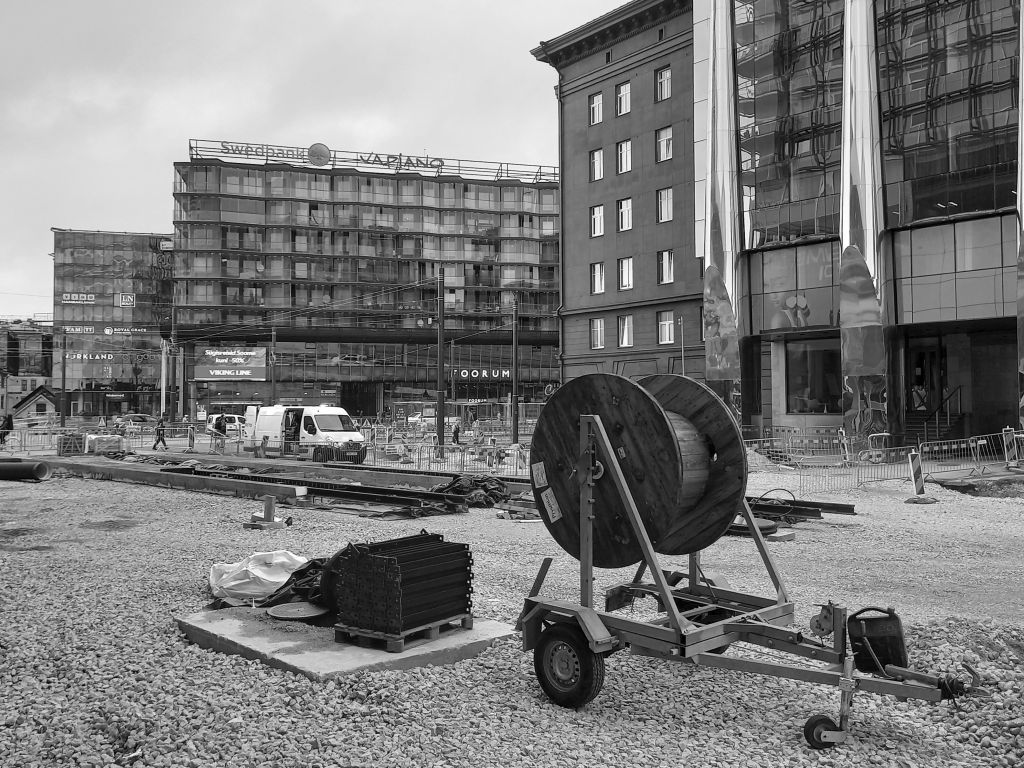
Tallinn is under construction, and I had to pull apart a few metal gates and step over a barrier to get to the conference. I felt like a little New York boy again. It gives me great satisfaction to break the rules. A few construction workers were shouting to each other in Russian. I hoped that they wouldn’t start talking to me. Imagine that something was about to explode, and they needed to tell me to run. How could I understand them? But what else is there to do? Most people in Tallinn speak Estonian. It’s actually their problem if they can’t make themselves understood, but also mine as well.
On the street, I saw a Russian teenager who was talking loudly in her phone. I realized that I had gotten accustomed to the silence of the Estonians. There was also an older woman who was wearing so much makeup, I thought at first that she was an actress from the Ugala Theatre. There are these little differences that for people in the Estonian world, or in my world, are not typical, but for them are everyday things. Europe remains a continent of tribes, and my tribes are nearer to me. For others, the Italians are, for example, utterly ridiculous, but for me, they seem completely normal. I feel the same way about the Estonians now, because my children are Estonians. Even if the Estonians have this weird thing that they won’t look you in the eye, or they always have this “no bullshit, get to the point” mentality, even when their conversations are so stupidly business-like and dull they are still, in a way, family to me.
Even in Helsinki I feel this sense of closeness, because many of the Finnish girls remind me of my daughters. Recently, I offered as a joke to my youngest daughter that she could get a job at Boost in some shopping center, because she likes their smoothies so much. She’s just 12, but she answered with sarcasm. “But I can’t work there because then I have to speak to clients in Russian.” Her cousin worked at Circle K in Tallinn and had to handle clients in Russian all the time, or at least she tried to. She is only 25. She doesn’t know Russian so well.
My daughter only complained more. “I don’t understand them. Why don’t they just use their Vladimir Putin Pocket Translator if they want to order something?” It made me sad to hear this, but I laughed when I imagined a gadget called the “Vladimir Putin Pocket Translator.” It’s not just sadness for a child who doesn’t want to work somewhere because she might have to speak Russian, but also for those Russians who, when faced with an Estonian server, can only blink at them like that kid in Brighton Beach and say, “что?”
There are, of course, loads of Russians who speak Estonian fluently. They also have to deal with the stereotypes perpetuated by their compatriots. And, as an American, I do know what it’s like to travel in a world where every other person has a negative opinion about you.
I once had a problem with a Russian man in Estonia, who thought that my car door had hit his car door. He was an older, self-confident character, who boasted that he had brought his wife from Russia, and that she knew not a word of the Estonian language. They lived together, mostly peacefully, in their own reality. People were afraid of him, but I wasn’t because I am not an Estonian and I don’t have the same kind of relationship with Russians and the Russian Empire. I can whistle “Za Tallina, za rodinu” with ease.
As a New Yorker, and a Mediterranean, I know that if someone threatens you, you have to threaten them back, naturally. He threatened to call the police if I did not give him any money, I told him to get the police and the army, he wouldn’t get a cent out of me. Instead, he left quietly and with empty pockets.
Fortunately, Italy is not located next to Russia. That would be really crazy.
***
Recently, I met a man who was born in Tallinn the same year that I was. His brother was baptized in the Orthodox church in the Old Town. But he was not granted citizenship automatically when they restored the state, because his family had arrived after 1940. His family left for the US instead in the early 1990s. They were poor. They had a lot of problems. But he managed. Today, he is a successful businessman. We sat together in a restaurant and I thought it was such a shame that he left Tallinn. He’s smart, talented. He could have been of great use to this country. His only problem was that he happened to be born into a complicated situation. I still don’t think the Russians fully understand who the Estonians are though. They understand that they are a people with a different language and culture, appearance. But the Estonians are actually an indigenous people. They are like one big, extended family. Becoming an Estonian is not as simple as learning the language and getting a passport. These are things I cannot change.
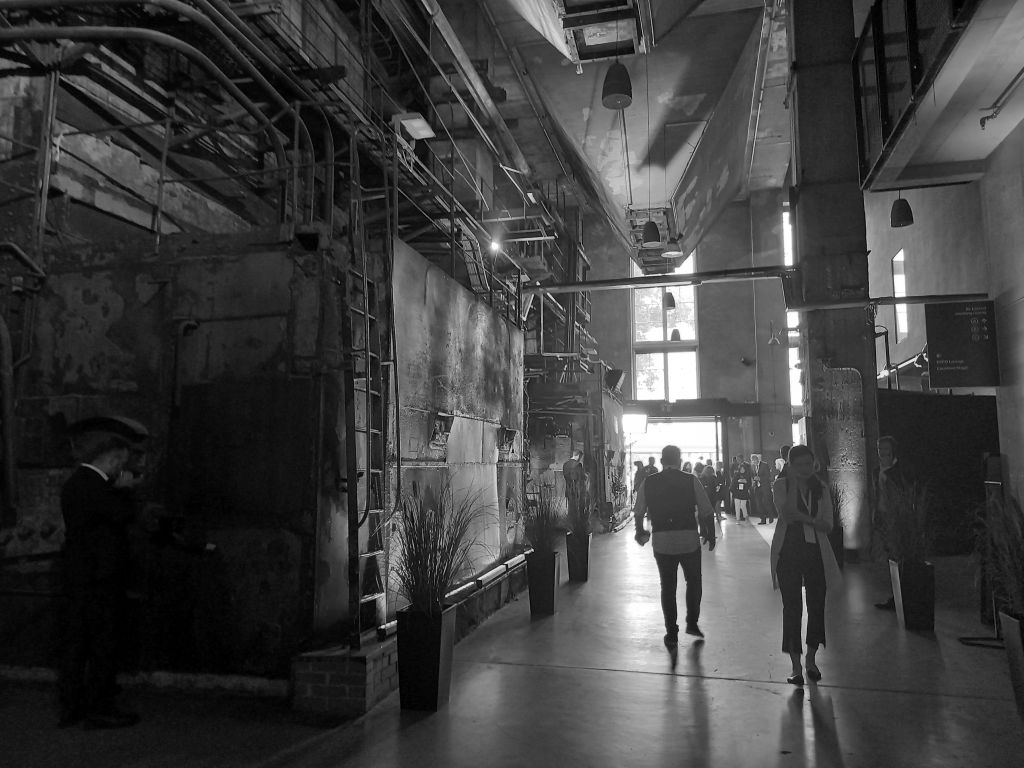
It’s still a shame that man left for America. But I am still here. I am in the Culture Hub at the Tallinn Digital Summit, where Danes and Lithuanians speak English to each other. I am sitting in the corner, listening to their English-language discussions and typing this up in Estonian. I have long since forgotten about that old Soviet war song. Everyone here is talking about the Nordics, about Europe. How interesting that it only takes a few steps. Just a few steps and you can leave the Russian world and arrive to the Nordic one.
Just a few hundred meters and everything is different.
–
An Estonian-language version of this article appears in Edasi. I wrote the Estonian-language version first and later translated it into English.
I HAD NEVER BEEN to one of these kinds of parties. If such an occasion can be called a party. Parties usually have music, don’t they? And food and drink? Parties also usually have a reason to be celebrated. Maybe it’s someone’s birthday, or someone graduated from college. Maybe.
But this party, if it can still be called a party, only existed for one reason: for a group of mostly strangers to gather in an uncomfortable place and have sex with each other. Yes, it was a swingers’ party, as they are called, and it was held in an apartment in downtown Tokyo. Don’t ask me where exactly, or in what prefecture. I can’t even begin to tell you how we arrived there, only that it was night and that it was raining. The neon lights of the business district were blinking, there were crowds on every corner, and we squeezed into a tight elevator.
I didn’t even know what was going to happen, until I saw what was happening. At once, a woman dropped to her knees and began pleasuring one of the other guests through his jeans. Then two people began rocking away right there on the carpet. It was a Roman scene, except in Japan. Tojo was there, and so was Elspet. Tojo took off his shirt and showed off his muscles. He was strongly built and must have been working out. I took it that he was the organizer of this impromptu group shagging. The apartment itself was stale, used up, an unhappy place. A dusty air hung over its furniture and its walls. The shelves were lined with compact discs.
It looked like an abandoned radio station.
There was a Spaniard nearby, breathing heavily into his partner’s ear, and a woman who looked just like Snow White stretched out beside me. She was even dressed like Snow White. Maybe she worked at Tokyo Disneyland? She was at least attractive, and also seemed kind of dazed, as if she also didn’t know how she got there. Who were these characters? How did I get here? I didn’t know what to do. I got down beside Snow White and we embraced anxiously.
AFTER I WOKE UP, I went next door into Sóla’s apartment to fetch Anaís’ ex-husband’s towel. Don’t ask me how it had wound up there, or why I was tasked with retrieving it. To make matters more bizarre, it was a cartoon beach towel, with Rupert’s image printed all over it.
It even said “Rupert” in bubbly white script scrawled across the bottom.
The strangeness of the situation didn’t end there, because I was in my underwear, a pair of comfortable navy blue boxer-briefs. I thought I could get in and out of the apartment without Sóla catching me. I knew the towel was in her bathroom on the shelf. Just in and out, while she was asleep. But I was wrong. When I came into the main room, Sóla was already awake, dressed in a glimmering silver dress and fixing her ears with shining silver ornaments.
There was a milky gray morning light in the room, and she stood facing a tall mirror. I stood opposite her, mostly naked. She combed her golden hair and observed herself in the mirror.
“But who is this Anaís, whose ex-husband’s towel you have been sent to fetch?”
“Anaís is a great writer. She is a woman who has led a colorful life, a life worthy of letters.”
Sóla put down her hairbrush and turned to me in that silver dress. She said, “But my life has been so boring lately. All I do is work and work. Nothing ever happens. I am either here or at the workshop. Always working. I would also like to live a colorful life, a life worthy of letters.”
At once, I swept her off her feet, carrying her toward the bed. Sóla gasped, but was soon purring away like a kitten. The bed had a canvas canopy around it, and I took her to the sheets.
Her dress jingled.
“Come, come,” I said. “Come to bed with me, Sóla. Let’s make your life a little more colorful.”
“I WAS STUCK IN GLASGOW once for 10 days. Really stuck in Glasgow. It was a weird situation. I had just joined the company. It was 2005. Actually, I was a young guy. I was still just 25 years old. I was with my wife and we had a baby. I was supposed to go to this tech conference in Europe, and they had canceled the conference at the last minute, but they didn’t tell anybody who had signed up for it that it was canceled. So, I had the plane tickets, and I was there, but there was no conference. So what did I do? I saw there was another conference Glasgow and I said, ‘I’m going to Glasgow.’ I was in Scotland already. I thought I might as well go to that conference, but it was 10 days in the future from that moment. So I was just hanging out in Glasgow for 10 days, but I got a very good taste for the city. At first, I hated Glasgow. Because I was coming from Edinburgh and I was expecting this sort of fairy tale castle magic and we rolled into the grim Glasgow bus station. But it really started to grow on me over time. The architecture. The weird, orange sunlight. Just this vibe. I can’t explain it. I started to really love it, especially on a Friday night, when Glasgow was like a war zone. There were fights and people getting sick and sleeping in the park. I can’t deny that it left a strong impression on me. Whenever I meet someone from Glasgow, I always think, what it was like to grow up in such a place. You know?”
SOMETIME IN THE BLEAK DEPTHS of the pandemic, I became aware of the arrival of some dark-haired, shadowy strangers in town, mysterious characters who would lurk at the margins of parties, or whose strumming of guitars might be overheard whenever I passed the room they were renting on Posti Street. The Chileans! The way people around me referred to them, it was as if a whole orchestra from Valparaíso had been shipwrecked on the shores of Lake Viljandi. In reality, there were just two: Tomás del Real and Javier Navarro. But they were important. They were part of something new: a little South American community in Viljandi.
Viljandi, despite its rather small size, has always hosted pocket-sized minority enclaves. One stretch of Pikk Street was once called “Jew Street,” because of the active Jewish community that dwelled there before the Soviets deported some and the Germans and their evil helpers murdered the rest. Viljandi’s Jews even had their own sauna and fire brigade. There are also stories about the Romani people, or mustlased, who once camped in the forests where the Metsakalmistu, or Forest Cemetery, is now located, and how the Romani women tried to convince Mayor Maramaa to buy them horses so that they could leave. As far as I know, there was never a Latin American community here, until the arrival of Tomás and Javier from Chile, and Pepi from Argentina, and Tito from Cuba, and Miguelito from Mexico too. Slowly, something new is coming into existence.
Of these Latin Viljandiers, musician Tomás del Real is perhaps among the better known. On August 26, he performed at the Pärimusmuusika Ait, or Folk Music Center, to celebrate the release of his latest album, Principios de Declaración. Del Real is no stranger to the iconic Ait. He even used to live in the cellar when he first arrived in Viljandi and got an artist’s residency.
“Downstairs is where my room used to be, and every time I go there, my heart skips a beat,” he says. “Next to it is the rehearsal room, and that also gets me emotional.” Tomás recalls staring at the stones in the wall, or looking out the windows of the Ait on winter days when everything about Estonia was new, and he would take long walks around the old castle ruins. “Every spot in the Ait contains memories,” he says. “Every time I perform in the Ait, I get nervous, because it matters to me.”
His own performance, in front of a mostly packed house, came off flawlessly. While the songs on the record have diverse origins, the quiet introspection of Viljandi life has seeped into all. He also structured his show in a unique way, with one half of the stage divided between a standing microphone, where he addressed the audience as would any singer songwriter, standing and at times, and discussing the political situation at home in Chile. On the other part of the stage, he had a “living room,” where he played his tunes just as if he was at home. Tomás says this is part of the duality of being a character and a witness to music being created. He adds that during the “living room” segment of his show, he for a time felt like he was home, which, for now at least, means Viljandi’s Old Town. He even has a composition on the record called “Viljandi.” Though he grew up so far away, he also says there are certain commonalities between Chileans and Estonians. The era of the military dictatorship in Chile officially ended in 1990, while Estonians restored their independence the following year.
Tomas del Real on stage in Viljandi on August 26. Photo by Kerttu Kruusla.
“We have both been oppressed and in difficult situations,” says Tomás. Because of that, he says, both cultures value friendships, because they have learned to rely on each other. “It’s the only way that people who have suffered for so long can function as a society,” Tomás says. He adds that Chileans have also learned to be tight-lipped like Estonians, for the same reasons.
Viljandi has also fostered a creative streak in Tomás, which is another reason why he has stayed here. At one point, he was writing one new song a day, some of which appeared on a record he cut with local musician Lee Taul last year, calling their duo Don’t Chase the Lizard. The rest of it populates the hypnotic tunes on his latest solo outing. But Tomás is not the only musician from South America in Viljandi these days. There is at least one other sudamericano.
He is the one known to all as “Pepi”.
Indeed José “Pepi” Prieto might, in some future almanac authored by local historian Heiki Raudla, be considered the pioneer Latin American in Viljandi. He was the first to explore it, the same way that explorer Juan Diaz de Solis once dropped anchor in what is now Argentina in 1516. A native of Buenos Aires, Pepi had almost anything one could dream of by his early twenties: a steady girlfriend, a band, a career. He was restless though, and decided to go abroad for a spell, where he worked as a programmer in Indonesia. A chance encounter with an Estonian woman there inspired him to come to the northern margins of Europe, just as it once inspired a young American journalist to do the same. It was a decade ago, and just a few days before Christmas. “I was told that it was -30 degrees, but I had no idea of how cold it actually was,” he says of this frosty arrival. Like any true South American, he showed up in Estonia in December wearing shorts. “We went straight to the shop after that to buy a good coat and boots,” he says.
Then he came to Viljandi. Immediately, it struck him as a quiet, inspiring place, where his creativity for unknown reasons began to surge in the same way that it would for Tomás later. For years, Pepi kept a room in the Koit Seltsimaja, or Koit Society House, on the corner of Koidu and Jakobsoni Streets that once housed the Ugala Theatre from the 1920s until the 1980s.
For a time he even managed a creative space there, called the Sama Sama Studios.
“I started to feel like I was the guardian of that house,” says Pepi. “I was the person bringing people to the house, and always showing people the rooms.” It also inspired him to write new music, to invite people to collaborate on music and to perform.
Araukaaria, as seen through the gates of the Koit Society House. Pepi Prieto, Lee Taul, Johannes Eriste, Fedor Bezrukov, and Norbert De Varrene. Photo by Paul Meiesaar.
These days, Pepi performs with Araukaaria, a quintet that also features Lee Taul on violin and vocals, as well as percussionist Johannes Eriste, a guitarist called Norbert De Varrene, and a bassist from Narva named Fedor Bezrukov. The band’s music is informed by South American psychedelia from the 1960s and 1970s, as well as Estonian folk. They have an earnest but passionate sound. The band named itself after the sacred tree of the indigenous Mapuche people of Chile and Argentina, and araucano is a Spanish name for the Mapuches. “I grew up seeing these trees,” says Pepi, whose father was Chilean. “They have always been in my life.” Pepi sees other kinds of trees these days though. Birches, pines, and alders. He loads them into his wood-heated furnace. He also has a summer place outside town where he is raising cucumbers and potatoes with his Estonian family.
That’s right, Pepi, like myself, has contributed to population growth in the Republic of Estonia. He can now be seen walking a small blonde child down the street and speaking Spanish to her. Sometimes his friend Leandro, another programmer from Argentina whom he enticed to Estonia, tags along. Leandro is also a regular in town, but has opted to live in Tallinn full time. When I see both of them, I have to look twice. Latin Americans in Viljandi? How did it even happen?
“They are not like stereotypical South Americans, because they enjoy winter and silence, so in that sense they are in the right place,” says Lee Taul, who collaborates with Tomás and Pepi. “We are richer that they have come here, and they also know how to attract people with their energy,” she says, describing both del Real and Prieto as industrious, motivated musicians.
“They love nature too,” says Lee of her respective bandmates. “That is perhaps one reason they are here, because the forest is in the city,” she says. “For every true artist, nature provides a rich environment, a golden nest from which to hatch something new to life.”
Tomás for his part concurs with her assessment, calling the Estonians’ relationship with nature as “connected and profound.” “It’s absolutely true that I am more creative here because of the environment,” remarks Pepi. Here I would have to say they are correct, even if I am not a South American, or only in my heart. I am grateful for the arrival of these Southerners. Not only are they inspired by Viljandi, but they have inspired me. I agree with them, and wholeheartedly.
ON SOME DAYS, I like to hike out to Karula Lake outside of Viljandi. It’s about eight kilometers door to door and it’s very pretty. The fields of rapeseed are in bloom, blanketing everything in delicious yellow. Agricultural laborers toil away in the fields. The Estonian countryside does have a certain desperate, Depression-era flavor to it though. Those abandoned, splintering houses, lost to time and graffiti. That empty bottle of whiskey tossed carelessly into a farmer’s field at some particularly fraught moment in the cold winter, only to be revealed later by the thaw, like the corpse of some ancient mastodon.
Sometimes I wonder about the local indigent people who might shelter in these discarded structures on the outskirts of Estonia’s country towns. Maybe they make bonfires at night and play harmonica like the bluesmen of the past? What kinds of horrors have these walls seen? In India, I once saw a man sleeping curled up in a rug by the roadside. I imagine it was something like that here. The countryside is mostly quiet, but one can always hear the birds singing. The Estonian birds are social and talkative. The people not so much. I have done this route many times, down to the lake, past the Baltic German cemetery. Then it’s back out onto the highway.
Other walkers come by, but nobody looks at you out here. It would seem that this would be the most opportune occasion to exchange some kind of pleasantries, or to acknowledge each other’s existence. Two strangers meet along a lonely highway on a hot summer’s day. I don’t expect much, you know. I understand that this is not California, and there will be no “have a terrific day!” wished upon me by some life-loving passing jogger. Still, a nod might do. Or some eye contact. There is nothing.
Yesterday, a young woman walked right past me. She was within arm’s distance. I looked to her, just to acknowledge that we existed along the same plane of reality. Was I really here? Was she? The wind was playing with her straw-colored hair. Her face was pale, as were her eyes. She looked like an extra from one of those Netflix Viking dramas. I wondered what she was thinking about. It must have been very important. Maybe she was wondering about what classes she should take, or how much her cousin Tõnu’s new car cost. “I wonder how much it cost? I wonder, I wonder.” Then it occurred to me that maybe she didn’t see me. Maybe I was invisible. What other explanation could there be? I didn’t know when my invisibility began to manifest itself in Estonia. Naturally, she didn’t say hi. She couldn’t see me.
***
A day later, I recounted the story to a friend in a local cafe in town. Well, at least I consider her to be a friend. Estonian is a Finnic language, which means it’s not at all related to Indo-European languages, though there are plenty of loan words. In Estonian, though, the word for “friend” is “sõber.” An Estonian sõber, however, is not exactly like an English friend. A friend in English is sort of like a person with whom you feel a kind of rapport or affinity and have shared some times together. A fellow traveler. A companion in life. Maybe sometimes you meet for a drink. An Estonian sõber demands more from you. If their car breaks down, they expect you to come and help. If they run out of money, they will ask you to loan them a hundred euros. If you say no, they might be disappointed. “But I thought we were friends” your Estonian friend will say.
An Estonian friend might also ask you for strange things, with no context for the request. You might be at home making coffee in the morning and receive a mysterious message, such as “Do you have a hammer?” To which you might wonder if it’s a trick question, or maybe it’s a state survey. Is Statistics Estonia compiling data on hammer ownership? It also happened once that a friend contacted me at midnight to inquire if I had any ice. “Do you have any ice?” I remember staring at the weird message. This kind of thing only happened in Haruki Murakami novels, I thought. Where could this request for ice lead? Maybe I would soon be blackmailed or drawn into some erotic thriller? I turned over and went back to sleep. It later turned out that she was at a neighbor’s making cocktails with friends. Had I known this, I might have really brought them some ice.
I just don’t understand these things. How does being friends mean that you have the right to borrow my hammer at a moment’s notice, or to go through my refrigerator for cocktail ice?
***
These are the kinds of things that happen to you when Estonians know you and consider you a friend, or at least an acquaintance or tuttav. In Estonia, personal relationships are very precise. Sometimes even if you have been in the same class, you are just called a classmate, or kursaõde or kursavend, a “class sister” or “class brother.” I am unsure if class sisters qualify as acquaintances. I can speak this language, but it still makes no sense to me. Sometimes I try to understand the roots of words to fish out their deeper meanings. That might help me understand Estonians better.
When I told my Estonian friend about my experiences on the lonesome highways, where everybody ignores each other and walks by as if you are invisible, she did not seem surprised.
“But of course, they didn’t say hello to you,” my Estonian friend said. “You’re võõras.”
Võõras. A word that translates roughly as “foreign,” “strange,” and “unknown.”
“That’s not true,” I said. “Everyone here in town knows who I am.”
“Yes, but they don’t really know you.”
There it was. I was a known unknown. I would only have to wait until a mutual Estonian friend introduced us in a social situation, or if we happened to take part in the same shared activity, maybe a kannel or folk dancing class, to say hello to these strangers. Then we would know each other. Only once we had been formally introduced could I greet them alone on the road. Until that time, we would remain apart. I could not, for example, walk across the road and actually introduce myself to the others. That would be alarming. I would have to wait until we knew each other. Then I would no longer be a stranger.
Selge pilt. A clear picture.
That word started to haunt me though. Võõras, võõras. Where did it come from? The word “stranger” in English derives from the Latin, “extra” and French estrangier, meaning “outsider.” “Foreign” similarly derives from a Latin word meaning “door,” so, again, an outsider. “Unknown” has a Germanic root in cnāwan, which means to identify, or to recognize.
This word might be closest in meaning to the Estonian word võõras.
I am not a linguist though, so I contacted the Estonian Language Institute to ask about the origins of the word võõras. I was then referred by someone to a special online query form where I could submit a question to the institute. I checked the online resources, and then plied my luck with the new translation tool for Finno-Ugric languages made recently available from the University of Tartu. It seemed that the Estonian word võõras exists in Karelian, where it is vieras, in Veps, where it is veraz, and in Livonian, where it is vȭrõz. This was a shared Finnic word, which meant that it developed from the shared mindset of the Baltic Finns. They had their own ways of determining who was known and who was unknown, who was a friend and who wasn’t. These people had their own systems for intuiting the world, and their language was just one manifestation of it. To be a friend was to be available at any moment to loan a hammer or give them some ice. If you had not been introduced, then you would always just be a stranger.
***
I started to ask around though. I wanted to see if anyone could provide more information on the Estonians’ behavior, on their determination of who was võõras and who wasn’t. At the café, I queried the esteemed diplomat Jaak Jõerüüt and his consort, the poetess Viivi Luik.
Jõerüüt blamed the Soviet regime. “This is Soviet stuff,” he said. In the old days, before Estonia fell to Comrade Stalin, before the war, collectivization, and Georg Ots’ singing career really got going, the Estonians were a jollier lot, Jõerüüt said. They were sitting around with big steins of beer and playing accordions and if you saw one in the countryside, he would call you over, and maybe cut you a slice of black bread. The horror years of Communism had done away with all of that. Who knows. I could be a bloodthirsty metsavend or “forest brother” out on that country highway. Or even NKVD.
“It’s better not to bother with other people,” said Jõerüüt. “It’s best to avoid contact.”
Jõerüüt offered another hypothesis. He noted that Northern Europeans have a tendency toward introversion. There are, I admit, some famous photos of Swedes and Finns waiting for buses and trains, where each one leaves plenty of distance between each other, and they don’t talk to each other either. This is the precious personal space that Northerners relish. They love nothing more than being alone, so that they can think lonesomely about things that affect them only. Their anthem is Depeche Mode’s 1990 hit “Enjoy the Silence.” “Words are very unnecessary. They can only do harm.” Depeche Mode played this August at the Song Festival Grounds in Tallinn.
They have a lot of fans here.
There are other theories. One musician friend blamed the cold weather. “People don’t want to waste energy communicating if they don’t want to,” she said. “Every ounce of energy is needed for the long winter.” Another musician friend said it had nothing to do with the Soviets at all. This woman, who is about 30 years old, was born after the restoration of independence. She said that she was taught in the 1990s that you always greeted people you saw in the countryside. In urban settings, anonymity was the rule. It had more to do with new technology. To be fair, many times I passed fellow walkers, they were staring at their phones.
They had vanished into a virtual existence. That’s what was happening.
One fellow cafe goer, who is from Australia, had his own theory about the Estonians that he was only too happy to share. “Oh, I think it’s clear that everyone in Estonia is suffering from a mild version of Asperger’s syndrome,” he said. He’s even been checking the scientific literature, but the Estonian Genome Center has yet to put out a paper on the high prevalence of autism in Estonians. Or maybe they already know about it and are merely hiding the truth from all of us?
About a year ago, I went to Copenhagen for a few days and was overwhelmed by the gregariousness of the Danes. I had conversations with people in cafes, in museums, on the trains. I talked with bartenders and waiters. The Danes seemed much livelier, earning their reputation as the Latinos of the Nordics. Then I returned to gray, quiet Estonia, only to stand in line at the supermarket, where every shopper stood apart from the other. None of them interacted, and when the time came to pay the cashier, one woman looked away as she deposited the money into the plastic dish, to avoid all possible eye contact. What was wrong with these people? I thought. Why do they behave in such a way? They won’t look you in the eye, and then they will ask you for ice at midnight. They’ll take your hammer and won’t say thank you. Yet a few days later, I too stood apart from the others. I was lost in my thoughts. I ignored eye contact with the cashier.
Three days. That’s all it took to become one of them.
***
Years ago, after returning from New York, I took the long train ride down into the South Estonia countryside and wondered again how I had even wound up living in such a place, though the scenery was nice. It seemed so far away from everything though, and I almost couldn’t believe that Estonia really existed. There were those familiar bales of hay though, rolled up and covered in tarps. Some Estonian farmers had covered their hay in blue, black, and white.
One night, I took a drive down to Abja-Paluoja to go to the sports and health center. I bought my ticket, went into the changing room, disrobed, and headed into the sauna to get a good sweat. Inside, there were four or five naked Estonian men sitting on the sauna benches, their red legs dangling. Not one of them looked at the others and not one of them said a word. They didn’t know each other, you see. They had not been introduced at a folk dancing course yet. They were all võõrad. Strangers. As was I.
The sauna had a speaker installed, and it was playing Radio Elmar, a national radio station, that evening. The song on the radio was “Pole Sul Tarvis” by Kukerpillid, a legendary Estonian country music act. The refrain to the song translates roughly as, “It’s not necessary for you to know what I’m doing.” That was just it. Forget “Mu Isamaa” or “My Fatherland,” the official national anthem. Kukerpillid’s “Pole Sul Tarvis” was the real one. I looked at the others. They did not look at me. What else was there to do than toss another ladle full of water on the sauna and listen to Kukerpillid in contemplative silence? We may have all been naked and in close proximity, but that’s where any familiarity ended. One more ladle full.





 north!