I WAS LOOKING FOR A DRUMMER. Someone told me I could find one in this particular white Victorian on the corner of whatever street this was. Somewhere in the older part of town. I came up the hill and could already hear him rehearsing. All of the windows were open, but I couldn’t see anyone inside. I could only hear the beat of those drums. I couldn’t tell if they were coming from upstairs or downstairs. Once inside, I walked into the second-floor apartment, only to find it vacant. There was no furniture upstairs. The floors were spotless. Downstairs, I went into the kitchen. That was when it seemed all hell, as they say, broke loose.
There were, I suppose, seven or eight of them. Some might call them squatters, others might call them hippies. It’s hard for me to describe for you what kinds of outfits they had on. It looked like a combination of traditional mid-1960s Hells Angels biker garb crossed with The Adventures of Buckaroo Banzai Across the 8th Dimension. They were not happy with me for intruding in their musicians-squatters den. It looked like a summary execution was being planned. I didn’t know how to get out of this predicament, but, unfortunately, the war came.
It had been a sunny, clear day, but on the horizon, at the end of the street, I saw an orange glow, then a column of darkness. I realized that it was a missile being launched from over the Russian border. There were more of them, spirals of black surrounded in a kind of orange, fiery haze. “Zelenskiy must have hit some targets within Russia,” I thought, “and now Putin is retaliating.” He had said he would strike NATO. But NATO was all, or most, of Europe. Maybe some of those missiles were headed toward Oslo, I thought. Or maybe toward Germany. Some certainly would hit Estonia. Putin hated Estonia. He wanted to kill us all. Wipe us off the map.
At the end of the street, I began to hear more drums, this time in the form of a marching band. It was some kind of Estonian military victory day parade. And here came Kaitseliit, the defense league, marching along to the sounds of drums and bagpipes. From the other end of the street, I watched as a Russian rocket turned into a kind of red fire dragon and sprouted wings. It sailed by the windows of the Victorian. By this time, about a dozen or so pensioners had taken refuge in the house and the squabble with the squatters had been forgotten, for now. We stood there by the windows as the parade went up in flames. Because I was taller, I could see more. The length of the street was now frozen over with ice and snow. Was this what they called Armageddon Time, I thought? Where could we even run to? Where could we go hide?
“What do you see?” an old man asked. “What’s going on?” “It’s over now,” I said. “It’s all over.”
I WAS WALKING in the garden when I saw it lying there on the pebbly ground. It was a quarter of a fish, neatly cut through on both sides. The cuts were fresh, and the flesh was still pink. The fish had a clean smell to it. I wasn’t sure what kind it was, maybe salmon, maybe trout. I’m not a fisherman like Murphy is. Stooping down, I examined the fish. Maybe it had fallen out of someone’s shopping bag? A likely story. The likeliest. A few paces away though there was another piece of fresh fish. This time it was a fish’s head. This piece had been severed at the gills. The fish’s eyes were intact, staring up at the gray skies. Thunder rumbled.
I walked along through the garden. I could see the hedge in the distance, and there was a fountain in the center. As I was walking, I heard a few thuds up ahead. There were more pieces of fish that had landed. What was going on? I surveyed the horizon, and could see small pieces of fish dropping from the clouds. How could it be? Maybe it happened sometimes, if there was a storm or squall. The storm might just draw up anything it could get its hands, or clouds on, into the heavens, and then release them somewhere else, like this English garden right here.
There were other things dropping. Bones. There was a nearly intact human skeleton up ahead. It was wearing an old-fashioned three-cornered hat, the kind you might find on a captain in the Golden Age of Piracy. At the house, some relatives had already begun to inspect one of these skeletal precipitations. “Look at its fingers,” a girl said. “This is an old skeleton. This was probably plucked out of a graveyard. That’s probably what happened. A great waterspout!”
Maybe it was. Maybe the clouds had absorbed a lake, complete with fish and a submerged cemetery. Now they were releasing the pieces in our garden. It was tea time by then, and we sat around on the terrace drinking a hot cup of tea. Two of my cousins were trying to piece together different bones like they were forensic scientists. One arm led to a torso. This leg attached to this pelvis. Some of the fingers had silver rings. What were we to do with the fish?
Maybe we should just fry them up on the spot?
I REMEMBERED AT THIS MOMENT that I had a gig up in Walnut Creek. Just me and my guitar. Riken, the lanky Japanese mountaineer and naturalist, had entered the house, a palatial English manor home, and I was telling him about the fish and the skeletons. He said there had to be some reasonable atmospheric explanation for everything. “It happens all the time that fish and pirate skeletons drop from the sky,” he said. I told him I was worried about the gig, he told me not to worry. “Just wing it. Play them some blues. Something from the Son House songbook.”
I loaded up my car and started the long drive north to the gig. Along the way, I stopped at my girlfriend’s house. Francesca wasn’t there, but all of her Italian cousins were, and her Uncle Rudy was also there. My car was filthy, and I began to quickly wipe down the dashboard as Uncle Rudy came over to examine it. “Mazda,” is all he said, with his thick eyebrows arching up. He looked like that old actor, Chaz Palminteri. He was even wearing a black polo shirt and, yes, a gold chain, but the chain wasn’t too big or too gold. Various Italian cousins were marching back and forth in front of the house, like those kids in The Sound of Music. “Francesca is out,” Uncle Rudy said. “I just wanted to say hi,” I said. “I’m late for a gig in Walnut Creek.” Uncle Rudy paid me no attention. He wanted to know more about the car, how it drove.
LATER WHEN I GOT BACK from the gig, I hid myself away from the world in the manor house. My room was overcrowded with junk. There was barely any space to sleep. Riken the mountaineer came in and turned on a lamp. “How did it go?” he asked. “It went all right. I played the blues, just as you advised. They liked it.” Riken nodded. It was like he knew everything before it was going to happen. Fish dropping from the sky with pirate skeletons? No problem. Gig in Walnut Creek for which one is ill-prepared? Just play some Son House.
“See, I knew you could do it,” Riken said approvingly. “I knew that you could play the blues.”
MY FATHER CALLED ME. He said, “Look up!” I looked up and saw the rocket flying overhead. It traveled slowly. It was painted yellow and looked like a telescope except that its narrow end, where you would look into the telescope, was in front. There was a red light blinking near the front of the rocket. It had the appearance of an oversized child’s toy. “So that’s what those new Swedish ICBMs look like,” I said. The rocket traced its path beyond the island and landed somewhere on the mainland. But no explosion came. Maybe it was just being transferred to a more powerful launcher to protect against a Russian advance? “Did you see it?” my father asked through the phone. “I saw it,” I said. We all had seen the rocket soar by overhead.
All of Viljandi Town had been evacuated to this island in the Baltic for at least part of the year. It looked much like Gotland or Saaremaa, but I had never visited the place before we were forced to flee the war. Of course, we brought along with us all of our small-town drama which had continued on as if nothing happened. During the days, I would cycle along the gravel roads of the island, traveling from community to community. Sometimes I would go to the main island town and write there at a café on the square. Everyone seemed to be affected by a kind of midlife ennui. We were stuck in some apocalyptic version of St. Elmo’s Fire or The Big Chill.
All we needed was a more memorable soundtrack.
Unfortunately, I got caught up in some romantic hijinks. One day, I came home only to discover my friend’s wife wandering around in my kitchen wearing my underwear. Yes, my pale blue boxer briefs. I was surprised that they didn’t just slide right off of her. She had nothing else on, and was speaking to me in a very inflected accent. I don’t remember was she was saying, I just knew that she was trouble. Eventually I got her to leave, fully clothed. She was standing there in the main square when the Swedish rocket went over. “Did you see it?” I called out to her. “Did you see the rocket?” “Yes,” she nodded. She was wearing sunglasses and clutching a small bag, as if that might give her some peace in this harsh world. “Yes, I saw it.”
Just then her husband appeared, wearing a black hat, the kind that Zorro might have worn. He came walking in my direction like a hungry, impatient dog, but did not run. “I warned you,” he growled. “I warned you to leave my wife alone!” “I found her in my kitchen!” I protested. “She was totally naked. She was wearing my underwear!” I said this last part as if I had been the victim of this romantic island triangle. How dare she? How dare she even show up naked in my kitchen, with her lovely breasts all over the place. And to involve my underpants in this mess?
“I have no interest in your girl,” I told him.
The angry husband stopped there in his Zorro hat and eyed me. This was like a scene in some old Western. The Good, The Bad, and The Ugly. I was waiting for the man to draw and to shoot me dead. Instead he took off his black hat and gestured at the sky. “You know, I believe you this time,” he muttered. “We have more important things to worry about these days anyway.”
‘IS THIS SEAT TAKEN?’ she asked. I looked up at the young woman in her school uniform. A black jacket, a black skirt. She had curly strawberry blonde hair, but her face was youthful, there was still a bit of baby fat around the chin, and she had a few pimples. I observed every part of her but could match her to no other individual in my mental database. I just had never seen her before. It was a weird question though. The table was small, and another person, a sort of nondescript young man with dark hair and glasses was sitting opposite me with his plate of potatoes, bulgur, and his glass of milk. He was doing a crossword. With a spoon, I was digging out the last chunks of chia pudding, made by the king of the folk music festival himself. Ando the K had gone into the confectionary trade, it seemed. It was tasty stuff. His speciality.
“I guess you could sit here,” I said to the young woman. With my invitation, it seemed like a storm blew through the cafeteria. A young man in a jean jacket walked by, with the wind from the storm in his hair. He looked like an extra from Top Gun in his shades but otherwise was undisturbed by this new hurricane. The young woman swept away all the plates and dishes from the table and I found myself on top of it. She mounted me at once, straddling me. Her hair was gusting up into the air. She looked like lightning. “This is what you wanted!” she yelled into my face. “You have been ignoring me, but you can never get away. This is what you want!”
“Yes,” is all I said, giving in to her. “Yes.”
LATER, I found myself at a construction site on the edge of town. A new hotel was being erected. At the edge of the hotel, there was a pool that had just been filled with water. Some people were jumping into the pool, even though it wasn’t allowed yet. Inside, there was a book event. There were books spilling all over the grand foyer of this brand new hotel. It was quite an impressive place, right out of the Gilded Age with its staircases, mirrors, and chandeliers. There was a new woman helping out with the sales of the books.
When the event was over, we had packed up all the books and were on our way out the door, when I saw the new woman standing in a shadowy corner. She was leaning against the wall there in the dark. Who was she even? She didn’t look familiar. She had tufts of dark curly hair and very pink lips. She could have been Israeli, or Palestinian. Throughout Estonia there were these Middle Eastern-looking Estonians. Spanish shipwreck off the island of Saaremaa. Or were they Portuguese? Some kind of story like that. I leaned in and we started to kiss. “Wow, so fast with you,” she said, kissing me back. “No small talk or anything, you get right to work.”
I felt like I was lost, lost in some maze or labyrinth of women. No matter which way I turned, one would be lurking in some corner, or mounting me on a lunch table in a stormy cafeteria. That’s when I woke up. I was in bed with the neighbor again. There I was, naked from head to toe. She was at one end. I was at the other. I felt warm in that bed. It felt like Christmas. The Doors were playing in the dim background. “I love those sounds you make,” she said, looking up with a glorious smile on her face. “I love that I can make you make those lovely sounds.”
ONCE UPON A TIME there was a music shop on Vestergade in Copenhagen. It was at an intersection in a white building, but lower than the street level inside, so that you could stand inside and look out the windows onto the sidewalk. On the wall there were maybe six sets of headphones and six sets of albums. New albums. One of these new albums was called Sound-Dust by a French-British outfit named Stereolab. It was released on 28 August 2001. A week later, Stereolab would play at Pumpehuset, a local city venue. I know this because I was there.
In the music shop on Vestergade there also worked a young woman who had in her possession at least one white-and-blue striped shirt. She was a quiet, aloof Danish lass, and had very light blonde hair and freckles. I can only barely remember the contours of her face, but I remember them because I have been looking for them ever since in the faces of other women. She would wear a black hat sometimes, a sort of floppy 1920s newsboy looking thing. I’m surprised by how intimidated I was by this quiet Danish record store girl. Who was she? Where is she? Almost every action of hers glided away with silent proficiency. She took my kroner, handed the music over to me in a paper bag. Only once I saw her outside the shop. She was either coming or going. She had on black stockings and black shoes and the white-and-blue shirt.
That was a gray, cool, somber Danish autumn. The leaves in the city turned yellow and orange and then fell into the yard of the Nicolaj church. The news cut right through all the skin and blood to the core of your bones. In the Albertslund communal kitchen, another American student was leafing through a magazine that showed Manhattanites leaping from the tower windows, their clothes fluttering in the wind. The student, who was from Maine or Washington State, or some other place with lots of pine trees, tossed the magazine across the table and announced, “I can’t stand to even look at this stuff anymore!” I picked up the magazine and looked at the photographs. They unsettled me in ways that I could not understand. I couldn’t articulate how they had unsettled me. I also put the magazine down.
Autumn turned to winter, and the sidewalks were covered in frost, and the windows of the shops and boutiques were strung with blinking Christmas lights. There were holiday parties in the streets. In the bookstore windows there were new editions of The Lord of the Rings, because the first film in the trilogy would soon be released. At the Vestergade music shop, the Danish mystery pige took down Stereolab’s Sound-Dust and replaced it with a newer record.
But which one did she choose next? Which record did she choose?
I DIDN’T KNOW that my new tablet had something that might have been deemed “magic GPS.” There I was, standing in a gymnasium full of so many relatives that we almost didn’t all fit. My parents were there, and my daughters, and their mother, and that neighbor who love/hates me, and I was being turned “every which way but loose”, to reference that old Clint Eastwood movie, the one with the orangutan. “Can you do this?” “Can you do that?” “He is the problem!”
Then I set the controls for the north and voila. I was floating above the Saint Lawrence River. Rick Rickard, an anthropologist from William and Mary who specialized in the study of indigenous peoples, was also there. He was sort of like that George Carlin character from Bill & Ted’s Most Excellent Adventure. Rufus! He was even wearing a black trench coat and curating the area to me. The American side of the river looked more wooded, with gently sloping landforms that gently descended into the rushing clear waters of the river. I could even see the boulders deep below the water’s surface. On the other side, cold, barren stones emerged carrying Canada up on their stony shoulders all the way to the cold north and frosty Nunavut.
Rickard showed me the Mohawk settlements of Kanehsatà:ke, Akwesasne, and Kahnawake, and there was some discussion about the limits of Haudenosaunee control, the Saint Lawrence Iroquoians, which once numbered more than a hundred thousand strong, and he showed me the site of the Attignawantan villages, who would later evolve into those Wyandot or Huron. “But as we know, not all Iroquoians were friends,” said Dr. Rick Rickard. And then he was gone.
Disappeared back to his university office.
I began to drift westward down the river. In my mind, I didn’t want to go in this direction, having some innate fear of Niagara Falls, and decided to head east. Holding my magic tablet, with its magic GPS, I meandered along the river, encountering beautiful French villages built into the bluffs around it. You would have thought that I was in Grenoble or some such place. It was almost night now, and I could see the glowing street lanterns of the Quebecois villages.
At some point, I noticed there was a sort of castle built on the east side of the river, and paused by an old bridge to take a photo of it. I thought my relatives would appreciate a snapshot of my river journeys. They were still messaging me, as if I happened to be lost somewhere outside that massive family gathering. But so far nobody had specifically requested that I do anything. As far as they knew, I was still on hand. They didn’t know that I was lost up in Canada taking photos of Quebec bastions along the Saint Lawrence River.
My plan was to follow it as far as I could east and, if I still had some time, to even swoop down to Nova Scotia, before returning quietly to the family gathering. But then the tablet stopped working. A passing car soaked it in mud and snow and the whole thing fell apart. I tried to put it back together, but the screen just wouldn’t work. I was truly screwed. I was stuck up on the Saint Lawrence River with no way home. Another car passed by and I flagged it down. It was being driven by an old Quebecois in a plaid shirt. His son was in the passenger side seat. I explained to them what had happened and the son, a good-natured lad, couldn’t believe it.
“Incredible! It cannot be true!”
We drove through a series of tunnels that had been built, perhaps, in the early years of Nouvelle-France. The roads through these river-side tunnels were paved with cobblestones. It had a particularly French feel. They let me out somewhere around Kamouraska, on the east bank of the Saint Lawrence River. The ancestral home of the Kerouacs. I felt disappointed about being unable to get that photo of the castle. I also had no idea how I would be getting home from Canada to the family gathering back in wherever. It was getting quite dark now, and a light snow began to fall. I was standing in an apple orchard along the Saint Lawrence.
THE HUNTINGTON Y was under construction again. There were just beams and cement floors. I was given a tour by an old friend whom I did not recognize but who seemed to know me quite well. He had on a blue jacket, his hair was cut short, and he wore glasses. In short, he looked rather like a real estate agent, or Mormon missionary lite. There he was, showing me around. The entire floor plan of the old Y.M.C.A. was recognizable to me. I remembered the first day I went to that school. How I had promised myself that I would not be a baby like the others and would not cry for my mother. I could remember it all so clearly. Like yesterday.
That was at least one day I had succeeded. We walked together to the room, which was the first on the left, or actually the right, because we entered from the rear side of the building. It looked smaller there. I could see its outline, and had a vague memory of doing some kind of arts and crafts at a table there. I remembered one of the girls, who had platinum blonde hair.
This girl seemed to stick out in my memory.
The place had been gutted of course, but in a way it was refreshing. The sunlight poured through the beams. I could look out on that part of Huntington and see the athletic fields. The breeze smelled fresh. After, we walked to the end of the hall. That’s where we had classes our second year of preschool at the Y. I remembered many things from that room, especially a small book called Ten Little Indians and an accompanying cassette. I could remember some of the lyrics from the song, “one lost his prayer-stick …” When Thanksgiving came, we were all divided up into Pilgrims and Indians. I wanted to be an Indian. They got to wear feathers. But the teachers put me into the Pilgrim group. I got the Pilgrim black hat with the gold buckle.
Looking around this empty room, it was hard to believe that it had all happened here. Those memories seemed so cloudy, they seemed to be submerged in in a gray haze of time. The 1980s? When was that? But now all had been reduced to its bare essence. Only the walls were left, with some scattered wires too. My friend and I decided to walk down the hall toward the pool. It at least was still there. Entirely intact. There were still people swimming in the pool.
Later, we descended the steps of the Huntington Y to the first floor. This had been turned into a sort of open air market, like the one at Balti Jaama Turg in Tallinn, or the Baltic Station Market, as it’s called in English. A woman, who looked something like a flapper from the 1920s, or at least had that kind of haircut, came up to me, and asked me if I would go fetch her dress. I went into a back hallway, which was also well lit, and saw an array of silver dresses hanging suspended from hooks along the wall in the light. Those 1920s la garçonne dresses. Which silver dress would fit the woman? I didn’t know anything about dresses. Which one would fit?
IGRAYNE TOOK A JOB teaching at an old manor house in the countryside. Her classroom was in the cellar. It had vaulted brick ceilings and no natural lighting. Supposedly these were part of an older system of fortifications erected during the Swedish Era. But they had been plastered white, thanks in part to EU funding which had provided for the entire upgrade and upkeep of the school. It was Christmas when I went there to help her with the students. The entire school had been decorated, and there was even a small tree in the corner of her room. She was an attractive though tormented young woman. The torment was the star attraction.
Yes, I liked her very much.
After the final lesson before the break, we walked to the elevator. As soon as the door shut behind us, or in front of us, our hands were all over each other. It was a nice, natural, and passionate feeling. I’m not sure if it could be called love, but it was certainly a form or manifestation of love. It was warm, it was soft. On the first floor, the elevator doors opened. There was a small crowd of Japanese tourists there, waiting. At first they were shocked. Naturally, they started taking pictures. Igrayne didn’t care. “Just keep going,” Igrayne told me. “Just keep going.”
THE TOWN HAD CHANGED while I was away, and I had only been away for a short while. Tall pines and birches has sprouted up in every park. Locals had put up field stone walls to demarcate their properties. The streets had crumbled too, and the roots of the trees had grown over the roads, so that it almost made it impossible to ride your bicycle from one end to another. But the inhabitants did ride their bikes. And scooters. Two little boys were doing tricks on their scooters at the corner of Posti Street and Koidu. There was a large barn set back some ways where there once was a series of apartment houses. It had been painted Swedish red. On the other side of the street, the Joala Park side, was a stone wall. Trees towered over every piece of prime town real estate. It was as if they were blocking out the sun.
When I arrived at my house, I was surprised to find Veikko, our old neighbor, working in the yard. I didn’t realize that we had become neighbors again. There he was spinning his metal saw round and round, cutting his wood silently. “Working?” I said to him. “I am,” came the answer, his nose close to the saw. Inside my house, I noticed that Saare Kika was there. He was standing in the kitchen, washing the floors. Then he picked up a large wooden pizza peel, the kind that looks like a shovel and that they use in places like Napoli to slide pizzas into wood-fired ovens. The pizza peel was just dripping with red sauce. Saare Kika tossed it into the sink. He has this stoic, silent-type, iron man aura to him. Rugged, determined features. He turned.
“Your life is a complete mess,” he said. “And I’ve come here to help you clean it up.”
I nodded along and looked him over. Then I noticed that Saare Kika had sprouted a pair of gray wings. Were they real wings? Or just part of an elaborate Halloween costume? This I could not really say for sure. But they were wings, dangling from his back as he scrubbed down the pizza peel in my sink. It reminded me of legends I had heard about The Mothman in both West Virginia and in and around Chicago. Dark, insect-like creatures with the bodies of men but the wings of moths. They called them ‘winged humanoids.’ One woman claimed to have seen several of them. I asked Saare Kika if he was the Mothman, but he just laughed at the question.
“Mothman? No,” he said, pulling the peel from my sink. “I am Batman,” Kika said. “I am Batman.”
WHO IS YOUR FAVORITE WRITER? Or who has been the most important writer in your life? People have often asked me this question. My answers change. Sometimes I say Scott Fitzgerald, who wrote every morning, even when his wife Zelda was in the psychiatric hospital. Sometimes I answer Henry Miller, who dared to write so poetically about the darker side of men and of the world. And certainly Ernest Hemingway haunts me, as he haunts every writer, with his strange, adventurous life story. But honestly, my guardian angel has been to this day Jack Kerouac, the author of On the Road. I see my life through the prism of his life, I understand myself through his books. Jack inspires me. Jack cautions me. I would like to write as well as Kerouac wrote his books. But I don’t want my life to have the same trajectory. I don’t want us to have a shared fate.
***
I was thinking about Jack one summery Saturday morning when I drove to Northport on Long Island. My parents live about half an hour east of there, but my mother is from Northport in part. Northport is a port town or perhaps village, about 70 kilometers from the center of Manhattan. It is drowning in greenery and there are lovely views. It used to be a summer place, to where city people would flee and go swimming. There were women with Victorian Era dresses and umbrellas to keep out of the sun and men in black top hats. You know what I’m talking about. They came from the city by train, to spend the summer by the sea. It reminds me of Haapsalu. But I went by car. When I got to Northport, I met up with some relatives. We went for a walk and told some stories. I’m not in the US so often. It was a nice summer morning and it was nice to spend time with my uncle and cousin and to drink some coffee. After our get together, I typed 34 Gilbert Street into the GPS and headed off in that direction. To get to Gilbert Street you have to take Main Street out of town, then turn onto Cherry Street and then again to Gilbert Street. It was interesting that I had been to Northport maybe a thousand times, but this was the first time I had ever been on this street. The house I had come to see was a white, wooden house, a typical working class house. The same kinds of houses are in Lowell, Massachusetts, where Jack was born. That’s why he wanted to live here, I’ve read.
Jack moved to Northport in 1958. Eisenhower was the president of the US. Khrushchev was the leader of the Soviet Union. Mao was building Communism in China. The Korean War was over and the Vietnam War hadn’t started. Kerouac was looking for a peaceful place that wasn’t too far from New York. He was already famous by this time. A year earlier appeared his most famous novel, On the Road. Kerouac was everywhere. On television. On the radio. In newspapers. In night clubs. He was the Beat Generation’s greatest prophet. A dutiful Catholic, Kerouac brought his mother Gabrielle Ange Lévesque to live with him in Northport. An older lady. Conservative. She had been born in Quebec at the end of the 19th century. Religious. Different. The Cold War was at its height and Kerouac hated Communism. He was, at his core, a Catholic, regardless of the fact that he did not exactly follow the church’s rules in his personal life. But the Communists had no faith. Kerouac yelled at the TV when they showed Khrushchev. His mother was making his pancakes and washing his socks. He was typing away at his typewriter too, when he wasn’t talking to fans who had climbed over the back fence, or he wasn’t at the local bar drunk again. Sometimes I wonder if my grandmother and Kerouac’s mother went to church at the same time in the same town. It probably happened, I think.
***
Neighbors later reported that mother and son fought a lot. What about, I don’t know. Nobody knew, because the Kerouacs’ loud arguments were in French. The youth of the town learned rather quickly that their new neighbor was the famous Jack Kerouac. It was hard for him to find a spare moment to write. They turned up at the front door, or chatted with him through the basement window. Kerouac even wrote about this in his 1962 book Big Sur. This was the first Kerouac book that I ever read. My girlfriend gave it to me when I was 16. I don’t know how much she even knew about Kerouac. Maybe she just bought it because of the title? But it was the right book for me. I especially liked the beginning. The story starts with Kerouac in San Francisco, waking up with a hangover to the sound of church bells. I went that summer to San Francisco and Big Sur and read that book along the way. There is one scene where Jack Kerouac is in bed with a woman and the woman’s child comes into the bedroom and watches. That was probably the first time I had ever read something like that in a book.
Through his life I learned that the world was much bigger and that adventures were waiting everywhere. That life was more of an interesting experience than anything else. Life was an experience, and a person could write about it as it happened, just like a photographer takes photos. His style was fluid, unique, and addictive. I think that once you get used to Jack Kerouac, it becomes harder to read more conventional literature. Books like Fifty Shades of Grey or The Da Vinci Code seem dull. Once you go on the road with Kerouac, there is no way back. And I am still on that road with Kerouac. In this way, I arrived at his old house, to take some photos of it and look it over. What did I expect anyway? That he would come outside, with garbage bags in his hands? That I would hear his mother yelling in the background? Ti Jean, my boy, your pancakes are ready! It was a hot, humid, and sunny day. Gilbert Street was quiet and empty. Some birds were singing away and there was a light breeze. The house is really just like any other. But when a writer like Kerouac has sat there with his typewriter, the importance of the house changes. People then come by and take pictures of it. They want to come face to face with the soul of that writer, at least just a little bit.
***
IT’S INTERESTING THAT Jack Kerouac wasn’t the only new inhabitant of Northport in 1958. Because my mother and her family showed up in town the same year. In some ways, my grandfather Frank and Kerouac were similar. Kerouac was born in 1922, and my grandfather Frank a year later. Kerouac’s home language was French. His parents were from Quebec and they moved to the US at the start of the 20th century to find work in New England, like many Quebecois did. Jack Kerouac’s real name was Jean-Louis Lebris de Kérouac. He attended Catholic school and his teachers were French-speaking nuns. Later, he praised the education he had received, and found that thanks to their rigid means of instruction, he had learned to write so well. I reminded my grandmother of this fact once when we spoke about Kerouac. To her, that crazy neighbor Kerouac wasn’t exactly an upstanding citizen, but the fact that he was a Catholic softened her position. Maybe he wasn’t so bad, she perhaps thought. If he was a Catholic, he was one of us. He just didn’t live his life the right way. Jack merely diverged from the road of Catholicism.
When he went to school, young Kerouac still didn’t speak English and had to learn as he went. He would study the dictionary to expand his vocabulary. It was the same for my grandfather. His parents were from Italy, and their home language was the Barese dialect. My grandfather also didn’t speak English until he started to go to school. A neighbor girl taught him how to speak it. My grandfather was ashamed of being different. He had a long Italian name. He had dark hair. For Americans, he was an outsider. Kerouac’s relationship with America was similar. He was an American in some regards, but he had a different perspective. He was both a local and a foreigner. But my grandfather lived a proper Catholic life. He was married by the age of 22. He had a job and five children. They lived on the edge of the City of New York, until one morning he took a ride out east to see what he could see. That’s how, one story goes, he discovered Northport, that same port town that Kerouac discovered around the same time. Both of them moved to Northport, and both took their mothers with them. Frank’s mother’s name was Maria. She made her son pizza, just like Kerouac’s mother Gabrielle made her son pancakes around the corner. In my mother’s home, they spoke both Italian and English. My mother is almost 77 now, and she still speaks English a bit differently. A professor of Italian once told her that she speaks like a child that has learned English from immigrants. The vocabulary and pronunciation are correct, but her sentence structure is a little off. The grammar is backwards, because she is using Italian grammar with English words. Sometimes I think that Kerouac’s bilingualism influenced his writing style. My mother never did meet with Kerouac, but her younger brother once recalled that on some nights he might have seen Kerouac, Neal Cassady, and Allen Ginsberg playing baseball. This was at the beginning of the 1960s. These were dangerous characters. Before there were punks, and before there were hippies, there were Beatniks. Ginsberg was a gay poet, and Cassady was simply a wild and crazy guy. Kerouac himself was not quite right. Some say that he hit his head too many times when he played football in school. Maybe that’s why he wrote so well? There are different theories.
I can only imagine how my uncle, then aged about nine, accidentally came across Kerouac, Cassady, and Ginsberg. Actually, they looked quite average. They just lived different lives. It was a warm summer’s night and he rode his bike by the baseball field and saw them playing. Just some Americans out playing baseball. Now that moment seems like a historical event.
***
Kerouac’s father died young, and when he was ill, a young Jack Kerouac promised his ailing father that he would care for his mother Gabrielle forever. This was a promise he made before God. So Jack was obliged to live with his mother. Or he was unable to leave her home really. Of course, he was married three times in his life, and he had one daughter (though he argued for a time that the child was not his, which was disproven by a blood test). A proper Catholic would have been married just once and stayed married. But Kerouac was unable to live that life. He had all kinds of worldly adventures, but the road always led Kerouac back home to his mother. His mother’s place was his main address. They lived in Northport until 1964.
They only lived on Gilbert Street for a year and a half before moving to Earl Avenue, into a small house on the edge of town with a Dutch roof. There they stayed for two years. Their last address was on Judy Ann Court, in a one-storey house. They spent three more years there. My mother’s family lived a few streets closer to the center of town. The story that my uncle claimed to have seen Kerouac playing baseball with the other Beats is probably true. Carolyn Cassady wrote in her memoir Off the Road how her husband Neil, Jack Kerouac and Ginsberg would go and play baseball together. For some time, Jack and Carolyn were even lovers. Neal was particularly supportive of their relationship, as he had cheated on his wife Carolyn many times. So if his wife had a lover, things would be more equal, he thought. Classic.
It’s interesting to read from time to time that Kerouac was gay, like Ginsberg. Even Gary Snyder, who is 94 at the moment, and who inspired Kerouac’s character Japhy Ruder in his novel The Dharma Bums said in a recent interview that Jack hated women and was probably gay. But then we have Carolyn Cassady who writes about her passionate relationship with her husband’s pal. I’ve also read Joyce Johnson’s book, The Voice is All: The Lonely Victory of Jack Kerouac. Johnson described a very charming character with blue eyes who whispered to her in French. Johnson, who is also a successful writer, was Kerouac’s girlfriend for several years. She once wrote that in the world of the Beat Generation, women were girlfriends or muses, but she wanted to be more. She also wanted to be a writer. This fact has really stuck with me, although I have been quite similar to my Beat predecessors in terms of my own perspective.
But Jack Kerouac always had some woman. Always. One of these was the Afroamerican Alene Lee, who inspired his character Mardou in The Subterraneans. This book has been translated into Estonian. Its Estonian title is Pilvealused and the translator was Triinu Pakk-Allmann. The second novel to appear in Estonian is On the Road, or Teel, translated by Peeter Sauter. The most colorful female character in On the Road is a Mexican woman named Terry with whom he lived a while in California. One of my favorite quotes in the book belongs to Terry when she says to Sal Paradise, the main character, “I love love.” Johnson wrote that this relationship was one of his most stable, and that Jack might have stayed together with Terry, who gave him the freedom to roam. But no. Kerouac promised his father that he would take care of his mother. True to his word, he did so. His responsibilities to his family were his priority.
The writer Gore Vidal once wrote that he had a relationship with Kerouac though. And Joyce Johnson acknowledged there had been some intrigues with Ginsberg. Sexuality among the Beats is an interesting topic, especially because at that time in the “hetero world” things were just different. Men would go to visit prostitutes together. Jack writes about spending time with Mexico City prostitutes. It was just a regular thing. “Guys, let’s go get some prostitutes!” Even Ginsberg went with them. What did he do there? Read some Mexican girl one of his poems?
One of Kerouac’s loves was certainly Tristessa, a young Mexican junkie. Her real name was Esperanza. It’s hard to think that a man who wrote so much about women was gay. But maybe it would be more honest to accept that things have changed since those days. In the 1950s, there was limited awareness of the LGBTQ+ community. There weren’t parades with rainbow flags. Neal Cassady could sleep with Ginsberg and his wife Carolyn and not lose any sleep wondering about which letter best described his sexual orientation. Was he bisexual? Pansexual? Omnisexual? Was he a G, a B, or maybe even a Q? Neal was just Neal, and Jack was Jack. It was just a different time. In Joyce Johnson’s book there is an interesting fact that Jack didn’t think of himself as being gay, but that he actually wanted to be gay. Most of the best writers of the day were gay. Gore Vidal. Truman Capote. James Baldwin. He was almost ashamed that he wasn’t, because everyone knew that gay writers wrote so well. This fact really astonished me. It was like an inverted reality. Maybe it’s inspired me to write more honestly about women. Men’s interest in women is deep, intriguing, at times terrifying, but inspiring. There is more to unearth from that treasure trove.
***
MY GRANDPARENTS WERE devout Catholics, but Kerouac had a long relationship with Buddhism. Carolyn Cassady recalls in her memoir how Jack found Buddhism and started to believe that the world was an illusion and that reality was just emptiness. He tried to live as the Buddha. He even wrote Wake Up: A Life of the Buddha and The Dharma Bums during this period, as well as Desolation Angels. I have read The Dharma Bums and Desolation Angels, but Wake Up hasn’t found a place on my bookshelf just yet. I understand that he had personal problems, especially with alcohol, but also within his family system, which kept him in a sort of personal prison in life. Other people got to enjoy their freedom, but he had responsibilities. He could travel and write, but his mother was still waiting for her boy at home.
Carolyn acknowledged in his memoir that the new, Buddhist Kerouac wasn’t exactly a barrel of laughs. He became very stern and serious. He went up to a mountaintop in the summer to contemplate emptiness. Kerouac no longer wrote to his friends about his thoughts, but about the dharma. He was looking to be liberated from himself. As a Catholic, his life was full of disappointment and guilt. In both the family and the church, there was a lot of confusion, stress. This I understand well. I started school in Northport, and my first school was a Catholic school. Kerouac was, by that time, dead. He died in the summer of 1969. He was 47. When I was younger, 47 sounded kind of old. Now, at the age of 44, it sounds like a teenager to me. I was born a decade after Kerouac died. I started school six years later, as I said, there in Northport. These facts are not so deeply connected to me or my life story. They are just a coincidence. Because I didn’t know anything about Jack Kerouac’s Northport period when I was a little boy.
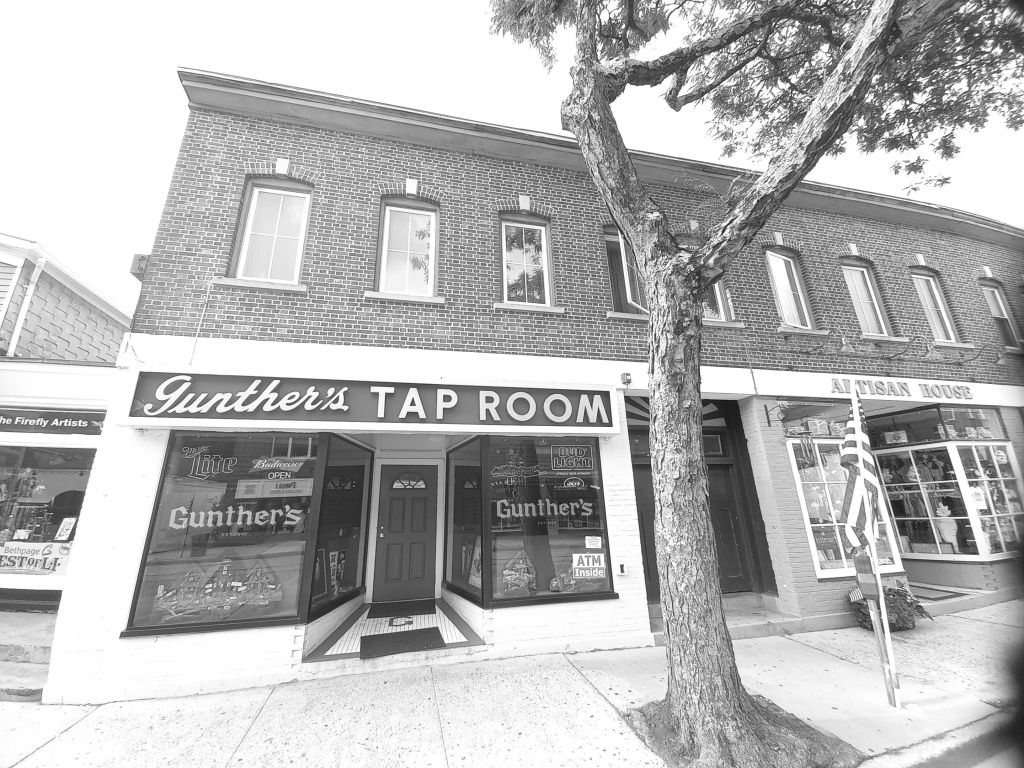
Still, his world was familiar to me. My grandfather died in Northport two summers before Jack. A heart attack. My grandmother lived long. Her house was full of crosses and angels. Lots of shining angels. My father’s uncles had a bar in Northport, but Kerouac’s favorite bar was another one called Gunther’s Tap Room. These days, Northport is a wealthier place. At that time, in the 1950s and 1960s, it was a rougher, working class down. There was a sand and gravel company nearby, and on their lunch breaks the workers would come to town, eat and drink. There were a lot of drunken bar fights. Pete Gunther, the bartender, who was the original owner’s son, was a teenager when he started working. He’s now long dead, but when I was 25 and working for a local newspaper, I met up with him and interviewed him about Jack Kerouac. There was even a sign on the wall that said, “Kerouac Drank Here.” Apparently, his alcoholism intensified during this period.
Pete Gunther, a bald older man with a round face, in general quite friendly. He told me straight that Jack Kerouac was a drunk. He was drunk every day of his life. This was like the scene in John Steinbeck’s East of Eden when the good son who believes his mother is dead finds out that she is very much alive and running a whorehouse in town. “Justin, your greatest hero was just some crazy drunk.” That’s what Pete Gunther related to me in our interview, more or less.
Jack once gave Gunther an autographed copy of one of his books in exchange for a beer, but Pete Gunther said he couldn’t make any sense of it. It was all crap, he said. He didn’t understand it. So he threw Kerouac’s book in the garbage. In some ways, I feel it was symbolic of how America treated him. Now that the original scroll of On the Road is displayed in museums, we can think that once upon a time a great writer lived in that small house over there. Or put up a sign that says, “Kerouac Drank Here.” Or try to collect memories of him from other people, people who once met him, or saw, perchance, him playing baseball with his friends. That summer when he died though people were more interested in hippies, the Vietnam War, and the Prague Spring. His best friend Neal had died a year prior in Mexico beside the railroad tracks. He was known to use drugs, but it was the rain and his lack of clothing that did him in.
When Neal died, Kerouac told his friends that he wanted to join his best friend in heaven. The writer and poet Gregory Corso, who you can see in Jack’s short film Pull My Daisy together with Ginsberg and the other Beats, recalled similarly. “Jack wanted to die,” he said. And so he did. He got into a bar fight and started bleeding inside. In the end, it was life-long alcoholism that took the life of Jack Kerouac. But he did want to be with the angels. Mr. Corso said so.
That morning, as I was looking over his first Northport home, I sat in my car for a while. I wanted to tell my old friend Jack not to drink so much. Leave your mother Gabrielle behind and go live with that Mexican girl. The one who said she loved love. Or some other girl. Or maybe even multiple girls. Life is for living, Jack. It’s too soon for wrestling with those angels.
When I was 16 and my girlfriend gave me my first Kerouac book, Big Sur, I started to write. I had read how Jack always had a notebook on him, and that he would write everything down. I can now see traces of that book in everything I write. So Kerouac continues to live on, quietly.
Here and there.
An Estonian version of this article, written by the author, appears here in the magazine Edasi.




 north!