training

RIKEN SUGGESTED I get in shape by running to the airport. We were going to do this Rocky style. He would ride a bike and supervise the run. There he was in his desert camouflage hiking gear. The bike was second hand. He had only paid €5 for it. He had related this to me with some typical understated pride. Riken the Japanese mountaineer was known far and wide for his thrift and his ability to subsist on under €20 per day, sometimes getting by only on a few cans of precooked lentils and boiled rice to survive. He carried herbs and spices in his pockets.

I wasn’t sure what airport I was running to, but in my mind it was JFK. Yet the terrain was unfamiliar. Perhaps Tallinn Airport was the real destination. Or even Tartu? The first 20 kilometers or so went smoothly. I ran down a slope by a school where children were out playing. Riken was up on his bike. “Steady,” he called out to me. “Steady.” I felt depressed when I reached the end of that road though. Only 20 kilometers and maybe 100 more at least to go.

It seemed like an impossible objective to accomplish. How would I ever make it there on foot?

Instead, I went into a diner by the roadside. There were some women inside, Klaudia among them. She was sitting in the back corner in a booth. I could barely see her, but went to sit with her and ordered a full breakfast with lots of black coffee. It was so dark, but I could make out her curly blonde hair, her red blouse. She was wearing some kind of necklace. I got closer to the necklace and began to study it. It looked like some kind of archaeological find. Could it be from the Ming Dynasty? Late 16th Century? “You know, if you’re going to get so close to me like that,” she said, “we might as well just take things all the way.” That’s how I wound up making love to Klaudia in the back of a diner in nowheresville. Klaudia smelled like breakfast.

Riken was outside all this time, standing stoically beside his bike, engrossed in meditation.

the gift

LATA FOUND ANOTHER LOVER, but he was doing it all wrong. His technique was off. I know because I watched them make love. He was on the surface a solid choice, in good shape, what women consider handsome. But his performance was suboptimal. Cut and dry. Same old, same old. Curiously, I was not jealous, probably because I never formed that kind of emotional attachment to her. Later, after they were done, we also made love. Lata was just insatiable.

Afterward, I went to visit Brynhild. I had a gift for her. It was something like a tapestry that had various declarations of affection written all over it. When I got to Brynhild’s house, she was sleeping. The idea of having any relationship with her seemed out of the question. She sat up in bed, beneath the blankets. Brynhild had aged since I was away. She seemed very confused.

Then Lata showed up. She told me to give her the gift. “I’m the one who came up with that template, that design,” she said, pulling on one end of it. “Give it to me, give it to me now,” she said. She was aggressive. That was a side of her that I had never found appealing. It kept me away. There was real hardness in her. “Give it here,” she said, tugging away. “Give it to me now.”

I’m not sure what happened after all of that. I could hear someone vacuuming out in the hall.

epistles of paul

FOR THE LONGEST TIME, I had been advised to go and see Paul. “Go and see Paul,” they said. “You have to go see Paul.” This was always said to me with a certain conviction. I simply had to go. There would be no either/or, this or that. It would be done. I would go see Paul. It was just a matter of time. “When are you going to see Paul?” The invitation came via an intermediary named Aki, another one of these Finnish drifters who has surfaced in Viljandi in recent years, along with Mika Vesalahti, who runs the art studio on Kauba Street, and Henrik, an older fellow with a terrific moustache who likes to frequent the Paulina Kohvik ice cream parlor.

I moved to Viljandi from Tartu, but Aki came via Saigon where he rented a room on the tenth floor of an apartment building (because the big spiders are usually on the ground floors). Aki is a bit rootless, a bit of an adventurer. He’s older than me and lives a thousand times more intensely than me, but he somehow looks younger. He has dark hair, a bit of a youthful moustache. Whenever an opportunity presents itself, Aki leaps into action. He gets a call to go to Kyiv, and the next day he’s already there. From there he gets another invitation to go to Italy and he’s there the day after that. Why not? This is Aki’s life. He specializes in writing about philosophy and pens articles for Finnish boating magazines like Vene for travel money on the side. And there’s more where he came from. One by one, more Finns are coming. Whether the Viljandiers like it or not.

I haven’t seen Aki in forever though. I used to see him all the time, but he’s vanished completely. I run into a group of the Finns at the Mai Jooks, the Great Run Around the Lake. Mika Vesalahti the painter is with them, as is Henrik, the old Finn with the white whiskers. Of course, none of them are running. When I inquire as to what has happened to Aki, they whisper among each other. He is in Viljandi, they can confirm, but will not discuss further.

A mysterious character this Aki. The most mysterious of the Viljandi Finns.

It was years ago that Aki and I became acquainted when Paul had an exhibition at the Paul Kondas Centre for Naive Art. We were all at lunch and Paul was trying to explain hynopsis to us and drawing diagrams about consciousness on a napkin. “You see, this is your mind going into this state, here, but if you trick your mind just at this point, it can actually go here.” Paul seemed like the kind of Viljandi person I should know and not just because he was an American but because he was unique in that he did not come for the love of a woman.

Paul came to Viljandi just because he liked it. 

He is of German extraction — all four grandparents were immigrants — and this becomes apparent the moment you step through the door at his house and you see the ordered stacks of books. I only discovered this the last time when Kati came to visit, because I had promised to go see Paul so many times, and it was only when Kati herself insisted that we absolutely must go see Paul at once, that we just went to his house by the lake, knocked on the door, and he let us in. Paul had been holding an exhibit in his house featuring Rabelais and Cervantes caricatures, and there even had been an opening hosted by none other than Mr. Aki, but I didn’t show because I was at the cafe writing. Yet it was a spring day and Kati insisted.

Paul’s house is a part of town I have spent little time in and that has somehow evaded me on my night walks and sojourns. There are streets that run along the lake down here with fine names like Aia, Pihlaka, and Luha. Almost everything is crooked in some way in this neck of town, the roofs, the fences. In spring, one enjoys the sight of firewood stacks, apple blossoms, the fragrance of this tiny nook of the universe where Paul has told everyone he intends to die. 

There was even a film made about this called Surmatants, “The Dance of Death.” Kati was at the viewing at Kondase Keskus just weeks ago, which is how she became enamored with Paul, this curious old man with the white-blond ponytail and sandals. He invites you in and makes you tea or coffee. His principal obsession actually is the Dance of Death, the Danse Macabre. Bernt Notke’s painting at Saint Nicholas’ Church in Tallinn is his inspiration, the work of this Lübeck master, a painting that has been copied and recopied. Paul scours old libraries and book shops across Europe in search of reproductions. His collection has expanded in recent years to about 200 prints by the French caricaturist Daumiere, many arrayed on his desk.

Downstairs, a wooden canoe imported from Papua New Guinea is suspended from the ceiling. To get this to Estonia, it was shipped from Papua New Guinea, to San Francisco, to Colorado, then down to the Gulf of Mexico, across the Atlantic, up the Baltic, and then to Tallinn and later Viljandi. The rest is a museum of 18th century caricatures, ancient Egyptian art, and Tibetan masks sprouting third eyes. A lot of Paul’s neighbors down here by the lake are pensioners like him. “But the truth is,” he says, lounging in his yard with me and Kati. “I was born in 1936. Most of the people my age are already dead. We lose more and more each day.” 

John McCain is gone. So is Vaclav Havel. Robert Redford somehow looks exactly the same.

Maybe Robert Redford and Paul are the lucky ones.

***

Paul is surrounded by admirers today. Some have come to help in the garden. Two are graybeards — Soviet-era hippies from deep in Mulgimaa. There is a younger woman too who befriended Paul long ago, and some young long-haired kids who pops by named Argo who is also keen to garden. Kati is also here, but only visiting from Võru. She has come up from Võru in her slack, bohemian dress, with long-hair flowing, and her young daughter clings to her when she is not poking around Paul’s place. Võru and Viljandi are arguably similar towns — both smaller, both in the south, both full of culture. But Kati says that Võru is not as freewheeling as Viljandi. These are the longest conversations she has had with strangers in months, she says. In Võru, you have to know the Võru dialect, and say words like määne and sääne to let them know you are one of them. But in Viljandi, anyone can join in. Even Paul, whose Estonian language is limited. He somehow fits into this town called Viljandi just fine.

It’s sunny out, not yet May, and the graybeards are engrossed in talk. They look like the old farmers and fishermen of Johannes Pääsuke’s time before the First World War, when he was going around with his camera and photographing traditional farm life. We are all copies, after all. Copies of copies. In 60 years time, Kati’s young daughter might look just like these graybeards here. Death, permanence, aging — these are Paul’s main themes. In his earlier days, he had a somewhat Indiana Jones-like nomadic existence. He was squatting out there in the hills of Tibet or Mongolia. He’s stayed in huts called “yents” and drank Mongolian kumis, the fermented mare’s milk drink. “This is really awful tasting stuff,” Paul says. “I don’t recommend.”

“I tell you,” he continues in his garden, “what they should teach you is how to get old. In fact, it’s the opposite. They only teach you how to stay young, how to look younger, how to feel younger. Dye your hair, get in shape. But nobody is out there teaching people how to get old!” 

Both levels of Paul’s house are rich libraries with volumes on Native American art, Scandinavian mythology, two books about drums by Mickey Hart, the Grateful Dead’s drummer, Indian tantra cults and the like. It is a nerd’s paradise which is to say, I fit right in.

“This is a living, open place,” says Paul. “I want you to feel at home. Take whatever you want to read and read it. Make yourself at home. If you see a book you like, grab it off the shelf.” 

He has various editions of the Kalevala and Kalevipoeg. Much of his work has focused on the similarities in shamanistic art around the globe. 

“Take two different cultures — say Latin American and Tibetan — and they will contain the same elements, the same concepts. This was at a time when nothing was written at all. ‘The dream time,’ as the Aborigines of Australia call it.”

Outside the graybeards are still enjoying their tea, coffee, and cake. Kati has since been overwhelmed by a desire to work in the garden. “Don’t you enjoy this work?” asks Kati. “I can’t resist. When I see people raking, I just want to pick up a rake.” 

“Not really,” I say. 

Instead I head out a rickety gate into the street, where you can see the sparkling waters of the lake. He came here because he liked it here, you know. There was no beckoning female character. Paul has been married before and has since sworn off romantic stuff. He’s decided to fly solo. I wonder if this will happen to me too. Maybe it already has. Maybe it already did.

Written May 2019

viiratsi’s white cats

VIIRATSI is a community on the margins of Viljandi. On one hot day in July, there was nothing but blue in the sky and it’s fields and parks were green and sun-kissed. Coming down the road from the mechanic’s shop where I left my car, I noticed a white cat that peered at me for a moment, then disappeared into the overgrown brush that had sprouted up between rows of abandoned garages. I waded into the growth, pushing aside flowers and weeds, searching for my little white friend. This was kind of like Alice in Wonderland, I thought. White cats. White rabbits. Where did the cat go? The garages were from the Soviet era, made of white bricks from the factory up north. Someone had built them, maybe in some forgotten summer in the 1970s. Now they were in ruins and the windows were shattered. Just more leftover Soviet crap.

Between the garages, there was a concrete platform. I stared at the platform for a while and couldn’t understand for what purposes it had been built. It looked almost as if one could land small aircraft on it, but that couldn’t happen here, could it? There was just no use for such a thing. What was this place? I heard something rustle behind me and turned to see if it was my friend, the white cat, but it was just a bird. The cat was gone, I decided. I returned to the road and the way back through Viiratsi. The mechanic said he would call me when the car was fixed.

I came down the hill to the park and its two large ponds. On one side of the park, a man was seated on a bench. He wore a black coat and held a book in his hands. I nodded to the man, but he did not return the gesture. Then, as I came closer, I discovered that his eyes were closed. I could see the sweat on his brow, hear him snore. He was asleep. I decided not to disturb him.

I followed the path by the ponds to an empty bandstand overseeing dozens of benches, all of them empty. At some point, a concert might have been held here, yet there was no sign of life. The bandstand was made of new wood and the benches too had been cared for. The smell of freshly cut grass was in the air and I sat on the bandstand to rest. The pond waters were still.

Where was everybody?

The community of Viiratsi is ancient. One can even find the name “Weiratz” on old maps from the 18th century. Today, you would not guess its age. Even the old apartment blocks have new facades. Many homes have lush, organized gardens. There are swings and terraces and grills. Not a few would qualify for Estonian Home of the Year. In a nearby park on most days, children experiment with skateboards and lick ice cream. Somewhere a radio plays American pop songs. Even here the names of Demi Lovato and Selena Gomez are known yet we are far from the streets of Los Angeles. This place is so clean, so safe, so cared for, that the only bad thing that could be said about it is that it is almost too nice, too quiet. Almost every property fits into a tight grid. It reminds me a bit of those Playmobil toys, where the scenes of life are reduced to a home and garden, or an ice cream truck, and the toy people have toy smiles.

At the bus stop in the center of the village, I noticed one of those new, blue local transport buses that have bright yellow folk patterns painted on them and say V I L J A N D I M A A. The bus was just standing there, idling, but there was no-one on the bus, and there was no driver. I suppose he had just stepped away to use the toilet or buy some peanuts from the Viiratsi Konsum. After waiting for the driver to return, I walked on, the bus still idling behind me.

I wondered what had happened to the driver and started to think that maybe a UFO had just kidnapped everybody in Viiratsi. It was just too quiet. I came up Sakala Street puzzled by the silence. At the crest of the hill, I at last spied sweet Viljandi across the lake, with its wooden slums all piled up on top of each other. Viiratsi was over here, clipped and cared for, Viljandi was over there, disheveled, chaotic, and unruly. There was no question to where I belonged.

***

A few days later, I received the message that the car was ready. This time I came down Kõrgemäe Street. Then I turned up Tartu Street and took it all the way down to the highway through the wetlands. Once I reached Viiratsi, I took a footpath back into the silent town.

The old man was no longer asleep on his bench by the two ponds. This time, there was no one in the park at all. I looked up at the sky and saw the trail of an airplane but heard no engine roar. All was very calm and quiet again. I looked around for my white cat, but only encountered a black one, running out from behind one of the garages. He was in a hurry and didn’t look up.

At the mechanic’s shop, I discussed payment with the owner, a cheerful type in overalls. On the wall, there was a poster of a woman with chestnut hair peering over at us from her bed. She looked like a French woman, I thought, with dark eyes. Her skin was flushed, and she looked satisfied, as if she had just made love. I looked into those eyes, but when I imagined them looking at me, all I sensed was indifference. As I turned to leave, something else caught my eye. A white cat was standing beside my car. It eyed me curiously. Hadn’t we met before?

“Unbelievable,” I told the mechanic. “This is the same white cat that I saw here the first day.”

“Oh her? Don’t be fooled by the cat, man,” said the mechanic. “Viiratsi is full of white cats.”

Written June 2018

veeriku thieves

I WAS ROBBED outside of Veeriku Selver in Tartu. It happened just last night. There were three of them, but a ringleader, of course. I’m seldom violent, but the joke about “stealing his backpack” turned into a non-joke. I don’t remember what the other two of them looked like. One was thinner and had darker hair. The other one was chunky. The ringleader was named Andreas or some variant on the name Andrew. Only later, I recognized his physical similarity to Bree van de Kamp’s son from Desperate Housewives, whose name was also Andrew. But he was speaking Estonian. So I was robbed by Andrew van de Kamp’s Estonian doppelganger.

She, a lady of my life, was AWOL meantime. She had reconnected over social media with an old lover from the Canary Islands. A British traveler who had retained a faded photograph taken at night on a beach in Maspalomas. In the photograph, he was noticeably older, with white already intruding into a red-colored beard and a flat cap. She was who she was at that time, looking somewhat naively out at the camera (and who took that photo? Probably some other tourist who had been passing by). That had all happened back in 1999. They had found each other. “Can’t you see,” she said, showing me the photo. “He was the real love of my life!” He was older now. Back then he was late forties. Now he was 70+. Age, they said, was just a number.

God, I hated my life, having to contend with undying 1990s soap operas and getting mugged at Veeriku Selver. It was almost as bad a lifetime sentence to suburbia. But, as Rage Against the Machine once sang, anger is a gift. I made short work of the Veeriku thieves. The other two retreated into the alleyways, and I picked “Andreas” up and brought him inside. He called me a coward and unmanly for not settling things the old-fashioned way and for leaving him with the guards. I told him that I wasn’t a policeman, it wasn’t my job to deal with criminals. Later, he tried to tell the Tartu Police that it had all been a gag, that he had just been pretend-stealing.

Inside of Veeriku Selver, I encountered Erland and his Musi examining some carrots and potatoes. They were gathering ingredients for soup, but seemed lost in their cooperative world of steady relationship. Upstairs, I discovered a room for guests and sat on a couch. I turned on the old-fashioned TV set. The TV was showing M*A*S*H. Alan Alda was making another one of those jokes I could never understand. And there was that other character, Radar. I can’t say I ever enjoyed M*A*S*H but it was the only thing on Estonian television.

Uncle Frank then appeared at the door with a box of pizza. Uncle Frank was a family friend, so he was not a biological uncle, but he fulfilled many uncle-like duties in his time. He had gray hair, blue eyes, wore a blue polo shirt open at the collar. He reminded me, vaguely, of the Skipper from Gilligan’s Island, though a more sober, slimmed down version. Uncle Frank was also my godfather and he was also dead. Uncle Frank sat across from me on the couch. He opened the pizza box and began to eat a slice and I did the same. We both sat there watching M*A*S*H and eating pizza. Uncle Frank sighed. He said, “Well, kid. You’ve had a hell of a life.”

uueveski

On Kõrgemäe Street stands a faded sign that reads “18%” and shows an incline. 

THE ROAD HERE shoots straight up and down, more or less, and even to traverse it by automobile requires a certain leap of faith as you release the break and pump hard on the gas. It reminds me of those high scary San Francisco hills, like on Divisadero Street, or Powell Street, where you rocket up to the precipice only to behold that gleaming beautiful San Francisco Bay below. Here Kõrgemäe winds down to a pacific lake, one cornered by soldierly lines of succulent shady green pines. On either side of Kõrgemäe Street, pretty Alpine-looking homes with great glass windows and red roofs and eaves and balconies frame this wondrous sharp descent. Yet there’s almost no-one here and those who are, are lost in their own stories.

In the distance, a couple walks a dog.

Down the way, a man takes a break and surveys the work to be done, a cigarette stub dangling and glowing from his rough hands. Terraces separate the homes, as do neat stacks of yellow firewood that line the peripheries of the properties. There are also the trampolines and tree houses, piles of rubbish from springtime renovation projects begun anew. German Shepherds crow at you from gates, but even their outbursts are a bit weary and resigned as the orange sun sinks in the sky, bringing the still nude tree branches of late April into sharp relief.

I step away from Kõrgemäe and head toward Peetrimõisa, crossing Jakobsoni Street, the main road that leads out of town, and heading toward the hills and the watery crash of the falls.

This part of Viljandi remains a mystery to me. I never come here, but I have no reason. Tonight though, I feel an itch to explore, to stretch my legs. I’d walk the whole world if I could, cross the frozen expanses of the Bering Straits. First I have to cross Jakobsoni, then turn onto Allika — “Spring Street” — and then turn again down a tiny side street — a põik — following it through the terraces and tidy homes and stacks of firewood, past lush hedges tailored and manicured to perfection — before turning up Pihlaka Street, and then crossing Uus, another major road here, before I begin to ascend Kalda Street, getting closer to the sounds of rushing crying water. Up, up, Kalda Street I rise, feeling the strain in my thighs, loving the strain.

Even as a child, I loved nothing more than to get lost like this, to follow the ways, disappear down the alleys. I loved nothing more than peering over fences, or overhearing the mothers scold their errant but deep-down good sons. “Mida sa tegid jälle?” “What did you do again?”

To hear it this evening in Estonian is a special treat.

At Kalda, the sound of the water grows stronger and I discover a path leading down to a small river that feeds a tiny body of water called “Kösti Lake” on maps. So there’s another lake in Viljandi? Nobody told me about this. Someone had built this staircase, a hardworking, resourceful local DIY type — hammered metal pipes into the ground and then placed cement blocks on top of them, creating a walk that leads down steep to the mossy muddy banks. I half expect it to give out on me as I amble down carefully, looking around and still seeing no one. When the stairs end, I walk as I did as a boy, keeping my feet against the incline as not to fall.

I look up at the houses, which loom above the woods. My brother-in-law used to live over here in this part of town, which is called “Uueveski,” or “New Mill,” years ago, before he died. He had mowed lawns like these, trimmed hedges like those. He had walked his dog here along the river bank. I had driven these same streets in the dark those nights. Yet that was all done now. He was gone, already for a long time, but the birds of Uueveski sing on.

I take in a great breath and go further down toward the waters enjoying their sound, hanging onto tree branches to slow my descent. I come up one side of the bank where the water swirls and consider traversing a line of rocks that leads to a little wooden staircase on the other side, and then see another line of rocks a bit of a ways down and try to cross that one too.

The space between the stones though is too great though, and the water is too deep, spinning in clear whirlpools, and I don’t feel like wading waist deep across. Lovely vibrant yellow flowers are in bloom here along the blank, as pert and ornamental as buttons on a beautiful woman’s waistcoat. I stoop to pick a few and put them away in my pocket. Think of all the trouble I saw in the forests when I was a boy, or how I would climb to the peaks of pines and descend with sap everywhere, and how my mother would use a solvent to get the tree sap off of my hands.

I just want to leap to the other side of the creek, but I don’t have the courage to do it. The rocks are too mossy. I’d be certain to fall in the water. My boyhood self would have done it gladly, and would have loved to fall. I am not my boyhood self though. I prefer to keep dry.

Defeated, I climb the steps to Kalda Street again, now high above the creek, and survey it as far as I can toward the other end. I still see no bridge to cross, but I keep walking down it anyway. If I had to, I would walk all the way around the little waterway, even to Rangoon. I’d love to walk, because I’m tired of writing and I have absolutely no use for people.

Down Kalda Street, the wooded banks of the creek open up to a large grassy park that rolls and rolls with small hills like the prairies of North Dakota. In the center of the park, someone has already set up a huge stack to be burned. I walk down past the bonfire pile, all wooden planks and discarded chairs, and come upon a new wooden bridge. The wood of the bridge is still yellow, and there is no marking on it, no graffiti, not even a pair of footprints. To think, I almost wound up swimming across the creek when this bridge had been placed here for me.

Just for me. I feel the wood of the railings, smooth and sanded perfect. Down and along the creek there is still no one. There are rows of castle-like homes rising on the other side, the part of town called “Peetrimõisa.” There are trampolines there and picnic tables, great green lawns, half moss, half grass. There is no one. This is dreamy solitude blanketed up in solitude.

At the center of the bridge, I pause a moment and listen to the water rush below me. I read recently in a book that what women most desire from men is that they would be present, that they would be there. Just there. Something to depend on. Something to latch on to. Not perfect, but present. There. We must be there. Our duty was to play the river bank, to lay perfectly still and muddy and mossy and calm and let their waters gurgle over us. When I first read it, I thought it was ridiculous. Nonsense! Why should I spend my life lying down on my back for someone else, all for her? Listening to the water singing and spurting beneath that wooden bridge, I acknowledge begrudgingly that it might be nice to get soaked now and then.

Sooner or later I was going to have to join up with another one of them. Some men try to ignore them, or to pretend they could have as many as they want. In their souls, they remain as only halves of hearts, yearning to unite with that something, as night is to day, light is to dark, heavy is to light, or struggling to remain autonomous, independent, which is a ruse. There was really no other way forward for me. I would have to reattach. “Women are like trolleys,” a tuttav, a friend, a mother of four children, had told me once. “One drops you off and another one comes and picks you up and takes you somewhere else. You just have to get on.” 

The trolley of another woman would come by and open its doors and I would notice the conductor from beneath her cap and I would get on.  “On the ovarian trolley,” as Henry Miller put it well way back in 1938 in Tropic of Capricorn. The water kept gushing. I would get on.

Written April 2018

trudeau eulogy

TRUDEAU, whatever you may think of him, gave Canada a face for 10 years. Everyone in the world knew who the prime minister of Canada was. For me, it elevated my first name from “Canadian pop singer” to “Canadian prime minister” status. Justins the world over were no longer ashamed. Due to some vague, beer goggles-induced similarities, I was even asked a few times if I was the Canadian prime minister. And I didn’t even need to don blackface or fall backwards down the stairs.

Quick, who were all those prime ministers before Trudeau? What? Can’t remember? Maybe it was the ultraboring Stephen Harper, the even more boring and boringly named Paul Martin. The last one who rings a bell is Jean Chrétien. Brian Mulroney? I mean, please. The last interesting Canadian prime minister before Trudeau was his father. And now he’s getting out to avoid online bullying by The Orange One.

In Trudeau, we saw pieces of ourselves. Our interfamilial vaccine feuds. Our health and fitness obsessions. Our hyperfocus on appearing youthful and ageless. Our smiling selfie poses. Our attempts to look respectable. Our collapsing marriages. Our bizarre Indian government assassinations. Nobody’s happy, but there was a brief thought that if the world was run by happy people, its leaders might very well look like Trudeau and Macron, youngish Frenchmen who it seemed just wanted to hang out and have something good to eat. And maybe go skiing.

Alas, it wasn’t to be. Back to the apocalypse.

võru apartment house

IN VÕRU, in the south-eastern corner of Estonia, there is a paneelmaja, or apartment building. This apartment building is made of the same elements of all the other apartment buildings of the 1960s. It is, in that sense, a standard Brezhnevka. However, there are some characteristics that separate it from others. For example, it’s built in a precise square with a courtyard at centre, including an old swimming pool. Nobody has been in that pool since Gorbachev was premier and it’s now used for storing potatoes. It’s covered in graffiti referencing Billie Eilish.

This common courtyard though is a place of interaction for the tenants of the Võru apartment building. They can watch each other, spy on each other’s comings and goings. I went there to stay in the building to spend some time with my child. What I found there was true delirium.

What kinds of people live in the Võru apartment building? Woodsy lumberjack-looking tenants with a predilection for the New Age. That means men in red flannel shirts and beards with tiny Ganesha statuettes bedside. They are all meditating and fasting when they are not sharpening their sharp axes. The women of the house make good use of them, and partners are switched and swapped out like lightbulbs. The men give when they are asked to and ask no questions. Such is the way of the Võrumaa matriarchy. When they are no longer needed for sexual favors or car repairs, they head into the Võru forests to tap birch juice or chop more wood for winter.

Children roam the halls of the Võru apartment building freely. I have seen small blonde children leaping between the floors. I myself was heading up a set of concrete stairs when I encountered a small boy in striped pajamas teetering dangerously on the edge of a balcony, the guard rail of which had collapsed. This small boy I took in my arms and went racing around the building looking for his mother. She turned out to be in bed managing her online business while listening to a few self-help podcasts from a guru. A light-haired blonde woman in a homemade blanket. She was still in her pajamas. She was stretching, blinking strangely at me.

“Your son almost fell off the balcony,” I told her. “Maybe you should take better care of him.”

“Don’t worry about Joosep,” said the lady. “He likes to play on the balcony but he never falls.”

notas rotas by tomás del real

WHAT IS WRONG with the youth of today? The world’s on fire, the clock is ticking, and Tomás del Real is hanging in backyards from Canada to Estonia, tinkering with his guitar, jamming with fellow travelers and otherwise observing the downfall of civilization coolly from behind his sunglasses. Even the cover photograph for his single “Prólogo,” released last August, shows the chill Chilean in media res, as if he was caught off guard while he was contemplating something more profound. He looks like a Latin Sigmund Freud, I think, one who just survived a natural disaster because there are broken couches around. Maybe that’s exactly who he is.

It’s the end of the world as we know it, but Tomás feels mostly fine. The cover to the album’s single ‘Prólogo.

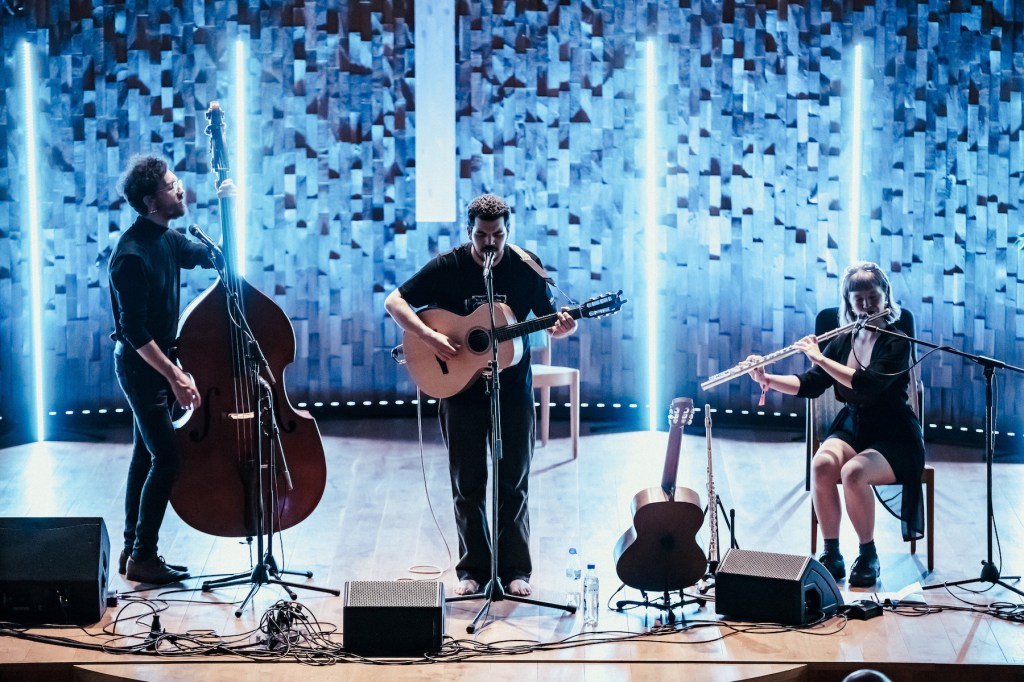
While listening to the entirety of the album Notas Rotas, I hear many interesting things. Released in the dreariest days of late November, it has a warmth to it. The opening song “Prólogo” is a burst of warm air, propelled by the violin of Alan Mackie and flute of Katariina Tirmaste. Right up front, this record promises something that food critics might call fusion cuisine. There’s del Real’s contemplative, Tropicalia-laced meditative poetry and innovative melodies coupled with what sound like North American and Estonian influences and driven forward by a thunderstorm rhythm section of percussionists Magnus Heebøll Jacobsen and Steven Foster: the former from Denmark and the latter du Canada

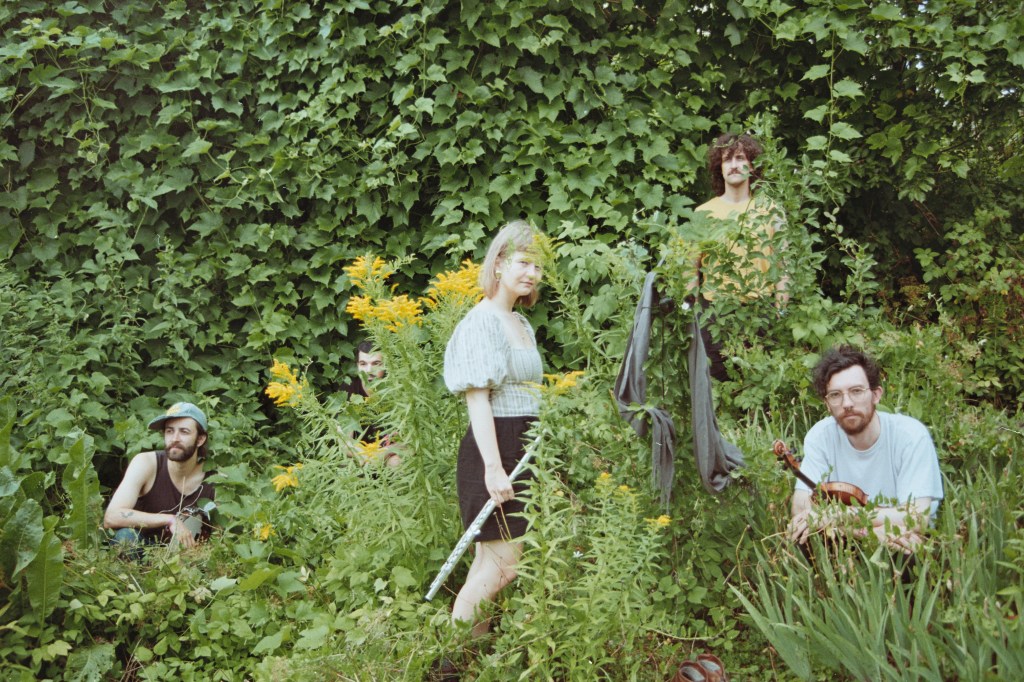
On the cover of the album, they all look like a bunch of farmers who took some time off from the harvest to fashion 10 incredible songs, and then went back to messing around with a tractor or something. But there was a method to this folk madness for del Real is the consummate artiste. 

The album cover. From left to right, del Real, Foster, Mackie, Tirmaste, and Heebøll Jacobsen.

“In every album, we try to shape and find the reason and the language in which the songs exist,” remarks del Real. “There were a couple of musical languages that were present in the picture.” In the case of ‘Prólogo,’ Alan Mackie, who also played bass on the record, was a co-composer and co-producer of the single, as he was on many of the album’s songs, bringing along his own sentiment (Mackie is from Prince Edward Island). In combining with del Real’s own Latin American folk, they have created a blend of music they jokingly refer to as LatinAmericana. But there are Old World influences too.

“There are a lot of European folk influences, such as Eastern European uneven time signatures,” says del Real, “which we tried to implement in a very organic way, and some Scandinavian influences, both in the percussion and in different colours in the instrumentation and arrangement.”

While del Real wrote the songs on the album and the record is credited to his solo project, it is very much an ensemble effort and grew out of an ongoing collaboration with Mackie and Tirmaste. Mackie and del Real even hit the road and toured Asia at the beginning of their co-sojourn, with dates in Japan, Taiwan, and South Korea. “I had a bunch of songs waiting to be something and we decided that could be a good place to try them out,” says del Real. “From that experience we started to shape where the sound was going and it felt very natural to start working on this.” 

Katariina Tirmaste was “another fundamental pillar” in the creation of Notas Rotas, helping to flesh out the compositions and to arrange them. Del Real credits her as a “creative and emotional performer,” one of who provided sensitive, flexible parts to the different songs that eventually made up the new record. “She’s incredibly versatile and also without taking up more space than needed, which is a very humble and Estonian approach in my opinion,” he says.

LatinAmericanaEstoniana on stage: Mackie, del Real, and Tirmaste.

The record itself was put down in home studios in Toronto, the south of France, the west coast of Sweden, not to mention a multitude of closets in apartments in Estonia. From this pastiche of on-the-fly audio recordings, a sound engineer of fortune called Jorge Fortune in Patagonia mastered the sonic tapestry of Notas Rotas, which is that rare record that sounds good whether it’s been played in the car, through headphones, or on your smartphone. 

I know because I have tried listening to it in all three environments. These recordings hold up.

Del Real I have known as a musician for years and have attended his shows, including some with Tirmaste and Mackie. While I hesitate to say anything about his songcraft, I can say that some of the melodies on this album challenged me and required multiple listens to fully digest, which for me, as a listener, is the mark of the very best music. Having a minimal knowledge of Spanish, even after years of instruction in high school, his lyrical intent remains a mystery to me. In his own words, it reflected the transient nature of his life as he moved around as well as the emotional winds blowing through. “It had a lot of reflections around inconclusive situations, self-awareness, letting go, and letting life take its course,” del Real says. 

He was also demoing the material on the road and in front of his fellow musicians, which took him out of the more introverted, isolated settings that fueled the creation of his last album, Principios de Declaración. Solo albums can be complicated territory for any musician, though del Real is a singer songwriter and thus a solo artist by default. With Notas Rotas I am reminded of David Crosby’s solo outings, particularly his first venture, If I Could Only Remember My Name, recorded at the very dawn of the singer-songwriter era in 1971, which saw a whole cast of characters join Croz in the studio (there’s even a cut with Jerry Garcia and Phil Lesh of the Grateful Dead paired with Neil Young and Santana drummer Michael Shrieve). 

While Croz’s musical influence might not be immediately apparent on Notas Rotas, his spiritual influence is everywhere and I think, might he have lived a little longer and heard the record, he would have approved. The kind of camaraderie that fueled Croz’s effort can be seen here, because these fellow musicians are del Real’s confidantes and he trusted them with this music.

A band apart or, for you non-Godard aficionados, a band of outsiders.

When this album was first released, del Real encouraged listeners to post their favorite songs. But what I have found upon multiple listenings is that my favorite track changes with each listen. Today, on a snowy January day, it is the sixth track, “Distracciones” with its vibrant fiddle parts. Any one of these tracks is sticky enough and interesting enough to catch a listener in its web. Perhaps “La Primera Nieve” or “The First Snow” is the most appropriate for this colder season. And then there is the finale, “Los Sueños” (which can be translated as ‘Dreams’ or ‘Visions’) which is carried along by lovely backing vocals like a ball being carried away upon the waves. 

There is, whether it exists or not, and whether intended or not, a maritime fluidity to this music.

For del Real who, like the writer of this review, calls Estonia home, it was this seabound country that most manifested itself in this latest work. It found its ways into its lyrics, its melodies, its colors and moods. “Personally I think it’s very inspired by Estonia, its pace and imagery,” del Real says. He also sees in it a breakage with his past, or the path he was once on, and a fresh intimacy that he credits with producing its raw, unfiltered, and, I would add, touching result.

russia surrenders

AFTER RUSSIA surrendered to Estonia, celebrations were held in both capitals. Estonians were able to roam the Grand Kremlin Palace in Moscow at will, taking photos of themselves lounging in its furniture. Koit Toome reclined by the fireplace, taking turns stoking the fire with Tanel Padar. Mart Sander was playing billiards in the other room with Anu Saagim. Someone had torn Lavrov’s portrait off the wall. One could only see half of Lavrov’s face.

My friend Stig decided to hold an ancillary meeting for the Estonian and Russian communities in the Canary Islands, which happened to coincide with his 18th annual 30th birthday party. It was held at the MTV Beach House, which meant Stig and Riken, the worldwise wandering Japanese mountaineer, spent much of the time networking and pressing the flesh with various dignitaries around the pool, which was filled with tanned young beautiful people in Baywatch red bikinis and swimming trunks playing volleyball. Stig was dressed in his summer finest, which included a Hawaiian shirt and matching shorts. Riken wore loose desert camouflage garb, including pants and jacket, and I wondered if he always was dressed to hike, or if those were the only clothes he owned. They walked around the pool celebrating New Victory Day.

“The Sign” by Ace of Base was playing.

Somewhat tired of the scene, I retired to my room at the Canary Islands MTV Beach House, where I began to work on the next chapter of what would surely prove to be a poorly received and misunderstood work. But Stig and Riken were soon at the window, chastising me for living more in the digital world and less in the real world, “where people stop being polite and start getting real,” as Stig put it as he admonished me. After that I returned to the party, only to meet a boisterous woman who looked Spanish but was speaking Estonian. She was clothed in a flowing blue dress and she had lots of silver rings on her fingers. She was sipping some kind of fruity cocktail and regaling her girlfriends with stories of outlandish behavior. These are the kinds of women I like, I thought. The ones who are truly horrible. The ones with filthy souls.

“We should go on a date,” I told the woman in the blue dress. “A date?” she answered me while licking a line of sea salt off her wrist before swallowing another shot. “You mean a date date?”

“Yes,” I said. “You can wear nice clothes and I can wear nice clothes. We can meet together somewhere and eat food. I will even offer to pay, but will accept if you refuse. Then we can talk about our lives, our jobs, who broke our hearts.” The woman in the blue dress wiped some of the tequila from her lips and said, “It doesn’t sound so bad, the way you put it. And I thought you had promised the world that you would never go on another date.” “Well, Russia just surrendered,” I told her. “Koit Toome is in the Kremlin. Surely that’s cause for celebration.”