
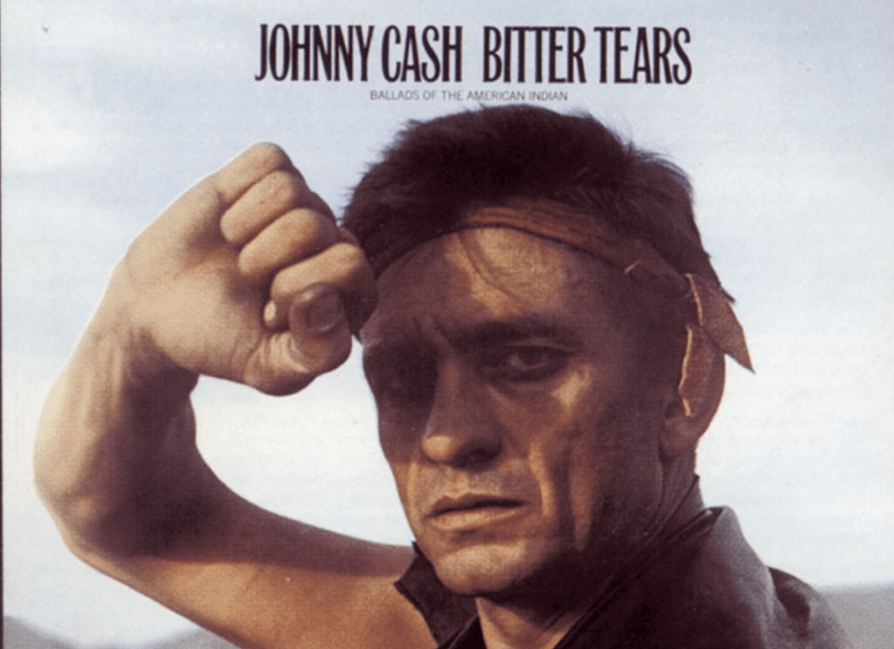
AMERICAN COUNTRY GENTLEMAN Johnny Cash was feeling particularly aggrieved in 1964 and wishing to highlight the struggles of indigenous peoples in the United States, so he recorded a whole album of songs called Bitter Tears: Ballads of the American Indian. The resulting record, released on October 1 of that year, less than a year after President Kennedy was killed in Dallas, and a month before Lyndon Johnson won a landslide victory against Barry Goldwater, is often a kind of side note. I don’t remember if it came up in Walk the Line. He didn’t mention it in A Complete Unknown either, even though it had just been recorded.
But it’s a beautiful collection, with spare, percussive musical accompaniment by the Tennessee Three, Cash’s backing band, which included Luther Perkins on guitar, Marshall Grant on bass, and WS Holland on drums. Session musicians Norman Blake, who is still alive (aged 87) and Bob Johnson helped out on guitar. The best parts of the songs are the lovely backing vocal contributions of The Carter Family. I had a hard time figuring out who was singing, but certainly Johnny’s future wife June Carter was in the lead, along with Maybelle, Helen, and Anita Carter. You can hear their sublime harmonies on “As Long As The Grass Shall Grow.”
“Custer” though might be my favorite on this record, if only for Johnny Cash’s dry and comic delivery. “Custer split his men / well, he won’t do that again.” We forget that for most of the time after George Armstrong Custer‘s defeat at the Battle of the Little Bighorn in 1876, he was considered to be an American military hero. But in the 1960s, the Lakota version of events started to win out (Custer’s widow Libbie, by the way, lived until 1933, which shows you how recent this history was.) Cash makes fine work of the legend here, though he didn’t write the song. Peter La Farge, a Greenwich Village folky regular, penned most of the songs on Bitter Tears. La Farge recorded several records of music with Native American and Western themes for Folkaways Records. La Farge died the year after Bitter Tears was released of an overdose.
Probably one of the most contentious aspects was Cash’s claim of Cherokee ancestry and accusations of being a Pretendian. On the cover of the album, his fist can be seen lifted in solidarity. Cash wears a headband, which makes him look just a little like Charlie Sheen’s character in Hot Shots. His claims of Cherokee identity were later debunked by Cash himself. He had no documented Cherokee ancestry. However, claims that he was purely of Scottish or British Isles descent are also false. A DNA test by his daughter revealed that she had African ancestry on both sides of her family, meaning that somewhere in Johnny’s “pure Scots” woodpile were some Africans. Note that this ancestry wasn’t documented either. And on Geni, at least some claim that Cash’s Hagler family from South Carolina might be linked to the Catawba Chief Hagler. So maybe Johnny was Catawba and not Cherokee. It’s certainly possible. This great record is the subject of a documentary and a tribute album too. “Custer” at two minutes and twenty-one seconds is not, maybe, the standout track, but it’s just perfect.
I remember that when Cash died in 2003, I said to a friend at that time, “But he was young, just 71 years old.” And the friend said, “But he had lived his life. He packed as much as he could into those 71 years.” I suppose after he lost June, just a few months prior, he had no reason to keep on living. But you are missed, Johnny Cash. We’re still listening to your music every single day.
 north!