
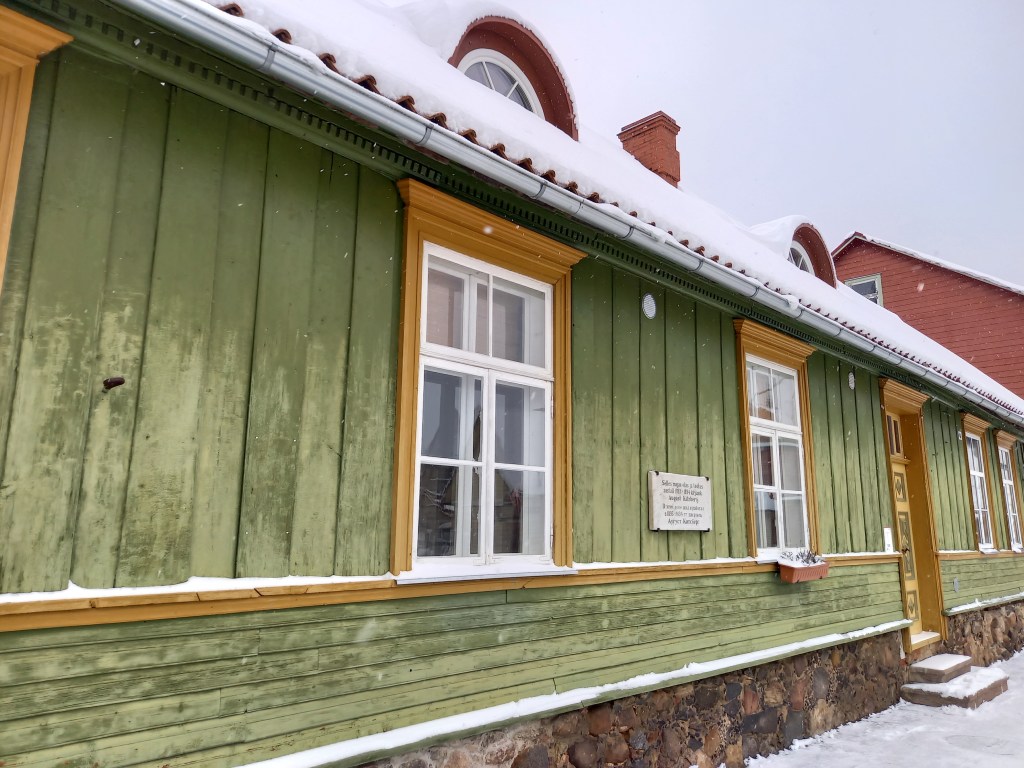
I LIVE IN A LITTLE WOODEN TOWN. Or so it’s been called by people who live in larger wooden towns. Each morning I rise and follow the same trajectories. I can see the milky light stirring behind the curtains, and I remember my third grade teacher telling us how there were places in the world where the sun never set in the summer and the winters were so dark.
Strange, I think, that I wound up living in one of these places. I wake up, shower and dress. I walk down one street toward one café, or I walk down another street to another. I cross by the courthouse, or that apartment building that used to be a dance school. There’s the park that used to host Joala, or the Konsum that used to be an A ja O. The preschool, the hairdresser’s, the Armenian restaurant. Estonian towns are full of bizarre surprises. In Viljandi, there’s an establishment called Suur Vend or “Big Brother” and another one called Sahara. There’s the Nuremberg Building, the façade of which is painted to look like it’s part of some German mountainside town. In three minutes you can travel from 1984 to Bavaria to North Africa. These small town trajectories are being engraved into my mental map. I call this my internal landscape. Your mind knows that the bank is here and the church and school are there.
Your mind knows, even when you aren’t paying attention.
DURING THE PANDEMIC, I started a writing project, one where I would write down my dreams in narrative form. I called this experiment “dream fiction.” What has resulted is a catalogue of stories, maybe a hundred already, that tell, in a way, my own story over the past five years. But it’s not only my story, it’s the story of the world. During the pandemic, I would have dreams about vaccines. When the war started, I had dreams about rockets. After Assad was overthrown, I had a dream about Russia surrendering to Estonia, and Koit Toome and Tanel Padar lounging in the Grand Kremlin Palace. There they sat stoking the flames in the fireplace beneath a torn portrait of Lavrov and complaining about how hard it is to be famous.
Another story was called, “Elon Musk’s Italian Restaurant.” I wonder how many of us are having dreams about Elon these days. I noticed in the dream that my mental landscape blended Viljandi with Stockholm, a city I have spent a lot of time in and that means a lot to me. In this combination of Stockholm and Viljandi — Stockholmdi? — Paalalinn and its lake were in Norrmalm. Elon Musk’s Il Colosseo was on one side of the lake, and his competitor’s was on the other. To get from one side of this lake, you had to take the metro, like you might in Stockholm. Viljandi had its own version of the T-Bana. Viljandi had its own Pressbyrån.
In another dream, Kihnu Island had merged with Viljandi, creating Kihlandi, so that all of the streets remained in their places, but the houses had been replaced by tall pines and red-painted wood barns, and the roads were gravel. There were fieldstone walls marking the boundaries of Joala Park. In another part of the town, San Diego was superimposed on Viljandi, creating Viljandiego. Viljandi was in the same layout, but all of the buildings were taken from the Gaslamp Quarter. There were even Kihnu women waiting for me on the other side of town, knitting in their red headscarves. I rode my bike past the mariachi bands and Mexican restaurants to get home. In this way, my town became half fantasy, half reality. I think that’s what happens when you live somewhere. Places get inside you. They fill your inner world.
***
People are arranged in such ways too. It’s not just streets and avenues, eateries and esoteric shops and lamp posts. Someone might be fixed in a certain place, such as the love of your life, for example. This woman is always there in that one spot, just like a mountain is always in one spot. You look up and see the mountain and it gives you a reassuring feeling, just like a certain person can reassure you through their presence. The mountain is always there and she is also always there in that place where she always has been. People become fixed in these places. Women become like mermaid statues spurting water. You go to visit them and to admire them.
It’s not easy to move mountains or mermaid statues and it’s not so easy to move people. This is how you can remain in love with the same person for years, even when it makes absolutely no sense, even when it causes you suffering. Buddhists call this attachment. They want to slip from place to place without ever paying these landscapes much notice. These people, these places, this yearning, it’s all like clouds drifting by. Do not get attached to women or to mermaid statues either, they say. Yet you do get attached. They are fixed in that place on your map, as much as Konstantin Päts’ enormous disembodied head is watching you from its perch beside the Estonian Theatre. You could try to move Päts’ head, but it’s too damn heavy. It’s been put there. So you just let it be. The woman you love is as fixed on your map as Päts’ head is fixed. It’s always just there, even if you don’t notice it every day. Sometimes you do notice it.
Some people do attempt to alter their inner landscapes through force. They get desperate and try to blow everything up with dynamite. I’m guilty as charged here and I have learned the hard way that it just doesn’t work. Movement creates countermovement, as the British-American philosopher and entertainer Alan Watts said in his lectures. Whatever you push against will push back against you doubly as hard. This creates balance and harmony, but people don’t want either. They want to be in control. They want this person here to be moved there. They want that person there to be erased. Out with the old and in with the new! From a cartographic perspective, this is like saying you would like Liivalaia to be relocated to Gonsiori. You want Rüütli Street in Tartu and Malmö Street in Pärnu to switch places. Let’s put Pirita in Kakumäe. Let’s move Rakvere to Karlova. But why? Because you think it will be better. You think that if you were able to redraw the map, everyone would be happier. You’re tired of loving that woman, or she doesn’t love you back. She has even said so. You want to exchange loyalties. You want to give your love to someone else, someone more deserving of your love.
But what happens in these ambitious inner world renewal projects? Things just fall back into place. Everything you did to rearrange your inner world was a total waste of time. There was no point in even trying. The world has its own natural order, just as towns do. In this way, whether you like it or not, she will remain the woman you love until one day, when there is a great earthquake or mudslide, or some other natural cataclysm that changes everything. This creates a before and after, just as burned cities only in part can be fully restored and rebuilt.
Estonian towns are full of such well-tended green parks that used to be grand structures. You walk through them all the time. Children play there, old women are out walking dogs there. Where there once were houses and hotels, there are now ice skating rinks. I wonder sometimes if we can still sense these places, even though they are no longer there, in the air about where the Golden Lion once stood before the March 1944 bombings, for example, in the same way we can still feel the presence of a woman in our lives through her long absence.
In this way, a lost person becomes both there and not there, just like the Golden Lion Hotel.
***
Recently I wrote down these words. I said that some things in life shattered us into pieces, leaving nothing in solid state. I said that in these situations, we become like free-floating mosaics, like the icy rings around Saturn or Neptune that, when viewed from a distance, almost look whole, but that upon closer inspection can be seen through. The light is visible between these leftover chunks of soul, feelings, and memory. They are suspended in time.
I wrote these words and then left to go to work on a rare sunny winter morning. On my left, I could see through some trees the spire of a small church, and on the right, I could see the sun on the windows of the courthouse. Often I am inspired to take photos of these little pieces of the town. I photograph sunlight against the wooden facades of old houses, I photograph frozen laundry strung across backyards, I capture the symmetry of the rail lines at Ülemiste.
Sometimes I see something interesting, like an old doll staring out a window at me. On that morning, my phone was dead and I could only watch the yellow light on the facades. A lot of people I know are nature enthusiasts. They ascribe to the Fred Jüssi School of Forest Asceticism. They try to fill the holes in themselves with birch juice, buckets of blueberries, and lake swims. For me, the sun on the facades of the buildings has become my own way of filling in those cracks, of gluing the pieces of myself together. Most people think we are all separate from each other and from our environments. I am me, you are you, this place is this place. I don’t think this is correct, because people are also places. This has become obvious. The universe is a continuum. I now know that this is true, but I am still trying to figure it all out.
*
An Estonian-language version of this piece appears in the magazine Edasi. Special thanks to Dea Paraskevopoulos for assisting with the Estonian translation, and to Casey Kochmer of Personal Tao for guidance.
 north!