IN MY TIME AWAY from Lennart Meri Tallinn Airport they had constructed a gleaming towering hotel on the eastern flank with views of Ülemiste Lake on one side and the runways and tree lines on the other. The architecture and interior was Nordic noir. The joint was decked out like an IKEA store at Christmas. Spare and white. Glass and metal. The words of a Romanian comic came to mind, “Estonia is like Norway, if Norway was made in China.” There was something to that, I thought as I rode the glass elevator down to the Departures area.
Descending, I noticed that the cat was sleeping in the hallway on the second floor. How did she even get there? She looked lost, with that inquisitive pink nose of hers up in the air, sniffing at the dry hotel air. Quickly I pressed at the buttons in the lift, trying to get out to rescue the cat, but the elevator arrived to the ground floor, some irritating tourists got in, and on the way back up to the top of the hotel, I saw that the cat was no longer on the second floor, but had gone up with the other elevator to the eighth floor. Again, I pressed the buttons in the elevator, but it was impossible to get out on the right floor. I was worried. What if she was to venture out onto the runway, only to be crushed, pancaked and splattered by the rubber wheels of a jet? My children would never forgive me for allowing the death of the cat.
Something had to be done.
When the elevator opened its doors again though, I was on the backside of the airport. I got onto a bus that took me all the way around to the other side of the airport, where the various rental car companies have their offices. Other irritating and slow tourists departed the bus here. Some were hugging each other on the escalators. As soon as I got off that bus, I began running through the airport. This part of it had changed too. It looked more like Arlanda, with Pippi Longstocking-inspired play areas for children, as well as counters loaded with cinnamon buns and open-faced sandwiches. Bookstores with Pride flags. There I was, rushing through the airport, trying to save the beloved black-and-white family cat. About halfway through, my wife came walking my way with the children. She was not amused by this funny airport scene.
“Why are you running through the airport like a lunatic?” she asked. “What’s wrong with you? I can’t take you anywhere.” “But I was trying to save the cat! She could get runover by a Ryanair jet.” My wife gave me a strange look. “What are you talking about, save the cat? The cat’s right there. She’s enjoying herself.” She gestured at the cat, who was sitting beneath a fake palm tree in the play area, biting her paws. “Come along,” she said to my youngest as they walked away. “Your father is weird.”
ON INDEPENDENCE DAY, we went to visit a producer in Helsinki, an older man whom I suspected of carrying on an extramarital liaison with my wife. We all went to visit him, and I decided to keep my mouth shut and not say anything, even as the two of them disappeared into the back garden to “talk about things.” I was in the living room with the kids, both mine and his own grandkids, I believe. We were watching TV and then we all fell asleep. There was a large tabby cat beside me. I could hear the cat purr. In the middle of the night, the cat awoke and went outside and I followed it out into the city shadows. I wandered past the cathedral.
I found my way to the Helsinki train station, the Helsingin Päärautatieasema. I got on the first train I saw, seconds before it was about to leave the station, found a seat inside, and again shut my eyes and began to dream deep. When I opened them, it was daylight and we were surrounded by the heather of the Scottish countryside, some ways south of Glasgow. Riken the Japanese mountaineer was seated across from me with his knapsack, looking over a paper map. He was marking his route with a short pencil. “Where does this train go?” I asked him. “Mons,” came the response. “This is the train to Mons.” “But where is Mons?” “It’s a little city to the south of here.” “I’ve never heard of it. I need to go back to Finland.” The train pulled up to an elevated platform in the middle of nowhere and Riken disembarked. “Don’t be such a nervous nelly,” Riken said, with that handkerchief of his on his head. “Just stay on the train.”
I leaned back in my seat and watched the Scottish countryside roll by and again shut my eyes for a while. When I opened them again, I was in the back of a truck driving up the sandy roads of Cape Hatteras National Seashore. We passed through Rodanthe, Pea Bridge, Whalebone, and Kitty Hawk, until the road would go no further. I could see fishermen out in the inlets pulling in nets full of fish. We began to hike into the jungles that separated the Carolina line from the Virginia line. The seawater was warm here, and we encountered a group of indigenous people diving for lobsters and crabs and filling buckets with them. This was a local tribe that was doing work for some company, but the owner was not there on the job site. His lone, shake-sided house stood on the sandy bank that separated the bay side from the Atlantic Ocean. “Which way should we go to get home?” someone asked. One of the Natives showed us into the forest. There was a trail that began here, leading deeper into the swamps and jungles.
The Native gestured with his head. “This is the way home,” he said.
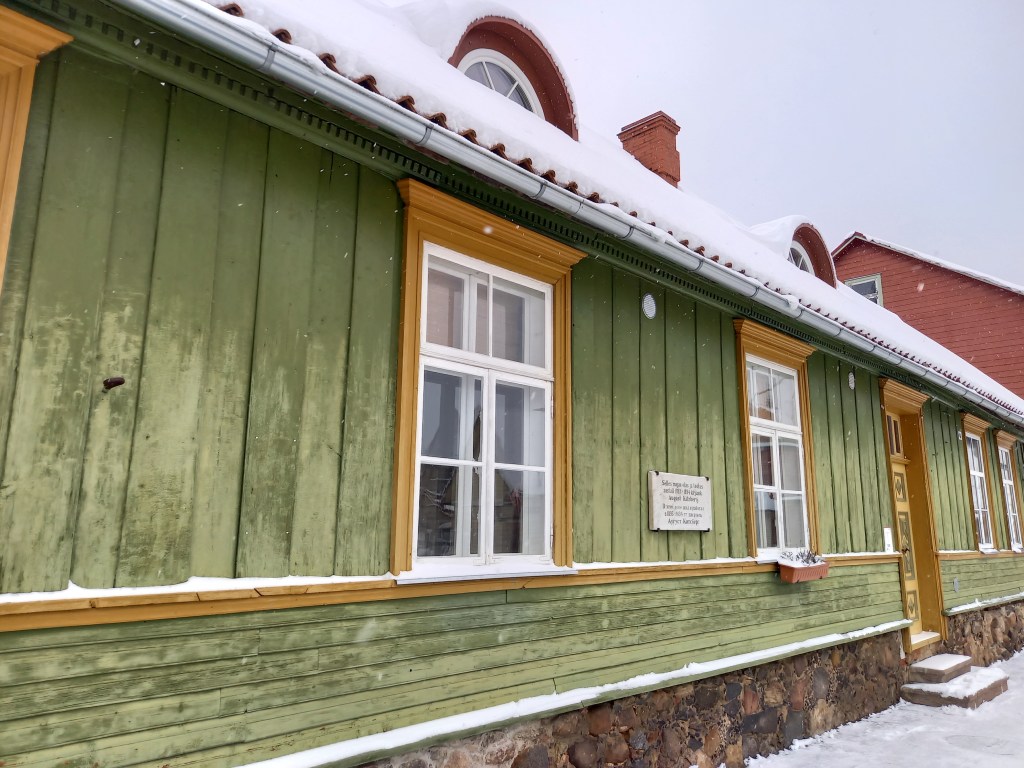
I LIVE IN A LITTLE WOODEN TOWN. Or so it’s been called by people who live in larger wooden towns. Each morning I rise and follow the same trajectories. I can see the milky light stirring behind the curtains, and I remember my third grade teacher telling us how there were places in the world where the sun never set in the summer and the winters were so dark.
Strange, I think, that I wound up living in one of these places. I wake up, shower and dress. I walk down one street toward one café, or I walk down another street to another. I cross by the courthouse, or that apartment building that used to be a dance school. There’s the park that used to host Joala, or the Konsum that used to be an A ja O. The preschool, the hairdresser’s, the Armenian restaurant. Estonian towns are full of bizarre surprises. In Viljandi, there’s an establishment called Suur Vend or “Big Brother” and another one called Sahara. There’s the Nuremberg Building, the façade of which is painted to look like it’s part of some German mountainside town. In three minutes you can travel from 1984 to Bavaria to North Africa. These small town trajectories are being engraved into my mental map. I call this my internal landscape. Your mind knows that the bank is here and the church and school are there.
Your mind knows, even when you aren’t paying attention.
DURING THE PANDEMIC, I started a writing project, one where I would write down my dreams in narrative form. I called this experiment “dream fiction.” What has resulted is a catalogue of stories, maybe a hundred already, that tell, in a way, my own story over the past five years. But it’s not only my story, it’s the story of the world. During the pandemic, I would have dreams about vaccines. When the war started, I had dreams about rockets. After Assad was overthrown, I had a dream about Russia surrendering to Estonia, and Koit Toome and Tanel Padar lounging in the Grand Kremlin Palace. There they sat stoking the flames in the fireplace beneath a torn portrait of Lavrov and complaining about how hard it is to be famous.
Another story was called, “Elon Musk’s Italian Restaurant.” I wonder how many of us are having dreams about Elon these days. I noticed in the dream that my mental landscape blended Viljandi with Stockholm, a city I have spent a lot of time in and that means a lot to me. In this combination of Stockholm and Viljandi — Stockholmdi? — Paalalinn and its lake were in Norrmalm. Elon Musk’s Il Colosseo was on one side of the lake, and his competitor’s was on the other. To get from one side of this lake, you had to take the metro, like you might in Stockholm. Viljandi had its own version of the T-Bana. Viljandi had its own Pressbyrån.
In another dream, Kihnu Island had merged with Viljandi, creating Kihlandi, so that all of the streets remained in their places, but the houses had been replaced by tall pines and red-painted wood barns, and the roads were gravel. There were fieldstone walls marking the boundaries of Joala Park. In another part of the town, San Diego was superimposed on Viljandi, creating Viljandiego. Viljandi was in the same layout, but all of the buildings were taken from the Gaslamp Quarter. There were even Kihnu women waiting for me on the other side of town, knitting in their red headscarves. I rode my bike past the mariachi bands and Mexican restaurants to get home. In this way, my town became half fantasy, half reality. I think that’s what happens when you live somewhere. Places get inside you. They fill your inner world.
***
People are arranged in such ways too. It’s not just streets and avenues, eateries and esoteric shops and lamp posts. Someone might be fixed in a certain place, such as the love of your life, for example. This woman is always there in that one spot, just like a mountain is always in one spot. You look up and see the mountain and it gives you a reassuring feeling, just like a certain person can reassure you through their presence. The mountain is always there and she is also always there in that place where she always has been. People become fixed in these places. Women become like mermaid statues spurting water. You go to visit them and to admire them.
It’s not easy to move mountains or mermaid statues and it’s not so easy to move people. This is how you can remain in love with the same person for years, even when it makes absolutely no sense, even when it causes you suffering. Buddhists call this attachment. They want to slip from place to place without ever paying these landscapes much notice. These people, these places, this yearning, it’s all like clouds drifting by. Do not get attached to women or to mermaid statues either, they say. Yet you do get attached. They are fixed in that place on your map, as much as Konstantin Päts’ enormous disembodied head is watching you from its perch beside the Estonian Theatre. You could try to move Päts’ head, but it’s too damn heavy. It’s been put there. So you just let it be. The woman you love is as fixed on your map as Päts’ head is fixed. It’s always just there, even if you don’t notice it every day. Sometimes you do notice it.
Some people do attempt to alter their inner landscapes through force. They get desperate and try to blow everything up with dynamite. I’m guilty as charged here and I have learned the hard way that it just doesn’t work. Movement creates countermovement, as the British-American philosopher and entertainer Alan Watts said in his lectures. Whatever you push against will push back against you doubly as hard. This creates balance and harmony, but people don’t want either. They want to be in control. They want this person here to be moved there. They want that person there to be erased. Out with the old and in with the new! From a cartographic perspective, this is like saying you would like Liivalaia to be relocated to Gonsiori. You want Rüütli Street in Tartu and Malmö Street in Pärnu to switch places. Let’s put Pirita in Kakumäe. Let’s move Rakvere to Karlova. But why? Because you think it will be better. You think that if you were able to redraw the map, everyone would be happier. You’re tired of loving that woman, or she doesn’t love you back. She has even said so. You want to exchange loyalties. You want to give your love to someone else, someone more deserving of your love.
But what happens in these ambitious inner world renewal projects? Things just fall back into place. Everything you did to rearrange your inner world was a total waste of time. There was no point in even trying. The world has its own natural order, just as towns do. In this way, whether you like it or not, she will remain the woman you love until one day, when there is a great earthquake or mudslide, or some other natural cataclysm that changes everything. This creates a before and after, just as burned cities only in part can be fully restored and rebuilt.
Estonian towns are full of such well-tended green parks that used to be grand structures. You walk through them all the time. Children play there, old women are out walking dogs there. Where there once were houses and hotels, there are now ice skating rinks. I wonder sometimes if we can still sense these places, even though they are no longer there, in the air about where the Golden Lion once stood before the March 1944 bombings, for example, in the same way we can still feel the presence of a woman in our lives through her long absence.
In this way, a lost person becomes both there and not there, just like the Golden Lion Hotel.
***
Recently I wrote down these words. I said that some things in life shattered us into pieces, leaving nothing in solid state. I said that in these situations, we become like free-floating mosaics, like the icy rings around Saturn or Neptune that, when viewed from a distance, almost look whole, but that upon closer inspection can be seen through. The light is visible between these leftover chunks of soul, feelings, and memory. They are suspended in time.
I wrote these words and then left to go to work on a rare sunny winter morning. On my left, I could see through some trees the spire of a small church, and on the right, I could see the sun on the windows of the courthouse. Often I am inspired to take photos of these little pieces of the town. I photograph sunlight against the wooden facades of old houses, I photograph frozen laundry strung across backyards, I capture the symmetry of the rail lines at Ülemiste.
Sometimes I see something interesting, like an old doll staring out a window at me. On that morning, my phone was dead and I could only watch the yellow light on the facades. A lot of people I know are nature enthusiasts. They ascribe to the Fred Jüssi School of Forest Asceticism. They try to fill the holes in themselves with birch juice, buckets of blueberries, and lake swims. For me, the sun on the facades of the buildings has become my own way of filling in those cracks, of gluing the pieces of myself together. Most people think we are all separate from each other and from our environments. I am me, you are you, this place is this place. I don’t think this is correct, because people are also places. This has become obvious. The universe is a continuum. I now know that this is true, but I am still trying to figure it all out.
DR. STERN’S HOUSE was at the end of Crane Neck. He was a gynecologist, I think. Or an orthodontist. Something like that. He wasn’t home when I arrived to this cedar-shaked masterpiece of architectural fusion, a crisscross of colonial and modernist influences. The property was green, the driveway pebbled. Birds glared down silently from the oaks and the maples. The taxi driver left me at the gate and I walked up to the house and went inside.
Inside the house, there were various characters hanging out and passing through. One of them was a businessman of the old breed, with a pocket watch and pince-nez glasses. He said he had made a fortune rigging baseball games in his day, but had discovered a new source of wealth and materiel: diamonds. He had on a red coat and was walking through the kitchen talking about his dealings in the gem business. There was a skylight and the gray light of the day shone down on his whiskers. “Indeed, the gem business is the best business, if I say so.”
Behind him, my grandmother emerged. Her hair had taken on a golden hue and she was more animate than ever. “Grandma? Is that really you?” She grabbed me by both hands and we spun in circles. “I’m 106 years old,” she said, “and I haven’t felt this good since the New York Yankees won the 1941 World Series!” There were others behind her carousing and I wondered what kind of parallel reality was dawning on me. Grandma kept telling me how great she felt and looked now that she was dead. She said so in her very genteel and proper Virginia accent.
Grandma let go of my hands and like that, I was out in the garden and the grounds were covered in snow. I was with my daughter and we began walk through a series of stalls, not unlike the little putkad that dot the Town Hall Square in Tallinn during the Christmas Fair. Everywhere I looked though, I only saw stacks of baked goods. Flour, flour, and more flour, covered with sugar, sugar, and more sugar and some chocolate. I bought my daughter some tasty candied quince in a paper bag and we walked away from the market, only to be chased down by several wild big black dogs. When a hellhound like that falls on you, it’s a real terror. My daughter fell in the snow as the dogs got closer, so I ran over and pulled her back into the house by her arm. I remember just seizing her by the hand and pulling the girl back inside.
And then I opened my eyes. We were back in the kitchen of the house and the sunlight was on our faces. Someone announced, “Dr. Stern is here to take you home now.” We went outside and there he was, standing beside a black 1934 Buick Victoria. It was a beauty of an automobile. He was wearing a purple tie-dye Grateful Dead shirt and had on a pair of khaki shorts. He had curly hair and seemed like the kind of doctor who had smoked a lot of dope back in med school. “Well, what are you all waiting for?” said Dr. Stern, opening the door to the black Buick. “Just get in!”
I GOT MYSELF a little helicopter, just like James Bond’s Little Nelly from You Only Live Twice, flying out to the east of the island, admiring all of the pine trees and swamps. Keeping close to the estuary, I looked down only to see Jack, a British adventurer in a khaki jacket, hiking across the wetlands with his son. Beside them was an enormous brown lump. It looked moist, pungent. Jack looked up at me and waved, I could see his gray hair. “Ahoy, what is that thing down there?” I shouted above the rotor sounds. Jack shouted back, “It’s a giant poo, mate!”
At the other end of the bay, I set Little Nellie down. Gunna was there, with her fringe or bangs cut across the front. She was at her usual position in the shop, wearing her apron, and appearing rather matter of fact. But over at the juice and taco bar, I encountered Gunna again, blending fruits and vegetables and scooping salsa. I looked back over to shopgirl Gunna, only to discover she was there at the same time. How could it be? How could Gunna be in two places at once? “But didn’t you know there are two of us?” Gunna said. She had a lovely, toothy smile. I once told Gunna that her smile was my greatest birthday present. I kept looking back and forth at the two Gunnas. “Yes, she is me and I am also me,” Gunna said. “We’re all me.”
“But how can that be?” I asked, scratching my head. “Because there are as many of me as there needs to be,” Gunna said, making another taco. She really was a cute girl. She looked like a three year old in a full-grown woman’s body. I reconciled myself to the idea of there being many manifestations of Gunna, just as all seven Matrikas were thought to be manifestations of Lakshmi. Each manifestation of Gunna, the Hindus had said, embodied some different aspect. Indeed, temple art unearthed by archaeologists showed the many faces of the goddess Gunna.
“She is me and I am also me,” she said. “She is me and I am also me.”

 north!