
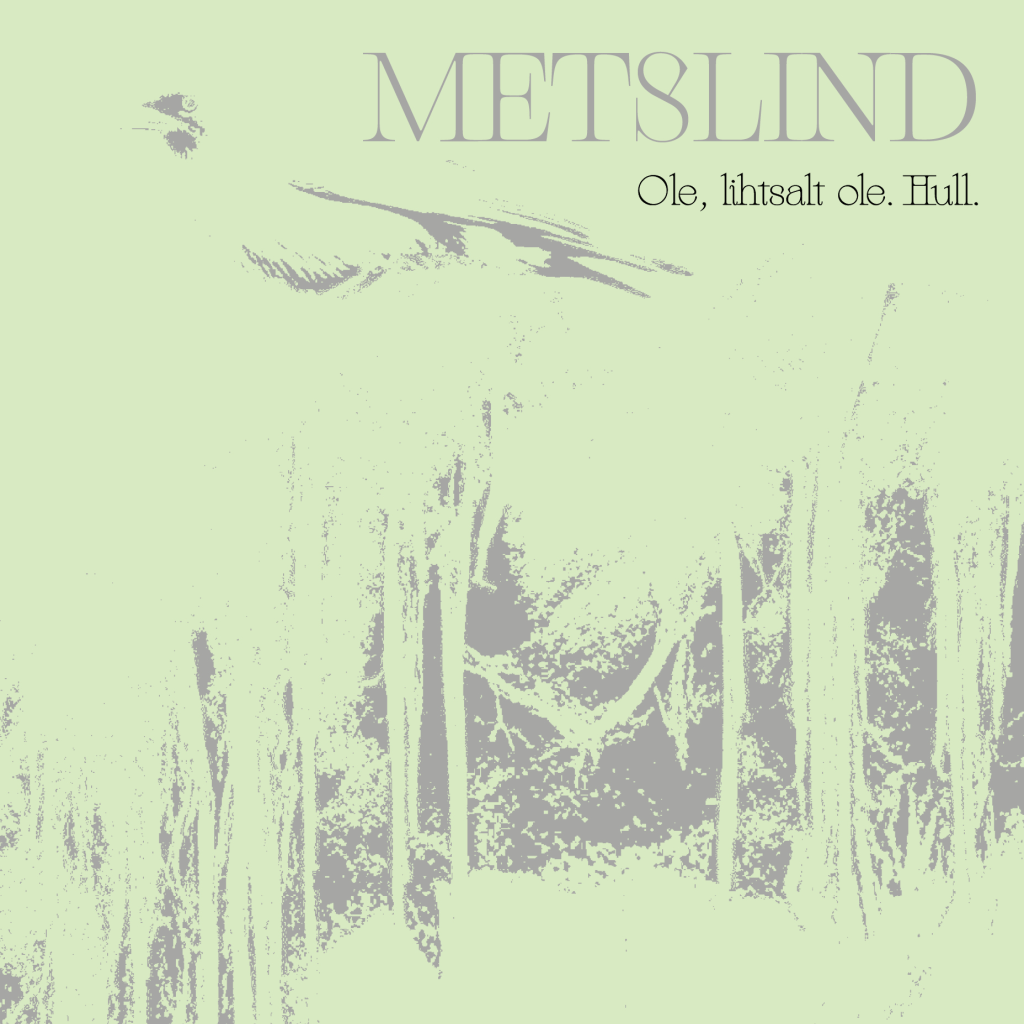
I’VE BEEN WAITING to write about this new Metslind record, because I am not sure how to approach it. In the early morning hours, as I began slurping down my first coffee of the day, I still had the somewhat jangly sounds of her guitar ringing between my ears. “She’s like The Smiths crossed with Fleetwood Mac,” I think. “As if Morrissey and Stevie Nicks had a baby.” Then I am somewhat terrified of the idea of a child with Morrissey’s face and Stevie Nicks’ hair and body. I don’t want anyone else to have that image pop into their heads. But maybe if Johnny Marr and Christine McVie had collaborated on an album in Estonian it might have sounded like this one. Maybe, but not really. Metslind is her own phenomenon. It’s a pitfall of Western and Estonian journalists alike that we look for these equivalents. Estonia must have its own Elvis, its own Michael Jackson, and its own Nokia, but there is only one Metslind. Not everything can be translated over.
Metslind’s record is two EPs combined. It arrived to me by Smartpost more than a month ago. I now have it on vinyl, but I gave my record player away, because it wasn’t very good. So now I just have an LP I cannot play. The album though is a kind of shrine, a shrine to the record player I will someday acquire. Then I will be able to play the album as intended. I will wake up and listen to Metslind at 7 am. In the meantime, I will listen to its conjoined EPs on Spotify. One is called Ole, lihtsalt ole (Be, just be) and the other one is called Hull (Crazy). The song titles paint a somber image. Other than the title tracks, there’s “Valu, Sa Oled Mul Jalus” (“Pain, You’re in My Way”), “Ära Sõdi” (“Don’t Fight”), and “Päris Inimesed” (“Real People”), along with “Rabalumm” (“Bog Enchantment”). There’s also “Tahan Olla Hea” (“I Want to Be Good”), “Ma Ei Tea Mis Saab” (“I Don’t Know What Will Happen”), “Mina Võin Ja Sina Võid Ka” (“I Can and So Can You”) and one more called “Elupuu Elab Mind Üle” (“The Tree of Life Will Outlive Me”).
This last title is the most puzzling one. Elupuu in Estonian refers to evergreens, but in my mind the name conjures up Yggdrasil, the tree of life in Norse mythology and the world tree of Estonian and Finnish mythology, which has stars in its branches and snakes at its roots. According to Metslind, the lyrics toy with Estonian trees like the evergreen (elupuu) and aspen (haavapuu, literally “wound tree”). “In the song, the Tree of Life outlives me,” says Metslind, “and the Wound Tree heals before I do. I say that it’s so good that I am no longer so young and that I don’t know what awaits me in life, though of course I would like to be younger and I would like to know what will happen. It’s about trying to have faith in the way things are.”
This is the Metslind musical universe. It’s a world of bogs, trees, and introspection. Her pop-infused indie guitar rock is expressed in dreamy tapestries of haunting vocals and layers of carefully selected sounds, but masks a kind of slow-burning inner torment.

According to Metslind, whose family calls her Maarja, a lot of this music came out of her separation from her long-time partner. In fact, “Hull” is about playing dumb when people would ask her uncomfortable questions about the split. “I started to give strange answers to their questions, so they wouldn’t know what to say or ask me about it anymore,” she says.
To this I have to agree. There are never satisfying answers to explain away life’s irrationality.
Metslind is fond of her name, which means “Wild Bird” in Estonian. “Every bird has its own song,” she says. “And I like it when a performer has a different name. They can be a different person.” Maarja also happens to be the name of a singer in Estonia, one that is trademarked.
But Maarja didn’t want to just be another singer named Maarja. Her Metslind persona was born. When she is not on stage, she is a music teacher, mostly of voice with some guitar teaching. She started attending music school at the age of seven in Kohila, and at her own instigation. Her family has supported her music, for which she considers herself lucky.
Other than the emotional tumult that led to sings like Ära Sõdi, which literally means “Don’t Wage War” and only coincidentally came out when the Ukrainian-Russian War intensified, Metslind is also somewhat unique in that she has chosen to sing in Estonian, rather than try to approach the international market with English-language songs. In fact, she used to write and compose her songs in English, but an encounter with Estonian musician Vaiko Eplik, who like Metslind is from Rapla, a town in North Estonia, encouraged her to switch back.
“You know, I have always listened to a lot of English-language music and singer songwriters,” she says. “I didn’t have a plan to write in Estonian, but then these songs just started to come.”
I would say it’s a welcome addition to the world of Estonian music. While listening to this record, I started to think about where Estonians listen to music, or where I hear Estonian music. Estonian-language music is played sometimes in major supermarkets, so that Estonian songs remind me of perusing produce, looking for good quality bell peppers. Estonian music is played at summer festivals, so that Estonian songs remind me of sitting outside in some amphitheater. And Estonian music is played during family get-togethers. So Estonian music reminds me of grilling šašlõkk while Kihnu Virve and Anne Veski’s golden hits are played.

Metslind’s music is not the soundtrack for supermarkets, summer festivals, or grilling šašlõkk. It’s more for long walks alone while you are trying to sort out various unresolved past issues. That, at least, was my experience of it. I don’t have a favorite song on the record, but I remember liking “Rabalumm” the most on the first listen. A good bog is medicine to the heart.
She herself mentions Joni Mitchell when asked about her approach. She uses Joni’s Open D tuning on her semi-acoustic Ibanez, which is as much a part of her look as her whiteblonde hair. She plays it with a chorus pedal which gives it that lovely atmospheric sound that almost reminds one of Peter Buck from REM. These are my own musical references, so bear with me.
The album was recorded in the studio at Linnahall in Tallinn, a sprawling stone monster of a building once called the VI Lenin Palace of Culture that was constructed for the 1980 Olympic Games (which the US boycotted on account of the then recent Soviet Invasion of Afghanistan).
“This is one of the last things that’s still functioning in that ruined old building,” says Metslind.
Metslind is an admirable character, I must conclude. She composes, she performs, she travels the roads with her Ibanez. She sings of the Tree of Life, bogs, and heartbreak. I find her to be an honest, direct artist. The Estonian word is siiras, but it doesn’t have an exact English-language equivalent either. And she will continue. “It would make more sense not to be a musician,” she says, “and I have tried many times to not be one. But when I tried, I started this new project That I called Metslind. What else can you do when your heart starts to sing?”
 north!
One thought on “ole, lihtsalt ole. hull. by metslind”