
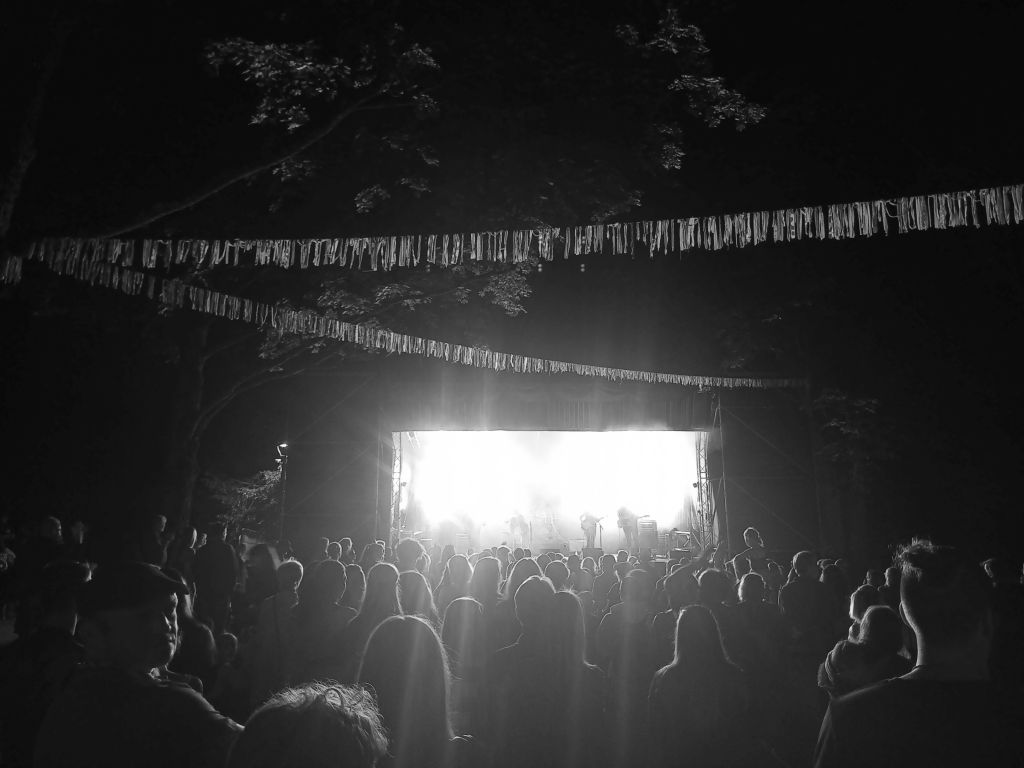
AT SOME MOMENT on Sunday evening I find myself in the grand hall of Viljandi’s Folk Music Center or Pärimusmuusika Ait looking for a good spot to rest a while and write. The hall is full of people, some standing, others gathering, talking and telling jokes. There are all kinds of people here, people with shaved faces and hairy chins, hippies, squares – but let’s be honest, most of them are a decade or more younger than I am. Beside the stage, three wonderfully light-haired girls are seated, one with shiny hoop earrings. I don’t know how old they are and don’t want to know. Two of them are looking at their phones, one has her head to her knees, apparently to just catch her breath. I watch them a moment more and then hoist myself up onto the edge of the stage. Every part of my body hurts: my legs, arms, back, and heart. My trustworthy satchel is wet from the rain, but my notebook is still dry. With a black pen, I begin to write. A few seconds later, a man appears before me, one with short hair and a brown sports jacket. He says he used to be my first daughter’s zoology teacher at the Viljandi Hobby School. That must have been a long time ago. His name is somewhat familiar, though I don’t recognize him. He has something in hand.
It’s a button. The kind you’d find on a jacket. There’s a trick too. There is something behind the button. This man goes around Viljandi installing these buttons on walls. When you tug the button, it pulls a piece of string behind it, and when the string goes back into the wall, the magic button plays beautiful music. “You just have to pull the button,” the man says. I don’t understand if I’m dreaming or not. I am at this moment so tired, that it all could be a hallucination. “That’s genius!” I say. The music is the same you would hear from a music box. “Why are you putting these buttons up?” I ask the man. “I wanted to bring a little more joy to the world,” he answers with a smile. Then the button man disappears into the crowds.
When the man is gone, I take some more time to unwind. The three girls are still sitting in the corner, looking half dead. It’s dark outside now. I actually have no idea what time it is, and only know, in a foggy way, that it is Sunday, which means that it’s the last day of Viljandi Folk. The concerts are still ongoing somewhere. And I promised Arno Tamm earlier that I would go see him during the final concert.
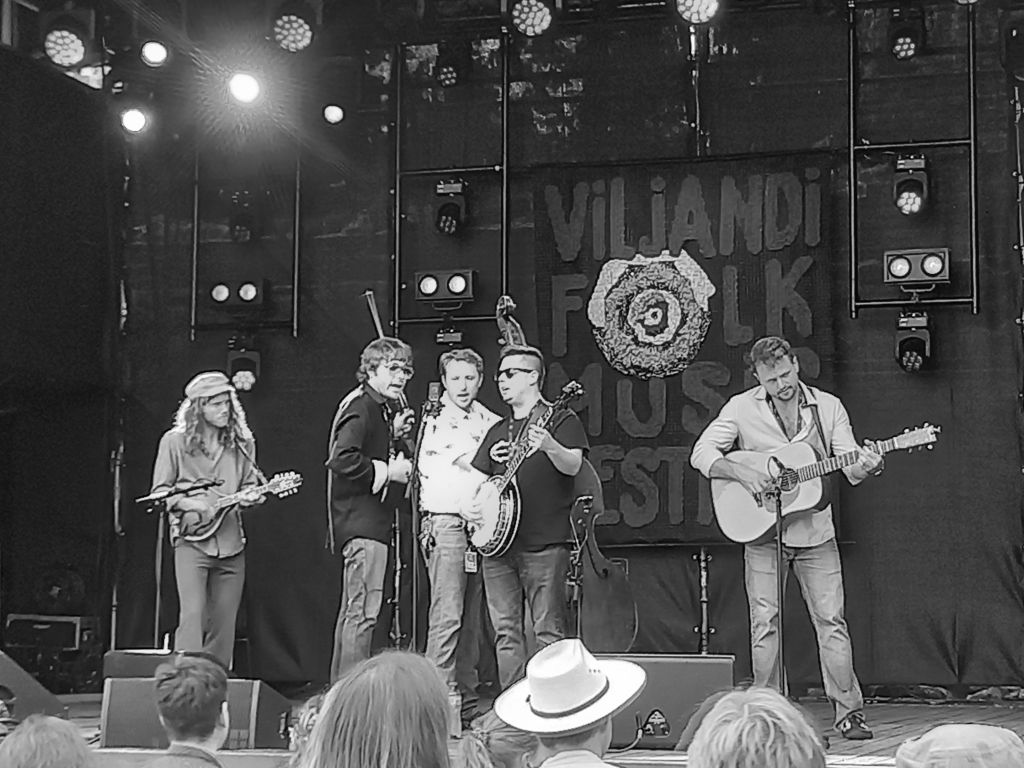
During one concert, I saw the American guitarist Jed Clark, who is from Arkansas and plays with the bluegrass band Midnight Ride, look out with tired eyes on Käevumägi, or the Well Hill, and a thousand or so beautiful people and say, “This festival is like a dream I don’t want to wake up from.” In the great hall of the Ait, I think that Jed is right. Earlier in the festival, I had a chat with him at the Green House Cafe. Jed told me in his soft Arkansas accent that Viljandi Folk was “just like paradise.”
I wasn’t so sure it was paradise. But a strange dream nonetheless.
***
“PEOPLE COME HERE from the US, from Canada, and they have a hard time believing that this is all real,” Tomás del Real, a Chilean musician, tells me the day after his concert was well received at the Jaak Johanson Stage. He performed on Saturday night, and people praised his performance the following morning. “It was all so intimate and cosy and yet so grand and so global,” some gushed to me. I had planned to go there, but somehow got lost along the way, and must admit that I don’t know exactly where I was when Tomás played that night. I allowed myself to live a little that evening and so everything from that evening has already faded into the mist. But I survived and supposedly the music was good.
“They see the lake, the castle ruins, and they think, what place is this?” Tomás continued his story. “For a festival, it’s a really great place, and the way the festival uses the surroundings, the aesthetics, are done with incredible taste. Nothing is overdone, everything is very natural, and they simply fill out the environment,” he said. Tomás is in some ways like me. A foreigner who came to Viljandi and got stuck here. Years before we came, Ruslan Trochynskyi, the trombonist from Svjata Vatra, arrived here from Ukraine and was similarly seduced. We are now like one big Folk family and not just us, who have come from abroad. Estonians have arrived here the same way. They come to Folk, go for a swim, and stay.
There is some kind of invisible pull. Even Tomás del Real, who is as clearheaded as they come, acknowledges this: “It is magnetic,” he admits.
I have of course heard criticism, that Estonian folk music is mostly fake and mostly synthetic, that the prices are too high, that this year’s Folk isn’t as good as last year’s, and so on. “These Folks are not like they used to be,” some say.
It is true that before there were fences and passes, folk was an anarchic experience and all kinds of weird people turned up in town. I called them the “zombie army” at the time, the drunks, Nazis, and rednecks. But all was permitted and the people enjoyed that anarchy. At some point, it was decided that Folk would be a bit safer and those days drew to a close. But the magic continued. Gates or no gates, the spirit of Folk cannot be contained. And the security staff are only looking for alcohol, really. They give your bag a squeeze and then wave you through with a grin. You have been examined. Go on your merry way.
I wanted to say, in response to this criticism, that whatever they have, people never seem to be satisfied with it. Something’s always missing from the picture. Unfortunately, this phenomenon is too familiar to me. I find myself on a train south, staring from a window. I think, what am I doing here in Viljandimaa? My heart is full of disappointment and melancholy. Other people, such as those from Tallinn, have said to me, “Why are you wasting your life in some hole in Estonia?”
Viljandi indeed is an odd place, one you can only reach intentionally. No one shows up here by accident. Folk does offer a lot of reasons for people to come here. It is a rich and deep event. For those who are never satisfied, I would say, take a look around. There is some value here. There is something different at least. I had these thoughts as I hid myself away in the press room in the cellar of the Pärimusmuusika Ait. Outside there was rain and thunder, and the Ait was full of soaking wet people. In the corner of the press room sat my one true love, the object of my affection. But who is this quiet girl? What’s her name?
She’s a coffee machine, naturally.
***

THERE ARE ALL KINDS of stories shared in the press room during the folk music festival. One day, after a concert by Canzoniere Grecanico Salentino, I found myself seated again beside my beloved coffee machine listening to her purr. I must acknowledge that Folk is an exhausting experience. Even after just a few hours at Folk, a person is squeezed dry. All of that noise, all of those conversations and songs. Espressos are needed for a quick pick-me-up, so that one can still walk and write. The Italian group CGS is from Puglia, the province in Italy from which my mother’s family originates. One of their songs was about love, of course. This melancholic song describes a lovestruck man who sits beneath a woman’s window night after night, until the woman closes the window. But there he continues to wait until death, so devoted is he to the woman he loves. For me, this song was somehow refreshing. I have never heard of an Estonian who would do such a thing. Estonians are too practical for that. They wouldn’t waste their time in the name of Mediterranean love. But Mediterranean love is just like that. Passionate. Full of devotion.
“But in Estonia,” I tell a colleague in the press room, “if you sat underneath that window, the woman would call the police.” “Well, yeah,” she answered. “That could be really annoying.”
“But what do Estonians do when they fall in love?” I ask. “Does someone gift the other some potatoes? Or a bucket full of chanterelles?”
“No, no, they just enjoy their time together,” the woman explained.
“So that they are in the forest somewhere and one says to the other, ‘Nice day, isn’t it?’ Is that how they do it?”
The woman looked at me with her clear blue eyes. “If it’s love, then there’s no need to talk. You just have to feel it.” Simple. So, sitting underneath someone’s window isn’t especially welcome here in Estonia. But I have definitely wanted to sit beneath some women’s windows, at least a few times, whether I am allowed to or not.
***

LOVE WASN’T THE ONLY SUBJECT haunting me at Folk. Another was age, certainly. Not that I really needed to think about age so badly, but when most of the people around you are at least 20 years younger than you at least, and three of them are your own daughters, then it comes to mind. At some moment, Uncle Justin wound up in the company of some young ladies in their early-twenties and forgot for a while whether he was a responsible parent or just another one of the pack. So I went along with them. It was a good feeling. I started to feel like one of those older Beatniks, like the poet Allen Ginsberg or wild man Neal Cassady, when they joined forces with the young hippies of the 1960s. If things are moving in that direction, then why not go with it? Why not? Beautiful kids with beautiful eyes. Students who aren’t yet jaded or embittered. They still have hope. They go to sleep listening to music. They don’t make the sarcastic jokes of our generation. With them I am gentler, I listen more, and I’m supportive.
As I told a friend at Folk, we are some kind of bridge generation. There are those important icons from the days of the Singing Revolution: Mart Laar, Edgar Savisaar, Siim Kallas, Tiit Vähi, and the others. And then there are these fresh young people who know nothing about that era and for whom it’s all just history. We are in between them, people like Margus Tsahkna or Jüri Ratas, who were both at Folk. We know where the bodies are buried, metaphorically, but we don’t want to share that information with the kids. Let them enjoy their youth. Let them run around holding hands when it’s raining and the Zetod are rocking. When someone comes by and reaches out, we take their hand in ours and run along together.
The Puuluup concert was a truly strange sight though. Their music is one that really does haunt you. The Hiiu kannel has the kind of sound that makes it hard to determine where it’s coming from. It sounds as if someone is playing with time. If I could ever play the sky and the clouds, it might just sound like the sound of a Hiiu kannel. There were so many people at the concert, it looked like a sea or bubbling soup. I watched and listened. Afterwards, I arrived at the idea that I no longer had an age. Age was just a number. But I felt in that moment, standing on that hilltop looking down, that I was more like some kind of Hindu deity. The embodiment of Shiva or Kali. Even when I was a child I knew it. The world told me what my age was, but inside myself I couldn’t tell the difference whether I was three or four years old.
“I don’t feel old,” said the American folk musician David Crosby shortly before his death last year. “I feel the same way I have always felt. It’s just my body that has aged.”
I was and I am.
When Midnight Ride played on Kaevumägi, they called themselves the sons of Bill Monroe and Earl Scruggs. But I thought instead that nobody is actually the son of anybody. There is no before and there is no after. Music doesn’t age, just like souls do not age. Music is undying, as they say and exists at all times. All you have to do is to play it. I exist. In this way, we are all like music, undying, immortal. These were the thoughts I had during the Puuluup concert.
***

A DAY AFTER THE CONCERT, I met up with Ramo Teder, half of Puuluup, who with his long white hair looks like he could be the managing director of Santa Claus’ elf toy factory at the North Pole. Maybe because he lived in Finland for so many years. Ramo is actually from Viljandi. On social media, one can see a photo of Ramo when he was a punk at the end of the 1980s. He looks quite stylish, a combination of Johnny Rotten and Wolfgang Amadeus Mozart. Puuluup is certainly not a punk group. There’s no “Anarchy in the UK” here, or in Estonia for that matter. But Ramo discussed how punk had influenced the ideas behind Puuluup.
“The idea that you have to overcome boundaries,” he said. The idea that all archetypes are tossed out the window. Estonian punk was different from American or British punk. Estonian punks were more like intellectuals. Most of the people in the Estonian SSR were standard issue. They wore the same clothes and had the same hairstyles. That some young man was walking around Viljandi with such hair was against the system. Hair, in this way, can be dangerous. There he now stands on stage, with a kannel in hand, age 53, singing about small birch trees. He also belongs to the tribe. Ramo is another brick in the Folk castle.
After the interview with Ramo, I found myself at the Eesti Etno concert. There were all kinds of musicians there, and they looked so happy. Were they too happy? I was dealing that week with the death of a high school friend. News about a friend’s suicide arrives slowly, even nowadays. Nobody talks about it on social media, only when you are famous. It took time to understand why this 43-year-old man had died “tragically and unexpectedly” as it said in a news article. But I eventually found out. So those Eesti Etno singers were singing and I was thinking about death and suicide.
One song did lift my mood. A young Indian was singing and the other sang along with him. At that point, I couldn’t really believe what I was seeing. Their clothes were so colorful. The music was so good. As sweet and satisfying as a mango lassi. It all looked like some kind of pajama party or Indian cult. Maybe some ashram had come to Estonia? Anyway, that was the right song for me at that moment, a person who was destabilized. Tragedy is like a little black cloud that follows you around everywhere. A song can help. Music can save lives. I would have liked to save my friend’s life the same way.
One night on the First Cherry Hill, as it is called, I thought I saw him, standing beneath a tree. But it was someone else.
***
DURING THE FESTIVAL, it becomes difficult to put one’s thoughts together. Looking through my notebook, I can find these kinds of scattered sentences and half-memories. “I left my journal in the press room, but Peeter the Estonian Swede came after me to tell me, and I ran back to get it, because my journal is full of kompromat that could make my life really difficult.” Or, “Some pharmacist from Tartu came up to me and started to talk about Paavo Matsin.” And, “Lauri Räpp was talking about resilience.”
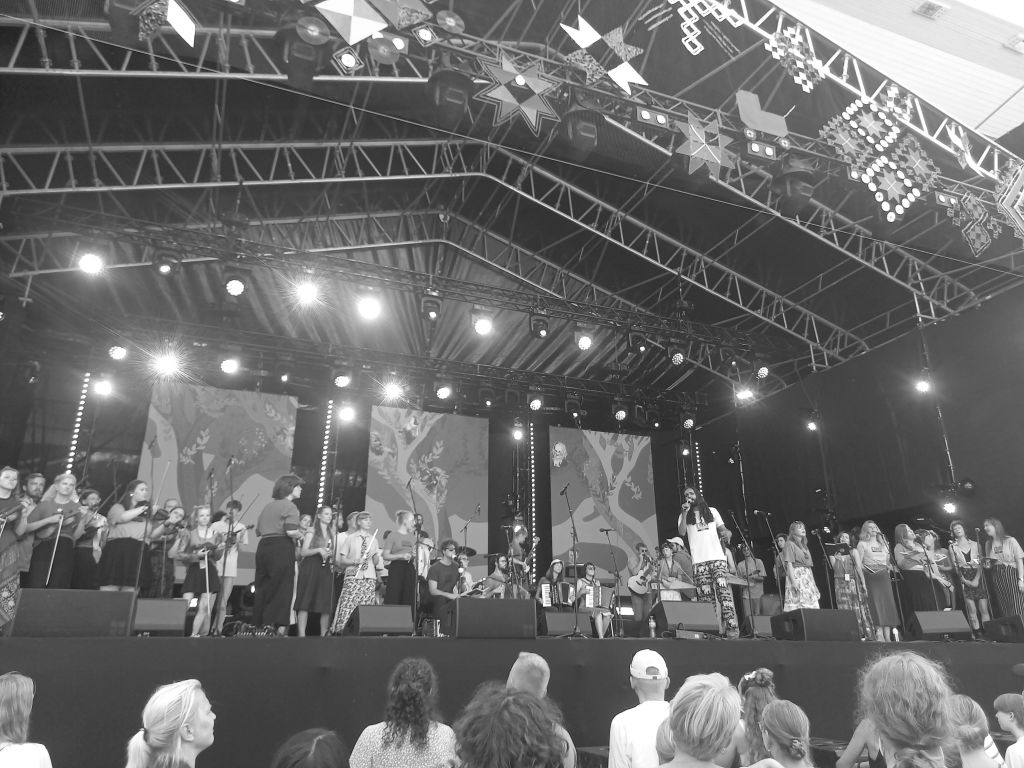
The days melted together. There were a lot of concerts, for sure. The Italians. The Mexicans. The 6hunesseq-ians. Now that was a powerful concert, held in St. John’s Church at midnight. I fell asleep multiple times, because I was so tired, but the music was soft, warm, and enveloping, like a comfortable blanket. The musicians were out of view, because they were on the second floor, where the church’s orel is located. After they came down and people applauded. I guess I went home after that. I don’t quite remember. My friend found a rabbit in a park in Viljandi around the same time and took it into her tent. Later, she found the rabbit’s owner. These kinds of things happen during Folk. The mind no longer works. There is too much information, too much stimulation.
Then one day I met a man who told me that Lennart Meri’s book Silver White is the Bible of the Estonians, and how the Estonians, or rather the Baltic Finns, are very special people, and how Meri, Uku Masing, and Valdur Mikita had written “philosophical diamonds!” The man is working with a project called Valge Laev, or White Ship, to develop the higher intellect of the Baltic Finns. “But if the Estonians are so smart,” I told him, “then why do you need me for your project?” “Because you can help us bring it to the wider world!” came the answer. He had a fur hat and a green shirt. A beard. Sparkling blue eyes. Like a photo from the collection of Johannes Pääsuke. The green shirt was inside out. Of course, I agreed to help. When the Land of Mary calls you, you heed that call.
The following morning I have a slight hangover, because I thought the prior evening that I would allow myself to live a little. I asked myself, what would your favorite writer Scott Fitzgerald do if he was at Viljandi Folk? The answer arrived at once: start drinking wine! Life is for living! That night I wound up at the Untsakad concert at midnight. This was really like Anarchy in Estonia. I have never seen so many happy young people before. Untsakad are old men. They played at the first festival 31 years ago. But their fans are teenagers, or at university. I’m not sure what’s the attraction. Waltzes? Polkas? I like the Mexican band Kumbia Boruka more. They brought every cell in their bodies alive with their rhythms. They also appealed to writer Gert Kiiler, who said they reminded him of the show Miami Vice. “You know, they always have that kind of music playing somewhere in the background.” My friend, a Tallinn businesswoman who attends Folk regularly, recalled how she once had Don Johnson’s picture in her bathroom, so she could see him while she was taking a shower.
But Untsakad won over people’s hearts in the end. Even my 17-year-old daughter awoke the next morning and started to sing the “The Forest Brothers’ Song.” Ai-tsih, ai-tsah, ai velled, me metsavennad oleme! Which means something like, “we are the forest brothers, we are.” It really got inside her. For her the experience was also something like a dream. I received her rendition joyfully. “You’re a good forest brother’s daughter,” I thought, “even if your father is not a forest brother.”
***
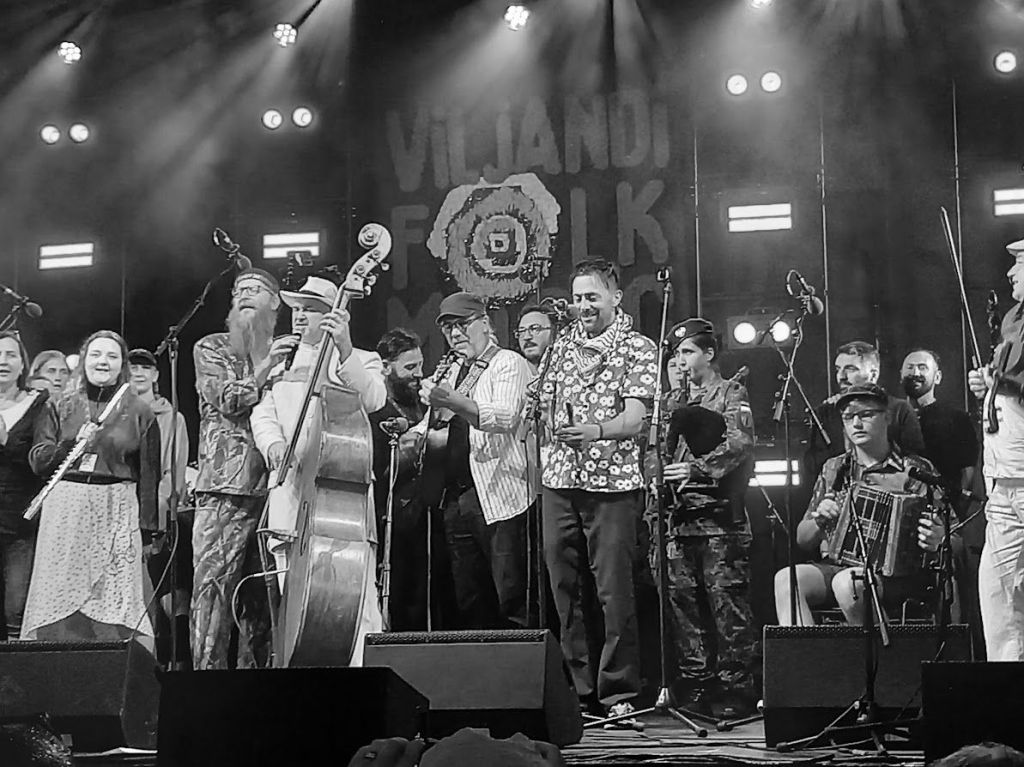
SOME PEOPLE COME and go during Folk, but then there are people like me who are folk soldiers and stay until the last concert. We gather in the rain as Ando and Friends sing. Ando Kiviberg is the founder of Folk and the festival usually falls on his birthday. This year, he’s 55! Ando and Friends is some kind of variety show. Every kind of band performs there. The man himself is a Leo, naturally. He is the king of the jungle. There he is with his fuzzy face in his white suit and white hat, looking like some kind of Latin American drug dealer. He plays the bass and sings along. It’s nice to see the king in his element. The leader role suits him well. Ando is neither arrogant nor pretentious. He doesn’t think that he’s better than the others, no. But still they come, like small house cats, with their offerings to the Great Lion! Neither dead birds or mice, but songs. Silver Sepp has taken Tony Rennis’ 1962 Italian pop song, “Quando, Quando, Quando,” and made it over. The song’s new name is “Ando, Ando, Ando.”
At some moment, I get tired of all those bagpipes and fiddles and go to the other side of the Second Cherry Hill. There I stand beneath an umbrella and put on my headphones. I’d like to hear a little Led Zeppelin now. I am done with all of this folk music! I’d rather listen to “When the Levee Breaks.” To my surprise, these two things suit each other surprisingly well. I look up at the big screen and see Ando singing. But instead I hear Robert Plant’s voice. Ando is singing, “Crying won’t help you, praying won’t do you no good!” It’s still raining. We are all soaked. Soon the levee really will break. An incredible combination. Ando and Zeppelin. My own levee really has broken. Then I realize that I have really lost it by now. I march over to the Ait. I look for a comfortable corner inside where a burned out writer can relax a little. Then that stranger appears with his magic button in hand. The three girls are in the corner and I am sitting on the edge of the stage. The man is showing me his button.
“That’s genius,” I say. My voice sounds distant, as if it belongs to someone else. “Just genius.”

An Estonian version of this article appears in Edasi, and the original was written by the author in Estonian and rewritten into English. The English and Estonian versions have some differences, so do read both!
 north!