
Every Uncle Frank has his own Uncle Frank.
EVERY ITALIAN FAMILY has at least one good Uncle Frank story. This is for the simple reason that there are so many Uncle Franks. Frank, or Francesco, continues to be one of the most popular Italian names, and even in the 2020s, it ranks second only behind Leonardo among new-born Italians.
My grandfather’s name was Frank, and so to all of his nieces and nephews, he was Uncle Frank. My mother’s brother is also called Frank. Believe me, we have a lot of Uncle Frank stories concerning this particular Uncle Frank. The funny thing is that all of those Uncle Franks also had their own Uncle Franks. It’s like looking through a kaleidoscope or prism; you point it at one Uncle Frank and then suddenly there are hundreds of them reflected in tiny pixels, a fantastic mosaic of Franks for the eyes.
This is not to be confused with Cousin Frank. Cousin Franks, sometimes nicknamed Frankie, are a different phenomenon. Thanks to Italian naming traditions, I have at least two Cousin Frankies that I know of, and there may be more. Years ago, when I briefly toyed with the idea of compiling a family biography, I began collecting stories. I knew that I had a Cousin Frankie who was in a rock band. Because of his dark and mysterious looks, he had at least for some time been nicknamed Cochise, after the Apache Indian guerrilla.
There was another cousin that I had heard of, however, who had ventured to the South Pole. And then there was a cousin who was running a pizza restaurant out in the Rocky Mountains The book project was going well, and I imagined all of these as three separate profile pieces. The rock musician, the Polar explorer, the pizza guy. After some investigation, however, it turned out that all of these cousins were the same person, Frankie Abbatecola, one of my great Uncle Vinny’s legions of grandchildren. Had I written the book, most of it would have been about the same person. This energetic Cousin Frankie is a Mötley Crüe devotee not much older than me, who slings pizza dough during the day, wakes up the neighbors with his electric at night and yes, even once made it to Antarctica, or at least some place where there happened to be lots of penguins. Today, Frankie runs a busy pizza restaurant in Massachusetts called “I Love Frankies.”
Whenever anyone questions my Italian identity, I just tell them about I Love Frankies.
“That’s my Cousin Frankie’s place,” I say. They seem satisfied by this information.
***
BUT THIS STORY is not about Cousin Frankie. This story is about Uncle Frank, and a certain Uncle Frank who happened to be the older brother of my grandfather Jerry’s mother Rosaria. I suppose to me, he would be a great great uncle. His real name was Francesco Petrellis, and he was born on a mountain top in Calabria in a village called San Giorgio Albanese overlooking the Ionian Sea, the same place where I once happened to spend the night watching Godzilla dubbed into Italian after almost sleeping in a furniture store. His birth year was 1889. It was a long time ago. At that time, America had not even yet formed itself on the lips of my predecessors. It’s interesting to imagine that if I rewound the clock back a century, most of my family was not speaking English. They were Italians, born and bred into the soil.
Uncle Frank emigrated to the United States with his family in 1900. It seems his father, whose name was Carmine Petrellis, and who came from an old Greek family in that little hilltop village of San Giorgio Albanese, had already crossed the mighty Atlantic once before, but this time decided to make the move with his whole family. There was Francesco, Rosaria, Maria Theresa, and their youngest sister Rosina.
It’s hard for me to imagine what the lives of this immigrant family was like because Carmine, the father, was illiterate, and when they later purchased a house in the town of Huntington on Long Island in the 1920s, where I was born, it was Carmine’s much younger wife, Anna Meringolo, who signed the contract, because her husband didn’t even know how to write. By that time, they had come to call themselves Peters, instead of Petrellis, to make their American lives more manageable. That was a fundamental aspect of American identity. Even if you were not born in America, and obviously were not an American, you could give yourself an American name. Petrellis became Peters. It was a cosmetic change though. Because a person can change their name, but that doesn’t change who they really are. A name is just a name.
The newly minted American “Frank Peters,” known to anyone within his circle of family and friends still as “Francesco Petrellis” was a loyal citizen of the United States but spoke Italian as a native tongue. He married, perchance, a Hungarian immigrant named Ethel, who was from a village called Nyírbátor near the Romanian border. I know much of this information because in 1920, she applied for a passport to visit Czechoslovakia. What I find fascinating about this is that she had never had a passport before then. In the early 1900s you could sail from country to country and settle with no documentation.
It seems that Uncle Frank and my grandfather Jerry had something of a rapport. Perhaps because my grandfather Jerry did not get on so well with his own father, Salvatore, which was understandable considering that he had once left him tied up in a basement cellar. According to my grandmother Margaret, they would go and visit Uncle Frank and share some coffee together. Maybe have cake.
Jerry had met my grandmother Margaret, who was not Italian, while working for a construction company in Virginia during the war. They were introduced by friends and married impulsively after knowing each other for just a few weeks. Margaret at that time was working as a school teacher. One can only imagine this young Virginian school teacher being introduced to the enigmatic Uncle Frank, with his fedora hat and thick Italian accent, and his equally mysterious Hungarian wife Ethel. He told the government whenever they asked him that he did odd jobs for a living. But according to various family members, Uncle Frank really made his living as a chauffeur for underworld figures. My father claims it was to Vito Genovese himself, “Don Vitone,” the founder of the Genovese crime syndicate who dominated the American mafia for most of the 20th century. Others claim that he drove around another mobster called Capone.
Whether true or not, Uncle Frank was well paid for whatever kind of work he was doing in his career of odd jobs. Then one day in early 1965, when he was already an old man with a cane, Uncle Frank paid his nephew Jerry a visit and gave him a $500 bill. This banknote, which is no longer in circulation, featured President William McKinley on the front. My father still recalls the scene of the old man in his fedora sitting in the family kitchen and handing his nephew the money. Uncle Frank visited all of his relatives that week and similarly gave each one of them a $500 bill. And this became the Uncle Frank Story, the old relative who showed up, handing out $500 left and right. He then departed the United States, ceased being Frank Peters, and resumed being Francesco Petrellis and died several months later in San Giorgio Albanese, his home village. After he died, my grandfather Jerry went over to his uncle’s house. Frank’s wife had died the previous year and the house was empty. To his surprise, he discovered bags of money, hidden in various places. There were several purses full of banknotes that had been stuffed in the oven.
***
AS AN ITALIAN-AMERICAN, such stories fascinated me. Not only because anything connected to the Mafia had been glamorized by Hollywood, or in glossy magazines that featured modern day bosses like John Gotti on their covers, but also because they were so distinct from neighbors or schoolmates, whose worldly predecessors might have been prominent attorneys, or perhaps the lieutenant governor of Massachusetts. What to make of this murky connection to murky people doing shady, shadowy things? And was I also one of them? Did the apple not fall from the tree? I had tried to be a respectable journalist, but respectability always seemed just out of grasp for my family. It was elusive. We were people who kept cash in ovens.
After I had returned to New York after an adventure in Calabria at the age of 30, I did show photos of San Giorgio Albanese to my Virginian grandmother, who was 91 years old then, and quite lucid, though fading mentally. This little old gray lady without a drop of Italian in her veins. Her body was trim and lean, and she had her own kind of measured or balanced energy that she carried with her. She spoke softly, and on the few occasions that I told her I loved her, she seemed a little embarrassed. Such was not the measured, restrained way of the Virginians. Her husband was gone, but here was his grandson asking questions.
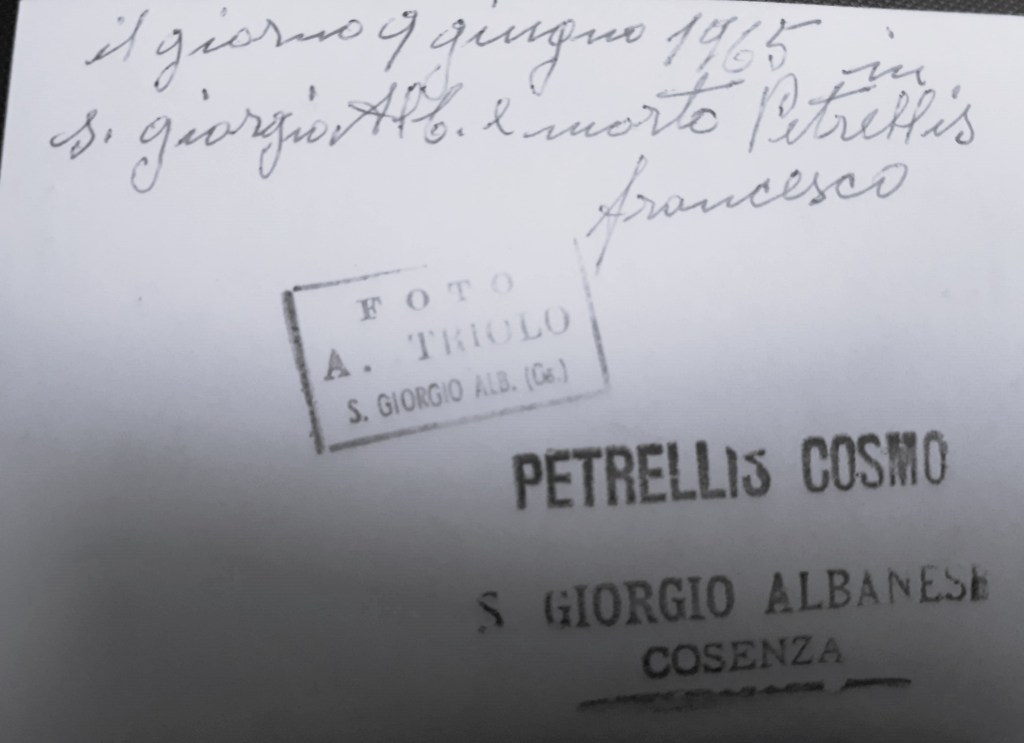
A few days later, she called the house to inform me and my father that she had found a curious photo. Later, when I saw it, I found it quite interesting indeed. For the black-and-white photo showed a dead man in a coffin, covered with bouquets of flowers. On the back of this photo read, in Italian, “On the 9th day of June 1965, in San Giorgio, died Petrellis Francesco.” The photo had been taken by A. Triolo, also of San Giorgio, and the photo was signed by Cosmo Petrellis.
This family curiosity had traveled across the Atlantic and across decades of forgotten memories, only to find its way into my hands, hands that had recently returned to that same village. In thinking about Uncle Frank with his fedora hat and bags full of mob money, I felt that I had understood something that perhaps only another Italian could understand. That whoever we were, and wherever we lived, and whatever names we called ourselves, we were still this illusory thing. Italians were just another unexplained meteorological phenomenon, like those tall waterspout tornadoes rising up like the mighty staff of Poseidon from the depths of the Ionian Sea. We came and we left, we appeared, vanished, and reappeared. One day, we might show up at your door in a crisp gray suit and fedora with a bag full of $500 bank notes. The next day we were gone. And weeks later, we might turn up in the old village, to greet our many relatives.
Just as I had done weeks before in the mountains of Calabria.
Uncle Frank was Frank Peters to the US government and Francesco Petrellis to the Italian one. His odd jobs were driving bigshot mobsters around. But Italians belonged to other kinds of systems. Governments didn’t mean as much as family. The mafia was just another kind of human organization, as legitimate or illegitimate as the local police. Laws were distant, arbitrary, written by strangers. Politics, like in the mafia, was personal, dangerous, and corrupt. And time was just imaginary. Everybody knew that it didn’t really exist.
 north!