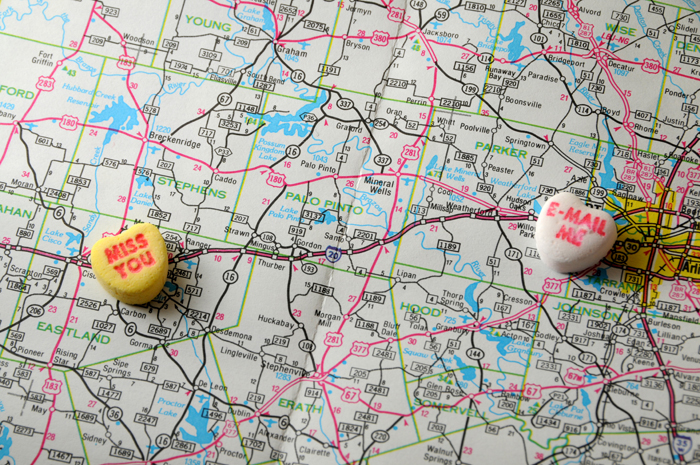
long distance families

A neighbor of ours has a child, but this child lives in New Zealand, which is very far away. It’s so far away that I don’t know the name of this person, or if it is male or female. I don’t want to ask, because our neighbor looked so sad when I inquired if she had any offspring.

New Zealand really is at the edge of the Earth. Sometimes, I tell my mother that while Estonia might seem like a long way from New York, it is relatively close. “It could be worse,” I say. “I could live in New Zealand.”

That’s true, but it never seems to make her feel better. She has resigned herself to a life of misery and longing over what might have been if I had never left my hometown. She’s tired of talking to my children via Skype, and being a ‘virtual’ grandmother, she says. She commiserates with the neighbor across the street, whose daughter lives in the Netherlands. They both long for the good old days, when families were close, both physically and emotionally.

But is ours really the first generation to suffer from this malady of globalization? I don’t think so. I think that in the past, it was even harder. Think of my poor great grandmother Maria who left the sunny fields of Bari for the winters of New York. And she never went back! Not once in her life. As an old woman, she sat, staring at the window and sighing to herself, perhaps thinking of Italy. Or so my mother tells me.

In comparison, these annual or biannual visits from far-flung relatives seem like a luxury. In the nearly 50 years that she spent in New York, Maria never went back once to Italy. But our friend Airi comes to visit Estonia from her adopted home in Brisbane, Australia, at least once a year. These are momentous visits too. She stayed about a day and a half at our house, where we drank wine and watched a movie. Then she was off to Tallinn, with plans to go to Riga the day after that. She has so many people to see in those two weeks that she is here. And my visits to the US are the same, brief encounters with friends and relatives, and then back onto the big airplane.

In my meeting with readers, I have met many sad-eyed grandmothers who bought books to send to their children in California or Australia or Brazil. Sometimes, I get the sense it’s to “show” their children that not everybody leaves Estonia for love. They have the same miserable look in their eye as my mother. It’s a look that shows that God has cheated them by denying them the right to have grandkids that live on the same street. And as much as they might think the weather in California is wonderful inside they hate California for stealing their baby. They long to have all of their relatives in a short driving distance.

The funny thing is that many of Epp’s relatives actually do live within driving distance, some even within walking distance, and we don’t see them so often. Grandma in the countryside gets one or two visits per season. Even my sister-in-law, who lives 10 minutes away, can disappear from our lives for weeks on end. If I added up all the days I have spent with my American family in the past five years and all the days I have spent with my Estonian family, they would probably be about even, if not tilted toward the Americans, with those month-long summer or winter visits.  So much for living so far away!

That’s still no consolation for those who miss their closest relatives. They are still unhappy. I have spent a lot of time trying to figure out why it is some people roam so far from the nest. After all that meditation, I have come to the conclusion that some people simply must leave home. Should Barack Obama have stayed in Honolulu? Should Toomas Hendrik Ilves have stayed in Leonia, New Jersey? Should Kerli Kõiv have never strayed from the city limits of Elva? I have an American friend in Estonia who used to work in a warehouse in the US. Now he’s the CEO of an important company and spends his days jetting around from Nigeria to Japan to Brazil. “Sometimes you just have to take risks,” he says of his life. And that means that some of us have to leave home. It’s hard on families, sure, it will break a mother’s heart, but, as I pointed out, physical distance and emotional distance are not always correlated.

Plus, as much as the sight of a big, extended family might make a person whose child lives in New Zealand jealous, the dirty truth is that a lot of these family members can barely tolerate each other. I know one Estonian woman who lived with her family for years in the US before returning home. I asked her recently if she ever thought of moving back. I thought she would say “no,” because Eestis on nii mõnus olla, it’s so swell to be in Estonia, but she confided in me that she missed America a great deal.

“We were so free there, we could do whatever we pleased,” she told me. “And you know,” she glanced over her shoulder, “in America we didn’t have so many relatives around.”

my first mobile phone

I got my first mobile phone in the autumn of 2001. I bought it myself at an Orange store on the walking streets of Copenhagen. I was urged to get my own phone by my trendy and overdressed Danish friends who, like most Europeans it seemed, had been using them for years. That way we could coordinate at which nightclub we would meet so we could down Tuborg beer and dance the night away to Kylie Minogue and Jennifer Lopez, which seemed to be the only music they played in clubs in Denmark at that time. I had always disdained new technology. Who really wanted to be available all the time, anywhere? But I gave in to their pressure. When in Europe, do as the Europeans.

Unfortunately for my Danish friends, and my social life, I never managed to use the new phone. It sat in an orange-colored box on my bookshelf in my dormitory room. I tried to set up my account a few times, but every time I called the number on the box, some woman picked up and started speaking to me in Danish. Since it was an automated service, she never replied when I tried to tell her that I didn’t understand what she was saying. I got so frustrated with that Danish bitch that I returned the phone and got my money back. I told them it didn’t work. In a way, I wasn’t lying.

I didn’t want a mobile phone to begin with. Nobody I had grown up with had ever had one. Pagers were for drug dealers and guys who wanted to feel like they were as cool as drug dealers. It wasn’t until my junior year of college when, while sitting with other misanthropic young men outside the dining hall, I noticed that most of the freshmen had mobile phones. Even more horrifying, it turned out that many had already had mobiles while they were in high school! Can you imagine? At age 21, I was already a cranky old man.

Upon the repulsive sight of the alien freshmen, my friends and I vowed that we never would join the sheep and get a mobile phone. We were free spirits who didn’t need to be fenced in by newfangled gadgets. But our pact didn’t last long. One by one, each friend went down, joining the herd and getting his own mobile. By the last semester of my senior year at my university in Washington, DC, I was one of the few left who had not yet given in to the temptation of technology, until my father approached me at Christmas with a gray Nokia in his hands.

“Son,” he said, “I want you to have this in case of emergencies,” emergencies meaning terrorists flying airplanes into strategically important buildings. I could see it unfold before my very eyes as I took the phone from his hands, first the new attacks, then the exodus out of the city. Maybe I would walk over the bridges to Virginia or fan out toward Maryland. And then I would take out my emergency phone and call home to let them know I was still alive. “Thanks for the phone, Dad,” I would say with a tear of gratitude in me eye.

But that never happened. Instead, the phone sat in the top drawer of my desk, buried under piles of never completed homework assignments. I found it useless. I had a normal land line phone in my room and most of my social life seemed to occur spontaneously. “‘Hey, want to go see a movie?’ ‘Ok.’ ‘Great, let’s go.'” The phone sat there so long I forgot it even existed.

By this time Eamon was one of my few friends who didn’t use a mobile and he was proud of it. “I’ll never get one of those annoying things,” he would say, proud of how far he had diverged from the mainstream. But somehow he came across a really cheap deal for a mobile, and finally bought into it. “I’m not a sell out,” he convinced himself. “I need it for work.”

Eamon was notoriously cheap and his inexpensive calling plan charged him a rate by the minute, but Eamon figured out that he wouldn’t be charged for calls if they were under one minute. He therefore became a master of extremely quick phone conversations. He would ring a friend up and say, “I’ll meet you at the restaurant in 20 minutes, ok? Bye!” If you were with him when he made these phone calls, you would see him glance at the phone to see how short the conversation had been and hear him exclaim, “That one was only 28 seconds! Awesome!”

One night Eamon rang my room phone to tell me to meet him somewhere on campus in 10 minutes. The only problem was that he didn’t know where he would be in 10 minutes. “Why don’t you just call me then?” he said as quickly as he could. “Don’t you have a mobile phone?” Click.

Did I have a phone? I thought about it for a moment, and then remembered the one my father had given me. I pulled it from the drawer and, after some clumsy attempts, managed to start the strange box up. I put it my pocket, and headed out.

Ten minutes later, I called him. “Where are you?” I asked. “I’m in front of the university hospital,” he said. It turned out that I was right across the street, but a bus had just let out and there were people everywhere. “But I don’t see you.” “Look under the sign.” And there, under the sign I saw a dark shadow with an arm held up to one side of its head. Then the shadow waved at me. It was Eamon! “What’s up man?” I said approaching him. “I’m glad I brought my phone this time.” But Eamon was too busy checking to see how long our conversation had been to greet me.

“Fifty nine seconds!” he cried out and smiled to me. “Now that one was a really close call.”

i flicked on the light switch

I flicked on the light switch and descended the cellar stairs, old and brown and half-rotten planks of wood, each one sloping downward, giving me the feeling that I was falling forward. The cellar is shared by the other family in our house, but until that point I had no idea they were using it. The box was heavy, so I had to balance my weight by pushing against the walls with my elbows. They became sticky with dirt and cobwebs along the way. The cellar floor was just dirt and broken bricks. I looked around the small, dim room, and then saw three ancient wooden cabinets, propped up on a corner, the doors held shut by rusty latches.

I stepped forward and opened the first one. Dozens of jars beamed back at me, the light reflecting off their red metal lids and smooth glass exteriors, revealing the contents: plums, apricots, squash. Then I opened the door to the second cupboard. Even more jars stared back at me, proud and modern. Altogether I counted 140 jars in the two cupboards, 37 of which alone contained pickles. Most of them were marked ‘2011’, but there were a few jams that bore the mark ‘2005.’ I imagined these were the last resort: what our neighbors would eat in the middle of a thermonuclear winter when they finally ran out of everything else.

The third cabinet was a little creepy. Somebody had scrawled the numbers 666 in pencil on the door. But I had no place to put our jams, so I breathed in and opened it. It was empty, save for a box of brown rotten carrots. No gateway to hell here. I tossed the carrots on the floor and slid our two dozen jars of plum juice and jam onto the top shelf, and closed the latch. Then I sprinted back up the old stairs and strode into our kitchen, where I announced: “Honey, the neighbor’s wife is even crazier than you are. She’s got 140 jars of food down there. She’s even got 37 jars of pickles. Thirty seven! Can you believe it?”

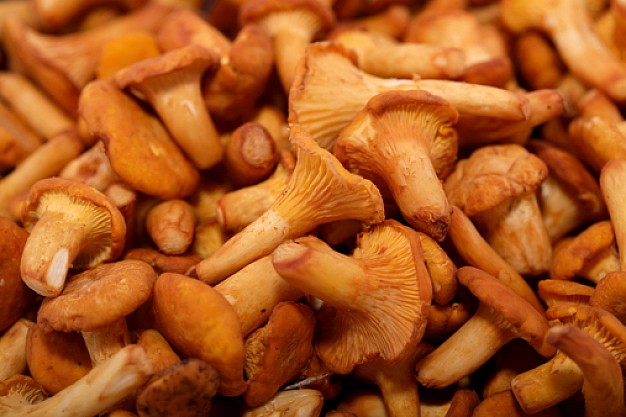
“Normal,” my wife shrugged, standing over a simmering pot of boiling plums. “And just think how many she’ll put away before winter,” she took a spoonful of sweet juice from the surface and licked it. “It’s only the start of fruit season.” Only the start? For weeks we have been putting away food for the winter. First it was the bags and boxes of strawberries and cherries and blueberries. We even acquired a new deep freezer to store them all. Next were the buckets of chantarelles. Our kitchen became something of a chantarelle factory. Wash them, slice them, fry them in butter, let them cool and pack them into plastic containers.

When the freezer was at last full, we turned to jams and juices. Last week was apple jam and redcurrant juice. This week it’s plums. On one hand it seems cozy and traditional to make and store food. On the other hand, I feel like I am living with a very strange woman. Of all things a person could do, read a book, listen to music, or go for a swim – she prefers to head to the market, buy a few boxes of fruit, and toil over a hot stove. In my deeply American mind, this makes no sense. Food is always available at the nearest store. If you have a craving for pickles, go get one jar. There’s no need for 37! But in my wife’s mind, we need to store up. It’s as if she starved one winter of her life, and is determined to never repeat the experience again.

It’s always been this way. Years ago during our honeymoon, she located a number of yellow mushrooms beneath a tree. Even though we were staying at a hotel and had no access to a kitchen of any kind, she had the urge to gather them, bring them home, and devour them at once. I managed to convince her to leave them there by telling her that they were poisonous, which they probably were but still, I didn’t even notice them to begin with. This summer we went to Kihnu Island and rented some bikes to ride around the island. Near the lighthouse, she started to encounter wild strawberries. A small dot of red on the side of the road would catch her eye and then she would stop and stoop down to gather them. In half an hour, we must have traveled 100 meters, because she had to pause every 30 seconds to collect the tiny forest berries. “I just can’t help it,” she said to me, a little guilty. “I just have to eat them. It’s what I am programmed to do.”

Maybe the reason I am more suspicious of nature is because where I grew up on the East Coast of the US, it was hard to tell the difference between the edible and poisonous berries. At least if you got them at the shop, you knew they were unlikely to make you sick or hallucinate. My good friend bought a book on mushrooms just so that he could start to gather the wild ones that grew so abundantly beside the river near his house. Sometimes it was hard to tell which ones were safe to eat. He would leave them under a glass over night. If spores had accumulated below the mushroom by the next morning, they were poisonous. If they hadn’t, the mushrooms were good. He told me that he only met one other guy while he was out collecting mushrooms by the river, a Pole. He said the Pole had four plastic buckets, two suspended from each arm. He was pacing around feverishly, trying to collect as many as possible.

“Can you believe it? All of these mushrooms out here and we’re the only ones picking them,” the Pole told my friend, mushrooms spilling from the tops of his buckets. Then he shook his head and said, “You Americans are all crazy.”

a perfect christmas

Somewhere in the depths of my memory, there is a perfect Christmas. This is a Christmas that occurred many years ago, when I was a little boy. The anticipation had been building for weeks. My mother had sewn an advent calendar, a felt green wreath adorned with plump little elves and fuzzy reindeer and one very cute and tiny baby Jesus nestled in the manger. Each day we added a character to the wreath. The night before the big day I had gone to sleep, my worn copy of Mauri Kunnas’ Santa Claus and His Elves in my arms.

Our Christmas tree was modest, not too big, not too small. It stood before the windows overlooking the harbor in the town where we lived, the orange sun rising up behind it. I can still see the stacks of modest toys before me, maybe a bicycle, maybe a record player, maybe a stuffed bear or some toy blocks. I can smell my mother’s cooking in the kitchen. Then the guests showed up, grandmothers, aunts, uncles, hordes of children more or less my age. People sat around talking to each other. They ate a hot meal of turkey and cranberry sauce and a dessert of pumpkin pie. Then, after a few more gifts, all wrapped up in colorful paper covered with images of sleighs and snowmen, they went home, and we all cuddled up beside a warm fire in pleasant silence. It was nice.

Our Christmases back home in New York are less ideal these days. When the cousins arrive they typically make straight for the big flat screen TV on the wall to watch the game or spend the evening texting their friends on their iPhones. I don’t have much to say to family members since I only see them at these big events, though it is still good to see them. The trees have grown larger in size, the gift giving more lavish, the meals grander. Our girls get so many presents, I can’t remember who gave what. When all the guests leave on Christmas in New York, I don’t feel cozy, I feel exhausted, glad that the day is over. I have simply lost my spirit of Christmas. I struggle just to remember what it might have been like.

Which makes the fact that we can celebrate Christmas in Estonia this year a very big opportunity. Here, I’m an immigrant, which means that I can start anew, try to recreate that ancient perfect Christmas, the one that still lurks in my mind, try to rekindle my enthusiasm for the season. But it’s not easy, because Estonia isn’t that different from America anymore. Just today I waded among the tacky plastic decorations on display at the local supermarket while Frank Sinatra sang “Happy Holidays” above. I might as well be in America. And the hypnotic pull of consumerism is even stronger here. Estonians it seems go even more bananas at Christmas time than they do on Saint John’s Day. Armies of buyers enticed by the word “sale” descend on shopping centers, eager to snatch up all the junk they can before someone else does.

Now that I have my own children, I also feel pressure to put on a good show for them. The gifts must be different, special, memorable, and yet I always walk away from Christmas regretting that I wasted so much money on things they hardly use. Last year in a pitch of pre-Christmas fever I bought my younger daughter an expensive glockenspiel from a music shop. “Don’t you think it’s too good for a three year old?” I told the grinning seller, who laughed and patted me on the back and said, “Sure, but, just think, she can play it when she grows up too!” It made perfect sense to me at the time. So I bought that. And I bought them skis, even though it seems that neither of them have any interest in the sport (and haven’t shown any since), and I bought and bought and bought, and still the spirit of Christmas eluded me.

Food is another challenge. I enjoy the overload of gingerbread that comes my way at Christmas time, the hot hõõgvein, the elves’ morning deposits of chocolate in my children’s slippers, but I have not yet accepted the Estonian Christmas kitchen with all of my heart. There is nothing appealing about blood sausage to me, it doesn’t really taste so great, it doesn’t look so great, and, there’s always the minor detail that it is filled with blood, but, I still manage to scarf down one or two during the holiday season. sauerkraut, fine, potatoes, fine. I’ll even go light candles at Julius Kuperjanov’s grave. Terrific. It doesn’t make me nostalgic though, because it’s all rather new. Even though I can enjoy an Estonian Christmas, it still doesn’t make me an Estonian.

But I am not giving up. I am determined to do Christmas right this year. No matter what it takes. Maybe it’s the right balance of gifts and family fun, I am searching for.Maybe I can tolerate a gentle helping of Frank Sinatra Christmas Carols bought on sale at the local supermarket, without falling for all the plastic crap I have to close my eyes to avoid. Maybe it is possible to control Christmas rather than have it control me.

I think what I am really yearning for when I think of my childhood Christmases is moderation. Just enough gingerbread, just enough decorations, just enough company, just enough gifts … and a tree that’s not to big and not too small.

the beginning and the end

Maria was born on a sunny Thursday afternoon in September. The midwife said she was of average length and weight. Her head was covered in thick dark hair, prompting comparisons to her father, and her eyes were long slits, clearly inherited from her mother. When she opened them she stared around, arching her small neck in different directions, confused by the shapes and sounds that swirled around her.

Soon after, Maria was clothed in yellow pajamas, complete with a small cap tied beneath her tiny chin, and bundled into warm blankets. As she lay there sleeping, with a mysterious and yet knowing smile on her tiny red lips, I took a photo with my digital camera to send to my family back in the US.

Three weeks later I showed the photo to my grandmother Margaret in an assisted living facility. This was after I reintroduced myself to her. Grandma is almost 93 years old, you see, and she doesn’t remember who I am anymore, at least most of the time.

“And you? Who are you?” These were the words she greeted me with as I slid into a chair across from her in a brightly lit kitchen. Just feet away more than a dozen ancient men and women, half of them in wheelchairs, sat murmuring to themselves, their eyes transfixed on a reality TV show beamed from a giant screen suspended on the wall.

“I’m your grandson,” I told her. “Justin.”

Grandma seemed to recognize the name. “Oh, Justin, that’s right,” she said slowly. “Well, I sure am surprised to see you.”

I would have felt bad to hear those words, as if I had abandoned her by moving to Europe, if I hadn’t sat before her at the same table only a week before. But Grandma can’t remember that. Sometimes she doesn’t know that she is in Assisted Living. She thinks that she is at a restaurant or at home. That’s why she is in the dementia ward. According to the ward psychologist, Grandma is convinced it’s still 1989.

It is hard to grasp that this is the same woman who was still fairly coherent less than a year ago. She was a little slow, but she could recall the events of yesteryear with startling precision. I asked my father when she started to lose it. “Sometime in the spring,” he shrugged. Grandma used to be so proud of her age too. “I love to tell people I was born in 1918,” she would say, “just to see the looks on their faces. Their eyes bulge when they hear it. I get a kick out of that.”

“Do you know who was president when you were born?” I asked her from across the table.

“Hmm, let me think,” she responded, her veiny hands folded before her. I waited for an answer, but one never came.

“Woodrow Wilson,” I said.

“Oh, that’s right,” she scratched her head, as if she had once heard the name.

Grandma is actually one of the most lucid residents of the dementia ward. The first time I went to see her, another gray-haired woman in a lime green jumpsuit went bananas over seating arrangements, crying, “I sit here, you sit there,” over and over again and nodding her head, until I stepped in and pushed her into her seat, saying, “That’s right, you sit in this chair right here, and my grandmother sits in that chair over there.” “See what I mean!” the crazy lady exclaimed, still bobbing her head. “I sit here, you sit there. I sit here, you sit there.” She looked up at me. “He gives us permission!”

The last time I went to visit here, we were joined by another old woman across the table with thick white hair and big brown eyes. “Where do you live?” she whispered to us. “New York,” I answered. “Do you have a car?” she asked. “Yeah.” “Do you think you could give me a ride home? Are you going to Long Island?” she pressed on further. Then my father interjected, “No, we’re not going to Long Island, we’re going to Florida today.” “Florida?” the old woman snapped her fingers in disappointment. “But I need to go to Long Island,” she leaned in again. “Do you think you could give me a ride?”

Just then another younger woman with brown hair approached me, wringing her hands, her eyes swimming in her head. “Mister, mister, can you help me? I just went to the bathroom and … and I did a job in there, but now I don’t know where to go,” she fretted. “Please help me, mister,” she whimpered as if she was about to cry. “I don’t know where I am!”

“If I ever get to this point, where I am in one of these places, just shoot me,” my father said and shook his head as we drove home. “I’m serious. I’ll get the shotgun. I’ll write it into my will.”

“I feel so bad for her,” I told him. “She’s in there with all those crazy people. Can you believe that’s your mother? She barely recognizes us.”

“Justin, she’s almost 93 years old,” he said, running his fingers through his thinning hair. “It will happen to me, it will happen to you,” he sighed. “It will happen to everybody.”

an estonian girl in new york

Liis was unhappy. She had seen most of what Midtown Manhattan had to offer: Times Square, Fifth Avenue, and Broadway, and within it, Macy’s, Toys ‘R’ Us, Tiffany’s, and FAO Schwartz. But something was missing. On the second floor of New York’s largest toy store, surrounded by obscenely sized teddy bears and Harry Potter merchandise, she confided in me: “I want to go back to Forever 21.”

Forever 21. For this teenage Estonian girl from Tartu one particular clothing store beckoned with its glistening escalators, booming dance music, flashing lights, elegant wardrobes, and ensemble cast of hundreds of blazed European tourists, ladies who were willing to spend to the bottom of their purses to capture a little bit of New York class in a bag. Liis is not yet 16, so 21 seems infinitely distant. As our babysitter in Estonia, she had saved for months and months just to come to Manhattan, just so that she could step foot in a place like Forever 21.

When Liis first saw the lights of New York from our car window on the way home from the airport, she was both awed and tremendously satisfied. “It’s so beautiful,” she cooed. And then, “My best friend Kaisa is just going to die of jealousy when I tell her about it. She is going to cry, cry, and cry some more!” There was no empathy in Liis’ voice. She was very content that she would be the first of her friends to see Manhattan. She had told us that the girls at her school in Tartu would gaze upon her with adoration and respect once they heard that she had been shopping in New York.

While Kaisa has no doubt drenched her sheets in envious tears by now, Liis obtained for her a consolation prize: a $30 Rolling Stones shirt acquired in Times Square. Liis spent an equal sum on a Beatles t-shirt, and then $10 for five “I Love NY” t-shirts for various friends. I thought this was the zenith of this young Estonian woman’s fevered spending frenzy. I was wrong. On the way back to Forever 21, we stopped inside another delectable spender’s paradise, this one called Strawberry. One t-shirt inside proclaimed its values. “I want clothes, money, boys, fame, candy, and good grades,” it read. I could only spend about thirty seconds in the place before I excused myself to walk around the block.

I had been amused by Liis’ shopping antics but also touched in some way. In New York, she seemed amazed by everything: the battered Subway lines, the glossy skyscrapers, the pulsing neon lights. Even the Empire State Building excited her. I had seen these things so many times, they had become like wallpaper to me. With Liis they came back to life. In Strawberry, though, I reached my limit. I was done with it in half a minute. She spent half an hour there. Why? What kind of person could spend so much time in a store filled with dresses and shoes?

The obvious answer: a woman. A woman like Liis, like my wife Epp, like my mother. When I was a little boy, my mother would take me to places like Strawberry. I would scan its interior, searching for something mildly interesting. Sometimes I would think I would see toys shimmering in the distant corners of the clothing store, only to be disappointed when I discovered the “toy mirage” was really just more shoes and bags. To pass the time, I would hide among the clothing racks to torment my mother. Only when the son had disappeared for awhile would she even notice his absence. She was always irritated when I popped out from behind a brassier to cry, “peak a boo!”

Maybe such episodes built up my tolerance for places like Strawberry. It’s true, I had matured since those days, warily accompanying Epp to shops to answer such probing questions as, “What do you think of this shirt?” Or, “Do you think this bag would go with my winter coat?” On such excursions, I usually just say, “Yes,” or, if I am feeling honest, “I don’t know.” I am generally useless, but don’t mind carrying an extra bag around or opening the door.

When Liis finally emerged from Strawberry, shopping bags dripping from every arm, I was relieved. “Thanks for waiting,” she feigned an exhausted smile. “Um, I don’t think we need to go to Forever 21 anymore,” she blushed. “I spent all my allowance.”

Epp later rejoined us after doing an interview for a book with an actress in Times Square. Liis had wanted to go uptown to the Dakota to see where John Lennon had been shot, but our group voted for Union Square where there was an organic farmers market and, for my purposes, a Virgin Megastore where I could hide out while the Estonians raided another hall of consumer goods.

It was now early evening, and everyone was beat from walking and shopping. Even Liis’ Strawberry afterglow had subsided. She didn’t need any more clothes; she needed a pillow. As we ascended the Subway stairs into the bustling, sunny square, though, her tired eyes fixed on several large signs. There was a Strawberry here, too, she noticed, and a DSW, where they sold discount shoes! And right between them, sparkling in the summer light, was a Forever 21.

“I can give you the rest of your allowance today,” Epp chirped as Liis rifled through her wallet.

“You will?” Liis guffawed.

“Isn’t New York fun?” I patted Liis on the shoulder. She didn’t answer, but from the mad gleam in her eye, I could see that she was once again very, very happy. But she wasn’t the only one. As if diving into an Olympic-sized swimming pool, Epp swooned into DSW to try on new pairs of shoes. I waltzed over to the music store to explore the sounds of Jamaica, Nigeria, Brazil. For me, going to the music store has always been like going on a round-the-world trip, or sometimes a voyage back in time, or to the future. Music takes me places, it adds meaning to my life. But where can a dress take you? What meaning can a pair of shoes give to your life?

“I have my own theory,” Epp informed us as we waited later for a Subway train. “Using our hands helps us to relieve stress. Our grandmothers sewed and made their own clothes. But to release tension nowadays, women go shopping instead.” I pondered the therapeutic benefits of shopping as our train shot us under Manhattan. And, at one stop, I caught a glimpse of very tired Liis softly stroking her new bag.

virgin sauna


Big floppy breasts hanging in your face. The flicker of the light of the fire and the chill of lake water on your body and the suspicion a snail might be hanging off your dick. But you just don’t care because the heat has sapped all your ability to think critically. At this point, you don’t think at all, only breathe. You might as well be a snail or a tree. And trees are all you smell; the sweet aroma of hot wood and hot leaves and then the pain of the steam on your ears, eyelids, lungs, and fingernails. The undulating blasts of the hot air come on strong. Pain, pleasure, curiosity, birch water. These are all things that remind me of the sauna.

In Estonia, the sauna is a cultural institution that teeters on the tight rope of logic and insanity. In winter, saunas make perfect sense. Like some sort of primitive math, the coldest of cold exteriors plus the hottest of hot interiors equals something resembling normal body temperature.  In summer, though, saunas make no sense at all. No normal person would even consider a sauna in the summertime. He or she would just go to the beach. Try selling sauna equipment in Rio de Janeiro, see how successful you are. If it’s already hot outside, why get even hotter?

So if summertime saunas make no sense, then why do the supposedly rational Estonians relish them so?

I posed this question to my friend Jüri, but he couldn’t come up with a reasonable answer, even though he’s a highly-regarded professor. His eyes bulged when I asked him one June evening, “Why do Estonians take saunas in the summertime?”

In response, total silence. Jüri was truly perplexed. He stared at his feet like he usually does when asked for his wisdom, searching the floorboards for answers. At one point, I was afraid his brain would just malfunction and his eyes would sort of fall out of the sockets. Jüri thought and thought and did shots of handsa and thought some more. In the end, all my Estonian host could say was that summer is the best time to sauna, it is THE time to sauna, and that’s why people sauna in summer. And I have to agree with him, summer it is the best time to sauna.

It seems that sometimes the things that make no sense make the most sense of all.

That was after my family and Jüri’s family had congregated in his smoke sauna in the sea-like fields of Setomaa. At first, I thought it was going to be a segregated sauna. Most saunas I’ve been in Estonia have been segregated, so that women can discuss knitting and men can discuss car repair during their respective time allotments.  So when Jüri’s wife Janika and children and my wife and our children arrived after Jüri and I had been sweating and steaming for a good hour, I started to put my clothes back on. Jüri was swimming in a nearby lake and waved to the ladies as they entered the sauna. But when he got out, rather than getting dressed too, Jüri brazenly reentered the sauna, wearing nothing except a stray leaf or snail.

“Hey, you can’t go in there, my wife is naked in there!” I thought in protest. But the fact that my wife was in there didn’t seem to bother Jüri at all. Like some kind of ancient man, Jüri thought that grunting and sweating next to some other guy’s wife in a dark hot room was appropriate. At first, I was confounded, but I quickly decided that two could play at the sauna game.

“If that guy gets to sauna with my wife,” I told myself, quickly dropping my trousers, “then I get to sauna with his!”

God, naked people are SO boring. With our clothes on, we all look rather intriguing, so it’s such a disappointment to see that two other naked adults look basically the same as everyone else. This is a luxury that only I and those who have enjoyed a mixed sauna know because in the US, you usually don’t get naked with your hosts after you eat dinner. Usually you sit around and complain about things with your clothes on. Then you shake hands or, if you’ve had a drink or two, hug and go home and watch TV.

Naked men look the most ridiculous. What do women see in us? We look like hairless apes carrying around a banana in front. Women are better but not much. Attractive when clothed, the child-rearing nature of the woman’s body is most apparent in the nude.  If men are hairless apes, then women are dainty cows. Their vast, udder-like breasts, alluring when restrained by colorful bikinis and braziers, are mostly unexciting when they are floating on the surface of a snail and leach-infested pond in the south of Estonia. In that context, nudity is all part of the scenery.

I thought these and other deep thoughts in the sooty smoke sauna where the smoke off the fire has rendered everything in its grasp black as space. I also pondered the carcinogenic properties of the smoke sauna, but one cannot openly criticize such a sacred place as being unhealthy, because the sauna an institution with near religious significance in Estonia. One must not question its hidden power. One must simply obey and follow its unspoken rules.

In the smoke sauna that night, small children tossed ladles of water on the hot stones, dangerously close to the source of the heat. A few times I implored the youth to stay away from the treacherous red rocks, but was silenced by my naked guests who scoffed at my American paranoia. “Neeme is a good boy, a tubli poiss. He knows exactly what he’s doing,” said Janika of her ladle-happy, three-year-old son. “He takes a sauna every day, you know.”

Later, fully clothed, we sat around an old wooden table, drinking a strangely sweet concoction called “birch juice.” I guzzled mine from an old ceramic cup that looked as if it had only been washed one time in 1968. The clear, mild “juice” was refreshing, but did not stay the questions gurgling around in my steam-shocked, foggy mind. “But if Estonians feel so comfortable getting naked in front of one another,” I asked Jüri, “then why do they even wear clothes at all?”

This time Jüri sort of snorted and rolled his eyes. Then, with a small smile on his lips he said, “Justin, maybe you should just shut up and drink your birch juice.”

I tilted the cup back and drank deep.